












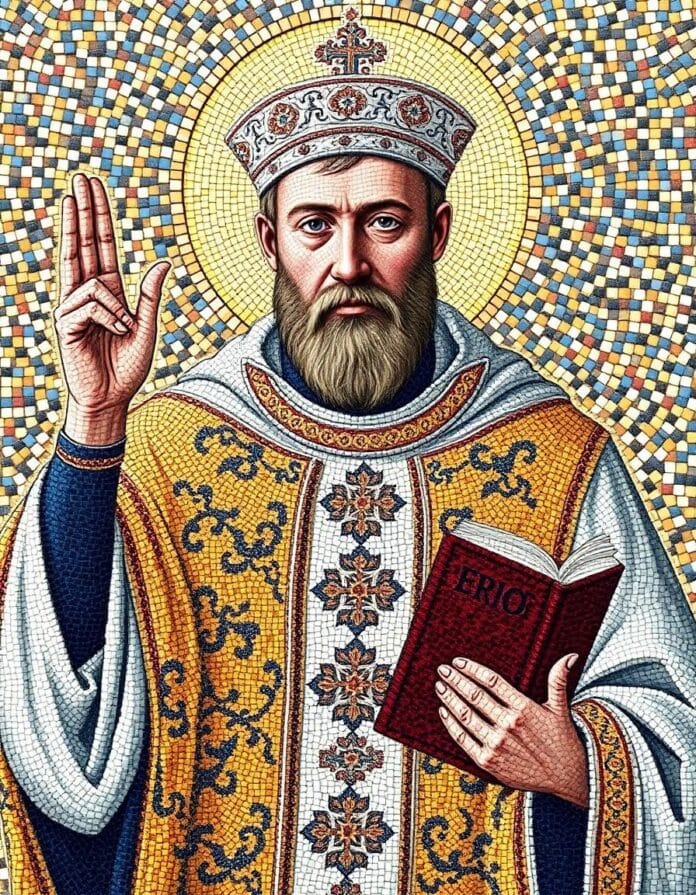
The lawyer turned bishop who stood up to the emperor – Milan, 4th century. Ambrose transformed the Latin liturgy, converted Augustine, and taught that no earthly power is exempt from the moral demands of the Gospel. His life testifies that authentic faith confronts injustice with courage, that spiritual authority is earned through consistency between word and deed, and that liturgical beauty nourishes the heart as much as the mind.
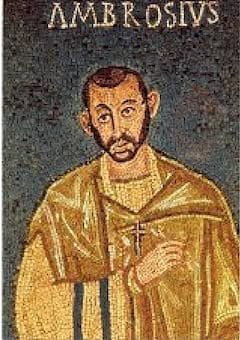
A provincial governor elected bishop without being baptized—this is how Ambrose's adventure began. Milan, 374: the crowd acclaimed the catechumen magistrate to lead the local Church, torn apart by Arian controversies. In a few days, he received baptism, ordination, and episcopal consecration. Sixteen years later, this same man would force the emperor into public penance for a massacre. Even today, his moral courage challenges our relationship to power, his liturgical teachings inspire our hymns, and his influence on Augustine reveals the power of a life lived with integrity.
From the praetorium to the altar
The lawyer at the peak of his career
Ambrose was born around 339 in Trier, the son of a high-ranking imperial official. Trained in Roman law, he excelled in oratory and quickly rose through the administrative ranks. Around 370, he became governor of the province of Liguria-Emilia, with Milan as its capital. He had a reputation as a fair administrator, a skilled negotiator, capable of maintaining order during a tumultuous period. Rome teetered between emperors, barbarian invasions threatened its borders, and Christians They are divided between Catholics and Arians. Ambrose navigates this chaos with the efficiency of a modern technocrat.
The election that changes everything
In 374, the Bishop of Milan died. The succession sparked a violent crisis between Catholics and Arians. Ambrose went to the cathedral to maintain public order. Instead of clashing, the crowd suddenly acclaimed him as bishop. He, the unbaptized catechumen, tried to flee. He refused, argued, and cited his theological incompetence. It was all in vain. Emperor Valentinian I confirmed the popular election. In eight days, Ambrose received baptism, passed through minor and major orders, and was consecrated bishop.
This abrupt transition forged his episcopal character. He distributed his possessions to the poor, studied Scripture diligently, and consulted the Greek Fathers. His legal background became a pastoral tool: he structured the liturgy like a lawyer organizes a code, and defended orthodoxy like a lawyer pleads a case. He discovered that governing souls required more moral rigor than ruling a province.
The confrontation with the empire
Successive emperors—Valentinian II, then Theodosius—wavered between favoring Catholics and making concessions to Arians. Ambrose navigated between diplomacy and firmness. In 385, Empress Justina, a staunch Arian, demanded a basilica for her worship. Ambrose refused, barricading his church with the faithful. For days, they sang hymns he composed for the occasion. The emperor relented.
The major confrontation occurred in 390. In Thessalonica, a riot broke out. Emperor Theodosius ordered massive reprisals: seven thousand people were massacred in the circus. Ambrose learned of the carnage. He wrote to Theodosius, refused him access to his church, and demanded public penance. The emperor, swayed by the bishop's moral authority, obeyed. For months, Theodosius did penance. When he received communion again, it was no longer in the sanctuary with the priests—an imperial privilege—but in the midst of the laypeople.
This episode establishes a historical precedent: even the supreme power submits to moral law. Ambrose demonstrates that the Church is not an appendage of the State. This principle will resonate throughout the centuries.
The liturgical educator
Ambrose understood that faith is transmitted as much through song as through sermons. He introduced the Greek practice of hymns into the Latin Church. These poetic compositions condensed dogma into memorable formulas, transforming prayer into collective thanksgiving. "Aeterne rerum Conditor" (God, Creator of All Things) is among his most famous works, still sung today.
This innovation addressed a concrete need: combating Arianism. Heretics used popular songs to spread their doctrines. Ambrose responded with Orthodox hymns, accessible to the people. Theology was sung, memorized, and lived in the daily liturgy. He thus invented musical catechesis, where beauty became a vehicle for truth.
The influence on Augustine
A young professor of rhetoric arrives in Milan in 384. Augustine, brilliant but disoriented, seeks truth through philosophy. He attends Ambrose's services, initially out of professional curiosity—to admire the eloquence of a great orator. Gradually, substance and style converge. Augustine discovers a spiritual interpretation of Scripture that transcends literalism. He also observes how Ambrose reads silently—a rare practice at the time—allowing the heart to meditate on the Word.
This encounter transformed Augustine. The coherence between Ambrose's words and his life, between the prayer of the Milanese Church and his acts of charity, dismantled his intellectual objections. In 387, Ambrose baptized Augustine. The future Bishop of Hippo, future Doctor of the Church, owed his conversion to this witness who lived what he preached.
Death in coherence
On April 4, 397, Good Friday, Ambrose died with his arms outstretched in the form of a cross. Even his agony became a form of catechesis. This final gesture encapsulates his life: mystical participation in Christ, teaching without words, silent witness. The Church celebrates him on December 7, the day of his episcopal ordination, for it was on this day that his true apostolate began. Patron saint of beekeepers—a symbol of the wisdom that produces the honey of doctrine—he also inspires the administrative corps of the French armed forces for his sense of authority in service of the common good.
The beehive, the governor, and the penitent emperor
An exceptional moral authority
History remembers the scene of Theodosius doing penance. The Chronicles Contemporary accounts—particularly those of Augustine and Theodoret of Cyrrhus—attest to the reality of the power struggle between the bishop and the emperor. Ambrose possessed a rare ability: to stand up to power without violence, through the sheer force of moral conviction. This firmness stemmed not from pride but from doctrinal clarity. He distinguished between the respect due to the emperor as a person and the moral imperative that transcends any political function.
Historical sources also confirm his role in Augustine's conversion. Confessions They describe precisely how Ambrosian sermons unlocked the intellectual resistance of the future saint. It was not merely rhetoric, but the example of a life aligned with preaching. Augustine observes that Ambrose silently reads the Scriptures—a seemingly insignificant detail that reveals a profound inner life, a meditative listening to God.
The introduction of Latin hymns is also a documented fact. Several hymns attributed to Ambrose survive in current liturgies. This pedagogical innovation transformed communal prayer, allowing the people to actively participate in the mystery being celebrated. Singing became a living memory of dogma, an antidote to the heresies propagated by Arian chants.
Bees and eloquence
Tradition tells of a swarm of bees that landed on the cradle of the infant Ambrose, going in and out of his mouth without stinging him. His father, terrified, wanted to chase the insects away, but his nurse stopped him, sensing an omen. When the swarm flew off, she predicted, "This child will become someone great." Medieval iconography draws on this legend, depicting Ambrose with a beehive made of woven straw.
This symbol encapsulates several meanings. Bees produce honey – the sweetness of God's word that the bishop distills in his sermons. They also embody the work Organized, communal order—virtues that Ambrose applied to the Milanese Church. Their sting evokes the truth that sometimes hurts, as when the bishop confronts the emperor. The beehive becomes an image of the Church itself: a structured community producing divine wisdom.
Another legendary tale recounts that during his election, a child's voice is said to have cried out "Ambroise, Bishop!" in the tumultuous basilica, triggering unanimous acclamation. This childlike voice symbolizes divine Providence, which chooses its servants independently of human plans. It also recalls the Gospel passage: "It is by the mouths of children that God confounds the wise."«
Power in the service of justice
The Ambrosian legends illustrate a central principle: authentic authority is earned through consistency. Ambrose did not become a saint because he was a bishop, but because he exercised the episcopate as a radical service to truth. The bees on his cradle foreshadow this mission: to communicate gentleness of the Gospel without watering down its demands.
The confrontation with Theodosius transcends mere historical anecdote. It raises the enduring question of the relationship between temporal power and moral authority. Ambrose does not contest the emperor's legitimacy, but reminds him that no office exempts him from the moral law. The massacre of Thessalonica was not a political decision that could be analyzed in terms of strategic efficiency, but a crime demanding repentance. This distinction between raison d'état and ethical imperative still resonates in our contemporary debates.
Augustine's influence reveals another truth: conversion rarely arises from abstract arguments. It is the encounter with a living witness—someone whose life embodies the doctrine—that unlocks inner resistance. Augustine sought wisdom in philosophical books. He discovered it in the life of a man who prayed, preached, confronted injustice, and sang divine praise with equal intensity.
Ambrosian hymns bear witness to a profound pastoral intuition: faith is transmitted through beauty as much as through magisterial teaching. People memorize a song more easily than a theological treatise. The liturgy thus becomes immersive catechesis, where body, voice, and melody unite to engrave truth on hearts. Ambrose understands that reason alone is not enough: it is necessary to engage emotions, imagination, and aesthetic sensibility.
Finally, his death, arms outstretched in the form of a cross, brought his teaching to a close. Until his very last breath, he bore witness. The silence of his agony spoke louder than a thousand sermons. This ultimate coherence between life and message constitutes his most precious legacy. It reminds every Christian—bishop or layperson—that the credibility of the Gospel depends on our ability to live it, not merely to proclaim it.
Spiritual message
Standing firm in the storm
Ambrose teaches us first and foremost the courage of conviction. At a time when the Empire is faltering, when heresies are seductive, and when the powerful exert constant pressure, he stays the course. Not out of stubbornness, but out of clarity on what is essential. He distinguishes between what can be negotiated—liturgical forms, cultural expressions—and what remains non-negotiable: the truth of the faith, the dignity of every person, and the primacy of justice over reasons of state.
This virtue speaks to us today. In a world where everything seems relative, where firm convictions are mistaken for intolerance, Ambrose shows that one can be both welcoming and demanding. He does not reject Theodosius; he calls him to conversion. He does not despise the Arians; he counters them with arguments and songs. Ambrosian firmness excludes no one; it simply draws the line between truth and compromise.
Consistency as preaching
Augustine converted less through Ambrose's arguments than through his life. This reality disturbs our intellectual habits. We accumulate training, conferences, and theological debates, but forget that our daily lives preach more powerfully than our words. Ambrose lived what he taught: he distributed his possessions, welcomed the poor, He confronted the powerful and prayed constantly.
This consistency stemmed not from perfectionism—Ambroise knew his limitations—but from sincerity. He wasn't playing a role; he was embodying his faith. Today, this authenticity is sorely lacking. Too many Christians separate Sunday from the rest of the week, private piety from public engagement. Ambrose reminds us that the Christian faith encompasses all of life: the way we exercise our authority, manage our money, treat our subordinates, and confront injustice.
The beauty that converts
The Ambrosian hymns reveal a profound intuition: truth is conveyed through beauty. The song touches the heart before it reaches the intellect. It creates a communal experience where doctrine becomes living prayer. In our current celebrations, often dull or disorganized, we need to rediscover this aesthetic dimension of faith.
Liturgical beauty is not superfluous decorum, but a theological language. When an assembly sings in unison, it experiences ecclesial communion. When a melody imprints a truth on the memory, it facilitates daily meditation. Ambrose understood that human beings are not merely intellect: imagination, emotions, and the senses must also be nourished. Faith then becomes a holistic experience, a complete transformation of the person.
Prayer
Lord, give us the strength of Ambrose
God of perfect justice, you raised up in Ambrose a courageous witness to your truth. While he held civil authority, you called him to serve your Church. He responded without hesitation, relinquishing security and prestige to embrace the episcopal mission. Grant us this same openness: that we may recognize your calls in unexpected circumstances, that we may be willing to step outside our comfort zones when you invite us to a new kind of service.
Teach us about consistency between words and actions
You shaped in Ambrose a pastor whose life authenticated his preaching. When he taught charity, He distributed his possessions. When he denounced injustice, he confronted the emperor. When he praised your mercy, he welcomed penitents with patience. Free us from this duplicity that undermines our witness. May our daily lives reflect our faith, may our concrete choices embody our proclaimed convictions. Grant us to live what we believe, so that our existence may become silent preaching.
Strengthen us in the necessary confrontations
Ambrose did not seek conflict, but neither did he flee from it when the truth demanded it. Faced with Theodosius, he could have remained silent out of political prudence. He chose to speak, at the risk of his life. In our lives, we encounter situations where silence becomes complicity. Inspire in us the discernment to distinguish worthwhile struggles from sterile quarrels. Grant us the courage to name injustice, even when it is powerful, the wisdom to do so with charity, and the perseverance to stay the course despite the pressures.
Renew our prayer through beauty
You inspired Ambrose to compose hymns that still nourish the Church today. These songs transform doctrine into praise, theology into thanksgiving, and teaching into communal celebration. Rekindle in us a love for beautiful liturgy, not for mere aesthetics, but because beauty reveals your splendor. May our congregations sing with one voice, may our hearts be opened to wonder, and may our minds be instructed by sacred poetry.
Convert us through authentic witnesses
Like Augustine, who was converted by observing Ambrose, may we encounter Christians whose lives challenge and attract us. But also make us witnesses for others. May our way of loving, serving, forgiving, and resisting evil challenge those around us. Not out of pride, but out of openness to your grace. May our lives become a sacrament of your presence, a place where seekers of truth can encounter you.
Teach us gentleness Gospel Farm
Ambrose was neither weak nor brutal. He combined the firmness of a rock and gentleness Honey – like the bees of his legend. Preserve us from the soft indulgence that tolerates everything out of cowardice, and from the harsh rigidity that crushes through legalism. Grant us the firmness that calls for good without condemning the person., gentleness who welcomes the sinner without condoning sin. May we become witnesses of a demanding truth and infinite mercy, like your Son who ate with tax collectors while calling for conversion. Amen.
To live
- Confronting a concrete injustice Identify a professional or social situation where you remained silent out of convenience. Speak truthfully and compassionately this week, even if it's uncomfortable.
- Praying through song Choose a hymn or psalm that you learn by heart. Sing it daily for ten minutes, letting the melody etch the truth into your heart.
- Aligning life and faith : examine a discrepancy between your stated values and your actual choices (proclaimed generosity but selfish budget, claimed justice but unethical purchases). Make a concrete decision to ensure consistency.
Memory and places
The Basilica of Saint Ambrose in Milan
The heart of Ambrosian memory beats in Milan, in the basilica that bears his name. Built by Ambrose himself between 379 and 386, initially dedicated to the Milanese martyrs, it now houses his tomb beneath the high altar. The current building, rebuilt in the 11th and 12th centuries in the Lombard Romanesque style, retains the understated majesty favored by the bishop. The portico, the atrium, and the two unequal bell towers create a harmonious whole that inspires contemplative prayer.
Inside, a 5th-century mosaic depicts Ambrose—one of the oldest surviving portraits of a saint. He appears in the apse, dressed in white, holding a book, flanked by the Milanese saints Gervasius and Protasius. This venerated image fascinates visitors: Ambrose's face, painted shortly after his death, seems to gaze at the viewer with the same moral authority that captivated Theodosius.
The crypt contains the relics of Ambrose alongside those of the martyrs Gervasius and Protasius, which he miraculously discovered in 386. This arrangement symbolizes the communion of saints, which the bishop particularly honored. Pilgrims come to pray before this transparent reliquary, asking the patron saint of Milan to intercede for their city, for the Church, and for leaders tempted by injustice.
The Ambrosian rite
Milan jealously guards a liturgical peculiarity inherited from its bishop: the Ambrosian Rite. Distinct from the majority Roman Rite, it is still practiced in the diocese of Milan and some neighboring territories. This liturgy preserves practices that Saint Ambrose instituted or codified: a slightly different organization of the liturgical year, specific chants, and unique rituals for Lent and Holy Week.
The Cardinal of Milan celebrates according to this rite in the cathedral (Duomo) and the principal diocesan churches. This age-old fidelity testifies to Ambrose's deep roots in Milanese identity. The hymns he composed still resonate in these celebrations, creating a living bridge between the 4th century and today. Participating in an Ambrosian liturgy offers a striking experience of ecclesial continuity.
Influence in France
Saint Ambrose is a particular inspiration to the French Military Diocese, which has chosen him as its patron saint. This devotion honors not so much the soldier—Ambroise was not one—but rather the wise administrator and moral authority capable of confronting military power when it erred. Military chaplains see in him a model of service within hierarchical structures, of ethical conscience in the face of unjust orders, and of courage in speaking the truth even to superiors.
Several French churches bear his name, notably in Paris (11th arrondissement) where the Church of Saint-Ambroise, built in the 19th century, perpetuates his memory in a working-class neighborhood. Its stained-glass windows recount the major episodes of his life: his unexpected election, his confrontation with Theodosius, and the conversion of Augustine. The faithful pray especially to Ambrose for moral courage and clarity in difficult decisions.
Ambrosian iconography
Western art frequently depicts Ambrose in the gallery of Doctors of the Latin Church, alongside Jerome, Augustine, and Gregory the Great. He is recognized by his attributes: the episcopal crosier, the book (his theological writings), and sometimes the whip (symbolizing his fight against Arianism). The beehive often appears, recalling the legend of his childhood and his reputation for "honeyed" eloquence.
Major painters have immortalized him: Van Dyck depicts him in mystical ecstasy, Rubens in a scene of theological dispute, Perugino alongside Benedictine saints. These works adorn museums and churches, testifying to the enduring fascination with this Father of the Church who combined intelligence, courage and holiness.
Liturgical festival and popular devotion
The Catholic Church celebrates Saint Ambrose on December 7, the anniversary of his episcopal ordination in 374. This liturgical choice emphasizes the beginning of his ministry rather than his death (April 4, Good Friday, 397), highlighting that his true birth was spiritual. In the Roman calendar, this obligatory memorial immediately precedes the Solemnity of the Immaculate Conception (December 8), creating a diptych between the Doctor of the Church and Married whom he deeply honored.
Beekeepers venerate him as their patron saint, sometimes organizing beehive blessings on December 7th. This rural devotion keeps the saint's memory alive in communities that would otherwise be unaware of him. Honey producers invoke his protection for their swarms, recognizing in the work ordered the bees an image of the patient wisdom he embodied.
Liturgy
Bible readings:
Isaiah 30, 19-21 («Your ears will hear a word behind you: This is the way») – evokes the role of spiritual guide that Ambrose played. Psalm 118 – praise of the divine Law that he defended with constancy. Matthew 9, 35-38 («The harvest is plentiful») – recalls his pastoral zeal to train workers for the Gospel.
Recommended anthem:
Te Deum Or Aeterne rerum Conditor (God, creator of all things) composed by Ambrose himself. Singing one of his authentic hymns creates a direct communion with his ancient prayer.
Proper prayer:
«"God, who gave to the Christian people Saint Ambrose as minister of eternal salvation and master of the faith, raise up in your Church..." pastors "According to your heart, which governs it with wisdom and courage."»
Preface of the Doctors of the Church:
Celebrating Mass with the preface proper to the Doctors honors the teaching charism that Ambrose displayed. It gives thanks for those who "by their writings and their example make the truth shine forth.".
Entrance and communion hymns:
Favor Gregorian repertoires or hymns that value the Word of God and liturgical beauty, faithful to the Ambrosian heritage. Christus vincit Or Veni Creator are particularly suitable.
Post-communion thanksgiving:
Meditate in silence on the example of Ambrose reading the Scriptures quietly, letting your heart converse with God. Extend this communion with ten minutes of lectio divina on a biblical passage which he commented on, enjoying that contemplative intimacy which Augustine admired in his spiritual master.