

4You have not strengthened the weak sheep, you have not cared for the sick, you have not bandaged the injured, you have not brought back the strayed, you have not sought the lost; but you have ruled over them with violence and cruelty.
26And if one member suffers, all the members suffer with him; if one member is honored, all the members rejoice with him.
3He heals the brokenhearted and binds up their wounds.
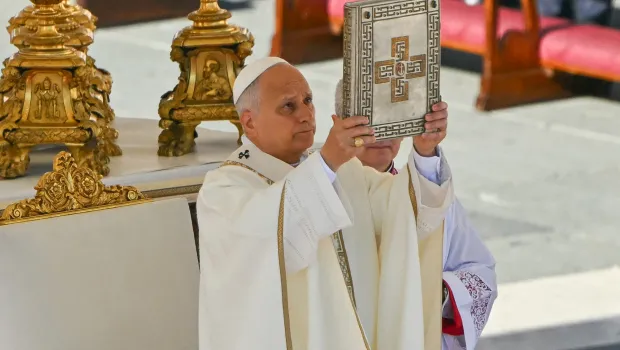
On Friday, October 2, Pope Leo XIV received Archbishop Thibault Verny of Chambéry, president of the Pontifical Commission for the Protection of Minors. Bishop Luis Manuel Alí Herrera of Colombia, secretary of the Commission, accompanied him. The audience took place six days after Lourdes, where the Pope had described sexual violence as a "still open wound." An open wound cannot be healed with words alone; it requires hands, tools, and perseverance. This audience, therefore, represents an initial response to the question posed by Lourdes: who will heal it, and how?

The timing speaks volumes. On September 27, the Pope listened to seven victims for two hours, just steps from the grotto. A few hours later, the Commission's plenary assembly opened in Rome. On October 2, its president was received in audience. In three days, on October 5, the Church in France will commemorate the fifth anniversary of the report that estimated the number of victims of violence within its ranks since 1950 at 330,000. These dates form a single message addressed to the entire Church: the wound is not new, it is not confined to a single country, and its healing is not yet complete.
I won't hide from you that this audience is taking place in a tense atmosphere. Controversies surround the Commission, and I won't go into any of them here, for lack of solid evidence. But Scripture teaches us to read institutions as the prophets read Israel, that is, by their fruits. Let us therefore look at what the Pope has said, what the Gospel sheds light on it, and what the Church must do to heal this wound.
From Lourdes to Rome: a two-part gesture
Lourdes has opened a path
For the first time, a meeting with victims of abuse within the Church was included in the official program of a papal trip to France. Seven people were received behind closed doors at the episcopal residence from 5:30 p.m. to 7:30 p.m. Their profiles were intentionally diverse: minors and adults, women and men, victims of a priest, a college, a religious order, or a movement. None spoke on behalf of an association. The choice of location was significant: Lourdes is the sanctuary for suffering bodies, where the Church has been learning for over a century to confront suffering.
That very morning, before the French bishops, Leo XIV had spoken of the "painful scourge" of abuse committed against minors by members of the clergy or within an ecclesiastical setting. He had encouraged them to continue their work of truth, reform, and reparation. That evening, according to the victims, he acknowledged before them the "systemic" nature of this violence. The word is weighty. He does not accuse every priest, but he rejects the convenient explanation of "isolated cases": structures, silences, and habits allowed the evil to occur.
One detail speaks volumes about how this trip was prepared. The mosaics by Father Marko Rupnik, a Slovenian priest accused of abuse, were covered at the request of the Bishop of Lourdes. Some victims considered the gesture courageous, while also demanding updates on the Roman legal proceedings. They raise a crucial point: you cannot ask a people to pray before images whose authorship is contested without informing them of the progress of the justice system. The symbolic gesture calls for acts of truth; otherwise, it becomes a mere facade.
Rome, a few hours later
On the same day, in Rome, the plenary assembly of the Commission opened, conceived as a body to support local churches. This timing was not accidental. The Pope knows that listening during an evening in Lourdes is only valuable if it informs a lasting policy: training, protocols, oversight, support for victims, and accountability of leaders. A trip is an event; an institution is a long-term commitment. The Lord himself, in his parables, praises the steward who perseveres more than the impetuous one.
On March 16th, before this same Commission, Leo XIV had already laid down the principle: prevention is not an "optional task," but a "constitutive dimension of the Church's mission." This statement deserves careful consideration. It places the protection of the vulnerable not among charitable works added when time allows, but among those that make the Church the Church, on the same level as preaching, the sacraments, and service to the poor. A parish without any protection policy would, by this logic, be an incomplete parish.
Bishop Verny, appointed on July 5, 2025, was chosen by Leo XIV for the continuity he represents: a member of the Commission since 2022, he comes from a Church in France that weathered the storm of the 2021 report. Bishop Alí Herrera, a psychologist by training and secretary since March 2024, traveled to Spain this month to meet with diocesan protection offices. These two men thus bring very different national experiences, and the Commission thrives on this exchange. Where one Church has conducted independent investigations, another is still learning how to observe.
What an audience says
A papal audience is not a decision. It is a sign of trust and a way of guiding priorities. By receiving its leaders less than a week after Lourdes, the Pope is signaling that the Commission is neither a showcase nor an extension, but the instrument of a transformation of governance. Now, we await to know what he is specifically asking of it: clear reports, assessments of local churches, and assistance to regions where such structures do not yet exist.
The Pope's trust does not exempt us from accountability. On the contrary, it compels us to greater transparency, precisely because controversies are circulating. An institution that asks dioceses to be transparent must itself be transparent. And when a controversy arises, the Gospel-inspired approach is neither to dismiss it nor to feed on it greedily: it is to seek the facts, to name what is established, to acknowledge what is not, and to correct without delay what needs correcting.
You might like...

What Scripture says about an open wound
The reproach to the pastors
The prophet Ezekiel addresses one of the harshest pronouncements in the Bible to the shepherds of Israel. He does not primarily accuse them of crimes, but of omissions: «You have not strengthened the weak, you have not cared for the sick, you have not bound up the injured» (Ezekiel 34:4). The text enumerates the basic acts of care and makes them the measure of ministry. A shepherd is judged by what he has done for the injured sheep, not by the beauty of his flock.
Read in light of the abuse crisis, this passage illuminates a painful truth. The fault did not lie solely with the abusers; it also lay with the pastors who deflected responsibility, protected, minimized, or simply turned a blind eye. The word "systemic" conveys this. It designates a chain of responsibility where each individual may have thought it was not their place to act. Ezekiel makes no excuse: "Behold, I am against these shepherds," declares the Lord, who will himself rebuke his sheep.
This reproach, however, is not a dead-end. The same chapter promises that God will seek the lost sheep and heal the wounded. In other words, reform is not merely a moral duty the Church imposes upon itself; it is the participation of its pastors in the very care of the Good Shepherd. A pontifical commission is only meaningful if it helps each bishop, each superior, each parish priest to finally become the shepherd the prophet describes.
A single body that suffers
Saint Paul, writing to the divided Corinthians, lays down a principle that gives the abuse crisis its ecclesial dimension: «If one member suffers, all suffer together with it» (1 Cor 12:26). This is not a comforting image, it is a rule. If the wound inflicted on a victim does not affect the whole body, then the Church is not a body but a collection of separate entities. The victims received at Lourdes expressed their expectation of ’actions«: they demand that what Paul affirms become visible.
This solidarity has very concrete consequences. It prevents us from leaving the issue solely to specialists, as if the protection of minors were a matter for lawyers or psychologists. It also dispels the illusion that the countries where investigations took place are the only ones concerned. When Leo XIV spoke of a wound "still open" in Spain, and then in France, he was speaking to the universal Church. Where no report has been published, it is not for lack of wounds, but perhaps for lack of attention.
Paul adds that the weakest members are the most necessary and must be given extra honor. For too long, the Church has done the opposite: it has honored the institution and rendered the victims invisible. Restoring the order of the Gospel means placing the vulnerable at the center, listening to them before defending oneself, and accepting that their words, sometimes harsh, are the primary source of reform. The Pope did this in Lourdes, sitting for two hours listening to seven stories.
He who heals broken hearts
The psalm says it succinctly: «He heals the brokenhearted and binds up their wounds» (Psalm 147:3). This verse doesn't promise the erasure of evil, but a God who bends down to help. It reminds believers that healing doesn't belong to them: they are servants of a care that comes from elsewhere. This protects them from two opposing temptations. The first is to believe oneself the savior of the victims, with a condescension that still wounds. The second is to despair, as if nothing could heal.
The victims are not asking for easy consolation; they are asking for the truth. Forgiveness that bypasses justice is false forgiveness; justice without compassion becomes a cold procedure. In Lourdes, the Pope reiterated that the Church must continue the search for truth, justice, forgiveness, and reparation. The order of these words is not arbitrary. One cannot ask a victim to forgive before the harm has been acknowledged, judged, and redressed. Forgiveness is a free gift that belongs to the one who has suffered, never an obligation that the institution can demand.
This is where the psalm takes on its true meaning: if God heals broken hearts, it is his Church's role to lend him its hands. This requires time, skilled professionals, welcoming spaces, financial reparations, and clear canonical procedures. None of this is spectacular. But the holiness of the Church is also measured by these acts of care, performed without witnesses, day after day, for those who have been wounded in his name.

Actions that heal the wound
Truth, justice, reparation
The truth comes first. The 2021 report, submitted to the bishops and religious of France by Jean-Marc Sauvé and his team, had this power: it provided figures, mechanisms, and accountability. It showed that the phenomenon had affected approximately 330,000 people over seventy years, including more than 210,000 victims of abuse committed by priests and religious. These numbers are not an indictment. They are a breach in the wall of silence, through which air has finally entered.
Justice follows. It is exercised first in the civil sphere, which the Church must never obstruct, and then in the canonical sphere, which must be swift, transparent, and accessible to victims. The five victims who wrote to the Pope on September 23rd were specifically requesting updates on a Roman procedure. This is the test: not the quality of the message, but the institution's ability to tell an individual the status of their case and why it is taking so long to resolve.
Finally, reparation cannot be limited to a financial gesture, even if such a gesture is necessary. It requires public recognition, spiritual and psychological support, and opportunities for victims to contribute to prevention. Several of them have committed themselves to this. Their presence in Church bodies is not a favor: it is an opportunity, because they know where the system failed and how it can be corrected.
📁 Special Report
Leo XIV1514 articles
Leo XIV, the first American pope, facing AI and digital technology: profile, social legacy of Leo XIII and challenges…
Access the folder →Controversies: a test of credibility
Let us return to these controversies surrounding the public. They raise a fundamental question: can an institution tasked with protection withstand being challenged? The Gospel answers with the example of Jesus, who did not fear scrutiny. "What is hidden will be revealed," he said. A Commission that works well has nothing to fear from a demand for clarity, provided that the criticisms are based on facts and not on suspicions of expediency.
The Church must therefore learn to distinguish between two things. There are legitimate criticisms, voiced by victims, associations, members of the faithful, or journalists, which point out delays, slowness, and inconsistencies. There are also the maneuvers of those who would like to discredit any protection policy in order to return to the previous silence. We must listen to the former, resist the latter, and never confuse the two. This clear-sightedness requires discernment, and it is an act of charity as much as of prudence.
A Commission's credibility is therefore earned through three actions: publishing its work, evaluating what isn't working, and being accountable to those it claims to serve. The annual report it submits to the Pope is a step in this direction. But it still needs to be made understandable to local churches, so that the faithful in Bogotá, Chambéry, Madrid, or Kinshasa know what their Church is actually doing for their children.
What everyone can do
Protecting minors isn't just a matter for Rome. It's a matter for the parish where catechists are trained, for the chaplaincy where two adults are always present, and for the youth movement where everyone knows who to report concerning behavior to. An attentive layperson is worth more than a protocol no one reads. It's simply a matter of asking the right questions: who supervises, who monitors, who listens, who receives the alert? The seriousness of a community is measured by these simple answers.
There is also prayer, which is not a refuge but a way of bearing the burden. To pray for the victims is to refuse to let them be alone. To pray for the pastors is to ask them for the courage to be what God expects of them. To pray for the Commission is to support it in a heavy, often thankless task. And to pray for those who have done wrong is to ask for their conversion without ever diminishing what they have done. These prayers do not replace action: they make it possible.
An open wound demands patience. The victims know this better than we do: healing takes years, it has setbacks, it requires unwavering commitment. The Church, too, must persevere. What the Pope said in Lourdes and what he reaffirmed in Rome commits a generation. It is up to us not to let our attention wane as soon as the news changes.
Lectio divina
«I will seek the lost sheep, I will bring back the strays, I will bind up the injured, I will strengthen the weak.» Ezekiel 34:16
When did you turn away from a wound you preferred not to see? Who, near you, is waiting to be sought rather than judged? Are you ready to let God heal you, too, where you have stood alone for too long?
Lord, Shepherd of wounded sheep, you do not turn away your gaze. You seek the lost in the night, you kneel beside the one who limps. Your hand brings oil and bandages, your steps follow the traces of blood. Forgive your pastors their silences, teach us the patience of the infirmary. May your Church become a house of healing, and not a wall that hides.
An open hand gently removes the bandage from a wound, and the light of dawn settles on it like warm oil.
✝ Biblical references
3 passages · 3 books
If I do not have love, I am nothing. (1 Corinthians 13:2)
Unity of the Church, ethical problems and a hymn to charity for the Corinthian community.
→ Explore the Codex 1 Corinthians- The gifts he gave were the Apostles and also the evangelists (Ephesians 4:1-7, 11-13)
- What remains today are faith, hope, and love; but the greatest of these is love (1 Corinthians 12:31–13:13)
- You are the body of Christ, and each one of you is a member of that body (1 Cor 12:12-14, 27-31a)
- By sinning against your brothers and wounding their weak conscience, you sin against Christ himself (1 Cor 8:1b-7, 10-13)


I will give you a new heart and put a new spirit in you. (Ezekiel 36:26)
Apocalyptic visions, oracles of judgment, and the promise of the restoration of Israel.
→ Explore the Ezekiel Codex- Massachusetts: When the state opens the archives that the Church didn't dare reopen
- Divorced and remarried: when Leo XIV asked the Church to examine what mercy had become
- Two miters under the sirens: when Ukraine receives two shepherds for its wounded sheep
- Two hours to listen: rebirth begins with the wounded


The Lord is my shepherd; I shall not want. (Psalm 23:1)
150 poems and songs of Israeli prayer: praise, lamentation, thanksgiving.
→ Explore the Codex Psalms🌍 4 countries involved


Still largely marked by its Catholic heritage, Spain today has a majority of baptized people, even though religious practice is declining sharply. According to an ancient tradition, Christianity arrived there as early as the 1st century…
Discover Spain →
With nearly half the population still identifying as Catholic, France remains marked by a deep Christian tradition within a context of strong secularization. The first communities appeared as early as the 1st century AD…
Discover France →
In the Vatican, the population is almost entirely Catholic, since this microstate exists in direct service to the universal Church. The Christian presence there dates back to the 1st century with the martyrdom and burial of Saint Peter…
Discover Vatican City →