












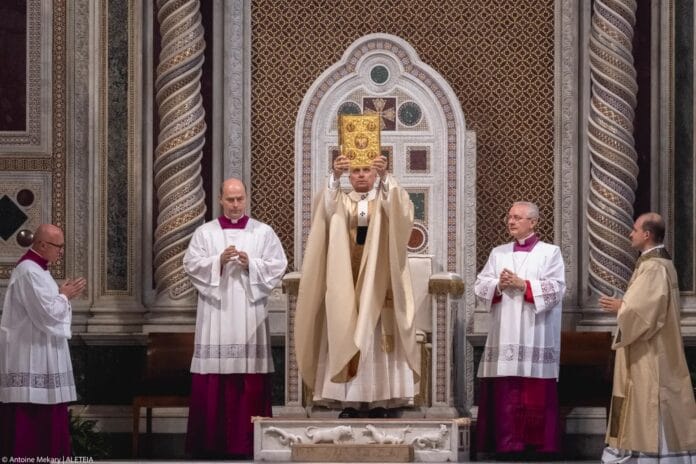
When the pope Leo XIV reminds us that the living heart of the Temple of God beats within us, through the Christ who died and rose again.
The mystery of the living sanctuary
The dedication of the Lateran: a sign of unity and memory
Every year, on November 9th, the’Universal Church celebrates the dedication of the Basilica of St. John Lateran, cathedral of pope and "mother of all the churches of Rome and the world." This anniversary goes far beyond the commemoration of a stone monument. It is a reminder that the Christian faith rests on an inner, living edifice, built upon Christ himself.
During the Angelus on November 9, 2025, the pope Leo XIV restored this liturgy to its spiritual dimension: the Lateran Basilica is a symbol, a visible metaphor for the invisible sanctuary that is Christ. Through this reminder, he wanted to show that every stone, every column, every architectural symbol of this church explains something of the mystery of salvation.
It is not insignificant that this dedication is celebrated in Rome, the beating heart of Catholicism. The Eternal City is not merely an administrative or historical center: it represents the living continuity of the apostolic faith, rooted in the Resurrection.
A place of stone and a place of the heart
THE pope Leo XIV insisted during this Angelus: the Lateran, The building, in all its artistic beauty and history, is not the end of the message. These walls speak, but they speak of a larger mystery: The true sanctuary of God is Christ, who died and rose again..
The sanctuary, therefore, is not a place where God takes refuge from humanity; it is the sign of His desire to dwell among them, in the very flesh of the Son. From this perspective, the Christian faith moves from a physical Temple—that of Jerusalem—to a spiritual Temple—the Body of Christ. In Him dwells the fullness of divinity, and it is this body, raised from the dead, that becomes the living sanctuary of God.
This passage, already foretold by Jesus when he said, “Destroy this temple, and in three days I will raise it up,” manifests the radical break between the old order of worship and the New Covenant. From now on, the true place of encounter with God is a person. And it is in this person, crucified and then glorified, that all humanity finds its access to the Father.
The sanctuary of Christ, the place of the new covenant
This shift from the Temple to Christ should not be understood as a mere spiritual symbol or a poetic metaphor. It represents a change of reality. On the cross, Jesus truly becomes the new altar, the new priest, and the new victim. In Him are concentrated all the functions of the old worship, but in a perfection that surpasses all human institutions.
Thus, Christ is not merely the sanctuary: He is its source, its content, and its purpose. Man no longer has to "go" to a place to encounter God: he is now invited to to remain in Christ. This intimacy is the foundation of the entire Christian spiritual life.
That's why the pope Leo XIV, By recalling that "the true sanctuary of God is Christ, who died and rose again," this message echoes the deepest thread of the entire theological tradition. It is an invitation to return to the essential: faith is not primarily an institution, an organization, or a rite. It is a relationship to a living presence.
Christ, temple of salvation
The Temple destroyed and rebuilt: a biblical reading
In the’Gospel according to Saint John, Jesus announces: Destroy this Temple, and in three days I will raise it up. The evangelist immediately clarifies:« He was talking about the Temple of his body. This phrase alone sums up the entire Christian mystery. The Temple is no longer made of stone, but of flesh. And this flesh—broken, crucified, glorified—becomes the new dwelling place of God among men.
At the heart of this revelation, the Resurrection is not just the victory of life over death. It is the reconstruction of the Temple. What men had destroyed — love of God incarnate — God rebuilds it definitively. From then on, the risen Christ becomes the eternal sanctuary, the indestructible dwelling place where humanity and divinity are united forever.
This perspective sheds light on the liturgy of the whole world: every church built in his name is but a visible sign of this invisible mystery, every altar an image of the glorified body of the Lord.
The Body of Christ and the Church: one sanctuary
The teaching of pope Leo XIV extends that of Saint Paul: "You are the body of Christ, and each one of you is a member of it."1 Corinthians 12,27). If Christ is the true sanctuary, then the Church—his Body—participates in that sanctuary. In other words, each baptized person in turn becomes a living stone of the risen Temple.
This vision radically transforms the way we understand the ecclesial community. The Church is not a building, nor even an institution: it is a living body, inhabited and animated by the presence of the Risen One. Hence the close link between unity and holiness: to remain united is to remain in Christ; to live holy is to let the glory of the inner Temple shine forth.
THE pope He also said: the twelve monumental statues of the apostles that adorn the nave of the Lateran They remind us that the Church rests on witnesses, not on structures. The unity of the sanctuary comes from testimony, not from marble.
A paradoxical sanctity: beauty in dirty hands
As his meditation progressed, Leo XIV Joseph Ratzinger quoted: «God chooses, with paradoxical love, even and precisely the dirty hands of men as the receptacle of his presence.» This is the very paradox of the Christian sanctuary. This sacred place is not closed to sinners: it is built from them. The Church is holy only because it welcomes Christ, not because its members are blameless.
Christ, in rising from the dead, did not erase the wounds of his Passion. He glorified them. These wounds become the gates of the sanctuary. Thus, the human wound, when it is pierced by mercy, becomes a place of divine presence. That is why the pope encourages the faithful not to flee from their weaknesses, but to offer them as a space for God to welcome them.
To become God's sanctuary
Living spiritual worship
If Christ is the sanctuary, then true worship is that which is lived in Him. Christian adoration is not an external ritual, but an internal act, an offering of oneself. Saint Paul expresses it thus: Offer your bodies as a living sacrifice, holy and pleasing to God: this is your spiritual worship.Rm 12,1)
Leo XIV revisits this intuition: Christians They are called to spread the Gospel of mercy, not only through their words, but through their very way of life. True worship does not end when one leaves the church; it continues in the work, family, society. Every act of charity, every act of forgiveness, every silent prayer becomes incense offered in the inner temple of Christ.
The call for unity and mission
Being the sanctuary of Christ is not limited to an individual experience. It establishes a universal mission. The Church, as the pope, must be "the mother who tenderly cares for Christians scattered throughout the world." This spiritual motherhood is expressed in prayer, but also in concrete witness.
The true sanctuary does not turn inward: it rayon. In the risen Jesus, the Temple opens. The walls disappear. Christ draws all people to himself. And thus, the baptized become, in the beautiful expression of Saint Peter, living stones called to build the’Universal Church.
Leo XIV invites thus Christians to overcome the prejudices and divisions that weaken the credibility of the Gospel. Too often, he says, it is the weaknesses and errors of believers that obscure the light of the mystery. Yet, to recall that Christ is the sanctuary is to recall that unity and peace do not come from our efforts, but from the presence of the Risen One at the center of our faith.
Contemplating the Lateran, to better allow oneself to be inhabited
To look at the Basilica of St. John Lateran is to contemplate a sculpted parable. Its powerful columns, its vibrant mosaics, its majestic vistas manifest the glory of God in human frailty. Each stone evokes a grace, each statue recalls a vocation. But this outward splendor is only a backdrop: the true sanctuary lies elsewhere.
Before this cathedral, the Christian is invited to a twofold movement: wonder and self-denial. Wonder, because beauty always leads to God. Self-denial, because it reminds us that God prefers humble hearts to walls of gold. From this tension arises joy of faith: knowing that we are inhabited, chosen, sanctified, despite everything.
Epilogue: Walking Towards the Eternal Temple
The dedication celebration of the Lateran is not a memory, but a anticipation. What we celebrate in stone foreshadows what will be fully revealed in the heavenly Jerusalem. Then there will be no temple, no altar, no external light: for «the Lord God Almighty and the Lamb are his temple» (Rev 21:22). pope Leo XIV, By adopting this apocalyptic perspective, it invites us to look to the future with hope: one day, everything will be sanctuary.
Until that day, we live the liturgy of the journey. The risen Christ walks with us, like a walking sanctuary, a tabernacle that travels the world. He dwells in our joys and our sorrows, our prayers and our silences. And everywhere love It is reborn, the Temple rises again.
To pray with the Angelus message
- Lord Jesus, true sanctuary of the Father, make our lives living stones of your Church.
- Teach us to recognize your presence in the wounded flesh of our brothers.
- May your Spirit continually renew us joy to serve you in the spiritual worship of charity.
- And that each day, as we walk through the world, we may be witnesses of your resurrected sanctuary.