












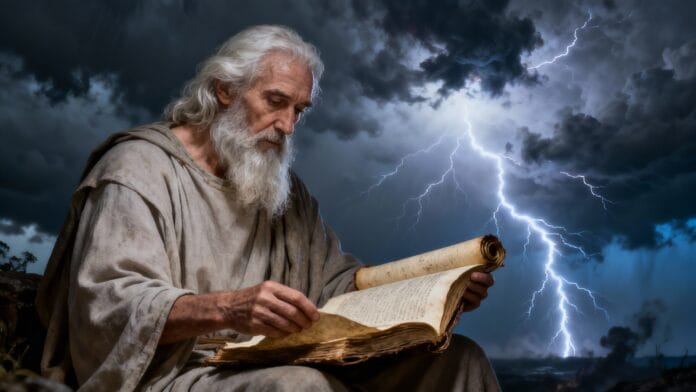
1° The title of the book. – The Greek word ἀποϰάλυψις, from which we have derived "apocalypse," literally means: the act of revealing. It is very accurately translated by revelation. The Latin noun revelation It represents a veil drawn back. The sacred writers of the New Testament use it up to eighteen times (cf. Luke 2:32; Romans 2:5; 8:19 and 16:25; 1 Corinthians 1:7; 2 Corinthians 12:1; Galatians 1:12, etc.). Very early on, as can be seen from the oldest manuscripts, it was used to designate the book we are discussing, which opens precisely with it (cf. Revelation 1:1). Originally, the title was quite short: Apocalypse of John. It is then gradually enlarged: Apocalypse of John the Theologian ; Apocalypse of John the Apostle and Evangelist, etc.). But although the Book of Revelation is a divine revelation, this does not mean that it reveals the secrets of heaven to us in terms that are always clear and unambiguous. The information provided about God's purposes remains hidden beneath images, allegories, and symbols whose meaning is not always easy to determine. Hence the old saying: "Apocalyptic style, obscure style." However, in this respect, how many oracles of the Old Testament have retained a certain obscurity, despite their fulfillment by Jesus Christ.
2° The author of the Apocalypse.
Several times in his writing, the author says his name is John (Rev. 1:1, 4:9; 22:8), and although nowhere does he formally present himself as an apostle (Rev. 1:1bHe takes the title of δοῦλος, i.e., servant of Jesus, which Saint Paul, Saint James And Saint Jude sometimes also add to their name. Cf. Romans 1:1; Philippians 1:1; ; Tite 1, 1 ; James 1, (1; Jude 1). This question has not been settled by the Magisterium of the Church. Some believe that the author of the Book of Revelation is the Apostle Saint John, but scholars are divided.
Those who support attributing the Book of Revelation to the apostle Saint John put forward the following arguments:
1° In Revelation 1:9, we read: «I, John, your brother, was on the island called Patmos because of the word of God and the testimony of Jesus.» Now, the earliest writers repeatedly state that the apostle Saint John was exiled to Patmos by Domitian (see Clement of Alexis, Quis dives…, c. 42; Origen, In Matthew., t. 16, 6; Eusebius, Ecclesiastical History, 3, 18; Tertullian, De Præscript., 36; Saint Jerome, De Vir. ill., 9, etc.).
2° We also know that Saint John spent the last years of his life in Ephesus, from where his apostolic authority extended over all the Christian communities of Proconsular Asia. This fact harmonizes with the seven letters addressed, in chapters 2 and 3, to the bishops of seven important churches in that region, for the author of Revelation was intimately familiar with the state of these churches, and he speaks to them as their supreme pastor. At that time, there was only one «John» in Asia who could address bishops in such a manner.
3° We can also note the repeated appeal that the author makes to his own testimony (Rev. 1, 2; 22, 18, 20, etc.); now, this is precisely a characteristic custom of the evangelist Saint John (cf. John, 19, 35; 21, 24; 3 John 12).
4° The threat issued, Rev. 22, 18 and 19, against those who would dare to falsify the book also presupposes a high dignity.
5° If we compare the Book of Revelation with the Gospel of John, we see a striking correspondence in the progression of the two narratives: on both sides, an increasingly intense struggle, culminating in the outward defeat of God's cause, and, through this very defeat, in his complete triumph. There is also a similar preponderance of the law of contrasts in both writings; a continual alternation of dark and light scenes, of faith and unbelief.
6° The testimony that the Book of Revelation itself bears to its author is confirmed by that of the most ancient tradition. Papias, a direct or indirect disciple of Saint John, regarded this book as possessing divine authority. The martyr Saint Justin Martyr (c. 140) clearly attests that the Book of Revelation was composed by the apostle Saint John (Dialogue with Tryphon, 81, 4; cf. Eusebius, Ecclesiastical History 4, 18, 8). According to Saint Irenaeus (Against Heresies, 4, 20, 11; cf. 5, 35, 2), «John, disciple of the Lord, contemplated in the Apocalypse the priestly and glorious arrival of the reign of Christ.» Theophilus of Antioch (Eusebius, Ecclesiastical History, 4, 24), Melito of Sardis and Apollonius of Ephesus (Eusebius, lk 5, 18; cf. Saint Jerome, of Hom. ill., 9), Polycrates of Ephesus (Eusebius, Ecclesiastical History, 3, 31 and 5, 24), also testify, in the second half of the second century, to the apostolic origin of the Apocalypse. The same belief prevailed in Rome, where Saint Hippolytus wrote, between 190 and 225, a book against the priest Caius, who denied its authenticity, and where the Muratorian canon clearly places the Apocalypse among the writings of Saint John. Tertullian (Against Marcion. 3, 14, 25 ; of Præscr., 33, etc.), Dionysius of Corinth (Eusebius, lc., 4, 23, 12), Clement of Alexandria (Stromata, 6, 13 ; Pedag., 2, 10, 12), Origen (In Matth., t. 16; ; in Jean., t. 1) and Saint Cyprian (Ep. 63 ad Caecil., 12 ; of Exhort. Mart., 2, etc.) thought the same. These attestations, so ancient and so numerous, many of which originate from the region for which the Apocalypse was directly composed (cf. Rev. 1:4, 11), constitute proof despite the absence of our book in the Peschita Syriac and its formal rejection by Marcion, Gaius and the tiny sect of Alogi.
7° It is true that in the middle of the 3rd century (201-300 AD), there was a temporary shift in opinion within the Greek Church on this matter, thanks to the influence of Bishop Dionysius of Alexandria (around 255). To more easily crush the crude millenarianism that a number of rash doctors claimed to support with various passages in the Book of Revelation (Rev. 20:4 ff., etc.), Dionysius could think of nothing better than to undermine the apostolic authority of the book itself, which he asserted was not the work of the beloved disciple, but rather of John Mark the Evangelist, or a priest named John, etc. His arguments are internal to the text of Revelation and can be reduced to three main points (see Eusebius, Ecclesiastical History 7, 25, 1, et seq.).
1° The apostle John never names himself in his writings (the fourth gospel and the three letters), the one who composed the Apocalypse mentions his name several times.
Answer: The Apocalypse is a prophecy, and all the Hebrew prophets name themselves, because their name is the only guarantee of the revelation they attribute to themselves.
2° "The Apocalypse does not have even a syllable" that can be found in the gospel and the letters of Saint John.
3. The style of the Apocalypse differs markedly from that of the apostle
Response to arguments 2 and 3: We must take into account the necessary dissimilarity that must exist between literary works as disparate as the fourth gospel, the First Letter of Saint John and the Apocalypse. These various writings clearly express the same dogmatic ideas, and one discovers striking coincidences in their approach to religious matters. Suffice it to note here the name of Logos, which is not used in the New Testament outside of the fourth gospel, of 1 John 1, 1 and of Revelation 19:13; the characteristic name of lamb, to designate Jesus Christ: Twenty-nine times in Revelation, twice in the’Gospel according to Saint John (1, 29 and 36), only once elsewhere (1 Peter 1:19); the living waters, presented as the symbol of divine grace (John 4:10-14 and 7:37-39; Rev. 7:17; 21:6; 22:1, 12); the manna, promised by the divine Master (John 6:32; Rev. 2:19); the mention of the pierced side of Jesus, accompanied by an identical quotation, borrowed from the prophet Zechariah 12:10 (cf. John 19:14 and Rev. 1:7); the ideas of testimony, of truth (ἀληθής), of genuine (ἀληθινός), etc.
Dionysius of Alexandria was not absolutely opposed to the Apocalypse considered in itself: "As for myself personally," he says (Eusebius, 1c, 5, 25, 1), "I would not dare to completely reject the book, because many faithful attach great importance to it; my opinion about it is that it surpasses my understanding and that the events it contains hold a hidden and marvelous meaning… I grant that it is the work of a holy man inspired by God.".
8° Dionysius of Alexandria's criticisms of the authenticity of the Apocalypse did not have lasting success, for although they managed to unsettle the ancient belief in the East for a time, this belief soon flourished again and remained almost unanimous until the time of Erasmus and Luther. The Western Churches always remained firm on this subject and did not experience the doubts of the Eastern Churches. Eusebius, while expressing personal doubts, acknowledges that the book was generally accepted in the Church (Ecclesiastical History, 3, 18, 2 ; 29, 1). If Saint Cyril of Jerusalem and Saint John Chrysostom do not mention the Apocalypse anywhere, Saint Ephrem of Nisibis, Lactantius, Saint Epiphanius, Saint Basil, Saint Gregory of Nyssa, Saint Hilary of Poitiers, etc., regarded it as the work of the Apostle Saint John.
3° The date and place of composition. Saint Irenaeus of Lyons dates this to around the years 93-96 AD, since Domitian reigned from 81 to 96: "The vision (of the Apocalypse)," he says (Cont. Her., 5, 30, 3 – comp. Eusebius, Ecclesiastical History, 5, 10, 6), does not date back a considerable time, but it was seen almost in our time, towards the end of Domitian's reign." This is implicitly confirmed by Saint Jerome (Illustrious Men 9), which mentions the fourteenth year of Domitian, that is, the year 95, as that of the banishment of Saint John to Patmos. Conversely, Saint Epiphanius, Hær., 51, 12, 33, dates the composition of the Apocalypse during the reign of Claudius in 41-54 BC.
Those who favor a composition dating from before the end of the 1st century AD point out that several of the churches addressed to the letters in chapters 2 and 3 had lost some of their initial fervor; however, it would be morally impossible for this to have occurred so quickly, just a few years after Saint Paul preached the Gospel in Asia Minor. The advanced state of the heresies mentioned in the same letters (see 2, 9 ff., etc.) also implies significant progress since the time of Saint Paul, who had already noted their first signs in his letters to the Philippians and Timothy; this too requires a considerable period of time.
Was the Book of Revelation composed on Patmos itself, where Saint John witnessed the heavenly visions (cf. 1:9 ff.), or only in Ephesus, when his exile had ended? The first hypothesis seems more likely to some, because it was in the order that the author should immediately recount what he had contemplated in his ecstasy, Jesus having communicated his revelations to him so that he might immediately put them in writing, and transmit them without delay to the Churches (cf. 1:1, 19, etc.).
4° The style of the Apocalypse differs markedly from that of the fourth gospel and the letters of Saint John. Two facts are certain: 1° that several expressions frequently used in the gospel and in the letters of Saint John do not appear anywhere in the Apocalypse: Among others, ἀληθεία, ζωή, ϰρίσις, φῶς, χάρις, etc; 2° that the style of the fourth gospel is grammatically correct (without being at all elegant, despite the contrary assertion of Dionysius of Alexandria), while the Apocalypse abounds in irregular constructions and outright solecisms (from the very first lines, we find this strange expression: χάρις ὑμῖν… ἀπὸ τὸ ὤν, ϰαὶ ὁ ᾖν, ϰαὶ ὁ ἐρχόμενος, 1, 4b. But it is explained by the author's desire to preserve all its solemnity for this divine name; he therefore treated it as if it were indeclinable. Furthermore, not having a past participle at his disposal, he replaced it with the formula ὁ ᾖν). Here are several examples, which consist mainly of falsely used cases, false appositions, and very harsh expressions: l, 5, ἀπὸ Ίησοῦ…, ὁ μαρτύς; 3, 12, τῆς ϰαινῆς Ίερουσαλὴμ, ἡ ϰαταϐαίνουσα…; 14, 12, ὑπομονὴ τῶν ἁγίων,… οἱ τηροῦντες…; 20, 2, τὸν δράϰοντα, ὁ ὄφις ὁ ἀρχαῖος; 4, 1, ἡ φωνὴ… λέγων; 9, 14, 13, φωνὴν…λέγοντα; 17, 4, γέμον βδελυγμάτων ϰαὶ τὰ ἀϰάθαρτα; 21, 14, τὸ τεῖχος τῆς πόλεως ἔχων; 3, 8, ἣν οὐδεὶς δύναται ϰλεῖσαι αὐτήν etc., etc. However, while it is true that the author of the Apocalypse makes many mistakes against grammar and the purity of language, it is no less certain that he knew Greek and its rules, since he usually writes it correctly, even in circumstances where the construction was more difficult.
Nevertheless, some believe that the style of the Apocalypse also has affinities with that of the fourth gospel and the three letters of the apostle John, so that several have recognized that no argument against its authenticity can be drawn from this side. Among the cases of resemblance, the most striking are the very frequent use of the conjunction καί to link the propositions together, the variety of particles, the use of various expressions (notably: ἔχειν μέρος, ἕϐραΐστι, ὅψις, σϰηνοῦν, σφάττειν, τηρεῖν, τὸν λόγον), which, in the New Testament, do not appear outside the writings of Saint John.
5° The prophetic nature and main theme of the Apocalypse. Our book presents itself as a prophecy (cf. 1:3; 10:11; 22:7, 10, 18, 19), and the author openly identifies himself as a prophet who has received divine revelations concerning the history of the Church (see 1:1; 22:9, etc.). But while the Old Testament abounds in prophetic writings, Revelation is the only book of this kind in the New Testament. This is because, under the Old Covenant, everything depended on the future, on the coming of the Messiah, so that the principal divine revelations aimed to announce the more or less imminent appearance of the promised Liberator, whereas, under the New Covenant, Christ having accomplished our redemption, the future no longer holds the same importance for us. Only one thing can interest the Church in this respect: the final consummation, accompanied by the return of Jesus Christ. Thus, it is towards this crucial event that the principal prophecies of the Savior and his apostles converge, in a more or less direct way (see, independently of the Apocalypse, Matthew 24:2 ff.; Mark 13:1 ff.; Luke 17:20 ff.; 19:41-44; 21:5-36; 2 Thessalonians 2:1-12; 2 Timothy 3:1-9; 2 Peter 3:1 ff., etc.).
The first part of Revelation, 1:1–3:22, has somewhat less of this prophetic character, which often bursts forth from 4:1 onward. The oracles transmitted are not presented in ordinary language, as is most commonly the case in the books of Isaiah, Jeremiah, etc., but in the form of visions and symbols, as frequently occurs in the writings of Ezekiel, Daniel, Zechariah, etc. The symbolism of Revelation is extraordinarily varied: there are symbols of numbers (the numerals 3, 3½, 7, 12, and following), of colors (cf. 1:13–14; 6:2 and following; 9:17; 12:1, 3; 17:4, etc.), of geometric shapes, of elements, of precious stones, of animals, etc. divine symbols, human symbols, sidereal symbols, etc.
The book's external form is that of a letter, written by John to the churches of Asia Minor (cf. 1:4; 22:16 ff.). He likely chose this form because he sent accounts of his visions from Patmos, where he was exiled, to the Christian communities he led. He therefore initially addresses them directly; but he ceases to address them directly from 1:10 onward.
The fundamental idea of Revelation is the second coming of Jesus Christ at the end of time. It appears from the very first lines (cf. 1:7-8); it then resounds throughout the text (2:16; 3:4, 11, 20; 6:2; 19:11, etc.); we find it again in the epilogue, where Jesus repeats up to three times: «Behold, I am coming soon» (22:7, 12, 20), while the Church responds (22:17, 20).b«Amen, come, Lord Jesus.» This second coming of Christ is therefore the proper subject of our book, just as his first coming was the subject of the prophecies of the Old Testament. Indeed, the history of the world in its essence can be summed up in these three words: He is coming (the period from the fall of Adam to Christmas); He has come (the Gospel period); He is coming again (from the Ascension until the end of time). He is coming again: this is the story of the final catastrophe, and of the terrible events that must precede it, more or less closely.
6° The book's outline. First there is a short prologue, 1, 1-8. According to 1, 19, Saint John contemplated in his vision the things of the past and those of the future: hence two very distinct parts, the first of which goes from 1, 10 to 3, 22; the second, from 4, 1 to 22, 5. The writing ends with an epilogue, 22, 6-4, which corresponds to the prologue.
The first part can be entitled "Letters to the Churches," for it contains seven letters that Jesus dictated to his disciple for seven specific Christian communities in Asia Minor (those of Ephesus, Smyrna, Pergamum, Thyatira, Sardis, Philadelphia, and Laodicea). The spiritual state of these churches is described in dramatic terms, with words of praise or blame, encouragement or warning, promise or threat. Jesus Christ is presented to us in this first part as the transfigured Son of Man (cf. 1:13ff.), who teaches the Church and gives it its commands. Later, from 4:1 to 19:10, he appears under the symbol of the Lamb slain and glorified; from 19:11 to 20:6, we see him as an irresistible victor.
The second part can be called "The Book of Visions," because it was in the form of seven successive visions that Jesus showed Saint John what was to be fulfilled in later times. The first is that of the book with the seven seals, 4:1–8:1, momentarily interrupted (7:1–8 and 9–17) by two episodes that together constitute a single vision. The third vision, that of the seven trumpets, runs from 8:2 to 11:19. It is interrupted, like the first, by two brief episodes (10:1–11 and 11:1–14). The fourth, 12:1–14:20, describes the struggle that God will wage on behalf of his Church against the powers of this world. The fifth, 15:1–16:21, is that of the seven angels who pour out bowls filled with divine wrath upon the globe. The sixth chapter, 17:1–19:10, recounts the ruin of the great worldly city, which represents the enemies of God and the Church. In the seventh chapter, 19:11–22:5, we see Jesus Christ himself rushing into battle to subdue all that is hostile to his people. The final vision takes place, complete and glorious, and the kingdom of God enters its eternal consummation.
These different visions can be grouped under three distinct headings, in three sections. The first section (4:1–11:14) corresponds to the first three visions: everything relates to the book with seven seals, which are broken one after the other. The second section (11:15–16:21) contains the fourth and fifth visions: it shows us the struggle of the Church of Christ against the synagogue of Satan. The third section (17:1–22:5), which includes the sixth and seventh visions, presents God's judgment against the enemies of the kingdom, the triumph of Christ, and the beginning of blessed eternity.
The overarching idea is the struggle of the glorified Jesus against the world. This struggle unfolds in a number of phases, which follow one another in a progression leading to the denouement.
7° The overall purpose of the Book of Revelation and its usefulness. The aim is less that of Saint John than that of God himself, since this writing was composed under particular circumstances, at the special command of the Lord (cf. 1:11, 19; 22:10, etc.). The divine intention is clear with regard to the first part, that is, the letters to the seven churches (chapters 2 and 3). It boils down to these two points: to strengthen Christians both against the heresies and persecutions of the time, and encouraging them with the prospect of eternal reward. Now, these two thoughts are found throughout the entire book, whatever opinion one holds regarding its interpretation: everywhere the faithful are urged to energetically maintain their faith against error and violence, these two powers perpetually hostile to the Church, and, to better motivate them to the struggle and to patience, They are reminded of the certainty of the final vision, the glorious crown reserved for them in heaven.
From this perspective, the usefulness of our book is undeniable, and it will only cease to exist at the end of time. «Is it not a great enough consolation for the persecuted faithful to sense, even in general, in the Book of Revelation, the strength that was to be inspired in the holy martyrs, and to discover with such magnificence not only their future glory in heaven, but also the triumph that was prepared for them on earth? What contempt must they have conceived?” Christians of the tyrannical power that oppressed them, when they saw its glory erased and its fall so clearly marked in the divine oracles?» (Bossuet, Complete Works, ed. Vivès, t. 2, p. 33). From a dogmatic point of view, the Apocalypse is also very useful, especially with regard to the divinity of Jesus Christ, the endless life of the Church, the existence of good and bad angels, the eternity of heaven and hell, etc.
8° The various systems of interpretation. The Book of Revelation is perhaps the part of the Bible that presents the most difficulties to the commentator. Nevertheless, its general and detailed obscurities, far from discouraging exegetes, have rather attracted them further. Unfortunately, many difficulties remain. This is because, for many exegetes, Revelation has served as a pretext for putting forward all sorts of false or arbitrary ideas, all sorts of more or less bizarre fantasies, concerning the history of the Church and especially the end times. Leaving aside everything that does not merit mention, there remain a number of systems, which we will reduce to four main ones, without, however, going into the multiple variations of each of them.
1. Pure imagination. Rationalists treat the Apocalypse as a work of pure imagination: This book is nothing more than a religious poem, entirely human in its origin and its end, intended to console and encourage the faithful burdened by persecution. The little it ventures to predict concerning future events is drawn either from probable conjectures about the course of events in the Roman Empire or from the firm hope it shared with all the disciples of Christ regarding the Savior's imminent and glorious return. Convinced that Christ would then annihilate all his enemies, the apocalyptic writer, giving free rein to his poetic imagination, depicts in vivid and varied imagery the vengeance that the Messiah will exact against the persecutors of his followers. These visions, moreover, are little more than those of Daniel and Ezekiel, slightly modified and adapted to Christian ideas..
2. Prediction of Church History. Some see in the Book of Revelation a detailed account of Church history, from the time of Saint John's vision until the return of Jesus Christ at the end of time. Some believe that everything has been foretold, even isolated events, while others are content to assert that only the broad outlines (the periods with their essential character) have been laid out in advance. Among the most famous proponents of this view, which can be called the historical system, is the German saint and scholar Bartholomew Holzhauser, who died in 1658. According to him, the Book of Revelation prophesies what will happen during the seven ages of the Church, already represented by the seven letters of chapters 2 and 3. He distinguishes the apostolic age; the age of martyrs; the age of doctors, from Constantine to Charlemagne; The age of Christ's social reign, from Charlemagne to Charles V; the age of salutary trials, beginning with Charles V and continuing until the advent of a holy pontiff and a great emperor; the age preparing the faithful for the tribulations of the end times; the age of the Antichrist. This age will end with the final judgment.
Others, following Nicholas of Lyra, are content with six periods. The first, represented by the seven seals, extends to Julian the Apostate (died in 363); it is the period of the apostles, martyrs, and doctors. The second corresponds to the seven trumpets; it runs from Julian the Apostate to the Eastern Roman Emperor, Maurice, whose reign began in 582. The third is represented by the struggle of the dragon against the woman; it extends to Charlemagne (800). The fifth period runs from Charlemagne to Henry IV (died in 1106); it is a time of turmoil and schism, designated by the seven bowls. The sixth extends to the advent of the Antichrist and begins in chapter 17. As Nicholas of Lyra said of himself that he did not possess the gift of prophecy, he did not explain the rest of the book.
This theory has more than one weakness, as evidenced by the great disagreement among those who have accepted it. First, by attempting to pinpoint the date of the end of the world, it seems contradicted by the Savior's words, "No one knows that day" (Mark 13:32-33). How, after speaking so clearly, could Jesus Christ have given the Book of Revelation to humanity precisely to help them make such a calculation?
The disagreement we have just pointed out is not surprising, given that all those who have adopted this mode of interpretation speak as if they were living in the last age of the world, so that, if we follow these authors chronologically, the last age recedes constantly from century to century. This was the case for Joachim of Fiore in the 13th century, for Nicholas of Lyra in the 14th, for Holzhauser in the 17th; the same is true of recent authors who follow in their footsteps. The same series of verses or chapters would thus correspond to very different events, and, if the world is to last for thousands of years, there will be almost nothing in the Book of Revelation to represent these future centuries. Furthermore, if this theory were true, the figures and symbols of the book would be illuminated by the events destined to serve as their fulfillment, as was the case with the prophecies of the Old Testament. But we cannot say that this is the case, since there is so much variety in the explanations given by the various supporters of the historical system.
3. Prediction of the early centuries of the Church. The Apocalypse would predict, not the distant future, but the events of the early centuries of the Church, in particular the victory that the Christianity It was supposed to prevail in turn over Judaism and paganism. This is the theory known as that of the preterists, because, according to it, a large number of the oracles of the book have already been fulfilled.
The Jesuit scholar Salmeron laid its foundations (In Apoc. Prælect., Madrid, 1598); another Jesuit, Alcazar, developed it (1614). Bossuet adopted it in turn, transforming it (The Apocalypse, with an explanation, Paris, 1689), and he succeeded in acquiring numerous and illustrious members for it (among others, Dupin, Analysis of the Apocalypse., Paris, 1712; later, Calmet, Literal commentary. He divides the Book of Revelation into three parts: the warnings (1:1–3:2); the prophecies (4:1–20:15); and the promises (21:1ff). The prophecies are further divided into three sections. 1. God's vengeance, exercised against those Jews who fight against Jesus Christ (4:1–8:12). [«The Jews are not collectively responsible for the death of Jesus»; see the Catechism of the Catholic Church, Nos. 595–597.] Preparation for this vengeance in the vision of the seven seals. Vengeance exercised under Trajan and Hadrian, symbolized by the first two trumpets. Reasons for Israel's misfortunes, manifested by the third and fourth trumpets. 2. The Judaizing heresies: these are the locusts announced by the fifth trumpet (9:1–12). 3. The Fall of the Roman Empire, 9:13–20:15. The great defeat of Emperor Valerian, proclaimed by the sixth trumpet. The apostle declares, in the vision of the seventh trumpet, the cause of the empire's fall: the persecutions carried out against Christians. The most terrible is that which Diocletian stirred up; this emperor is the beast of the Apocalypse. The seven bowls symbolize the desolation of the Roman Empire from Valerian onward. Then there is talk of the seven kings who persecuted the Church, and the ten barbarian kings, instruments of God's wrath, who come down upon the Romans in turn; finally, the ruin of Rome and its power is completed under Alaric. Bossuet does not dare to attempt to pierce the veil that covers the prophecy of chapter 20, whose events are to be fulfilled in the future. Another author explains this prophecy of peace which the Church enjoys after the fall of idolatry; this peace is represented by the millennial reign of Christ with his saints. This reign must end with the coming of the Antichrist. He will renew the persecutions against the Church; but he will be defeated and exterminated. After this will take place the resurrection and the universal judgment, and the world will be renewed (20, 7-22, 5).
This system is rightly criticized for reducing a considerable portion of a book that presents itself as prophetic in its entirety (cf. 1:1, 3, 19; 22:7, 10, 18) to a mere account of the past. Furthermore, why should some visions, similar in their content, concern the past while others refer to the future? And then, it must be said that, until the end of the 17th century, the Book of Revelation was, for the Church, a completely sealed book. Finally, here again (and it could not be otherwise), the interpretations of the commentators who accept this theory differ entirely from one another: yet, if the oracles in question had truly been fulfilled, as is claimed, it would seem that reaching an agreement about them should be less difficult.
4. Prediction concerning the last days of the Church. The last system consists in saying that, while chapters 2 and 3 (the letters to the seven churches) concern the very time when the Book of Revelation was written, the greater part of the book (chapters 4-22) deals with the final period of ecclesiastical history, whose trials and tribulations it foretells, followed by the magnificent final victory that Christ and his Church will win over the enemy powers. These oracles form a kind of grand and terrible drama, whose isolated scenes will be fulfilled successively, in the manner indicated by the mysterious symbols that announce them. Everything, therefore, remains in the future from chapter 4 onward, and this is precisely why obscurity still reigns over so many points in the prophetic descriptions of Saint John.
This opinion was essentially that of a great number of Fathers and early ecclesiastical writers, as can be seen either from the quotations of Saint Irenaeus (Cont. Her., 5, 26 et seq.), of Saint Hippolytus (By Christo and Antichr., 36 et seq.), of Saint Augustine (De Civ. Dei, 20, 7 and following), or through the commentaries of Saint Victorinus of Pettau, Primasius, the Venerable Bede, Alcuin, and Rupert of Deutz. This opinion is our preference because it seems to us the most natural and the simplest of all.
9. Considered as the last book of the Bible, the Book of Revelation seals the entire sacred literature in the most perfect way; it is its worthy conclusion and glorious crowning achievement. Although unique in its kind, this book has points of contact with all other inspired writings, for it is by turns historical, doctrinal, and moral, while remaining essentially prophetic. By transporting us to the end times, it reminds us especially of Genesis, which deals with the origins of the world. In the same way, indeed, that the first of the sacred books recounts the beginnings of divine activity, so too does the Apocalypse describe its end, which will consist of renewing everything (Rev. 21, 1 and 5), putting an end to all the suffering caused by the sin of the first man (Rev. 21, 4), and providing the elect with eternal delights in heaven (Rev. 21, 3-4).
10° Catholic authors to consult. – The best are the following: in the time of the Church Fathers, among the Greeks, Andrew, Archbishop of Caesarea, and his immediate successor, Aretas; among the Latins, Saint Victorinus of Pettau (a city in Styria), Primasius of Adrumetum (late 6th century), and Bede the Venerable (8th century). In the 20thth century: E.-B. Allo (Saint John the Apocalypse, Paris, Gabalda, 1921). [Dom de Monléon, The Mystical Meaning of the Apocalypse, Paris, Nouvelles éditions Latines.]
Revelation 1
1 The revelation of Jesus Christ, which God gave him to show his servants what must soon take place; he made it known by sending it through his angel to John his servant, 2 who testified to the word of God and the testimony of Jesus Christ in all that he saw. 3 Blessed is the one who reads aloud the words of this prophecy, and blessed are those who hear it and take to heart what is written in it, because the time is near. 4 John, to the seven churches in Asia: Grace and peace to you from him who is, and who was, and who is to come, and from the seven spirits before his throne 5 and from Jesus Christ, the faithful witness, the firstborn from the dead, and the ruler of the kings of the earth. To him who loved us and freed us from our sins by his blood 6 and who has made us kings and priests of God, his Father, to him be the glory and the power for ever and ever, amen. 7 Behold, he is coming on the clouds. Every eye will see him, even those who pierced him, and all the tribes of the earth will mourn at his sight. Yes, amen. 8 «I am the Alpha and the Omega,» says the Lord God, who is, who was, and who is to come, the Almighty. 9 I, John, your brother, who shares with you in the affliction, the kingship, and the patience in Jesus [-Christ], I was on the island called Patmos, because of the word of God and the testimony of Jesus. 10 I was in the Spirit on the Lord's Day, and I heard behind me a loud voice like a trumpet, saying: 11 «Write what you see in a book and send it to the seven churches that are in Asia: to Ephesus, Smyrna, Pergamum, Thyatira, Sardis, Philadelphia, and Laodicea.» 12 So I turned around to see whose voice was speaking to me, and when I turned around, I saw seven golden candlesticks, 13 And among the lampstands was someone like a son of man, dressed in a long robe, with a gold sash around his chest., 14 His head and hair were white like white wool, like snow, and his eyes were like a flame of fire., 15 His feet were like bronze that had been heated in a furnace, and his voice was like the sound of rushing waters. 16 He held seven stars in his right hand, a sharp, double-edged sword came out of his mouth, and his face was like the sun shining in all its strength. 17 When I saw him, I fell at his feet as though dead, and he placed his right hand on me, saying, «Do not be afraid, I am the First and the Last.” 18 And the Living One, I was dead and behold I am alive forevermore, and I hold the keys of death and Hades. 19 Write down the things you have seen, and those that are now happening, and those that are yet to come., 20 the mystery of the seven stars that you saw in my right hand and the seven golden lampstands. The seven stars are the angels of the seven churches, and the seven lampstands are seven churches.»
Apocalypse 2
1 Write to the angel of the church in Ephesus: These are the words of him who holds the seven stars in his right hand, who walks among the seven golden lampstands. 2 I know your works, your labor and your patience, I know that you cannot tolerate wicked people, that you have tested those who claim to be apostles but are not, and have found them liars, 3 that you have patience, that you had to endure for my name and that you did not tire of. 4 But I hold it against you that you've let go of your first love. 5 Remember therefore from where you have fallen, repent and return to your former works, otherwise I will come to you and remove your lampstand from its place, unless you repent. 6 Yet you have in your favor that you hate the works of the Nicolaitans, works which I also hate. 7 Whoever has ears, let them hear what the Spirit says to the churches. To the one who overcomes, I will give the right to eat from the tree of life, which is in the paradise of God. 8 Write again to the angel of the church in Smyrna. These are the words of the First and the Last, who died and came to life again. 9 I know your tribulation and your poverty, But you are rich, and the insults of those who call themselves Jews but are not, but rather a synagogue of Satan, are not to be feared. 10 Behold, the devil is about to throw some of you into prison, so that you may be tested and have tribulation for ten days. Be faithful unto death and I will give you the crown of life. 11 He who has ears to hear, let him hear what the Spirit says to the churches. He who overcomes will suffer no harm from the second death. 12 Write again to the angel of the church in Pergamum: These are the words of him who has the sharp, double-edged sword: 13 I know where you live: where Satan's throne is, but you hold fast to my name and have not denied my faith, even in these days when Antipas, my faithful witness, was put to death among you, where Satan dwells. 14 But I have a few grievances against you, namely, that you have there people who adhere to the teaching of Balaam, who advised Balak to put a stumbling block before the children of Israel, to make them eat meat sacrificed to idols and to commit fornication. 15 Likewise, you also have people who hold to the teaching of the Nicolaitans. 16 Repent, or I will come to you quickly and I will make them the war with the sword of my mouth. 17 Whoever has ears, let them hear what the Spirit says to the churches. To the one who overcomes, I will give some of the hidden manna, and I will give him a white stone, and on the stone a new name written, which no one knows except the one who receives it. 18 Write again to the angel of the church in Thyatira: These are the words of the Son of God, whose eyes are like blazing fire and whose feet are like precious bronze: 19 I know your works, your love, your faith, your kindness, your patience, and your latter works, which are more than your former works. 20 But I have a few grievances against you: that you tolerate that woman Jezebel, who calls herself a prophetess, to teach and seduce my servants into sexual immorality and to eat food sacrificed to idols. 21 I gave her time to do penance and she does not want to repent of her immodesty. 22 Behold, I will cast her upon a bed and plunge her adulterous companions into great sorrow, if they do not repent of the works which she taught them. 23 I will strike her children dead, and all the churches will know that I am he who searches hearts and minds, and I will repay each of you according to your deeds. 24 But to you, the rest of you who believe in Thyatira, who do not accept this teaching, who have not learned Satan’s so-called deep secrets, I say: I will not impose any other burden on you, 25 Only hold fast to what you have, until I come. 26 And to the one who overcomes and keeps my works until the end, I will give authority over the nations., 27 He will rule them with an iron scepter, just as one smashes earthen vessels, 28 as I myself received the power from my Father, and I will give him the morning star. 29 Let anyone who has ears hear what the Spirit says to the churches.
Apocalypse 3
1 Write again to the angel of the church in Sardis: These are the words of him who holds the seven spirits of God and the seven stars. I know your deeds; you have a reputation of being alive, but you are dead. 2 Be watchful and strengthen what remains that was about to die, for I have not found your works perfect in the sight of my God. 3 Remember therefore the teaching which you have received and heard, hold fast to it, and repent. If you do not wake up, I will come to you like a thief, and you will not know at what hour I will come to you. 4 Yet you have some people in Sardis who have not soiled their clothes; they will walk with me in white clothes, because they are worthy. 5 The one who overcomes will be clothed in white garments, and I will not blot out his name from the book of life, but I will confess his name before my Father and before his angels. 6 Let anyone who has ears hear what the Spirit says to the churches. 7 Write again to the angel of the church in Philadelphia: These are the words of him who is holy and true, who holds the key of David, who opens and no one shuts, who shuts and no one opens: 8 I know your deeds. See, I have placed before you an open door, which no one can shut, because you have little power, yet you have kept my word and have not denied my name. 9 Behold, I will make unto you some of the synagogue of Satan, who say that they are Jews and are not, but lie; behold, I will make them come and bow down at your feet, and they shall know that I have loved you. 10 Because you kept my word on patience, I too will keep you from the hour of trial that is coming on the whole world, to test those who dwell on the earth. 11 “Look, I am coming soon: hold fast to what you have, so that no one takes your crown.”. 12 The one who overcomes, I will make him a pillar in the temple of my God, and he will never leave it again. I will write on him the name of my God and the name of the city of my God, the new Jerusalem, which comes down out of heaven from my God, and my new name. 13 Let anyone who has ears hear what the Spirit says to the churches. 14 Write again to the angel of the church in Laodicea: These are the words of the Amen, the faithful and true witness, the ruler of God’s creation: 15 I know your works: you are neither cold nor hot. Would to God that you were either cold or hot. 16 Also, because you are lukewarm and neither hot nor cold, I am going to vomit you out of my mouth. 17 You say: I am rich, I have acquired great wealth, I need nothing, and you do not know that you are wretched, miserable, poor, blind, and naked., 18 I advise you to buy me gold refined by fire, so that you may become rich, white clothes to wear so that you do not expose the shame of your nakedness, and salve to anoint your eyes, so that you may see. 19 I rebuke and discipline all those I love, so be zealous and repent. 20 Behold, I stand at the door and knock: if anyone hears my voice and opens the door, I will come in to you and eat with him, and he with me. 21 To the one who overcomes, I will grant to sit with me on my throne, just as I also overcame and sat down with my Father on his throne. 22 Let anyone who has ears hear what the Spirit says to the churches.
Apocalypse 4
1 After this I saw a door opened in heaven, and the first voice I had heard was like a trumpet speaking to me, saying, «Come up here, and I will show you what must take place after this.» 2 At once I was in the Spirit, and behold, a throne was set up in heaven, and one was seated on the throne. 3 The one who was seated had an appearance similar to jasper and sardonyx stone, and the throne was surrounded by a rainbow, with an appearance similar to emerald. 4 Around the throne were twenty-four thrones, and on these thrones sat twenty-four elders, clothed in white garments, with golden crowns on their heads. 5 From the throne came flashes of lightning, rumblings, and peals of thunder, and before the throne seven blazing lamps were burning: these are the seven Spirits of God. 6 In front of the throne, there was something like a sea of glass, like crystal, and in front of the throne and around the throne, four animals full of eyes, in front and behind. 7 The first animal resembles a lion, the second a young bull, the third has a face like a man, and the fourth resembles a flying eagle. 8 These four creatures each have six wings, they are covered with eyes all around and within, and they never cease day and night to say: «Holy, holy, holy is the Lord God Almighty, who was, and is, and is to come.» 9 When the animals give glory, honor, and thanks to Him who sits on the throne, to Him who lives forever and ever, 10 The twenty-four elders bow down before Him who sits on the throne and worship Him who lives forever and ever, and they cast their crowns before the throne, saying: 11 «You are worthy, our Lord and God, to receive glory and honor and power, for it is you who created all things, and it is because of your will that they came into existence and were created.»
Apocalypse 5
1 Then I saw in the right hand of Him who sat on the throne a scroll with writing on both sides and sealed with seven seals. 2 And I saw a mighty angel crying out in a loud voice, «Who is worthy to open the scroll and break its seals?» 3 And no one in heaven or on earth could open the book or look at it. 4 And I wept a lot because there was no one who was worthy of opening the book, or even looking at it. 5 Then one of the elders said to me, «Do not weep! See, the Lion of the tribe of Judah, the Root of David, has triumphed, so that he can open the scroll and its seven seals.» 6 And I saw, and behold, in the midst of the throne and of the four living creatures and in the midst of the elders, 7 A Lamb was standing there, looking as if it had been slain, having seven horns and seven eyes, which are the seven Spirits of God sent out into all the earth. He came and received the scroll from the right hand of him who sat on the throne. 8 When he had received the book, the four living creatures and the twenty-four elders fell down before the Lamb, each holding a harp and golden bowls full of incense, which are the prayers of the saints. 9 And they sang a new song, saying: «You are worthy to receive the scroll and to open its seals, because you were slain, and with your blood you purchased for God persons from every tribe and language and people and nation, 10 And you have made them kings and priests, and they will reign on the earth.» 11 Then I saw and heard around the throne, around the animals and the elders, the voice of a multitude of angels, and their number was myriads and thousands upon thousands. 12 They said in a loud voice, «Worthy is the Lamb who was slain, to receive power and wealth and wisdom and might and honor and glory and blessing!» 13 And every creature that is in heaven, on earth, under the earth, and in the sea, and all things that are in them, I heard saying: «To Him who sits on the throne and to the Lamb be praise and honor and glory and power for ever and ever.» 14 And the four animals said, "Amen." And the elders bowed down and worshiped.
Revelation 6
1 And I saw the Lamb opening the first of the seven seals, and I heard one of the four living creatures saying in a voice like thunder: 2 «"Come," and I saw a white horse appear. The one who rode it had a bow, he was given a crown, and he went out as a conqueror, ready to conquer. 3 And when he had opened the second seal, I heard the second living creature say, «Come!» 4 And He brought out another horse, a red one. Its rider was given authority to remove peace from the earth so that men would slaughter one another, and he was given a large sword. 5 And when he had opened the third seal, I heard the third living creature say, «Come!» and I saw a black horse. Its rider was holding a pair of scales in his hand., 6 And I heard what sounded like a voice among the four living creatures, saying, «A quart of wheat for a denarius, three quarts of barley for a denarius,» and, «Do not spoil the oil and the wine.» 7 And when he had opened the fourth seal, I heard the voice of the fourth beast saying, «Come» 8 And I saw a pale horse appear. Its rider was named Death, and Hades followed him. They were given authority over a fourth of the earth, to kill by sword, famine, plague, and by the wild beasts of the earth. 9 And when he had opened the fifth seal, I saw under the altar the souls of those who had been slain for the word of God and for the testimony they had given. 10 And they cried out in a loud voice, saying, "How long, O Holy and True Master, will you not do justice and demand our blood from those who dwell on the earth?"« 11 Then they gave each of them a white robe and told them to rest a little longer, until the number of their fellow servants and brothers who were to be put to death like them was complete. 12 And I saw, when he had opened the sixth seal, that there was a great earthquake and the sun became black like sackcloth made of goat hair, and the whole moon appeared as blood, 13 and the stars of heaven fell to earth, as unripe figs fall from a fig tree shaken by a strong wind. 14 And the sky receded like a book being rolled up, and all the mountains and islands were moved from their places. 15 And the kings of the earth, and the great men, and the generals, and the rich, and the powerful, and every slave or free man, hid in the caves and rocks of the mountains, 16 And they said to the mountains and the rocks, «Fall on us and hide us from the face of him who sits on the throne and from the wrath of the Lamb!”, 17 For the great day of his wrath has come, and who can stand?»
Apocalypse 7
1 After this I saw four angels standing at the four corners of the earth, holding back the four winds of the earth, so that no wind would blow on the earth, or on the sea, or on any tree. 2 And I saw another angel ascending from the east, holding the seal of the living God, and he cried out in a loud voice to the four angels who had been given power to harm the earth and the sea, saying: 3 «Do not harm the earth, the sea, or the trees until we have sealed the servants of our God on their foreheads.» 4 And I heard the number of those who had been sealed, one hundred and forty-four thousand from all the tribes of the children of Israel: 5 From the tribe of Judah, twelve thousand marked with the seal; from the tribe of Reuben, twelve thousand; from the tribe of Gad, twelve thousand., 6 from the tribe of Asher, twelve thousand, from the tribe of Naphtali, twelve thousand, 7 From the tribe of Manasseh, twelve thousand; from the tribe of Simeon, twelve thousand; from the tribe of Levi, twelve thousand, 8 from the tribe of Issachar, twelve thousand, from the tribe of Zebulun, twelve thousand, from the tribe of Joseph, twelve thousand, from the tribe of Benjamin, twelve thousand marked with the seal. 9 After this I saw a great multitude that no one could count, from every nation, tribe, people and language, standing before the throne and before the Lamb, dressed in white robes and holding palm branches in their hands. 10 And they cried out with a loud voice, saying, «Salvation comes from our God who sits on the throne and from the Lamb!» 11 and all the angels They stood around the throne, around the elders and the four living creatures, and they bowed down with their faces to the ground before the throne, saying: 12 «"Amen. Praise and glory and wisdom and thanksgiving and honor and power and strength be to our God, forever and ever."» 13 Then one of the elders spoke to me and said, "Those you see dressed in white robes, who are they and where did they come from?"« 14 I said to him, «My Lord, you know.» And he said to me, «These are they who come out of the great tribulation; they have washed their robes and made them white in the blood of the Lamb. 15 That is why they are before the throne of God and serve him day and night in his sanctuary. And he who sits on the throne will shelter them in his tent; they will neither hunger nor thirst, 16 The sun's heat will no longer overwhelm them, nor any scorching heat., 17 For the Lamb at the center of the throne will be their shepherd; he will lead them to springs of living water, and God will wipe away every tear from their eyes.»
Revelation 8
1 And when the Lamb had opened the seventh seal, there was silence in heaven for about half an hour. 2 Then I saw the seven angels who stand before God, and to them were given seven trumpets. 3 Then another angel came and stood at the altar with a golden censer in his hand. He was given much incense to offer as a sacrifice of prayers. all the saints, on the golden altar which is before the throne, 4 and the smoke of the incense, formed from the prayers of the saints, rose from the hand of the angel before God. 5 Then the angel took the censer, filled it with fire from the altar, and threw it to the earth, and there were peals of thunder, peals of lightning, and the earth shook. 6 And the seven angels who had the seven trumpets prepared to sound them. 7 And the first one sounded his trumpet, and there was hail and fire mixed with blood, which fell upon the earth, and a third of the earth was burned up, a third of the trees were burned up, and all the green grass was burned up. 8 And the second angel sounded his trumpet, and something like a great mountain, all fire, was thrown into the sea, and a third of the sea turned to blood., 9 and a third of the living marine creatures perished and a third of the ships were destroyed. 10 And the third angel sounded his trumpet, and a great star, blazing like a torch, fell from the sky on a third of the rivers and on the springs of water. 11 The name of this star is Wormwood and a third of the waters were turned into wormwood and many men died from these waters, because they had become bitter. 12 And the fourth angel sounded his trumpet, and a third of the sun was struck, and a third of the moon, and a third of the stars, so that a third of these celestial bodies were darkened, and a third of the day was without light, and likewise the night. 13 Then I saw and heard an eagle flying in midair, saying in a loud voice, «Woe, woe, woe to those who dwell on the earth, because of the sound of the other three trumpets which the three angels are about to sound.»
Revelation 9
1 And the fifth angel sounded his trumpet, and I saw a star that had fallen from the sky to the earth, and to him was given the key to the shaft of the abyss. 2 She opened the shaft of the abyss, and smoke rose from the shaft like that of a great furnace, and the sun and the air were darkened by the smoke from the shaft. 3 From this smoke locusts escaped to earth, and they were given power like that of earth scorpions, 4 and they were commanded not to harm the grass of the earth, nor any green plant, nor any tree, but only those men who do not have the seal of God on their foreheads. 5 They were given power not to kill them, but to torment them for five months, and the torment they cause is like that of a man stung by a scorpion. 6 In those days, men will seek death but will not find it; they will long for death, but death will flee from them. 7 These grasshoppers resembled horses prepared for battle; they had crowns of gold on their heads, and their faces were like human faces., 8 their hair like women's hair and their teeth like lions' teeth. 9 They had breastplates like iron breastplates, and the sound of their wings was like the sound of many-horsed chariots rushing into battle. 10 They have scorpion-like tails and stingers, and it is in their tails that the power to harm men for five months is located. 11 They have at their head, as king, the angel of the abyss who is called Abaddon in Hebrew, Apollyon in Greek. 12 The first "misfortune" has passed, and now two more are coming in the sequel. 13 And the sixth angel sounded his trumpet, and I heard a voice coming from the four horns of the golden altar that is before God, saying to the sixth angel who had the trumpet: 14 «"Untie the four angels who are bound at the great river Euphrates."» 15 Then the four angels were released, who had been standing ready for the hour and the day and the month and the year, to kill a third of mankind. 16 And the number of the cavalry troops was two myriads of myriads, I heard the number. 17 And this is how the horses appeared to me in the vision, as well as those who rode them: they had breastplates the color of fire, hyacinth, and sulfur; the heads of the horses were like the heads of lions, and their mouths spewed fire, smoke, and sulfur. 18 A third of mankind was killed by these three plagues, by the fire, by the smoke, and by the sulfur that came out of their mouths. 19 For the power of these horses is in their mouths and in their tails: for their tails, like serpents, have heads, and it is with them that they wound. 20 The other men, who were not killed by these plagues, did not repent of the works of their hands, to no longer worship demons and idols of gold, silver, bronze, stone, and wood, which can neither see nor hear nor walk, 21 and they did not repent of their murders, nor of their sorceries, nor of their debauchery, nor of their thefts.
Revelation 10
1 Then I saw another mighty angel coming down from heaven, clothed with a cloud, with a rainbow above his head; his face was like the sun and his feet like pillars of fire. 2 He held a small open book in his hand, and having placed his right foot on the sea and his left foot on the land, 3 He cried out with a loud voice, like a lion roaring, and when he had uttered this cry, the seven thunders uttered their voices. 4 After the seven thunders had spoken, I was about to write, but I heard a voice from heaven saying, "Seal up what the seven thunders have said; do not write it down."« 5 Then the angel I had seen standing on the sea and on the land raised his right hand toward heaven, 6 and swore by Him who lives forever and ever, who created heaven and the things in it, the earth and the things in it, the sea and the things in it, that there would be no more delay, 7 but that in the days when the seventh angel utters his voice with the sound of his trumpet, the mystery of God will be accomplished, just as he announced to his servants the prophets. 8 And the voice I had heard from heaven spoke to me again and said, "Go, take the little book open in the hand of the angel who stands on the sea and on the land."« 9 And I went to the angel and asked him to give me the little book. He said to me, «Take it and devour it; it will be bitter in your stomach, but in your mouth it will be sweet as honey.» 10 Then I took the little book from the angel's hand and devoured it, and it was sweet as honey in my mouth, but when I had devoured it, it caused bitterness in my stomach. 11 Then I was told, "You must prophesy about many peoples, nations, languages, and kings."«
Revelation 11
1 Then I was given a reed like a staff, and I was told, «Get up and measure the temple of God, the altar, and those who worship there. 2 But leave out the outer court of the temple and do not measure it, for it has been given over to the nations, and they will trample the holy city underfoot for forty-two months. 3 And I will give power to my two witnesses to prophesy for 1,260 days, clothed in sackcloth. 4 These are the two olive trees and the two lampstands which are set up before the Lord of the earth. 5 If anyone wants to harm them, fire comes out of their mouths and devours their enemies: so must whoever wants to harm them. 6 They have the power to shut up the heavens to prevent rain from falling during the days of their preaching, and they have power over the waters to turn them into blood and to strike the earth with all kinds of plagues, as many times as they want. 7 And when they have finished their testimony, the beast that comes up from the abyss will make them the war, He will defeat and kill them., 8 and their dead bodies will lie in the square of the great city, which is figuratively called Sodom and Egypt, where their Lord was crucified. 9 Men from various peoples, tribes, languages and nations will have their corpses laid out for three and a half days, without being allowed to be buried. 10 And the inhabitants of the earth will rejoice over them, they will give themselves over to gladness and send gifts to one another, because these two prophets tormented the inhabitants of the earth. 11 But after three and a half days, the spirit of life from God entered the corpses, they stood up on their feet, and great fear fell on those who looked at them. 12 And they heard a loud voice from heaven saying to them, «Come up here.» And they went up to heaven in a cloud, in the sight of their enemies. 13 At that very hour there was a great earthquake, a tenth of the city collapsed and seven thousand men perished in the earthquake, the others, seized with terror, gave glory to the God of heaven. 14 The second "misfortune" has passed, now the third "misfortune" is coming soon. 15 And the seventh angel sounded his trumpet, and loud voices were heard in heaven, saying, «The kingdom of the world has passed to our Lord and to his Messiah, and he will reign for ever and ever.» 16 Then the twenty-four elders who sit on their thrones before God fell on their faces and worshiped God, saying: 17 «We give thanks to you, Lord God Almighty, who are and who were, because you have clothed yourself with your great power and you reign. 18 The nations were angry, and your wrath has come, as well as the time for judging the dead, for rewarding your servants, the prophets, the saints, and those who fear your name, both small and great, and for destroying those who destroy the earth.» 19 And God’s sanctuary in heaven was opened, and the ark of his covenant was seen within his sanctuary. And there were flashes of lightning, rumblings, peals of thunder, an earthquake, and a severe hailstorm.
Revelation 12
1 Then a great sign appeared in heaven: a woman clothed with the sun, with the moon under her feet and a crown of twelve stars on her head. 2 She was pregnant and she was screaming, in the work and the pains of childbirth. 3 Another sign appeared in the sky: suddenly a great red dragon with seven heads and ten horns, and on its heads, seven diadems, 4 With its tail, it swept down a third of the stars of heaven and flung them to the earth. Then the dragon stood before the woman who was about to give birth, so that it might devour her child as soon as she gave birth. 5 She gave birth to a male child, who is to rule all nations with an iron scepter, and her child was snatched up to God and to his throne., 6 and the woman fled into the desert, where God had prepared a refuge for her, so that she might be nourished there for 1,260 days. 7 And there was war in heaven. Michael and his angels fought against the dragon, and the dragon and his angels fought back., 8 But they could not conquer, and their very place was no longer found in heaven. 9 And the great dragon was hurled down, the ancient serpent, who is called the devil and Satan, the deceiver of the whole world; he was hurled down to the earth and his angels were hurled down with him. 10 And I heard a loud voice in heaven saying, «Now salvation and power and dominion belong to our God, and authority to his Christ, for the accuser of our brothers, who accuses them day and night before our God, has been hurled down. 11 They too overcame him by the blood of the Lamb and by the word to which they bore witness, and they despised their lives, even unto death. 12 Therefore, rejoice, you heavens, and you who dwell in them! Woe to the earth and the sea, for the devil has come down to you, with great fury, because he knows that his time is short.» 13 When the dragon saw himself hurled to earth, he pursued the woman who had given birth to the male child. 14 And the two wings of the great eagle were given to the woman to fly to the desert, to her retreat, where she is nourished for a time, times and half a time, out of the presence of the serpent. 15 Then the serpent spewed water like a river from its mouth after the woman, to sweep her away with the river. 16 But the earth came to the woman's aid; it opened its mouth and swallowed the river that the dragon had spewed out of its mouth. 17 And the dragon was filled with fury against the woman, and he went and did the war to the rest of his children, to those who observe God's commandments and keep the testimony of Jesus. 18 And he stopped on the sand of the sea.
Revelation 13
1 Then I saw a beast rising out of the sea, having seven heads and ten horns, and on its horns ten diadems, and on its heads blasphemous names. 2 The beast I saw resembled a leopard, its feet were like those of a bear, and its mouth like the mouth of a lion. The dragon gave it his power, his throne, and great authority. 3 One of its heads appeared to be mortally wounded, but its fatal wound was healed, and the whole earth, filled with wonder, followed the beast., 4 And they worshiped the dragon because he had given authority to the beast, and they worshiped the beast, saying, «Who is like the beast, and who can fight against it?» 5 And he was given a mouth uttering arrogant and blasphemous words, and he was given power to act for forty-two months. 6 And she opened her mouth to utter blasphemies against God, to blaspheme his name, his tabernacle, and those who dwell in heaven. 7 And it was given to him to do the war to the saints and to overcome them, and authority was given him over every tribe, people, language, and nation. 8 And all the inhabitants of the earth will worship him, those whose names have not been written in the book of life of the Lamb who was slain from the foundation of the world. 9 Let anyone who has ears hear. 10 If someone puts others in prison, he will go to prison, If someone is to be killed by the sword, he must be killed by the sword. This is where patience and the faith of the saints. 11 Then I saw another beast rising out of the earth, which had two horns like a lamb's, but it spoke like a dragon. 12 She exercised all the power of the first beast in her presence and made the earth and its inhabitants worship the first beast, whose deadly wound had been healed. 13 She also performed great wonders, even making fire come down from heaven to earth in the sight of men, 14 and it deceived the inhabitants of the earth by the signs which it was given to perform in the presence of the beast, persuading the inhabitants of the earth to set up an image to the beast which was wounded by the sword and lived. 15 And it was given power to give breath to the image of the beast, so that it could speak and cause all who would not worship the image of the beast to be killed. 16 She decreed that everyone, young and old, rich and poor, free and slave, should be marked on their right hand or forehead., 17 and that no one could buy or sell unless he had the mark of the name of the beast or the number of its name. 18 This calls for wisdom: let the one who has understanding calculate the number of the beast, for it is the number of a man, and that number is 666.
Revelation 14
1 I looked again, and behold, the Lamb was standing on Mount Zion, and with him 144,000 who had his name and the name of his Father written on their foreheads. 2 And I heard a sound coming from heaven, like the sound of rushing waters and the voice of mighty thunder, and the sound I heard was like a concert of harpists playing their instruments. 3 And they sang a new song before the throne and before the four living creatures and the elders, and no one could learn this song except the 144,000 who were redeemed from the earth. 4 These are those who have not defiled themselves with women, for they are virgins. These are the ones who follow the Lamb wherever he goes. They were redeemed from among mankind as firstfruits for God and the Lamb, 5 and no lie was found in their mouths because they are blameless. 6 Then I saw another angel flying in midair, and he had the eternal gospel to proclaim to those who live on the earth—to every nation, tribe, language and people. 7 He said in a loud voice, «Fear God and give him glory, for the hour of his judgment has come; worship him who made heaven and earth, the sea and the springs of water.» 8 And another angel followed, saying, «Fallen, fallen is Babylon the great, she who made all nations drink of the wine of the fury of her fornication.» 9 And a third angel followed them, saying in a loud voice, «If anyone worships the beast and its image and receives its mark on his forehead or on his hand, 10 He too will drink the wine of God’s fury, the pure wine poured into the cup of his anger, and he will be tormented with fire and sulfur in the presence of the holy angels and the Lamb., 11 And the smoke of their torment will rise forever and ever, and there will be no rest, day or night, for those who worship the beast and its image, or for anyone who has received the mark of its name.» 12 This is where you must show up patience saints who keep God's commandments and faith in Jesus. 13 And I heard a voice from heaven saying, «Write this: Blessed are the dead who die in the Lord from now on.» «Yes,» says the Spirit, “they shall rest from their labors, for their deeds follow them.” 14 Then I looked, and behold, a white cloud appeared, and on the cloud sat one like a son of man, having on his head a golden crown, and in his hand a sharp sickle. 15 And another angel came out of the sanctuary, crying with a loud voice to him who was sitting on the cloud, «Throw in your sickle and reap, for the time to reap has come, because the harvest of the earth is ripe.» 16 Then He who was sitting on the cloud swung his sickle over the earth, and the earth was harvested. 17 Another angel came out of the sanctuary which is in heaven, also carrying a sharp sickle. 18 And another angel, the one who has power over fire, came out from the altar and spoke in a loud voice to him who had the sharp sickle, saying, «Throw your sharp sickle and cut off the clusters of grapes from the vine of the earth, for its grapes are ripe.» 19 And the angel swung his sickle upon the earth and gathered the vine of the earth and threw its clusters into the great winepress of God's wrath. 20 The vat was trampled outside the city and blood flowed out up to the level of the horses' bits, over a distance of 1,600 stades.
Revelation 15
1 Then I saw another sign in heaven, great and astonishing: seven angels holding in their hands the seven last plagues, for with them the wrath of God must be completed. 2 And I saw something like a sea of glass mingled with fire, and on the edge of this sea stood the conquerors of the beast, of its image, and of the number of its name, holding the sacred harps. 3 They sang the song of Moses, the servant of God, and the song of the Lamb, saying: «Great and marvelous are your works, Lord God Almighty. Just and true are your ways, O King of ages.”. 4 Who would not fear you, Lord, and glorify your name? For you alone are holy, and all nations will come to worship before you, for your righteous acts have been revealed.» 5 After that, I saw the sanctuary of the tabernacle of the testimony opened in heaven. 6 And the seven angels who had the seven plagues in their hands came out of the sanctuary, clothed in pure, bright linen, and wearing golden sashes around their chests. 7 Then one of the four living creatures gave to the seven angels seven golden bowls full of the wrath of God who lives forever and ever. 8 And the sanctuary was filled with smoke from the glory of God and from his power, and no one could enter the sanctuary until the seven plagues of the seven angels were completed.
Revelation 16
1 And I heard a loud voice from the temple saying to the seven angels, «Go and pour out the seven bowls of God’s wrath on the earth.» 2 And the first angel went and poured out his bowl on the earth, and a foul and painful boil struck the people who had the mark of the beast and those who worshiped its image. 3 Then the second angel poured out his bowl into the sea, and it became like the blood of a dead man, and every living thing that was in the sea died. 4 Then the third angel poured out his bowl into the rivers and springs of water, and the waters became blood. 5 And I heard the angel of the waters saying, «You are righteous, you who are and who were, you Holy One, for having executed this judgment 6 For they shed the blood of the righteous and the prophets, and you gave them blood to drink; they deserve it.» 7 And I heard the altar saying, «Yes, Lord God Almighty, your judgments are true and just.» 8 Then the fourth angel poured out his bowl on the sun, and it was given power to scorch people with fire. 9 And the men were burned with extreme heat, and they blasphemed the name of God, who is the master of these plagues, and they did not repent to give him glory. 10 Then the Fifth poured out his bowl on the beast's throne, and his kingdom was plunged into darkness; men gnawed their tongues in pain. 11 And they blasphemed the God of heaven because of their pains and their sores, and they did not repent of their deeds. 12 Then the sixth poured out his bowl on the great river Euphrates, and its waters were dried up, in order to give passage to the kings coming from the East. 13 And I saw three unclean spirits like frogs come out of the mouth of the dragon, out of the mouth of the beast, and out of the mouth of the false prophet. 14 for they are demonic spirits who perform wonders, and they go out to the kings of the whole earth to gather them for the battle on the great day of God Almighty. 15 Behold, I come like a thief. Blessed is he who stays awake and keeps his clothes on, so as not to go naked and be shamefully exposed. 16 And they gathered them together in the place called in Hebrew Armageddon. 17 Then the seventh angel poured out his bowl into the air, and a loud voice came from the throne in the sanctuary, saying, «It is done.» 18 And there were flashes of lightning, rumblings, peals of thunder, and a great earthquake, such as never before, since man has been on earth, has there been such a great earthquake. 19 The great city was divided into three parts and the cities of the nations collapsed, and God remembered Babylon the great to make her drink the cup of the wine of his fierce anger. 20 All the islands fled away and no mountains could be found. 21 And enormous hailstones, each weighing a talent, fell from the sky upon men, and men blasphemed God because of the plague of hail, for this plague was very great.
Revelation 17
1 Then one of the seven angels who carried the seven bowls came and spoke to me, saying, «Come, I will show you the judgment of the great prostitute who is seat on the great waters, 2 with which the kings of the earth have defiled themselves and which has intoxicated the inhabitants of the earth with the wine of her immorality.» 3 And he carried me away in the spirit into a desert. And I saw a woman seat on a scarlet beast, full of blasphemous names and having seven heads and ten horns. 4 This woman was dressed in purple and scarlet and richly adorned with gold, precious stones and pearls; she held in her hand a golden cup, filled with abominations and the filth of her prostitution. 5 On her forehead was a name, a mysterious name: "Babylon the Great, the mother of prostitutes and of the abominations of the earth."« 6 I saw this woman drunk with the blood of the saints and the blood of the martyrs of Jesus, and, seeing her, I was seized with great astonishment. 7 And the angel said to me, «Why are you amazed? I will tell you the mystery of the woman and of the beast that carries her and has the seven heads and the ten horns. 8 The beast that you saw was, and is not, and will rise again from the abyss and go to destruction. And the inhabitants of the earth, whose names have not been written in the book of life from the foundation of the world, will be astonished when they see the beast, because it was, and is not, and will come again. 9 This is where a wise mind is needed. The seven heads are seven mountains, upon which the woman is seat. They are also seven kings, 10 The first five have fallen, one remains, the other has not yet come, and when he comes, he must remain only a short time. 11 And the beast that was, and is no more, is itself an eighth and is one of the seven., 12 and it goes to destruction. And the ten horns that you saw are ten kings who have not yet received the kingdom, but who will receive royal authority for one hour along with the beast. 13 They have one single purpose and they put their power and authority at the service of the beast. 14 They will the war to the Lamb, but the Lamb will overcome them, because he is Lord of lords and King of kings, and those who are with him are the called, the chosen, and the faithful.» 15 And he said to me, «The waters that you saw, at the place where the prostitute is seat, These are peoples, crowds, nations, and languages. 16 And the ten horns that you saw on the beast will themselves hate the prostitute, they will make her desolate and naked, they will eat her flesh and consume her with fire. 17 For God has put it into their hearts to carry out his purpose and to give their kingdom to the beast, until the words of God are fulfilled. 18 And the woman you saw is the great city that rules over the kings of the earth.
Revelation 18
1 After this I saw another angel coming down from heaven, having great power, and the earth was illuminated by his glory. He cried out with a loud voice, saying: 2 «Fallen, fallen is Babylon the great. She has become a dwelling place of demons, a haunt of every unclean spirit, a lair of every foul and detestable bird, 3 because all the nations have drunk the wine of the passion of her immorality, and the kings of the earth have defiled themselves with her, and the merchants of the earth have grown rich from her excessive luxury.» 4 And I heard another voice from heaven saying, «Come out of her, O my people, so that you will not share in her sins and will not suffer any of her calamities, 5 for his sins have piled up to heaven, and God has remembered his iniquities. 6 Pay her back as she herself has paid, and give her back double according to her deeds; in the cup in which she has poured, pour her double., 7 As much as she glorified herself and indulged in luxury, so much torment and grief give her. For she says in her heart: I reign as queen; I am not a widow and will not know mourning. 8 Because of this, in a single day calamities will fall upon her: death, mourning, and famine, and she will be consumed by fire, for mighty is the God who has judged her.» 9 The kings of the earth who indulged in fornication and luxury with her will weep and wail over her fate when they see the smoke of her burning. 10 Standing at a distance, for fear of her torment, they will say: "Woe! Woe! O great city, Babylon, O mighty city, in one hour your judgment has come."« 11 And the merchants of the earth weep and mourn over him, because no one buys their cargo anymore: 12 cargo of gold, silver, precious stones, pearls, fine linen, purple, silk and scarlet, and all kinds of fragrant wood, and all kinds of ivory articles, and all kinds of articles of very precious wood, bronze, iron and marble, 13 and cinnamon, perfumes, myrrh, frankincense, wine, oil, fine flour, wheat, cattle, sheep, horses, chariots, bodies, and souls of men. 14 The fruits you used to enjoy are gone from you, all the delicate and beautiful things are lost to you and you will never find them again. 15 The merchants of these products, who have grown rich from her, will stand at a distance for fear of her torments; they will weep and grieve, saying: 16 «Woe! Woe! O great city, clothed in fine linen, purple, and scarlet, and richly adorned with gold, precious stones, and pearls! In one hour so much wealth has been laid waste.» 17 And all the captains and all those who sail to the city, the sailors and all those who work the sea, kept their distance, 18 And they cried out, seeing the smoke from its burning: "What could be compared to this great city?"« 19 And they threw dust on their heads and cried out, weeping and lamenting: «Woe! Woe! The great city, whose wealth enriched all who had ships at sea, has been reduced to a desert in one hour.» 20 Rejoice over her, O heaven, and you also, saints, apostles and prophets, for in judging her, God has done you justice. 21 Then a mighty angel took up a stone like a great millstone and threw it into the sea, saying, «Thus Babylon, the great city, will be suddenly thrown down, and will be found no more. 22 In you, the sounds of harpists, musicians, flute players, and trumpeters will no longer be heard; in you, no craftsman of any trade will be found, and the sound of the millstone will no longer be heard., 23 The light of a lamp will no longer shine there, nor will the voice of bridegroom and bride be heard there anymore, because your merchants were the great ones of the earth, because all the nations were deluded by your enchantments. 24 And it was in this city that the blood of the prophets and saints and of all those who were slaughtered on earth was found.»
Revelation 19
1 After this I heard what sounded like the roar of a great multitude in heaven saying, «Hallelujah! Salvation and glory and power belong to our God!”, 2 because his judgments are true and just. He has judged the great prostitute who corrupted the earth with her immorality; he has avenged the blood of his servants shed by her hands.» 3 And they said a second time: "Hallelujah, and the smoke of its burning rises forever and ever."« 4 And the twenty-four elders and the four living creatures fell down and worshiped God who sat on the throne, saying, «Amen. Alleluia.» 5 And a voice came from the throne, saying, «Praise our God, all you his servants and you who fear him, both small and great.» 6 And I heard what sounded like the voice of a great multitude, like the roar of many waters, like the crash of mighty thunders, saying: «Hallelujah, for the Lord our God, the Almighty, reigns. 7 Let us rejoice and be glad and give him glory, for the wedding of the Lamb has come and his bride has made herself ready. 8 and he was given fine linen to wear, bright and pure.» This fine linen represents the virtues of the saints. 9 And the angel said to me, «Write this: Blessed are those who are invited to the wedding supper of the Lamb.» And he added, «These are the true words of God.» 10 I fell at his feet to worship him, but he said to me, «Do not do that, I am a fellow servant with you and with your brothers who keep the testimony of Jesus, worship God,» for the testimony of Jesus is the spirit of prophecy. 11 Then I saw the sky opened and there appeared a white horse, the one who rode it is called Faithful and True, he judges and makes war with justice. 12 His eyes were like a burning flame, he wore several diadems on his head, and bore a name written that no one knew but himself., 13 He was clothed in a garment dyed with blood, and his name is the Word of God. 14 The armies of heaven followed him on white horses, dressed in fine linen, white and pure. 15 From his mouth came a sharp sword with which to strike down the nations; he will rule them with an iron scepter, and he will tread the winepress of the furious wrath of God Almighty. 16 On his garment and on his thigh, he bore this name written: King of kings and Lord of lords. 17 And I saw an angel standing in the sun, and he called out in a loud voice to all the birds that flew in midair: «Come, gather together for the great feast of God, 18 to eat the flesh of kings, the flesh of military leaders, the flesh of valiant soldiers, the flesh of horses and those who ride them, the flesh of all men, free and slave, small and great.» 19 And I saw the beast and the kings of the earth with their armies, gathered to do the war to Him who rode the horse and to his army. 20 And the beast was captured, and with it the false prophet who, by the signs performed in its presence, had deceived those who had the mark of the beast and those who worshiped its image. Both of them were thrown alive into the lake of fire that burns with sulfur., 21 The rest were killed by the sword that came out of the mouth of the one who rode the horse, and all the birds gorged themselves on their flesh.
Apocalypse 20
1 And I saw an angel coming down from heaven, holding in his hand the key to the abyss and a great chain, 2 He seized the dragon, the ancient serpent, who is the devil and Satan, and he bound him for a thousand years. 3 And he threw him into the abyss, which he locked and sealed over him, so that he could no longer deceive the nations until the thousand years were ended. After that, he must be set free for a little while. 4 Then I saw thrones, where seated were persons to whom authority to judge had been given. And I saw the souls of those who had been beheaded for their testimony about Jesus and for the word of God, and those who had not worshiped the beast or its image and had not received its mark on their foreheads or their hands. They came to life and reigned with Christ for a thousand years. 5 But the other dead did not come to life until the thousand years had passed. This is the first resurrection. 6 Blessed and holy are those who share in the first resurrection. The second death has no power over them, and they will be priests of God and of Christ and will reign with him for a thousand years. 7 When the thousand years are over, Satan will be released from his prison And he will go out to deceive the nations at the four corners of the earth, Gog and Magog, to gather them for battle. Their number is like the sand of the sea. 8 They went up onto the surface of the earth and surrounded the camp of the saints and the beloved city, 9 But God called down fire from heaven, and it devoured them. And the devil, who deceived them, was thrown into the lake of fire and sulfur, where the beast and the false prophet were., 10 and they will be tormented day and night forever and ever. 11 Then I saw a great throne shining with light, and Him who was seated on it. From His presence the earth and the heavens fled away, and no place was found for them. 12 And I saw the dead, great and small, standing before the throne. Books were opened, and another book was opened, which is the book of life, and the dead were judged according to what was written in the books, according to their works. 13 The sea gave up its dead, and Death and Hades gave up theirs, and they were judged, each according to their deeds. 14 Then Death and Hades were thrown into the lake of fire: this is the second death, the lake of fire. 15 Anyone whose name was not found written in the book of life was thrown into the lake of fire.
Revelation 21
1 And I saw a new heaven and a new earth, for the first heaven and the first earth had passed away. 2 and there was no more sea. And I saw the holy city, a new Jerusalem, coming down out of heaven from God, dressed as a bride adorned for her husband. 3 And I heard a loud voice saying, «Behold, the dwelling place of God is with men, and he will dwell with them, and they shall be his people, and he himself will be God with them, and he shall be their God. 4 And God will wipe every tear from their eyes, and there will be no more death or mourning or crying or pain, for the old order of things has passed away.» 5 And He who was seated on the throne said, «Behold, I am making all things new.» And He added, «Write this down, for these words are trustworthy and true.» 6 Then he said to me, «It is done. I am the Alpha and the Omega, the beginning and the end. To the thirsty I will give water without cost from the spring of the water of life.”. 7 The one who overcomes will possess these things, and I will be his God and he will be my son. 8 But as for the cowardly, the unbelieving, the vile, the murderers, the sexually immoral, those who practice magic arts, the idolaters and all liars, their place will be in the fiery lake of burning sulfur. This is the second death.» 9 Then one of the seven angels who had the seven bowls full of the seven last plagues came and spoke to me, saying, «Come, I will show you the new bride, the Bride of the Lamb.» 10 And he carried me away in the Spirit to a great and high mountain, and showed me the holy city, Jerusalem, coming down out of heaven from God., 11 shining with the glory of God, and the star that illuminates it is like a most precious stone, like a jasper stone, transparent as crystal. 12 It has a great and high wall, with twelve gates, at the gates are twelve angels and names inscribed, those of the twelve tribes of the sons of Israel. 13 There are three gates to the east, three gates to the north, three gates to the south, and three gates to the west. 14 The city wall has twelve foundation stones on which are twelve names, those of the twelve apostles of the Lamb. 15 And the one who was speaking to me held a measuring rod, a golden reed, to measure the city, its gates, and its wall. 16 The city is quadrangular and its length is equal to its width. He measured the city with his reed, up to twelve thousand stadia, its length, width and height being equal. 17 He also measured its wall, one hundred and forty-four cubits, a man's measure, which is also an angel's measure. 18 The city wall is built of jasper and the city is of pure gold, like pure crystal. 19 The foundation stones of the city wall are adorned with all kinds of precious stones; the first base is jasper, the second sapphire, the third chalcedony, and the fourth emerald., 20 the fifth, sardonyx, the sixth, sardonyx, the seventh, chrysolite, the eighth, beryl, the ninth, topaz, the tenth, chrysoprase, the eleventh, hyacinth, 21 The twelfth, of amethyst. The twelve gates are twelve pearls, each gate is of a single pearl, the street of the city is of pure gold, like transparent glass. 22 I did not see a temple there, for the Lord God Almighty and the Lamb are its temple. 23 The city does not need the sun or the moon to shine on it, for the glory of God gives it light, and the Lamb is its lamp. 24 Nations will walk in its light, and the kings of the earth will bring their glory to it. 25 Its doors will not be closed every day, because there will be no night. 26 We will bring to it what the nations have that is most magnificent and most precious, 27 and nothing impure will enter it, nor will anyone who practices abomination or falsehood, but only those whose names are written in the Lamb’s book of life.
Revelation 22
1 Then he showed me a river of the water of life, clear as crystal, flowing from the throne of God and of the Lamb, 2 In the middle of the city street, and on both sides of the river, were trees of life bearing twelve kinds of fruit, yielding it once a month, and whose leaves were for the healing of the nations. 3 There will be no more curses, the throne of God and of the Lamb will be in the city, and his servants will serve him., 4 and they will see his face, and his name will be on their foreheads. 5 There will be no more night, and they will not need the light of a lamp or the light of the sun, because the Lord God will give them light, and they will reign forever and ever. 6 And the angel said to me, «These words are certain and true, and the Lord, the God of the spirits of the prophets, has sent his angel to show his servants the things that must soon take place. 7 »Behold, I am coming soon. Blessed is the one who keeps the words of the prophecy of this book.” 8 It was I, John, who heard and saw these things. And after hearing and seeing them, I fell at the feet of the angel who showed them to me, to worship him. 9 But he said to me, «Do not do that. I am a servant just as you are, and as are your brothers the prophets, and those who keep the words of this book. Worship God.» 10 And he said to me, «Do not seal up the words of the prophecy of this book, for the time is near. 11 Let the unjust continue to do evil, let the impure continue to be defiled, let the righteous continue to practice justice, and let the holy continue to be holy. 12 And behold, I am coming soon, and my reward is with me, to give to each one according to his deeds. 13 I am the alpha and the omega, the first and the last, the beginning and the end. 14 Blessed are those who wash their robes, so that they may have the right to the tree of life and may enter the city by the gates. 15 Outside are the dogs, the magicians, the sexually immoral, the murderers, the idolaters, and everyone who loves and practices falsehood. 16 »It is I, Jesus, who have sent my angel to testify to these things for the churches. I am the root and the son of David, the bright morning star.” 17 And the Spirit and the Bride say, «Come.» Let the one who hears say also, “Come.” Let the one who is thirsty come. Let the one who desires take the free gift of the water of life. 18 I also warn everyone who hears the words of the prophecy of this book that if anyone adds to them, God will add to that person the plagues described in this book., 19 and that if anyone takes away from the words of this prophetic book, God will take away from him his share in the tree of life and in the holy city, which are described in this book. 20 He who testifies to these things says, «Yes, I am coming soon.» Amen. Come, Lord Jesus. 21 May the grace of the Lord Jesus be with all.
Notes on the Apocalypse
1.1 Revelation is the translation of the Greek word Apocalypse. ― Soon "The fulfillment of the announced events will begin at the end of the apostolic age, and will continue throughout the ages, until the kingdom of God has reached its perfection, achieved its final triumph, at the second coming of Jesus Christ." To John, his servant. Saint John, who had not named himself in his Gospel or in his letters, named himself in the Apocalypse, because this book is a prophecy and the prophet must attest to the reality and authenticity of his revelations by signing them, so to speak, with his name.
1.2 The testimony of Jesus Christ, etc.; that is, who has borne witness to all that he has seen of Jesus Christ.
1.4 See Exodus 3:14. To the seven churches. These churches are named in verse 11.
1.5 See 1 Corinthians 15:20; Colossians 1:18; Hebrews 9:14; 1 Peter 1:19; 1 John 1:7.
1.7 See Isaiah 3:13; Matthew 24, 30; Jude 1:14.
1.8 See Isaiah 41:4; 44:6; 48:12; Revelation 21:6; 22:13. The Alpha and the Omega are the first and last letters of the Greek alphabet.
1.9 From the testimony of Jesus ; That is, for having borne witness to Jesus, for having preached the name of Jesus. On the island of Patmos. A small island in the Aegean Sea, one of the Sporades, east of Caria, south of Samos. It was just a rock, almost entirely barren, 12 km long and 5 km wide. A cave is shown on the island where it is believed that Saint John wrote the Book of Revelation.
1.10 The Lord's Day ; Sunday, the first day of the week.
1.11 In Asia, in the Roman province that bore that name and included part of Asia Minor. ― At Ephesus. See Acts of the Apostles, 18, 19. ― In Smyrna. See further, Apocalypse, 2, 8. ― At Pergamum. See further, Apocalypse, 2, 12. ― To Thyatira. See Acts of the Apostles, 16, 14. ― To Sardes. See below., Apocalypse, 3, 1. ― In Philadelphia. See below., Apocalypse, 3, 7. ― At Laodicea. See Colossians, 2, 1.
1.12 Seven candlesticks, «symbols of the seven Churches (see verse 20): every Church, like every Christian, must be «the light of the world» (see Matthew 5, 14-15).
1.17 See Isaiah 41:4; 44:6; 48:12; Revelation 22:13. I am the first and the last. See verse 8.
1.20 The Seven Angels, etc.; that is to say, the seven bishops, who are indeed the angels visible to God, or his messengers. Cf. Malachi, 2, 7.
2.6 Nicolaitans ; heretics who had taken their name from Nicholas, one of the seven deacons of Jerusalem, who was the author, or rather the occasion, of this sect.
2.7 This tree of life in the middle of paradise is Jesus Christ present in heaven; the fruit of this tree is the possession of God. The Tree of Life, planted in the middle of the earthly paradise, and whose fruits were to impart immortality to our first parents, was the symbol of the intimate communion of man with God, source of true life: the same image here symbolizes the incessantly renewed communication of divine life granted to the elect, the ever-new nourishment of their eternal love.
2.8 Smyrna, an Ionian city, an Aegean port in Asia Minor, located north of Ephesus, famous for its trade.
2.9 Who call themselves, etc. They called themselves Jews, but were not, because a true Jew is not one who appears so outwardly, but one who is one inwardly. See Romans, 2, 28-29.
2.11 The second death is eternal damnation, just as the first is the death of the body.
2.12 Pergamum, Pergamon, a city in Mysia, Asia Minor, at the confluence of the Caicus and Cetius rivers, was renowned for its temple of Asclepius, its rich library, and its parchment workshops. The word "parchment" is simply a corruption of the name Pergamon.
2.13 Antipas, According to some theories, he was bishop of Pergamum before the one to whom Saint John addressed himself. The martyrologies tell us that he suffered his martyrdom in the belly of a burning bronze bull.
2.14 See Numbers, 24, 3; 25, 2.
2.18 Thyatira. See Acts of the Apostles, 16, 14.
2.19 Your kindness, there distribution of alms. See. 2 Corinthians, 8, 4 ; 9, vv. 1, 12-13.
2.20 Jezebel She was undoubtedly an influential Christian woman who had been led astray into the party of error. Moreover, the name Jezebel might not be genuine, but rather a disguised appellation borrowed from the impious wife of Ahab, king of Israel. It could designate either a personified sect (the Nicolaitans?), or a real person whose name is taken from the infamous queen of Israel, so zealous in spreading idolatry and persecuting God's servants (see 1 Kings, (chapter 19 and following).
2.23 See 1 Samuel 16:7; Psalms 7:10; Jeremiah 11:20; 17:10; 20:12.
2.26 Here we see that the saints, after their deaths, live with God and have power over the nations.
2.27 See Psalm 2:9.
2.28 It is Jesus Christ himself who is the’morning star (see Apocalypse, 22, 16), which will arise in our hearts (see 2 Pierre, 1, 19), by revealing himself to us, and who will give himself to us, communicating to us the splendor of his glory.
3.1 Sardinians, metropolis of Lydia, in Asia Minor, entirely devoted to pleasures, on the slope of the Tmolus, bathed by the Pactolus, ancient capital of Croesus. There were many Jews.
3.3 See 1 Thessalonians 5:2; 2 Peter 3:10; Revelation 16:15.
3.7 See Isaiah 22:22; Job 12:14. Philadelphia It was in Lydia, like Sardis, at the foot of Mount Tmolus, on the Caistro River. It had been built by Attalus II Philadelphus, who gave it his name. Since 132 BC, it had been subject to the Roman province.
3.14 See John 14:6. Colossians, 2, 1.
3.18 This gold tested by fire is the symbol of charity ; these white clothes, that of innocence, Christian virtues, holy works (see Apocalypse, 19, 8), and this eye drops, that of the’humility which opens our eyes, by making us aware of our flaws.
3.19 See Proverbs 3:12; Hebrews 12:6.
3.20 God knocks at the door of our hearts through the warnings he gives us; he enters us through charity which he pours into our hearts; he dines with us through the graces with which he fills us in this life, considered as the evening preceding the great day of eternity.
4.1 Heaven, the Lamb, the book with seven seals, Chapters 4 and 5. Chapter four contains the description of heaven, the seat of divine grandeur, power, and justice. It is there that all the decrees executed on earth are made. God is seen seated on his throne, as on a tribunal; below is a sea of crystal, calm, immense, and transparent, like the firmament. Around him are twenty-four elders or priests, forever in adoration before the infinite majesty. They bear the title of priests because they fulfill the most essential function of the priesthood, which is to adore, bless, and celebrate his infinite perfections. They are seated on thrones because they rest in glory, fixed forever in the very essence of God. They wear crowns because they share in his power and sovereignty. Ahead is the Savior, the divine Lamb, standing and alive, yet as if slain, bearing the marks of a double immolation: that which he suffered in his person and that which he endures in his mystical body. It is his mission and his glory to reveal all secrets and lift all veils. It is he, therefore, who receives from the hands of the eternal Father the book of divine decrees; who reveals to Saint John the events that the latter foretold. He is, like the Father, the object of the adoration of all creation. This vision is to those that follow what that of the first chapter is to the revelations made to the bishops of the seven Churches. It is the prelude to the pronouncements that will be made in heaven and executed on earth.
4.4 The twenty-four old men. The most learned scholars believe that these twenty-four elders, who pay homage to the Lord on behalf of all creation, represent the entirety of the elect, dedicated to the praises of God. Since they fulfill the principal office of priests, they bear that title. They are twenty-four in number, like the heads of the priestly families of the ancient people. According to Bossuet, twelve represent the saints of the Old Testament, descended from the patriarchs, and twelve the saints of the New Testament, of whom the Apostles are like fathers. They have but one voice to praise Him who sits on the throne and the Lamb.
4.6 The four symbolic animals. «Most see in them a personification of the four Gospels, as animating and inspiring the preachers of the Christian faith. They are scarcely distinguishable from one another. All their intelligence, all their activity, all their zeal are employed in making known the perfections and designs of God; they are the custodians of all his decrees; they reflect all his thoughts on the future as well as the past. Their appearance proclaims grandeur as well as activity. Their wings indicate the swiftness of their flight and their soaring heights. They fill the world with praise of divine majesty. — To form an idea of the heavenly court, as it was shown to Saint John, one must add to this picture that of the multitude of the elect, depicted in chapter 7. Nothing is more solemn, more animated, more captivating than this description, which seems to have inspired the author of the Te Deum its most magnificent verses. — It is impossible not to be struck by the connection between the honors paid to God in heaven, chapters 4 and 5, and the worship we offer him in our churches. Every Sunday, since the beginning of the Christianity, In our churches, we have gatherings similar to that heavenly assembly which Saint John describes here. An old man presides, surrounded by sacred ministers, priests, dressed in white robes and wearing crowns. In the center, there is an altar; beneath this altar, relics; on the altar, the slain Lamb who acts as Mediator and receives adoration; before the altar, incense, prostrations, hymns for two choirs, and a book that not everyone is given to read and understand. — Whether the Holy Spirit This vision suggests to us that we are called to contemplate in heaven what exists in form or veiled in our sanctuaries; whether the Church on earth, like Moses of old, has taken the idea for its liturgical rites from this view of heaven, one can always conclude that our principal ceremonies date back to the origin of the Christianity, and that they have their sanction in the authority of God.
4.8 See Isaiah 6:3. Holy, holy, holy. The Hebrews formed one of their superlatives by repeating the positive adjective three times.
4.11 In this chapter, the heavenly singers praise God for creation, which was the first manifestation of divine perfections and the source of all His grace. In the following chapter, they will praise God and the Savior for redemption.
5.1 Three groups of symbols appear successively: seven seals, seven trumpets, and seven bowls. While it is clear that all these symbols relate to the same object, the destruction of the idolatrous world, it is no less clear that their succession indicates the duration and progress of the work. Thus, each new group adds to the meaning of the preceding one. The removal of the seals shows that the decree of Justice has been issued, without yet being promulgated; the sound of the trumpets is the promulgation of the decree; the pouring out of the bowls will be like the application of the punishment to the guilty party. At the last bowl, the words "It is done" will be heard from the heavens. Apocalypse, 16, 17, which is echoed by the cry of the dying Apostate: «You have overcome, Galilean.» — It is clear that these are plagues or divine punishments. These plagues fall upon the idolatrous empire like the plagues of Egypt upon Pharaoh’s kingdom. The difficulty remains of assigning each sign a particular meaning, or of indicating precisely when it occurs, to which event it relates. It seems to us that a measure must be taken in this determination, that we must not try to distinguish everything or go into too much detail, that various signs may refer to events of the same period and sometimes to the same events considered from different perspectives. Obviously, it is less to agree with historical facts than to conform to the conventions of symbolic language that the signs follow one another in a regular, sevenfold fashion. «The number seven,” says Saint Augustine, is that of the totality.» Several exegetes have not sufficiently taken this consideration into account. Not only have they assigned a particular meaning to each series of symbols, but they have also given each sign a specific fact as its object. Thus they have plunged into conjecture, and the desire for precision has caused them to lose even plausibility. The symbols are, like the parables, less precise than striking. “Taken as a whole,” says P. Lacordaire, “the prophecy of Saint John is extremely clear; but it eludes the efforts of those who want to follow it step by step and apply all its scenes to events that have already taken place.”
5.2 To break its seals. In the past, books and tablets were sealed by wrapping and binding them with linen or similar material, and then applying the seal over it. See Isaiah, 8, 16.
5.8 What are the prayers of the saints?. This text clearly proves that the saints in heaven offer to Jesus Christ the prayers that the faithful make on earth.
5.11 See Daniel, 7, 10.
5.13-14 The hymn in honor of redemption is sung first by the redeemed themselves, the 24 elders (see verses 8-10); then by the countless choir of angels; then, further still, in the spheres that embrace the entire universe, all creatures make it heard; finally, celestial harmony returns to the center through the’Amen of the four animals, and the silent adoration of the 24 elders concludes the first act of the vision.
6.2-8 This warrior mounted on a white horse represents Jesus Christ going to subdue the world to his Gospel; the four horses, the judgments and punishments that were to fall upon the enemies of Jesus Christ and his Church; the red horse signifies wars; the black one, famine and the pale one ridden by Death, plagues and pestilence.
6.9 Under the altar. Jesus Christ, as a man, is that altar under which the souls of the martyrs live in heaven, just as their bodies are laid here under our altars.
6.10 holy and true. See. Apocalypse, 3, 7. ― Won't you, etc. The saints do not ask this out of hatred for their enemies, but out of zeal for the glory of God, desiring that the Lord hasten the universal judgment, and the complete beatitude of his elect.
6.11 A white dress, stole. See Luke, 15, 22.
6.12 Black as a bag of horsehair. The mourning bags that prophets usually used were made of black or brown hair, either from goats or camels.
6.13 Its figs. Figs are usually plentiful on fig trees, and a strong wind causes them to fall in abundance.
6.14 Like a rolled-up book. Ancient books were large rolls of paper or vellum.
6.16 See Isaiah 2:19; Hosea 10:8; Luke 23:30.
7.3 On the front : "the mark of the seal will be a safeguard against the tribulations of the last days, and against every kind of moral fall or failure.
7.9; 7.13 White robes, stolai. See Luke 15:22.
7.9 huge crowd : this refers not to God's chosen ones still on earth in the midst of trials (Verses 1, 8), but to the countless blessed ones, from all places and all times, in possession of the glory of heaven.
7.16 See Isaiah 49:10.
7.17 See Isaiah 25:8; Revelation 21:4.
8.5 Voices, thunder, lightning, and the earth trembled : signs foreshadowing God's judgments. Thus, the same cause that has just caused the prayers of the saints to rise to God, asking for justice against the persecutors (see Apocalypse, 6, 9-11), becomes the sign of divine punishments.
8.7 Any green grass ; that is to say, all kinds of grass indiscriminately, but not generally all grass. ― Cf. the plague of Egypt described in Exodus 9:18-25.
8.8-9 See. Exodus, 7, 17.
9.1 One star ; That is to say, a great heretic. He was given ; That is to say, it was given to the star that used it to open the shaft of the abyss, and not to the angel. This is the meaning indicated by the very construction of the sentence. Let us add that the four preceding angels appear only to sound the trumpet, and that they let the plagues act when these are summoned. — At the sound of the fifth trumpet, Saint John first sees a sublime and radiant being, cast down from heaven, opening the abyss, the abode of demons and the executors of divine justice. The smoke rising from it suggests a volcanic eruption, recalling that of Vesuvius which had terrified the world eighteen years earlier. Immediately afterward, an innumerable multitude of locusts appears, like squadrons of cavalry armed for war, spreading desolation everywhere, yet without harming the society of those who bear the sign of the living God on their foreheads. This painting is reminiscent of that of Joel, chapters 1 and 2, and should have a similar meaning.
9.6 See Isaiah 2:19; Hosea 10:8; Luke 23:30.
9.7 See Wisdom, 16, 9.
9.7 and following The following description borrows its features from natural grasshoppers, but transforms and enlarges them in a marvelous way. The head of these animals seems to emerge from the thorax, like that of a horse emerging from the breastplate that covers its chest (see Job, 39, 20; Joel, 2, 4); that is, hay horses. They have a protuberance or crest on their head with a yellow-green sheen: this is the golden diadem. This head also bears a vague resemblance to the profile of a human face. Their long antennae are reminiscent of women's hair, their voracity of a lion's teeth (see Joel, 1, 6), their hard thorax an iron cuirass. For the sound of their wings, cf. Joel, 2, 5.
9.13 At the four corners of the altar Four horns were placed there, emblems of the power of prayer and sacrifice (see Exodus, 30, 3). The altar from which the voice originates is the very one where the prayers of the saints ascended before God (see Apocalypse, 8, verse 3 and following): they were answered and obtained from God the plague which will be described.
9.14 The four angels, "probably good angels, although they are presented as linked ; that which binds the angels, "These are the supreme commands of God," said Bossuet. The Euphrates is put here by figure: it is from there that, in the Old Testament (see Isaiah, 7, 20; 8, 7; Jeremiah, (46, 10) the enemy armies set out to ravage the infidel Jews. The great river Euphrates originates in Armenia and waters the Syria, Mesopotamia and Babylonia and after merging with the Tigris, flows into the Persian Gulf.
10.5 See Daniel, 12, 7.
10.9 See Ezekiel 3:1.
11.1-2 The temple The image shown to Saint John is certainly not that of Jerusalem, long since destroyed; it is the image of the Church, the heavenly city, the sanctuary par excellence of the true God. Thus, it is in heaven that Saint John sees it. He measures it at the word of the Angel, just as Ezekiel measured the Temple in Jerusalem, to make it understood that the Lord wishes to preserve it in all its integrity, that no part of it will be taken. This symbol corresponds to that of the seal, with which are marked the one hundred and forty-four thousand elect whom God wishes to draw from the twelve tribes. As for the outer court, that is to say, what belongs to the Church without being the Church itself, Saint John does not need to measure it, because it is abandoned to the fury of the pagans, to be devastated and trampled underfoot. Thus, God reserves for Himself the essential: the interior, the faith, the worship, the holy things; nothing can destroy or change them. But the outside will be ransacked, the physical buildings destroyed, the property looted, the priests and the faithful mistreated or put to death, the weak overthrown.
11.2 the outer courtyard of the temple, in Greek naos. See Matthew 21, 12. ― « The Holy City, Delivered to the pagans and sacked by the infidels, this is the Church considered in its greatest extent, as including with the temple all its dependencies, even the dwellings of Christians. Some modern commentators want to see Jerusalem there; but besides the fact that Jerusalem had long been in ruins and devastated, Saint John would not have given the title of holy city to the city of the deicide, so harshly punished by God, nor that of temple of God at the seat of a cult that had become obsolete and condemned. Moreover, the affliction of this quoted must cease after three and a half years, forty-two months, one thousand two hundred and sixty days, the period of time that lasted in Israel the miraculous drought requested and obtained by the prophet Elijah.
11.3 My two witnesses. The Fathers and exegetes commonly heard from these two witnesses Enoch (see Genesis, 5, 22; Ecclesiastical, 44, 16; Hebrews, 11, 5) and Elijah, "who must return at the end of time to preach repentance to men.
11.4 «"Allusion to Zacharie, 4, verse 2 and following, where two olive trees appear to the right and left of a lampstand, symbolizing Zerubbabel and the high priest Jesus (Joshua), the defenders of God's people. But this is merely a comparison between two fundamentally different visions. The witnesses of Christ, like the olive tree, must bear the oil of the Holy Spirit and His divine light.
11.6 «"The first part of this verse clearly recalls Elijah (see 1 Kings, 17, 1; cf. Jacques, 5, 17), the second Moses (see Exodus, (7:19), the former representing the Law, the latter prophecy, and consequently the Gospel. Saint John had seen them both on Mount Tabor, witnesses to the glorification of Jesus and conversing with him about his sufferings (see Luke, 9, 30).
11.7 In these words and those that follow, Saint John describes the war, the death and physical victory in which God will grant the Antichrist triumph over these two prophets, after their war and spiritual victory against him. The Antichrist is here called the beast that rises from the abyss. By The beast, Saint John therefore designates the Antichrist, or the son of perdition who will appear in the world towards the end of time. 1° He is called the beast, 1. Because of his abominable life, which he will spend in lust and the concupiscence of women. 2. Because of his unparalleled cruelty, with which, like the ferocious leopard, he will rage against Christians. 3. A ferocious beast devours and tears apart everything it encounters; and it is in this way that the Antichrist will devour and mutilate all holy and sacred things; he will abolish the continual sacrifice, he will trample the Holy of Holies underfoot, he will not fear the God of his fathers, and will not be concerned with any god (see Daniel, 11, 37). 4° As the ultimate destiny of the beast is to be born and live to be killed or perish; so the Antichrist will be born and will be designated and chosen to do only evil, and to rush to his own destruction; this is why he is called the son of perdition. It is said that the beast will rise from the abyss, because the Antichrist will attain power through the most insidious and hidden frauds and the most culpable artifices; and it is with the help of the power of darkness that he will enter the kingdom and rise above all, and then because he will possess the treasures of gold, silver, and the most precious jewels hidden in the depths of the earth and the sea; and these treasures will be revealed and given to him by the demon Maozim whom he will worship (see Daniel, 11, 38). We should also note here that the verb to ascend is in the present tense, while the verbs to do, to conquer and to kill are in the future tense; this is to teach us that it is not from the moment of his elevation to the throne that the Antichrist will be allowed to act against the two prophets, but only after they have given and completed their testimony of Jesus Christ.
11.8 Big city, etc. These details are suitable for Jerusalem (see Isaiah, 1, 10; 3, 9; Ezekiel, (16, 49); but everything in this picture being symbolic, Jerusalem must be too: compare verses 9 and 10. This name therefore signifies every city, every region of the corrupt earth as Sodom, Rebellious against God's commands like Egypt, crucifying Jesus Christ anew in its members like Jerusalem. We can therefore think of the Jerusalem of the Gentiles: Rome, which became apostate at the end of time.
11.11 But after three and a half days : allusion to the resurrection of the Savior. ― A spirit of life : cf. Ezechiel, 37, 10.
12.1 The woman clothed in the sun, crowned with twelve stars and in the work The Church is in the throes of childbirth. The sun with which she is adorned is Our Lord, whose glory she shares and whose light she radiates throughout the world. She has the moon beneath her feet, to show that she reigns over all the turmoil and vicissitudes of this world. On her head is a crown of twelve stars, because her glory and authority come from the twelve Apostles. She is in the throes of childbirth because, amidst so many persecutions and martyrdoms, she must give birth to a new people, the Christian people, destined to rule over the faithless nations. It is not without great effort and without stirring up the uprisings of hell that she will bring them into the world. She will be forced to evade Satan's rage many times; and her prudence will not prevent the devil from dragging a number of Christians and pastors into the same abyss as himself. The holy doctors were right to apply this emblem to the Blessed Virgin. Being the Queen of the Church, Married must possess all its gifts and share all its prerogatives. One could say that the idea of both is presented here simultaneously.
12.3-4 A great dragon, «Satan, represented in the sky, because he has, in a way, returned to it, having himself worshipped by the whole world; redhead Or red, by allusion either to the fires of hell or to the blood of martyrs. ― Seven heads, etc.; these are roughly the insignia of the beast (see Apocalypse, 13, 1 and chapter 17), which derives its power from the dragon. ― Stars in the sky, angels whom he led astray in his rebellion; according to others, believers of every condition, led to their destruction by Satan.
12.7 Michel. The leadership of the Jewish people was entrusted to this archangel; see Daniel, 10, 21.
12.9 Devil means slanderer, and Satan, opponent.
12.11 by the word to which they bore witness ; that is to say, by the confession they made of their faith.
12.14 a total of 42 months (see Apocalypse, 11, 2), or 1260 days (see Apocalypse, 11, 3).
12.17 Those who keep the testimony of Jesus ; This is generally explained as: Those who have faithfully maintained the testimony they bore to Jesus Christ, who have remained steadfast in the confession they made of Jesus Christ. Compare to verse 11.
13.1 A beast : a worldly power, a domineering empire, opposed to God and his Christ; the image is borrowed from the Roman Empire. Others: the Antichrist. The seven heads are kings or kingdoms (see Apocalypse, (note, 17.10-13).
13.2 See Apocalypse, note 11.7.
13.3 One of its heads, etc. The meaning of this trait is obscure; some future event will undoubtedly provide the explanation. It may refer to the Antichrist, who will make people believe he was killed and then fabricate a false resurrection to better impersonate Christ.
13.4 The dragon was worshipped ; That is, the inhabitants of the earth will worship. Compare to verse 8.
13.8 those whose names have not been written in the book of life of the Lamb who was slain, from the foundation of the world ; see Apocalypse, 17, 8: Whose names are not written in the book of life from the foundation of the world.
13.10 See Genesis 9:6; Matthew 26:52.
13.11 Cornelius a Lapide (1565-1637) wrote this: «Saint Ambrose, Tertullian and others… understand by this Beast a notorious imposter who will be like a precursor and herald of the Antichrist, as Saint John the Baptist was of Christ… Joseph Acosta (De temp. Noviss. II, 17) says: These two horns are those of episcopal dignity, those of the mitre (which is indeed bicorned). It would therefore seem that this pseudo-prophet will be an apostate bishop, passing himself off as a religious, a traitor to the ecclesiastical state, who will spread the dragon's venom among the people through his speeches.»Corn. (In Apoc., XIII, 11). Saint Thomas Aquinas (Booklet 68) specifies: «This amounts to saying: His doctrine had the likeness of that of the Lamb, namely Christ… but in reality it was the horns of the devil, that is to say, his fetid doctrine…» — « who spoke like a dragon». She, a Christian in name only, presents the lamb to spread secretly The dragon's poisons are the heretical Church; indeed, it would not imitate the likeness of the lamb if it spoke openly. She now feigns a Christian spirit, in order to more surely deceive the unwary; that is why the Lord said: “Beware of false prophets”" (see Matthew 7, 15). » (Saint Caesarius of Arles) ― « Its horns are like those of a lamb; it does not resort to physical force; but its language is that of a snake Its weapons are cunning and seduction. — Hildegard of Bingen: «This beast that will rise from the earth is a false prophet (see Apocalypse, (16:13; 19:20; 20:10) who will announce the son of perdition as being Christ, and he will be the arm by which the Antichrist will perform astonishing things both through signs and the power of his weapons. (...) It is said that this beast will have two horns like those of a lamb, because she will be an apostate Christian and will rise to power secretly and fraudulently. She (…) will occupy the papal seat, will kill the last pope legitimate successor of Saint Peter (…). Then the Church will be scattered in solitudes and deserted places, (…) because the shepherd will have been struck down, and the sheep will be scattered. For it will be the same as at the time of the Passion of Our Lord. The Latin Church will be torn apart, and with the exception of the elect, there will be a total defection from the faith. (…)»
13.16 Pagans used to wear the name of the false deity to which they devoted themselves on their wrist or forehead.
13.18 Its number is 666. "The ancients liked to designate people by mysterious characters and numbers. This latter method of designation was all the more natural among them because each letter had its own value." digital. Hence the words: "His number is 666," meaning that his name contains letters whose value is equivalent to this number. Is such information sufficient to define this name? Obviously, it is insufficient, because there are many names that fit this description, for example: Τειταν, Titan, which was compared to Titus, Ουλπιανος, Ulpianus, Trajan's first name, Λντιμος, Honori contrarius, Λαμπετις, Splendidus, ο Νιχητης, Victor, Αμνος αδιχος, Agnus nocens, Καχος οδηγος, penalty of, Γενσηριχος, Genseric, Gentium seductor, Apostas, Apostate, Maometis, Mohammed, Lateinos, Latinus, in Hebrew and Greek: Nero Caesar, Caius Caesar Caligula and Diocles Augustus, in Latin; etc. — Consequently, several commentators have been led to say that this number has only a mystical value; that the number 6, symbol of the day of man, indicates imperfection, while the number 8, symbol of the day of God, indicates the perfection of eternity. From this they deduce that 666, the number of the Antichrist, signifies radical imperfection, just as 888, the number of Jesus, signifies perfection at the highest power.
14.3 Who have been redeemed from the earth ; that is to say, who, at the price of the blood of the Lamb, were redeemed, so that by leaving the earth they entered into his kingdom.
14.7 See Psalm 145:6; Acts of the Apostles, 14, 14.
14.8 See Isaiah 21:9; Jeremiah 51:8. This great Babylon,Babylon, the ancient enemy of the Israelites, is put in place of Rome, Rome for the Roman Empire, the Roman Empire for paganism.
14.15 See Joel 3:13; Matthew 13:39. Throw your sickle, For to mow the harvest.
15.2 The harps ; that is to say, similar to those which were used in the temple for divine service; or excellent harps, divine, worthy of God; which would be a Hebrew superlative.
15.4 See Jeremiah 10:7.
16.12 The Euphrates. See Apocalypse, 9, 14.
16.15 See Matthew 24, 43; Luke, 12, 39; Revelation, 3, 3. ― Saint John alludes to the thieves who stole the bathers' clothes.
16.16 It is the dragon who, through the ministry of unclean spirits, will gather the kings. Armageddon ; that's to say mountain of gathering, Or Mageddo mountain, a city located at the foot of Mount Carmel, famous for its bloody battles (see Judges, 1, 27; 5, 19; 2 Kings, 9, 27; 23, 29). But this word has so many variants that it is impossible to know its true reading, and consequently its true meaning.
16.17 It's done. Everything that God had decreed concerning the downfall of the persecutors of his Church has been fulfilled. Cf. Apocalypse, 21, 6.
16.21 that can weigh a talent ; to say of an extraordinary, prodigious size; talent being the strongest weight.
17.1-5 The great Babylon. Under the symbolic names of prostitute and Babylon, it is indeed pagan Rome, the Rome of the Caesars, the city of seven hills, representing the entire Roman Empire, that is described here. Thus, it is to this city and this empire that most exegetes apply this chapter. Those who postpone the events announced by the visions of the Apocalypse until the end of time do not dispute this; but, according to them, Saint John borrows only its colors and details from the Rome of the Caesars, and it is not this city that he truly has in mind, but either the same city, having reverted to paganism at the end of time, or another rich and powerful city, idolatrous and corrupt, which will be, in the last days of the world, the capital of the final anti-Christian empire. Cf. Apocalypse, 14, 8. ― Seated on the great waters : a feature borrowed from historical Babylon located on the Euphrates, (see Jeremiah, (51:13). These waters signify peoples, multitudes, and nations (see verse 15), over which the prostitute reigns. The name that the woman bears seat On the great waters, it indicates that she is a personification, a symbol whose meaning must be grasped: mystery. Now, since the beast is prefigured by the idolatrous and persecuting empire, the woman who is seat The beast must depict the capital of this empire, Rome, the center of power and principal seat of idolatry. Indeed, every feature of the image points to it; and it can be said that everyone today recognizes it (…). — That this woman represents a city, Saint John states explicitly. Moreover, he adds that this city is the city par excellence, the queen of cities, the great city, that it has seven mountains and seven kings, that it extends its dominion over all peoples and all princes. Such an indication alone would suffice; for Rome was not referred to otherwise at that time, and no other city has been referred to in this way. — This great city is depicted as the principal supporter of idolatry, as a source of error and depravity for the entire world. It is full of abominations and impurities, that is to say, idols and pagan temples. It is covered with sacrilegious and blasphemous inscriptions. It is a new Babylon, for tyranny as well as for pride, power, and impiety. It persecutes Christianity; it revels in the blood of the saints and martyrs of the Savior. It has caused the death of apostles and prophets, and all the blood shed in the world for the cause of truth is shed by it. — Who could fail to recognize in these details the Rome of the emperors, as it was under Domitian, at the time of the martyrdom of Saint John and his exile on Patmos? We have already seen that Christians They called it Babylon. It was also called Sodom or Egypt. Not content with professing idolatry, it attributed divinity to itself. It claimed to be eternal; and like its emperors, living and dead, it had its temples, its statues, its altars. It had them within its walls as well as in the provinces. As for its cruelty towards Christians, The catacombs stand as an undeniable monument to its persecutions and the number of its victims. This new Babylon was destined to fall like the old, never to rise again. It was meant to be prey to those it oppressed, to be burned and slain like a criminal condemned to divine punishment, and finally, to be utterly destroyed. Its fall was to spread terror, astonishment, and desolation throughout the earth, but at the same time, it would signal the triumph of the Church worldwide. Christians would escape punishment, just as they had escaped corruption. — One only needs to have read the history of the fifth and sixth centuries to recognize in the ruin of Rome the perfect prefiguration of these predictions. Captured, pillaged, and sacked four times: by Alaric, king of the Goths (409), by Genseric, king of the Vandals (455), by Odoacer, king of the Heruli (466), and by Totila, king of the Ostrogoths (546), the capital of the empire finally disappeared beneath its rubble, along with its gods and temples. The empire became prey to the barbarians. Only a small number of Christians remained of Rome's population, and they built a new city on the ruins of the old.
17.10-13 Bisping and proponents of the eschatological interpretation say this: the seven heads are the powers of this world which, in the course of history, have acted or will act in turn the war to the people of God: Egyptians, Assyrians, Babylonians, Medo-Persians, Macedonians, Romans, modern states born of the Revolution or imbued with its principles. When the anti-Christian element has reached its full development, an eighth king will come, drawn from the seven (and not one of them, as is often translated), that is to say, a worldly power, which will summarize within itself and carry to the supreme degree the impiety of the first seven. The ten horns designate the various states of the end times, states not independent, but vassals, subject to the sovereignty of the Antichrist (the beast. Bisping lit Okay, no, instead of oupôThat is why they do not wear crowns (cf. Apocalypse, 13, 1). Their power will last one hour, that is to say, a short time, for they will be defeated by the Lamb (see verse 14: this victory of the Lamb is described in chapter 19).
17.14 See 1 Timothy 6:15; Revelation 19:16.
17.15 Peoples, crowds, nations, and languages: these expressions are intended to show Rome as the center where all the nations of the earth converge and mingle in their strange variety.
17.18 The great city, Rome. The Rome of the Caesars foreshadowing a new Rome of the end times, just as the Rome of the Caesars was another Babylon.
18.2 See Isaiah 21:9; Jeremiah 51:8; Revelation 14:8.
18.6 Give it back to him, etc., return the favor, treat her as she treated you.
18.7 See Isaiah 47:8.
18.12 Scented wood of all kinds . This can notably be the white cedar known as cupressus thyoides.
18.13 The expression the bodies and souls of men is taken in Scripture sometimes for slaves, sometimes for men In general. "But here," said Bossuet, "since Saint John contrasts men with slaves, by men we must understand free men; for everything is sold, slaves and free men alike, in a city with such a large access point."«
18.14 All things delicate and beautiful, not only the finest produce of the earth, but also the most exquisite and delicate dishes. We therefore believe that Saint John is alluding here to the pleasures offered by a well-set table and a splendid feast.
18.20 God has granted you justice., God has avenged you for all the harm she did to you.
18.21 Like a large millstone : the punishment pronounced by the Savior against those who caused scandal. See Matthew 18, 6.
19.3 And its smoke ; that is to say, the smoke from its burning.
19.8 The virtues of the saints are the good works by which men become righteous and holy.
19.9 See Matthew 22, 2; Luke 14:16.
19.13 See Isaiah 63:1.
19.15 See Psalm 2:9.
19.16 See 1 Timothy 6:15; Revelation 17:14.
19.19-21 The beast «"who had come up from the abyss (see Apocalypse 17, 3-8), the Antichrist, with the ten kings (see Apocalypse, 17, verse 12 and following) and their armies. ― The false prophet, the two-horned beast of’Apocalypse, 13, verse 11 and following. Cf. Apocalypse, 16, 13. The war It signifies the conspiracy of human powers against the Church. The final general battle, inspired by Satan and led by the Antichrist, signifies the last enemy coalition which will end, with the victory of Christ, in the universal judgment.
20.1-6 A thousand years. Based on the foregoing, we can imagine this thousand-year reign, a prelude to ultimate glory, as a more complete fulfillment of the phrase from the prayer of the Our Father: Thy kingdom come. The Church has won a great victory over Satan (see verse 2) and over the world, which the prince of darkness can no longer use as an instrument of his seductions. Undoubtedly, the struggle between spirit and flesh has not ceased; the children of God still walk in faith, not in clear vision: they are still pilgrims here below; death still demands its due. But a more abundant outpouring of the gifts of the Holy Spirit is poured into souls; the battles of virtue are less arduous, more often victorious. During this era of peace, the Christianity extends his influence everywhere; he permeates the arts, the sciences, and all social relations with his spirit. Many apply the joyful images of Isaiah to this period of blessing (see Isaiah, 11, 6-9; 30, 6; 65, 20) and of Daniel (see Daniel, (2:35-44; 7:13 ff.). During the early centuries of the Church, millenarianism was conceived as the glorious return of Jesus Christ to reign on earth with his saints for a thousand years before the Last Judgment. This expectation was common, we might even say popular, among the early faithful (Papias, Saint Justin Martyr, Saint Irenaeus, Tertullian, etc.); it sustained and consoled them under the fire of persecution. Alas, heretics mixed in crude ideas that quickly led to its rejection. From the time of Saint Jerome onward, a different view emerged: according to Saint John, Jesus Christ is to reign for a thousand years from heaven with his saints, and not visibly present on earth, and this reign is to precede the Second Coming, without being identical to it. Saint Augustine, After some hesitation, he finally came to see the thousand-year reign as encompassing the entire duration of the Church's earthly existence (The City of God, 20, 7, 13). Bossuet has it begin with Jesus Christ and end in the year 1000. Others place it between Charlemagne and the French Revolution. We believe, with Bisping, that the millennium has not yet made its appearance.
20.2 Who is the devil and Satan?. See Apocalypse, 12, 9.
20.4 Because of the testimony, etc.; that is, because they bore witness to Jesus Christ, preached his name and the word of God. Cf. Apocalypse, 1, 9.
20.7 See Ezekiel 39:2. — Under the name of Gog and Magog, famous for the prophecy of Ezekiel, Saint John here designates all the enemies of God and his Church.
21.1 See Isaiah 65:17; 66:22; 2 Peter 3:13.
21.4 See Isaiah 25:8; Revelation 7:17.
21.5 See Isaiah 43:19; 2 Corinthians 5:17.
21.6 It's done ; That is to say, everything that God had resolved from all eternity concerning the world, the elect and the reprobate, is fulfilled. Cf. Apocalypse, 16, 17. ― The Alpha and the Omega, the first and last letters of the Greek alphabet.
21.16 Twelve thousand stadiums : the stadium measures 185 meters.
21.17 Which is also an angel's measure ; which is the one the angel used for measuring. Saint John makes this remark to indicate that the cubits and stades mentioned here are no different from those we know and ordinarily use. — The cubit is equivalent to 52 centimeters.
21.23 See Isaiah 60:19.
21.25 See Isaiah 60:11.
22.5 See Isaiah 60:20. — What can we conclude from the Book of Revelation concerning the end of the world, its circumstances, and its date? Saint John seeks less to satisfy our curiosity than to strengthen our faith and awaken our vigilance. He tells us little about the end of the world. We clearly see in the last chapters of Revelation that there will be a general resurrection and a universal judgment, that the wicked will be prey to hell, and that the elect will enter into heaven. We also learn that, in the last days of the world, the devil will emerge from the abyss, seduce the nations, and regain his dominion; that the city of the saints, or the Church, will be surrounded by enemies and subjected to all kinds of attacks; and that its enemies will be miraculously defeated. Furthermore, there is reason to believe that what has been said about the final persecutions of the Roman Empire, and the deceptions caused by false wisdom and its theurgic practices, will be repeated then with even greater scandal. But that is about all that can be concluded. The rest is merely conjecture or imagination. — On the date of the end of the world, in particular, the Book of Revelation provides only one piece of information, and it follows that it must take place long after the end of the persecutions and the fall of Rome. Between the chaining of Satan, which follows the ruin of the empire, and the Last Judgment, Saint John places a period of peace, then a time during which Satan will regain his dominion and deceive the nations. Now, the period of peace must last a thousand years, that is to say, a very long period of time, incomparably longer than the persecutions, although the round number of a thousand should not be understood in a more literal way than numbers seven, twelve, three, etc. And for the period of seduction and impiety, which is believed to be that of the Antichrist, it is not said that the universal judgment must follow it immediately.
22.11 Let the one who is unjust continue to do evil; let the impure continue to defile themselves., etc. This is not permission or advice given to the wicked to do evil, but a mere supposition. The true meaning, therefore, is: If the unjust person continues their injustices, they will soon suffer the consequences; likewise, if the righteous person becomes even more righteous, they will soon receive their reward. Moreover, the following verse suffices to justify this interpretation. Let us add that our own language provides examples of this type of construction.
22.13 See Isaiah 41:4; 44:6; 48:12; Revelation 1:8, 17; 21:6.
22.14 Wash their dresses, borrowed from Apocalypse, 7:14: They sanctify their lives. Through the doors : cf. Genesis, 3, 24.
22.15 Dogs outside. Among the Hebrews, the dog was considered an unclean animal; therefore, one could not express a deeper contempt and greater horror for someone than to call it dog. See Philippines, 3, 2; Matthew 7, 6. ― The lie : cf. Apocalypse, 21, 8.
22.16 I am the offspring: the root; as creator and source of life. ― The race ; that is to say, the descendant.
22.17 See Isaiah 55:1. The Spirit of God in the hearts of the faithful (see Romans, 8, vv. 15-16, 26) and the Wife, that is, the Church of the Savior (see Apocalypse, 21, vv. 2, 9) answer him, sighing for his glorious return: Come. ― Water of life : cf. Revelation, 21, 6; 22, 1; Jeans, 4, 14; 7, 37.
22.19 If anyone takes away from the words of this prophetic book ; That is to say, the promises that are contained in this book.
22.20 The one Jesus Christ, before taking leave of the Seer, confirms the hope of the Church with these words: yes, I am coming soon; to which John replies in the name of the Church: Come, etc.