









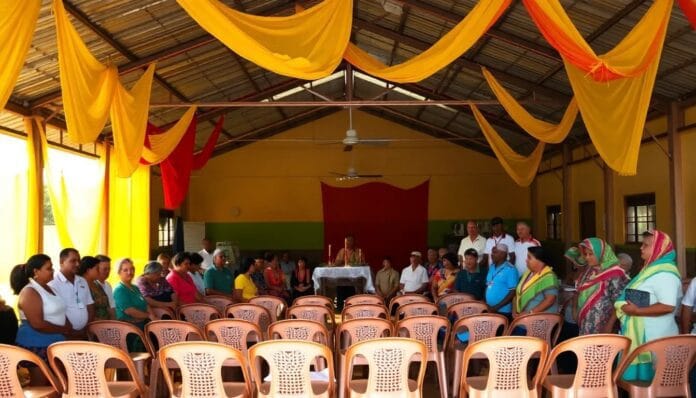
Under the covered playground of a kindergarten in Belém, northern Brazil, yellow, red, and green tarpaulins create a scene that is both simple and symbolic. In front of some forty plastic chairs and an improvised altar, the "Mass for Climate Justice" brings together delegates from Ireland, the Congo, the Philippines, and Brazil. The participants' badges, usually worn in the negotiation rooms of the COP30, here they match the headscarves of local communities.
That evening, faith and science, prayer and advocacy intertwined without conflict. The Church, often perceived as an observer, was fully engaged. For many, this presence fostered a sense of unity. "Being here together gives me hope," confided Maria Conceição, a Brazilian activist from a parish near Belém.
A Church that goes out, listens and connects
From Laudato Si' to the field: the coherence of a commitment
Since the publication of Laudato Si'’ In 2015, the Church's social doctrine was enriched by an explicit ecological dimension. Francis invited believers to an "ecological conversion," a change of perspective and lifestyle. Ten years later, this orientation finds concrete embodiment in Belém.
Catholic representatives from the Global South report that their commitment often precedes public policy. In the Andes, priests support communities affected by melting glaciers. Africa, Women's religious orders are running reforestation programs. And in Southeast Asia, bishops have supported fishermen threatened by rising sea levels.
The plural face of Catholic witness
In Belem, more than a hundred actors linked to the Church took part in the COP30 Official delegations from the Holy See, Catholic NGOs, religious orders, universities and youth movements were present. The pavilion entitled "Common Houses" served as a meeting point.
Every afternoon, one could find debates on agroecology, discussions about divesting from fossil fuels, or even spiritual testimonies. The atmosphere was different from the institutional pavilions: fewer technical speeches, more human stories.
«We are not here just to plead, we are here to listen,» explains Father Joseph Mutombo, head of an African Catholic network for climate justice. Local voices take precedence: the Amazonian populations, often the first victims of climate change, spoke alongside the cardinals.
Between tension and hope: the challenges of Catholic discourse
Controversies surrounding gender and rights
Despite this unprecedented mobilization, some international delegations criticized the Vatican for its positions on gender and the recognition of sexual minorities in climate policies. These tensions serve as a reminder that the Catholic voice, universal yet diverse, does not always garner consensus.
In the corridors of the conference center, Latin American representatives acknowledged the difficulty of reconciling the defense of life in all its forms with the evolving frameworks of the UN. "We are trying to build bridges without betraying our convictions," summarized a Brazilian nun involved in an educational program on biodiversity.
Dialogue as a method
For other participants, these differences do not detract from the value of the dialogue that the Church has long championed. Francis had emphasized this approach in Fratelli Tutti : constructive dialogue as a path to peace and transformation.
In Belém, this approach resulted in interfaith meetings, moments of shared silence, and joint signings of appeals for climate justice. The Archbishop of Manaus, present at the COP, summarized the approach as follows: "We come not to impose, but to propose a vision where every creature counts."«
Hope, the driving force of integral ecology
A spirituality embodied in action
What is striking in Belém is the consistency between the Church's teachings and the actions of the communities. In the Brazilian countryside, parish groups participate in cooperative ecotourism projects managed by local families. In the cities, young Catholics lead workshops on energy conservation.
These concrete actions show that integral ecology is not just a theory, but a way of life that connects the environment, social justice and faith. "What distinguishes our approach is the link between inner conversion and collective transformation," summarizes Sister Angélica, head of a pan-Amazonian network.
Universality Revisited
There COP30 This has revealed a new dimension: the Church in the Global South is proving to be a driving force. While Rome retains a central spiritual role, the dynamism now comes from the peripheries. African and Asian bishops, drawing on their direct experience of the effects of climate change, are forming a prophetic voice that is pushing the institution towards greater coherence.
This reversal of center and periphery breathes new life into the universal mission. «Hope often comes from the margins,» a young Kenyan layman remarks. This statement aptly reflects the sentiment shared by those who, beyond doctrinal divisions, believe in the power of global fraternity.
A shared hope
On the final evening of the COP, after the negotiations had concluded, the small school in Belem fell silent once more. A few song sheets and a banner bearing the words "Everything is connected" remained on the empty chairs.«
The atmosphere is not triumphant, but deeply felt. Whatever the final decisions, those who have prayed, debated and shared here leave with a conviction: faith can still fuel collective action in the face of the ecological crisis.
«Being here together gives me hope,» Maria repeats, calmly putting away the candles. This sentence resonates with a whole spirituality of presence: being there, even modestly, is already a victory against indifference.