












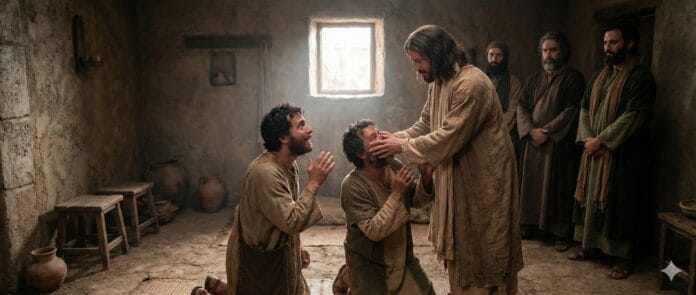
Gospel of Jesus Christ according to Saint Matthew
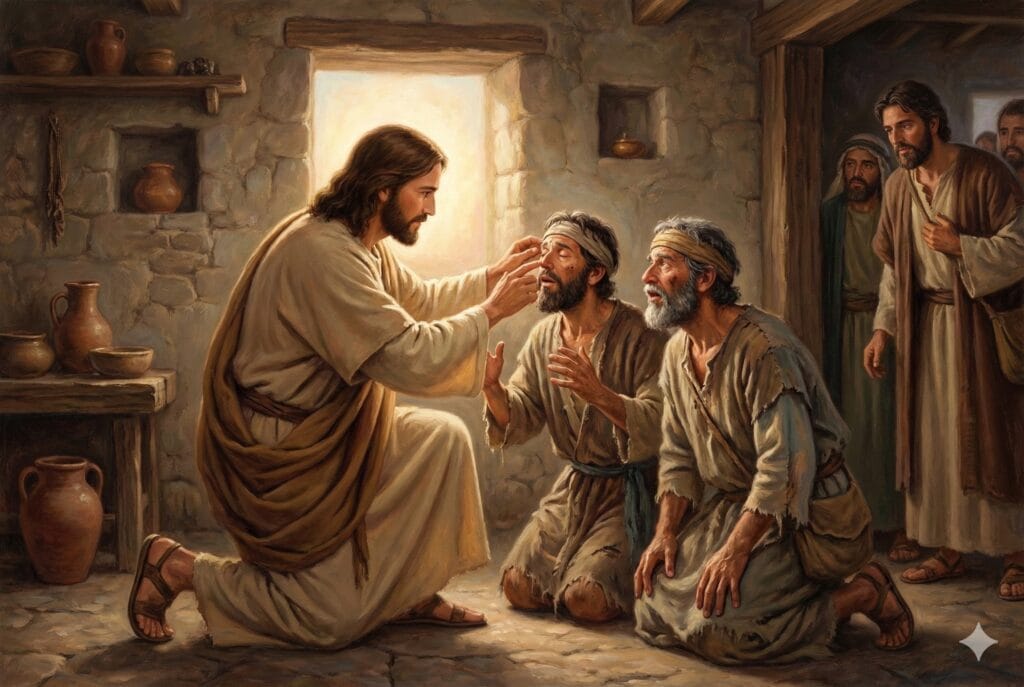
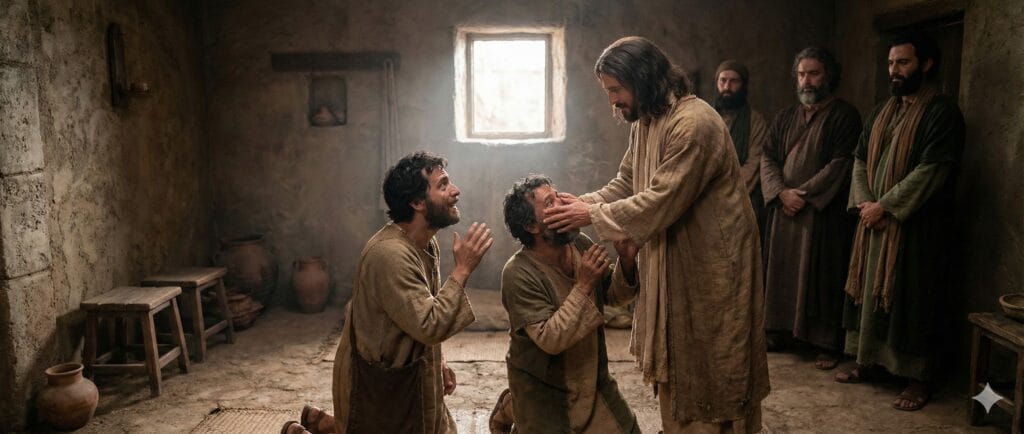
At that time, Jesus was walking along; two blind men followed him, crying out, «Have mercy on us, Son of David!» When he entered the house, the blind men came to him, and Jesus asked them, «Do you believe that I am able to do this?» They answered him, «Yes, Lord.» Then he touched their eyes, saying, «According to your faith let it be done to you.» Their eyes were opened, and Jesus strictly warned them, «See that no one hears about this!» But they went outside and spread the news about him throughout all the surrounding region.
Opening the eyes of faith: when believing precedes healing
How the encounter between two blind men and Jesus reveals the path to a transformed vision of God, of oneself, and of the world.
Two men shout in the streets, chasing an itinerant rabbi they cannot see. Their physical blindness masks an astonishing spiritual clarity: they recognize Jesus as the Messiah even before being healed. This passage from Matthew 9 overturns our certainties about faith, prayer, and transformation. It invites us to examine our own blindness and discover that true vision always begins with an act of trust that precedes the obvious.
This article explores the paradoxical dynamic of faith that sees before it sees. We will discover how these blind men teach us persistence in prayer, the importance of public confession, and the audacity to believe against all appearances. We will also see why Jesus asks for silence and how this tension between proclamation and discretion illuminates our own witness today.
The background to a decisive encounter
This account appears in a sequence of miracles that punctuate Jesus' Galilean ministry according to Matthew. After raising Jairus' daughter from the dead and healing the woman with the hemorrhage, the evangelist presents this double healing of the blind as a progressive demonstration of Christ's messianic authority. The historical and literary context reveals several essential dimensions.
Matthew structures his Gospel around five major discourses and narrative sections that illustrate Jesus' teachings. In chapter 9, we are in a phase where the opposition of the religious authorities begins to solidify, while the crowds marvel at the works of the Nazarene. The healing of the blind occurs just before the calling of the twelve apostles and their sending out on mission, thus creating a bridge between the personal manifestation of the Messiah and the extension of his ministry by his disciples.
The cultural environment of first-century Palestine placed particular significance on blindness. Blind people constituted a marginalized social group, often reduced to begging, and were considered bearers of a divine curse according to some strict interpretations of the Torah. This theological view of blindness as punishment for sin permeated mentalities, even though the Old Testament texts offered a more nuanced perspective.
The use of the title "Son of David" reveals a remarkable messianic awareness among these beggars. In Jewish tradition, this title designated the awaited Messiah, the Davidic king who was to restore Israel. By using it, the blind men demonstrate a theological understanding that even Jesus' disciples would take time to fully grasp. They recognize in this itinerant rabbi the fulfillment of ancestral promises, the one who was to bring liberation and healing.
The geographical setting remains deliberately vague in this passage. Matthew does not specify in which city the scene takes place, focusing our attention on the relational dynamic rather than on topographical details. This vagueness universalizes the narrative: it can occur anywhere suffering people are determinedly seeking Jesus. The "house" mentioned thus becomes a symbolic space, a place of intimacy where a true encounter with Christ can take place, far from the tumult of the crowds.
The narrative structure of faith in action
The narrative unfolds in a dramatic four-part progression that reveals divine pedagogy. This narrative structure is not accidental but inherently conveys a teaching on the nature of faith and spiritual healing.
First, the persistent pursuit. Two blind men follow Jesus, shouting. The Greek verb used for "to follow" is the same one that elsewhere designates discipleship. Matthew thus suggests that these men, in their disability, are already performing a radical act of faith by following someone they cannot see. Their repeated cry, "Have mercy on us, Son of David," structures their supplication according to a liturgical formula reminiscent of the psalms of lamentation. They do not explicitly ask for healing but invoke mercy divine, implicitly acknowledging their total dependence.
The second part: entering the house and Jesus' question. Christ does not immediately respond to the cries of the blind men in the street. This apparent delay is not indifference but a pedagogical approach. It allows the two men to demonstrate their perseverance and their deep desire. Once inside the privacy of the house, Jesus asks a disconcerting question: "Do you believe that I can do this?" This question is not intended to obtain information that Jesus might not know, but to elicit an explicit confession of faith. The Lord always expects a personal response, a commitment of the heart that goes beyond the mere hope of material benefit.
Third stage: confession and the healing gesture. The blind men's response is brief but decisive: "Yes, Lord." This double title, "Lord," adds a dimension of divine authority to the messianic recognition ("Son of David"). Jesus then touches their eyes, accompanying this gesture with a creative word: "Let it be done to you according to your faith." This formulation reveals the central theological principle of the passage. Faith is not a magical force that compels God, but the space of trust that allows divine power to operate. The miracle actualizes a possibility that faith has already made real in the spiritual realm.
Fourth moment: the instruction to remain silent and its transgression. Jesus firmly orders the healed men not to speak to anyone. This instruction, typical of Matthean's "messianic secret," creates dramatic tension. The two men immediately disobey and speak of Jesus throughout the region. This paradoxical disobedience raises the question of authentic witness: how can one remain silent when one has been transformed by an encounter with Christ? Yet, the text does not present their proclamation as a model to be followed, suggesting an ambiguity regarding the proper forms of witness.
The paradox of faith that sees before seeing
The first major theological dimension of this passage lies in the reversal it effects between physical and spiritual vision. The blind see spiritually before they see physically, while so many figures in the Gospels see Jesus with their eyes without truly recognizing him.
This reversal reveals that physical blindness is never, from the Gospel perspective, an absolute obstacle to knowing God. On the contrary, it can become the source of a particular lucidity. Deprived of ordinary sight, these men develop an inner perception that allows them to discern the profound identity of Jesus. They call "Son of David" the one whom the scribes and Pharisees, despite their scriptural erudition, do not yet recognize. Their disability thus paradoxically becomes a privileged opening to revelation.
This dynamic runs throughout Scripture. The prophet Isaiah already foretold: «In that day the deaf will hear the words of the scroll, and out of gloom and darkness the eyes of the blind will see» (Is 29,18). Prophetic tradition associated the restoration of sight with messianic times, a sign that God himself was coming to visit his people. By healing the blind, Jesus fulfilled these prophecies, but he did so in a way that revealed that the most fundamental healing concerns the eyes of the heart.
Paul develops this theology of inner vision in his letters. He prays that the Ephesians may receive «a spirit of wisdom and revelation, so that you may know him better. May the eyes of your heart be enlightened to see the hope to which he has called you» (Ephesians 1:17-18). True blindness, in this perspective, is not the absence of visual perception but the inability to recognize God's action and the identity of Christ.
The passage from Matthew thus confronts us with our own blindness. How often do we see without seeing, look without perceiving? We can possess an impressive theoretical knowledge of Christian doctrine while remaining blind to the living presence of Christ in our daily lives. We can multiply religious experiences without ever truly recognizing who the One we claim to follow is. The blind men of Capernaum teach us that there is a vision deeper than sight, a knowledge that precedes sensory perception.
The confession of faith as a creative act
The second theological dimension explores the role of confession of faith in the work of healing. Jesus does not heal the blind before receiving their answer to his question: «Do you believe that I can do this?» This question makes healing not a unilateral act of divine power, but a cooperation between the grace offered and the faith that receives it.
Faith, in biblical theology, is never a mere intellectual adherence to doctrinal truths. It is first and foremost a relationship of trust, a surrender of oneself into the hands of an Other recognized as worthy of complete trust. The blind men manifest this relational faith by following Jesus without seeing him, by attributing to him titles that reveal their recognition of his unique authority, and by agreeing to follow him to the house where the decisive encounter will take place.
But Jesus asks for more than implicit trust. He elicits an explicit confession, a word that commits. «Do you believe I can do this?» This question demands a personal response, a clear stance. There is no room for ambiguity or half-measures. One must say yes or no, publicly affirm one's conviction that Jesus has the power to transform the situation. This word of faith itself becomes creative, opening the space where the miracle can occur.
Jesus' final statement confirms this dynamic: "According to your faith let it be done to you." This statement does not mean that human faith mechanically produces results, as if we could manipulate God through spiritual techniques. Rather, it reveals that faith is the locus of covenant, the relational space where divine power can be freely exercised because it encounters a receptive trust. Faith is not the efficient cause of the miracle, but its enabling cause, making it possible by creating the conditions for a genuine encounter.
This theology of confession of faith runs throughout the New Testament. Jesus declares elsewhere, «If you can believe, all things are possible to him who believes» (Mark 9:23). Paul affirms that «with the heart one believes and is justified, and with the mouth one professes faith and is saved» (Romans 10:10). James emphasizes that «the prayer offered in faith will make the sick person well» (James 5:15). Confession of faith is therefore not an optional accessory but a constitutive element of the process of healing and salvation.
Persistence in prayer as a path to maturation
The third theological dimension examines the theme of perseverance. The blind men do not simply make a quiet appeal. They cry out, they follow Jesus despite the obstacles, they persist even when the Lord does not respond immediately. This obstinacy reveals an essential quality of authentic faith: it does not give in to discouragement in the face of an apparent lack of response.
Christ teaches elsewhere this necessity of persevering prayer through several parables. The unwelcome friend who knocks on the door in the middle of the night until he gets what he wants (Luke 11,5-8), the widow who harasses the unjust judge until he grants her justice (Luke 18,(verses 1-8) illustrate the same principle. God does not always answer our prayers immediately, not out of indifference but for the sake of teaching. The delay allows us to clarify our desire, to purify our request, to move from a simple self-serving request to a true search for God himself.
The blind cry out in the street, but their prayers are not answered immediately. Jesus enters a house and does not prevent them from following him. This spatial movement symbolizes a spiritual progression: from a public outcry to an intimate encounter, from a collective appeal to a personal response. Persistent prayer leads us from the external to the internal, from the surface to the depths, from request to relationship.
This perseverance is not stubbornness or blind obstinacy. Rather, it demonstrates a profound conviction that Jesus can and wants to answer. The blind men do not change their minds, do not seek another healer, and do not resign themselves to their fate. They believe that the Son of David has the power to save them, and they cling to this certainty despite the initial silence. Their faith is not shaken by the lack of an immediate response because it is based on the identity of Jesus rather than on obtaining a specific result.
Applications for our spiritual life today
These theological teachings are concretely applied in several areas of our Christian life. They do not remain pious abstractions but become practical paths to deepen our relationship with Christ.
In our prayer life, the example of the blind men calls us to abandon lukewarm and distant prayers. How often do we murmur distracted requests without truly believing that God will intervene? How often do we pray out of habit, out of obligation, without any real commitment of our desire? The blind men cry out, persist, and insist. Their prayer is urgent, personal, and confident. They do not recite a learned formula but express a vital need. Our prayer should rediscover this intensity, this conviction that Jesus can transform our situation.
In our relationship to faith, this passage frees us from the illusion that we must first understand in order to then believe. The blind believe before they see, confess before they are healed. This counterintuitive sequence reveals that authentic faith always precedes proof. We live in a culture that demands demonstrations before commitment, guarantees before trust. The Gospel reverses this logic: it invites us to say yes in the darkness, to confess our conviction before the evidence becomes apparent. This faith precedes and prepares the experience of transformation.
In our testimony, the tension between the silence demanded and the proclamation of the healed challenges us. Jesus commands discretion, but the blind cannot remain silent. This dialectic reveals that true witness springs from an irrepressible inner transformation. We do not bear witness strategically or out of moral obligation, but because we have been touched by Christ and this encounter naturally overflows from our lips. At the same time, Jesus reminds us that the most authentic witness is not always the loudest. There is a silent proclamation, a discreet radiance that can be more powerful than any speech.
In our community relationships, the collective dynamic deserves attention. Matthew mentions two blind men, while Mark presents only one. This plurality suggests that faith is often lived in communion, that we need one another to maintain our confidence when times are difficult. The two men support each other in their pursuit of Jesus, strengthen each other in their convictions, and profess their faith together. Our Christian life is not a solitary adventure but a communal journey where we encourage one another to continue believing despite obstacles.
The Patristic Tradition and the Theology of Illumination
The Church Fathers meditated on this passage with a depth that greatly enriches our understanding. Origen of Alexandria, in the third century, developed an allegorical interpretation in which physical blindness symbolizes the spiritual blindness of fallen humanity. For him, all humans are born blind to divine truth and need Christ, the light of the world, to receive spiritual vision. Jesus' touch of the eyes prefigures baptism, the sacrament of illumination that opens the eyes of the heart to the reality of the Kingdom.
Augustine of Hippo, in the fifth century, meditates at length on the theme of desire in this passage. The blind men manifest an intense longing, a burning thirst for healing that compels them to overcome all obstacles. For Augustine, this very desire is already the work of grace. God cultivates desire within us before fulfilling it, preparing our hearts to receive what He wants to give us. The persistent prayer of the blind men reveals that God is already at work within them even before the visible miracle. The holy bishop writes in his Confessions that our hearts are restless until they rest in God, illustrating this same dynamic of desire created and fulfilled by grace.
John Chrysostom, Patriarch of Constantinople in the fourth century, emphasized Jesus' gradual teaching method. The Lord did not immediately respond to the cries of the blind for several reasons: to test their faith, to teach them patience, to lead them toward a more intimate encounter. Chrysostom also emphasizes the wisdom of the question, "Do you believe I can do this?" Not that Jesus is unaware of their thoughts, but he wants to make their faith explicit, to move them from a vague hope to a clear confession. This divine pedagogy respects human freedom while guiding it toward a personal decision.
Eastern theology particularly develops the theme of illumination. The healing of the blind becomes a type, a figure of baptism understood as "photismos," illumination. Saint Gregory of Nazianzus speaks of baptism as a luminous seal, a mark of light that radically transforms the baptized. The neophyte passes from darkness to the wondrous light of God, receiving a new vision that allows him to perceive the spiritual reality invisible to the eyes of the flesh. This theology of baptismal illumination resonates deeply with the Matthew narrative.
Medieval Latin tradition also exploits symbolism digital. Saint Bernard of Clairvaux meditates on the fact that there are two blind men, seeing in this a reference to the two commandments of love: to love God and to love one's neighbor. Spiritual blindness consists precisely in the inability to see God and to recognize the face of Christ in our brothers and sisters. Healing restores this twofold vision, allowing us to contemplate divine glory and to discern the presence of the Lord in every human person.
A six-step meditation path
To personally integrate this gospel, following a structured meditative path helps to move from intellectual understanding to inner experience.
Step 1: Identify my blind spots. Take a moment of silence to honestly acknowledge the blind spots in my life. Where am I not seeing clearly? What aspects of my life are I groping in the dark? These might be blocked relationships, uncertain career choices, unresolved questions of faith, or unhealed wounds. Name these blind spots precisely, without minimizing or dramatizing them.
Step 2: Setting out on the journey to Jesus. Imagine concretely what it means to follow Christ in my current situation. The blind men pursued Jesus without seeing him, guided by his voice and his reputation. I too must accept walking towards him with the means at my disposal, even when everything is not clear. This journey can take the form of regular prayer, diligent reading of Scripture, community involvement, or a process of reconciliation.
Step 3: Cry out my supplication. Dare to express my request with intensity, without false modesty or excessive restraint. «Have mercy on me, Son of David.» Repeat this invocation several times, let it descend from my head to my heart, charge it with all my desire for transformation. Accept being a beggar before God, acknowledge my radical dependence, my poverty essential.
Step 4: Entering into intimacy. Moving from public outcry to personal encounter. The blind men followed Jesus into the house. I too must accept stepping out of the hustle and bustle, leaving behind distractions, to enter into a space of intimacy with the Lord. This could be a spiritual retreat, a silent chapel, a corner of my room transformed into a place of prayer. The essential thing is to create the conditions for a one-on-one encounter with Christ.
Step 5: Answering His Question. Let Jesus ask me his question: «Do you believe I can do this?» Don’t answer too quickly out of habit or politeness. Delve into my doubts, my fears, my hesitations. Then, beyond these resistances, find within myself that core of trust that can say: «Yes, Lord, I believe you can.» Speak this confession aloud, even write it down, to anchor it in reality.
Step 6: Receiving the touch and accepting the transformation. Opening myself to the action of Jesus, accepting that he touches the blind spots in my life. This healing may not be instantaneous or spectacular. It may unfold gradually, in successive touches. But I can already anticipate the new vision that is promised to me, prepare myself to see differently, to recognize God's presence where I did not perceive it before.
Contemporary challenges of faith without seeing
Our postmodern era poses specific challenges to the faith of the blind. Several cultural and spiritual obstacles complicate our ability to believe before seeing, to confess before receiving.
The first challenge is the demand for tangible proof. We live in a scientific civilization that values empirical verification, reproducibility, and objective measurement. This epistemology has produced remarkable advances in the natural sciences but becomes problematic when it claims to be the only way to access reality. Biblical faith does not oppose reason but recognizes modes of knowledge that go beyond pure logical demonstration. Believing that Jesus can heal us before seeing the result clashes with our contemporary mindset. Yet, every authentic relationship, every deep commitment, requires this kind of anticipatory trust. We cannot love, marry, or have children by first demanding absolute proof that everything will be alright.
The second challenge is the proliferation of spiritual offerings. The blind recognize Jesus as the Son of David and look no further. Our era offers a burgeoning spiritual marketplace where everyone can pick and choose according to their preferences. This diversity can be enriching but also risks diluting commitment. Authentic Christian faith demands a form of exclusivity, not out of narrow-mindedness, but because recognizing Jesus as Lord implies ultimate allegiance. Choosing Christ means renouncing making him just another option, a provider of spiritual services competing with others.
The third challenge is individualism, which weakens communal faith. The two blind men journey together, supporting each other in their quest for healing. Our culture values autonomy to such an extent that it makes each individual an isolated atom, constructing their own truth. This atomization makes perseverance in faith difficult. Without a community to carry our prayers when we falter, without brothers and sisters to rekindle our conviction when we doubt, our faith risks withering away. The Church is not an optional club for sociable Christians, but the body of Christ, the space where each person's faith is supported by that of all.
Fourth challenge: spiritual consumerism, which seeks immediate results. The blind persevered despite Jesus' initial silence. Our culture of instant gratification ill tolerates waiting, delays, and slow maturation. We want quick fixes, spectacular transformations, and effortless healings. This impatience hinders true conversion, which requires time. The Kingdom of God grows like a seed, slowly and invisibly at first, before yielding an abundant harvest. Accepting this rhythm of organic growth clashes with our desire for control and immediate results.
These challenges are not insurmountable. They simply require particular vigilance and a spiritual discernment renewed. Faced with scientism, we can affirm the legitimacy of other modes of knowledge without abandoning rationality. Faced with pluralism, we can maintain our Christological conviction while respecting sincere seekers of other traditions. Faced with individualism, we can reinvest in community life, rediscovering the Church as a spiritual family. Faced with consumerism, we can cultivate patience, learning to inhabit the time of waiting as a fertile time of inner maturation.
Prayer for opening the eyes of the heart
Lord Jesus, Son of David and Son of God, Light come into the world to dispel our darkness, we cry out to you from the depths of our blindness. Like the blind men of Capernaum, we pursue you without always seeing you, we call to you without always discerning your presence. Have mercy on us.
You know the dark corners of our existence, the places where we grope without finding our way, the questions that torment us without finding answers, the wounds that still bleed in secret. You see our confusion, our doubts, our fears. You know how difficult it is for us to believe when everything remains obscure, to trust you when you seem silent.
Grant us the faith of the blind who dared to cry out your name in the street, who persisted despite the initial silence, who crossed the threshold of the house to enter into intimacy with you. Increase within us this ardent desire to truly encounter you, this thirst for transformation that accepts risking everything to receive everything.
We confess before you our fragile faith: yes, Lord, we believe that you can heal what is broken within us, open what is closed, illuminate what remains in darkness. We believe that you possess the authority and the power to transform our most entrenched situations, to free what was chained, to resurrect what seemed dead.
Touch the eyes of our hearts, Lord. Grant us that inner vision which recognizes your presence beneath the veil of appearances. Teach us to see you in the events of our daily lives, to discern your providence in the twists and turns of our history, to recognize your face in the faces of our brothers and sisters in humanity.
Grant us also the courage to bear witness. Like the healed blind who could not remain silent, may our whole lives proclaim the wonders you have worked for us. May our words and deeds radiate your light, may our existence become a transparency of your presence, may our joy be contagious to all those who still walk in darkness.
Help us to endure the waiting period when you do not immediately answer our prayers. Help us understand that your apparent silence is often a lesson, that you guide us towards a deeper encounter, that you cultivate desire within us so that we may better fulfill it.
We pray for all those who seek the light without knowing where to find it, for those who cry out in the night without receiving an answer, for those paralyzed by despair who no longer dare even to beg you. May they hear your voice calling them, may they feel your tender gaze upon them, may they discover that you always go before them on their path.
We entrust to you especially those who suffer from physical blindness, that their disability may paradoxically become a source of heightened spiritual vision. We also present to you all those who suffer from collective blindness: societies trapped in deadly ideologies, religious communities imprisoned by legalism or fanaticism, and families incapable of truly seeing and loving one another.
Come, Lord Jesus, with your healing power. Accomplish in us today what you accomplished for the blind of old. May everything happen for us according to our faith, and may that faith itself be your gift, your grace, your work in us.
Through your Holy Spirit, enlighten us, transform us, and mold us in your image. Make us shining witnesses of your resurrection, bearers of hope for this world that stumbles in darkness. May we... Married, your mother and our mother, may we sing of the wonders you accomplish for the humble who trust in you.
We give you thanks for the healings already received, for the enlightenment already given, for the conversions already accomplished. We adore you, O Christ, light of the world, way, truth, and life. To you be glory, honor, and praise, now and forever. Amen.
From blindness to sight, a path that is always open
The Gospel of the two healed blind men speaks to us in our own blindness with a liberating promise: Jesus can open our eyes, he wants us to see, he awaits our trust to accomplish his work of transformation within us. This passage is not merely the account of a single miracle that occurred two millennia ago in Palestine, but the revelation of a permanent spiritual dynamic, ever-present and relevant.
We discovered that true blindness is not primarily physical but spiritual, that the eyes of the heart matter more than the eyes of the flesh. We understood that authentic faith always precedes proof, that it consists of saying yes in the darkness before receiving the light. We grasped the importance of perseverance in prayer, this trusting obstinacy that pursues Christ despite apparent silence and the obstacles encountered.
The question Jesus asked the blind men resonates with each of us today: «Do you believe I can do this?» This question awaits our personal response, our heartfelt commitment, our explicit profession of faith. We cannot remain in indecision or ambiguity. We must choose, take a stand, dare to affirm our conviction that Christ has the power to radically transform our lives.
The healing of the blind also reminds us that God respects our freedom. He never forces his way into our hearts, nor does he impose his light by force. He awaits our consent, our desire, our supplication. This is why prayer remains essential, not to inform God of our needs, which he already knows, but to express our availability, our openness to his action, our active collaboration in the work of grace.
The path offered by this Gospel remains open before us today. We can, right now, identify our blind spots, set out on the journey toward Jesus, cry out our supplication, enter into intimacy with him, confess our faith, and receive his healing touch. This spiritual journey does not guarantee magical or instant results, but it places us within a dynamic of gradual transformation where Christ patiently works to open our eyes.
The final invitation is clear: to become witnesses ourselves of the light received. Like the healed blind men who could not remain silent despite the instruction to be discreet, we are called to share joy of the transformative encounter with Christ. Not through aggressive proselytism or a desire to convince at all costs, but through the natural radiance of a life illuminated from within, through the consistency between our words and our actions, through the authentic love that we show to all.
Practices for living this gospel
- To institute a daily time of silent prayer, even a brief one, to create this space of intimacy with Jesus comparable to the entry of the blind into the house, away from the tumult and distractions.
- Identify an area of spiritual blindness in my life and explicitly entrust it to Christ each day for a week, repeating the prayer of the blind: "Have mercy on me, Son of David."«
- Practicing lectio divina with this passage from Matthew, letting it resonate within me, questioning my resistances, awakening my desire for transformation, until it becomes a personal word addressed to my situation.
- To join or strengthen my participation in a faith community to live this spiritual journey collectively, supporting myself with other believers in perseverance and trust.
- Write my own confession of faith in response to Jesus' question, clearly explaining the areas where I believe he can intervene, the transformations I expect from him, and the commitment I am making.
- Exercising discernment over my testimony, finding the right balance between the required discretion and the necessary proclamation, learning to share my faith respectfully and authentically without imposing it.
- Cultivate the spiritual patience by accepting that some healings take time, by relinquishing the demand for immediate results, by serenely inhabiting the time of inner maturation.
References
Benedict XVI, Jesus of Nazareth, Flammarion, 2007, particularly the chapter on miracles as signs of the Kingdom.
Brown Raymond E., What do we know about the New Testament?, Bayard, 2000, for the historical and literary context of the Gospel of Matthew.
Origen, Commentary on the Gospel according to Matthew, Christian Sources, for the allegorical and spiritual patristic interpretation of the passage.
Penna Romano, The Gospels: Texts and Contexts, Cerf, 2017, for the contemporary exegetical analysis of healing narratives in the Synoptic Gospels.
Augustine of Hippo, Homilies on the Gospel of John, Augustinian Library, especially the passages on light and spiritual blindness.
Chouraqui André, The Universe of the Bible, Lidis-Brepols, for understanding the Palestinian Jewish context of the first century and the meaning of the title "Son of David".
Wright NT, Jesus, Part One, 2010, for a historical and theological reading of miracles of Jesus as signs of the Kingdom inaugurated.
Guardini Romano, The Lord, Alsatia, 1945, for a profound meditation on the person of Christ and his transformative action in the gospels.