












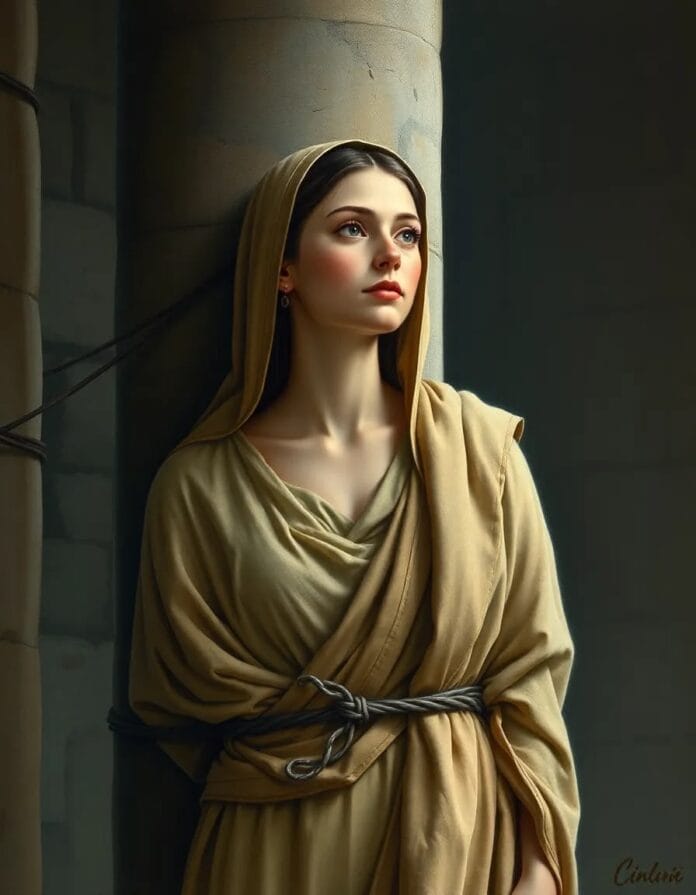
Bibiana, a Roman martyr of the 4th century, embodies the inner resistance against the persecutions of Julian the Apostate. The daughter of a disgraced prefect and a Christian mother, she endured humiliation, poverty and the threat of forced prostitution without renouncing her faith. Her testimony transcends mere hagiography: it challenges our capacity to preserve our convictions in spaces of violence and degradation. Even today, her story illuminates the struggle of those who refuse to be broken by oppressive systems. Rome dedicated a basilica to her as early as the 5th century, a sign of the lasting impact of her martyrdom on the Christian conscience.
Rome, 363. Julian the Apostate restores paganism. Christians High-ranking officials become prime targets. Bibiane, daughter of a disgraced prefect, loses everything: her father is branded and exiled, her mother and sister die of deprivation. Alone against the praetor who imprisons her in a brothel to break her faith, she resists. Her final martyrdom—beaten to death against a column—becomes the symbol of radical fidelity. Fifteen centuries later, her memory still challenges us: how can one remain standing when the world around us is collapsing?
From Roman nobility to martyrdom
Origin and family background
Bibiana was born into a senatorial family in Rome at the beginning of the 4th century. Her father, Flavian, held the prestigious position of Prefect of the City. Her mother, Dafrosa, was a devout Christian who raised her two daughters—Bibiana and Demetria—in the Christian faith. This period was marked by relative peace for Christians after the edicts of tolerance. But the arrival of Julian to power in 361 abruptly reversed the situation. The emperor, nicknamed "the Apostate" by Christians, He attempts to restore the worship of the Roman gods. He does not persecute directly but employs more insidious methods: dismissals, confiscations, public humiliations.
Flavien refuses to sacrifice to the idols. The Christian prefect then becomes a prime target for the authorities. Julian orders his immediate dismissal.
Flavien's downfall
The emperor had Flavian arrested. He ordered that Flavian be branded on the forehead with a red-hot iron—a shameful punishment reserved for runaway slaves. This brand publicly identified him as a traitor and renegade. Then came exile to Tuscany, far from Rome, without resources or protection. The conditions of his banishment were calculated to bring about a slow death. Flavian succumbed quickly, broken both physically and morally.
This administrative execution stripped the family of all social standing. Dafrose and her daughters lost their property, their protection, their rank. They remained in Rome in their former home, now under house arrest. Julian employed his preferred strategy: letting Christian families die of exhaustion and hunger rather than creating spectacular public martyrs.
Death of Dafrose and Demetry
Dafrose, the mother, dies first. Ancient sources suggest a combination of grief, deprivation, and perhaps psychological torture. Her body cannot withstand the collapse of her entire world. Demetria, Bibiana's sister, soon follows. Some accounts suggest she dies of terror at the praetor's threats. Others mention death by starvation in their prison domestic.
Bibiane finds herself the sole survivor of a wiped-out family. She is about twenty years old. The magistrate in charge of the case — whose name is not preserved by the sources — decides to use a particularly cruel method against her.
The brothel
The praetor orders Bibiana's confinement in a Roman brothel. The objective is threefold: to publicly humiliate a former patrician, to break her virginity consecrated to Christ, and to force her to renounce her faith to escape this degradation. This condemnation represents a social death even before physical death. For a woman of her rank, being exposed in a brothel is tantamount to the total annihilation of her identity.
Hagiographic sources insist: Bibiana remained steadfast. She prayed continuously. Her inner strength transformed the space of violence into a sanctuary. The men who entered her cell were struck by a presence that prevented them from touching her. Some accounts speak of a supernatural light, others of an invisible force that protected the young woman. The miracle did not eliminate the ordeal but preserved Bibiana's integrity in the midst of abjection.
This resistance lasts for several days or weeks. The lender realizes that his strategy has failed.
The final martyrdom
Furious at the failure of his tactics, the praetor ordered an exemplary public execution. Bibiana was dragged from the brothel and tied to a column in the public square. The executioners used lead-weighted ropes—whips tipped with lead balls that tore through the flesh with every blow. The torture was long and agonizing. Bibiana died slowly under the blows, offering her suffering to Christ, whom she had refused to deny.
His body remained exposed for two whole days, without burial, to deter other Christians. But some faithful eventually recovered his remains secretly and buried him with honor. The traditional date of his martyrdom is December 2, 363, shortly before the death of Julian himself in June 363 (some sources correct the chronology).
Immediate descendants
Bibiana's memory quickly became prominent in the Roman Church. From the 5th century onwards, the pope Simplicius (468-483) dedicated a basilica to her on the Esquiline Hill, on the presumed site of her family home. This papal act officially recognized her cult and inscribed Bibiana in the Roman liturgical calendar. Her name has endured through the centuries, carried by the symbolic power of her testimony: a young woman alone who refused to yield to the destructive machinery of an empire.
The column symbol
The established fact
Ancient sources agree on Bibiana's method of execution: flogging to death against a column. This detail is not insignificant. The column is a recurring instrument of Christian martyrdom—think of Saint Sebastian riddled with arrows while tied to a tree trunk, or other saints whipped until their last breath. In Bibiana's case, the tethering to the column prolongs the public exposure that began in the brothel. She remains visible, motionless, exposed to stares and blows. Her body becomes a spectacle intended to terrorize the Christian community.
The legendary developments
Medieval hagiography enriches the narrative with several symbolic motifs. Some versions recount that the column to which Bibiana was chained exuded blood for years after her death, reminding the Romans of the crime committed. Other texts describe a miraculous healing obtained by a man who touched this column. These accounts amplify the significance of the place of execution: the column becomes a relic, a point of contact between Heaven and Earth, a living memory of Bibiana's testimony.
Another tradition claims that the Basilica of Saint Bibiana in Rome preserves a fragment of this column, embedded in the main altar. Worshippers come to pray there for strength and courage in their own trials.
Symbolic significance
Beyond historical or legendary details, the column represents Bibiana's spiritual uprightness. Standing tall despite the blows, she refuses to bend. This image permeates Christian art: sculptures, frescoes, and stained-glass windows often depict Bibiana bound, her gaze raised to heaven, while her executioners relentlessly attack her. She embodies inner stability in the face of external chaos.
The column also evokes Christ being flogged before the crucifixion—Bibiane participates in the Passion of the Lord. Her martyrdom is part of a theological continuity: suffering with Christ in order to rise with him. This identification transforms torture into mystical participation.
Finally, the column echoes the pillar of faith spoken of by Paul in his epistles: «The church of the living God, the pillar and foundation of the truth» (1 Tim 3:15). Bibiana literally becomes this pillar—her body bound, her spirit unwavering, her life given to support the faith of others. The symbol still resonates today in situations where people suffer violence and humiliation while maintaining their dignity and convictions.
Spiritual message
Standing tall in humiliation
Bibiane first teaches us about inner resistance. She endures three consecutive humiliations: her father's disgrace, poverty forced into prostitution, she is imprisoned in a brothel. Each step destroys an aspect of her social identity—patrician, daughter of a prefect, respectable woman. Yet nothing touches her spiritual core. She remains herself, true to her convictions, connected to a source of strength that transcends her circumstances.
This story speaks to anyone facing the collapse of their sense of security. Job loss, family breakdown, illness, public defamation—contemporary forms of humiliation abound. Bibiane shows that one can lose status, security, and reputation without losing one's soul.
Spiritual virginity
Bibiane's virginity transcends the purely physical. It symbolizes integrity—the refusal to be fragmented, divided, possessed by the forces that seek to dominate us. In the brothel, Bibiane maintains her inner unity. She does not allow herself to be mentally colonized by the degrading environment. Her constant prayer creates a sacred space within the profane.
Today, this "virginity" translates into the ability to protect our inner life in toxic environments. Violent work environments, abusive relationships, systems that seek to mold us—Bibiane invites us to preserve a sanctuary within ourselves where no one can enter without our consent.
Strength in vulnerability
Bibiane is completely vulnerable physically. She has no protection, no power, no escape strategy. Yet, it is in this accepted vulnerability that she finds her strength. She does not try to negotiate, flee, or compromise herself. She accepts the situation and transforms it from within through her conscious and prayerful presence.
This paradox of the Gospel—strength in weakness—echoes Paul's experience: «When I am weak, then I am strong» (2 Corinthians 12:10). Bibiana does not deny her fragility but entrusts it to God. She discovers that one cannot break someone who fully accepts their own vulnerability while relying on a transcendent strength. The image that comes to mind is that of the reed that bends in the wind but does not break, unlike the rigid oak that snaps.
Prayer
Lord, Bibiana stood firm when everything crumbled around her. She maintained her dignity in humiliation, her integrity in violence, her faith in abandonment. Grant me that same inner strength when circumstances press upon me from all sides.
May I find in you the pillar to which I cling when my own strength falters. May your love be the sacred space that no one can profane, even if my body and possessions are delivered to the brutality of the world.
Teach me to distinguish what can be taken from me—status, comfort, reputation—from what remains indestructible within me: that divine spark you placed in my creation. May I cease to confuse my true identity with social roles and material possessions that can vanish overnight.
Bibiane prayed in the brothel, transforming hell into a sanctuary through her conscious presence. Grant me the grace to carry your presence into the places of degradation where life sends me—toxic offices, abusive relationships, oppressive systems. May I be that light that disturbs and liberates, without arrogance but with the quiet assurance of one who belongs to another order of reality.
Strengthen me in the moments when I must say no—no to compromise, no to injustice, no to the pressure that would make me renounce my convictions. May my refusal never be rigid pride but loving fidelity to your truth.
Finally, when the hour of blows—symbolic or real—comes, bind me to your cross. Let me understand that suffering with you is participating in the redemption of the world. Transform my pain into an offering, my tears into the seed of new life. And may I find, at the end of martyrdom, whatever form it may take, the resurrection that you promise to all those who have held on until the end.
Through Jesus Christ, who was himself chained, beaten, and humiliated, and who transformed this torment into a victory of love. Amen.
To live
- Identify a necessary "no" Identify a situation where you're tempted to give in to pressure that goes against your values. Say a clear no today, even if it creates relational or professional discomfort. Bibiane shows us that integrity comes at a price, but that price is always better than betraying yourself.
- Create an inner sanctuary Take ten minutes to meditate on a verse (suggestion: 2 Corinthians 12:10 on strength in weakness). Visualize a sacred space within yourself that nothing and no one can violate. Return to this space several times throughout the day, especially during moments of stress or verbal aggression.
- Accompanying a humiliated person Think of someone in your life who is going through a humiliating ordeal—a job loss, a breakup, defamation, illness. Send them a simple message that acknowledges their unbreakable dignity despite the circumstances. Sometimes, a look that doesn't judge or pity is enough to remind someone that they are not defined by their hardship.
Memory and places: the geography of testimony
The Roman basilica of the Esquiline
THE pope Around 470, Simplicius dedicated a basilica to Bibiana on the Esquiline Hill in Rome. The building stands on the presumed site of the martyr's family home, where she was placed under house arrest and from where she was taken to the brothel and then to the place of her execution. This basilica has survived the centuries, rebuilt and embellished several times.
In the 17th century, the pope Urban VIII entrusted the complete restoration of the church to the architect Gian Lorenzo Bernini. Bernini sculpted a masterful statue of Saint Bibiana, still visible today above the high altar. The saint is depicted standing, holding the palm of martyrdom and a broken column—an explicit symbol of her suffering. The expression on her face blends serenity and determination. Bernini succeeded in capturing in marble this tension between physical vulnerability and spiritual strength that characterizes Bibiana's testimony.
The basilica also houses relics attributed to the martyr, venerated by the faithful who come to seek her intercession. Every December 2nd, her feast day, a special liturgical celebration attracts pilgrims from all over the world. The building remains a vibrant place of prayer, frequented by Romans who seek strength and solace in their own trials.
The relics in Fougères
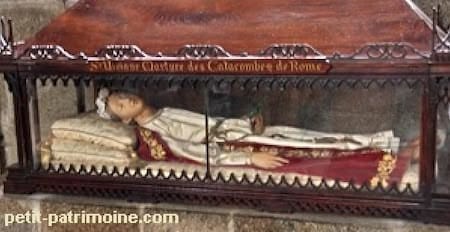
Surprisingly, the small town of Fougères in Brittany also possesses a relic of Saint Bibiana. The reliquary is located in the Tanners' Chapel of the Church of Saint-Sulpice. How did these relics arrive in Brittany? Records suggest a papal gift during the Middle Ages, perhaps linked to relations between the papacy and the Dukes of Brittany. The tanners, a powerful guild in Fougères, adopted Bibiana as their patron saint.
This choice was not insignificant. The tanner's trade involved working with animal hides using foul-smelling and often toxic substances. Tanners were socially marginalized, their workshops relegated to the outskirts of cities because of the stench. Bibiane, who had experienced confinement in a place of abjection, naturally became the protector of those who practiced a trade deemed "impure" by society. The saint who had sanctified the brothel through her prayerful presence could also sanctify the malodorous vats of the tanneries.
Even today, the reliquary of Fougères attracts pilgrims and curious onlookers. It testifies to the geographical spread of the cult of Bibiana far beyond Rome, and to its ability to reach diverse social circles.
Iconography and representations
Christian art frequently depicts Bibiana, usually tied to a column, sometimes holding the palm of martyrdom or a crown. Some works show her praying in the midst of the brothel, surrounded by a supernatural light that repels her attackers. Others focus on the final scene of her torture, emphasizing the violence of the blows and the serenity of the martyr's face.
In the Church of Saint-Sulpice in Fougères, stained-glass windows illustrate various episodes from his life: the arrest of his father Flavien, the death of his mother and sister, and his own martyrdom. These depictions were used for the catechetical instruction of illiterate parishioners in the Middle Ages. They still serve today as aids to meditation.
Regional roots and popular devotion
Beyond Rome and Fougères, other minor shrines honor Bibiana in Europe. In Italy, several rural churches bear her name, often in regions marked by persecution or barbarian invasions. Bibiana's memory seems particularly enduring in places where Christian communities have had to resist violent external pressures.
The ancient liturgy fixed her feast day on December 2nd, a date maintained in the traditional Roman calendar. On that day, some regions organized solemn processions, carrying the saint's relics through the streets. These rituals allowed the community to rekindle the memory of her martyrdom and draw strength from this ancient testimony to face contemporary challenges.
Today, the veneration of Bibiana is experiencing a quiet but real revival, driven by Christians facing persecution or radical marginalization. Her story resonates particularly with women victims of sexual violence or human trafficking. Several associations that help prostitutes have placed their work under her patronage, seeing in her a companion who experienced the horror of the brothel without losing her dignity.
Liturgy
- Suggested reading Wisdom 3:1-9 (The souls of the righteous are in the hand of God); Psalm 30 (Into your hands I commit my spirit); 2 Corinthians 12:7-10 (When I am weak, then I am strong); Matthew 10:28-33 (Do not be afraid of those who kill the body)
- Opening Song : «Arise, shine forth» or any hymn evoking steadfastness in faith and the victory of martyrdom
- Gospel Matthew 10:28-33, where Jesus calls us not to fear those who kill the body but cannot kill the soul—a text that directly illuminates Bibiana's courage in the face of her executioners.
- Universal Prayer For those trapped in situations of violence and abjection; for victims of human trafficking; for those who resist pressure to renounce their beliefs; for persecuted Christian communities
- Communion Hymn "You are present here" or any meditative song about the presence of God in the midst of hardship
- Final blessing May God give you Bibiana's strength to stand firm in the storms; may He make your vulnerability a place for the manifestation of His power; and may He keep you in the integrity of your heart until the day you see Him face to face