












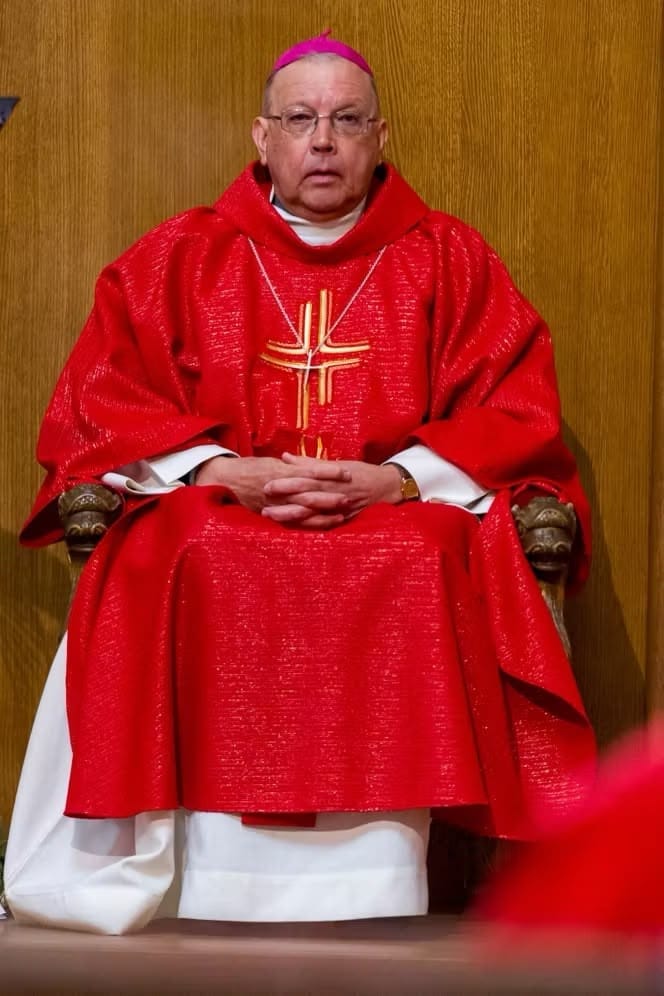
There are times in the life of a religious community when it must weather storms. These storms, often unexpected, test the faith, trust, and credibility of the Church. The case of Bishop Jean-Paul Gusching, the former Bishop of Verdun, is one such example. According to recent revelations, he is the subject of a canonical investigation following accusations concerning his relationships with women. This story, a blend of faith and controversy, raises profound questions about transparency, accountability, and how the Church manages its internal crises.
In this article, we offer a friendly immersion into this complex situation, explaining the context, the facts, the stakes, and what it means for the Catholic Church in France.
Who is Bishop Gusching?
Jean-Paul Gusching was ordained Bishop of Verdun in 2012, assuming leadership of this diocese located in the Meuse region, in the heart of Lorraine. Known for his commitment to social issues, his pastoral approach, and his closeness to his parishioners, he was well-liked by a segment of the community. His simple and approachable style allowed him to forge a special bond with his parishioners.
However, like any public figure, his life was quickly marked by more difficult periods, particularly related to his health, which he mentioned upon his departure. But, above all, he has recently been embroiled in a controversy that extends beyond the local sphere.
The context of the canonical inquiry
Let us first recall what a canonical inquiry is. It is an internal process within the Church, designed to examine serious accusations concerning the morality or conduct of its members. clergy. Unlike a civil legal procedure, a canonical inquiry aims to preserve the reputation of the institution while judging with complete discretion.
It was the Apostolic Nunciature in France, the diplomatic mission of the Holy See, that recently confirmed that Bishop Gusching was the subject of such proceedings. The official reason given by the Nunciature is "relations with women"—an expression which, in the context of the Church, often refers to behavior deemed inappropriate or incompatible with priestly life.
This type of situation is not unprecedented. The dynamics of power And loneliness in religious life can sometimes lead to excesses or problematic behaviors, which the Church tries to denounce and correct.
The controversy: a resignation due to health reasons or something else?
Initially, Bishop Gusching announced his resignation for “health reasons,” an argument often used by episcopal leaders to protect their privacy and avoid media attention. However, shortly afterward, the nunciature indicated that this version was incomplete.
According to several sources within the Church, the resignation was a decision imposed by Rome following reports and the opening of an investigation. The notion of "relationships with women" suggests behaviors that, in most cases, are contrary to vows of chastity and the ideal of priestly life. The decision to resign thus appears to be a necessary step for the Church to avoid a wider scandal and to preserve the institution's credibility.
The case raises a central question: how far does transparency go? The Church, faced with a rise in scandals in several countries, is trying to manage this crisis internally, while being under pressure to play the transparency card.
The Church's role in the face of scandals
In recent years, the Catholic Church has experienced a series of scandals involving abuse, deviant behavior, and abuses of power. The handling of these crises has often been criticized for its lack of transparency or its delayed efforts to address them.
In this context, Bishop Gusching's situation is no exception: it must be understood that the Church is facing a challenge of trust. It must both preserve the reputation of its leaders while seeking to restore trust with his followers, especially in a society where secularization challenges his moral authority.
What's interesting is how the Church hierarchy is handling these matters. Rome's decision to demand Gusching's resignation shows a willingness to act firmly, but discretion remains the rule.
The reaction of the faithful and the press
Once the affair was revealed, reactions were mixed. Some members of the faithful expressed their confusion or disappointment, while hoping that the Church's justice system would shed light on the matter and hold those responsible accountable.
Others, more critical, wonder if all this isn't a way for the Church to conceal its failings or protect its interests. The press, for its part, is closely following every step of this story, fueling the public debate on the morality and governance of the institution.
This type of controversy shows how transparency and trust are now at the heart of the challenge the Church must face in order to continue to play a credible role in modern society.
The implications for the Church in France
The Gusching case is not an isolated incident. It occurs within a context where the Church is seeking to address several challenges: increasing secularization, increased mistrust following to past scandals, and the need to reconnect with an often disillusioned public.
This case will likely serve as a test of the institution's ability to reform, implement more transparent mechanisms, and reassure its members. The way the Church manages this crisis will be crucial for its future in France.
What are the key takeaways?
What emerges from this affair is that, behind the figure of the bishop, lies an institution undergoing profound change. Human reality, with its flaws and complexities, sometimes catches up with the life of a clergyman, just like everyone else.
The canonical investigation against Bishop Gusching reminds us that the Church is not a sphere immune to imperfections, but that it must face its responsibilities with courage and transparency. Faith is not limited to protocols or resignations; it also rests on the capacity to rise again, to learn, and to move forward with humility.
Conclusion
The case of Bishop Jean-Paul Gusching is a poignant episode that sheds light on a lesser-known aspect visible to the Catholic Church. While this crisis raises questions, it can also pave the way for necessary changes for an institution that must continue to embody its values while remaining true to its moral principles.
The road ahead will surely be long, but this kind of process is essential: it not only sheds light on abuses or excesses, but also shows that the Church, like any human community, can evolve and question itself.