












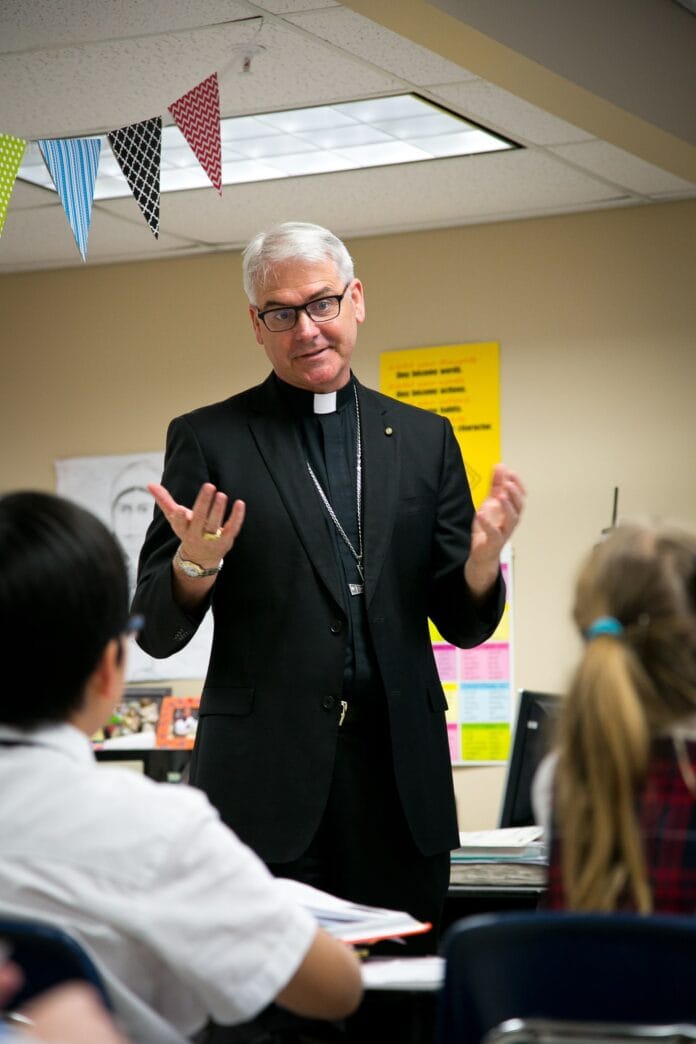
On Tuesday, November 11, 2025, a significant turning point occurred for the Catholic Church in the United States: Archbishop Paul S. Coakley of Oklahoma City was elected president of the United States Conference of Catholic Bishops (USCCB). This election marks the beginning of a three-year term in a highly charged national context, where political issues and social challenges are closely intertwined with the pastoral and moral role of the Church. American bishops.
Who is Bishop Paul Coakley?
Born in 1955 in Norfolk, Virginia, Bishop Coakley grew up in Kansas, where he began his ecclesiastical journey. Ordained a priest in the Diocese of Wichita, he gradually rose through the ranks of theAmerican ChurchIn 2004, he was appointed Bishop of Salina, before being designated Archbishop of Oklahoma City in 2010 by the pope Benedict XVI, officially taking office in 2011. At 70 years old, this experienced archbishop is recognized for his deep pastoral commitment and his expertise in the workings of the USCCB, where he served as secretary before his election to the presidency.
A conservative leader with nuanced convictions
Bishop Coakley is often described as conservative, particularly in his doctrinal positions. In this sense, he represents a traditional anchor in theAmerican ChurchBut it also demonstrates a sensitivity to certain complex social issues that transcend political divides. For example, on the issue of immigration, a burning issue in the United States, he expressed a balanced stance: opposing illegal immigration while denouncing the suffering inflicted by deportation policies. This approach illustrates his effort to combine doctrinal rigor with compassion evangelical.
The major challenges of Bishop Coakley's mandate at the USCCB
Bishop Coakley's election comes at a time climate American politics is marked by strong tensions on several fronts, including immigration, Christian nationalism, and bioethical debates. The new president will have to navigate these challenges skillfully.
Immigration and migrants' rights: a delicate dialogue
One of the priorities announced by Bishop Coakley is the issue of migration, particularly the treatment of migrants and refugees in the United States. While supporting the need for secure borders and the fight against crime related to illegal immigration, he calls for a "humane response" that does not sacrifice human dignity. He denounces the climate of fear created by certain administrative policies, in particular mass deportations, and encourages the Conference and the faithful to work towards a reform that respects fundamental rights.
Defense of life and ethical issues
A firm believer in the protection of human life from conception to natural death, Bishop Coakley is a staunch advocate of pro-life measures. He has supported Oklahoma's restrictive abortion laws while emphasizing that legal change must be accompanied by a "conversion of the heart" to build a true culture of life. Furthermore, he opposes the death penalty, denouncing the exacerbation of social violence it engenders.
A divided episcopate to be brought together
The USCCB is often marked by internal divisions between more progressive and more conservative bishops. The choice of Bishop Coakley, who is familiar with the internal dynamics and enjoys a reputation as an institutionalist, seems to reflect a desire for stability and dialogue in a context where theAmerican Church seeks to reposition itself morally and pastorally in the face of contemporary challenges.
A presidency under the world's gaze
The election of Bishop Coakley is not only of interest to American Catholics, it is also attracting the attention of theUniversal Church and political observers.
A figure under observation
Considered close to the Church's traditional values, Bishop Coakley must also manage a public perception often hardened by the intense political confrontation surrounding religion and American values. His appointment comes shortly after the rise of Christian nationalism, which influences certain conservative groups, potentially fueling both criticism and high expectations for his role.
Towards an engaged but cautious American Church
With this presidency, the United States Conference of Catholic Bishops seems to be choosing a path of active prudence. Bishop Coakley has shown that he is not afraid to address difficult social issues while prioritizing church cohesion and dialogue with government officials. His leadership will be closely watched, not only for the decisions he makes, but also for how he embodies the pastoral mission in a rapidly changing country.
The election of Bishop Paul Coakley as head of the USCCB marks a crucial moment for the Catholic Church in the United States. An experienced leader and nuanced conservative, he is called upon to guide his peers through a context rich in political, ethical, and social challenges. His style, combining doctrinal firmness and pastoral humanity, could well shape the next stage of the Church's development.American Church, between tradition and adaptation to the demands of the contemporary world.