












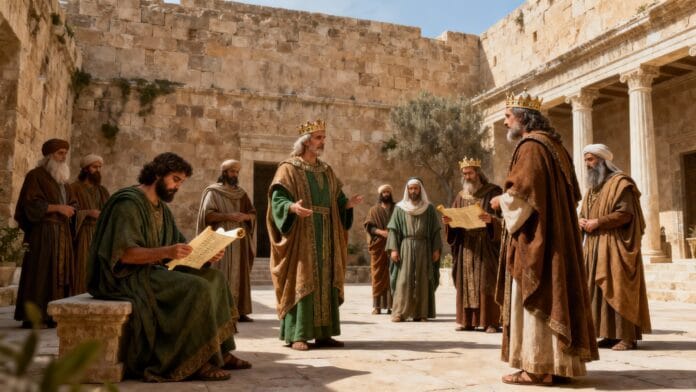
(2d Paralipomena in the Vulgate Bible)
Introduction to both Books of Chronicles
1° Their unity.— Like the books of Samuel (1 and 2) and the books of Kings (1 and 2), the books of Chronicles originally formed a single text: we have the authors of the Talmud as guarantors of this (Baba bathra, ( , f.14), the historian Josephus (C. Apion., 1, 8), Manetho (Ap. Euseb., Hist. Eccles., 4, 26), Origen (Ibid., 6, 25), Saint Jerome (Praef. Ad Domin. Et Rogat. "First, it must be understood that for the Hebrews, the books of Chronicles are one single book, which we have divided because of its length."), all the manuscripts of the Bible written in Hebrew. The division, which is entirely artificial, is in no way required by the subject: it was the Septuagint [Jewish Bible, written in Greek 250-200 BC] that introduced it (Παραλειπομένων πρώτη, δευτέρα). The division was not logically flawed – between the reigns of David and Solomon.
2° Their name. — In the Bible written in Hebrew, our double writing is called Dibré hayyâmim, or "Verba dierum", as Saint Jerome translates it very well (Loc. Cit.), that is, "Acta diurna," a title which generally designates a political journal similar to those regularly kept in certain courts of the East. Cf. Esther 2, 23; 6, 1; 10, 2. However, it must be taken here in a broad sense, because the Chronicles do not contain continuous and complete annals. Saint Jerome had initially adopted this Hebrew name, contenting himself with substituting the equivalent name of "Chronicle" ("Verba dierum, quod significantius Chronicon totius divinae historiae possumus appellare." Prologue. Galeat.): hence the words Liber chronicorum, Chronica, which are found in several early editions of the Vulgate [the Bible written in Latin], and also in most Protestant translations of the Bible. But the title of Παραλειπομένα, or Chronicles, The title, placed at the beginning of the book by the translators who lived in Alexandria (in Egypt), prevailed very early on. However, it is less accurate, for it literally means "the things omitted"; it would therefore tend to make the entire work appear as a mere supplement, intended to fill the gaps in the Books of Kings (this opinion seems to have been quite widespread among the ancient ecclesiastical writers). "Paralipomenon means in Greek what we call omitted or left out." St. Isid. of Seville, Origin., 6, 1. Cf. Theodoret, Praef. In libr. Reg., etc.), and we will soon see that we must look more than that in the Dibré hayyâmim.
3° The subject and the purpose. — The Book of Chronicles opens with a brief outline of the history of God's people from Adam to David, in the form of genealogical tables (1 Chr. 1-9). After recounting the death of Saul as a transition (1 Chr. 10), the author presents at considerable length the events of David's reign (1 Chr. 11-29), then describes, at varying lengths depending on the demands of his plan, the reigns of Solomon, Rehoboam, and all the kings of Judah up to Zedekiah (2 Chr. 1-36, 1-21); he concludes abruptly with an abridged quotation from the edict that ended the Babylonian captivity (2 Chr. 36, 22-23). Nothing is mentioned, at least not directly, of the schismatic kingdom of Israel.
This summary shows that the Chronicles occupy a unique position in the Old Testament, since, on the whole, they do not present a new narrative, but merely reproduce a significant part of Jewish history, as already recounted in the two books of Samuel and the two books of Kings. Often, there is, on both sides, an almost pure and simple repetition of the same events, with only verbal differences: List of passages common to the books of Chronicles and Samuel and Kings: [1 Chr. 10:1-19 = 1 Sam. 31 = 2 Chr. 1-6:11-14 = 1 Kings 15:17-24], [1 Chr. 11:1-9 = 2 Sam. 5:1-3:6-10 = 2 Chr. 18:2-34 = 1 Kings 22:2-35], [1 Chr. 11, 10-47 = 2 Sam. 23, 8-39 = 2 Chr. 20, 31-21, 1 = 1 Kings 22, 41-51 ], [1 Chr. 13, 1-14 = 2 Sam. 6, 1-11 = 2 Chr. 21, 5-10, 20 = 2 Kings 8, 17-24 ], [1 Chr. 14, 1-17 = 2 Sam. 5, 11-25 = 2 Chr. 22, 1-9 = 2 Kings 8, 25-29; 9, 16-28 ], [1 Chr. 15, 16 =2 Sam. 6, 12-23], [1 Chr. 17-18 =2 Sam. 7-8 = 2 Chr. 22, 10-23, 21 = 2 Kings 11], [1 Chr. 19 = 2 Sam. 10 = 2 Chr. 24, 1-14, 23, 27 = 2 Kings 12, 1-22], [1 Chr. 20, 1-3 = 2 Sam. 11, 1; 12, 26-31 = 2 Chr. 25, 1-4, 17-28 = 2 Kings 14, 1-14, 17-20], [1 Chr. 20, 4-8 = 2 Sam. 21, 18-22 = 2 Chr. 26, 1-4, 21-23 = 2 Kings 14, 21-22; 15, 2-7], [2 Chr. 1, 2-13 = 1 Kings 3, 4-15 = 2 Chr. 27, 1-3, 7-9 = 2 Kings 15, 33-38], [2 Chr. 1, 14-17 = 1 Kings 10, 26-29 = 2 Chr. 28, 1-4, 26-27 = 2 Kings 16, 2-4, 19-20], [2 Chr. 2 = 1 Kings 5, 15-32 = 2 Chr. 29, 1-2 = 2 Kings 18, 2-3], [2 Chr. 3, 1-5 = 1 Kings 6, 1-7 = 2 Chr. 32, 1-21 = 2 Kings 18, 13-19, 37], [2 Chr. 5, 2-7, 10 = 1 Kings 8 = 2 Chr. 32, 24-25, 32-33 = 2 Kings 20, 1-2, 20-21 ], [2 Chr. 7, 11-22 = 1 Kings 9, 1-9], [2 Chr. 8 = 1 Kings 9, 10-28 = 2 Chr. 33, 1-10, 2-25 = 2 Kings 21, 1-9, 18-24 ], [2 Chr. 9, 1-28 = 1 Kings 10, 1-29], [2 Chr. 9, 29-31 = 1 Kings 11, 41-43 = 2 Chr. 34:1-2, 8-32 = 2 Kings 22:1-23:3], [2 Chronicles 10:1-11 = 1 Kings 12:1-24 = 2 Chronicles 35:1, 18-24, 26-27; 36:1-4 = 2 Kings 23:21-23, 28-34], [2 Chronicles 12:2-3, 9-16 =
[1 Kings 14:21-31], [2 Chr. 13:1-2, 22-23 = 1 Kings 15:1-2, 6-8 = 2 Chr. 36:5-6, 8-12 = 2 Kings 23:36-37; 24:8-19], [2 Chr. 14:1-2; 15:16-19 = 1 Kings 15:11-16]
However, the differences are no less considerable than the similarities, because often also the Chronicles They omit certain incidents, shorten or add others, thereby proving that they do not merely form an additional writing, intended to complement older narratives, but that they are in reality an entirely personal and independent work, composed for a special purpose, which is easy to discover.
The aim was to group together, in a condensed form, the principal events in the history of the royal house of David, in order to present them to Israel, at the end of the Babylonian exile, as a valuable lesson, as a revealing mirror in which the religious and moral conduct of the theocratic nation, so tested for its past sins, would be indicated in advance. Everything easily comes down to this end, which, as we see, is none other than to paint the ideal portrait of the reborn Israelites, to help them lead, in all its perfection, despite the difficulties of the present time, the holy life that God had prescribed for them and which would draw down upon them His most paternal blessings.
Hence the genealogies at the beginning, to show them their true, glorious place in world history (other genealogical lists are frequent in the course of the narrative. Cf. 1 Chr. 11:26-47; 12:1-14; 14:4-7; 15:5-11, 17-24; 24:7, 18, etc.). Hence the numerous details relating to the construction and ornamentation of the temple, the organization of worship, and the service of the Levites; for religion was the center of Israel's life (it has rightly been said that the narrative is ecclesiastical in the books of Chronicles, political in the books of Samuel and Kings). Hence the history of the schismatic kingdom of the ten tribes, passed over in silence, this kingdom having adopted an anti-theocratic stance from the outset. Hence the lion's share given to the biography of David, the model king, and of several other good kings, such as Jehoshaphat, Hezekiah, and Josiah. Hence, finally, the frequent reflections by which the historian, in a way, underlines the events, in order to draw conclusions from them from a moral point of view and to show the hand of the Lord visible everywhere, either to punish crimes or to reward acts of virtue (see, for example, 1 Chr. 10:13; 11:9; 12:2; 13:18; 14:11-12; 16:7; 17:3, 5; 18:31; 20:30; 21:10; 22:7; 24:18, 24; 25:20; 26:5, 7, 20; 27:6, etc.). This goal establishes very well the unity between the different parts of the work, linking together the genealogies and the narratives.
4° The division. — The two books, considered collectively, are divided into two parts of very unequal length: 1° the genealogical tables, 1 Chr. 1-9; 2° the history of David, Solomon, and the kings of Judah up to the Babylonian captivity, 1 Chr. 10-2 Chr. 36. The second part comprises three sections: the reign of David, 1 Chr. 10-29; the reign of Solomon, 2 Chr. 1-9; the kings of Judah from Rehoboam to Zedekiah, 2 Chr. 10-36.
If we consider each of the two books separately, we can accept the following divisions:
First book of the Chronicles. — Two parts: 1° the genealogical lists, 1, 1-9, 44; 2° the history of King David, 10, 1-29, 30 (two sections: the main events of the reign of David, 10, 1-21, 30; the end of the reign, 22, 1-29, 30).
Second book of Chronicles. — Two parts as well: 1° History of the reign of Solomon, 1, 1-9, 31 (three sections: the Lord blesses the young monarch at the beginning of his reign, 1, 1-17; construction and dedication of the temple, 2, 1-7, 22; main political events of the reign of Solomon, 8, 1;9, 31); 2° History of the kings of Judah from the schism of the ten tribes until the Babylonian captivity, 10, 1-36, 23 (seven sections: reign of Rehoboam, 10, 1-12, 16; reigns of Abijah and Asa, 13, 1-16, 14; reign of Jehoshaphat, 17, 1-20, 37; reigns of Joram, Ahaziah and Joash, 21, 1-24, 27; reigns of Amaziah, Uzziah, Jotham and Ahaz, 25, 1-28, 27; reign of Hezekiah, 29, 1-32, 33; the last kings of Judah, 33, 1-36, 23).
5° The date of composition and the author. — The Chronicles were certainly not composed before the end of the Babylonian exile. Indeed, 1) they end with an abridged quotation from the edict of Cyrus, which ended the captivity of the Jews (2 Chronicles 36:22-23); 2) they give, at least up to the third generation, the genealogy of the descendants of the holy and celebrated Zerubbabel, who brought the first Jewish settlers back to the sacred land as soon as the exile ended (1 Chronicles 3:19-24); 3) the dariques, The coins mentioned in 1 Chronicles 29:7, as common currency, existed only under Persian rule, therefore during the reign of Cyrus; 4) the style is quite similar to that of the books of Ezra, Nehemiah, and Esther, which postdate the exile. The composition therefore cannot be dated before 536 BC, and it probably even took place somewhat later (around the middle of the 5th century BC); however, not at the later dates accepted by the rationalist school (the end of Persian rule, the Seleucid era, the reign of Alexander the Great).
Jewish tradition unanimously identifies Ezra as the author of the Book of Chronicles, and most believing exegetes, both in antiquity and in our time, have adopted this view. A comparison between the book we are studying and the surviving pages of Ezra confirms the traditional testimony, for it demonstrates in both a similar spirit (in particular, the same fondness for genealogies, for everything pertaining to worship and the tribe of Levi), the same method of composition, and an identical wealth of expressions used with a meaning specific to each text. (The most famous of these is...) kammišpât , to mean: "according to the law of Moses").
6° The Sources of the Chronicles. — A distinction must be made. For the genealogies placed before or interspersed with the narrative, the author used as sources: 1° historical books composed before his own; 2° special documents, which had not been used by the sacred writers, because several of his lists are entirely new (cf. 1 Chr. 2, 18-24, 25-41, 42-45; 3, 17-24; 6; 7, 1-3, 6-12, 14-19, 20-29, 30-39; 8, 1-32, 33-39; 9, 35-44).
For the rest of the work, or for the history itself, he is careful to frequently indicate the writings from which he drew most heavily. 1. The "Book of the Kings of Israel and Judah" (cf. 2 Chr. 16:11; 25:26; 27:7; 28:26; 35:27; 36:8), sometimes called the "Book of the Kings of Judah and Israel," or, in short, the "Annals of the Kings of Israel" (2 Chr. 33:18-19), a probable compilation of the two documents so often cited in the first and second books of Kings under the titles: "Book of the Annals of the Kings of Judah, Book of the Annals of the Kings of Israel." 2. Various historical works, almost all composed by prophets and relating the history of one or another distinct reign. These are the accounts of King David (1 Chr. 27:24); the acts of Samuel the Seer, the acts of Nathan the Prophet, the acts of Gad the Seer (1 Chr. 29:29); the book of Ahijah the Shilonite, the vision of Addo the Seer (2 Chr. 9:29); the acts of Shemaiah the Prophet, the book of Addo the Seer on genealogies (2 Chr. 12:15); the commentary of Addo the Prophet (2 Chr. 13:22); the acts of Jehu, son of Hanan (1 Chr. 20:34); the commentary on the book of Kings (2 Chr. 24:27); the acts of Isaiah concerning Uzziah (2 Chr. 26:22); the vision of Isaiah (2 Chr. 32:32); The acts of Hozai (2 Chronicles 33:19). We cannot accurately describe the nature and extent of these various compositions; however, it is clear that they were contemporary with the events they recounted and that they came from the most authoritative sources. Their use demonstrates the conscientious research of the author of Chronicles. 3. Undoubtedly, also the canonical books of Samuel and Kings, although they are not cited anywhere.
7° Historical value of the Chronicles; their importance. Despite the serious guarantees this book offers, its veracity has been the subject of unjust and violent attacks. It is claimed to be a biased work that colors history and distorts the facts; moreover, it is alleged to contradict itself and other historical books of the Bible.
It is true that there are a number of errors in the figures or proper names which inevitably create some difficulty for the commentator. However, these are not the work of the author, but of the copyists; and if they abound more than elsewhere in the ChroniclesThis is due to their very subject matter, since they contain so many proper names or numbers, and nothing lends itself more readily to transcription errors.
The importance of our two books could not be better described than by the following words of Saint Jerome (Epist. Ad Paulin): «The Book of Chronicles is an instrument of such importance that anyone who tries to claim knowledge of the Holy Scriptures without it is deluding themselves. Through each of its words and its associations of words, the book touches upon the stories recounted in the Books of Kings [1 and 2 Kings in the Vulgate Bible = 1 and 2 Samuel. And 3 and 4 Kings = 1 and 2 Kings in our current French Bibles. The way the four Books of Kings are referred to has changed among Catholics since the 20th century] and explains a great many of the questions in the Gospel.» Therefore, it holds both historical importance with regard to the Israelites and dogmatic importance with regard to the Messiah, solemnly promised to David and prefigured by several of his noble ancestors.
8° Authors to consult are few in number because the Chronicles have been less studied than other parts of the Bible. For a detailed explanation, see Theodoret's Quaestiones, and the works of Serarius, Cornelius a Lapide (Cornelius of the Stone).
2 Chronicles 1
1 Solomon, son of David, was established in his kingship; the Lord his God was with him and he exalted him to a very high degree. 2 Solomon gave orders to all Israel, to the commanders of thousands and hundreds, to the judges and to all the leaders of all Israel, to the heads of families, 3 And Solomon went with the whole assembly to the holy place which was at Gibeon. There was the tent of meeting with God, which Moses, the servant of the Lord, had made in the desert, 4 As for the ark of God, David had moved it from Cariathiarim to the place he had prepared for it, for he had pitched a tent for it in Jerusalem. 5 The bronze altar that Bezalel son of Uri, son of Hur, had made was also there, before the tabernacle of the Lord. Solomon and the assembly sought the Lord. 6 There, on the bronze altar that was before the Lord, near the tent of meeting, Solomon offered a thousand burnt offerings. 7 The following night, God appeared to Solomon and said to him, "Ask for whatever you want me to give you."« 8 Solomon answered God: «You have shown great kindness to David, my father, and have made me king in his place. 9 Now, Lord God, let your word be fulfilled which you spoke to David, my father, since you have made me king over a people as numerous as the dust of the earth. 10 »Grant me wisdom and understanding, so that I may know how to conduct myself before your people. For who is able to judge this great people of yours?” 11 God said to Solomon, «Because this is what is in your heart, and you have not asked for riches, possessions, glory, or the death of your enemies, nor have you even asked for long life, but you have asked for yourself wisdom and understanding to govern my people over whom I have made you king, 12 Wisdom and understanding are given to you. I will also give you riches, possessions, and honor, such as no king before you has ever had and none after you will ever have.» 13 From the holy place of Gibeon, from before the tent of meeting, Solomon returned to Jerusalem and reigned over Israel. 14 Solomon assembled chariots and horsemen; he had fourteen hundred chariots and twelve thousand horsemen, whom he placed in the cities where the chariots were stored and near the king in Jerusalem. 15 The king made silver and gold as common in Jerusalem as stones, and he made cedars as numerous as sycamores growing in the plain. 16 Solomon's horses came from Egypt; a caravan of the king's merchants would take them in droves at an agreed price., 17 They brought up and brought out of Egypt a chariot for 600 shekels of silver and a horse for 150 shekels. They also brought them out in the same way, on their own, for all the kings of the Hittites and for the kings of Syria. 18 Solomon resolved to build a house in the name of the Lord and a royal house for himself.
2 Chronicles 2
1 Solomon counted seventy thousand men to carry the burdens, eighty thousand to cut the stones in the mountain and three thousand six hundred to supervise them. 2 Solomon sent word to Hiram, king of Tyre: «As you did for David my father, to whom you sent cedars so that he might build himself a house to live in, do the same for me. 3 Behold, I am building a house in the name of the Lord my God, to dedicate it to him, to burn fragrant incense before him, to continually present the bread of the Presence, and to offer burnt offerings morning and evening, on the Sabbaths, on the new moons, and on the feasts of the Lord our God, as prescribed to Israel forever. 4 The house I am going to build must be large, because our God is greater than all gods. 5 But who is able to build him a house, since heaven and the highest heaven cannot contain him? And who am I to build him a house, except to burn incense before him? 6 And now send me a skilled craftsman to work with gold and silver, bronze and iron, red, crimson and violet dye, and skilled in engraving, to work with the skilled craftsmen who are with me in Judah and Jerusalem, whom David my father has prepared. 7 Send me some too Lebanon cedar, cypress, and sandalwood, for I know that your servants know how to cut down trees. Lebanon. My servants will be with your servants, 8 to prepare plenty of wood for myself, because the house I am going to build will be large and magnificent. 9 And behold, to the woodcutters who cut the timber, to your servants, I will give, for their food, twenty thousand cors of wheat, twenty thousand cors of barley, twenty thousand baths of wine, and twenty thousand baths of oil.» 10 Hiram, king of Tyre, replied in a letter he sent to Solomon: "It is because the Lord loves his people that he has made you king over them."« 11 And Hiram said, «Blessed be the Lord, the God of Israel, who made heaven and earth, for he has given King David a wise, prudent, and understanding son, who will build a house for the Lord and a royal house for himself. 12 And now I am sending you a skilled and intelligent man, Master Hiram, 13 son of a woman from among the daughters of Dan and of a Tyrian father, skilled in working with gold and silver, bronze and iron, stone and wood, red purple, violet purple, crimson, fine linen, in making all kinds of engravings and in elaborating any plan that will be proposed to him, in concert with your skilled men and with the skilled men of my lord David, your father. 14 And now, let my lord send to his servants the wheat, barley, oil, and wine of which he has spoken. 15 And we will cut down some of the trees Lebanon, as many as you need and we will ship them to you by sea in rafts to Joppa and you will bring them up to Jerusalem. 16 Solomon counted all the foreigners who were in the land of Israel, according to the census that David his father had taken. They found one hundred and fifty-three thousand six hundred. 17 And he took seventy thousand for burdens, eighty thousand to cut stones in the mountain and three thousand six hundred as overseers to make the people work.
2 Chronicles 3
1 Solomon began to build the house of the Lord in Jerusalem, on Mount Moriah, which had been shown to David his father, at the place that David had prepared, on the threshing floor of Ornan the Jebusite. 2 He began to build on the second day of the second month, in the fourth year of his reign. 3 These are the foundations that Solomon laid to build the house of God. The length, in cubits of the old measure, was sixty cubits and the width twenty cubits. 4 The portico which was at the front of the length, corresponding to the width of the house, was twenty cubits long and one hundred and twenty cubits high; Solomon covered it with pure gold on the inside. 5 He covered the great house with cypress wood, he covered it with pure gold and had palm fronds and chains carved on it. 6 He adorned the house with precious stones to decorate it, and the gold was from Parvaim. 7 He overlaid the house, the beams, the thresholds, the walls and the doors with gold, and he had cherubim carved on the walls. 8 He built the Holy of Holies, its length corresponding to its width, twenty cubits, and its width twenty cubits. He overlaid it with pure gold, worth six hundred talents, 9 and the weight of the gold for the nails was fifty shekels. He also overlaid the upper chambers with gold. 10 He made two cherubim in the house of the Holy of Holies, the work of a sculptor, and they were clothed with gold. 11 The wings of the cherubim together were twenty cubits long. One wing of the first, five cubits long, touched the wall of the house and the other wing, five cubits long, touched the wing of the other cherub. 12 One wing of the second cherub, five cubits long, touched the wall of the house, and the other wing, five cubits long, joined the wing of the other cherub. 13 The wings of these cherubim, when spread, were twenty cubits long. They stood upright on their feet, facing towards the house. 14 Solomon made a veil of purple, violet, red, and crimson yarn and fine linen, and he embroidered cherubim on it. 15 He made two columns in front of the house, thirty-five cubits high, and the capital that was on top of them was five cubits high. 16 He made chains, like in the sanctuary, and put them on top of the columns, and he made a hundred pomegranates which he put in the chains. 17 He erected the columns in front of the temple, one on the right, the other on the left, he named the one on the right Jachin and the one on the left Boaz.
2 Chronicles 4
1 Solomon made a bronze altar; its length was twenty cubits, its width twenty cubits, and its height ten cubits. 2 He made the sea of molten bronze. It was ten cubits from rim to rim, perfectly round, five cubits high, and a line thirty cubits measured its circumference. 3 Figures of oxen surrounded it below the rim, ten per cubit, going all around the sea, in two rows, the oxen were cast with it in one piece. 4 It was placed on twelve oxen, three of which faced north, three faced west, three faced south, and three faced east; the sea was upon them, and the entire rear part of their bodies was hidden within. 5 Its thickness was one palm and its rim was similar to the rim of a cup, like a fleur-de-lis. It could hold three thousand baht. 6 He made ten basins and placed five on the right and five on the left for washing, and for cleaning what was to be offered as a burnt offering. The sea was for the purifications of the priests. 7 He made the ten golden lampstands, according to the instructions given for them, and he placed them in the Temple, five on the right and five on the left. 8 He made ten tables and placed them in the Temple, five on the right and five on the left. He made one hundred golden bowls. 9 He made the priests' courtyard and the great court, with the gates for the court, and he covered their leaves with bronze. 10 He placed the sea on the right side, to the east, towards the south. 11 Hiram made the pots, the shovels, and the bowls. Thus Hiram finished the work he did for King Solomon in the house of God: 12 the two columns, the moldings and the capitals that are on the top of the columns, the two trellises to cover the two moldings of the capitals that are on the top of the columns, 13 the four hundred grenades for the two trellises, two rows of grenades per trellis, to cover the two ridges of the capitals which are on the columns. 14 He laid the foundations, he built the basins on the foundations, 15 the sea and the twelve oxen below, 16 The pots, the shovels and the forks. Master Hiram made all these utensils for King Solomon, for the house of the Lord; they were of polished bronze. 17 The king had them melted in the plain of the Jordan, in clay soil, between Sochot and Zareda. 18 Solomon made all these utensils in very large quantities, because the weight of the bronze was not verified. 19 Solomon also made all the other furnishings for the house of God: the golden altar, the tables on which the bread of the Presence was placed, 20 the lampstands with their pure gold lamps, so that, according to the law, they may be lit before the sanctuary, 21 the flowers, the lamps, and the golden tweezers, of very pure gold, 22 knives, cups, bowls and censers of pure gold, as well as gold doors for the inner door of the house at the entrance to the Holy of Holies and for the door of the house at the entrance to the temple.
2 Chronicles 5
1 Thus was completed all the work that Solomon did in the house of the Lord. And Solomon brought what David his father had consecrated, as well as the silver, the gold, and all the vessels, and he deposited them in the treasuries of the house of God. 2 Then Solomon assembled in Jerusalem the elders of Israel and all the heads of the tribes, the leaders of the families of the children of Israel, to bring up from the city of David, that is, from Zion, the ark of the covenant of the Lord. 3 All the men of Israel gathered around the king for the festival, which took place in the seventh month. 4 When all the elders of Israel had arrived, the sons of Levi carried the ark. 5 They transported the ark, as well as the tent of meeting and all the sacred utensils that were in the tent; it was the Levite priests who transported them. 6 King Solomon and the entire assembly of Israel, who had gathered around him, stood before the ark. They sacrificed sheep and oxen that could not be counted or numbered because of their multitude. 7 The priests brought the ark of the covenant of the Lord to its place, into the sanctuary of the house, into the Holy of Holies, under the wings of the Cherubim, 8 and the Cherubim spread their wings over the place of the ark and the Cherubim covered the ark and its poles from above. 9 The poles were so long that their ends could be seen from a distance from the ark in front of the sanctuary, but they could not be seen from the outside. The ark has remained there to this day. 10 The only things in the ark were the two tablets that Moses had placed there at Horeb, when the Lord made a covenant with the children of Israel after their exodus from Egypt. 11 When the priests left the Holy Place, for all the priests present had sanctified themselves without observing the order of classes 12 And all the Levites who were singers, Asaph, Heman, Idithun, their sons and their brothers, clothed in fine linen, stood at the east of the altar with cymbals, lyres and harps, with one hundred and twenty priests beside them who sounded trumpets. 13 And as soon as those who sounded the trumpets and those who sang, united in one accord to celebrate and praise the Lord, made the sound of the trumpets, cymbals and other musical instruments resound and praised the Lord, saying: «For he is good, for his mercy endures forever.» At that moment the house, the house of the Lord, was filled with a cloud. 14 The priests could not remain there to perform the service because of the cloud, for the glory of the Lord filled the house of God.
2 Chronicles 6
1 Then Solomon said, «The Lord wants to dwell in darkness. 2 And I have built a house that will be your home and a place for you to dwell in forever.» 3 Then the king turned his face and blessed the whole assembly of Israel, and the whole assembly of Israel was standing. 4 And he said, «Blessed be the Lord, the God of Israel, who spoke by his mouth to David my father and who has fulfilled by his hands what he declared, saying: 5 From the day I brought my people out of the land of Egypt, I have not chosen a city from among all the tribes of Israel in which to build a house where my name might dwell, nor have I chosen a man to be leader over my people Israel, 6 But I have chosen Jerusalem so that my name may reside there, and I have chosen David to reign over my people Israel. 7 David, my father, intended to build a house in the name of the Lord, the God of Israel, 8 But the Lord said to David, my father: Since you have it in your heart to build a house for my name, you have done well to have this intention. 9 But you will not be the one to build the house, but your son, who will come from your body, will build the house for my name. 10 The Lord has fulfilled the word that he had spoken: I have risen in place of David my father and I have sat on the throne of Israel, as the Lord had said, and I have built the house of the Lord, the God of Israel. 11 And I placed there the ark containing the covenant of the Lord, which he made with the children of Israel.» 12 Solomon stood before the altar of the Lord, in front of all the assembly of Israel, and he spread out his hands. 13 For Solomon had made a bronze platform and set it up in the middle of the courtyard; its length was five cubits, its width five cubits, and its height three cubits. He went up onto it and, kneeling before all the assembly of Israel, he stretched out his hands toward heaven. 14 and said, «The Lord, the God of Israel, there is no God like you in heaven and on earth, you who keep the covenant and mercy towards your servants who walk wholeheartedly before you, 15 Just as you have kept for your servant David, my father, what you said to him, what you declared with your mouth, you have accomplished with your own hand, as it is seen this day. 16 Now, Lord, God of Israel, observe, in favor of your servant David, my father, what you have said to him, in these words: «You shall never lack a descendant to sit on the throne of Israel before me, provided that your sons take heed to their way, walking in my law as you have walked before me. 17 And now, Lord, God of Israel, let the word that you spoke to your servant David be fulfilled. 18 But is it really true that God dwells with man on earth? Behold, heaven and the highest heaven cannot contain you; how much less this house that I have built! 19 However, Lord, my God, give attention to the prayer of your servant and to his supplication, listening to the joyful cry and the prayer that your servant utters before you, 20 keeping your eyes open day and night on this house, on the place where you said you would put your name, listening to the prayer that your servant makes in this place. 21 Hear the supplications of your servant and of your people Israel, when they pray in this place. Hear from your dwelling place, from heaven, hear and forgive. 22 If someone sins against his neighbor and is made to take an oath, if he comes to swear before your altar in this house, 23 Listen to him from heaven, act and judge your servants, condemning the guilty and bringing down his conduct upon his own head, declaring the innocent righteous and rewarding him according to his innocence. 24 When your people Israel are defeated before the enemy because they have sinned against you, if they return and glorify your name, if they offer prayers and supplications to you in this house, 25 Listen to them from heaven, forgive the sin of your people Israel, and bring them back to the land you gave to them and their ancestors. 26 When the heavens are shut up and there is no rain because they have sinned against you, if they pray toward this place and give glory to your name, and turn from their sins because you have grieved them, 27 Hear from heaven, forgive the sins of your servants and your people Israel, teaching them the right way in which they should walk, and send rain on the land you have given your people as an inheritance. 28 When famine strikes the land, when plague strikes, when blight strikes, mildew strikes, locusts strike, locusts strike, when the enemy besieges your people in the land, in its gates, when any plague or sickness strikes, 29 If a man, if all your people Israel, offer prayers and supplications, and each one, acknowledging their wound and their pain, stretches out their hands toward this house, 30 Listen to him from heaven, from your dwelling place, and forgive, and render to each according to all their ways, you who know their heart, for you alone know the hearts of the children of men., 31 so that they may fear you, walking in your ways, all the days they live in the land you gave to their fathers. 32 As for the foreigner, who is not of your people Israel, but who comes from a distant land because of your great name, your strong hand, and your outstretched arm, when he comes to pray in this house, 33 Listen to him from heaven, from your place of residence, and do according to all that the foreigner asks of you, so that all the peoples of the earth may know your name, to fear you, as your people Israel do, and to know that your name is called upon this house that I have built. 34 When your people go out to fight their enemy, following the path you have sent them on, if they pray to you, with their faces turned toward this city you have chosen and toward the house I have built for your name, 35 Hear from heaven their prayer and their supplication and grant them justice. 36 When they sin against you—for there is no man who does not sin—and when, angry with them, you hand them over to the enemy, and their conqueror carries them off as captives to a land far away or near, 37 If they come to their senses in the land where they are captives, and return to you and plead with you in the land of their captivity, saying, “We have sinned, we have done wrong, we have committed a crime,”, 38 if they return to you with all their heart and soul, in the land of their captivity where they have been taken captive, if they pray to you, facing the land you gave to their ancestors, the city you have chosen, and the house I have built for your name, 39 Listen from heaven, from your dwelling place, to their prayer and their supplication, and uphold their cause and forgive your people their transgressions against you. 40 Now, O my God, let your eyes be open and your ears attentive to the prayer offered in this place. 41 Now, Lord God, arise, come to your resting place, you and the ark of your strength. May your priests, Lord God, be clothed with salvation, and may your saints rejoice in happiness. 42 Lord God, do not reject the face of your anointed one; remember the favors shown to David, your servant.»
2 Chronicles 7
1 When Solomon had finished praying, fire came down from heaven and consumed the burnt offering and the victims, and the glory of the Lord filled the house. 2 The priests could not enter the house of the Lord, because the glory of the Lord filled his house. 3 All the children of Israel saw the fire and the glory of the Lord descend upon the house, and falling facedown on the pavement, they worshiped and praised the Lord, saying, «For he is good, for his mercy endures forever.» 4 The king and all the people offered sacrifices before the Lord. 5 King Solomon offered as a sacrifice twenty-two thousand oxen and one hundred and twenty thousand sheep. Thus the king and all the people dedicated the house of God. 6 The priests stood at their posts, and the Levites too, with the musical instruments of the Lord that King David had made to praise the Lord, "for his mercy endures forever," when he praised the Lord through their ministry. The priests sounded trumpets opposite them, and all Israel stood. 7 Solomon consecrated the middle of the courtyard which is in front of the house of the Lord, for there he offered the burnt offerings and the fat of the peace offerings, because the bronze altar which he had made could not hold the burnt offering, the grain offering and the fat. 8 Solomon celebrated the festival at that time for seven days, and all Israel with him, a very large multitude who came from the entrance of Emath to the Wadi of Egypt. 9 On the eighth day they held the closing assembly because they had dedicated the altar for seven days and celebrated the feast for seven days. 10 And on the twenty-third day of the seventh month, Solomon sent the people back to their tents, joyful and glad of heart for the good that the Lord had done to David, to Solomon, and to Israel, his people. 11 Solomon finished the house of the Lord and the house of the king, and he carried out all that had come to his mind to do in the house of the Lord and in the house of the king. 12 And the Lord appeared to him during the night and said to him, «I have heard your prayer and I have chosen this place as the house where sacrifices will be offered to me. 13 When I shut up the heavens so that there is no rain, when I command locusts to devour the land, or when I send a plague among my people, 14 If my people, who are called by my name, will humble themselves and pray and seek my face and turn from their wicked ways, then I will hear from heaven, and I will forgive their sin and will heal their land. 15 Now, my eyes will be open and my ears attentive to the prayer offered in this place. 16 Now I choose and consecrate this house, so that my name may reside here forever, and here my eyes and my heart will forever be. 17 And you, if you walk before me as David your father walked, putting into practice all that I have commanded you, and if you observe my statutes and my ordinances, 18 I will establish your royal throne, according to the covenant I made with David your father, saying: You will never lack a descendant to reign in Israel. 19 But if you turn away, if you abandon my laws and my commandments that I have set before you, and if you go and serve other gods and bow down before them, 20 I will uproot them from my land that I gave them, this house that I consecrated to my name; I will cast it out of my sight and make it a byword and an object of ridicule among all peoples. 21 This house, which was so high, will be a source of astonishment to anyone who passes by it, and they will say: Why has the Lord treated this land and this house in this way? 22 And the answer will be: »Because they abandoned the Lord, the God of their ancestors, who brought them out of the land of Egypt, and instead embraced other gods, bowing down to them and serving them, that is why he brought all these calamities upon them.”
2 Chronicles 8
1 After twenty years, when Solomon had built the house of the Lord and his own house, 2 He rebuilt the cities that Hiram had given him and settled the children of Israel there. 3 Solomon marched against Emath-soba and captured it. 4 He built Thadmor in the desert and all the storehouse cities that he built in the land of Emath. 5 He built Béthoron the upper and Béthoron the lower, fortified towns, with walls, gates and bars, 6 Baalath and all the store cities belonging to Solomon, all the chariot cities, the cavalry cities, and everything else Solomon chose to build in Jerusalem, at Lebanon and throughout the country under its rule. 7All the people who remained of the Hittites, Amorites, Perizzites, Hivites, and Jebusites, not being part of Israel, 8 namely, their descendants, who had remained after them in the land and whom the children of Israel had not destroyed, Solomon raised them up as forced laborers, which they have been to this day. 9 But Solomon did not make any of the children of Israel slaves for his work, for they were men of war, the chiefs of his officers, the commanders of his chariots and his cavalry. 10 King Solomon's chief inspectors numbered two hundred and fifty, charged with commanding the people. 11 Solomon brought Pharaoh's daughter up from the City of David to the house he had built for her, for he said, "My wife shall not dwell in the house of David king of Israel, because these places are holy, into which the ark of God has entered."« 12 Then Solomon offered burnt offerings to the Lord on the altar of the Lord, which he had built before the portico, 13 offering each day what was prescribed by Moses, as well as on the Sabbaths, the new moons and the feasts, three times a year, at the Feast of Unleavened Bread, at the Feast of Weeks and at the Feast of Tabernacles. 14 He established, according to the order of David his father, the divisions of the priests in their service, the Levites in their functions to celebrate the Lord and to minister before the priests according to the order of each day, and the gatekeepers according to their divisions, for each gate, for thus had David the man of God ordained. 15 They did not deviate from the king's regulations concerning the priests and Levites, whatever the subject matter, and especially with regard to the treasures. 16 Thus was prepared all the work of Solomon, until the day of the foundation of the house of the Lord, until its completion. The house of the Lord was completed. 17 Solomon then went to Aeziongaber and to Aiath, on the shores of the sea, in the land of Edom. 18 And Hiram sent ships and men who knew the sea to Solomon by his servants. They went with Solomon's servants to Ophir and there they took four hundred and fifty talents of gold, which they brought to King Solomon.
2 Chronicles 9
1 The Queen of Sheba, having heard of Solomon's fame, came to Jerusalem to test him with riddles, bringing a very large retinue and camels laden with spices, a great quantity of gold, and precious stones. She went to Solomon and told him everything that was in her heart. 2 Solomon answered all his questions and there was nothing that remained hidden from the king, without him being able to answer. 3 When the Queen of Sheba saw Solomon's wisdom and the house he had built 4 and the food on his table and the apartments of his servants and the rooms and the clothing of his attendants and his cupbearers and their clothing and the stairway by which he went up into the house of the Lord, she was beside herself, 5 And she said to the king, "So it was true what I heard in my country about you and your wisdom. 6 I did not believe the story until I came and saw with my own eyes, and behold, I had not been told half the greatness of your wisdom. You surpass what fame had made known to me. 7 Blessed are your people, blessed are your servants, who continually stand before you and hear your wisdom. 8 Blessed be the Lord your God, who has been pleased with you and has placed you on his throne as king for the Lord your God. Because your God loves Israel and wants to establish it forever, he has made you king over it to do what is just and right.» 9 She gave the king one hundred and twenty talents of gold, a very large quantity of spices, and precious stones. There were never again so many spices like those that the Queen of Sheba gave to King Solomon. 10 Hiram's servants and Solomon's servants, who brought gold from Ophir, also brought sandalwood and precious stones. 11 The king made balustrades for the house of the Lord and for the king's house, and harps and lyres for the singers, out of sandalwood. Such wood had not been seen before in the land of Judah. 12 King Solomon gave the Queen of Sheba everything she desired, everything she asked for, even more than she had brought to the king. Then she returned home and went back to her own country, she and her servants. 13 The weight of gold that reached Solomon in one year was six hundred and sixty-six talents of gold, 14 Besides what the merchants and traders brought him, all the kings of Arabia and the governors of the country brought gold and silver to Solomon. 15 King Solomon made two hundred large shields of hammered gold, using six hundred shekels of hammered gold for each shield, 16 and three hundred small shields of beaten gold, using three hundred shekels of gold for each shield, and the king put them in the house in the forest of the Lebanon. 17 The king made a great throne of ivory and covered it with pure gold. 18 This throne had six steps and a golden footstool attached to the throne; there were arms on each side of the seat, and two lions stood near the arms., 19 And twelve lions stood there on the six steps, six on each side. Nothing like it has ever been done in any other kingdom. 20 All of King Solomon's drinking vessels were of gold, and all the dishes in the House of the Forest were of gold. Lebanon It was made of pure gold. Nothing was made of silver; it was completely disregarded in Solomon's time. 21 For the king had ships that went to Tarshish, sailing with Hiram's servants; once every three years, the ships from Tarshish arrived, bringing gold and silver, ivory, monkeys, and peacocks. 22 King Solomon was greater than all the kings of the earth in riches and wisdom. 23 All the kings of the earth sought to see Solomon, to hear the wisdom that God had placed in his heart, 24 and each one brought his gift, articles of silver and articles of gold, clothing, weapons, spices, horses and mules, every year. 25 Solomon had four thousand stalls for the horses intended for his chariots and twelve thousand horsemen, whom he placed in the cities where his chariots were stored and near the king in Jerusalem. 26 He ruled over all the kings, from the River to the land of the Philistines and to the border of Egypt. 27 The king made silver as common in Jerusalem as stones, and he made cedars as numerous as sycamores growing in the plain. 28 Horses were brought for Solomon from Egypt and from all countries. 29 The rest of the acts of Solomon, from first to last, are they not written in the words of Nathan the prophet, in the prophecy of Ahijah the Shilonite, and in the visions of Addo the seer concerning Jeroboam the son of Nebat? 30 Solomon reigned for forty years in Jerusalem over all Israel. 31 And Solomon rested with his fathers and was buried in the city of David, his father, and Rehoboam, his son, became king in his place.
2 Chronicles 10
1Rehoboam went to Shechem, for all Israel had come to Shechem to make him king. 2 Jeroboam, son of Nebat, having learned what was happening, while he was still in Egypt, where he had fled from King Solomon, returned from Egypt, 3 And they sent for him. Then Jeroboam and all Israel came and spoke to Rehoboam, saying: 4 «"Your father made our yoke harsh; now lighten the harsh servitude your father imposed on us and the heavy yoke he put upon us, and we will serve you."» 5 He told them, "Come back to me in three days." And the people went away. 6 King Rehoboam consulted the elders who had stood with Solomon, his father, during his lifetime, saying, «What do you advise me to say to these people?» 7 They spoke to him, saying, «If you are kind to these people, if you receive them with favor and speak kindly to them, they will be your servants forever.» 8 But Rehoboam disregarded the advice given to him by the elders and consulted the young men who had grown up with him and who stood before him. 9 He said to them, "What do you advise me to say to these people who speak to me, 'Lighten the yoke your father imposed on us'?"« 10 The young men who had grown up with him answered him, saying: «This is what you will say to the people who spoke to you: ‘Your father made our yoke heavy, you lighten it for us.’ This is what you will say to them: ‘My little finger is thicker than my father’s loins.’”. 11 »Well, my father laid a heavy yoke on you, and I will make your yoke even heavier; my father chastised you with whips, and I will chastise you with scorpions.” 12 Jeroboam and all the people came to Rehoboam on the third day, as the king had said, «Return to me in three days.» 13 The king answered them harshly. Leaving the council of elders, 14 King Rehoboam spoke to them according to the advice of the young men, saying: «My father made your yoke heavy, and I will make it even heavier; my father chastised you with whips, and I will chastise you with scorpions.» 15 The king therefore did not listen to the people, for this was God's way of fulfilling the word that the Lord had spoken through Ahijah the Shilonite to Jeroboam, son of Nebat. 16 When all Israel saw that the king would not listen to them, the people answered the king, saying, «What share do we have in David? We have no inheritance in the son of Jesse. Every man to his own tent, O Israel. As for you, David, see to your own house.» So all Israel went to their tents. 17 It was only over the children of Israel who lived in the cities of Judah that Rehoboam reigned. 18 Then King Rehoboam sent Aduram, who was in charge of taxes, but Aduram was stoned to death by all Israel. And King Rehoboam quickly mounted a chariot to flee to Jerusalem. 19 This is how Israel separated itself from the house of David to this day.
2 Chronicles 11
1 Back in Jerusalem, Rehoboam gathered the house of Judah and Benjamin, one hundred and eighty thousand elite warriors, to fight against Israel, in order to bring the kingdom back to Rehoboam. 2 But the word of the Lord came to Shemaiah, the man of God, saying: 3 «Speak to Rehoboam, son of Solomon, king of Judah, and to all Israel in Judah and Benjamin, saying: 4 Thus says the Lord: Do not go up and do not the war to your brothers. Each of you return to your home, for this thing has happened because of me.» They listened to the words of the Lord and returned, without marching against Jeroboam. 5 Rehoboam resided in Jerusalem and built fortified cities in Judah. 6 He built Bethlehem Étam, Thécué, 7 Bethsur, Socho, Odollam, 8 Geth, Maresa, Ziph, 9 Aduram, Lachis, Azéca, 10 Saraa, Aielon and Hebron, fortified cities located in Judah and Benjamin. 11 He put the fortresses in a state of defense and placed commanders there, as well as stores of food, oil and wine. 12 He placed shields and spears in each city and made them very strong. Judah and Benjamin belonged to him. 13 The priests and Levites who were throughout Israel came from all their territories to present themselves to Rehoboam, 14 because the sons of Levi abandoned their pastures and their possessions and went to Judah and Jerusalem, because Jeroboam and his sons excluded them from the priestly functions in honor of the Lord, 15 and that he had appointed priests for the sacred places, for the goats and for the calves that he had made. 16 Following them, those from all the tribes of Israel who applied their hearts to seek the Lord, the God of Israel, came to Jerusalem to sacrifice to the Lord, the God of their fathers. 17 They thus strengthened the kingdom of Judah and established Rehoboam, Solomon's son, for three years, for they walked for three years in the way of David and Solomon. 18 Rehoboam took as his wife Mahalath, daughter of Jerimoth, son of David and Abihail, daughter of Eliab, son of Jesse. 19 She bore him sons: Jehus, Somoria and Zom. 20 After her, he took Maah, daughter of Absalom, who bore him Abijah, Ethai, Ziza, and Shelomith. 21 Rehoboam loved Maah, daughter of Absalom, more than all his wives and concubines, for he had eighteen wives and sixty concubines and he fathered twenty-eight sons and sixty daughters. 22 Rehoboam gave Abijah, son of Maah, the first rank to be leader among his brothers, for he wanted to make him king. 23 He skillfully dispersed all his sons throughout all the lands of Judah and Benjamin, to all the fortified cities, he provided them with abundant food and asked for a multitude of wives for them.
2 Chronicles 12
1 When Rehoboam had established his kingdom and gained strength, he abandoned the law of the Lord and all Israel with him. 2 In the fifth year of Rehoboam’s reign, Shesack, king of Egypt, came up against Jerusalem because they had sinned against the Lord, 3 with twelve hundred chariots and sixty thousand horsemen and one could not count the people who came from Egypt with him: Libyans, Sukkians and Ethiopians. 4 He took the fortified cities that belonged to Judah and reached Jerusalem. 5 Shemaiah the prophet came to Rehoboam and the leaders of Judah who had gathered in Jerusalem at the approach of Shesak, and he said to them, «Thus says the Lord: You have forsaken me, therefore I also forsake you into the hand of Shesak.» 6 The leaders of Israel and the king humbled themselves and said, «The Lord is just.» 7 When the Lord saw that they humbled themselves, the word of the Lord came to Shemaiah, saying: «They have humbled themselves, I will not destroy them; in a little while I will give them deliverance, and my anger will not be poured out on Jerusalem by the hand of Shesak. 8 But they will be subject to him, so that they may know what it is to serve me or to serve the kingdoms of the countries.» 9 Shesak, king of Egypt, came up against Jerusalem, and he took the treasures of the house of the Lord and the treasures of the king's house: he took everything. He took the golden shields that Solomon had made. 10 In their place, King Rehoboam made bronze shields and gave them to the chief messengers who guarded the entrance to the king's house. 11 Whenever the king went to the Lord's house, the runners came and carried them and then brought them back to the messengers' room. 12 Because Rehoboam had humbled himself, the Lord's anger turned away from him, so that he was not completely destroyed, and there were still good things in Judah. 13 King Rehoboam established himself in Jerusalem and reigned. He was forty-one years old when he became king, and he reigned seventeen years in Jerusalem, the city the Lord had chosen out of all the tribes of Israel to put his name there. His mother's name was Naamah the Ammonite. 14 He did evil because he did not apply his heart to seeking the Lord. 15 Are not the acts of Rehoboam, the first and the last, written in the words of Shemaiah the prophet and in those of Addo the seer concerning the genealogies? There were always wars between Rehoboam and Jeroboam. 16 Rehoboam rested with his ancestors and was buried in the city of David. Abijah, his son, reigned in his place.
2 Chronicles 13
1 In the eighteenth year of King Jeroboam, Abijah became king of Judah 2 and he reigned three years in Jerusalem. His mother's name was Micaiah, daughter of Uriel of Gibeah. There was war between Abijah and Jeroboam. 3 Abijah engaged in hostilities with an army of valiant warriors, four hundred thousand elite men, and Jeroboam drew up in battle against him with eight hundred thousand elite men, valiant warriors. 4 From the top of Mount Shemeron, which is in the hill country of Ephraim, Abijah stood up and said, «Listen to me, Jeroboam and all Israel. 5 Do you not need to know that the Lord, the God of Israel, gave David the kingship over Israel forever, to him and his sons, by an inviolable covenant? 6 And Jeroboam, son of Nebat, servant of Solomon, son of David, rose up and rebelled against his master. 7 Some worthless people, the sons of Belial, gathered around him and overpowered Rehoboam, Solomon's son. Rehoboam was still a young man, timid at heart, and he could not resist them. 8 And now you think you can prevail against the kingdom of the Lord, which is in the hands of the sons of David, and you are a great multitude, and with you are the golden calves that Jeroboam made for you as gods. 9 Have you not rejected the priests of the Lord, the sons of Aaron and the Levites, and have not made priests for yourselves, like the peoples of the lands? Whoever comes with a young bull and seven rams to be consecrated has become a priest of what is not God. 10 For us, the Lord is our God and we have not abandoned him, the priests who serve the Lord are sons of Aaron and the Levites are at their ministry. 11 Every morning and every evening they burn burnt offerings to the Lord, along with fragrant incense, they place the bread of the Presence on the pure table, and every evening they light the golden lampstand with its lamps, for we observe the ordinance of the Lord our God, but you have forsaken him. 12 Behold, God and his priests are with us, at our head, and the trumpets of sound, to sound them against you. Children of Israel, do not the war to the Lord, the God of your ancestors, for you would have no success.» 13 Jeroboam made the warriors in ambush move around so that they came to the rear of the enemy, so that his troops were in front of Judah and the ambush was behind them. 14 Those from Judah turned around and were attacked from the front and the rear. They cried out to the Lord, and the priests sounded trumpets. 15 The men of Judah raised a war cry, and while the men of Judah were raising the war cry, God struck down Jeroboam and all Israel before Abijah and Judah. 16 The children of Israel fled before Judah, and God delivered them into his hands. 17 Abijah and his people inflicted a great slaughter, and five hundred thousand elite men fell dead among Israel. 18 The children of Israel were humbled at that time, and the children of Judah were strengthened, because they relied on the Lord, the God of their fathers. 19 Abijah pursued Jeroboam and took cities from him: Bethel and its dependencies, Jesanah and its dependencies, Ephron and its dependencies. 20 Jeroboam did not recover his strength during the time of Abijah; the Lord struck him down and he died. 21 But Abia became powerful, he took fourteen wives and fathered twenty-two sons and sixteen daughters. 22 The rest of Abia's actions, gestures and words, are written in the Memoirs of the Prophet Addo. 23 Abijah rested with his ancestors and was buried in the city of David. Asa, his son, reigned in his place, and in his time the land had rest for ten years.
2 Chronicles 14
1 Asa did what was good and right in the eyes of the Lord his God. He removed the altars of the foreigner and the sacred places, 2 He broke the pillars and cut down the Asherah poles. 3 He commanded Judah to seek the Lord, the God of their fathers, and to fulfill the law and the precept. 4 He removed the sacred places and statues from all the cities of Judah, and the kingdom was at rest before him. 5 He built fortified cities in Judah, for the land was at rest and there was no war against him during those years, because the Lord gave him rest. 6 He said to Judah, «Let us build these cities, let us surround them with walls, towers, gates, and locks; the land is still open before us, for we have sought the Lord our God, we have sought him, and he has given us rest on every side.» So they built and succeeded. 7 Asa had an army of three hundred thousand men from Judah, bearing shields and spears, and two hundred and eighty thousand from Benjamin, bearing shields and shooting bows, all valiant warriors. 8 Zara, the Ethiopian, came out against them with an army of one million men and three hundred chariots and advanced as far as Maresa. 9 Asa went out against him and they drew up in battle formation in the valley of Sephathah, near Maresah. 10 Asa cried out to the Lord his God, saying, «Lord, you are able to help the weak as easily as the strong; help us, Lord our God! For we rely on you, and in your name we have come against this vast army. Lord, you are our God; let no one prevail against you.» 11 The Lord struck the Ethiopians before Asa and before Judah, and the Ethiopians fled. 12 Asa and the people with him pursued them as far as Gerar, and so many Ethiopians fell that there was no hope of recovery for them, for they were crushed before the Lord and his army. Asa and his people took a very great amount of plunder, 13 They attacked all the cities around Gerara, for the terror of the Lord was upon them; they plundered all the cities because there was a great deal of booty there. 14 They also attacked the tents of the flocks and captured a large number of sheep and camels, and returned to Jerusalem.
2 Chronicles 15
1 The Spirit of God came upon Azariah, son of Oded, 2 who went to meet Asa and said to him, «Listen to me, Asa and all Judah and all Benjamin. The Lord is with you When you are with him, if you seek him, he will let himself be found by you, but if you abandon him, he will abandon you. 3 For a long time, Israel was without a true God, without a priest to teach, without law, 4 But in his distress he turned to the Lord his God; they sought him and he was found by them. 5 In those times, there was no security for those who came and went, because great confusion weighed on all the inhabitants of the countries. 6 People clashed with each other, city with each other, because God was agitating them with all kinds of tribulations. 7 Therefore, be strong and do not let your hands grow weak, for your works will be rewarded.» 8 Upon hearing these words, the prophecy of Oded the prophet, Asa took courage, he removed the abominations from all the land of Judah and Benjamin and from the cities which he had taken in the hill country of Ephraim, and restored the altar of the Lord which was before the portico of the Lord. 9 He gathered together all Judah and Benjamin and those from Ephraim, Manasseh and Simeon who had come to stay among them, for a great number of people from Israel had crossed over to his side, seeing that the Lord his God was with him. 10 They assembled in Jerusalem in the third month of the fifteenth year of Asa's reign. 11 That day they sacrificed to the Lord, from the plunder they had brought back, seven hundred oxen and seven thousand sheep. 12 They made a solemn commitment to seek the Lord, the God of their fathers, with all their heart and with all their soul, 13 and whoever did not seek the Lord, the God of Israel, would be put to death, both small and great, male and female. 14 They swore an oath to the Lord with loud cries of joy, to the sound of trumpets and horns, 15 all Judah was in joy of this oath, for they had sworn with all their heart, for it was of their own free will that they had sought the Lord, and he had allowed himself to be found by them, and the Lord gave them peace on all their borders. 16 King Asa even stripped Maacha, his mother, of her title as queen mother because she had made an abominable idol for Astarte. Asa cut down her abominable idol and, having ground it to powder, burned it in the Kidron Valley. 17 But the sacred places did not disappear from Israel, although Asa's heart was perfect throughout his life. 18 He placed in the house of God the things consecrated by his father and the things consecrated by himself, silver, gold, and vessels. 19 There was no war until the thirty-fifth year of Asa's reign.
2 Chronicles 16
1 In the thirty-sixth year of Asa’s reign, Baasha king of Israel came up against Judah and built Ramah to prevent the people of Asa king of Judah from going out and coming in. 2 Asa took silver and gold from the treasuries of the house of the Lord and of the king's house, and he sent messengers to Ben-Hadad, king of Syria, who lived in Damascus, to say: 3 «Let there be a covenant between me and you, as there was between my father and your father. I am sending you silver and gold. Go, break your covenant with Baasha, king of Israel, so that he will depart from me.» 4 Ben-Hadad listened to King Asa, he sent the commanders of his army against the cities of Israel and they defeated Ahion, Dan, Abel-Maim and all the cities with storehouses of Naphtali. 5Baasa, having learned of this, ceased building Rama and interrupted his work. 6 King Asa took all Judah and they carried off the stones and timber with which Baasha built Ramah, and he built with them Gibeah and Maphah. 7 At that time, Hanani, the seer, came to Asa, king of Judah, and said to him, «Because you relied on the king of Syria and that you did not rely on the Lord your God, because of this, the army of the king of Syria has slipped through your fingers. 8 Did not the Ethiopians and Libyans form a large army, with numerous chariots and horsemen? And yet, because you relied on the Lord, he delivered them into your hands. 9 For the eyes of the Lord range throughout the earth to strengthen those whose hearts are fully committed to him. You have acted foolishly in this matter, for from now on you will have wars.» 10 Asa was angry with the seer and had him put in prison, because he was angry with him because of his words. At the same time, Asa oppressed some of the people. 11 And behold, the acts of Asa, the first and the last, are written in the book of the kings of Judah and Israel. 12 In the thirty-ninth year of his reign, Asa's feet became so diseased that he suffered greatly, but even in his illness he did not seek the Lord, but doctors. 13 Asa rested with his ancestors and died in the forty-first year of his reign. 14 They buried him in his tomb which he had dug for himself in the city of David, they laid him on a bed which had been filled with perfumes and spices prepared according to the art of the perfumer, and they burned a very considerable quantity of them.
2 Chronicles 17
1 Jehoshaphat, son of Asa, reigned in his place. He strengthened himself against Israel: 2 He placed troops in all the fortified cities of Judah and he placed garrisons in the land of Judah and in the cities of Ephraim which Asa, his father, had captured. 3 The Lord was with Jehoshaphat, because he walked in the ways of his father David and did not seek the Baals., 4 But he sought the God of his father and followed his commandments, without imitating the actions of Israel. 5 The Lord established the kingdom in his hands; all Judah brought gifts to Jehoshaphat, and he had abundant riches and honor. 6 His courage grew in the ways of the Lord, and he also removed the holy places and the Asherahs from Judah. 7 In the third year of his reign, he sent his officials, Ben-Hail, Obadiah, Zechariah, Nathanael, and Micah, to teach in the cities of Judah, 8 and with them the Levites Shemeiah, Nathaniah, Zabadiah, Asahel, Semiramoth, Jonathan, Adonijah, Thobadoniah, and with these Levites the priests Elishama and Joram. 9 They taught in Judah, having with them the book of the law of the Lord; they went through all the cities of Judah and taught among the people. 10 The terror of the Lord seized all the kingdoms of the countries surrounding Judah, and they did not the war to Jehoshaphat. 11 Philistines brought Jehoshaphat gifts and a tribute of silver, and the Arabs also brought him livestock, seven thousand seven hundred rams and seven thousand seven hundred goats. 12 Jehoshaphat was on his way to rising to the highest degree of greatness. He built fortresses and cities in Judah to serve as storehouses, 13 and he had plenty of provisions in the cities of Judah and warriors, valiant men, in Jerusalem. 14 Here is their census, according to their families. From Judah, commanders of thousands: Adna, the commander, and with him, three hundred thousand valiant warriors, 15At his side was Johanan, the leader, and with him, two hundred and eighty thousand men., 16 and at his side, Amaziah, son of Zechariah, who had voluntarily dedicated himself to the Lord, and with him, two hundred thousand valiant warriors. 17 From Benjamin: Eliada, a valiant man, and with him, two hundred thousand men armed with bow and shield, 18 and at his side, Jozabad, and with him, one hundred and eighty thousand armed men for the war. 19 These were those who served the king, besides those whom the king had placed in the fortified cities throughout the territory of Judah.
2 Chronicles 18
1 Jehoshaphat had abundant riches and glory, and he allied himself by marriage with Ahab. 2 After a few years, he went down to Ahab in Samaria and Ahab slaughtered a great number of sheep and oxen for him and for the people who were with him and persuaded him to go up to Ramoth-in-Gilead. 3 Ahab, king of Israel, said to Jehoshaphat, king of Judah, «Will you come with me to Ramoth-gilead?» Jehoshaphat replied, «It will be with me as with you, with my people as with your people; we will go with you to attack it.» 4 Jehoshaphat said to the king of Israel, "Now please consult the word of the Lord."« 5 The king of Israel summoned the prophets, four hundred in number, and said to them, «Shall we go up to attack Ramoth-in-Gilead, or shall I refrain?» They replied, «Go up, and God will deliver it into the king’s hands.» 6 But Jehoshaphat said, «Is there no longer any prophet of the Lord here, through whom we may inquire of him?» 7 The king of Israel answered Jehoshaphat, «There is still one man through whom the Lord can be inquired, but I hate him, for he never prophesies anything good about me, only bad: Micaiah son of Jemlah.» Jehoshaphat said, «Let the king not speak like that again.» 8 Then the king of Israel summoned a eunuch and said to him, «Bring Micaiah son of Jemlah at once.» 9 The king of Israel and Jehoshaphat, king of Judah, were sitting each on his throne, clothed in their royal robes, they were sitting in the square, at the entrance of the gate of Samaria and all the prophets were prophesying before them. 10 Zedekiah, son of Canaan, had made himself iron horns and said, "This is what the Lord says: 'With these horns you will gore the Syrians until you have destroyed them.'"« 11 And all the prophets prophesied likewise, saying, «Go up to Ramoth-gilead and be victorious, for the Lord will deliver it into the king’s hand.» 12 The messenger who had gone to summon Micaiah spoke to him in these words: «Behold, the words of the prophets are unanimous in announcing good to the king; therefore, let your word be in accordance with that of each of them: announce good.» Micaiah replied: 13 «"The Lord lives. What my God says, I will proclaim."» 14 When he arrived near the king, the king said to him, «Micah, shall we go up to Ramoth-in-Gilead, or shall I refrain?» He replied, «Go up and be victorious, for they are delivered into your hands.» 15 And the king said to him, "How many times must I adjure you to tell me only the truth in the name of the Lord?"« 16 Micah answered, «I see all Israel scattered on the mountains, like sheep without a shepherd, and the Lord said, »These people have no master; let them return in peace, each to his own home.’” 17 The king of Israel said to Jehoshaphat, "Didn't I tell you? He prophesies nothing good about me, only bad."« 18 Micah said, «Therefore listen to the word of the Lord. I saw the Lord sitting on his throne, and all the host of heaven standing on his right hand and on his left.”. 19 And the Lord said, «Who will deceive Ahab king of Israel into going up to Ramoth-gilead and perishing there?” They answered one in one way, and another in another. 20 Then the spirit came and stood before the Lord and said, “I will deceive him.” The Lord said to him, “How?” 21 He replied, “I will go out and be a lying spirit in the mouths of all his prophets.” The Lord said to him, “You will deceive him and succeed; go out and do so.”. 22 »So now the Lord has put a lying spirit in the mouths of your prophets who are here, and the Lord has pronounced disaster against you.” 23 But Zedekiah, son of Canaan, approached, struck Micaiah on the cheek, and said, «By what way did the Spirit of the Lord go out from me to speak to you?» 24 Micah replied, "You will see it on that day when you go from room to room to hide."« 25 The king of Israel said, «Take Micaiah and bring him to Amon, the governor of the city, and to Joash, the king’s son. 26 You will tell them: Thus says the king: Put this man in prison and feed him with the bread of affliction and the water of affliction, until I return in peace.» 27 And Micaiah said, «If you truly return in peace, the Lord has not spoken through me.» He added, «Listen, all you peoples.» 28 The king of Israel and Jehoshaphat, king of Judah, went up to Ramoth-in-Gilead. 29 The king of Israel said to Jehoshaphat, "I will disguise myself to go into battle, but you put on your clothes." So the king of Israel disguised himself and they went into battle. 30 The king of Syria had given an order to his chariot commanders, in these terms: "You shall attack neither small nor great, but only the king of Israel."« 31 When the chariot commanders saw Jehoshaphat, they said, "This is the king of Israel!" and they surrounded him to attack him. Jehoshaphat cried out, and the Lord helped him, and God drew the Syrians away from him. 32 When the chariot commanders saw that it was not the king of Israel, they turned away from him. 33 Then a man shot his bow at random and struck the king of Israel between the joints and the breastplate. The king said to the chariot driver, «Turn around and take me out of the camp, for I am wounded.» 34 The fighting became violent that day. The King of Israel stood on his chariot facing the Syrians until evening, when he died around sunset.
2 Chronicles 19
1 Jehoshaphat, king of Judah, returned peacefully to his house in Jerusalem. 2 Jehu, son of Hanani, seeing him, went out to meet him and said to King Jehoshaphat: «Should you help the wicked and love those who hate the Lord? Because of this, the wrath of the Lord has come upon you. 3 Yet some good was found in you, for you removed the Asherah poles from the land and set your heart to seek God.» 4 Jehoshaphat resided in Jerusalem and again he visited the people from Beersheba to the hill country of Ephraim and brought them back to the Lord, the God of their fathers. 5 He appointed judges in the land, in all the fortified cities of Judah, for each city. 6 And he said to the judges, «Be careful what you do, because you are not dispensing justice for men, but for the Lord; he will be with you when you do justice. 7 And now, I say to you, let the fear of the Lord be upon you; be careful what you do, for with the Lord our God there is no injustice, no favoritism, and no acceptance of bribes.» 8 In Jerusalem also, when they returned to that city, Jehoshaphat appointed Levites, priests, and heads of houses of Israel for the judgments of the Lord and for disputes. 9 And he gave them these instructions: «You shall act in this way, fearing the Lord, in loyalty and the integrity of the heart. 10 In every case that comes before you from your brothers living in their towns, concerning a matter of distinction between murder and murder, between law, commandment, precept, and ordinance, you shall enlighten them, so that they may not incur guilt before the Lord and his wrath may not fall upon you and your brothers. If you do this, you will not be guilty. 11 »And behold, you shall have Amariah the high priest over you in all matters concerning the Lord, and Zebadiah son of Ishmael, the prince of the house of Judah, over all matters concerning the king, and you shall have the Levites before you as officers. Be courageous and get to work, and may the Lord be with you.”
2 Chronicles 20
1 After this, the Moabites and the Ammonites, along with some of the Ammonites, came against Jehoshaphat to do to him the war. 2 Messengers came to inform Jehoshaphat, saying, «A great multitude is marching against you from beyond the Dead Sea, from the Syria And now they are at Asason-Thamar, which is Engaddi.». 3 Frightened, Jehoshaphat resolved to seek help from the Lord and he proclaimed a fast for all Judah. 4 Judah gathered together to call upon the Lord; indeed, people came from all the cities of Judah to call upon the Lord. 5 Jehoshaphat stood in the midst of the assembly of Judah and Jerusalem, in the house of the Lord, before the new court, 6 And he said, «Lord, God of our fathers, are you not God in heaven and do you not rule over all the kingdoms of the nations and do you not have in your hand strength and power, so that no one can resist you? 7 Was it not you, O our God, who drove out the inhabitants of this land before your people Israel and gave it forever to the descendants of Abraham, your friend?. 8 They lived there and built a sanctuary for you in your name, saying: 9 If calamity befalls us, the sword of judgment, plague, or famine, we will stand before this house and before you, for your name is upon this house; we will cry out to you in the midst of our anguish, and you will listen and save. 10 Now, these are the Ammonites, the Moabites, and the inhabitants of Mount Seir, whom you did not allow Israel to enter when they came out of Egypt, but from whom they turned away without destroying them, 11 Here they are, rewarding us by coming to drive us out of your inheritance, which you gave us to possess. 12 »Our God, will you not judge them? For we are powerless against this vast army that is coming against us, and we do not know what to do, but our eyes are on you.” 13 And all Judah stood before the Lord, with their grandchildren, their wives, and their sons. 14 Then, in the midst of the assembly, the spirit of the Lord came upon Jahaziel, son of Zechariah, son of Benaiah, son of Jehiel, son of Mattaniah, a Levite, one of the sons of Asaph. 15 And Jahaziel said, «Listen, all you Judah and inhabitants of Jerusalem, and you, King Jehoshaphat. This is what the Lord says to you: Do not be afraid or dismayed because of this vast army, for it is not you who are concerned.” the war, But God. 16 Tomorrow go down against them, for they will come up by the hill of Sis and you will find them at the end of the valley, opposite the desert of Jeruel. 17 You will not have to fight in this matter: stand up, stand firm, and you will see the deliverance the Lord will grant you, O Judah and Jerusalem. Do not be afraid or discouraged; tomorrow go out to meet them, and the Lord will be with you.» 18 Jehoshaphat bowed his face to the ground, and all Judah and the inhabitants of Jerusalem fell down before the Lord to worship the Lord. 19 The Levites from among the sons of Kohath and from among the sons of Korah stood up to praise the Lord, the God of Israel, with a loud and exalted voice. 20 The next day, having risen early, they set out for the Desert of Tekoa. As they departed, Jehoshaphat stood and said, «Listen to me, Judah and inhabitants of Jerusalem. Trust in the Lord your God and you will not be shaken; trust in his prophets and you will succeed.» 21 Then, after deliberating with the people, he appointed singers who, clothed in sacred vestments and marching before the army, were to praise the Lord, saying: «Praise the Lord, for his mercy endures forever.» 22 At the very moment when the singing and praise began, the Lord set traps for the Ammonites and Moabites and for those from Mount Seir who had come to Judah, and they were defeated. 23 The sons of Ammon and Moab stood against the inhabitants of the mountain of Seir to slaughter and exterminate them, and when they had finished with the inhabitants of Seir, they helped each other to destroy themselves. 24 When Judah arrived at the desert lookout post, they turned towards the multitude and saw only corpses lying on the ground, with no one having escaped. 25 Jehoshaphat and his people went to plunder their spoils and they found abundant riches, corpses and precious objects and they took so much for themselves that they could not carry it, it took them three days to plunder the spoil, for it was considerable. 26 On the fourth day, they gathered in the valley of Beraca, for there they blessed the Lord, and that is why they called that place the valley of Beraca, which is its name to this day. 27 All the men of Judah and Jerusalem, with Jehoshaphat at their head, joyfully set out to return to Jerusalem, for the Lord had filled them with joy by delivering them from their enemies. 28 They entered Jerusalem to the sound of lyres, harps and trumpets, towards the house of the Lord. 29 The terror of the Lord seized all the kingdoms of the lands when they learned that the Lord had fought against the enemies of Israel. 30 And the kingdom of Jehoshaphat was at peace, and his God gave him rest on every side. 31 Jehoshaphat became king of Judah. He was thirty-five years old when he became king, and he reigned twenty-five years in Jerusalem. His mother's name was Azubah, daughter of Shelahi. 32 He walked in the way of Asa his father and did not turn aside, doing what was right in the eyes of the Lord. 33 Only the sacred places did not disappear, and the people had not yet firmly attached their hearts to the God of their fathers. 34 The rest of the acts of Jehoshaphat, the first and the last, are written in the words of Jehu son of Hanani, which are inserted in the book of the kings of Israel. 35 After that, Jehoshaphat, king of Judah, allied himself with Ahaziah, king of Israel, whose conduct was criminal. 36 He partnered with him to build boats to go to Tharsis, and they built the boats in Asiongaber. 37 Then Eliezer son of Dodau of Mareshah prophesied against Jehoshaphat, saying, «Because you have allied yourself with Ahaziah, the Lord has destroyed your work.» And the ships were wrecked, and they could not go to Tarshish.
2 Chronicles 21
1 Jehoshaphat rested with his ancestors and was buried with them in the city of David; Joram, his son, reigned in his place. 2 Joram had brothers, sons of Jehoshaphat: Azariah, Jahiel, Zechariah, Azariah, Michael and Shaphatiah, they were all sons of Jehoshaphat, king of Judah. 3 Their father had given them considerable gifts of gold and silver and precious objects, with fortified cities in Judah, but he left the kingdom to Joram, because he was the firstborn. 4 Joram established himself on his father's kingdom and, when he had become firmly established, he put to death with the sword all his brothers and also some of the leaders of Israel. 5 Joram was thirty-two years old when he became king and he reigned eight years in Jerusalem. 6 He walked in the way of the kings of Israel, as the house of Ahab had done, for he had a daughter of Ahab as his wife, and he did what was evil in the sight of the Lord. 7 But the Lord did not want to destroy the house of David, because of the covenant he had made with David and because he had told him that he would always give him and his sons a lamp. 8 In his time, Edom revolted against the rule of Judah and gave itself a king. 9 Joram set out with his commanders and all his chariots, and having risen by night, he defeated the Edomites who surrounded him and the commanders of the chariots. 10 Edom broke free from Judah's rule, to this day. Lobnah also broke free from its rule at the same time, because he had abandoned the Lord, the God of his fathers. 11 Joram even made sacred places in the mountains of Judah, he drove the inhabitants of Jerusalem to prostitution, and he seduced Judah. 12 A letter came to him from the prophet Elijah, saying, «This is what the Lord, the God of your father David, says: Because you have not walked in the ways of Jehoshaphat your father, nor in the ways of Asa king of Judah, 13 but that you have walked in the way of the kings of Israel, because you have led Judah and the inhabitants of Jerusalem into prostitution, as the house of Ahab led Israel into prostitution, and because you have put to death your brothers, better than yourself, even your father's house: 14 behold, the Lord will strike your people, your sons, your wives, and all that belongs to you, with a great plague., 15 "And you will be afflicted with severe illnesses, with a disease of the bowels, so that your bowels will come out violently for many days.". 16 And the Lord stirred up against Joram the spirit of the Philistines and of the Arabs neighboring the Ethiopians. 17 Having gone up to Judah, they spread out there, plundered all the riches that were in the king's house and also took his sons and his wives, so that he had no other son left except Jehoahaz, the youngest of his sons. 18 After all this, the Lord struck him in his bowels with an incurable disease. 19 As the days passed, towards the end of the second year, Joram's bowels violently spilled out. He died in great agony, and his people did not burn incense in his honor, as they had burned incense for his ancestors. 20 Joram was thirty-two years old when he became king, and he reigned eight years in Jerusalem. He departed without being mourned and was buried in the city of David, but not in the tombs of the kings.
2 Chronicles 22
1 Instead of Joram, the people of Jerusalem made Ahaziah, his youngest son, king, because the band of Arabs who had come to the camp had killed all the older men. Thus Ahaziah, son of Joram, king of Judah, reigned. 2 He was forty-two years old when he became king and he reigned for one year in Jerusalem. His mother's name was Athaliah, daughter of Amri. 3 He too walked in the ways of the house of Ahab, for his mother was his advisor in making him sin. 4 He did what was evil in the sight of the Lord, like those of the house of Ahab, for after the death of his father, they were his advisors to his downfall. 5 It was also on their advice that he set out and went with Joram, son of Ahab, king of Israel, to fight Hazael, king of Syria, at Ramoth-en-Gelaad. The Syrians wounded Joram. 6 Joram returned to Jezrehel to recover from the wounds the Syrians had inflicted on him at Ramah, when he fought against Hazael, king of Syria. Azariah, son of Joram, king of Judah, went down to see Joram, son of Ahab, at Jezrehel, because he was sick. 7 By the will of God, it was Ahaziah's downfall to go to Joram. When he arrived, he went out with Joram to Jehu, son of Nimshi, whom the Lord had anointed to destroy the house of Ahab. 8 And as Jehu was executing justice against the house of Ahab, he found the leaders of Judah and the sons of Ahaziah’s brothers, who were in Ahaziah’s service, and he killed them. 9 He searched for Ahaziah, and they seized him in Samaria, where he had hidden, and brought him to Jehu and killed him. Then they buried him, for they said, «This is the son of Jehoshaphat, who sought the Lord with all his heart.» And there was no one from the house of Ahaziah who was able to reign. 10 Athaliah, the mother of Ahaziah, seeing that her son was dead, arose and destroyed all the royal line of the house of Judah. 11 But Jehosabeth, the king's daughter, took Joash, son of Ahaziah, and rescued him from among the king's sons who were being slaughtered, and she put him and his nurse in the bedchamber. Thus Jehosabeth, daughter of King Joram, wife of Jehoiada the priest, and sister of Ahaziah, hid him from the sight of Athaliah, who did not have him killed. 12 He stayed with them for six years, hidden in the house of God, and it was Athaliah who reigned over the land.
2 Chronicles 23
1 In the seventh year, Jehoiada, having become established, took with him as allies the centurions Azariah son of Jeroham, Ishmael son of Johanan, Azariah son of Obed, Maaziah son of Adaiah, and Elisaphat son of Zechri. 2 They traveled through Judah and, having gathered the Levites from all the cities of Judah and the heads of families of Israel, they came to Jerusalem. 3 The whole assembly made a covenant with the king in the house of God. Jehoiada said to them, «Behold, the king’s son shall reign, as the Lord has declared concerning the sons of David. 4 This is what you will do: A third of you who come on duty on the Sabbath day, priests and Levites, will serve as gatekeepers, 5 One third will serve at the king's house and one third will serve at the Jesod Gate, all the people will be in the courts of the Lord's house. 6 No one shall enter the house of the Lord except the priests and the Levites who serve: they may enter, for they are holy, and all the people must keep the observance of the Lord. 7 The Levites shall surround the king on all sides, each with weapons in hand, and if anyone enters the house, he shall be put to death, and you shall be near the king when he enters and when he leaves.» 8 The Levites and all Judah did according to all that Jehoiada the priest had commanded. They each took their men, those who entered service and those who left service on the Sabbath day, for Jehoiada the priest had not exempted any of the divisions. 9 The priest Jehoiada handed over to the centurions the spears and shields, large and small, which had belonged to King David and which were in the house of God. 10 He had all the people placed, each with their weapon in hand, from the right side of the house to the left side of the house, near the altar and near the house, so as to surround the king. 11 They brought forward the king's son, placed the diadem and the testimony on him, and made him king. Then Jehoiada and his sons anointed him and said, "Long live the king!"« 12 When Athaliah heard the noise of the people running and acclaiming the king, she came to the people at the house of the Lord. 13 She looked, and behold, the king was standing on his platform at the entrance; near the king were the chiefs and the trumpeters, and all the people of the land were in joy, Trumpets were sounded and the singers with musical instruments gave instructions for the hymns of praise. Athaliah tore her clothes and cried, "Conspiracy! Conspiracy!"« 14 Then Jehoiada the priest brought out the centurions who were at the head of the army and said to them, «Bring her out between the ranks, and let anyone who follows her be put to death by the sword.» For the priest had said, «Do not put her to death in the house of the Lord.» 15 They made room for her on both sides and she went to the entrance of the Horse Gate, towards the king's house, and there they put her to death. 16 Joïada made a covenant between himself, all the people and the king, by which they were to be the people of the Lord. 17 And all the people entered the house of Baal and they demolished it, they smashed its altars and its images and they killed Mathan, priest of Baal, in front of the altars. 18 Jehoiada put guards in the house of the Lord, under the authority of the priests and Levites, whom David had distributed in the house of the Lord to offer burnt offerings to the Lord, as it is written in the law of Moses, with rejoicing and singing, according to the ordinances of David. 19 He appointed gatekeepers at the gates of the house of the Lord, so that no one defiled in any way might enter it. 20 He took the centurions, the prominent men, those who had authority over the people, and all the people of the land, and brought the king down from the house of the Lord. They entered the king's house through the upper gate and seated the king on the royal throne. 21 All the people of the country rejoiced and the city was at peace; Athaliah was put to death by the sword.
2 Chronicles 24
1 Joash was seven years old when he became king, and he reigned forty years in Jerusalem. His mother's name was Shebiah, from Beersheba. 2 Joash did what was right in the eyes of the Lord throughout the lifetime of Jehoiada the priest. 3 Joïada took two wives for Joash, who fathered sons and daughters. 4 After that, Joash was determined to restore the house of the Lord. 5 He assembled the priests and Levites and said to them, «Go to the cities of Judah and collect money from all Israel every year to repair the house of your God, and do this quickly.» But the Levites did not hurry. 6 The king summoned Jehoiada the high priest and said to him, «Why did you not oversee the Levites to bring from Judah and Jerusalem the tax imposed on Israel by Moses the servant of the Lord and by the congregation, for the tent of testimony? 7 For the wicked Athaliah and her sons have ravaged the house of God and have used for the Baals all the things consecrated to the house of the Lord.» 8 Then the king ordered that a chest be made and placed outside the door of the Lord's house. 9 And it was proclaimed in Judah and in Jerusalem that everyone should bring to the Lord the tax imposed in the wilderness on Israel by Moses, the servant of the Lord. 10 All the leaders and all the people had some of it. joy and they brought and threw into the chest all that they owed. 11 When the time came to deliver the chest to the king's inspectors through the Levites, and they saw that there was a great deal of money in the chest, the king's secretary and the high priest's commissioner would come and empty it, taking it out and putting it back in its place. They did this every time and collected a great deal of money. 12 The king and Jehoiada gave it to those who were carrying out the work on the house of the Lord, and they hired stonemasons and carpenters to restore the house of the Lord, as well as iron and bronze craftsmen to strengthen the house of the Lord. 13 The workers labored and the restoration progressed in their hands; they restored the house of God to its former state and strengthened it. 14 When they had finished, they brought the remaining silver before the king and before Jehoiada, and it was used to make utensils for the house of the Lord, utensils for the service and for burnt offerings, bowls, and other utensils of gold and silver. And burnt offerings were continually offered in the house of the Lord throughout the lifetime of Jehoiada. 15 Joïada grew old and full of days and died; he was one hundred and thirty years old when he died. 16 He was buried in the city of David with the kings, because he had done good in Israel and toward God and his house. 17 After the death of Jehoiada, the leaders of Judah came and bowed down before the king, and the king listened to them. 18 And, abandoning the house of the Lord, the God of their fathers, they honored Asherah poles and idols. The Lord's anger came upon Judah and Jerusalem because of this transgression. 19 To bring them back to him, the Lord sent prophets among them who testified against them, but they did not listen to them. 20 The Spirit of God came upon Zechariah, son of Jehoiada the priest, who stood before the people and said to them, «Thus says God: Why do you transgress the commandments of the Lord? It will not prosper you. Because you have forsaken the Lord, he has forsaken you in turn.» 21 And they conspired against him and stoned him by order of the king, in the courtyard of the house of the Lord. 22 Joash did not remember the affection Jehoiada, Zechariah's father, had for him, and he killed his son. As Zechariah died, he said, "May the Lord see and avenge."« 23 At the return of the year, the Syrian army marched against Joash and came to Judah and Jerusalem. They killed all the leaders of the people and sent all their plunder to the king of Damascus. 24 The Syrian army had come with a small number of men, but the Lord delivered a vast army into their hands because they had abandoned the Lord, the God of their ancestors. The Syrians carried out the judgment against Joash. 25 When they had left him, leaving him covered with many wounds, his servants conspired against him because of the blood of the sons of Jehoiada the priest; they killed him on his bed, and he died. He was buried in the City of David, but not in the tombs of the kings. 26 These are the ones who conspired against him: Zabad, son of Shemnaath, an Ammonite woman, and Jozabad, son of Samariath, a Moabite woman. 27 Concerning his sons, the many prophecies directed against him, and the restoration of the house of God, this is written in the Book of Kings. Amaziah, his son, reigned in his place.
2 Chronicles 25
1 Amasias became king at the age of twenty-five and reigned for nine years in Jerusalem. His mother's name was Jehoadan, from Jerusalem. 2 He did what was right in the eyes of the Lord, but not from a perfect heart. 3 When the kingship was established upon him, he put to death his servants who had killed the king, his father, 4 But he did not put their sons to death, according to what is written in the Law, in the book of Moses, where the Lord gives this commandment: «Fathers shall not die for their children, nor children die for their fathers, but each shall die for their own sins.» 5 Amaziah gathered the men of Judah and organized them according to families, commanders of thousands, and commanders of hundreds, throughout Judah and Benjamin. He took a census of all those twenty years old and above, and found three hundred thousand elite men fit to go to the war and to wield the spear and shield. 6 He also took into his pay, from among those of Israel, one hundred thousand valiant warriors for one hundred talents of silver. 7 A man of God came to him, saying, «O king, do not let an army of Israel march with you, for the Lord is not with Israel, with all the sons of Ephraim. 8 But go alone, act, be valiant in the fight, and God will not let you fall before the enemy, for God has the power to help and to bring down.» 9 Amasias said to the man of God, "But what about the hundred talents I gave to the troops of Israel?" The man of God replied, "The Lord can give you much more than that."« 10 Amaziah separated the troops who had come to him from Ephraim, so that they might go to their own land. But the anger of these people was kindled against Judah, and they went back to their own lands in a rage. 11 Amaziah, filled with courage, led his people, he went into the Valley of Salt and defeated ten thousand men of the sons of Seir. 12 The sons of Judah took ten thousand of them captive alive and brought them to the top of a rock, threw them down from the top of the rock and they were all crushed. 13 However, the people from the troupe whom Amasias had sent away so that they would not go to the war With him, they attacked the villages of Judah, from Samaria to Beth-horon, killing three thousand men and carrying off many spoils. 14 After Amaziah returned from defeating the Edomites, he brought the gods of the sons of Seir and, having established them as his gods, he bowed down before them and offered incense to them. 15 The Lord’s anger burned against Amaziah, and he sent a prophet to him, who said, «Why have you honored the gods of this people, who could not deliver their people from your hand?» 16 As he was speaking to him, Amaziah said, «Have we made you an advisor to the king? Withdraw. Why should we strike you?» The prophet withdrew and said, «I know that God has resolved to destroy you, because you have done this and have not listened to my advice.» 17 After consulting with him, Amaziah, king of Judah, sent word to Joash, son of Jehoahaz, son of Jehu, king of Israel: «Come, let us meet face to face.» Joash, king of Israel, then sent word to Amaziah, king of Judah: 18 «"The thorn that is at Lebanon sent word to the cedar tree which is at Lebanon Give your daughter as a wife to my son. And the wild beasts that are in Lebanon they passed by and trampled the thorn. 19 You say to yourself, »Look, you have defeated the Edomites, and your heart is full of pride. Now stay at home. Why bring yourself into trouble, so that you and Judah will fall with you?” 20 But Amasias did not listen to him because it was according to God's will that he waged this war, in order to deliver the men of Judah into the hands of the enemy, because they had honored the gods of Edom. 21 And Joash, king of Israel, went up and they saw each other face to face, he and Amaziah, king of Judah, at Bethsames, which is in Judah. 22 Judah was defeated before Israel, and everyone fled to their tents. 23 And Joash, king of Israel, took from Bethsames Amaziah, king of Judah, son of Joash, son of Jehoahaz. He brought him to Jerusalem and made a breach of four hundred cubits in the wall of Jerusalem, from the Ephraim Gate to the Corner Gate. 24 He took all the gold and silver and all the utensils that were in the house of God, in Obededom and the treasures of the king's house, he also took hostages and returned to Samaria. 25 Amaziah, son of Joash, king of Judah, lived fifteen years after the death of Joash, son of Jehoahaz, king of Israel. 26 The rest of the acts of Amaziah, the first and the last, are they not written in the book of the kings of Judah and Israel? 27 After Amaziah turned away from the Lord, a conspiracy was hatched against him in Jerusalem and he fled to Lachish, but men were sent after him to Lachish and he was put to death there. 28 They transported him on horses and buried him with his ancestors in the city of Judah.
2 Chronicles 26
1 All the people of Judah took Uzziah, who was sixteen years old, and made him king in place of his father, Amaziah. 2 Uzziah rebuilt Elath and brought it back to Judah, after the king had rested with his ancestors. 3 Uzziah was sixteen years old when he became king and he reigned fifty-two years in Jerusalem. His mother's name was Jechelia, from Jerusalem. 4 He did what was right in the eyes of the Lord, according to all that Amaziah his father had done. 5 He was willing to honor God during the life of Zechariah, who taught him to fear God, and in the time that he honored the Lord, God made him prosper. 6 He went to war against the Philistines, he broke down the wall of Geth, the wall of Jabnia and the wall of Azoth and built cities in the territory of Azoth and among the Philistines. 7 God helped him against the Philistines, against the Arabs who lived in Gur-Baal, and against the Maonites. 8 The Ammonites gave gifts to Ozias and his fame reached the entrance to Egypt, for he became very powerful. 9 Uzziah built towers in Jerusalem at the corner gate, at the valley gate, and at the corner, and he fortified them. 10 He built towers in the desert and dug many cisterns, because he had many flocks there, as well as in the Sephelah and on the plateaus and farmers and vinedressers in the mountains and in Carmel, because he loved agriculture. 11 Ozias had an army of warriors who went into battle in troops, counted according to their enumeration by the secretary Jehiel and the commissioner Maasias, under the orders of Hananiah, one of the king's chiefs. 12 The total number of heads of households, valiant warriors, was two thousand six hundred. 13 They commanded an army of 307,500 men, who were the war with great power, to support the king against the enemy. 14 Ozias provided all this army with shields, spears, helmets, breastplates, bows and slings for throwing stones. 15 He had machines built in Jerusalem, invented by an engineer and intended to be placed on the towers and corners of the walls, to launch arrows and large stones. His fame spread far and wide, for he was wonderfully helped until he became powerful. 16 But when he became powerful, his heart was lifted up to ruin. Sinning against the Lord his God, he entered the temple of the Lord to burn incense on the altar of incense. 17 The priest Azarias entered after him, with eighty priests of the Lord, courageous men, 18 They opposed King Uzziah and said to him, «It is not for you, Uzziah, to offer incense to the Lord, but for the priests, the sons of Aaron, who have been consecrated to burn incense. Leave the sanctuary, for you have sinned, and this will not reflect well on you before the Lord God.» 19 Ozias, who held a censer in his hand to offer incense, became angry and, as he raged against the priests, leprosy broke out on his forehead in the presence of the priests, in the house of the Lord, before the altar of incense. 20 When the high priest Azariah and all the priests turned to him, behold, he had leprosy on his forehead. They hastily put him out, and he himself hurried out, because the Lord had struck him. 21 King Uzziah was a leper until the day of his death, and he lived in a secluded house, as a leper, for he was excluded from the house of the Lord. Jotham, his son, was in charge of the royal household, judging the people of the land. 22 The rest of the acts of Uzziah, the first and the last, Isaiah the prophet, son of Amos, wrote. 23 Ozias lay down with his ancestors in the field where the kings were buried, for they said, "He is a leper." Jotham, his son, reigned in his place.
2 Chronicles 27
1 Jotham was twenty-five years old when he became king and he reigned sixteen years in Jerusalem. His mother's name was Jerusa, daughter of Zadok. 2 He did what was right in the eyes of the Lord, according to all that Uzziah his father had done, only he did not enter the temple of the Lord, but the people were still corrupt. 3 Joatham built the upper gate of the Lord's house and did much building on the wall of Ophel. 4 He built cities in the mountains of Judah, he built forts and towers in the woods. 5 He the war to the king of the Ammonites, and he prevailed over them. The Ammonites gave him that year one hundred talents of silver, ten thousand cors of wheat, and ten thousand of barley, and the Ammonites brought him the same amount in the second and third years. 6 Joatham increased his power, because he had established his ways before the Lord his God. 7 The rest of the acts of Jotham, all his wars and all that he did, behold, it is written in the book of the kings of Israel and Judah. 8 He was twenty-five years old when he became king and he reigned for sixteen years in Jerusalem. 9 Joatham rested with his ancestors and was buried in the city of David. Ahaz, his son, reigned in his place.
2 Chronicles 28
1 Ahaz was twenty years old when he became king, and he reigned sixteen years in Jerusalem. He did not do what was right in the eyes of the Lord, as his father David had done. 2 He walked in the ways of the kings of Israel and even made cast images for the Baals. 3 He burned incense in the Valley of Ben Hinnom and made his sons pass through the fire, according to the abominations of the nations that the Lord had driven out before the children of Israel. 4 He offered sacrifices and perfumes at sacred places, on the hills and under every green tree. 5 The Lord, his God, delivered him into the hands of the king of Syria, The Syrians defeated him and took many prisoners, whom they brought to Damascus. He was also handed over to the king of Israel, who inflicted a great defeat upon him. 6 Phacaeus, son of Romélias, killed in Judah in one day one hundred and twenty thousand men, all valiant, because they had abandoned the Lord, the God of their fathers. 7 Zechariah, a warrior from Ephraim, killed Maasiah, the king's son, and Ezricah, the head of the royal house, and Elkanah, the second in command after the king. 8 The children of Israel took two hundred thousand captives from among their brothers, women, sons and daughters, and they took a considerable amount of plunder from them and brought the plunder to Samaria. 9 There was a prophet of the Lord there, named Oded. Going out to meet the army returning to Samaria, he said to them: «Behold, in his anger against Judah, the Lord, the God of your fathers, has delivered them into your hands and you have killed them with a fury that reached to heaven. 10 And now you are planning to subdue the people of Judah and Jerusalem to be your servants. But have you not also sinned against the Lord your God? 11 »Now listen to me and release these captives whom you have taken from among your brothers, for the fierceness of the Lord’s anger is upon you.” 12 Some of the leaders of the Ephraimites—Azariah son of Johanan, Barachiah son of Mosollamoth, Hezekiah son of Shellum, and Amasa son of Adali—rose up against those returning from the army., 13 And they said to them, «You shall not bring the captives here, for it is to add to our sins and our transgressions that you intend to burden us with guilt against the Lord, for our guilt is great and the fierceness of the Lord’s anger is upon Israel.» 14 The soldiers abandoned the captives and the spoils before the leaders and the entire assembly. 15 And the men who were mentioned by name arose and, having taken the captives, they clothed with the plunder all those who were naked, giving them garments and sandals, then they fed and gave them drink and anointed them, and carrying on donkeys all those who were faint, they brought them to Jericho, the city of palm trees, to their brothers. And they returned to Samaria. 16 At that time, King Ahaz sent word to the kings of Assyria to ask for help. 17 For the Edomites had come again, they had defeated Judah and taken captives. 18 The Philistines had spread throughout the cities of Shephelah and the Negev of Judah; they had taken Bethsames, Ailon, Gaderot, Socho and its dependencies, Thamna and its dependencies, Gamzo and its dependencies, and had settled there. 19 For the Lord humbled Judah because of Ahaz, king of Israel, who encouraged immorality in Judah and committed sins against the Lord. 20 Thelgath-Phalnasar, king of Assyria, came against him, treated him harshly and did not fortify him. 21 For Ahaz had plundered the house of the Lord, the house of the king and of the princes, and had given gifts to the king of Assyria: but this was of no benefit to him. 22 While he was in distress, he continued to offend the Lord, he, King Ahaz. 23 He sacrificed to the gods of Damascus, who were striking him, and he said: "Since the gods of the kings of Syria "They come to their aid, I will offer sacrifices to them, and they will help me." But they became a stumbling block to him and to all Israel. 24 Ahaz gathered the utensils of the house of God and broke the utensils of the house of God into pieces, and having closed the doors of the house of the Lord, he made altars for himself at all the corners of Jerusalem. 25 He established sacred places in each of the cities of Judah to offer incense to other gods. In doing so, he angered the Lord, the God of his fathers. 26 The rest of his acts and all his ways, from beginning to end, are written in the book of the kings of Judah and Israel. 27 Ahaz rested with his ancestors and was buried in the city, in Jerusalem, for he was not placed in the tombs of the kings of Israel. Hezekiah, his son, reigned in his place.
2 Chronicles 29
1 Hezekiah became king at the age of twenty-five and reigned twenty-nine years in Jerusalem. His mother's name was Abijah, daughter of Zechariah. 2 He did what was right in the eyes of the Lord, according to all that David his father had done. 3 In the first month of the first year of his reign, he opened the doors of the house of the Lord and repaired them. 4 He summoned the priests and Levites and, having gathered them in the eastern square, 5 He said to them, «Listen to me, Levites. Now consecrate yourselves, consecrate the house of the Lord, the God of your fathers, and remove the unclean things from the sanctuary. 6 For our fathers sinned, they did what was evil in the sight of the Lord our God, they forsook him, they turned their faces away from the dwelling place of the Lord and turned their backs on him. 7 They even shut the gates of the portico and extinguished the lamps, and they did not burn incense or offer burnt offerings in the sanctuary to the God of Israel. 8 And the Lord's anger was upon Judah and Jerusalem, and he made them an object of terror, amazement, and derision, as you see with your own eyes, 9 And behold, because of this, our fathers have fallen by the sword, and our sons, our daughters, and our wives are in captivity. 10 Now I intend to make a covenant with the Lord, the God of Israel, so that the fierceness of his anger will turn away from us. 11 Now, my children, do not be negligent any longer, for it is you whom the Lord has chosen to stand before him in his service, to be his servants and to offer him incense.» 12 Then the Levites stood up: Mahath son of Amasai, Joel son of Azariah, of the sons of the Kaathites, of the sons of Merari, Cish son of Abdi, Azariah son of Jalaleel, of the Gershonites, Joah son of Zemmah, Eden son of Joah, 13 The sons of Elisaphan, Samri and Jahiel, and the sons of Asaph, Zechariah and Mattaniah, 14 sons of Heman, Jahiel and Shemei, and sons of Idithun, Shemeiah and Oziel. 15 They gathered their brothers and, after having sanctified themselves, they came, according to the king's command, according to the words of the Lord, to purify the house of the Lord. 16 The priests went into the house of the Lord to purify it, they brought out into the courtyard of the house of the Lord all the impurities which they found in the temple of the Lord and from there the Levites took them out to the valley of Kidron. 17 They began to purify on the first day of the first month, on the eighth day of the month they entered the portico of the Lord and they spent eight days purifying the house of the Lord, on the sixteenth day of the first month they had finished. 18 They then went to King Hezekiah and said, «We have purified the whole house of the Lord, the altar of burnt offering and all its utensils, and the table of the Presence and all its utensils. 19 And all the utensils that King Ahaz had desecrated during his reign, in his transgressions, we have restored and purified; they are before the altar of the Lord.» 20 King Hezekiah, having risen early in the morning, assembled the leaders of the city and went up to the house of the Lord. 21 They presented seven bulls, seven rams, seven lambs, and seven goats as a sin offering for the kingdom, the sanctuary, and Judah. The king told the priests, the sons of Aaron, to offer them on the altar of the Lord. 22 They slaughtered the oxen and the priests collected the blood, which they sprinkled on the altar; they slaughtered the rams and sprinkled the blood on the altar; they slaughtered the lambs and sprinkled the blood on the altar. 23 Then they brought the goats forward for sin before the king and the assembly, and all laid their hands on them. 24 The priests slaughtered them and with their blood they made atonement at the altar, making atonement for all Israel, for it was for all Israel that the king had commanded the burnt offering and the sin offering. 25 He placed the Levites in the house of the Lord with cymbals, lyres, and harps, according to the order of David, Gad the king’s seer, and Nathan the prophet, for this order came from the Lord through his prophets. 26 The Levites took their places with David's instruments and the priests with the trumpets. 27 And Hezekiah said to offer the burnt offering on the altar. At the moment the burnt offering began, the song of the Lord also began, and the sound of trumpets, accompanied by the instruments of David, king of Israel. 28 The whole assembly bowed down, they sang the hymn and sounded the trumpets, all this until the burnt offering was finished. 29 When the burnt offering was finished, the king and all those who were with him knelt and worshiped. 30 King Hezekiah and the leaders told the Levites to praise the Lord with the words of David and Asaph the seer, and they praised him joyfully and bowed down in worship. 31 Then Hezekiah spoke and said, «Now that you have consecrated yourselves again to the Lord, come near and offer sacrifices and thanksgivings in the house of the Lord.» And the congregation offered sacrifices and thanksgivings, and all whose hearts were generous offered burnt offerings. 32 The number of burnt offerings that the assembly offered was seventy oxen, one hundred rams and two hundred lambs: all this for a burnt offering to the Lord. 33 In addition, six hundred oxen and three thousand sheep were dedicated. 34 But the priests, being few in number, could not strip all the burnt offerings, their brothers, the Levites, helped them until the work was finished and until the other priests had sanctified themselves, for the Levites had put more sincerity of heart than the priests in sanctifying themselves. 35 There were also many burnt offerings, besides the fat of the peace offerings and the drink offerings for the burnt offerings. So the service of the house of the Lord was restored. 36 Hezekiah and all the people rejoiced because of what God had prepared for them, for it had happened suddenly.
2 Chronicles 30
1 Hezekiah sent messengers throughout Israel and Judah and wrote letters to Ephraim and Manasseh, inviting them to come to the house of the Lord in Jerusalem to celebrate the Passover in honor of the Lord, the God of Israel. 2 The king, his officials, and the entire assembly in Jerusalem had held council so that the Passover might be celebrated in the second month, 3 because it could not be done at the time, because the priests had not been sanctified in sufficient numbers and the people had not gathered in Jerusalem. 4 The matter seemed just in the eyes of the king and the entire assembly. 5 They decided to send a proclamation throughout all Israel, from Beersheba to Dan, that people should come to Jerusalem to celebrate the Passover to the Lord, the God of Israel, because they had not celebrated it in great numbers, as it is written. 6 The messengers went with the letters from the king and his officials throughout Israel and Judah, saying, according to the king's order: "Children of Israel, return to the Lord, the God of Abraham, Isaac, and Israel, and he will return to those who remain, to those of you who have escaped from the hand of the kings of Assyria. 7 Do not be like your fathers and like your brothers, who sinned against the Lord, the God of their fathers, and whom he gave over to desolation, as you see. 8 Therefore do not stiffen your necks, as your fathers did, but give your hand to the Lord and come to his sanctuary, which he has consecrated forever, and serve the Lord your God, so that the fire of his anger may turn away from you. 9 For if you return to the Lord, your brothers and your children will find mercy with those who took them captive, and he will not turn his face away from you if you return to him.» 10 The couriers thus went from town to town in the land of Ephraim and Manasseh and as far as Zebulun, but they were laughed at and mocked. 11 Only a few men from Asher, Manasseh, and Zebulun humbled themselves and came to Jerusalem. 12 In Judah too, the hand of God was extended to give them one heart and to make them carry out the order of the king and the leaders, according to the word of the Lord. 13 A large crowd gathered in Jerusalem to celebrate the Feast of Unleavened Bread in the second month: it was a huge assembly. 14 Having risen, they removed the altars that were in Jerusalem, they also removed all the altars of incense and threw them into the Kidron Valley. 15 They then sacrificed the Passover lamb on the fourteenth day of the second month. The priests and Levites, overcome with shame, consecrated themselves and offered burnt offerings in the house of the Lord. 16 They occupied their usual place, according to their regulations, according to the law of Moses; the man of God and the priests shed the blood which they received from the hand of the Levites. 17 Since there were many in the assembly who had not sanctified themselves, the Levites were charged with sacrificing the Passover victims for all those who were not pure, in order to consecrate them to the Lord. 18 For a large part of the people, a multitude from Ephraim, Manasseh, Issachar, and Zebulun, had not purified themselves, and they ate the Passover meal contrary to what was written. But Hezekiah prayed for them, saying, «May the Lord, who is good, forgive them.” 19 to all those who have set their hearts to seek God, the Lord, the God of their fathers, even though they do not possess the purity required in the sanctuary.» 20 The Lord listened to Hezekiah and forgave the people. 21 And the children of Israel who were in Jerusalem celebrated the Feast of Unleavened Bread for seven days with great joy, and every day the Levites and priests praised the Lord with mighty instruments, in honor of the Lord. 22 Hezekiah spoke kindly to all the Levites, who showed great skill in the service of the Lord. They ate the festival offerings for seven days, offering peace offerings and praising the Lord, the God of their ancestors. 23 The whole assembly agreed to celebrate for seven more days, and they celebrated for seven more days joyfully., 24 for Hezekiah, king of Judah, had given to the assembly a thousand bulls and seven thousand sheep, and the leaders had given him a thousand bulls and ten thousand sheep, and a great number of priests had consecrated themselves. 25 The entire assembly of Judah, the priests and Levites, the entire assembly from Israel, and the foreigners from the land of Israel or those residing in Judah, gave themselves over to joy. 26 There was great rejoicing in Jerusalem, so that nothing like it had taken place in Jerusalem since the days of Solomon, son of David, king of Israel. 27 The Levitical priests stood up and blessed the people, and their voice was heard; their prayer reached the holy dwelling place of the Lord, to heaven.
2 Chronicles 31
1 When all this was finished, all the Israelites who were there went to the towns of Judah and broke down the pillars, cut down the Asherah poles, and demolished the high places and altars throughout Judah, Benjamin, Ephraim, and Manasseh, until they were completely destroyed. Then all the Israelites returned to their towns, each to their own territory. 2 Hezekiah established the divisions of the priests and Levites according to their classes, each of the priests and Levites according to his functions, for the burnt offerings and the peace offerings, for the service of worship, for the songs and the praises, at the gates of the camp of the Lord. 3 He also provides from his own possessions the king’s portion for burnt offerings, for the morning and evening burnt offerings, and for the burnt offerings of the Sabbaths, the new moons, and the feasts, as it is written in the law of the Lord. 4 And he told the people who lived in Jerusalem to give the portion belonging to the priests and Levites, so that they might hold fast to the law of the Lord. 5 When this order was spread, the children of Israel offered in abundance the firstfruits of wheat, new wine, oil, honey, and all the produce of the fields; they also brought in abundance the tithe of everything. 6 The children of Israel and Judah who lived in the cities of Judah also gave the tithe of oxen and sheep and the tithe of the holy things which were consecrated to the Lord their God, and they made many heaps of them. 7 The piles were started to be formed in the third month and were finished in the seventh month. 8 Hezekiah and the leaders came and, having seen the heaps, they blessed the Lord and his people Israel. 9 And Hezekiah questioned the priests and Levites about these heaps. 10 The high priest Azariah, of the house of Zadok, answered him, «Since the offerings taken from the house of the Lord were brought, we have eaten and been satisfied, and have left much behind, for the Lord has blessed his people, and the remainder is this great quantity.» 11 Hezekiah said to prepare rooms in the house of the Lord, and they prepared them. 12 The gifts collected, the tithe, and the consecrated things were faithfully brought there. The Levite Chonenias was in charge of it, and his brother Shemei was second in command. 13 Jahiel, Azariah, Nahath, Asahel, Jerimoth, Jozabad, Eliel, Jesmachiah, Mahath and Benaiah were overseers under Choneniah and his brother Shemei, according to the order of King Hezekiah and Azariah, ruler of the house of God. 14 The Levite Korah, son of Jemmah, who was gatekeeper to the east, was in charge of voluntary offerings to God, to distribute what was set aside for the Lord and the most holy things. 15 At his disposal, faithfully standing in the priestly cities, were Eden, Benjamin, Jeshua, Shemeiah, Amariah, and Shecheniah, to make distributions to their brothers, great and small, according to their classes: 16 except for registered males, three years old and above, to all who entered the house of the Lord, according to the need of each day, to do their service according to their functions and classes. 17 The register of priests was drawn up according to their paternal houses and the Levites were registered from twenty years of age and above, according to their functions and classes. 18 The register included all their children, their wives, their sons and daughters, the whole assembly, for in their faithfulness they took holy care of the holy offerings. 19 And for the sons of Aaron, the priests who lived in the territory of the suburbs of their cities, there were in each city men appointed by name to distribute the portions to every male among the priests and to all the Levites registered. 20 This is what Hezekiah did throughout Judah; he did what was good, what was right, and what was true before the Lord his God. 21 In every work he undertook for the service of the house of God, for the law and the commandments, seeking his God, he acted with all his heart and prospered.
2 Chronicles 32
1 After these things and these acts of faithfulness, Sennacherib, king of Assyria, set out and, having entered Judah, he encamped against the fortified cities, with the intention of capturing them. 2 When Hezekiah saw that Sennacherib had come and was turning against Jerusalem to attack it, 3 He held a council with his leaders and valiant men to cover the waters of the springs that were outside the city, and they came to his aid. 4 A large crowd gathered together and they covered all the springs and the stream that flowed through the middle of the land, saying, «Why should the kings of Assyria, when they come here, find abundant water?» 5 Hezekiah took courage, he rebuilt the whole wall which was in ruins and restored the towers, he built the other wall outside, fortified Mello in the city of David, he had a quantity of weapons and shields made. 6 He appointed military leaders for the people and, having gathered them around him in the square by the city gate, he spoke to them heartfeltly, saying: 7 «Be strong and courageous, do not be afraid or terrified before the king of Assyria and all the multitude that is with him, for there are more with us than with him. 8 "With him is an arm of flesh, and with us is the Lord our God, to help us and lead us in our battles." The people trusted in the words of Hezekiah, king of Judah. 9 After this, Sennacherib, king of Assyria, sent his servants to Jerusalem. He was before Lachish with all his royal forces, to Hezekiah, king of Judah, and to all the people of Judah who were in Jerusalem, to tell them: 10 «"Thus says Sennacherib, king of Assyria: On what do you trust, that you remain besieged in Jerusalem in distress?" 11 Is not Hezekiah deceiving you into giving you up to death by famine and thirst, when he says: The Lord our God will save us from the hand of the king of Assyria? 12 Was it not Hezekiah who removed the holy places and the altars of the Lord, saying to Judah and Jerusalem, “You shall worship before one altar and burn incense on it”? 13 Do you not know what we, my fathers and I, have done to all the peoples of the lands? Could the gods of the peoples of the lands truly have saved their lands from my hand? 14 Which of the gods of these nations that my fathers exterminated was able to deliver his people from my hand, so that your god might deliver you from my hand? 15 And now, do not let Hezekiah seduce you and deceive you in this way. Do not trust him. For no god of any nation or kingdom has been able to deliver his people from my hand and from the hand of my ancestors; how much less will your god deliver you from my hand!» 16 Sennacherib's servants spoke again against the Lord God and against Hezekiah, his servant. 17 He also wrote a letter to insult the Lord, the God of Israel, and to speak against him, expressing himself in these terms: «Just as the gods of the nations of the lands could not deliver their people from my hand, so the god of Hezekiah will not deliver his people from my hand.» 18 And his servants shouted aloud in the Jewish language to the people of Jerusalem who were on the wall, to frighten and terrify them, so that they might take possession of the city. 19 They spoke of the God of Jerusalem as of the gods of the peoples of the earth, the work of human hands. 20 Because of this, King Hezekiah and the prophet Isaiah, son of Amos, began to pray and they cried out to heaven. 21 And the Lord sent an angel who destroyed all the mighty warriors, princes, and commanders in the camp of the king of Assyria. The king returned to his own country in disgrace. When he entered the house of his god, some of his own descendants struck him down with the sword. 22 And the Lord saved Hezekiah and the inhabitants of Jerusalem from the hand of Sennacherib king of Assyria and from the hand of all his enemies, and he guided them on every side. 23 Many people brought offerings to the Lord in Jerusalem and rich gifts to Hezekiah, king of Judah, who was from then on exalted in the sight of all the nations. 24 At that time, Hezekiah was ill and at the point of death. He prayed to the Lord, and the Lord spoke to him and granted him a miracle. 25 But Hezekiah did not respond to the kindness he had received, for his heart was proud, and the Lord’s anger was upon him, as well as upon Judah and Jerusalem. 26 And Hezekiah humbled himself because of the pride of his heart, he and the inhabitants of Jerusalem, and the wrath of the Lord did not come upon them during the lifetime of Hezekiah. 27 Hezekiah had great wealth and glory. He amassed treasures of silver, gold, precious stones, spices, shields, and all kinds of desirable objects. 28 He built storehouses for grain, wine and oil, stables for all kinds of livestock, and he had flocks for the stables. 29 He built cities and had many herds of cattle and sheep, for God gave him considerable wealth. 30 It was Hezekiah who also covered the upper outlet of the Gihon waters and directed them downwards towards the west of the city of David. Hezekiah succeeded in all his undertakings. 31 And God did not abandon him to the messengers whom the leaders of Babylon sent to him to inquire about the wonder that had taken place in the land, except to test him, in order to know all that was in his heart. 32 The rest of the acts of Hezekiah and his righteous deeds are written in the vision of the prophet Isaiah son of Amos and in the book of the kings of Judah and Israel. 33 Hezekiah rested with his ancestors and was buried in the highest place among the tombs of the sons of David, and all Judah and the inhabitants of Jerusalem honored him at his death. And Manasseh, his son, reigned in his place.
2 Chronicles 33
1 Manasseh was twelve years old when he became king, and he reigned fifty-five years in Jerusalem. 2 He did what was evil in the sight of the Lord, imitating the abominations of the nations that the Lord had driven out before the children of Israel. 3 He rebuilt the sacred places that Hezekiah, his father, had destroyed, he erected altars to the Baals, he made Asherahs, and he bowed down before all the host of heaven and served them. 4 He built altars in the house of the Lord, of which the Lord had said, «My name shall be in Jerusalem forever.» 5 He built altars for all the host of heaven in the two courts of the house of the Lord. 6 He made his sons pass through the fire in the valley of Ben-Ennom, he practiced augury, divination and magic, he instituted necromancers and sorcerers. 7 He placed the image of the idol that he had made in the house of God, of which God had said to David and to Solomon his son: «In this house and in Jerusalem, which I have chosen out of all the tribes of Israel, I will put my name forever. 8 »I will no longer bring Israel’s feet out of the land I gave to your ancestors, provided they carefully follow all I commanded them, according to all the law, the statutes, and the ordinances given through Moses.” 9 Manasseh led Judah and the inhabitants of Jerusalem astray, to the point that they did more harm than the nations that the Lord had destroyed before the children of Israel. 10 The Lord spoke to Manasseh and his people, but they paid no attention. 11 Then the Lord brought against them the commanders of the army of the king of Assyria, and they captured Manasseh with rings and bound him with a double bronze chain, and brought him to Babylon. 12 When he was in distress, he implored the Lord his God and humbled himself greatly before the God of his fathers. 13 He prayed to him, and the Lord, moved by his plea, listened to his supplication and brought him back to Jerusalem in his kingdom. And Manasseh acknowledged that the Lord is God. 14 After this, he built an outer wall around the City of David, to the west, towards Gihon in the valley, as far as the entrance to the Fish Gate, so as to surround Ophel, and he raised it to a great height. He also placed military commanders in all the fortified cities in Judah. 15 He removed from the house of the Lord the foreign gods and the idol, as well as all the altars that he had built on the mountain of the house of the Lord and in Jerusalem, and he threw them out of the city. 16 He rebuilt the altar of the Lord and offered sacrifices of peace and thanksgiving on it, and he told Judah to serve the Lord, the God of Israel. 17 The people still sacrificed in the sacred places, but only to the Lord, their God. 18 The rest of the acts of Manasseh, his prayer to his God, and the words of the seers who spoke to him in the name of the Lord, the God of Israel, are found in the acts of the kings of Israel. 19 His prayer and how it was answered, his sins and infidelities, the places where he built the holy sites and erected Asherahs and images before he humbled himself, this is written in the Words of Hozai. 20 Manasseh rested with his ancestors and was buried in his house. Amon, his son, reigned in his place. 21 Amon was twenty-two years old when he became king and he reigned two years in Jerusalem. 22 He did what was evil in the sight of the Lord, as Manasseh his father had done; Amon sacrificed to all the images that Manasseh his father had made and served them., 23 and he did not humble himself before the Lord, as Manasseh his father had humbled himself, for he, Amon, multiplied his sins. 24 His servants conspired against him and put him to death in his house. 25 But the people of the land struck down all those who had conspired against King Amon, and the people of the land installed Josiah, his son, as king in his place.
2 Chronicles 34
1 Josiah was eight years old when he became king, and he reigned thirty-one years in Jerusalem. 2 He did what was right in the eyes of the Lord and walked in the ways of David his father, and did not turn aside to the right or to the left. 3 In the eighth year of his reign, while he was still a young man, he began to seek the God of David his father, and in the twelfth year he began to cleanse Judah and Jerusalem of the holy places, the Asherahs, the carved images, and the cast images. 4 They overturned the altars of the Baals before him and he cut down the images dedicated to the sun that were placed on them; he smashed the Asherahs, the carved images, and the cast images, and, having reduced them to dust, he scattered this dust on the tombs of those who had offered sacrifices to them., 5 And he burned the bones of the priests on their altars. And he purified Judah and Jerusalem. 6 In the cities of Manasseh, Ephraim, Simeon, and as far as Naphtali, amidst their ruins, 7 He overturned the altars, smashed and ground to dust the Asherahs and carved images, and cut down all the sacred sun statues throughout the land of Israel. Then he returned to Jerusalem. 8 In the eighteenth year of his reign, after he had purified the land and the house of God, he sent Shaphan son of Asliah, Maaziah, commander of the city, and Joha son of Jehoahaz, the recorder, to repair the house of the Lord his God. 9 They went to Helkiah the high priest and handed over the money that had been brought into the house of God and that the Levites guarding the gate had collected from Manasseh and Ephraim and from all the rest of Israel and all Judah and Benjamin and the inhabitants of Jerusalem. 10 They handed this money over to those who were carrying out the work, who were appointed overseers in the house of the Lord, and these gave it to the workers who were working on the house of the Lord to repair and strengthen the house. 11 And they gave it to the carpenters and masons and they used it to buy dressed stone and timber for the framework and to put beams in the buildings which the kings of Judah had destroyed. 12 These men worked faithfully in their task. They had as overseers Jahath and Obadiah, Levites from among the sons of Merari, Zechariah and Mosollam, from among the sons of the Kaathites, who directed them, as well as other Levites who all knew how to play musical instruments. 13 These men also oversaw the maneuvers and directed all the workers for each task. There were also Levites who served as secretaries, commissioners, and gatekeepers. 14 When the money that had been brought into the house of the Lord was being taken away, the priest Helcias found the book of the law of the Lord, given through Moses. 15 Then Helcias, speaking up, said to Saphan the secretary, "I have found the book of the law in the house of the Lord," and Helcias gave the book to Saphan. 16 Saphan brought the book to the king and also reported to the king, saying, «Everything that was entrusted to your servants, they have done: 17 They emptied the money that was in the house of the Lord and handed it over to those appointed as overseers and to those in charge of carrying out the work.» 18 Saphan, the secretary, then made this further communication to the king: "The priest Helcias gave me a book." And Saphan read from this book in front of the king. 19 When the king heard the words of the law, he tore his clothes 20 And he gave this order to Helcias, to Ahicam son of Shaphan, to Abdon son of Micha, to Shaphan the secretary, and to Asaah, the king's servant: 21 «Go and inquire of the Lord for me and for the remnant of Israel and Judah concerning the words of the book that was found, for great is the wrath of the Lord that has been poured out on us, because our ancestors did not keep the word of the Lord, doing according to all that is written in this book.» 22 Helcias and those whom the king had appointed went to the prophetess Holda, wife of Shellum, son of Tekuath, son of Hasrah, keeper of the wardrobe; she lived in the second quarter of Jerusalem. When they had spoken to her according to their mission, 23 She said to them, «This is what the Lord, the God of Israel, says: Tell the man who sent you to me: 24 Thus says the Lord: Behold, I am going to bring disasters upon this place and upon its inhabitants, all the curses written in the book which was read before the king of Judah. 25 Because they have forsaken me and have offered incense to other gods, provoking me to anger with all the works of their hands, my wrath has been poured out on this place and will not be quenched. 26 And you shall say to the king of Judah, who sent you to inquire of the Lord: Thus says the Lord, the God of Israel: As for the words that you have heard, 27 because your heart has repented and you have humbled yourself before God when you heard these words against this place and against its inhabitants, because, in humbling yourself before me, you have torn your clothes and wept before me, I also have heard you, oracle of the Lord. 28 »I will gather you to your ancestors, you will be gathered in peace to your grave, and your eyes will not see all the disasters I will bring upon this place and its inhabitants.” They reported this answer to the king. 29 The king sent to gather all the elders of Judah and Jerusalem. 30 And the king went up to the house of the Lord with all the men of Judah and the inhabitants of Jerusalem, the priests, the Levites and all the people, from the greatest to the least, and he read before them all the words of the book of the covenant that had been found in the house of the Lord. 31 The king, standing on his platform, concluded the covenant before the Lord, pledging to follow the Lord and to observe his precepts, his ordinances and his laws with all his heart and with all his soul, putting into practice the words of the covenant which are written in this book. 32 And he made all those who were in Jerusalem and Benjamin agree to the covenant, and the inhabitants of Jerusalem acted according to the covenant of God, the God of their fathers. 33 Josiah removed all the abominations from all the lands belonging to the children of Israel, and he compelled all who were in Israel to serve the Lord their God. As long as he lived, they did not turn away from the Lord, the God of their fathers.
2 Chronicles 35
1 Josiah celebrated the Passover in Jerusalem in honor of the Lord, and the Passover lamb was sacrificed on the fourteenth day of the first month. 2 He established the priests in their functions and encouraged them to serve in the house of the Lord. 3 He said to the Levites who taught all Israel and who were consecrated to the Lord: «Place the holy ark in the house that Solomon, son of David, king of Israel, built; you no longer have to carry it on your shoulders. Now serve the Lord your God and his people Israel.”. 4 Be ready, according to your families, in your classes, according to the regulations of David, king of Israel, and according to the plan of Solomon, his son. 5 Stand in the sanctuary according to the divisions of the families of your brothers, the sons of the people, for each division a class of the family of Levites. 6 "Sacrifice the Passover lamb, consecrate yourselves, and prepare it for your brothers and sisters, so that we may conform to the word of the Lord, which he spoke through Moses."» 7 Josiah gave to the people small livestock, lambs and kids, in the number of thirty thousand, all in view of the Passover, for all those who were there and three thousand oxen, all taken from the king's property. 8 Its leaders spontaneously made a gift to the people, the priests, and the Levites: Helkiah, Zechariah, and Jahiel, princes of the house of God, gave the priests for the Passover two thousand six hundred lambs and three hundred oxen, 9 Chonenia, Shemeiah and Nathanael, his brothers, Hasabiah, Jehiel and Jozabad, leaders of the Levites, gave to the Levites for the Passover five thousand lambs and five hundred oxen. 10 Thus the service was organized: the priests stood at their posts, as well as the Levites, according to their divisions, in accordance with the king's order. 11 The Levites slaughtered the Passover lamb and the priests sprinkled the blood they received from their hands, while the Levites skinned the victims. 12 They set aside the pieces intended for the burnt offering, to give them to the divisions of the families of the people, so that they might offer them to the Lord, as it is written in the book of Moses, and the same for the oxen. 13 They roasted the Passover over the fire, according to the regulations, and they cooked the holy offerings in pots, cauldrons, and pans, and they hastened to distribute them to all the people. 14 Then they prepared the Passover for themselves and for the priests, for the priests, the sons of Aaron, were busy until night offering the burnt offering and the fat: therefore the Levites prepared it for themselves and for the priests, the sons of Aaron. 15 The singers, sons of Asaph, were in their place, according to the order of David, Asaph, Heman and Idithun; the king's seer and the gatekeepers were at each gate; they did not have to turn away from their duties, for their brothers, the Levites, were preparing the Passover for them. 16 Thus was organized the whole service of the Lord on that day, to celebrate the Passover and to offer burnt offerings on the altar of the Lord, according to the order of King Josiah. 17 The Israelites who were there celebrated Passover at that time and the Feast of Unleavened Bread for seven days. 18 No Passover like this had been celebrated in Israel since the days of Samuel the prophet, and none of the kings of Israel had made a Passover like the one celebrated by Josiah, the priests and Levites, all Judah and all Israel who were there, and the inhabitants of Jerusalem. 19 This Passover was celebrated in the eighteenth year of Josiah’s reign. 20 After all this, when Josiah had repaired the house of the Lord, Necho, king of Egypt, went up to fight at Charcamis, on the Euphrates, and Josiah went out to meet him. 21 And Necho sent messengers to him, saying, «What do you want with me, king of Judah? I have not come against you today, but against a house with which I am at war, and God has told me to hurry. Stop opposing God, who is with me, and do not let him put you to death.» 22 But Josiah did not turn away from him and disguised himself to attack him; he did not listen to the words of Necho, which came from the mouth of God, and advanced to fight in the plain of Mageddo. 23 The archers shot at King Josiah, and the king said to his servants, "Take me away, for I am badly wounded."« 24 His servants removed him from the chariot and placed him in his own other chariot, and took him to Jerusalem. He died and was buried in the tombs of his ancestors. All Judah and Jerusalem mourned for Josiah. 25 Jeremiah composed a lament for Josiah; all the male and female singers spoke of Josiah in their lamentations, and to this day it has become a custom in Israel. And behold, these songs are written in the Book of Lamentations. 26 The rest of the acts of Josiah and his pious works, in accordance with what is written in the law of the Lord, 27 His acts, the first and the last, are written in the book of the kings of Israel and Judah.
2 Chronicles 36
1 The people of the land took Jehoahaz, son of Josiah, and made him king in place of his father, in Jerusalem. 2 Jehoahaz was twenty-three years old when he became king and he reigned for three months in Jerusalem. 3 The king of Egypt deposed him in Jerusalem and imposed on the country a contribution of one hundred talents of silver and one talent of gold. 4 And he made Eliakim, Jehoahaz's brother, king over Judah and Jerusalem, and changed his name to Jehoiakim. Necho took his brother Jehoahaz and brought him to Egypt. 5 Joakim was twenty-five years old when he became king, and he reigned eleven years in Jerusalem. He did what was evil in the sight of the Lord his God. 6 Nebuchadnezzar, king of Babylon, went up against him and bound him with a double bronze chain, to take him to Babylon. 7 Nebuchadnezzar carried off to Babylon articles from the house of the Lord and put them in his temple in Babylon. 8 The rest of the acts of Jehoiakim, the abominations he committed and what was found in him, are written in the book of the kings of Judah and Israel. Jehoiachin, his son, reigned in his place. 9 Joachim was eight years old when he became king, and he reigned three months and ten days in Jerusalem. He did what was evil in the sight of the Lord. 10 At the return of the year, King Nebuchadnezzar had him taken to Babylon, along with the precious utensils of the house of the Lord, and he established Zedekiah, Jehoiachin's brother, as king over Judah and Jerusalem. 11 Zedekiah was twenty-one years old when he became king and he reigned eleven years in Jerusalem. 12 He did what was evil in the sight of the Lord his God, and he did not humble himself before Jeremiah the prophet, who spoke to him from the Lord. 13 He even rebelled against King Nebuchadnezzar, who had made him swear by God, stiffening his neck and hardening his heart, so as not to return to the Lord, the God of Israel. 14 All the chief priests and the people also multiplied their transgressions, according to all the abominations of the nations, and they profaned the house of the Lord, which he had sanctified in Jerusalem. 15 The Lord, the God of their fathers, had sent them warnings through his messengers, early and repeatedly, because he had compassion on his people and on his own dwelling place. 16 But they mocked God’s messengers, despised his words, and ridiculed his prophets, until God’s anger rose against his people and there was no remedy. 17 Then the Lord brought against them the king of the Chaldeans, who killed their young men with the sword in the house of their sanctuary and spared neither young man, nor virgin, nor old man, nor white-haired man; the Lord gave them all into his hand. 18 Nebuchadnezzar carried to Babylon all the utensils of the house of God, great and small, the treasures of the house of the Lord and the treasures of the king and his officials. 19 They burned the house of God, they demolished the walls of Jerusalem, they gave fire to all its palaces and all its precious objects were given over to destruction. 20 Nebuchadnezzar took captive to Babylon those who escaped the sword, and they were his slaves and those of his sons until the dominion of the kingdom of Persia. 21 Thus was fulfilled the word of the Lord, which he had spoken by the mouth of Jeremiah: Until the land had enjoyed its Sabbaths, for it rested all the days of its desolation, until the completion of seventy years. 22 In the first year of Cyrus king of Persia, to fulfill the word of the Lord, which he had spoken by the mouth of Jeremiah, the Lord stirred up the spirit of Cyrus king of Persia, so that he made this proclamation throughout his kingdom, both orally and in writing: 23 «Thus says Cyrus, king of Persia: The Lord, the God of heaven, has given me all the kingdoms of the earth, and he has told me to build him a house in Jerusalem, which is in Judah. Who among you belongs to his people? May the Lord his God be with him, and let him go up.»
Notes on the Second Book of Chronicles
1.1 See 1 Kings 3:1.
1.3 Gabaon. See 1 Kings 3.4.
1.4 See 2 Samuel 6:17; 1 Chronicles 16:1. From Cariathiarim. See 1 Chronicles 13, 5.
1.5 See Exodus 38:1. There ; that is to say, Gibeon.
1.10 See Wisdom, 9, 10.
1.14 See 1 Kings 10:26.
1.15 The sycamores with figs. See Luke 19, 4.
1.17 Hittites. See 1 Kings 10, 29.
2.3 See 1 Kings 5:2.
2.9 Cors. See, for this word, 1 Kings 4, 22.
2.15 Joppé, Today, Jaffa, a port on the Mediterranean, is about a twelve-hour walk from Jerusalem.
3.1 See 1 Kings 6:1; 2 Samuel 24:25; 1 Chronicles 21:26. The mountain of Moria, to the east of Jerusalem, in which it was later enclosed, above the western slope of the Kidron Valley.
3.2 In the second month. See 1 Kings 6, 22.
3.3 There first or the old one measure was the one used in the time of Moses and Solomon, that is, before the Babylonian captivity; it was one palm longer than the Babylonian cubit. ― The ordinary cubit was 525 millimeters long.
3.5 The big house, that is to say, the Saint.
3.8 THE talent weighed 43 and a half kilograms.
3.9 THE century weighed 14.20 grams.
3.10 The word House here means in Hebrew place, L'’interior space, THE inside.
3.13 The house ; that is to say, the Holy Place and the courtyard.
3.14 See Matthew 27:51.
3.15 See Jeremiah 52:20.
3.17 On Jachin And Booz, see 1 Kings 7, 21.
4.2 See 1 Kings 7:23.
4.5 A palm tree, 8 centimeters.
4.17 Clay soil. See 1 Kings 7, 46.
5.1 See 1 Kings 7:51.
5.2 See 1 Kings 8:1.
5.3 Seventh month, part of September and part of October.
5.11 had sanctified themselves ; That is to say, purified. The order established by David (see 1 Chronicles chapter 24 and following), had not yet been executed; and that is why many priests were not yet purified, and therefore could not enter into the exercise of their functions.
6.1 See 1 Kings 8:12.
6.6 So that my name. See 1 Kings 11, 36.
6.14 See 2 Maccabees 2:8.
6.22 This is probably a man who, being accused of having offended his neighbor, comes to the temple to swear an oath against his accuser that he is innocent, and to wish himself a curse in the event that he is guilty.
6.28 See 2 Chronicles 20:9.
6.36 See 1 Kings 8:46; Ecclesiasticus 7:21; 1 John 1, 8.
6.41 See Psalm (Vulgate) 131:8. Clothed in salvation ; that is to say, filled with your grace and protection.
6.42 Your anointed, the king whom you have chosen, and who has been consecrated to you by holy anointing.
7.1 See 2 Maccabees 2:8.
7.5 See 1 Kings 8:63.
7.8 After the seven-day festival of the dedication of the temple, Solomon celebrated the Solemnity of the Tabernacles, which fell at the same time. From the entrance of Emath to the Wadi of Egypt. The entrance to Emath marks the northern border of Solomon's kingdom, and the Wadi of Egypt, the southern border.
7.11 See 1 Kings 9:1.
7.18 See 2 Samuel 2, 4.
8.1 See 1 Kings 9, 10.
8.3 Emath-Soba is, according to the most common opinion, the city of Emath (see 2 Samuel 8, 9), referring here to the kingdom of which this city was the capital.
8.5 Both Béthoron, placed at the entrance of the passes which led into the land of the Philistines and into Egypt, were for this reason very important.
8.6 Baalath, a city of the tribe of Dan.
8.11 See 1 Kings 3:1.
8.17 To Asiongaber and Ailath, ports on the Red Sea, at the northern end of the Gulf of Elanitica.
8.18 Ophir, probably Abhira, in India, at the mouth of the Indus.
9.1 See 1 Kings 10:1; Matthew 12:42; Luke 11, 31. ― Saba. See 1 Kings 10, 1.
9.4 She was delighted.
9.13 Six hundred and sixty-six talents of gold See 1 Kings 10, 14.
9.14 Arabia, the country which extends east and south of Palestine to the Red Sea.
9.16 Three hundred shekels of gold were used to cover a single shield.
9.21 Boats that went to Tharsis. See 1 Kings 10, 22.
9.27 Sycamore trees with figs. See Luke 19, 4.
10.1 See 1 Kings 12:1. Shechem, in the center of Palestine. See Genesis 12, 6.
10.6 Who had stood, etc.; who had been on his father's council.
10.11 With scorpions. See 1 Kings 12, 11.
10.15 See 1 Kings 11:29.
10.16 What share do we have?, etc. See 1 Kings 12, 16.
10.18 Aduram. See 1 Kings 4, 6.
11.1 See 1 Kings 12:21.
11.3 In Judah and Benjamin ; that is, in the tribes of Judah and Benjamin.
11.6 Bethlehem. See Ruth, 1.1.
11.7 Bethsur, a city of Judah, on a rise, near the Fountain of Saint Philip, overlooking the road that leads to Hebron. It played a major role in the Maccabean Wars.
11.9 Aduram, a city in Judah, west of Hebron.
12.2 Sesac, founder of the XXIIe Egyptian dynasty. See 1 Kings 14, 25.
12.9 The golden shields that Solomon had made with the gold his fleet had brought back from Ophir. See 1 Kings 10, 16-17.
12.13 See 1 Kings 14:21.
13.1 See 1 Kings 15:2.
13.3 See 1 Kings 15:7.
13.4 From Mount Semeron, probably the mountain on which Samaraim was built (see Joshua, 18, 22), in the vicinity of Bethel.
13.6 See 1 Kings 11:26.
13.7 Son of Belial. See 2 Corinthians 6, 15.
13.9 See 1 Kings 12:31. With a young bull, etc.; that is to say, by the immolation of a young bull taken from a herd of oxen.
13.17 Five hundred thousand elite men. The number must have been inflated by the transcribers of the text.
13.19 Bethel, north of Jerusalem. Jesana And Ephron were in the vicinity, towards the border of the kingdoms of Judah and Israel.
14.1 See 1 Kings 15:8.
14.6-7 Build, as already noted, often means, in the Bible, to rebuild, to expand, to embellish.
14.8 Zara, the Ethiopian, According to several Egyptologists, this is Osorkon Ier, pharaoh of the 22nde Egyptian dynasty, which succeeded Sesak, the victor over Rehoboam. Marésa was located between Hebron and Azotus.
14.9 Sephata, in the territory of the tribe of Judah.
15.3 Some understand what is said in this verse to mean the kingdom of Israel, that is, the tribes who had since then replaced the worship of the true God with a superstitious and idolatrous worship.
15.5 By the expression came and went, The Hebrews understood all actions and all situations of life.
15.8 He renewed and repaired the’altar of the Lord, the altar of burnt offerings which had been erected some sixty years earlier and was undoubtedly in need of repair.
15.16 A simulacrum of Priapus in the form of a stake of Asherah or Astarte. Cedar, valley to the east and southeast of Jerusalem.
16.4 Abel-Maïm is called elsewhere simply Abela, see 2 Samuel 20, 14. All the cities mentioned here are in the north of Palestine, and they were the first that Ben-Hadad's army encountered when invading Israel from the direction of Dan.
16.7 Hanani is probably the father of Jehu, who announced to Baasha the downfall of his house, see 1 Kings 14, 1.
16.8 See 2 Chronicles 14:9.
16.10 The seer, the prophet Hanani.
16.14 Compare to Proverbs 7, 17.
17.3 The first lanes, etc.; that is to say, the irreproachable conduct that David had maintained before committing the sins of which he later became guilty; for, although he expiated them through sincere repentance, it is nevertheless this that gives rise to a particular distinction of his former ways. The Baals. See Judges, 2, 11.
17.9 The Book of the Law of the Lord, the Pentateuch, which contains the law given by God to Moses.
18.1 See 2 Kings 8:18; 2 Chronicles 21:6.
18.2 In Samaria. See 1 Kings 16, 24. ― Ramoth-in-Galaad. See Deuteronomy 4, 43.
18.9 Near the Samaria Gate. See 1 Kings 22, 10.
18.24 From room to room. See 1 Kings 20, 30.
19.4 He visited his people as he traveled throughout the country. From Bersabée. See Genesis 21, 14.
19.7 See Deuteronomy 10:17; Wisdom 6:8; Ecclesiasticus 35:15; Acts of the Apostles, 10:34; Romans 2:11; Galatians 2:6; Ephesians 6:9; Colossians 3:25; 1 Peter 1:17.
19.8 For the Lord's judgment and for disputes, that is to say, both for religious causes concerning the laws of God and his worship and for purely civil causes, of whatever nature they might be.
20.1 Ammonites. Since the Ammonites were the same as the children of Ammon, this may refer to the Idumeans, who, not daring to declare the war to Jehoshaphat, to whom they were tributaries, they took the name Ammonites to satisfy their hatred for the Hebrews. What lends some probability to this explanation is that in verses 10, 22, and 23 of the same chapter we see the inhabitants of Seir, that is, the Edomites, mingled with the children of Ammon and Moab. It is more believable that’Ammonites is a misreading for Maonites, inhabitants of a part of Idumea.
20.2 From the Syria ; that is to say, the lands of the Moabites and Ammonites, which are also called Syria in the broadest sense of the word. ― Asason-Thamar, who is Engaddi, in the Judean desert, west of the Dead Sea.
20.10 See Deuteronomy 2:1. The inhabitants of Mount Seir. See verse 23. ― Mount Seir is the land of Edom or Idumea.
20.16 Sis, Chasasah, today probably, is a pass that leads from Engaddi to the high plateaus of the Judean Desert. The Jeruel Desert extends between the Thecae Desert and the Dead Sea.
20.20 The Desert of Thecue took its name from the city of Tekoa, in the Judean Desert, south of Jerusalem and Bethlehem.
20.21 See Psalm (Vulgate) 135, 1. ― The singers were divided into twenty-four bands or classes.
20.26 They called… to this day. See 1 Kings 9, 13. ― Valley of Blessing, in Hebrew Beraca, in the desert of Tekye, not far from Engaddi.
20.35 See 1 Kings 22:45.
20.36 Asiongaber, a Red Sea port, at the northern end of the Gulf of Aegean. ― On Tharsis, see 1 Kings 10, 22.
21.1 See 1 Kings 22:51.
21.7 A lamp ; a posterity, shining like a lamp, that is to say, illustrious.
21.8 Edom ; is taken here to refer to Idumea and the Idumaean people.
21.10 Lobna, a fortified city of the tribe of Judah.
21.16 Arabs, neighbors of the Ethiopians, that is to say, those who live in southern Arabia.
21.19 And his people, etc. Compare to 2 Chronicles 16, 14.
22.1 See 2 Kings 7:25.
22.2 Forty-two. We read, in 2 Kings 8, 26: Twenty-two ; That is the real lesson.
22.5 Ramoth-in-Galaad. See Deuteronomy, 4, 43.
22.6 Jezreel. See 1 Kings 21, 1.
22.10 See 2 Kings 11:1.
22.12 With them ; with Joiadah, the high priest, and the priests.
23.1 See 2 Kings 11:4. The centurions, those who commanded a hundred men.
23.2 From Israel ; that is to say of Judah. The author of the Chronicles, who was writing at a time when the kingdom of Israel was destroyed and scattered, and when Judah and those who had joined it represented all of Israel and the whole race of Jacob, does indeed sometimes use Israel for Judah, since in his time there could be no ambiguity.
23.6 That is to say, he watches in the temple courtyards to ensure that no one from Athaliah's party comes to kill Joash.
23.8 They took, etc.; that is to say, they took both the men who in turn entered into weekly service and those who left it. — The Levites served weekly, according to the regulations made by David, see 1 Chronicles chapters 24 to 26.
24.1 See 2 Kings 11:21; 12:1. From Bersabée. See Genesis 21, 14.
24.7 The Baals. See Judges 2, 11.
24.9 See Exodus 30:12.
24.16 In Israel ; That is, to Judah; for there was no relationship with the Israelites, who were then given over to idolatry. See 2 Chronicles 23, 2. ― His house ; the house of David, to which Jehoiada did good, in fact, by putting Joash on the throne.
24.18 The Asherahs. Sacred groves, in Hebrew the Asherim, idolatrous symbols.
24.22 See Matthew 23:35.
24.23 See 2 Kings 12:17.
25.1 See 2 Kings 14:2.
25.4 See Deuteronomy 24:16; 2 Kings 14:6; Ezekiel 18:20.
25.7 A man of God ; a prophet. ― Awith all the sons of Ephraim ; which means none of Ephraim's children. Or under the name of the children of Ephraim The sacred writer includes the ten tribes of Israel, among which the tribe of Ephraim held the first rank.
25.11 In the Salt Valley. See 2 Samuel 8, 13.
25.13 Béthoron. See 2 Chronicles 8, 5.
25.21 Bethsames, a border town of the tribe of Judah, not far from Accaron.
25.27 Lachis, a city of the tribe of Judah.
26.1 See 2 Kings 14:21.
26.2 Elath, at the northern end of the Elanitic Gulf.
26.5 Zacharie ; he was probably the son of the one who was stoned under Joash, (see 2 Chronicles 24, 20-21).
26.6 Geth, a Philistine city, at the foot of the mountains of Judah. ― Jabnia, in the Sephelah, west of Accaron. ― Azot, south of Jabnie and north of Ascalon.
26.7 Gur-Baal, Location unknown.
26.9 The corner door, probably the northwest gate. ― The gateway to the valley, probably the western gate, corresponding to the direction of the current Jaffa gate.
26.10 These tours served as a refuge for shepherds and their flocks during raids by Arabs and bandits. ― The Carmel The one in question here is not the Carmel, located on the Mediterranean near the Cishon, in the kingdom of Israel, but the one that was in the land of Judah. In the desert of Judah. ― In the countryside in the plain of the Philistines, the Sephelah.
26.18 See Exodus 30, verse 7 and following.
26.21 See 2 Kings 15:5.
27.1 See 2 Kings 15:33.
27.3 Ophel, the southern slope of the hill on which the Temple was built.
27.5 Ten thousand horns. See 1 Kings 4, 22.
28.1 See 2 Kings 16:2.
28.3 In the Ben Hinnom Valley or of Gehenna south of Jerusalem.
28.15 They stood up ; Hebraism, for they prepared themselves, they arranged themselves. ― Jericho, east of Jerusalem, in the plain and not far from the Jordan.
28.18 From the plain of the Sephelah. See Judges, 15.5.
28.20 Thelgath-Phalnasar, king of Assyria. See 2 Kings 16, 7.
28.23 Achaz, in his blindness, imagined that the gods of Damascus were the cause of his first misfortunes.
29.1 See 2 Kings 18:2.
29.16 In the Kidron Valley, to the east and southeast of Jerusalem.
29.18 The proposal table. See Numbers, 4, 7.
29.26 David's Instruments, That is to say, what David had done.
29.34 The skin of the holocausts ; ellipsis for the skin of victims destined for the holocaust.
29.36 Hezekiah and the people rejoiced that the Lord had so quickly restored his worship, and disposed minds in such a way as to make them pass all at once from the worship of idols to that of the true God.
30.1 To Ephraim and Manasseh, that is, to the inhabitants of the kingdom of Israel who had not been taken into captivity by the king of Assyria.
30.5 From Beersheba to Dan. See Judges 20, 1.
30.27 The blessing formula can be found at Numbers 6, 24. It does not appear from this passage that the Levites had the right to bless the people. If they are confused here with the priests who were blessing, it is undoubtedly because they were praying with them, or because they added their acclamations or the sound of their instruments to the priests' voices.
31.1 They cut down the Asherah poles., the symbols of the goddess Astarte.
32.1 See Ecclesiasticus 48:20; Isaiah 36:1. Sennacherib, king of Assyria. See 2 Kings 18, 13.
32.4 That is to say, if the king of the Assyrians comes, they will not find him, etc. ― They covered all the sources. See below, verse 30.
32.5 He rebuilt, he built,See 1 Kings 12, 25. ― Mello, see 2 Samuel 5, 9.
32.9 Lachis, a city of the tribe of Judah, on the road from Hebron to Gaza. Sennacherib had himself represented in a bas-relief in his palace in Nineveh receiving the tribes of Lachish, after the capture of that place.
32.21 See Tobit 1:21.
32.24 See 2 Kings 20:1; Isaiah 38:1. — See, on the illness and miraculous healing of Hezekiah, 2 Kings Chapter 20.
32.31 A prodigy, etc. See 2 Kings 20, 8-11.
33.1 See 2 Kings 21:1.
33.3 Baals. See Judges 2, 11. ― See 2 Kings 20, 8-11.
33.4 See 2 Samuel 7:10. ― The name God is often mistaken for divine majesty, God himself.
33.6 In the Ben-Ennom Valley, also called Geennom, Ghe-ben-Hinnomon, Valley of the Sons of Ennom, located southwest and south of Jerusalem, which, by its depth and steepness, makes the city impregnable from that side. It separates Mount Zion from the Mount of Evil Counsel.
33.7 See 1 Kings 8:18.
33.11 The leaders of the army of the king of Assyria, Ashurbanipal, king of Nineveh, son of Esaraddon and grandson of Sennacherib. He ascended the throne in 668 BC and died around 626 BC. He sent Manasseh to Babylon, because he was also king there and had suppressed the rebellion of one of his brothers whom he had appointed governor.
33.14 Gihon, southeast of Jerusalem. ― The Fish Gate was at the eastern end of the southern city wall.
34.1 See 2 Kings 22:1.
34.7 All which was related to idol worship.
34.14 Compare to 2 Kings 22, 8.
34.22 In the second district. See 2 Kings 22, 14.
34.28 See 2 Kings 23:1.
34.31 The platform that Solomon had placed in the Temple. See 2 Chronicles 6, 13.
35.1 See 2 Kings 23:21.
35.20 Nechao. See 2 Kings 23, 29. ― Charcamis, on the western bank of the Euphrates. It had been the capital of the Hittites; having fallen into the hands of the Assyrians, it had remained the general warehouse of trade between Western Asia and Assyria.
35.22 See Zechariah 12:11. In the field of Mageddo, in the Esdrelon plain, near the city of Mageddo.
35.25 Mentions of Josiah are different from those we read today at the end of the prophecies, in which there is nothing that relates directly to Josiah. Thus, the lamentations in question here have not reached us.
36.1 See 2 Kings 23, 30.
36.3 The King of Egypt, Néchao.
36.4 See Matthew 1:11. — See, on the names Eliacim And Joakim, 2 Kings 22, 34.
36.6 Nebuchadnezzar. See 2 Kings 24, 1.
36.9 Eight years. We read at 2 Kings 24, 8 eighteen ; This is also what the Alexandrian Greek manuscript and the Syriac and Arabic versions convey here. If we want to preserve the reading eight, It can be said that Joachim was eight years old when he began to reign with his father, but that he was eighteen when he began to reign alone.
36.10 See 2 Kings 24:17; Jeremiah 37:1.
36.18 See 2 Kings 25:14-15.
36.22 See Ezra 1:1; 6:3; Jeremiah 25:12; 29:10. — This verse and the following one are the same as those found at the beginning of the first book of Ezra, where the continuation of this edict is seen. Cyrus, King of Persia, around 560 BC, seized Babylon in 538 and perished, according to Herodotus, in a battle in 529