












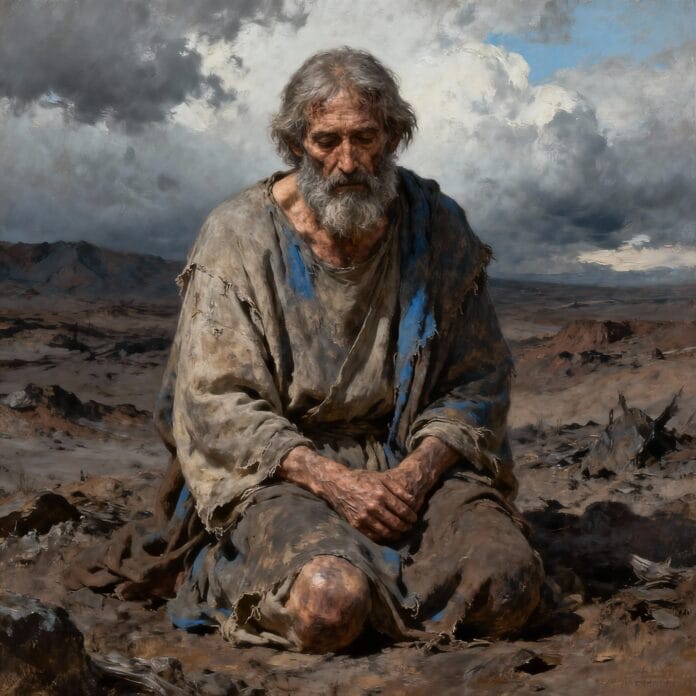
1° The subject and division of the book. — The name of the first of the didactic and poetic writings of the Old Testament, according to the order followed by the Vulgate, is, as with several of the historical books, that of the main character himself. Job, a pious and wealthy man from the land of Hus, hitherto blessed with every human comfort, is suddenly afflicted with the most terrible misfortunes imaginable, God allowing it to test him. He initially bears his misfortune with admirable patience, until a visit from his three friends, Eliphaz, Baldad, and Zophar, provokes a heated argument between them and him about the cause of his suffering: they claim that he must have brought it upon himself through his sins, and they urge him to do penance to obtain God's mercy; he, on the contrary, protests vehemently that he is innocent, but in the heat of the debate, he lets slip some ill-considered words about God. Having exhausted all arguments, the three friends fall silent, and Job asserts his innocence more vehemently than ever, when a new character appears: Elijah. Considering the problem from a more accurate perspective, Elijah demonstrates that God is just, even when He strikes men unaware of having gravely offended Him. The Lord Himself intervenes and indirectly resolves the matter with a magnificent description of His omnipotence and the unfathomable mysteries of His wisdom. Job humbly laments the audacity with which he presumed to speak of God's conduct toward him, and he receives not only His forgiveness but also the reward for his patience.
The book divides itself quite naturally into three parts, most clearly marked by its external form, as Saint Jerome observed (Praefat. In libr. Job) : prosa incipit, versu labitur, pedestri sermone finitur. There is the prologue, written in prose, 1, 1-2, 13, which briefly recounts Job's earlier life and the story of his misfortunes; then comes the body of the book, 3, 1-42, 6, written in verse, and expounding throughout the discussion of the problem mentioned above; there is finally the brief epilogue, 42, 7-16, written in prose like the prologue, and where we take leave of the hero after having seen him happy as in the early days.
The poem itself is subdivided into three parts: 1° Job's ardent debate with his three friends on the origin of his sufferings, 3.1-31.40 (four sections: the first phase of the debate, chap. 3-14; the second phase, chap. 15-21; the third phase, chap. 22-26; a triumphant monologue by Job, chap. 27-31); 2° Eliu's intervention and speeches, 32.1-37.24; 3° the divine intervention, 38.1-42.6.
2° Unity and beauty of the plan; the integrity of all parts of the book. — The preceding analysis, despite its brevity, suffices to demonstrate the existence of a perfect plan and sequence in the Book of Job. The prologue first orients the reader to the general situation; above all, it introduces them to the divine decrees concerning Job and to the purpose the Lord intends in permitting the holy man's misfortunes. Thanks to this preliminary information, the reader has a useful guiding thread to navigate the labyrinth of the thirty-nine chapters that follow; they do not have to painstakingly solve the problem, since they already possess the solution and need only verify the successive steps. The discussion begins between Job and his friends, and they soon arrive at the crux of the matter, a crux that tightens and becomes increasingly complex under the influence of their impassioned arguments: the interlocutors must part without having been able to reach an agreement. Eliu, emerging from the group of listeners who had attended the debate, brings his own perspective; he gives the question a new direction, one that prepares and hints at the resolution, but is still far from providing it. It is at this very moment, when the men are exhausted in their efforts and knowledge, that the Lord appears, not, however, to give in direct terms the long-sought solution, but to describe his divine attributes, utterly immeasurable, which surpass human understanding and judgment. The epilogue completes the resolution.
Everything follows and flows admirably throughout each page of the Book of Job, and everything progresses in a very regular, albeit slow, manner. It is clear from this that it is impossible to remove a single part of this admirable work without immediately rendering the others very obscure or incomprehensible, without breaking this harmonious unity and shattering the links of the chain. So-called critics, rationalists or Protestants, have not hesitated, however, to strike out considerable passages with a stroke of the pen: sometimes the prologue and the epilogue, so as to leave only an incomplete torso (the prologue is clearly assumed to be within the body of the poem; cf. 8:4; 29:5, 18, etc. Likewise the epilogue; cf. 13:10; 16:21; 22:30); Sometimes pages 27:11–28:28 are cited as incompatible with Job's earlier discourses on the Lord's retributive justice, as if the holy man's thought were doomed never to progress; sometimes, and more specifically, Elijah's discourses are cited, on the pretext that their genre differs from everything else (a real difference, but attributable to the very character of this new interlocutor) (see the note on 32:1); sometimes the last part of God's discourses, 40:10–41:25 (the descriptions of the hippopotamus and the crocodile), although, in the opinion of other rationalists, the style "is that of the best passages in the poem" and shows nothing less than an interpolation. Truly, it has been rightly said, one must have lost all taste for aesthetic beauty to put forward such theories. And we could cite the extrinsic evidence, that is, the multiple testimonies of tradition, which demonstrate that the book of Job has been transmitted to us as it was composed, without essential change.
3° The purpose of the book of Job. The main and dominant idea of this sublime poem is no less comforting than it is important. It is the great and painful problem that so often occupies and troubles the human heart, even amidst the illuminations of the New Testament: the origin of suffering here below, the cause of the manifold miseries that afflict humankind, and, more specifically, the cause of the sufferings of the righteous (see Psalms 36 and 72, which also address this theme). This mysterious problem is not unfolded in an abstract way, in the form of a philosophical dissertation; it is discussed in relation to a very concrete case, which gives it much more life, interest, and clarity. The poem seeks, therefore, the principles that guide the Lord in his conduct toward those subjected to the fire of trial, and it concludes with a complete justification of his Providence. Job's three friends hold a narrow view of the distribution of good and evil in this world: for them, suffering is always and solely the result of sin. Eliu suspects that it can have a pedagogical character and be inflicted even on the righteous; the prologue and epilogue clearly show it, in Job's specific case, as a trial intended to further sanctify an already virtuous man. The conclusion, therefore, is that one must worship and remain silent, the ultimate reason for our suffering being none other than the infallible wisdom of God.
Alongside this dogmatic goal, there is also the moral goal, which consists of providing, in patience Job, a perpetual example of courage for troubled souls. This is what is perfectly expressed Saint James (5:10-11): “Brothers and sisters, take as an example of suffering and patience the prophets who spoke in the name of the Lord. Behold, we shall call blessed those who have persevered. You have heard of patience of Job, and you have seen the end the Lord brought about for him, for the Lord is full of mercy and compassion.” In this respect, Job had the great honor of being regarded as the type and figure of Jesus Christ, the august and innocent victim, who suffered so much without complaint (Cf. Saint Gregory the Great, Moralium libri, (preface, 6, 14. On the famous messianic passage in chapter 19, verse 21 ff., see the commentary).
4° Historical character of the book.For a long time, it has been claimed that the poem of Job is pure fiction, invented from scratch, the hero himself never having existed; it would therefore be "from beginning to end a purely allegorical poem, a religious and philosophical novel." According to others, it is "a mixed poem, that is to say, a work of imagination woven around a historical background." It is easy to demonstrate that the entire series of events recounted truly corresponds to objective reality.
Job is a very real historical figure. Nothing could be more evident from the way several sacred writers speak of him; Ezekiel especially, who compares him to other famous men, Noah and Daniel, whose existence is beyond doubt (Ezekiel 14:14, 20; cf. Tobit 2:12, 15; James 5:11). Jewish and Christian traditions also affirm this very explicitly; and one finds scarcely a dissenting voice here and there: for example, among the Jews, that scholar who claimed that "Job did not exist and was not created (by God), but is only a parable" (Talmud, treatise Bab bathra, fol. 15, a), and, in Christians, the audacious Theodore of Mopsuestia, who was condemned by the Fifth General Council for having maintained a similar error (the Latin Church celebrates the feast of Job on May 10; the Greek Church, on May 6). The tone of the book leads us to the same conclusion, for everywhere "the reader irresistibly feels the impression that the events are real." If one objects to the perfection of the form, and the implausibility that speeches admirable down to their smallest details could have been improvised on the spot, we will respond following Mr. Le Hir: "One can believe, with the majority of exegetes, that Job and his companions only uttered the substance of the speeches put in their mouths, and that the delivery belongs to the sacred author, without being thereby justified in seeing in the entire work only a poetic fiction (The Book of Job, (pp. 232-233).»
It is stated very explicitly, from the beginning of the prologue, that Job was from the land of Hus (1:1; see the commentary); consequently, he was not part of the Hebrew people. In what era did he live? Most likely during the so-called patriarchal era, prior to Moses and the Exodus from Egypt. This is clearly indicated by the main features of the book and its principal omissions. The general character of Job and his time reveals very ancient customs. His longevity (Job lived at least 180 years according to 42:16; 240 years according to the Septuagint) also places him very far back in history. Similarly, his religion, for he practiced perfect monotheism (cf. 34:26-27, etc.), whereas, since Mosaic times, the worship of the one true God seems to have been the exclusive domain of the Hebrews. Job performs the priestly functions within his family (cf. 1:5), in the manner of the patriarchs. Furthermore, the book, which contains several allusions to the earliest events in world history (creation, the fall, the giants and their crimes, the flood), makes no mention of the legislation of Sinai or the theocratic nation. Moreover, Job is more recent than Abraham and Esau, since two of his friends were descendants of them. But we cannot be more precise.
5° The author and the period of composition. — As regards this twofold point, the most learned authors are reduced to mentioning more or less lengthy series of conjectures, and then admitting that "it is impossible to say exactly by whom and at what time the book of Job was written" (Man. Bibl., t. 2, n. 610). This was already the conclusion of Saint Gregory the Great: «Qui haec scripserit, valde supervacue quaesitur. » (L. c.(c. 1) The composition has been attributed in turn to Job himself, to one of his friends, to Elijah, to Moses or one of his contemporaries, to Solomon or his time, to Isaiah, to Daniel, and to many others. It is clear that no established tradition has formed on this subject. As for the style, it has been used to support all sorts of opinions. It is perfect and reveals a master, a genius: this is why it has been believed worthy of Moses and Solomon; but sometimes it contains very ancient expressions, used only in the Pentateuch (notably the coin called qesîtah; ; (See the note on Genesis 33:19), and sometimes he presents others that appear relatively recent. It is certain that the composition dates back further than Jeremiah, since this prophet borrowed from the poem in various ways (cf. Jeremiah 12:1 and Job 21:7; Jeremiah 17:1 and Job 19:23; Jeremiah 20:14-18 and Job 3:3-10; Jeremiah 20:17 and Job 3:11; etc.). Today, it is more commonly accepted that this magnificent poem belongs to the time of Solomon, the golden age of sacred literature.
6° The poetic form of the Book of Job; its literary beauties. — Since the Hebrews never had any drama or epic (see the introduction to the poetic books, p. 483 of this volume), it is sometimes inaccurate to attempt to classify the Book of Job in one or the other of these major classical genres. Drama, to which it has most often been linked, «requires external action; there is only an internal struggle in the Book of Job.» This poem, although clearly didactic in its purpose, is above all lyrical in its form, its momentum, its movements. The parallelism is almost everywhere two-part, with lines of roughly uniform length.
The beauties are first-rate and universally praised. «A poem so perfect in its plan, and so magnificent in its execution. One of the greatest literary masterpieces in the entire world. Admirable art in its whole as well as in its details. Majestic, sonorous, and concise style. Portraits of the various characters engraved as if by an artist, in vigorous and delicate strokes. The historical narration is clear and swift; it offers the simplicity and grace of ancient literature; the dialogues abound in vehement outbursts, vivid imagery, and sudden contrasts between passionate struggle and calm, profound, and grave contemplation of spiritual truths. The interest grows to the very end. There is no poetry that can be compared to the Book of Job.» This is the concise summary of the praise bestowed upon the Book of Job by poets, critics, and commentators.
7° The difficulties of interpretation and their causes. — The pages of this incomparable poem undoubtedly rank, almost in their entirety, among the most difficult in the whole Bible. Saint Jerome says that it is «a figurative, slippery book; an eel or a moray eel» that escapes the very moment one thinks one has grasped it best. Indeed, nowhere does one find such an elevated style, such rare expressions, such bold imagery, such frequent hesitations. And if this is true of the Hebrew text, it must be affirmed even more so of the versions, and especially of the Septuagint, which has astonishingly mistreated the Book of Job. The Vulgate is not without its flaws, as Saint Jerome candidly admits; nevertheless, it is generally agreed that «it is an excellent work for its time,» that «the translator spared neither time, nor effort, nor money, proceeding with independence and taste.» It is superior to all the ancient translations.
8° Works to consult. Few biblical writings have been as studied and commented upon as the one bearing the name of Job; but it is our intention to cite only the best works published by Catholic exegetes. These are: Moralium libri, sive Expositio in librum B. Job, by Saint Gregory the Great, «a gigantic study, which scarcely lets a point of dogma or morality pass untouched;» the commentary of Saint Thomas Aquinas, Venice, 1505 [translated into French by Éditions Sainte-Madeleine, cf. barroux.org, €35]; ; Commentariorum in librum Job libri tredecim, by Jean de Pineda, Madrid, 1597 to 1601; the commentary of Sanctius (Sanchez), Lyon, 1625; Job elucidatus, by B. Cordier, Antwerp, 1646; F. Vavassor, Jobus brevi commentario et metaphrasi poetica illustratus, Paris, 1638; the commentaries of Tirinus, Menochius and Calmet; Lesêtre, the Book of Job, Paris, 1886; especially Commentarius in librum Job, by PJ Knabenbauer, Paris, 1886.
Job 1
1 In the land of Hus there was a man named Job, a blameless, upright man, a worshiper of God, and far from evil. 2 He had seven sons and three daughters. 3 He owned seven thousand sheep, three thousand camels, five hundred pairs of oxen, five hundred donkeys and a very large number of servants and this man was the greatest of all the sons of the East. 4 His sons used to visit each other and have a feast, each in turn, and they would send invitations for their three sisters to come and eat and drink with them. 5 And when the cycle of feasting was over, Job would send for his sons and purify them, and then he would rise early in the morning and offer a burnt offering for each of them, for he said to himself, "Perhaps my sons have sinned and offended God in their hearts." And Job did this every time. 6 It came to pass one day that, when the sons of God came to present themselves before the Lord, Satan also came among them. 7 And the Lord said to Satan, «Where do you come from?» Satan answered the Lord and said, «From roaming the world and walking around on it.» 8 The Lord said to Satan, «Have you considered my servant Job? There is no one like him on earth, blameless and upright, fearing God and turning away from evil.» 9 Satan answered the Lord, «Does Job fear God for nothing?” 10 Have you not surrounded him, his house, and all that belongs to him with a fence? You have blessed the work of his hands, and his flocks cover the land. 11 "But stretch out your hand, touch everything that belongs to him, and we'll see if he doesn't curse you to your face."» 12 The Lord said to Satan, «Behold, all that belongs to him is in your power, only do not lay a hand on him.» And Satan went out from the presence of the Lord. 13 One day, while his sons and daughters were eating and drinking wine in their elder brother's house, 14 A messenger came to Job and said, «The oxen were plowing and the donkeys were grazing around them, 15 Suddenly the Sabeans came and took them away. They put the servants to the sword, and I alone escaped to tell you.» 16 He was still speaking when another messenger arrived and said, «The fire of God fell from heaven and consumed the sheep and the servants; and I alone have escaped to tell you.» 17 He was still speaking when another arrived and said, «The Chaldeans, divided into three bands, fell upon the camels and carried them off. They put the servants to the sword, and I alone escaped to tell you.”. 18 He was still speaking when another man arrived and said, «Your sons and daughters were eating and drinking wine at their eldest brother’s house, 19 And then a great wind arose from the other side of the desert and seized the four corners of the house; it collapsed on the young men, and they died. I alone escaped to tell you.» 20 Then Job got up, tore his robe and shaved his head, then, throwing himself on the ground, he worshiped 21 And he said, «Naked I came from my mother’s womb, and naked I will return there. The Lord gave, and the Lord has taken away; blessed be the name of the Lord.» 22 In all this, Job did not sin or say anything foolish against God.
Job 2
1 It came to pass one day that, when the sons of God came to present themselves before the Lord, Satan also came among them to present himself before the Lord. 2 And the Lord said to Satan, «Where do you come from?» Satan answered the Lord and said, «From roaming the world and walking around on it.» 3 The Lord said to Satan, «Have you considered my servant Job? There is no one like him on earth, blameless and upright, fearing God and turning away from evil. He always maintains his integrity, even though you have provoked me to destroy him without cause.» 4 Satan answered the Lord and said, «Skin for skin. A man gives what he has to preserve his life. 5 But stretch out your hand, touch his bones and his flesh, and we'll see if he doesn't curse you to your face.» 6 The Lord said to Satan, «Behold, I deliver him into your hands; only spare his life.» 7 And Satan went out from the presence of the Lord. And he struck Job with a painful leprosy from the soles of his feet to the crown of his head. 8And Job took a piece of broken pottery to scrape his wounds and he sat down on the ashes. 9 And his wife said to him, "You still persist in your integrity. Curse God and die."« 10 He said to her, «You speak like a foolish woman. Shall we accept good from God and not also evil?» In all this, Job did not sin with his lips. 11 Three friends of Job, Eliphaz the Temanite, Baldad the Shuhite and Zophar the Naamathite, heard of all the misfortunes that had come upon him, they each went from their country and consulted with one another to come and grieve for him and comfort him. 12 Having looked up from afar, they did not recognize him, and they raised their voices and wept, they tore each of their cloaks and threw dust toward the sky above their heads. 13And they sat on the ground beside him seven days and seven nights, without any of them saying a word to him, because they saw how great his pain was.
Job 3
1 Then Job opened his mouth and cursed the day he was born. 2 Job spoke up and said: 3 May the day I was born perish, and the night that said, "A man is conceived."« 4 On that day, let it turn into darkness; let God above not be concerned, let no light shine upon it. 5 Let darkness and the shadow of death claim him, let a thick cloud cover him, let the eclipse of his light cast terror. 6 Let darkness take hold of this night; let it not be counted among the days of the year, nor entered into the reckoning of the months. 7 May this night be a barren desert, may no cry of joy be heard there. 8 Let those who curse the days, who know how to evoke Leviathan, curse her. 9 May the stars of her twilight grow dark, may she wait for the light, without it coming, and may she not see the eyelids of dawn, 10 because she did not close the doors of the breast to me and did not hide suffering from my sight. 11 Why did I not die in my mother's womb, and come forth from her loins, why did I not expire?. 12 Why did I find two knees to receive me on, and why breasts to suckle? 13 Now I would lie down in peace, I would sleep and rest. 14 with the kings and great men of the earth, who built themselves mausoleums, 15 with the princes who had gold and filled their dwellings with silver. 16 Or, like the ignored abortion, I would not exist, like those children who have not seen the light. 17 There the wicked no longer wreak their violence, there the man, exhausted of strength, finds rest., 18 The captives are all at peace there; they no longer hear the voice of the work master. 19 There are the small and the great, the slave freed from his master. 20 Why give light to the unfortunate and life to those whose souls are filled with bitterness?, 21 who long for death and death does not come, who seek it more ardently than treasures, 22 who are happy, who leap for joy and rejoice when they have found the tomb, 23 to the man whose path is hidden and whom God has enclosed on all sides? 24 My sighs are like my bread, and my groans flow like water. 25 What I fear is what is happening to me; what I dread is bearing down on me. 26 No more tranquility, no more peace, no more rest, and turmoil seized me.
Job 4
1 Then Eliphaz the Temanite spoke up and said: 2 If we risk a word, perhaps you will be distressed, but who could restrain their words? 3 Behold, you have instructed many, you have strengthened their weak hands, 4 that your words have lifted up those who were faltering, that you have strengthened the faltering knees 5 And now that misfortune comes to you, you weaken; now that it reaches you, you lose courage. 6 Was not your fear of God your hope? Was not your trust in the purity of your life? 7 Search your memory: who was the innocent person who perished? In what place in the world were the righteous exterminated? 8 For me, I have seen it: those who plow iniquity and sow injustice reap its fruits. 9 By the breath of God they perish, they are consumed by the wind of his anger. 10 The lion's roar and thundering voice are stifled, and the young lion's teeth are broken., 11 The lion perished for lack of prey, and the lioness's cubs scattered. 12 A word reached me stealthily and my ear caught its faint murmur. 13 In the hazy visions of the night, at the hour when deep sleep weighs upon mortals, 14 A fear and trembling seized me and shook all my bones. 15 A spirit passed before me. The hairs on my skin stood on end. 16 He stood up, I didn't recognize his face, like a ghost before my eyes. A great silence, then I heard a voice: 17 Will man be just in the eyes of God? Will a mortal be pure before his Creator? 18 Behold, he does not trust his servants and finds fault in his angels: 19 How much more so those who live in mud houses, whose foundations are in the dust, who will be reduced to dust, as by a moth.20 From morning till night they are exterminated and without anyone noticing, they perish forever. 21 The rope of their tent is cut; they die before they have known wisdom.
Job 5
1 Call out then. Will anyone answer you? To which of the saints will you turn? 2 Anger kills the fool, and rage kills the madman. 3 I saw the fool spreading his roots and suddenly I cursed his dwelling. 4 There is no salvation for his sons, they are crushed at the gate and no one defends them. 5 The hungry man devours his harvest, he leaps over the hedge of thorns and carries it off; the thirsty man swallows up his riches. 6 For misfortune does not spring from dust, nor does suffering sprout from the ground, 7 so that man is born for suffering, like the sons of lightning to raise their flight. 8 If I were you, I would turn to God; it is to Him that I would direct my prayer. 9 He does great things, which cannot be fathomed, wonders that cannot be counted. 10 He pours rain on the earth, he sends waters upon the fields, 11 It exalts those who are humbled, and the afflicted find happiness again. 12 He thwarts the plans of the treacherous, and their hands cannot carry out their plots. 13 He catches the clever in their own cunning and overturns the advice of shrewd men. 14 During the day they encounter darkness, at midday they grope as if in the night. 15 God saves the weak from the sword of their tongue and from the hand of the powerful. 16 Then hope returns to the unfortunate, and iniquity shuts its mouth. 17 Blessed is the man whom God chastens. Therefore, do not despise the correction of the Almighty. 18 For he wounds and he binds up, he strikes and his hand heals. 19 Six times he will deliver you from anguish, and on the seventh, no harm will touch you. 20 In famine, he will save you from death; in battle, from the blows of the sword. 21 You will be safe from the lash of the tongue, you will be without fear when devastation comes. 22 You will laugh at devastation and famine, you will not fear the beasts of the earth 23 for you will have a covenant with the stones of the field, and the beasts of the earth will be at peace with you. 24 You will see happiness reign in your tent, you will visit your pastures and nothing will be lacking. 25 You will see your descendants increase and your offspring multiply like the grass of the field. 26 You will enter the tomb ripe, like a sheaf of wheat harvested in its season. 27 This is what we have observed: it is the truth. Listen to it and take advantage of it.
Job 6
1 Then Job spoke up and said: 2 Oh, if only it were possible to weigh my affliction and put all my calamities together in the balance 3 They would be heavier than the sand of the sea: that is why my words border on madness. 4 For the arrows of the Almighty pierce me and my soul drinks their venom; the terrors of God are arrayed in battle against me. 5 Does the onager roar beside the tender grass? Does the ox low before its pasture? 6How can one nourish oneself with a bland, salt-free dish, or find flavor in the juice of a tasteless herb? 7 What my soul refuses to touch, that is my bread, all covered in defilement. 8Who will grant me that my wish may come true and that God may fulfill my expectation? 9 May God deign to break me, may he let his hand go and cut off my days 10 And may I at least have this consolation, which makes me tremble in the midst of the afflictions with which he overwhelms me: that I have never transgressed the commandments of the Holy One 11 What is my strength, that I should wait? How long are my days, that I should be patient? 12 Is my strength the strength of stones, and is my flesh bronze? 13 Am I not without all help and has all hope of salvation been taken from me? 14 The unfortunate man has a right to the pity of his friend, even if he had abandoned the fear of the Almighty. 15 My brothers have been treacherous like the torrent, like the water of the flowing torrents. 16 The ice floes disrupt its course, the snow disappears in their flow. 17 In times of drought, they vanish; with the first heat, their bed dries up. 18 Along various paths their waters are lost, they evaporate into the air and they dry up. 19 The caravans of Thema relied on them, the travelers of Saba placed their hopes in them, 20 They are frustrated in their waiting, having arrived at their shores, they remain confused. 21 So I miss you at this hour; at the sight of misfortune, you flee in terror. 22 Did I tell you, "Give me something, share your possessions with me, 23 "Deliver me from the hand of the enemy, snatch me from the hand of the robbers?"» 24 Instruct me and I will listen in silence; show me where I have failed. 25 How powerful are fair words! But on what do you place your blame? 26 Do you want to censor words? Speeches that have escaped despair are prey to the wind. 27 Ah, you cast a net on an orphan, you dig a trap for your friend. 28 Now, deign to turn back to me and you will see if I am lying to your face. 29 Come back, don't be unfair, come back and my innocence will appear. 30 Is there iniquity on my tongue, or does my palate not know how to discern evil?
Job 7
1 Man's life on earth is a time of service, and his days are like those of a mercenary. 2 Like a slave longs for shade, like a worker waits for his wages, 3 Thus I shared months of pain, and for my part, nights of suffering. 4When I go to bed, I say, «When will I get up? When will the night end?» And I am filled with anxieties until daybreak. 5 My flesh is covered with worms and an earthy crust, my skin is cracking and oozing. 6 My days pass faster than the weaver's shuttle, they vanish: no more hope. 7 O God, remember that my life is but a breath. My eyes will never see happiness again. 8 The eye that looks at me will no longer see me; your eye will search for me, and I will be no more. 9 The cloud dissipates and passes, so he who descends into Sheol will never return., 10 He will never return to his home; the place he lived in will no longer recognize him. 11 Therefore I will not restrain my tongue, I will speak in the anguish of my spirit, I will vent my complaints in the bitterness of my soul. 12 Am I the sea or a sea monster, that you put a barrier around me? 13 When I say, "My bed will comfort me, my couch will calm my sighs,"« 14 So you frighten me with dreams, you terrify me with visions. 15 Ah, my soul prefers violent death, my bones call for demise. 16 I am in the throes of dissolution, life is slipping away from me forever, leave me, for my days are but a breath. 17 What is man, that you hold him in such high esteem, that you deign to take care of him?, 18 that you visit it every morning and experience it at every moment? 19When will you stop staring at me? When will you give me time to swallow? 20 If I have sinned, what can I do to you, O Guardian of men? Why make myself a target for your arrows and a burden to myself? 21 Why do you not forgive my offense? Why do you not forget my iniquity? For soon I will sleep in the dust; you will seek me, but I will be no more.
Job 8
1 Then Baldad of Suhe spoke and said: 2 How long will you continue these speeches, and will your words be like a breath of storm? 3 Does God bend justice, or does the Almighty overturn justice? 4 If your sons have sinned against him, he has delivered them into the hands of their iniquity. 5 For you, if you turn to God, if you implore the Almighty, 6 If you are upright and pure, then he will watch over you; he will restore happiness to the dwelling place of your righteousness., 7 Your first state will seem insignificant, so flourishing will the second be. 8 Ask questions of past generations, pay attention to the experience of your fathers: 9 For we are of yesterday and know nothing; our days on earth pass like a shadow., 10 Won't they teach you, speak to you, and draw out sentences from their hearts? 11 «"Does papyrus grow outside of marshes? Does rush grow without water?" 12 While still tender, without being cut, it dries before any grass. 13 Such are the ways of all who forget God; the hope of the wicked will perish. 14 His confidence will be shattered, his assurance is like a spider's web. 15 He leans on his house and it doesn't hold, he clings to it and it doesn't stay standing. 16 It is full of vigor, in the sun, its branches spread over its garden, 17 Its roots intertwine among the stones, it plunges to the depths of the rock. 18 If God snatches him from his place, his place denies him: I have never seen you. 19 That is where his joy ends, and from the same soil others will rise after him.» 20 No, God does not reject the innocent, he does not take the hand of evildoers. 21 He will fill your mouth with laughter and put songs of joy on your lips. 22 Your enemies will be covered in shame and the tent of the wicked will disappear.
Job 9
1 Then Job spoke up and said: 2 I know that this is the case: how could man be just towards God? 3 If he wanted to argue with him, he wouldn't be able to answer a single one of a thousand things. 4 God is wise in heart and mighty in power: who has resisted him and remained at peace? 5 He moves mountains without their knowledge; he overturns them in his anger., 6 It shakes the earth at its base and its pillars are shaken. 7 He commands the sun and the sun does not rise; he seals up the stars. 8 Alone, he stretches out the heavens, he walks on the heights of the sea. 9 He created the Great Bear, Orion, the Pleiades, and the southern sky regions. 10 He performs wonders that cannot be fathomed, prodigies that cannot be counted. 11 Here he is passing near me and I don't see him, he moves away without my noticing him. 12 If he seizes prey, who will oppose him, who will say to him, "What are you doing?"« 13 God, nothing softens his anger, before him the legions of pride bow down. 14 And I would think about how to respond to him, how to choose my words to discuss with him. 15 If justice were on my side, I would not respond; I would implore the clemency of my judge. 16 Even if he had responded to my call, I wouldn't believe he would have listened to my voice: 17 He who shatters me as if in a whirlwind and multiplies my wounds without reason, 18 which doesn't let me breathe and fills me with bitterness. 19 If it is a matter of force, behold, he is strong; if it is a matter of right, he says, "Who is suing me?"« 20 Even if I were irreproachable, my own mouth would condemn me; even if I were innocent, it would declare me perverse. 21 I am innocent, I do not value existence and life is a burden to me. 22 It matters to me after all, that's why I said, "He destroys both the righteous and the wicked."« 23 If only the plague killed instantly. Alas, it mocks the trials of the innocent. 24 The earth is given into the hands of the wicked; God hides the face of his judges: if it is not he, who then is it? 25 My days are faster than a letter; they flee without having seen happiness., 26 They pass by like a reed boat, like an eagle swooping down on its prey. 27 If I say, "I want to forget my complaint, to leave my sad expression behind, to adopt a joyful expression,"« 28 I tremble for all my pain, I know you won't hold me innocent. 29 I will be found guilty: why take an unnecessary sentence? 30 When I wash myself in the snow, when I purify my hands with soda, 31 You would plunge me into the mud and I would loathe my clothes. 32 God is not a man like me, so that I should answer him, so that we should appear together in court. 33 There is no referee between us who lays his hand on the two of us. 34 Let him remove his staff from me, let his terrors cease to frighten me: 35 So I will speak without fear, otherwise I am not myself.
Job 10
1 My soul is weary of life, I will give free rein to my complaint, I will speak in the bitterness of my heart. 2 I say to God: Do not condemn me, teach me what you are accusing me of. 3 Do you find pleasure in oppressing, in rejecting the work of your hands, in showing favor to the counsel of the wicked? 4 Do you have eyes of flesh, or do you see as men see? 5 Are your days like the days of man, or your years like the years of a mortal?, 6 so that you may seek out my iniquity, so that you may pursue my sin, 7 When you know that I am not guilty and that no one can deliver me from your hand? 8 Your hands formed and shaped me, entirely, and you would destroy me. 9 Remember that you molded me like clay: and you would return me to dust. 10 Didn't you melt me like milk and curdle me like cheese? 11 You clothed me with skin and flesh, you wove me together with bones and sinews. 12 With life, you have granted me your favor and your providence has preserved my soul. 13 And yet, this is what you were hiding in your heart: I see clearly what you were plotting. 14 If I sin, you watch me; you do not forgive my iniquity. 15 Am I guilty? Woe to me. Am I innocent? I dare not raise my head, filled with shame and seeing my misery. 16 If I get up, you chase me like a lion, you start tormenting me strangely again., 17 You bring new witnesses against me, you redouble your fury against me, fresh troops come to assail me. 18 Why did you take me from my mother's breast? I would have died and no eye would have seen me. 19 I would be as if I had never existed, as if I had been carried from my mother's womb to the tomb. 20 Are my days not so short? Let him leave me. Let him withdraw and let me breathe for a moment., 21 before I depart, never to return, into the region of darkness and the shadow of death, 22 a bleak and gloomy region, where the shadow of death and chaos reign, where light is like darkness.
Job 11
1 Then Zophar the Naamathite spoke up and said: 2 Will the multitude of words remain unanswered, and will the chatterer be right? 3 Will your empty words silence people? Will you mock, and no one will confound you? 4 You said to God, "My thoughts are true, and I am blameless before you."« 5 Oh, if God would speak, if he would open his lips to answer you, 6 If he were to reveal to you the secrets of his wisdom, the hidden recesses of his designs, you would then see that he forgets a part of your crimes. 7 Do you presume to fathom the depths of God, to reach the perfection of the Almighty? 8 It is as high as the heavens: what will you do? Deeper than the grave: what will you know? 9 Its length is greater than the earth, it is wider than the sea. 10 If he pounces on the culprit, if he arrests him, if he summons the court, who will oppose it? 11 Because he knows the perverse, he discovers iniquity before she suspects it. 12 At this sight, even the madman would understand, and the young wild ass would become reasonable. 13 For you, if you direct your heart towards God and stretch out your arms towards him, 14 If you remove the iniquity that is in your hands and do not allow injustice to dwell in your tent, 15 Then you will lift up your spotless forehead, you will be steadfast and you will fear no more. 16 Then you will forget your suffering, you will remember it like waters flowing away, 17 The future will dawn for you brighter than midday, darkness will turn into sunrise. 18 You will be full of confidence and your waiting will not be in vain, you will look around you and you will go to bed peacefully. 19 You will rest, without anyone worrying you, and many will caress your face. 20 But the eyes of the wicked will burn out: for them, there is no refuge, their hope is the breath of a dying man.
Job 12
1 Then Job spoke up and said: 2 Truly you are as wise as an entire people, and with you wisdom will die. 3 I too have intelligence like you, I don't give you any less in that regard, and who doesn't know the things you say? 4 I am the laughingstock of my friends, I who invoked God and to whom God answered, their laughingstock, I the righteous, the innocent. 5 Shame on misfortune. That's the motto of the fortunate; contempt awaits the one whose foot falters. 6 Peace However, under the tent of the brigands, there reigns security for those who provoke God and who have no other god than their own arm. 7 But please ask the animals and they will teach you, the birds of the air and they will tell you, 8 Or speak to the earth and it will teach you; even the fish of the sea will tell you. 9 Who among all these beings does not know that the hand of the Lord has done these things?, 10 that he holds in his hand the soul of all that lives and the breath of all humans? 11 Does not the ear discern words, as the palate savors food? 12 Wisdom belongs to white hair, prudence is the fruit of long days. 13 In God reside wisdom and power; to Him belong counsel and understanding. 14 Behold, he overthrows and it cannot be rebuilt; he shuts the door on man and it cannot be opened to him. 15 Behold, he stops the waters, they dry up; he releases them, they overturn the earth. 16 To Him belongs strength and prudence, to Him belongs the one who is led astray and the one who leads astray. 17 He takes captive the advisors of the people and he deprives judges of their senses. 18 He loosens the kings' belts and girds their loins with a rope. 19 He drags the priests into captivity and overthrows the powerful. 20 He takes away the speech of the most capable men and he takes away the judgment of the elderly. 21 He heaps contempt upon the nobles and loosens the belt of the strong. 22 It brings to light the things hidden in darkness and produces the shadow of death. 23 He makes nations grow and he destroys them, he expands them and he shrinks them. 24 He takes away the intelligence of the leaders of the peoples of the earth and leads them astray in trackless deserts, 25 They grope in the darkness, far from the light; he makes them wander like a drunken man.
Job 13
1 Now my eye has seen all this, my ear has heard and understood it. 2 What you know, I know too; I am in no way inferior to you. 3 But I want to speak to the Almighty, I want to plead my case with God. 4 Because you are nothing but charlatans, you are all useless doctors. 5 Why didn't you remain silent? It would have served as wisdom for you. 6 Listen, I beg you, to my defense; pay attention to the plea from my lips. 7 Will you speak lies on behalf of God, for him? Will you speak deceit? 8 Will you show bias in favor of God? Will you be his advocates? 9 Will he be grateful if he searches your hearts? Will you deceive him as one deceives a man? 10 He will certainly condemn you if you secretly show bias. 11 Yes, his majesty will terrify you, his terrors will fall upon you. 12 Your arguments are reasons of dust, your fortresses are fortresses of clay. 13 Be quiet, leave me alone, I want to speak, whatever happens to me will happen. 14 I want to take my flesh between my teeth, I want to put my soul in my hand. 15 Even if he were to kill me, and I had nothing left to hope for, I would defend my conduct before him. 16 But he will be my salvation, for the wicked cannot appear in his presence. 17 Listen to my words, pay attention to my speech. 18 Here I have prepared my case, I know I will be vindicated. 19 Is there anyone who wants to plead against me? Right now I want to be silent and die. 20 Only spare me two things, O God, and I will not hide from your face: 21 Keep your hand away from me and let your terrors no longer frighten me. 22 After that, call and I will answer, or I will speak first and you can answer me. 23 What is the number of my iniquities and my sins? Make me know my transgressions and my offenses. 24 Why hide your face like that and look at me as your enemy?. 25 Do you want to frighten a leaf stirred by the wind, chase after a dried-out straw, 26 so that you will write bitter things against me, so that you will blame me for the faults of my youth, 27 so that you may place my feet in wooden shackles, observe my every step, and mark a boundary on the soles of my feet, 28 while my body is being consumed like rotten wood, like a garment devoured by moths.
Job 14
1 The man born of woman lives a few days and is filled with miseries. 2 Like a flower, it is born and cut down; it flees like a shadow, without stopping. 3 And it is on him that you have your eye, him that you bring to justice with you. 4 Who can separate the pure from the impure? No one. 5 If man's days are numbered, if you have fixed the number of his months, if you have set a limit he must not exceed, 6 Turn your eyes away from him so that he may rest, until he tastes, like the worker, the end of his day. 7 A tree has hope: cut down, it can still turn green again, it does not cease to produce offshoots. 8 Whether its root has aged in the earth, whether its trunk has died in the dust, 9 As soon as it smells water, it turns green again, it puts out branches like a young plant. 10 But when a man dies and lies there, when he has expired, where is he? 11 The lake's waters disappear, the river dries up and becomes dry: 12 Thus the man lies down and does not rise again; he will not awaken as long as the sky remains; he cannot be roused from his sleep. 13 Oh, if you would hide me in the realm of the dead, keep me hidden there until your anger has passed, set a time for me when you would remember me. 14 If a man could live again once he died. All my time in service I would wait to be relieved. 15 Then you would call me and I would answer you, you would long for the work of your hands. 16 But alas, now you count my steps, you have your eye open on my sins, 17 My transgressions are sealed in a bag, and you put a coating over my iniquities. 18 The mountain collapses and disappears, the rock is carried out of its place, 19 The waters wear away the stone, their overflowing floods carry away the dust of the ground: thus you annihilate the hope of man. 20 You strike him down and he goes away, you disgrace his face and you dismiss him. 21 Whether his children are honored, he does not know; whether they are in abasement, he is unaware. 22 His flesh feels only its own suffering, his soul groans only for itself.
Job 15
1 Then Eliphaz the Temanite spoke up and said: 2 Does the wise man respond with empty knowledge? Does he inflate his chest with wind? 3 Is he defending himself with futile remarks, with speeches that serve no purpose? 4 You destroy even the fear of God, you annihilate all piety towards God. 5 Your mouth reveals your iniquity, and you adopt the language of the deceitful. 6 It is not I, it is your mouth that condemns you, it is your lips that testify against you. 7 Were you born the first of men? Were you brought forth before the hills? 8 Have you attended God's council? Have you stolen wisdom for yourself alone? 9 What do you know that we do not know? What have you learned that is not familiar to us? 10 We also have among us white hair, old men richer in years than your father. 11 Do you consider God's consolations and the gentle words we address to you to be of little value? 12 Where does your heart take you, and what does that rolling of your eyes mean? 13 What, is it against God that you turn your anger and that you utter such words from your mouth? 14 What is man, that he should be pure, or the son of woman, that he should be righteous? 15 Behold, God does not trust even his saints, and the heavens are not pure before him: 16 How much less this abominable and perverse being, the man who drinks iniquity like water. 17 I will instruct you, listen to me, I will tell you what I have seen, 18 What the wise teach, they do not hide, having learned it from their fathers., 19 The country had been given to them alone, and no foreigner ever passed among them. 20 «"The wicked man is consumed by anguish throughout his days, but only a few years are reserved for the oppressor.". 21 Frightening noises resounded in his ears, within peace, the devastating force descends upon him. 22 He does not hope to escape the darkness; he feels that he is being watched for the sword. 23 He wanders in search of his bread, he knows that the day of darkness is coming, at his side. 24 Distress and anguish fall upon him, they assail him like a king armed for battle. 25 For he has raised his hand against God, he has defied the Almighty, 26 He ran towards him with his neck stiff, beneath the thick back of his shields. 27 His face was covered in grease and his sides were heavy with fat. 28 He occupied cities that no longer exist, houses that no longer have inhabitants, destined to become heaps of stone. 29 He will not grow richer, his fortune will not last, his possessions will no longer extend over the earth. 30 He will not escape the darkness, the flame will wither his offspring, and he will be carried away by the breath of God's mouth. 31 Let him not hope for anything from the lie, he will be caught in it, the lie will be his reward. 32 She will arrive before her days are full and her branch will no longer turn green. 33 It will shake off, like the vine, its fruit as soon as it blossoms, it will drop its flower, like the olive tree. 34 For the house of the wicked is barren, and fire devours the tent of the corrupt judge. 35 He conceived evil and he gives birth to misfortune; in his womb ripens a fruit of deception.»
Job 16
1 Then Job spoke up and said: 2 I have often heard similar harangues; you are all unbearable comforters. 3 When will these empty speeches end? What spurs you to reply? 4 I too would know how to speak like you; if you were in my place, I would arrange beautiful speeches for you, I would nod my head at you., 5 I would encourage you with my mouth, and you would find relief in the restlessness of my lips. 6 If I speak, my pain is not eased; if I remain silent, is it relieved? 7 Today, alas, God has exhausted my strength, O God, you have reaped all my loved ones. 8 You strangle me, it's a testimony against me, my thinness rises up against me, facing me it accuses me. 9 His anger tears me apart and pursues me, he gnashes his teeth at me, my enemy glares at me. 10 They open their mouths to devour me, they strike me on the cheek with outrage, they all conspire together to destroy me. 11 God has delivered me to the perverse; he has thrown me into the hands of the wicked. 12 I was at peace, and he shook me, he seized me by the nape of the neck and he broke me. He set me as an object to his arrows, 13 His arrows fly around me, he pierces my sides without pity, he spills my entrails on the earth, 14 He is breaching me breach after breach, he is bearing down on me like a giant. 15 I sewed a bag onto my skin and rolled my forehead in the dust. 16 My face is red with tears and the shadow of death spreads across my eyelids., 17 although there is no iniquity in my hands and my prayer is pure. 18 O earth, do not cover my blood and let my cries rise freely. 19 At this very hour, behold, I have my witness in heaven, my defender in the high places. 20 My friends mock me, but my eyes weep for God. 21 Let him judge for himself between God and man, between the son of man and his fellow man 22 because the years allotted to me are passing by and I am entering a path from which I will not return.
Job 17
1 My breath is failing, my days are fading away, all that remains for me is the grave. 2 I am surrounded by mockers, my eye watches over them amidst their insults. 3 O God, be my guarantor before yourself: who else would strike me on the hand? 4 Because you have closed their hearts to wisdom, do not allow them to exalt themselves. 5 He invites his friends to share, when his children's eyes fail him. 6 He has made me the laughingstock of the people; I am the man who is spat upon. 7 My eyes are clouded by grief and all my limbs are but a shadow. 8 Upright men are astonished, and the innocent are angered against the impious. 9 The righteous man, however, remains steadfast in his way, and he who has clean hands redoubles his courage. 10 But all of you, come back, come then, shall I not find a wise man among you? 11 My days are over, my plans destroyed, those plans that my heart cherished. 12 From the night they make day; in the face of darkness, they say that light is near. 13 Though I wait, Sheol is my dwelling place; in darkness I have made my bed. 14 I said to the grave, "You are my father," to the worms, "You are my mother and my sister."« 15 Where is my hope? Who can see my hope? 16 She descended to the gates of Sheol, if indeed one finds rest in the dust.
Job 18
1 Then Baldad of Suhe spoke and said: 2 When will you put an end to this talk? Be intelligent, and then we'll talk. 3 Why do you look at us like brutes and are we stupid in your eyes? 4 You who tear yourself apart in your fury, do you want the earth to become desolate because of you, and the rock to be removed from its place? 5 Yes, the light of the wicked will be extinguished and the flame of his hearth will cease to shine. 6 The day will darken beneath his tent, his lamp will go out above him. 7 His firm steps will be cramped, his own advice hastens his downfall. 8 His feet throw him into the net; he steps on the trap. 9 The net caught his heels; he was tightly bound in its knots. 10 For him, the lakes are hidden underground and the trapdoor is on his path. 11 Terrors besiege him from all sides and pursue him step by step. 12 Famine is his punishment and ruin is ready for his downfall. 13 The skin of his limbs is devoured, his limbs are devoured by the firstborn of death. 14 He is dragged from his tent, where he thought he was safe, and taken to the King of Terrors. 15 None of his people dwell in his tent; sulfur is sown on his dwelling. 16 At the bottom, its roots are drying out; at the top, its branches are being cut. 17 His memory has vanished from the earth; he no longer has a name in the land. 18 We chase him from the light into the darkness, we banish him from the universe. 19 He left no descendants or posterity in his tribe, no survivors in his sojourn. 20 The peoples of the West are astonished by its ruin, and those of the East are filled with horror. 21 Such is the dwelling place of the wicked, such is the place of the man who does not know God.
Job 19
1 Then Job spoke up and said: 2 How long will you afflict my soul and overwhelm me with your words? 3 This is the tenth time you have insulted me, shamelessly outraged me. 4 Even if I had failed, the fault would still lie with me. 5 But you, who rise up against me, who invoke my disgrace to convince me, 6 Finally, know that it is God who oppresses me and who enfolds me in his net. 7 Here I am, crying out against violence and no one answers me. I appeal for help and there is no justice. 8 He has blocked my path and I cannot pass: he has spread darkness on my ways. 9 He has stripped me of my glory, he has taken the crown from my head. 10 He has undermined me from all sides and I am falling; he has uprooted my hope, like a tree. 11 His anger was kindled against me; he treated me like his enemies. 12 His battalions came together, they fought their way to me, they are laying siege to my tent. 13 He has distanced my brothers from me, and my friends have turned away from me. 14 My loved ones have abandoned me, my close friends have forgotten me. 15 The guests in my house and my servants treat me like a stranger; I am a stranger in their eyes. 16 I call to my servant, but he does not answer me; I am reduced to begging him with my mouth. 17 My wife hates my breath, my own children are disgusted by me. 18 Even the children despise me; if I stand up, they mock me. 19 All those who were my confidants now hate me, those I loved have turned against me. 20 My bones are attached to my skin and flesh, I escaped with the skin of my teeth. 21 Have pity, have pity on me, you at least, my friends, for the hand of God has struck me. 22 Why do you pursue me, as God pursues me? Why are you insatiable for my flesh? 23 Oh, who will grant that my words be written down, who will grant that they be recorded in a book, 24 that with an iron chisel and lead, they may be forever engraved in the rock. 25 I know that my redeemer lives and that he will be the last to rise from the dust. 26 Then from this skeleton, clothed in its skin, in my flesh, I will see God. 27 I myself will see it, my eyes will see it and no other; my loins are consumed with expectation within me. 28 Then you will say, "Why were we pursuing him?" and the justice of my cause will be recognized. 29 On that day, fear the sword for yourselves: terrible are the vengeances of the sword. And you will know that there is justice.
Job 20
1 Then Zophar the Naamathite spoke up and said: 2 That is why my thoughts suggest an answer to me, and because of my agitation, I am eager to give it. 3 I have heard reproaches that outrage me; in my intelligence, my mind will find the reply. 4 Do you know that, from time immemorial, ever since man was placed on Earth, 5 The triumph of the villains was short-lived and joy of the impious of a moment? 6 Even if he were to raise his pride to the heavens and his head to touch the clouds, 7 Like his garbage, he perished forever; those who saw him said, "Where is he?"« 8 It flies away like a dream and is no longer to be found; it fades away like a vision of the night. 9 The eye that saw him can no longer see him, his dwelling will no longer perceive him. 10 His children will beg the poor, He will return his loot with his own hands. 11 His bones were full of his hidden iniquities; they will sleep with him in the dust. 12 Because the evil was sweet to his mouth, because he hid it under his tongue, 13 that he savored it without abandoning it and kept it in the middle of his palate: 14 Her food will turn to poison in her guts, it will become the venom of the asp in her breast. 15 He has swallowed riches, he will vomit them up, God will remove them from his stomach. 16 He sucked the asp's venom, the viper's tongue will kill him. 17 He will never see the rivers flow, the torrents of honey and milk. 18 He will return what he has earned and will not gorge himself on it, to the extent of his profits, and he will not enjoy it. 19 Because he oppressed and abandoned the poorHe ransacked their house and did not rebuild it: 20 His greed could not be satisfied; he will not take with him what he holds most dear. 21 Nothing escaped his voracious appetite, so his happiness will not last. 22 In the midst of abundance, he falls into want; all the blows of misfortune come upon him. 23 This is what will fill his stomach: God will send the fire of his anger upon him, and it will rain down upon him, even into his bowels. 24 If he escapes the iron weapons, the bronze bow pierces him. 25 He pulls out the arrow, it comes out of his body, steel gleams from his liver, the terrors of death fall upon him. 26 A deep night swallowed his treasures, a fire that the man did not light devoured him and consumed everything that remained in his tent. 27 The heavens will reveal his iniquity, and the earth will rise up against him. 28 The abundance of her house will be scattered; it will disappear on the day of wrath. 29 This is the portion that God reserves for the wicked and the inheritance that God destines for them.
Job 21
1 Then Job spoke up and said: 2 Listen, listen to my words, so that I may at least have this consolation from you. 3 Allow me to speak in my turn, and when I have spoken, you can laugh. 4 Is my complaint against a man? How so? patience Wouldn't she escape me? 5 Look at me and be amazed and put your hand over your mouth. 6 When I think about it, I shudder and a shiver runs through my flesh. 7 Why do villains live and grow old, increasing in strength? 8 Their posterity is strengthened around them, their offspring flourish in their eyes. 9 Their home is at peace, safe from fear; the rod of God does not touch them. 10 Their bull is always fertile, their heifer gives birth and does not abort. 11 They let their children run around like a flock, their newborns bouncing around them. 12 They sing to the sound of the tambourine and the zither, they entertain themselves to the sound of the reed pipe. 13 They spend their days in happiness and in an instant they descend into Sheol. 14 Yet they said to God, «Depart from us, we do not desire to know your ways. 15 What is the Almighty, that we should serve Him? What would we gain by praying to Him?» 16 Is not their prosperity in their own hands? However, far be it from me to follow the advice of the wicked. 17 Do we often see the lamp of the wicked extinguished, ruin befall them, and God assign them a portion in his anger? 18 Do we see them as straw carried away by the wind, as chaff swept away by the whirlwind? 19 «"God, you say, reserves his punishment for his children." But let God punish him himself so that he may feel it., 20 that he may see with his own eyes his ruin, that he may himself drink the wrath of the Almighty. 21 Indeed, what does his house matter to him after he dies, once the number of his months is decided? 22 Is it to God that wisdom will be taught, to him who judges the highest beings? 23 One dies in the midst of his prosperity, perfectly happy and peaceful., 24 the flanks laden with fat and the bone marrow filled with sap. 25 The other dies, bitter in his soul, without having tasted happiness. 26 They both lie down in the dust and the worms cover them both. 27 Ah, I know very well what your thoughts are, what unfair judgments you make about me. 28 You say, «Where is the house of the oppressor? What has become of the tent inhabited by the wicked?» 29 Have you never questioned the travelers and are you unaware of their remarks? 30 In the day of misfortune, the wicked are spared; in the day of wrath, they escape punishment. 31 Who will condemn his conduct to his face? Who will hold him accountable for what he has done? 32 He is honorably carried to his tomb and his mausoleum is watched over. 33 The clods of earth in the valley are light to him and all the men follow him there, as countless generations have preceded him. 34 What then is the meaning of your vain consolations? All that remains of your answers is treachery.
Job 22
1 Then Eliphaz spoke up and said: 2 Can man be useful to God? The wise man is only useful to himself. 3 What does it matter to the Almighty whether you are righteous? If you are upright in your ways, what does He gain? 4 Is it because of your piety that he punishes you, that he enters into judgment with you? 5 Is not your malice immense, your iniquities without measure? 6 You took pledges from your brothers without cause, you stripped the naked from those who were naked. 7 You did not give water to the exhausted man, you refused bread to the hungry. 8 The land belonged to the strongest arm, and the protected one established his dwelling there. 9 You sent widows away empty-handed, and the arms of orphans were broken. 10 That's why you are surrounded by traps and troubled by sudden terrors, 11 in the midst of darkness, unable to see and submerged by the flood of waters. 12 Is not God in the heights of heaven? Look at the faces of the stars: how high they are. 13 And you said, "What does God know? Can he judge through the deep clouds?" 14 The clouds form a veil over him, and he cannot see; he wanders on the circle of the sky.» 15 Do you then keep to the ancient ways, where men of iniquity walked?, 16 which were swept away before their time, whose foundations were torn away by the waters. 17 They were the ones who said to God, "Get away from us. What could the Almighty do to us?"« 18 Yet it was he who had filled their homes with riches. Far be it from me to follow the counsel of the wicked. 19 The righteous see their downfall and rejoice, the innocent mock them: 20 «"There are our enemies destroyed. Fire has devoured their riches."» 21 Therefore, reconcile yourself with God and find peace, and happiness will be restored to you. 22 Receive instruction from his mouth and put his words in your heart. 23 You will rise again if you return to the Almighty, if you remove iniquity from your tent. 24 Throw the gold ingots into the dust and the gold of Ophir among the pebbles of the stream. 25 And the Almighty will be your gold, he will be a heap of silver for you. 26 Then you will find your delight in the Almighty and lift up your face to Him. 27 You will pray to him and he will listen to you, and you will fulfill your vows. 28 If you form a plan, it will succeed, and light will shine on your paths. 29 To bowed heads you will cry: "Up!" and God will help the one whose eyes are downcast. 30 He will even deliver the guilty, saved by the purity of your hands.
Job 23
1 Then Job spoke up and said: 2 Yes, today my complaint is bitter, and yet my hand holds back my sighs. 3 Oh, who will tell me where to find him, how to reach his throne. 4 I would plead my case before him and fill my mouth with arguments. 5 I would know the reasons he might give me, I would see what he might have to say to me. 6 Would he oppose me with the grandeur of his power? Wouldn't he at least glance at me? 7 Then the innocent man would argue with him, and I would leave, absolved forever by my judge. 8 But if I go to the east, he is not there; in the west, I do not see him. 9 Is he occupied in the north? I cannot see him; is he hiding in the south? I cannot discover him. 10 However, he knows the paths I walk; let him examine me, and I shall emerge pure as gold. 11 My foot has always trodden in his footsteps, I have stayed in his path without deviating. 12 I have not deviated from the precepts of his lips; I have submitted my will to the words of his mouth. 13 But he has one thought: who will bring him back? What he desires, he does. 14 He will therefore accomplish what he has decreed concerning me, and he has many such plans. 15 That's why I get flustered in his presence; when I think about it, I'm afraid of him. 16 God melts my heart, the Almighty fills me with awe. 17 For it is not darkness that consumes me, nor the gloom that veils my face.
Job 24
1 Why has the Almighty not set aside days when he would exercise his judgment, when his faithful would see him intervene? 2 We see men moving boundary markers, grazing the flock they stole. 3 They drive the orphan's donkey before them and hold the widow's ox as a pledge. 4 They force the poor By turning away from the path, all the humble people of the country are reduced to hiding. 5 Like the wild ass in its solitude, they go out to work early in the morning, searching for their food. The desert provides sustenance for their children., 6 They cut the ears of grain in the fields, they plunder in the vineyard of their oppressor. 7 Naked, they spend the night, lacking clothes and without blankets against the cold. 8 The mountain rain penetrates them; lacking shelter, they huddle against the rock. 9 They snatch the orphan from the breast, they take pledges on the poor. 10 These men, completely naked and without clothes, carry, starving, the master's sheaves of grain., 11 They press the oil in its cellars, they tread the grapes, and they are thirsty. 12 From the heart of the cities rise the groans of men and the souls of the wounded cry out, and God does not heed these crimes. 13 Others are among the enemies of the light; they do not know its ways, they do not stand in its paths. 14 The assassin rises at daybreak, he kills the poor and the needy, he prowls at night like a thief. 15 The eye of the adulterer spies on the twilight, "No one sees me," he says, and he throws a veil over his face. 16 At night, others break into houses; by day, they remain hidden: they do not know the light. 17 For them, morning is like the shadow of death, for the horrors of the night are familiar to them. 18 Ah, the wicked man glides like a light body over the face of the waters; he has only a cursed portion on the earth; he does not walk on the path of the vineyards. 19 Just as drought and heat absorb the water from the snow, so too does Sheol engulf the fishermen. 20 Ah, the mother's breast forgets him, the worms delight in him, he is no longer remembered, and iniquity is broken like a tree. 21 He devoured the barren and childless woman, and he did no good to the widow. 22 But God, by his power, shakes the mighty; he rises up, and they no longer rely on life., 23 He gives them security and confidence, and his eyes watch over their paths. 24 They rose up and in an instant they are no more, they fall, they are harvested like all men, they are cut down like the heads of the ears of corn. 25 If it is not so, who will convict me of lying? Who will render my words meaningless?
Job 25
1 Then Baldad of Suhe spoke and said: 2 Domination and terror belong to him; he makes them reign peace in his lofty residences. 3 Are not his legions countless? Upon whom does his light not rise? 4 How can a man be righteous before God? How can the son of a woman be pure? 5 Even the moon is without light, and the stars are not pure in its eyes: 6 How much less man, that worm, the son of man, that vile insect.
Job 26
1 Then Job spoke up and said: 2 As you know how to help the weak, to lend aid to the powerless arm. 3 How well you advise the ignorant. What an abundance of wisdom you display. 4 To whom do you speak? And whose spirit is that which comes from your mouth? 5 Before God, the shadows tremble beneath the waters and their inhabitants. 6 Sheol is laid bare before him, and the abyss has no veil. 7 He extends the north over the void, he suspends the earth over nothingness. 8 It contains the waters in its clouds, and the clouds do not tear under their weight. 9 He veils the face of his throne, he spreads his clouds over it. 10 He drew a circle on the surface of the waters, at the point where light and darkness were divided. 11 The pillars of heaven tremble and recoil in terror at his threat. 12 By his power he stirs the sea, by his wisdom he breaks pride. 13 By his breath the sky becomes serene, his hand has formed the fleeing serpent. 14 Such are the edges of its paths, the faint murmur we perceive from them, but the thunder of its power, who will be able to hear it?
Job 27
1 Job resumed his speech and said: 2 By the living God who denies me justice, by the Almighty who fills my soul with bitterness: 3 As long as I have breath, as long as the breath of God is in my nostrils, 4 My lips will not utter anything unjust, my tongue will not speak a lie. 5 Far be it from me to admit you're right. Until my dying breath, I will defend my innocence. 6 I have undertaken my justification, I will not abandon it, my heart does not condemn any of my days. 7 May my enemy be treated like the wicked. May my adversary suffer the fate of the impious. 8 What hope will the wicked have when God cuts him off, when He takes away his soul? 9 Will God listen to his cries on the day when anguish comes upon him? 10 Does he find his delight in the Almighty? Does he always address his prayers to God? 11 I will teach you God's ways and I will not hide from you the plans of the Almighty. 12 Look, you yourselves have all seen it, so why are you talking in vain? 13 This is the portion that God reserves for the wicked, the inheritance that the violent receive from the Almighty. 14 If he has many sons, it is for the sword; his offspring will not be satisfied with bread. 15 Those who survive will be buried in death, and their widows will not mourn them. 16 If he amasses silver like dust, if he piles up clothes like mud, 17 He is the one who hoards, but the righteous one carries them; the righteous one inherits your money. 18 His house is like the one built by the moth, like the hut built by the vineyard keeper. 19 The rich man goes to bed, it's for the last time, he opens his eyes, he is no more. 20 Terrors descend upon him like waters, a whirlwind sweeps him away in the middle of the night. 21 The east wind carries it away and it disappears, violently tearing it from its home. 22 God hurls his arrows at him without mercy; he flees in terror from his hand., 23 People clap their hands over him, and hiss at him from their homes.
Job 28
1 For silver there is a place from which it is extracted, for gold there is a place where it is refined. 2 Iron is extracted from the earth and molten stone yields copper. 3 Man puts an end to the darkness; he explores, to the very depths of the abyss, the stone hidden in the darkness and the shadow of death. 4 He digs, far from inhabited places, galleries, unknown to the feet of the living, suspended, he wavers, far from humans. 5 The earth, from which the bread comes, is shaken in its bowels as if by fire. 6 Its rocks are the source of sapphires and gold dust is found there. 7 The bird of prey does not know the path, the vulture's eye has not seen it. 8 Wild animals have not trodden upon it, the lion has never passed through it. 9 The man places his hand on the granite, he shakes the mountains to their roots. 10 He bores tunnels through the rocks; nothing precious escapes his gaze. 11 He knows how to stop the seepage of water, he brings to light everything that was hidden. 12 But where can Wisdom be found? Where is the place of Intelligence? 13 Man does not know its price; it is not found on the land of the living. 14 The abyss says, "She is not in my bosom," and the sea says, "She is not with me."« 15 It cannot be given for pure gold, it cannot be bought by the weight of silver. 16 It cannot be compared with Ophir gold, precious onyx, or sapphire. 17 Gold and glass cannot be compared to it; it is not exchanged for a vase of fine gold. 18 Let no mention be made of coral and crystal: the possession of wisdom is better than pearls. 19 Ethiopian topaz cannot equal it, and pure gold cannot reach its value. 20 Where does wisdom come from? Where does intelligence reside? 21 It is hidden from the eyes of all living things, it is hidden from the birds of the sky. 22 Hell and death say, "We've heard about it."« 23 God knows her way; he knows where she resides. 24 For he sees to the ends of the earth, he perceives all that is under heaven. 25 When he regulated the weight of the winds, when he balanced the waters, 26 when he gave laws to the rain, when he traced the path for the lightning bolts, 27 So he saw it and described it, he established it and explored its secrets. 28 Then he said to the man, “The fear of the Lord, that is wisdom, and fleeing from evil, that is understanding.”.
Job 29
1 Job resumed his speech and said: 2 Oh, who will give me back the months of yesteryear, the days when God watched over me?, 3 when his lamp shone upon my head and his light guided me through the darkness. 4 As I was in the days of my mature years, when God visited me familiarly in my tent, 5 when the Almighty was still with me and my sons were around me, 6 when I washed my feet in milk and the rock poured streams of oil on me. 7 When I went out to the city gate and set up my seat in the public square, 8 When they saw me, the young men hid, the old men got up and stood. 9 The princes held their tongues and put their hands over their mouths. 10 The leaders' voices remained silent; their tongues clung to their palates. 11 The ear that heard me proclaimed me happy, the eye that saw me bore witness to me. 12 For I saved the poor who cried out for help and the orphan who had no support. 13 The blessing of the one who was about to perish came upon me; I filled the widow's heart with joy. 14 I put on righteousness as a garment; my justice was my cloak and my turban. 15 I was the eye of the blind man and the foot of the lame man. 16 I was the father of the poor, I carefully examined the cause of the unknown. 17 I broke the jaw of the unjust man and snatched his prey from between his teeth. 18 I used to say: "I will die in my nest, I will have many days like the sand. 19 My roots extend towards the waters, the dew spends the night in my foliage. 20 My glory will ever flourish again, and my bow will regain its strength in my hand.» 21 They listened to me and waited, they silently gathered my opinion. 22 After I had spoken, no one added anything; my words flowed over them like dew. 23 They were waiting for me like one waits for rain, they opened their mouths as if for spring showers. 24 If I smiled at them, they couldn't believe it; they eagerly received this sign of favor. 25 When I went to them, I had the first place, I sat like a king surrounded by his troops, like a comforter in the midst of the afflicted.
Job 30
1 And now I am the laughingstock of men younger than me, whose fathers I would not have deigned to put among the dogs of my flock. 2 What would I have done with the strength of their arms? They are deprived of all vigor. 3 Dried out by poverty and hunger, They graze on the desert, a land that has long been arid and desolate. 4 They pick bitter buds from the bushes, their only bread is the root of the broom. 5 They are excluded from human society, and people shout at them as if they were thieves. 6 They live in dreadful valleys, in caverns in the earth and rocks. 7 Their wild cries can be heard among the undergrowth; they lie down together under the brambles: 8 senseless people, nameless race, banished with contempt from the inhabited earth. 9 And now I am the subject of their songs, I am the target of their words. 10 They hate me, they flee from me, they do not turn their spit away from my face. 11 They give themselves free rein to insult me, they reject all restraints in my face. 12 Wretches rise up at my right, they seek to shake my feet, they blaze their murderous paths right up to me. 13 They have disrupted my paths, they are working towards my ruin, they whom no one would help. 14 They rush towards me, as if through a wide breach, they plunge through the rubble. 15 Terrors besiege me, my prosperity is swept away like a breath, my happiness has passed like a cloud. 16 And now my soul pours out within me; the days of affliction have seized me. 17 The night pierces my bones, consumes them, the evil that gnaws at me does not sleep. 18 Because of its violence, my garment has lost its shape; it fits me like a tunic. 19 God has thrown me into the mire; I am like dust and ashes. 20 I shout to you and you don't answer me, I stand there and you look at me with indifference. 21 You are becoming cruel towards me, you are attacking me with the full force of your arm. 22 You take me away, you make me fly with the wind and you annihilate me in the crash of the storm. 23 Because, I know, you are leading me to death, to the rendezvous of all the living. 24 However, will not the one who is about to perish stretch out his hands and cry out in his distress? 25 Did I not shed tears for the unfortunate man? Did my heart not soften for the destitute? 26 I was waiting for happiness and misfortune arrived, I was hoping for light and darkness came. 27 My insides are constantly boiling, the days of affliction have descended upon me. 28 I walk in mourning, without sunshine. If I rise in the assembly, it is to shout. 29 I have become the brother of jackals, the companion of ostrich daughters. 30 My livid skin is falling away in shreds, my bones are burned by an inner fire. 31 My zither now produces only mournful chords, my reed pipe only plaintive sounds.
Job 31
1 I had made a pact with my eyes, and how could I have stopped my gaze on a virgin?. 2 What portion, I asked myself, would God reserve for me from above? What fate would the Almighty make for me from his heaven? 3 Is not ruin for the wicked and misfortune for the workers of iniquity? 4 Does not God know my ways? Does not he count all my steps? 5 If I have walked in the path of lies, if my foot has chased after fraud, 6 May God weigh me in just scales and he will recognize my innocence. 7 If my steps have strayed from the right path, if my heart has followed my eyes, if any defilement has clung to my hands, 8 that I sow and another eats, that my offspring be uprooted. 9 If my heart has been seduced by a woman, if I have watched at my neighbor's door, 10 that my wife grinds for another, that strangers dishonor her. 11 Because this is a horrible crime, an offense punishable by judges, 12 a fire that devours everything to the point of ruin, which would have destroyed all my possessions. 13 If I have disregarded the rights of my servant or my maidservant when they were in dispute with me: 14 What will I do when God rises? On the day of his visit, what will I answer him? 15 He who made me in my mother's womb, did he not also make me? Did not the same Creator form us? 16 If I have denied the poor what they desired, if I have caused the widow's eyes to languish, 17 if I ate my piece of bread alone, without the orphan having had his share: 18 From my childhood he looked after me like a father, from my birth he guided my steps. 19 If I have seen the unfortunate perish without clothing, the destitute without a blanket, 20 without his loins having blessed me, without the fleece of my lambs having warmed him, 21 If I raised my hand against the orphan because I saw myself as having support in the judges, 22 that my shoulder should detach from my torso, that my arm should be torn off at the elbow. 23 For I fear God's vengeance, and before his majesty I cannot stand. 24 If I have placed my trust in gold, if I have said to pure gold, "You are my hope,"« 25 if I rejoiced in the abundance of my possessions, in the treasures my hands had gathered, 26 if, seeing the sun cast its light and the moon advance in its splendor, 27 My heart was secretly seduced, if my hand went to my mouth,28 This is yet another crime that the judge punishes; I would have denied the Most High God. 29 If I rejoiced at the ruin of my enemy, if I exulted when misfortune struck him: 30 No, I did not allow my tongue to sin, by calling for its death with an imprecation. 31 If the people in my tent didn't say, "Where can you find someone who isn't satisfied with their meal?"« 32 if the stranger spent the night outside, if I did not open the door to the traveler. 33 If I, like men, have disguised my faults and hidden my iniquities within myself, 34 out of fear of the large gathering, out of fear of the contempt of the families, to the point of remaining silent and not daring to cross the threshold of my door. 35 Oh, who will help me find someone who will listen to me? Here is my signature: May the Almighty answer me. May my adversary also write his indictment. 36 We'll see if I don't put it on my shoulder, if I don't encircle my brow with it like a diadem. 37 I will give an account to my judge of all my steps; I will approach him like a prince. 38 If my land cries out against me, if I have made its furrows weep, 39 If I ate her products without having paid for them, if I took them from their rightful owners,40 that instead of wheat thorns should grow there, and weeds instead of barley. Here end the words of Job.
Job 32
1 These three men stopped answering Job, because he persisted in considering himself righteous. 2 Then Eliu, son of Barachel the Buzite, of the family of Ram, became angry. His anger burned against Job because he claimed to be more righteous than God. 3 She also became angry with her three friends, because they had not found good answers to give her and yet they condemned Job. 4 Because they were older than him, Eliu had waited to speak to Job. 5 But seeing that there was no further response from the mouths of these three men, he flew into a rage. 6 Then Eliu, son of Barachel the Buzite, spoke up and said: I am young and you are old men, therefore I was afraid and dreaded to tell you my feelings. 7 I told myself, "Time will tell, and many years will reveal wisdom."« 8 But it is the spirit placed in man, the breath of the Almighty, that gives him intelligence. 9 It is not age that gives wisdom, nor is it old age that discerns justice. 10 That's why I say, "Listen to me, I too will express my thoughts."« 11 I waited while you spoke, I listened to your arguments, until the end of your debates. 12 I have followed you closely, and no one has convinced Job, none of you has refuted his words. 13 Do not say, "We have found wisdom; it is God who strikes him, not man."« 14 He did not direct his speeches against me, but I will not answer him with your words. 15 They are speechless, they don't answer, they are unable to speak. 16 I waited until they had finished speaking, until they remained silent and without answer. 17 Now it's my turn to speak; I also want to say what I think. 18 for I am full of talk, the spirit within me oppresses me. 19 My heart is like wine stored in a wineskin, like a wineskin full of new wine about to burst. 20 Let me speak, then, so that I may breathe easily, let my lips open to answer 21 I will not take sides with anyone, I will not flatter anyone 22 because I don't know how to flatter, otherwise my Creator would take me away immediately.
Job 33
1 Now therefore, Job, listen to my words, pay attention to all my speeches. 2 Now I open my mouth, my tongue forms words on my palate, 3 My words will come from a righteous heart; pure truth will be expressed by my lips. 4 The spirit of God created me, the breath of the Almighty gives me life. 5 If you can, answer me, lay out your arguments before me, stand firm. 6 Before God I am your equal, like you I was formed from clay 7 Thus my fear will not frighten you and the weight of my majesty cannot overwhelm you. 8 Yes, you said it in my ears and I clearly heard the sound of your words, 9 «I am pure, free from all sin, I am blameless, there is no iniquity in me.”. 10 And God invents reasons for hatred against me; he treats me as his enemy. 11 He has shackled my feet, he watches my every step.» 12 I will tell you that in this you have not been just, for God is greater than man. 13 Why argue with him, because he doesn't answer to anyone for his actions? 14 Yet God speaks sometimes in one way, sometimes in another, and we pay no attention. 15 He speaks through dreams, through night visions, when a deep sleep weighs upon mortals, when they sleep in their beds. 16 At that moment, he opened men's ears and sealed his warnings there., 17 in order to turn man away from his evil deeds and to remove pride from him, 18 in order to save his soul from death, his life from the sting of the dart. 19 Through pain, too, man is taken back to his bed, when a continuous struggle shakes his bones. 20 So he developed a disgust for bread and a horror of exquisite dishes., 21 His flesh vanished before our eyes, his bones, which were previously unseen, were laid bare. 22 He approaches the pit, his life prey to the horrors of death. 23 But if he finds an angel among a thousand to intercede with him, who will make man aware of his duty, 24 God took pity on him and said to the angel, "Spare him from going down to the pit; I have found a ransom for his life."« 25 His flesh then has more freshness than in his early years; he returns to the days of his youth. 26 He prays to God and God is favorable to him, he contemplates His face with joy and the Most High restores his innocence. 27 He sings among men, he says: «I have sinned, I have violated justice, and God has not treated me according to my sins. 28 He spared my soul from descending into the pit, and my life flourishes in the light.» 29 There you have it, God does all this, twice, three times, for man., 30 in order to bring him back from death, to illuminate him with the light of the living. 31 Pay attention, Job, listen to me, be silent, so that I may speak. 32 If you have something to say, answer me, speak, because I want to find you fair. 33 If you have nothing to say, listen to me, be silent and I will teach you wisdom.
Job 34
1 Eliu resumed and said: 2 Wise men, listen to my words; intelligent men, lend me your ear. 3 For the ear judges words as the palate discerns food. 4 Let us try to discern what is right, let us seek among ourselves what is good. 5 Job said: "I am innocent and God denies me justice.". 6 When I defend my right, I am considered a liar; my wound is painful, though I have not sinned.» 7 Is there a man like Job? He drinks blasphemy like water. 8 He associates with the artisans of iniquity, he walks with perverse men. 9 For he said, «It profits a man nothing to seek God’s favor.» 10 Listen to me, you wise men: Far be it from God to do wrong, far be it from the Almighty to do wrong. 11 He rewards man according to his deeds; he recompenses each person according to their ways. 12 No, indeed, God does not commit iniquity, the Almighty does not violate justice. 13 Who gave him the government of the earth? Who entrusted him with the universe? 14 If he thought only of himself, if he withdrew his mind and his breath, 15 All flesh would instantly perish and man would return to dust. 16 If you have intelligence, listen to this, lend an ear to the sound of my words: 17 Would an enemy of justice hold supreme power? Do you dare condemn the Just, the Mighty?, 18 who calls a king "Scoundrel" and princes "Pervert"« 19 who does not take the side of the powerful, who does not look more on the rich than on the poor, because all are the work of his hands? 20 In an instant they perish, in the middle of the night, peoples stagger and disappear, the powerful are swept away without human intervention. 21 For the eyes of God are open to the ways of man; he sees clearly all his steps. 22 There is no darkness or shadow of death where those who commit iniquity can hide. 23 He doesn't need to look at a man twice to bring him to judgment with him. 24 He brings down the powerful without investigation and puts others in their place. 25 He therefore knows their works, he overthrows them at night and they are crushed. 26 He strikes them like impious people, in a place where they are being watched., 27 because by turning away from him, by refusing to know all his ways, 28 They raised up to him the cry of the poor, they made him attentive to the cry of the unfortunate. 29 If he grants peaceWho will find it wicked if he hides his face? Who will be able to look upon him, whether people or man, whom he treats thus? 30 to put an end to the reign of the wicked, so that he will no longer be a snare for the people? 31 But had he said to God, "I have been punished, I will sin no more?", 32 "Show me what I do not know; if I have committed iniquity, shall I not do it again?"» 33 Is it according to your opinion that God should render justice so that you can reject his judgment? Choose as you please, not me; what you know, state it. 34 Sensible people will tell me, as will the wise man who is listening to me: 35 «Job spoke without understanding, and his speeches lacked wisdom.”. 36 Well, let Job be tested to the end, since his answers are those of an ungodly man. 37 For to the offense he adds rebellion, he claps his hands in our midst, he multiplies his words against God.»
Job 35
1 Eliu spoke again and said: 2 Do you think it's just to say, "I'm right against God?"« 3 For you have said, «What good is my innocence to me? What do I gain compared to if I had sinned?» 4 I'm going to answer you and your friends at the same time. 5 Consider the heavens and look, see the clouds: they are higher than you. 6 If you sin, what harm do you cause him? If your offenses multiply, what do you do to him? 7 If you are just, what do you give him? What does he receive from your hand? 8 Your iniquity can only harm your fellow men, your righteousness is only useful to the son of man. 9 The unfortunate groan under the violence of the vexations and cry out under the hand of the powerful. 10 But no one says: "Where is God, my Creator, who gives songs of joy to the night?", 11 which has made us more intelligent than the animals of the earth, wiser than the birds of the air.» 12 They cry out then, without being heard, under the proud tyranny of the wicked. 13 God does not heed foolish speeches, the Almighty does not look at them. 14 When you tell him, "You don't see what's happening," your case is before him; await his judgment. 15 But, because his anger has not yet taken hold and he seems unaware of his madness, 16Job lends his mouth to empty words and pours forth foolish speech.
Job 36
1 Eliu spoke again and said: 2 Wait a little while and I will instruct you, for I still have words for the cause of God, 3 I will rise above my reasons and demonstrate the justice of my Creator. 4 Rest assured, my words are free from falsehood; before you stands a man sincere in his judgments. 5 Behold, God is mighty, yet he does not despise anyone; he is mighty in the strength of his understanding. 6 He does not let the wicked live and he brings justice to the unfortunate. 7 He does not turn his eyes away from the righteous, he seats them on the throne with kings, he establishes them forever, and they are exalted. 8 If they fall into chains, if they are caught in the bonds of misfortune, 9 He denounces their works, their faults caused by pride. 10 He opens their ears to rebuke, he urges them to turn away from evil. 11 If they listen and submit, they will end their days in happiness and their years in delight. 12 But if they do not listen, they will perish by the sword; they will die in their blindness. 13 The ungodly hearts give themselves over to anger; they do not cry out to God when he puts them in chains. 14 Thus they die in their youth and their lives wither like those of the infamous. 15 But God saves the unfortunate in their misery; he teaches them through suffering. 16 He will also bring you out of distress and set you free, and your table will be prepared with rich food. 17 But if you fill the measure of the wicked, you will bear the sentence and the punishment. 18 Beware that God, in his anger, may inflict punishment upon you, and that your rich offerings may lead you astray. 19 Will your cries pull you out of distress and even summon all your strength? 20 Do not sigh for the night, during which peoples are annihilated on the spot. 21 Beware of turning to iniquity, for you prefer it to affliction. 22 Look: God is sublime in his power. What master is like him? 23 Who shows him the path he should follow? Who can tell him, "You did wrong?"« 24 Think instead of glorifying his works, which men celebrate in their songs. 25 Every man admires them, mortals contemplate them from afar. 26 God is great beyond all knowledge; the number of his years is unfathomable. 27 It attracts the drops of water, which spread out as rain under their weight. 28 The clouds let it flow and fall upon the mass of men. 29 Who can comprehend the expansion of the clouds and the roaring of the tent of the Most High? 30 Sometimes it spreads its light around itself, sometimes it hides itself as if at the bottom of the sea. 31 This is how he exercises his justice over the peoples and provides food in abundance. 32 He takes the light in his hands and marks the goal to be reached. 33 Its thunder announces it, the terror of the flocks announces its approach.
Job 37
1 At this sight, my heart is trembling all over, it leaps out of its place. 2 Listen, listen to the crash of his voice, the growl that comes out of his mouth. 3 He gives it free rein under the vastness of the heavens, and his lightning shines to the ends of the earth. 4 Then a roar erupts, he thunders with his majestic voice, he no longer holds back the lightning, when his voice is heard, 5 God thunders with his voice in a wonderful way. He does great things that we do not understand. 6 He said to the snow, "Fall on the earth," he commanded the showers and torrential rains. 7 He places a seal on the hand of every man, so that every mortal may recognize his Creator. 8 Then the wild animal returns to its lair and remains in its den. 9 The hurricane emerges from its hidden retreats, the north wind brings the frost. 10 At God's breath ice forms and the mass of water is imprisoned. 11 It fills the clouds with vapors, it disperses its luminous clouds. 12 According to his decrees, we see them wandering in all directions, to carry out all that he commands them, on the face of the inhabited earth. 13 He sends them sometimes as punishment for his land and sometimes as a sign of favor. 14 Job, pay attention to these things, stop and consider the wonders of God. 15 Do you know how he operates them and how the clouds cause lightning to strike? 16 Do you understand the swaying of the clouds, the wonders of him whose science is perfect?, 17 you whose clothes are warm, when the earth rests in the midday breeze? 18 Can you, like him, stretch out the clouds and make them as solid as a bronze mirror? 19 Tell us what we should say to him: we cannot speak to him, being ignorant as we are. 20 Ah, don't let anyone repeat my speeches to him. Has any man ever said he wished for his own downfall? 21 We cannot see the sunlight now, shining behind the clouds, but when a wind passes, it disperses them. 22 The gold comes from the north, but God, how awesome is his majesty. 23 The Almighty, we cannot reach him: he is great in power and in right and in justice, he answers to no one. 24 Let men therefore revere him. He does not look upon those who consider themselves wise.
Job 38
1 Then the Lord answered Job out of the midst of the storm and said: 2 Who is it that obscures the divine plan in this way, with words devoid of understanding? 3 Gird up your loins like a man: I am going to question you and you shall answer me. 4 Where were you when I laid the foundations of the earth? Tell me, if you have understanding. 5 Who determined its dimensions? Do you know? Who stretched the line across it? 6 On what do its foundations rest, or who laid its cornerstone?, 7 when the morning stars sang in chorus and all the sons of God shouted for joy? 8 Who shut the sea with gates, when it burst forth impetuous from its mother's womb?, 9 when I gave him clouds for clothes and thick mists for swaddling clothes, 10 when I imposed my law upon him, when I put doors and bolts in his way, 11 and that I say to him: "You will come this far, not beyond, here the pride of your waves will stop"? 12 Have you, since you came into existence, given orders in the morning? Have you assigned its place at dawn?, 13 so that it may grasp the ends of the earth and shake off its wicked, 14 so that the earth may take shape, like clay under a seal, and appear adorned as with a garment, 15 So that wrongdoers may be deprived of their light and the arm raised for crime may be broken? 16 Have you gone down to the springs of the sea, have you walked in the depths of the abyss? 17 Have the gates of death been opened before you? Have you seen the gates of the dark abode? 18 Have you embraced the expanse of the earth? Speak, if you know all these things. 19 Where is the path that leads to the abode of light, and where is the dwelling place of darkness? 20 You could seize them in their domain; you know the paths of their stay. 21 You probably know this, since you were born before them, the number of your days is so great. 22 Have you entered the treasures of the snow? Have you seen the reservoirs of the hail?, 23 that I have prepared for the time of distress, for the days of the war And what about the fight? 24 By what means does the light divide and the east wind spread over the earth? 25 Who opened channels for the downpours and traced a path for the fires of thunder, 26 so that rain may fall on an uninhabited land, on the desert where there are no people, 27 so that it may water the vast, empty plain and make the green grass sprout there. 28 Does rain have a father? Who gives birth to the dewdrops? 29 From whose breast does ice spring? And the frost of the sky, which gives birth to it, 30 so that the waters may harden like stone and the surface of the abyss may solidify? 31 Is it you who tightens the bonds of the Pleiades, or could you loosen the chains of Orion? 32 Is it you who makes the constellations rise in their time, who guides the Bear with her cubs? 33 Do you know the laws of heaven, do you regulate its influences on earth? 34 Do you raise your voice to the heavens, so that torrents of water fall upon you? 35 Is it you who releases the lightning bolts so that they leave and tell you, "Here we are"?« 36 Who placed wisdom in the clouds, or who gave intelligence to the meteors? 37 Who can accurately count the clouds, tilt the wineskins of the sky, 38 so that the dust forms into a solid mass and the clods stick together? 39 Is it you who hunts for the lioness, who satisfies her prey? hunger lion cubs, 40 When they are lying in their den, lying in ambush in the thicket? 41 Who prepares food for the crow, when its young cry out to God, wandering here and there without food?
Job 39
1 Do you know the time when wild goats have their babies? Have you ever watched does giving birth? 2 Have you counted the months of their litter and do you know the time of their delivery? 3 They kneel, lay down their little ones, and are rid of their pain. 4 Their fawns grow strong and mature in the fields, then they leave and never return. 5 Who set the onager free, who broke the wild donkey's bonds?, 6 To whom have I given the desert as a home, the salt plain as a dwelling place? 7 He despises the tumult of cities, he does not hear the cries of a master. 8 He roams the mountains in search of his pasture, following the slightest traces of greenery. 9 Will the buffalo want to serve you, or will it spend the night in its stable? 10 Will you tie it with a rope to the furrow, or will it harrow behind you in the valleys? 11 Will you trust him because he is very strong? Will you let him do your work? 12 Will you rely on him to bring in your harvest, to gather the wheat on your threshing floor? 13 The ostrich's wing beats joyfully; it has neither the down nor the plumage of the stork. 14 She abandons her eggs on the earth and leaves them to heat up on the sand. 15 She forgets that feet can trample them, that beasts of the field can crush them. 16 She is harsh with her children, as if they were not her own; she does not worry that her work is in vain. 17 For God denied him wisdom and did not bestow understanding upon him. 18 But when she beats her flanks and takes flight, she laughs at the horse and rider. 19 Is it you who gives the horse its strength, who clothes its neck with a flowing mane?, 20 What makes him leap like a grasshopper? His proud neighing spreads terror. 21 He digs his feet into the earth, he is proud of his strength, he rushes forward into battle. 22 He laughs at fear, nothing frightens him, he does not back down from the sword. 23 The quiver, the gleaming lance, and the javelin resounded above him. 24 It trembles, it stirs, it devours the ground, it can no longer contain itself when the trumpet sounds. 25 At the sound of the trumpet, he said, "Let's go." From afar he could smell the battle, the thundering voice of the leaders and the cries of the warriors. 26 Is it through your wisdom that the sparrowhawk takes flight and spreads its wings towards the south? 27 Is it at your command that the eagle rises and builds its nest on the heights? 28 He dwells in the rocks, he makes his home in the teeth of the stone, on the summits. 29 From there, he watches for his prey, his gaze piercing into the distance. 30 Its young feed on blood; wherever there are corpses, it can be found.
Job 40
1 The Lord, speaking to Job, said: 2 Does the Almighty's censor still wish to plead against him? Can he who argues with God answer? 3 Job answered the Lord, saying: 4 Wretched as I am, what can I answer you? I put my hand over my mouth. 5 I have spoken once, I will not reply; twice, I will add nothing. 6 The Lord spoke again to Job from the midst of the storm and said: 7 Gird up your loins, like a man, I am going to question you and you shall answer me. 8 Do you want to destroy my justice, to condemn me in order to have rights? 9 Do you have an arm like God's and do you thunder with his voice? 10 Adorn yourself with grandeur and magnificence, clothe yourself with glory and majesty, 11 unleash the floods of your anger, with a look that humbles all pride. 12 With a single glance, he can make everything magnificent bend, crushing the wicked on the spot., 13 Hide them all together in the dust, enclose their faces in darkness. 14 So, I too will pay you homage, that your right hand can save you. 15 Look at Behemoth, whom I created like you: he feeds on grass, like an ox. 16 Look, his strength is in his loins and his power in the muscles of his sides. 17 It raises its tail like a cedar, the nerves in its thighs form a solid bundle. 18 His bones are like bronze tubes, his ribs like iron bars. 19 This is God's masterpiece; its Creator has equipped it with a sword. 20 The mountains provide fodder for him, and around him all the beasts of the fields play. 21 He lies down beneath the lotuses, in the secrecy of the reeds and marshes. 22 Lotuses cover it with their shade, willows from the stream surround it. 23 He does not fear that the river should overflow; he would be calm if the Jordan rose to his mouth. 24 Is it from the front that we can seize him, with nets, and pierce his nostrils? 25 Will you pull Leviathan out with a hook and strangle his tongue with a rope? 26 Will you put a ring through his nostrils and pierce his jaw with a ring? 27 Will he offer you fervent prayers, will he speak sweet words to you? 28 Will he make an alliance with you? Will you always take him into your service? 29 Will you play with him like a sparrow, will you tie him up to amuse your daughters? 30 Do the fishermen involved trade it, or do they share it among the merchants? 31 Will you riddle his skin with darts, will you pierce his head with a harpoon? 32 Try to get your hands on him: remember the fight and you won't go back to it.
Job 41
1 The hunter's expectations are thus thwarted; the sight of the monster is enough to overwhelm him. 2 No one is bold enough to provoke Leviathan: who would dare to resist me face to face? 3 Who has compelled me, that I should have to repay him? All that is under heaven is mine. 4 I do not want to remain silent about its members, its strength, the harmony of its structure. 5 Who has ever lifted the edge of their breastplate? Who has crossed the double line of their rack? 6 Who opened the doors of its mouth? Terror dwells around its teeth. 7 The lines of its scales are superb, like tightly fitting seals. 8 Each one touches its neighbor; not a breath would pass between them. 9 They adhere to one another, they are joined and cannot be separated. 10 Her sneezes bring forth light, her eyes are like the eyelids of dawn. 11 Flames erupt from its mouth, sparks of fire fly out. 12 Smoke comes out of his nostrils, as if from a burning, boiling cauldron. 13 His breath ignites the coals, the flame leaps from his mouth. 14 Strength resides in his neck, terror leaps before him. 15 The muscles of his flesh held together, fused to him, unshakeable. 16 His heart is as hard as stone, as hard as the lower millstone. 17 When he rises, even the bravest are afraid; terror makes them faint. 18 Attack him with the sword, and the sword cannot withstand him, nor the spear, nor the javelin, nor the arrow. 19 He considers iron to be straw, and bronze to be rotten wood. 20 The girl with the bow does not frighten him away; the stones of the sling are but straw to him., 21 the club, a wisp of straw, he laughs at the crash of the pikes. 22 Beneath its belly are sharp shards: it looks like a harrow that it is spreading over the silt. 23 He makes the deep boil like a cauldron, he makes the sea a vessel of perfumes. 24 He leaves behind a trail of light; it's as if the abyss has white hair. 25 He has no equal on earth; he was created to fear nothing. 26 He looks straight at everything that is raised; he is the king of the proudest animals.
Job 42
1 Job answered the Lord and said: 2 I know you can do anything and that no goal is too difficult for you. 3 «"Who is it that obscures the divine plan, without knowing?" Yes, I have spoken unintelligently of wonders that are beyond me and that I do not know. 4 «"Listen to me, I'm going to speak, I'm going to question you, answer me."» 5 My ear had heard of you, but now my eye has seen you. 6 That is why I condemn myself and repent, in dust and ashes. 7 After the Lord had spoken these words to Job, he said to Eliphaz the Temanite, «My anger is kindled against you and against your two friends, because you have not spoken of me according to the truth, as my servant Job has. 8 Now take seven young bulls and seven rams, and come to my servant Job and offer a burnt offering for yourselves. My servant Job will pray for you, and I will not deal with you according to your folly, because you have not spoken of me truthfully, as my servant Job has.» 9 Eliphaz the Temanite, Baldad the Shuhite, and Zophar the Naaman went and did as the Lord had told them, and the Lord accepted Job’s prayer. 10 The Lord restored Job to his former state, while Job interceded for his friends, and the Lord restored to Job twice all his possessions. 11 His brothers, sisters, and old friends all came to visit him and ate with him in his house. They pitied him and comforted him for all the misfortunes the Lord had brought upon him, and each gave him a silver coin and a gold ring. 12 And the Lord blessed the latter days of Job more than the former, and he had fourteen thousand sheep, six thousand camels, a thousand yoke of oxen, and a thousand donkeys. 13 He had seven sons and three daughters., 14 He named the first Jemima, the second Ketsia, and the third Keren-Hapouk. 15 Nowhere in all the earth were there women as beautiful as Job's daughters, and their father gave them a share of the inheritance among their brothers. 16 After that, Job lived 140 years, and he saw his sons and his sons' sons to the fourth generation. 17 And Job died old and full of days.
Notes on the Book of Job
1.1-5 The prologue introduces us to the main character and the circumstances that lead to the discussion on the problem of the existence of evil, a problem whose solution forms the core of the poem. — 1° Job's piety amidst the greatest prosperity: his moral greatness is equal to that of his fortune, chapter 1, verses 1 to 5.
1.1 In the land of Hus. See the’Introduction.
1.3 Among the Orientals, the Arabs.
1.4 On his day ; on the day appointed for him; according to some, on the day of their birth. Compare to Genesis 40, 20 ; Matthew 14, 6.
1.5 My sons had bad thoughts. Compare to 1 Kings, 21, 10.
1.6-12 2. Resolution that God makes to test loyalty From his servant, chapter 1, verses 6 to 12. We are transported from earth to heaven, where everything that happens here below has its root and ultimate reason. Satan, "the adversary," the enemy of mankind, appears in the midst of the good angels to slander the righteous; but this is ultimately to contribute, despite his malice, to God's designs and to work against his will toward the fulfillment of Providence's plan.
1.6 THE Son of God are the angels— In this prologue, which extends to the end of Part Ier In this chapter, the sacred writer shows us: 1° the efforts of the devil against the servants of God; 2° that this evil spirit can do nothing without divine permission; 3° that God does not allow him to tempt his servants beyond their strength, but assists them with his grace, so that the impotent efforts of their enemy only serve to highlight their virtue and increase their merit.
1.7 I've gone around, etc. Compare. 1 Peter 5, 8.
1.11 If he doesn't curse you. See verse 5.
1.13 3. Job undergoes seven consecutive trials: the first four affect his possessions and his children, the fifth his body; the sixth and seventh are moral trials. The first four do not happen before his eyes; he receives news of them through four messengers of misfortune: 1. The Sabeans, in a raid, take away all his herds of cattle and donkeys, chapter 1, verses 13 to 15; 2. lightning kills his sheep, chapter 1, verse 16; 3. the Chaldeans, in a raid, take away his camels, his greatest wealth, chapter 1, verse 17; — 4. A violent wind overturned the house where all his children were gathered to partake of the feast offered by their eldest brother, and crushed them all, chapter 1, verses 18 and 19. — Job listened in silence to the account of the first three misfortunes, but, at the fourth, when he learned of the death of his sons, he could no longer contain his grief; however, it only served to highlight the strength of his virtue, for it drew from him only these admirable words, which are the very expression of his resignation and which will forever be the admiration of men: «Naked I came from my mother’s womb, and naked I will return there; God gave me, and God has taken me away; blessed be the name of the Lord!»
1.15 The servants ; that is to say, the guards.
1.16 A fire of God ; that is to say, a very great fire, or, sent by God. ― Lightning, according to most; the simoom, a burning wind that can kill men and animals, according to other commentators.
1.21 See Ecclesiastes5:14; 1 Timothy 6:7.
2.1 Job's misfortunes were not yet over: 5. Satan returned to attack him after an indeterminate time, demanding to strike him personally after having already struck him in his possessions. God allowed it, and the holy patriarch was afflicted with one of the most terrible skin diseases that plagued the East, elephantiasis. Having thus become prey to leprosy, Job was forced to withdraw from the village where he lived (chapter 2, verses 1-8).
2.3 Syears reason; That is to say, it was in vain that you put him to the test; this ordeal did not shake his loyalty. Others translate it, without reason, wrongly, without him having deserved it.
2.4 The man will give skin for skin, etc.; that is to say, he would gladly give the lives of others to preserve his own; he would even give his children, his livestock, and everything he possessed to save his own life. Thus, Job lost his possessions and his children; but he hopes to have others. If he were struck in his own body, if he were to lose his health, he would not be able to endure this trial; his faithfulness would be shaken.
2.5 May he curse you. See Job 1:5.
2.7 Satan… struck Job with a horrible wound. Based on all the characteristics of Job's illness scattered throughout the book, J.D. Michaelis believes that the illness Job suffered was elephantiasis. It begins with the eruption of pustules, which are shaped like knots, hence its Latin name. lepra nodosa ; It then covers the entire body like a canker, consuming it in such a way that all the limbs seem to detach. The feet and legs swell and become covered with scabs, resembling those of an elephant, hence the name elephantiasis. The face is puffy and shiny, as if anointed with tallow; the gaze is fixed and wild, the voice weak; the patient sometimes ends up completely mute. Plagued by excruciating pain, disgusted by himself and others, experiencing an insatiable hunger, overwhelmed by sadness, unable to sleep or tormented by terrible nightmares, he finds no cure for the disease that consumes him. This cruel condition can last twenty years or more. He sometimes dies suddenly, after a persistent fever or suffocated by the disease.
2.8 Sitting on the manure.
2.9 God presents Job with another trial: the reproaches of his wife. This is his sixth trial. Instead of encouraging him to patienceShe wanted to drive him to despair, but he gave her this admirable answer: If we have received good things from God's hand, why should we not also receive bad things?
2.11 Job's seventh trial was the visit of his friends. It was initially a silent visit, preparing the ground for the discussion or conflict that would form the core of the poem. The following passage will show that this trial was the most difficult Job ever faced. They came to comfort him, but instead of easing his suffering, they only exacerbated it with the unjust accusations they leveled against him. It is likely that some time had passed between the moment Job was struck and the arrival of his friends.
2.13 The mourning lasted seven days; but it should not be assumed that Job's friends did not leave him for a single moment during all that time, and that they did not address a single word to him. These are hyperbolic expressions that are found quite often in the Bible, and generally in Eastern writers. They sat down with him. When they see him, they greet him from a distance, with those extraordinary displays of grief customary in the East, and they spend seven days and seven nights without uttering a word. This prolonged silence proves that, faced with such suffering, they lack the strength to console him. Job must be the first to speak, and receiving no word of encouragement from them, he can only vent his woes.
3.1-26 The following curses and imprecations are merely emphatic expressions commonly used in the East to depict intense grief. — Here begins the second part, containing the discussion between Job and his three friends, from chapter 3 to chapter 31. First discussion, from chapter 3 to chapter 14. — 1. Job's monologue, chapter 3. It contains three main ideas: 1. Job curses the day of his birth, verses 3 to 10; — 2. he regrets not having died, verses 11 to 19; — 3. he wonders why life was given to the wretched man, verses 20 to 26. — His long-suppressed grief bursts forth vehemently: he first complains with bitter eloquence of his suffering and, after pouring out his feelings, he gives the reason for his complaints. Job is not a Stoic, a Titan, or a rebellious Prometheus, as some have claimed; he is a man who suffers: the pangs of illness cause him to cry out in anguish; but because he is also righteous, deep in his conscience he remains steadfast, trusting in God's justice. We will see him thus throughout the book, keenly feeling his suffering, yet strengthened by his innocence and animated by an unwavering confidence in God's judgment.
3.3 See Jeremiah 20:14.
3.8 Those who curse the day ; the enchanters who have formulas of blessing and cursing for the days, who predict happy or unhappy days, and exercise their power over the most terrible animals. Compare to Job 40:20; 41:1. — This is generally understood to mean Leviathan the crocodile.
3.12 Was I received on my knees? See Genesis 30, 3.
3.13 Death is often called in Scripture a sleepto remind us of the memory of the resurrection future.
3.14 The consuls ; the king's advisors, the nobles. ― They build vast solitudes ; That is to say, superb mausoleums, where they are buried alone, or else they build magnificent palaces in vast solitudes.
3.18 Chained together. Fugitive and unruly slaves were chained together in pairs. ― Job does not deny here the judgments that God must exercise against the wicked after their death; but he speaks in human language and in accordance with the ordinary way of looking at death, that is to say as the end of all the evils of life.
3.21 Who are waiting for death, and search for it with as much fervor as if they were digging in the earth to find treasure.
3.23 To a man ; it is the complement of why the light Or Has life been given?, from verse 20. ― Whose path is hidden. The path he has to walk on is so overgrown that he doesn't know where to put his foot.
4.1 After Job's monologue, his three friends will appear on stage one after another. They will all defend the same thesis: that one is only unhappy through one's own fault and as punishment for one's sins. 1. Eliphaz, a true patriarchal sheikh, grave, dignified, calmer and more thoughtful than his two friends, is named first and speaks first, because he is the oldest of them all (see Job 15:10), and perhaps also because he is from Teman, whose wisdom is renowned (see Jeremiah, 49, 7 ; Obadiah, 1, 8 ; Baruch, 3:22-23. He initially shows Job, in his first speech, more affection and sympathy than his two companions, but, misled by a blind faith in an opinion he has never heard challenged—namely, that one only suffers because one deserves it—he does not believe in the innocence of the one he has come to comfort, and soon becomes harsh and unjust towards him. The truth he most strives to emphasize in his speech is the majesty and purity of God (see Job 4:12-21; 15:12-16). Eliphaz opens the discussion with the confidence inspired by experience and in the tone of a prophet. It is in his first speech that he speaks with the most assurance. The substance of his words is true; it is only false in the exaggerated application he makes of them to the present case. Everything fits together very well in what Eliphaz says: from the point of view of the oratorical arrangement and the arrangement of the parts, this speech is the most perfect of the poem. Revelation and experience, the inhabitants of heaven and those of earth, taught him what to expect regarding the problem of suffering: 1. Job must not forget that he once comforted the unfortunate by telling them that only the wicked, not the righteous, perish (chapter 4, verses 2-11). 2. A night vision taught him that no one is righteous before God (verses 12-21). 3. The grief that prevents Job from seeking the intercession of angels is the cause of the ruin of the foolish (chapter 5, verses 1-7). 4. He must turn to God, the just judge of the righteous and the wicked (verses 8-16). 5. Blessed is the one whom God disciplines. God, through this punishment, wants to prepare a great happiness for him, verses 17 to 27. Each of these five thoughts is at once a thesis and a reproach against Job.
4.7 Who has ever perished, etc. One can be innocent and perish in this life; one can be afflicted by misfortunes and yet be just and innocent. Several prophets and martyrs offer a clear example of this.
4.17 See Job 25, 4.
4.18 See Job 15:15; 2 Peter 2:4; Jude 1:6. Those who serve him, etc.; that is to say the angels are not, by themselves and without divine assistance, capable of maintaining themselves in goodness. In her angels ; fallen ones, who although so pure and so perfect, have nevertheless fallen into pride and infidelity.
4.21 Not in wisdom ; in their madness, like fools.
5.1 So call, etc. Opponents of Catholicism have claimed to prove by this passage that we should not invoke the saints, since they could not know our prayers. First, the speeches of Job's friends are not dogmas recognized as such by the Church. Second, Eliphaz's aim here is simply to prove to Job that, since no saint has been treated by God as he is, the cause of his misery and suffering must necessarily be his own sins. [Job 42:7-9 is, on the contrary, a request from God that we resort to the intercession of the saints. God makes it the condition of his forgiveness:] 7 After the Lord had spoken these words to Job, he said to Eliphaz the Temanite, «My anger is kindled against you and against your two friends, because you have not spoken of me according to the truth, as my servant Job has. 8 Now take seven young bulls and seven rams, and come to my servant Job and offer a burnt offering for yourselves. My servant Job will pray for you, and I will not deal with you according to your folly, because you have not spoken of me truthfully, as my servant Job has.» 9 Eliphaz the Temanite, Baldad the Shuhite, and Zophar the Naamanite went and did as the Lord had told them, and the Lord accepted Job's prayer.
5.13 See 1 Corinthians 3:19.
5.16 Will contract his mouth ; That is to say, he will close it; he will remain silent.
5.19 In six tribulations, etc. It is a poetic expression, which seems to mean that God will always prevent the misfortunes into which man may fall from harming him in any way, provided that he humbles himself and submits to his orders.
5.22 The beasts of the earth ; that is to say, wild animals.
5.23 There will even be, etc. You will not stumble against the stones; they will not hurt your feet. In the past, people walked barefoot. This is the simplest interpretation; it is also justified by a fairly large number of similar expressions.
5.24 Your beauty ; that's to say your wife, according to some; but Hebrew, the Septuagint, the Chaldean paraphrase, Syriac and Arabic bear your dwelling, your house. ― You shall not sin ; Or, according to others, based on one of the meanings of Hebrew, You won't make a mistake, you won't miss your goal..
5.26 You will enter, etc.; you will die rich.
6.1 IIe Job's speech; ID Response to Eliphaz, chapters 6 and 7. Eliphaz's speech surprised and grieved Job, who found, instead of a comforter, an accuser: 1° He justifies the bitterness of his complaints by the magnitude of his woes; They are such that, faced with approaching death, he has no other consolation than that he did not deny God, chapter 6, verses 2 to 10. — 2. Indirect reproaches to his friends who did not console him and betrayed his hopes, verses 11 to 20. — 3. Direct reproaches: they gave him only empty words, verses 21 to 30. — 4. The misery of man in general and of Job in particular: a picture intended to move them to pity for his fate, chapter 7, verses 1 to 10. — 5. Prayer to God: Why does He strike him so cruelly? Why, if he has sinned, does He not forgive him? Verses 11 to 21.
6.5 An onager, wild donkey.
6.7 My soul, Hebraism for my person, me.
6.10 Saint ; God, par excellence.
6.11 What is my end? In other words, what will the end of my life be like, so that I can maintain my patience until then?
6.16 By fleeing from me, my friends believe they are avoiding one evil; but, as a just punishment for their inhumanity, they will fall into another, greater evil.
6.18 They are hidden (compare to Job 3, 23); according to others, circuitous, convoluted.
7.3 Empty months of rest and consolation.
7.4 Until the darkness ; that is, until nightfall.
7.5 From a dirty dust; ; literally and through Hebraism, dirt and dust.
7.9 Scheol. See, for the true meaning of this word, Genesis 37, 35.
7.10 Its location ; that is to say, the place where he was previously, his dwelling, his home.
7.15 My soul has chosen ; That is to say, I would prefer (Compare to Job 6:7). A violent destruction ; literally the act of hanging ; Hebrew strangulation. The meaning of the verse is therefore: My whole being would prefer a violent and cruel death to the suffering I endure.
7.17 For you to make such a big deal about him ; by examining it, testing it, and afflicting it. ― Put yourself, etc., that is to say, do you think about him, do you take care of him?
7.20 In speaking thus, Job was not at all murmuring against God, but he was only lamenting the disastrous consequences of original sin.
8.1 Baldad, whose name means "son of contention", possesses neither great originality nor great independence of character; he relies partly on the maxims of ancient sages, partly on the authority of his older friend, Eliphaz. His temperament is more violent than the latter's; he has fewer arguments and more invectives; his language is also less rich; he is abrupt, without tenderness.
8.2 Blowing from all sides ; literally multiplied. The corresponding Hebrew term also has this meaning. However, it is quite commonly translated as tall, strong, impetuous. ― Ier Baldad's speech, chapter 8. Baldad sees in Job's response to Eliphaz an accusation of injustice against God; he therefore repeats to him, in his own way, the words of his old friend. God is not unjust: his children had thus deserved death for their sins, and he himself is currently atoning for his own faults. His former happiness only proves that God had delayed punishing him. The prevailing idea is that if Job does not want to believe his friends, he at least believes the ancient sages whose thoughts Baldad recounts, when he declares that the happiness of the wicked is not lasting and that God punishes those who have deserved it. His ideas continue as follows: 1° Advice and reproaches to Job who spoke to God without respect, verses 2 to 7. ― 2° Appeal to the ancient sages who testify that the wicked are doomed to perdition, verses 8 to 19. ― 3° Horizon of happiness for Job, if he converts, verses 20 to 22.
8.6 Peace ; That is to say, all kinds of prosperity. The dwelling place of your justice ; the dwelling that will belong to you, righteous man, in which you will conduct yourself according to righteousness.
8.8 Fathers ; according to Hebrew, of their fathers, That is to say, fathers of the previous generation. The singular generation, being a collective noun, can agree with a plural.
8.9 See Job 14:2; Psalm 143:4.
8.14 His madness, etc. He will condemn his own foolish hope. ― The Spider's House is his canvas.
8.17 He will stop ; It will thrive even among the stones. Its prosperity will at first appear firm and unshakeable.
8.18 When the wicked fall into misfortune, even those who were closest to him disown him as a stranger.
8.19 Joy of his way ; That is to say, the happiness of his condition, of his situation. The meaning of this verse is therefore: This is what the prosperity of the wicked on earth amounts to; he withers on the earth, so that others may grow like the plant and develop in his place.
8.20-22 The Lord will not abandon you if you live righteously; he will restore you to your former state and will make you joy and the happiness you previously enjoyed, and, moreover, your enemies will be covered in shame.
8.20 Simple ; that is to say, innocent, just, perfect.
9.1 IIIe Job's speech; his response to Baldad, chapters 9 and 10. Since Job did not say that God is unjust, Baldad's entire argument is flawed, but it is hurtful to the unfortunate righteous man who is told that his suffering is deserved. 1. Job, therefore, repeats in turn that he knows God is just and powerful, chapter 9, verses 2 to 12. 2. But he nonetheless protests his innocence, verses 13 to 24. 3. He does not, however, accuse God of injustice, because he may be guilty of some faults, but he would like to be able to answer him, if he accuses him, in order to justify himself, verses 25 to 35. 4. How can God, in fact, afflict him so severely, knowing his innocence? Chapter 10, verses 1 to 12. ― 5° May he therefore deign to ease his suffering before his death, verses 13 to 22.
9.2 The [Protestants] use this passage to establish that no man truly possesses inner justice before God. But this is a clear misuse of it; for this passage means only either that a man who tries to compare himself to God cannot be justified, because this very comparison is the result of great pride and causes him to fall from the justice he could have possessed; or that all the justice of man, when compared to that of God, is nothing.
9.6 Who stirs the earth, by earthquakes.
9.9 Arcturus, the constellation of the Great Bear.
9.13 Those who carry the universe are the angels that the Creator has established to govern and as it were to sustain the world by the wisdom of their conduct, and by the power that God has placed in their hands for this purpose.
9.16 I wouldn't believe it., etc., so unworthy do I feel of the attention of such a holy and exalted God, and I would not be sure that I have anything more to fear from his anger.
9.17 For no reason, known to me; for he does not make known to me the cause for which he sends me so many evils.
9.20 My own mouth, etc., by the very fact that I presume of my justice, and that I say I am innocent, I make myself guilty; for I thus fail in the respect due to his sovereign majesty.
9.23 If he hits, etc. In his oriental and hyperbolic language, Job simply means that the blows of God's hand are so terrible, and the danger of falling into impatience and murmuring so great, that one should rather wish for death than be exposed to a temptation to which one might succumb. He also means that he treats his most faithful friends with a severity that would seem to prove his indifference to their suffering. He acts like the surgeon who, during an operation, continues to cut and slice the flesh of the sick man, appearing deaf and unmoved by his cries.
9.26 As, etc., that is to say, with the speed of ships that carry fruit. These ships are very fast, either because they are lightly loaded, or because their transit time is shortened as much as possible, so that the fruit does not spoil.
9.29 Why did I work in vain?, by taking so much care to avoid the slightest sins, and by purifying myself from those into which I feared I had fallen.
10.1 I will speak my own word, etc. Compare to Job 7:11.
10.7 And you should know through information, examination, and research.
10.10 The ancients believed that the fetus formed in the mother's womb in the same way that milk curdles and thickens. Job could all the more easily conform his language to this opinion (…).
10.13 Whatever you are hiding, etc.; that is to say, although by the way you treat me today you seem to have forgotten that I am your work, your creature, once filled with your kindness, I am certain that you have not changed, and that you have not rejected me.
10.14 For what Do you want to remind me of my past mistakes today?
10.15 If I have been impious, etc. Unjust or just, I have no reason to complain, nor to accuse you of injustice. I admire the depth of your plans. Compare to Job 9, verses 15, 17, 21, 30, 31.
10.16 Like the lioness ; That is to say, like hunting a lioness. You will torment me again ; literally and through Hebraism: back, you will torment me.
11.1 Sophar differs from his two friends, Eliphaz and Baldad; he is a young man with a lively, sometimes insulting and hurtful speech, especially in his second speech, chapter 20; he is the type of the narrow-minded and prejudiced people of his time.
11.2 Ier Zophar's speech against Job, chapter 11. The entire response to Baldad can be summarized as follows: God is not unjust, but He punishes Job severely for minor faults of which he is not even aware. The impetuous Zophar, in turn, seeks to refute him: 1. He reproaches Job for daring to speak presumptuously against divine wisdom (verses 2-6). 2. This wisdom is impenetrable and unfathomable. If God were to argue with him, He would soon prove that his fate is not too harsh (verses 7-12). This reflection on God's intervention, right from the start, masterfully prepares the denouement (chapters 38-41). 3. An exhortation to Job: let him turn to God with contrition and he will be comforted; otherwise, like the wicked, he will have no hope (verses 13-20).
11.6 The law, whether natural or Mosaic, contained many precepts. That he demands, etc.; literally that you are required (punished) by him according to much less than.
11.7 The traces ; That is to say, the roads. Perfectly, or: The perfect Almighty, which is equivalent to the meaning of the Hebrew word which carries: The perfection of the Almighty.
11.11 Doesn't he consider her, To punish her one day?
11.13 To God ; literally towards him. The pronoun him obviously represents the word God, expressed in verse 7.
11.18 Calm ; without fearing that your tomb will be violated; or, certain of a better condition after this life.
11.19 See Leviticus 26:6. Your face will beg ; That is to say, will seek your favor.
11.20 See Leviticus 26:16. Their hope, etc. The things in which they had placed their hope, such as honors and riches, will be objects of abomination to them.
12.1 IVe Job's speech: his ID The response to Sophar, from chapter 12 to chapter 14. Sophar's threats wound the righteous innocent. He first refutes his friends, from chapter 12 to chapter 13, verse 12; Then he complains to God himself, from chapter 13, verse 13 to chapter 14. — I. Refutation of his friends: 1. He denies the thesis that punishment always follows crime here below and that affliction is proof of the afflicted's guilt: "The tents of thieves abound, and they boldly defy God," see Job 12:6. His friends do not have the exclusive privilege of knowing God; he knows Him as they do, by nature and by tradition, chapter 12, verses 2 to 13. — 2. He, too, knows the power and wisdom of his Master, and he describes it in magnificent terms, as well as general and particular Providence, verses 14 to 25. — 3. He does not want to deal with them, since they are blinded by their prejudices, but with God, chapter 13, verses 1 to 12. ― II. Complaint to God, from chapter 13, verse 13 to chapter 14. — 4. His sincerity encourages him to address God himself, provided that He will not overwhelm him with the splendor of His majesty, chapter 13, verses 13 to 22. — 5. Even if his sins were as great as his sufferings, life is already bitter enough without God punishing so severely the faults that may have escaped him in his youth, from chapter 13, verse 23 to chapter 14, verse 3. — 6. Man's origin is too low, his life too sad, for God to be without pity toward him, verses 4 to 12. — 7. If man were to return to earth, God could mistreat him once, but he never returns, verses 13 to 22.
12.2-3 It is certainly not pride that inspires Job to speak this way. On the contrary, we have seen how much he humbled himself before God, comparing his own righteousness to that of the sovereign judge of all mankind. Moreover, the boasting of his friends, who falsely applied pronouncements that were true to a certain extent in themselves, forced him to humble their pride; and it is solely for this purpose that he seems to glorify himself by highlighting their inferiority.
12.3 See Job 20, 2.
12.4 See Proverbs 14:2.
12.11 See Job 34, 3.
12.12 In a long life ; literally in a long time.
12.13 In God ; literally In him. Job usually refers to God by the pronoun him.
12.14 See Isaiah 22:22; Revelation 3:7.
12.17 He brings, etc. Calvin misused this passage, and others like it, to establish that God is the author of sin. But such expressions in sacred texts only mean that God allows us to fall because, through judgment, he distances himself from those who despise his light and who, wanting to follow their own wisdom, fall into errors that lead them to death.
12.18 He unties the harness, etc.; he strips kings of their authority. He belted, etc.; that is to say, he reduces them to the condition of slaves.
13.6 Judgment of my lips ; that is to say, to the evidence that will come out of my mouth.
13.8-10 To accept the person Or of the face To judge someone, according to the language of Scripture, is to take into account their power, their dignity, in short, their position rather than their true personal merit; which is what unconscientious judges usually do.
13.14 I carried, etc., that is to say, am I exposing my life to danger, to death?
13.16 After and he himself will be my savior, there is an ellipsis of because I'm not a hypocrite.
13.17 Puzzles ; Hidden truths that you seem unwilling to understand.
13.20 But don't do two things to me. This is how the Hebrew and the Vulgate read it; but the Septuagint does not carry the negation, which agrees much better with the rest of the discourse.
14.2 See Job 8, 9; Psalm 143, 4.
14.4 See Psalm 50:4. The one who was conceived, etc. Job is obviously alluding to original sin; therefore the Greek and Latin Church Fathers used this passage to establish the dogma of original sin, the source of all evils and especially of concupiscence.
14.5-6 It is obviously necessary to do violence to this passage, in order to find in it, as several heretics have done, something to establish a certain fatality or destiny, which imposes a kind of inevitable necessity on all men, either by their death, or even for all the actions of their life.
14.8 If a trunk were completely dead, it would be impossible to make it grow shoots; but it often happens that a trunk which appears dead still retains some living fiber inside which the humidity sets in motion.
14.10 Where is he, please? The living can no longer find him, see him, or speak to him.
14.11 They don't come back... it doesn't flow again. These words, or others like them, are obviously implied. Moreover, ellipses of this kind are often found in Scripture.
14.12 When he fell asleep ; when he died. What is said in this verse most likely applies to the resurrection which will take place at the end of the world.
14.14 The rest of the speech proves that, in the form of a question, Job expresses his deepest conviction. I'm waiting for my change to comeThese words and those of the following verse further clearly express the dogma of the resurrection.
14.16 See Job 31:4; 34:21; Proverbs 5:21.
14.17 You sealed, etc. You have stored my offenses in the treasuries of your justice; but the penance I have done for them, and the evils with which you have overwhelmed me, make me hope that my iniquity is forgiven.
14.20 You will change his face ; through old age. ― You will send it far away ; That is to say, you will take him out of this world through death.
15.1 Second discussion, from chapter 15 to chapter 21. — Nature of the second discussion. What distinguishes the second discussion from the first is that in the first, Job's friends did not directly attack him; they defended God himself, and it was only as a consequence, and without usually expressing it formally, that they declared Job guilty. From now on, it will no longer be the same; they will no longer be reticent. Job's speeches force them, in a way, to unmask themselves. By his final response, he made it impossible for them to continue their tactics, by showing them that he possessed wisdom as well as they did, and by repeating to God his complaints, which had been the starting point of their attacks. — IIe Eliphaz's speech, chapter 15. Eliphaz enters the fray first. He first tries to refute Job, verses 2 to 19; then he attacks him, verses 20 to 35. — I. Refutation of Job. 1. If he were truly wise, he would not answer with such passion and would not forget the respect due to God, verses 2 to 6. — 2. On what, then, are his claims to such high wisdom based? Verses 7 to 11. — 3. And how can a sinful man dare to argue against God, who finds stains in his angels? Verses 12 to 16. — 4. Transition. Let him listen, then, to what he is about to say to him according to revelation and tradition, verses 17 to 19. — II. Attack against Job. — 5. The wicked man has no rest; he must fear at every moment the most terrible ruin, verses 20 to 24, — 6. because he was presumptuous in prosperity; that is why it has an end and finishes in a terrible way, verses 25 to 30. — 7. The lies on which he trusts will not protect him, but will be a snare for him, verses 31 to 35.
15.2 Will he fill it?, etc.; that is to say, will he become inflamed by speeches full of violent ardor?
15.3 Who is not equal to you ; which is infinitely above you. You say what, etc., since you maintain that God afflicts both the righteous and the guilty.
15.4 You have destroyed, etc., by teaching that neither good nor evil receives its reward in this life (see Job 9:22). And you have destroyed the prayers that we must do before God, since you yourself refuse to address God in prayer.
15.10 See Ecclesiasticus 18:8.
15.14 May it be spotless ; That is to say, he believes himself to be without blemish.
15.15 See Job 4:18.
15.23 His bread ; literally in Hebrew bread ; But as we have already noted, the definite article is often used in Hebrew to replace the possessive pronoun. It's ready in his hand, Or at his side ; Hebraism, for is close.
15.26 Inflexible neck ; literally fat, thick. Compare to Deuteronomy, 31, 27 ; 32, 15.
15.28 Desolate cities, deserted houses ; Hebrew carries: Cities that will be desolate, houses that will be deserted.
15.30 From his mouth ; That is, from the mouth of God, named in verse 25. It has been noted that in several passages Job implies the word God.
15.33 Its cluster ; his posterity. Compare to Job 1:18-19.
15.35 See Psalm 7:15; Isaiah 59:4. His heart ; literally and according to Hebrew her belly, her inside.
16.1 Ve Job's speech: IIe Response to Eliphaz, chapters 16 and 17. ― Eliphaz only repeated his first speech. 1. Job refutes these empty words, which are nothing but repetitions (chapter 16, verses 2-5). 2. Speaking or remaining silent is equally useless to him, it is true, but he cannot restrain his complaints, seeing that God and his friends are so hostile to him (verses 6-11). 3. His fate is all the more harsh because he was struck down in the midst of his prosperity, unexpectedly, without being aware of any wrongdoing (verses 12-17). 4. But his innocence also gives him a feeling of joy, because even if he were to die, his justice would prevail and God would be his witness against his friends (from chapter 16, verse 18 to chapter 17, verse 2). 5. He therefore calls upon God with confidence (verses 3-9), and 6. he rejects the consolations of his friends, verses 10 to 16.
16.4-6 And would have it in God's name, etc.; that is to say, if you were in my place, I would know how to find another way to console you: my gestures and the movements of my head would indicate how deeply I was affected by your afflictions; I would try to encourage you with words full of friendship and compassion. Move, Or shake your head at someone means, sometimes to mock, sometimes to have compassion for him. See Job 42:11; ; Nahum, 3, 7. But it is in the latter sense that this expression must be taken here.
16.11 They hit my cheek. Job, imbued with the spirit of prophecy, often spoke in the name of Jesus Christ, whom he represented. Similarly, at another time, Isaiah, marking this same circumstance (see Isaiah 50, 6), apparently spoke of himself, although in reality he spoke in the name of Jesus Christ.
16.13 He grabbed me by the neck ; a metaphor derived from the common practice among wrestlers of seizing their opponent by the neck, attempting to throw him to the ground. ― Like a goal to his features.
16.21 My friends, etc.; that is to say, while my friends attack me with vague and importunate speeches, I have recourse only to God alone, and I find consolation only in the tears I shed before Him.
17.1 My mind ; That is to say, my life force.
17.2 My eye saw, etc. My eye swims in the bitterest tears, or else, sees only the bitterest outrages.
17.5 He promises, Eliphaz. The eyes of her children will go out, That is to say, her children will be unhappy.
17.6 Example ; according to the Greek, ridiculed, a subject of ridicule ; according to Hebrew, the’the act of deafening, mockery ; but many modern Hebraists, explaining the Hebrew term by Chaldean and Arabic, render it as sputum, and figuratively by abomination.
17.10 Convert ; That is to say, change your mind; do not condemn me any longer as impious simply because I am unhappy. And I won't find, etc. And I will show you that none of you possesses true wisdom.
17.13 ; 17.16 As we have already noted, by the Hebrew word sheol, we must understand, not the sepulcher, THE tomb (Hebrew Keber), but this subterranean place that the Hebrews regarded as the abode of souls after death. Thus, this word provides irrefutable proof of the survival of souls beyond bodies.
18.1 IIe Baldad's speech, chapter 18. He reproaches Job for being harsh with his friends and for complaining unjustly about his suffering. — 1. How long, despising his friends, will he attack Providence, which governs the world and always punishes the wicked in the end? Verses 2-11 — 2. Yes, the wicked perish with all their descendants, their memory fades, and nothing remains of them but the confused recollection of the catastrophe that engulfed them, verses 12-21.
18.2 Will you take the plunge… Understand, etc. Baldad uses the plural here, probably because he is addressing Job and all those who think like him. This plural is also found in Hebrew; but the Septuagint uses the singular.
18.5 The light Among the Hebrews it was the symbol of prosperity.
18.6 The lamp, etc.; allusion to the custom of keeping lamps suspended above the head in houses.
18.7 His firm steps and fast; literally the steps of his strength. ― Will be tightened. Compare to Proverbs 4, 12. The steps are shortened when the path is very narrow or obstructed; for in this case one can neither take long strides nor walk quickly. The Arabs also say Big strides, not tighter steps, For great wealth, prosperity, And adversity, state of misery.
18.11 The fears, etc.; a metaphor borrowed from hunting, where the animal is frightened into throwing itself into the trap that has been set for it. Compare to Isaiah 24, 17 ; Jeremiah, 48, 43-44.
18.13 The cruellest death ; literally and through Hebraism death the firstborn. The Hebrew text reads the firstborn of death, that is to say, the most deadly disease. ― The beauty of her skin. An allusion to the leprosy that devours Job and attacks his skin first.
18.15 So, spread sulfur, and fire falling from heaven, as in Sodom and Gomorrah (see Genesis 19, 24). Perhaps Baldad is alluding to the heavenly fire that consumed Job's sheep and servants (see Job 1:16). Or that sulfur be poured into his tabernacle to purify it, because it has been defiled by the presence of his corpse.
18.17 See Proverbs 2:22.
18.18 He will chase him away. That's probably God what does the pronoun represent here he. We have already noticed that Job often implies the word God. Others translate: We will chase him away. 18.20 His fatal day ; the day of his death. ― The latest ; those who will come after him. ― The first ; that is to say, his contemporaries.
19.1 VIe Job's speech: IIe Reply to Baldad, chapter 19. This is Job's most important speech, and in some respects, the most important in the entire book. Since he can no longer rely on his friends, Job seeks solace without their help and turns to God more than ever. — 1. Reproaches to his friends, verses 2-5. — 2. They should consider that it is God himself who is tormenting him so terribly, verses 6-12. — 3. That is why he has withdrawn the support of all those who once stood by him, verses 13-20. — 4. They should have even more compassion for him, for his right remains unshaken; therefore, he is certain that he will be avenged in another life and the final judgment will vindicate him, verses 21-29. This is the climax of the discussion. The sight of his Redeemer softened the holy patriarch; henceforth his ardor had fallen; he no longer had the same impetuosity and complained only calmly; placing all his trust in God, he sought less to defend himself and was more concerned with refuting the thesis of his adversaries.
19.5 You accuse me, etc. You claim that I am guilty because I suffer from disgrace.
19.6 It is not by virtue of a judgment of that justice which punishes crime and rewards virtue that God has afflicted me; for I am not guilty at all, as you understand it; but it is in his capacity as all-powerful and infinitely wise creator, who treats his creatures according to the impenetrable designs of his infinite wisdom, and consequently without them being able to understand his designs.
19.12 They made their way through me ; this is the literal meaning of the Vulgate, which is generally explained by they trampled me underfoot, saying that this is the meaning of Hebrew and Greek; but it seems to be forgotten that the Hebrew and Greek preposition which is translated by on, above, also means against, and that this latter meaning is much more appropriate here. Thus, the most natural meaning of the sentence seems to be: They fought their way through me.
19.17 The children, etc. Most exegetes believe, according to the Septuagint, that these are the children that Job had with his second wives.
19.21 Saint Gregory [the Great] says that Job still calls his friends those who overwhelm him with their insults, either in order to oblige them by this term of tenderness to behave better towards him; or to incite himself to regard their insults as useful to his salvation (Greg. Moral., 64, c. 23).
19.22 Why... did you feast on my flesh? Why do you slander me or speak ill of me? This image is found, in more or less different forms, in all languages, although we are not accustomed to the Hebrew form. A passage from a letter of Machiavelli to Giuliano de' Medici clearly illustrates this figure of speech: "I am sending you, Giuliano, some thrushes… If you have someone around you who is pleased…" to bite me, You can throw one at its teeth: by eating this bird it will forget to tear apart one's neighbor… Of my poor flesh, my enemies They take good bites. »
19.23 A book. This is how the Greek version reads. In truth, the Hebrew reads the book in this passage; but in one of the parallel places, as Isaiah 30, 8 ; Jeremiah 30, 2, it does not have the determinative article.
19.24 Inscriptions were engraved on metal and stone from ancient times in the land that Job inhabited.
19.25-27 Almost all the Fathers recognized in these words of Job a very clear profession of faith in the resurrection bodies, and in the early centuries of the Church, after the persecutions, pious Christians had this act of faith engraved on their tombs as an expression of their own belief.
19.25 My Redeemer. This Redeemer is, according to the common opinion of the Fathers and exegetes, the Son of God, who is to judge all men at the end of the world.
19.28 A fundamental statement ; literally a root, a foundation of speech, a radical speech.
20.1 IIe Zophar's speech, chapter 20. This speech is, in a way, the’ultimatum of Zophar; in the third discussion, he will no longer speak; thus, his violence is now very great. — 1. Job's threats, comparing them to persecutors, force Zophar to insist again on the argument that he and his friends have maintained until now, verses 2 to 5. — 2. The guilty one perishes, despite his power; he is stripped of his unjustly acquired possessions, despite his greed, verses 6 to 17. — 3. A just punishment thus comes to rebuke him for his plundering and his insatiability; he will not escape, verses 18 to 29.
20.2 That's why ; That is to say, it is because there is a judgment. See Job 19:29. — In other words, a subject of accusation against Job.
20.9 Its location. See Job 7:10.
20.11 His bones will be, etc. The excesses of his youth will penetrate to his very bones.
20.14 Spike gall, the venom of this snake which is very dangerous.
20.16 The heads of the asps, their venom.
20.17 Torrents… of butter. In the hot countries of the East, butter is in a liquid state and is poured from the vessels that contain it like milk.
20.18 His acquired wealth ; Greek carries the word wealth ; Hebrew reads work, which still very often means the fruits of labor, the riches.
20.20 See Ecclesiastes, 5, 9.
20.25 In his bitterness ; That is to say, to bear its bitterness, or a bitter, cruel death. — Instead of the’horrible of the Vulgate, the Hebrew carries terrors.
20.26 All sorts, etc. It is in vain that he will seek to hide in the darkness; he will not find a hiding place where the darkness can penetrate.
20.28 The offspring of his house They are his children, his offspring.
21.1 VIIe Job's speech; IIe Reply to Zophar, chapter 21. In his previous speeches, Job had primarily focused on convincing his friends of his innocence; unable to succeed, he now turns against them, and, abandoning the terrain of personal justification to that of principles, he attacks their thesis itself; he no longer merely tells them that they propose it in too general a way and that they misapply it to him, he denies it. — 1. He will give them a decisive answer; they will thus cease to mock him, verses 2 to 4. — 2. The opposite of what they assert is the truth: many wicked people are happy on earth, verses 5 to 15. — 3. All their argument against this fact of experience is without force; It would be prideful of them to deny it and to want to dictate to God the path he should follow, verses 16 to 26. ― 4° He is well aware of the malicious applications contained in their speeches, but their assertions are refuted by experience, verses 27 to 34.
21.2 Do penance ; That is to say, change your feelings.
21.4 Do I not have just cause to be saddened, when I am not dealing with a man, but with God, who by the evils with which he overwhelms me seems to authorize the accusations of my enemies?
21.5 Be amazed. The astonishing thing that Job will speak of, according to most modern commentators, is the prosperity of the wicked on earth. Saint Jerome thinks, and with more reason it seems, that it refers to the happiness that God grants indiscriminately to the wicked and the good, without making any perceptible or apparent difference between them.
21.7 See Jeremiah 12:1; Habakkuk, 1, vv. 3, 13.
21.12 Organ ; An instrument which, among the ancient Hebrews, was composed of several flute pipes glued together, and which was played by successively passing these various pipes along the lower lip. A harp, in Hebrew, kinnor, stringed instruments, a type of harp.
21.13 In an instant they descend into hell.. They are happy until the end of their lives, but death abruptly puts an end to their happiness and fills them with terror by plunging them into the sheol.
21.15 See Malachi, 3, 14.
21.16 In their hands ; that is to say, not their power. ― I admit that the wicked are often happy, but their happiness is not certain, so God forbid that I should have their feelings.
21.19 Then he will understand that there is a sovereign justice which will render to each according to their merits.
21.20 His eyes, etc. He will see his complete ruin with his own eyes; literally his murder.
21.21 Even, or and if, That is to say, what does it still matter to him, if the number, etc. The verse is susceptible to this double analysis.
21.22 Those who are raised ; the great ones of the earth, according to some, the inhabitants of heaven, according to others. The Hebrew term, like that of the Vulgate, is susceptible to these two meanings. The Septuagint translated phonous, that's to say murders ; but there are copies that bear sohous Or wise men.
21.28 Where is the house?, etc. The house of a wicked prince and the tabernacles of the wicked no longer stand, because they were wicked whom God destroyed. So it is because you are wicked that God has treated you like them.
21.30 This verse contains the response of passers-by, that is, foreign travelers.
21.32 He will watch over him ; he will live on in a way thanks to a sumptuous mausoleum that will preserve his memory among men; or else he will live in hell among the dead.
22.1 Third discussion, from chapter 22 to chapter 31. ― IIIe Eliphaz's speech, chapter 22. — The third discussion is the shortest in terms of both the number and scope of the speeches. It is again Eliphaz who initiates it. Following what Job has just said, his friends can only logically respond in two ways: either by denying the happiness of the wicked that he has just affirmed, or by maintaining that this happiness proves nothing in his favor. Eliphaz does neither directly: he considers Job's speech null and void; he shifts the focus and continues to assert with the same certainty that his friend's suffering is the punishment for his sins. Becoming increasingly aggressive, he accuses Job of a great number of crimes, verses 2 to 11; — 2° he warns him not to bring upon himself, through his obstinacy and impenitence, a severe judgment like that which God pronounces against the wicked, verses 12 to 20; ― 3° he promises him, if he amends his ways, a return of happiness and greater prosperity than before, verses 21 to 30.
22.4 Is it out of fear, etc. Is it because he has something to fear from you?
22.6 Nude ; That is to say, those who only had an undergarment. Compare to 1 Kings, 19, 24 ; Isaiah 20, 2.
22.7 You didn't give, etc. We will see below (see Job 29, verse 15 and following; 31, verse 16 and following) how far removed Job was from this inhumanity. Eliphaz reminds him of all the excesses into which a man of his rank could have fallen, readily reproaching him for having committed some of them; for it is difficult to believe that Eliphaz considered Job guilty of all these faults.
22.8 Your land, literally in Hebrew the earth; but in this language, as well as in other Semitic languages, the determinative article is sometimes used for the possessive pronoun, which is obviously the case here.
22.15-16 An allusion to the famous impious people of ancient times, probably the giants who were punished by the flood.
22.16 A river ; the flood.
22.19 See Psalm 106:42.
22.24 A rock. In the Hebrew text better, slices or pieces of metal, either gold or silver, which were cut for use in purchases and transactions, before the invention of money as such.
22.29 See Proverbs 29:23.
23.1 VIIIe Job's speech: IIIe Response to Eliphaz, chapters 23 and 24. — Despite the vehemence of Eliphaz's attacks, Job now remains calm. — 1. He first reiterates his desire to justify himself before God. His complaints are seen as a rebellion against Him; however, He would allow him to speak freely in His presence. But Job clearly sees that he will not be granted the favor of being admitted before Him (chapter 23, verses 2-9). — 2. In any case, he is certain that he has observed God's commandments. Why then does God punish him? He is unaware of it, verses 10 to 17. — 3° But who can understand why so many innocent people suffer in the world, chapter 24, verses 1 to 12, and — 4° why, on the contrary, the wicked are not punished as they deserve and go on happily until their death? Verses 13 to 25.
23.2 Bitterness ; That is to say, sadness, pain. Violence ; literally the hand, that is to say, strength, power.
23.3 May I know how to find God ; literally and through Hebraism: As far as I know and as far as I can find.
23.4 I will fill, etc., to refute the false accusations directed against me.
23.7 Fairness ; That is, ordinary justice which punishes crime and rewards virtue. Compare to Job 19:6. And my cause will prevail ; literally and through Hebraism: And that my cause may obtain.
23.8-9 These two verses are the answer to what was said in 3e : Who will grant me, etc.
23.9 Left…, right. Left is north; right is south, because the Orientals determined the four cardinal points by looking straight ahead at the east.
23.13 His soul. We have already noticed that in Hebrew as in Arabic the word soul often mistakes himself for person, individual.
23.14 A large number of similar methods to grieve me, without anything being able to stop it.
23.16 It softened my heart ; took away all his strength.
23.17 Because I have not perished, although I have been afflicted by many evils. The darkness often signify in Scripture, the ills, THE calamities. ― Darkness did not cover my face, to the point that I don't see all the misfortunes that overwhelm me.
24.1 Those who know him ; Even his faithful servants are unaware his days ; That is to say, the days when he must repay each person according to their deeds.
24.2 Transport the terminals It was a very great crime among the ancients. They regarded boundaries as sacred and inviolable things. They grazed them in their own pastures, as if they were masters of the flocks.
24.5 For their work, which is to plunder and steal.
24.17 If all of a sudden, etc. If dawn catches them in the middle of their flights, they are frightened, as one is naturally frightened when suddenly enveloped in deep darkness.
24.18 It is lighter, etc. He is put for each of them. This kind of change of number occurs very often in Hebrew. Thus, as soon as dawn appears, he flees faster than the flowing water; or, according to others, so quickly that it seems he could walk on the surface of the water. Along the vineyard path. Vines are usually planted in places with a beautiful appearance.
24.20 That mercy forgetting. The Hebrew text reads: that the breast that bore him may forget him.
24.21 He fed, etc. Hebrew can mean: He broke ; meaning given in the Chaldean version. The Septuagint rendered it as: He did not do the sterile woman any good.
24.22 He will not believe it, etc. He will not feel secure in his life; he will continually fear for his days.
24.23 See Revelation 2:21.
24.24 They. Job resumes the plural form which he had abandoned since verse 18.
24.25 Put, etc., that is to say, to accuse them, in order to have them convicted.
25.1 IIIe Baldad's speech, chapter 25. — Instead of answering Job, he speaks as if he had heard nothing and adds only a few short, solemn words to Eliphaz's speech about the incomprehensible majesty of God and the nothingness of man. Before God, even the holiest creatures are not pure. He wants Job to understand by this that he himself cannot be pure before God, verses 2 to 6. This is the last word from his friends. Zophar does not speak again.
25.2 Who establishes ; which maintains this harmony and admirable order which appears in its high places, in the heavens that belong to Him.
25.3 His soldiers That is to say, all the celestial bodies, or, according to others, the angels.
25.4-5 All that is most holy, most beautiful in heaven, and most perfect on earth, is but imperfection, but weakness before God.
26.1 IXe Job's speech: IIIe Response to Baldad, chapter 26. — Job responds briefly to Baldad's last speech. — 1. He ironically reproaches him for the futility of what he has just said (verses 2-4), and then shows him that he can depict God's power just as well, which he does in fact, in a superior way. — 2. He describes divine power in hell (the sheol), verses 5 to 7; ― 3° in the air, verses 8 to 10; ― 4° in the sky and on the seas, verses 11 to 14.
26.5 The giants groan beneath the waters ; That is to say, in hell; for it was under the sea that the ancients placed it. Compare to Genesis 6, 4 ; 7, 21 ; Wisdom 14, 6 ; 1 Peter 3, 20. Some exegetes understand by giants sea monsters; but this opinion does not appear to be founded at all.
26.6 The Abyss ; literally perdition, the place of perdition ; it's still hell under another name.
26.7 These words are images and should not be taken literally, as Saint Thomas observed.
26.9 The face ; That is to say, the front. He holds his throne inaccessible to our sight.
26.13 His acting hand ; literally obstetrician ; That is to say, his hand formed a twisting snake ; the dragon, a constellation in the northern hemisphere.
26.14 From its ways ; of his actions, of his works. ― A little word ; literally a tiny drop. Words are often compared in Scripture to rain or dew. See Deuteronomy, 32, 2 ; Isaiah 55, 10-11. ― From his own words ; That is to say, speech concerning him, spoken about him. The brilliance. Either this word is implied, or it is the antecedent of the genitive. of his word East a drop, which precedes; for it is necessary for the verb contemplate An accusative case as a complement. Job, it seems to us, means here: I have only recounted to you a very small part of the works of God's power. If, therefore, you have only with difficulty heard the few words I have spoken of him, how will you bear me if I make you hear the terrible voice of his thunder, and if I place before your eyes the wonders of his infinite greatness?
27.1 Job, taking, etc., literally and through Hebraism Job added, continuing. ― His parable ; that's to say the sacred oracle that God inspired him; for such is the meaning that this word has in the sacred text. ― Xe Job's speeches, chapters 27 and 28. — With Job's friends no longer responding to him, he remains master of the battlefield. He takes advantage of this to complete his victory in two speeches. In the first, thinking of his friends, and in the second, no longer thinking of them, he opens his whole soul, develops his ideas and beliefs, expresses his fears regarding his own fate, and makes known his views on Providence. At the beginning of the first speech, — 1° he attests to his friends that his entire life refutes their accusation; He cannot admit guilt, for he is not guilty: if he did, he would betray the truth and thus deserve his suffering, chapter 27, verses 2 to 12. — 2. He also acknowledges that Providence often punishes the sinner, even in this world, but this law has exceptions, verses 13 to 23. — 3. God's ways are hidden; man may well fathom the depths of the earth, chapter 28, verses 1 to 11; — 4. but not the depths of God; hell or the sheol He himself cannot do it, verses 12 to 22. ― 5° Only God knows his own secrets; it is up to man to have the fear of God, verses 23 to 28.
27.2 Who denying me justice; which did not allow me to prove my innocence.
27.3 A breath of God ; That is to say, a breath granted by God.
27.7 It is my enemy and adversary who must be regarded as impious and unjust, since they do not admit that sometimes God punishes the righteous to test them, and that he often lets them go. the fishermen By going unpunished in this life, they thereby accuse God of not always observing the rules of justice; which is a true impiety.
27.11 With the help ; literally and through Hebraism, by hand, by means. ― What the Almighty does ; That is to say, the way of acting towards men. This is one of the meanings of which the Hebrew text is susceptible, and which is perfectly in accordance with the text.
27.14 It's for the sword; They will perish by the sword.
27.15 They will be buried, etc.; that is to say, according to the fairly common opinion, that they will die without a grave.
27.18 Through these comparisons, Job wants to highlight the lack of substance in the house of the wicked.
27.19 See Psalm 48:18. He will open his eyes and find nothing. In Hebrew: He will open his eyes and he will no longer be, That is to say, his death will be so swift that it will barely leave him time to open his eyes before he expires.
27.23 Will clap his hands ; literally will shake his hands, that is to say, will applaud. ― Its location ; the place of his happiness, from which he has fallen. ― And will whistle at him, will laugh at him.
28.1 Money has sources in its veins. in the earth. — [Job is probably referring to the work of the Egyptians in the mines of the Sinai Peninsula.] Diodorus Siculus describes the way the Egyptians purified gold: «At the far end of Egypt, on the borders of Arabia and Ethiopia, there is a region rich in gold mines, from which this metal is extracted at great expense and through arduous labor. The earth, black in color, is filled with protuberances and veins of remarkably white marble… It is in this earth that those in charge of the mining operations have the gold collected by a large number of workers… These are the processes employed to treat the ore.» The hardest part of the earth containing the gold is exposed to intense fire, causing it to crack and then worked by hand… The strongest men are busy splitting the marble found in the mine with iron hammers… As the workers find themselves in darkness amidst the winding tunnels, they carry lit lanterns strapped to their foreheads… The children gather the detached fragments of stone and carry them to the open air, to the gallery's exterior opening. Other workers take a measure of these fragments and grind them in stone mortars with iron pestles until they are reduced to the size of a lentil. Beside them are the women and the elderly, who receive these small stones, throw them under millstones arranged several in a row, and two or three of them, taking their places at the crank of each millstone, turn it until, by this sort of grinding, they have converted the amount of stone delivered to them into a powder as fine as flour… Finally, men skilled in the art of working metals take hold of the stones reduced to the degree of fineness we have indicated, and put the finishing touches on the work. They begin by spreading this marble dust on a wide, slightly sloping board, and then stir it, pouring water over it. The earthy part, softened by the water, runs down the inclined board, and the heavier gold remains there. They repeat this operation several times, first lightly rubbing the material between their hands; Then, gently pressing it with very fine sponges, they gradually remove the excess earth until only the gold flake remains pure on the board. Others receive a certain measure of these flakes, delivered to them by weight, and place them in baked clay vessels, mixing them with a lead ingot of a weight proportionate to the quantity of flakes in the vessel, a few grains of salt, a very small amount of tin, and some barley bran. Afterward, they seal these vessels with a perfectly fitting lid, carefully coated with diluted clay, and place them in a kiln where they heat them continuously for five days and five nights. They then remove them from the fire, let them cool, and upon opening them, find nothing but the gold, now perfectly pure and having lost very little of its weight: all the other materials have disappeared.»
28.2 This description applies to copper mining, not to gold, silver, or iron mining. The Egyptians mined copper in the Sinai. They also extracted turquoise and malachite, which is a green copper carbonate.
28.3 Man penetrates the dark depths of the earth to extract the ore and there he triumphs over the darkness.
28.5 Bread is often taken in Scripture for food, nourishment In general. The meaning of the verse is therefore: A land previously cultivated and fertile, since the miners discovered it, has been disturbed internally because of the furnaces that had to be established there, to melt the metals.
28.15 See Wisdom, 7, 9.
28.16 To the colorful fabrics of India ; in Hebrew: to the gold of Ophir.
28.17 Because in the distant past in which Job lived, glass was very rare, he could count it among the most precious things.
28.18 Wisdom, etc. According to the Hebrew: The possession of wisdom is more than red coral, or pearls.
28.25 Who made a weight, etc., that is to say, who weighed the winds and measured the waters, so as to contain both within certain limits.
29.1 Job still taking, etc. See Job 27:1. — XIe Job's discourse, from chapter 29 to chapter 31. — By so eloquently describing the impenetrability of divine wisdom, Job showed his friends how rash it was for them to try to assign reasons why God was causing him suffering. Since they did not reply, Job began a long discourse, divided into three parts: — I. he described his past happiness, which he could not recall without pain in his present state; — II. he then described his current suffering; — III. finally, he said how inexplicable it was to him, because he was unaware that he had deserved it through his sins. This discourse was less a continuation of the discussion than a methodical and complete recapitulation of what he had already stated: — 1. that he did not deserve his misfortune, and — 2. that he did not know its cause. — ID Part: Past Happiness, Chapter 29. ― 1° Melancholy memories of the happiness, honors, and esteem he once enjoyed, verses 2 to 11. ― 2° The esteem he enjoyed was deserved by his zeal in defending the rights of the oppressed; this is why he believed he could count on the stability of his happiness, verses 12 to 20. ― 3° He inspired confidence in everyone, and this confidence was founded on the trouble he took for the good of others, verses 21 to 25.
29.2 Seeing that his friends did not respond to his arguments, Job continued to speak in this chapter and the two following. This was a new discourse, but one that aimed at the same goal as the previous ones. He began by defending himself in response to the unjust reproaches Eliphaz had made against him (see Job 22, verse 5 and following). He concluded by describing his misfortunes and arguing that they were not punishment for his past sins (from chapter 29 to chapter 31).
29.3 His lamp, etc. In many passages of the Bible, light signifies prosperity, and darkness, adversity.
29.6 I was washing my feet, etc. These hyperbolic expressions indicate great abundance. ― The butter is usually in a liquid state in the East.
29.23 In these eastern lands, it hardly rains except in two seasons of the year, spring and autumn. As the autumn rains follow the great heat of summer, and when the earth was completely parched and as if parched, sacred authors borrowed images from this to express a great longing, an ardent desire.
29.24 The light on my face ; That is to say, a gracious look from me. Did not fall to the ground ; It was not neglected; on the contrary, it was very well received.
30.1 IIe part of the XIe Job's speech: Present woes, chapter 30. — They are described in three scenes, all beginning with the word NOW. — 1. Now even the most despicable men rise up against him (verses 1-8); — 2. Now he is an object of mockery to them; they attack him with all their might (verses 9-15); — 3. Now, however, he has enough to suffer, without this additional pain, from his own afflictions and from God (verses 16-23); — 4. How much less should his friends turn against him, since his happiness has been turned into such cruel sorrow (verses 24-31).
30.2 Which I didn't count for anything, etc.; the strength of their arms was entirely useless to me; I had absolutely no need of their help.
30.4 Herbs, in Hebrew malouakh, kali of the Arabs, a kind of hook, with a salty flavor, of which the poor They eat the buds and young leaves. Some Pythagorean philosophers also fed on it, according to Athenaeus. The abundance of broom in a part of the Sinai desert gave it its name, Rithmah, at one of the Israelites' encampments in the peninsula, see Numbers 33, 18. The root of this plant is very bitter.
30.6 In the caves. This refers to a type of Troglodyte or a people similar to those mentioned by Genesis 14, 6, and Deuteronomy 2, 12, the Chorreans Or Horrheans. These were the aboriginal inhabitants of Mount Seir, probably allies of the Emim and Rephaim. They were driven out by the descendants of Esau. Hundreds of their dwellings, hewn from sandstone, can still be seen in the mountains of Edom and especially at Petra. The Troglodytes mentioned by Job inhabited the Hauran, whose name perhaps means "land of caves," because caves abound there. Some of these caves are still inhabited today. Mr. Drake gave the following description, which also reveals to us the wretched life of the Troglodytes, similar to that of Job's contemporaries: "They dwell in the ancient caves, together with their cows, sheep, and goats." The entrance is usually a passage cut into the rock, about a meter wide, open at the top, and descending either by a ramp or by small steps to the cave entrance, which is a little over a meter by 0.75 centimeters. The cave walls are rarely polished. It is circular or oval in shape and rarely two meters high. The middle is occupied by livestock; the section reserved for the human inhabitants is marked and delimited by a line of stones. The manure is carried outside every morning… When heavy rain brings a few centimeters of water into the cave, this water, combined with the dampness of the walls, the mosquitoes, the vermin, and the foul odor emanating from both men and beasts, makes this dwelling the most dreadful of stables. And yet the indolent, well-built men who own this stable are too lazy to build themselves a hut. They prefer to remain in the caves bequeathed to them by their ancestors, and they wander the hills with their flocks, or else, wrapped in their rags, they slumber in some sheltered corner, with no other desire than to fill their stomachs with wild herbs which they eat raw. These wild herbs, millet bread, and milk prepared in various ways constitute their ordinary food.«
30.7 Under brambles. Hebrew: the brambles, or rather nettles They use them as beds.
30.8 The region Job describes has always been inhabited by raiders, living partly by banditry. The current population of eastern Trachonitis, which today bears the highly significant Arabic name of Ledjah, that is to say refuge, because it is there indeed that adventurers and bandits take refuge as in an inaccessible lair, particularly recalls this feature of Job's description.
30.11 He put a stopper in my mouth. The Assyrian bas-reliefs depict men whose mouths have actually been bridled.
30.17 Those who, etc., can be understood as referring to his enemies, or perhaps better, to the worms that were eating him away.
30.18 This phrase means, as Menochius notes, that the worms crawling above Job's neck formed a kind of hood that surrounded and covered his head.
30.19 I became like mud. Pathological details, expressed metaphorically, on the elephantiasis from which Job suffers. In this disease, the skin first becomes strongly colored red; it then becomes black and scaly and has the appearance of an earthy and dirty crust.
30.22 Landing as if on the wind, etc. Holding me as if suspended in the air, that is to say after having lifted me up, you let me fall, etc.
30.23-24 All men go to their death; but you do not desire their complete destruction; you preserve them in this life. If they stumble, you lift them up. This, Lord, is the way you treat ordinary men; but for me, it seems you wish to treat me differently.
30.27 Has not stopped burning ; that is the true meaning of Hebrew, which takes it literally: They (my insides) burned and did not stop.
30.29 I was a brother to jackals and a companion to ostriches., That is to say, I have become like them through the cries that pain wrings from me. The yelp of the jackal wearies all who hear it, and the shrill cry of the ostrich has something plaintive and mournful about it that fills one with dread. «When ostriches,» recounts a traveler, “prepare to run or fight, they let out from their long, outstretched necks and their long, gaping beaks a wild, terrible noise, like a hiss. In the silence of the night, they utter plaintive and horrible moans that sometimes, from a distance, resemble the roar of a lion, but more often the hoarse bellow of a bull. I have often heard them moan, as if they were in the throes of the most dreadful tortures.” (SHAW.)
30.31 Organ. See, for the meaning of this word, Job 21, 12.
31.1 IIIe part of the XIe Job's speech: Awareness of his innocence, chapter 31. — At least his conscience is on his side. — 1° He never gave in to his passions, verses 1 to 12; — 2° he never used his strength to unjustly treat the weak, verses 13 to 23; — 3° he was never arrogant, as he was accused of being, neither towards God nor towards men, verses 24 to 40.
31.6 My simplicity ; That is to say, my integrity, my innocence.
31.7 The way Right, just right.
31.11 Adultery ; literally That, which is what Job has just been talking about. Now that's the’adultery which he designated in the two preceding verses.
31.12 Until perdition. The Hebrew term abaddon also means the place of perdition, hell. Compare to Job 26:6. Adultery is indeed a true flame that devours both riches, reputation, and the most excellent qualities of body and soul. Adultery also eradicates all productions, that is, the entire race or legitimate children.
31.13 The conclusion of these sentences is found in verse 22. If I have scorned, etc. Slaves regularly had no action against their master in public before the judges; the master had an absolute right over them; but in private, slaves could complain; and it was fair to their master to listen to their humble remonstrances and to do them justice.
31.36 A book, containing his sentence. The one who judges ; the judge par excellence, the supreme judge, God. After having presented his innocence, Job asks his sovereign judge to deign to pronounce and write his sentence, because, far from fearing that it might be unfavorable to him, he will instead wear it as a trophy and adorn himself with it as with a precious ornament.
31.36 On my shoulder. Among the Hebrews, as among several other ancient peoples, princes and nobles wore the symbols of their rank on their shoulders. See Isaiah 9, 6 ; 22, 22.
31.37 Like a prince ; as a gift fit for a prince; according to others: like my prince ; This is to deviate from the text. Hebrew literally carries I will present him like a prince ; which is explained thus: I will give this book to whoever wants to read, with the same assurance, the same boldness as a prince who presents the titles of his rank, who pronounces a sentence or who gives his orders.
31.39 Without money, without paying them.
31.40 Job's words are finished. ; That is to say, his words to his friends; he does not speak to them again, in fact, afterwards, he only answers God, who intervenes to end the dispute.
32.2 IIIe Part: Elijah's intervention, from chapter 32 to chapter 37. ― Job's conclusion is that, being innocent, he does not know why God afflicts him. Elijah intervenes and wants to teach him the reason for his suffering. He is a young man, probably from a collateral branch of Abraham's family, see Job 32, vv. 2, 6; ; Genesis 22:21. He listened in silence, as befitted his youth, but not without indignation, to men older than himself (see Job 32:6-7), who seemed to him to have put forward many errors. Moved by divine inspiration, he now addresses both sides. They are all mistaken, since neither side has seen one of the principal purposes of suffering: that God speaks to man through the voice of pain and teaches him all virtues. While highlighting this medicinal, preventative, and didactic character of suffering, Elijah also corrects what appeared to him to be false to some degree in the words of Job and his friends. His discourses are four in number. The Fathers have judged them severely. Elijah is indeed presumptuous and eager to show off his knowledge, but he nonetheless brings to light a new truth, one that had not yet been presented: the usefulness of suffering in purifying and instructing humankind. This demonstrates that even the righteous can be afflicted. He thus prepares the way for God's manifestation by putting an end to Job's complaints; God, upon appearing, will then only have to make Job confess that he was wrong to complain.
32.6 Ier Elijah's speech: Man is not without blemish in God's eyes, chapters 32 and 33. — After the historical introduction, in prose, chapter 32, verses 1 to 6has, in which Job's indignation against his friends is mentioned, verses 1 and 3, and Eli's reasons for remaining silent at first and speaking now, ― 1° Eli begins by saying that he let Job's older friends speak, hoping that they would refute him, but since he was mistaken, he speaks, verse 6b 14. — 2. When they had finished their speeches, he remained silent for some time longer; now the spirit compels him to express without bias what he thinks, verses 15 to 22. — 3. Let Job listen to him, for he will be sincere and clear; moreover, Job has no reason to fear him as he does God, since he is his equal, chapter 33, verses 1 to 7. — 4. When he has finished this long introduction, he gets to the heart of his subject. Job has declared himself innocent before God, but it is false that God does not manifest his will to man; he manifests it in several ways, first through night visions, verses 8 to 18; — 5. then through suffering and illness, which is one of God's languages. These blows should not discourage the man, but rather, through the intercession of the saints, make him recognize his sins, verses 19 to 30. ― 6° Peroration: Job can continue to listen to him calmly or answer him, v. 31 to 33.
32.7 Such an advanced age… such a multitude of years, is said by metonymy, for men of such advanced age; … men who are many years old.
32.13 Don't , etc. It is not enough to say that God himself has rejected him, that what he suffers is a more manifest proof of his sin than anything we could say; we must convince him, and avenge the justice of God offended by his insolent words.
33.2 my tongue forms words in my palate. The Hebrews, in their narratives, often expressed material and physical action. This is how we read in 1 Kings, 10, 9: When he had turned his shoulder away, to leave. These kinds of expressions are true archaisms, which have not been understood by all Hebraists, but which we had to preserve in our Translation, without worrying about the sarcasm of some ignorant Voltaireans.
33.9 I am pure, etc. Job maintained his innocence against the slander of his friends; but he did not claim to be absolutely pure of all sin in the eyes of God; for he said the contrary in several places, notably in Job 7, 20-21; 9, 2-3; 13, verses 23, 26; 14, 16-17. He put my feet in shackles (see) 2 Chronicles, 16, 10.
34.1 IIe Elijah's speech: Apology for Divine Justice, chapter 34. — Job does not reply. Elijah devoted part of his first speech to showing that God is not unjust to humankind; he devotes the entire second to developing this idea and establishing that God governs the world with equity. — 1. He asks those present to listen and speak. Job accuses God of not treating him justly, verses 2 to 9; — 2. But how could God be unjust, since he creates and governs the world freely? Verses 10 to 18. — 3. God's justice toward his creatures is evident on all sides: his omnipotence and infinite knowledge allow him to judge with perfect justice, verses 19 to 28. — 4. How could one slander God's ways, since he sets as his goal the good of humankind? We should rather humble ourselves before him, and it is because Job does not do so that he deserves divine punishment, verses 29 to 37.
34.3 See Job 12:11.
34.12 The right. See verse 5.
34.17 The one who is righteous God, par excellence.
34.19 See Deuteronomy 10:17; 2 Chronicles 19:7; Wisdom 6:8; Ecclesiasticus 35:15; Acts of the Apostles10:34; Romans 2:11; Galatians 2:6; Ephesians 6:9; Colossians 3:25; 1 Peter 1:17.
34.20 Without human hands ; without the hand of a man striking him, because God himself takes him away through illness, etc.
34.27 All its paths. This is the usual translation; in our opinion, it would be more accurate to say: None, none of her ways ; because, as we have already noted, the word All In Hebrew, when joined to a negation, it means none, none.
34.31 In his speech, Eliu spoke of God, whom he undertook to defend against the alleged blasphemies of Job, but without addressing him directly.
34.37 His, omitted in the Vulgate, is expressed in Hebrew.
35.1 IIIe Elijah's speech: refutation of Job's second assertion on the futility of trusting in God, chapter 35. — In this speech, he develops the idea he had already expressed against Job (see Job 34:9), and he asserts that, through piety or impiety, man makes himself useful or harmful. — 1. When Job says that piety is useless to man, does he mean that man can give or take something away from God? Verses 2-8. — 2. Those who presumptuously neglect to turn to God complain in vain; let Job beware lest he become like them! Verses 9-16.
35.2 I am right against God. Job had not uttered such a blasphemy; but he had maintained his innocence in such strong terms that in some places he seemed to accuse God of injustice towards him.
35.6 Him represents God, which is expressed in verse 2.
35.8 Son of a man ; poetic expression, synonym of the word man.
35.9 They will shout ; That is to say, the wicked oppressed by other wicked people will cry out, but they will not be heard, because they will not cry out to God, as it says in verse 2.
35.15 Not yet ; that is to say, in this world.
36.1 IVe Elijah's speech: God afflicts man to keep him from sin and to incite him to repentance, chapters 36 and 37. — In his final speech, Elijah elaborates even more fully on the reasons why God allows the righteous to be afflicted: it is to keep them from sin, or, if they have sinned, to incite them to repentance. — 1. His opening presents decisive reasons in favor of his thesis, chapter 36, verses 2 to 4. — 2. God is all-powerful, but he does not disdain anyone, and this is what he shows by testing those he loves, verses 5 to 12. — 3. It is for Job's greater good that God afflicts him; He must therefore be careful not to lose, through his own fault, the blessing that God wishes to bestow upon him, verses 13 to 22. ― 4° Man must humbly praise this incomparable master who manifests his power and wisdom through his marvelous works and atmospheric phenomena, verses 23 to 33. ― 5° Eliu describes in detail the storm, its magnificence and its aftermath, chapter 37, verses 1 to 13. ― 6° Faced with such spectacles, Job can well recognize his weakness and ignorance, just as Eliu recognizes his own, verses 14 to 24. This is the natural conclusion of Eliu's discourses and the preparation for the appearance of God, who is now manifesting himself within one of these storms that the speaker has just described.
36.2 literally suffer me, bear with me.
36.14 Into the storm of a sudden and violent death.
36.16 The table… will be full of fatty meats; literally and by hypallage, a grammatical figure very familiar to sacred writers: Your table will be full of food., etc.
36.17 Since your cause is very bad, the judgment you will suffer will be proportionate to that cause; it will be very bad for you, very unfavorable.
36.24 His works that men have sung. The ancients preserved the memory of great events only through hymns composed specifically for them.
36.25 Everyone is observing him from afar, and consequently in an imperfect, confused, and somewhat obscure way. Compare to 1 Corinthians 13, 12.
36.29 It was assumed that God lived in a tent or pavilion made of clouds that surrounded him on all sides and hid him from the sight of men.
37.1 It is because of the wonders I have just mentioned, and especially of the thunder, whose effects are so terrible and whose cause is so unknown. — The Book of Job is generally considered a great work of Hebrew poetry. There is as much picturesque charm in the depiction of each phenomenon as there is artistry in the didactic composition of the whole. The Lord walks upon the crests of the sea, upon the backs of the waves heaved by the storm. Dawn embraces the contours of the earth and shapes the clouds in diverse ways, as the hand of man kneads malleable clay. We see the pure air there, when the devouring winds of the south come to blow, spread like molten metal over the parched deserts.
37.2 Thunder is often called in Scripture the voice of God.
37.3 He considers everything that happens under the sky. His lightning ; that is to say, the flashes of lightning that accompany thunder.
37.4 Wherever he goes, frightening noises announce his presence.
37.5 We cannot say anything certain and indisputable about the cause, the place and the circumstances of the thunder.
37.7 puts a seal, etc. We are all like slaves of God, who has engraved, so to speak, on the hand of each man his job, his quality and his rank, his commitment. This custom of branding slaves is known throughout antiquity. Compare to Isaiah 44, 5 ; Ezekiel, 9, 6 ; Apocalypse, 7.3; 13.16. Among the Romans, a certain mark was branded on soldiers who were enlisted using a hot iron. See Vegetal., Book I, Chapter VIII; Book II, Chapter V. Eliu can therefore allude here to this ancient custom to show our dependence on the Lord. However, others interpret this passage to mean that God, during storms, closes and seals the hands of men, as it were, to prevent them from working the land, and that they recognize that all their works are done only by the Lord's command.
37.13 his land, a land that belongs to him, where he has his worshippers. Compare to Psalm 68, 10.
37.16 Perfect science, necessary to understand cloud-related phenomena.
37.18 Mirrors are mentioned in Scripture only in this passage and Exodus 38, 8. All the mirrors of the ancients were made of metal; this explains the comparison contained in this verse. A great number of ancient mirrors have been found in Egypt. They are made of a metal composed mainly of copper. The skill of the Egyptians in mixing metals was such that it was possible to restore the reflective power of some of those discovered at Thebes, even though they had been buried in the earth for centuries.
38.1 Part IV: The Appearance and Discourse of God, from Chapter 38 to Chapter 41. — What Job had so ardently desired (see Job 13:22) finally comes to pass: God appears. The mystery of suffering has not yet been fully clarified. It is demonstrated that the thesis of Job's first three adversaries is untenable; it is established that Job's ideas are not all equally correct either; however, Elijah himself has not had the last word. The sufferings of the holy patriarch were intended to manifest the sincerity of his virtue and to demonstrate that loyalty Duty can endure in good times and bad, but none of the interlocutors suspected this, and, in truth, this purpose could only have been known through revelation. It belongs to God alone to settle the dispute; he alone can distribute blame and praise to each, declare Job innocent while reproaching him for the excesses of speech into which he allowed himself to be drawn; make his three friends feel their harshness and obstinacy. It seems that God could not intervene without humbling himself, and yet he appears as the sovereign master. He does not justify himself, he does not say a single word to explain his conduct, he disdains to speak of the speculative questions that were the subject of the debate; he had the problem at the beginning of the book resolved by the inspired writer, who revealed the divine secret to us in the prologue. Now things unfold quite differently than Job had imagined when he called for God's presence. Surprised and overwhelmed by the questions his Lord poses, he understands his presumption and imprudence; he humbles himself and remains silent. God wants to remind us of our ignorance, to teach us to humble ourselves before Him, and to recognize that true wisdom lies in not attempting to fathom what is impenetrable. How could we fathom the Lord's plans and scrutinize His designs, since He is so great and we are so small?
38.2 God's Discourse, from chapter 38 to chapter 41. — It is divided into three parts. The first contains the description of physical phenomena, the second the description of the animal kingdom, the third that of two animals, the hippopotamus and the crocodile. The first and second parts are roughly equal in length: chapter 38, verses 1 to 38; from chapter 38, verse 39, to chapter 39, verse 30; the third is almost twice as long: chapters 40 and 41. — ID Part 1, Chapter 38, verses 1 to 38. — 1. God questions Job. He who wishes to argue with the Almighty, did he witness the creation, the imprisonment of the ocean, and the subjugation of light? Verses 2 to 15. — 2. Did he discover the secret of the mysteries of nature, verses 16 to 30, and — 3. in particular, the laws that govern the stars? Verses 31 to 38.
38.3 Belts, etc. Gird up your loins Among the ancient Hebrews, this was said of a man who undertakes a journey, or who goes into battle.
38.7 The sons of God ; that's to say the angelsCompare to Job 1:6.
38.12 Its location ; the place where she is to be born.
38.14 She ; That is to say, the earth, after the wicked have disappeared from it, will return to its former form, just as soft earth returns to its shape after a seal has been applied to it, because it is not firm enough to retain the seal's imprint. A garment magnificent, splendid; that is the meaning of Hebrew. ― A soft, distinctive land. Orientals still use a particular clay today as a sealing wax.
38.21 SO ; when I created all these things.
38.22-23 God holds lightning, snow, hail, winds, and storms as weapons ready to be used against his enemies. Compare: Psalm 32, 7 ; 134, 7 ; Jeremiah, 10, 13; 50, 25.
38.39 Will you fill the soul that is to say, will you satisfy your hunger? hunger. ― IIe Part of God's discourse, from chapter 38, verse 39 to chapter 39, verse 35. Description of the animal kingdom. — 1. The lion's and the raven's diet, the doe's birth, from chapter 38, verse 39 to chapter 39, verse 4. — 2. Comparison of domestic animals with wild animals, of the buffalo with the ox, of the onager with the donkey, chapter 39, verses 5 to 12. — 3. Description of the ostrich, verses 13 to 18; — 4. of the horse, verses 19 to 25; — 5. of the eagle, verses 26 to 30. — After this display of his power, God asks Job if he will answer him. Job confesses that he spoke rashly and should have remained silent, verses 31 to 35.
38.41 See Psalm 146:9.
39.1 In the original, the first animal is literally named rock climber, that is, wild goat, ibex, a kind of chamois similar to that of Switzerland and the Tyrolean Alps, which inhabits the steepest places.
39.2 The months of their conception ; that is to say, the months that have passed since the moment they conceived their fruit.
39.5 The evening primrose. This animal is very famous in the East because of its speed, and it seems that this quality is the source of its oriental name. It is said that no rider can catch it. Oriental poets compare a squadron of horsemen passing by with lightning speed to a herd of onagers. It is a very wild animal, ash-red in color, with long ears, and lives in herds in the deserts.
39.6 A land of salt ; it is a field filled with nitrate, uncultivated, sterile.
39.10 To your features ; to the strokes of your plow. ― After you ; when plowing, the animals go in front of the plowman, and when harrowing. ― Valleys ; that's to say furrows, as translated by the Septuagint.
39.13 Literally in the original: The ostrich's wing beats joyfully; is it the pious wing (of the stork which is called pious because of its tenderness for its young)? No; is it the wing taking flight (or the wing of the sparrowhawk)? No, for it does not fly.
39.14 Naturalists and travelers report contradictory things on this point. While the ostrich does not entirely neglect its eggs, it seems certain that it takes little care of them, especially in the days following laying, and that it always abandons them when pursued by hunters.
39.15 The ostrich makes its nest in a hole it digs in the sand. Eggs that are poorly buried or scattered are often prey for jackals and hyenas.
39.16 The ostrich works in vain, laying eggs, placing them in a nest, even incubating them for a time, since afterward she abandons them without being compelled to do so by any fear. If other birds sometimes leave their nests, it is either because their eggs have cooled, or their nest has been disturbed, or they have been chased away and frightened. But the ostrich abandons her eggs without being forced to do so by any of these reasons.
39.17 We know that the ostrich is a forgetful and stupid animal. That's how naturalists describe it. — "More foolish than an ostrich," says an Arab proverb.
39.18 She laughed ; etc. Pliny says (Book X, Chapter I) that when the ostrich is pursued by hunters, it spreads its wings, using them like sails to help it run, and that it runs with a speed approaching that of the fastest flight. Diodorus Siculus adds (Book II) that while running, it throws stones behind it with its feet so violently that it often kills the hunters. Naturalists confirm these details. "The ostrich's run is very fast," says one of them. "The most agile greyhounds cannot catch them. Even the Arab, mounted on his horse, is forced to resort to trickery to catch them, skillfully throwing a stick at their legs. In their flight, they throw pebbles behind them like arrows at their pursuers."«
39.20 The proud breath from its nostrils spreads terror. A horse, animated and heated, shows a certain boldness by the breath from its nostrils, which inspires fear in those who see it.
39.26 deploys its wings towards the south. This word alludes to the habit of migrating of the sparrowhawk in question.
39.30 Wherever there is a corpse. The common eagle does not feed on carrion, but there is a species that readily devours it. Furthermore, all eagles eat dead bodies before they begin to decompose.
40.1 IIIe Part 1, chapters 40 and 41. — To make him recognize his nothingness even more, God continues: — 1. Let Job show his wisdom by mastering what is most untamable in the world. But he is not even capable of dominating Behemoth, that is to say, the hippopotamus, which is found in the waters of the Nile, in Egypt, where it was called Péhémouth, a name which became, in Hebrew, Behemoth, that is to say, "the beasts or the great animal," chapter 40, verses 2 to 19. ― 2° Nor can he tame Leviathan, a word which designates the crocodile; how much less can he then fight against God, from chapter 40, verse 20 to chapter 41, verse 3. ― 3° Dreadful power and beauty of Leviathan, chapter 41, verses 4 to 13. ― 4° Picture of his superiority and his undisputed sovereignty in his kingdom, verses 14 to 26. ― Chapters 38 and 39 had spoken of the animals of the earth and the animals of the air; the description thus ends with the aquatic or amphibious animals, with the two most singular animals of Egypt.
40.2 Gird your loins. See Job 38:3.
40.4 Similar to that of God.
40.10 Behemoth ; literally, enormous beasts, is here a plural of excellence. As for the particular animal that this word designates, it is the whale, according to ancient exegetes; ; the elephant, according to some modern scholars; but Bochart seems to have proven that it should be understood in the sense of’hippopotamus. The Church Fathers apply to the devil, or to evildoers animated by his spirit, what is said here of Behemoth. — The name Behemoth is Hebrew, but it was probably chosen because of its resemblance to the Egyptian word Pehemouth, The hippopotamus, literally the water ox, composed of p, article, ehe beef, and must It lives in the water. It feeds on grass like an ox. This trait is noted because it is surprising in an animal that lives in the water. It is because it is herbivorous that this animal is harmful. It ravages crops along the banks of the Nile at night.
40.11 Several commentators thought they recognized the elephant in Behemoth. The feature we have here: her virtue in the navel of her belly It is perfectly suited to the hippopotamus, but not to the elephant, whose belly skin is quite tender. 1 Maccabees 6, 46, Eleazar, kills an elephant by piercing its belly.
40.15 The hippopotamus has teeth shaped like a curved, harped saber; and the elephant, besides its teeth, has a trunk for a tusk. — All commentators today recognize in this sword the hippopotamus's teeth. "With its teeth," said Wood, "the hippopotamus can bend the grass as evenly as with a scythe." These teeth, said Abbot Prévot, in his History of travel, "They are harder and whiter than ivory." The hippopotamus grazes on the hills bordering the Nile in Upper Egypt. All the field animals play around it. Since it is a herbivore and not a carnivore, the other animals have nothing to fear.
40.23 An allusion to the Nile floods. The Jordan here refers not to the Jordan River in Palestine, but to the Nile itself.
40.24 We will take, we will pierce, literally and through Hebraism, he will take, he will pierce. In Hebrew, an active verb is often used in an impersonal way.
40.25 Leviathan ; it's the crocodile, according to common opinion. See Job 3:8. The Fathers allegorically explain what is said in this account of the devil. Leviathan. ― Leviathan is less a special name than a generic one. Etymologically, it means something that coils into a garland, a snake. Here, it is applied to the crocodile.
40.26 A passage from Journey in search of the sources of the Nile, J. Bruce's account provides an excellent commentary on this verse. This traveler recounts that the fishermen on the banks of the Nile, when they catch a fish, pull it ashore, pass an iron ring through its gills, and throw it back into the river after threading a rope through the ring, which is then securely tied to the shore. "Those who desire fish buy them alive in this way. We bought two, and the fisherman showed us ten or twelve others that were thus imprisoned in the water."«
40.30 Friends, etc. Will your friends carve up Leviathan at your table, or will merchants trade in it? — Or rather, the partners, the fishermen who join together for fishing. — Although the crocodile was sacred in some parts of Egypt, at Elephantine and Apollinopolis, it was salted and sold in pieces, but this could not be done often, because, as verse 26 indicates, it was very difficult to catch. — Merchants, in Hebrew; the Canaanites or Phoenicians who were such famous merchants that their name had become synonymous with merchants.
40.31 Were crocodiles already being harpooned in Job's time? This verse seems to prove the contrary, or at least the ineffectiveness of the method. Moreover, even today, harpooning is generally ineffective unless it strikes the animal precisely between the neck and head or in the belly. The projectiles slide off its scales without damaging them.
40.32 If you attack him, you will remember the fight by the many bloody wounds you received and you will not dare to speak of it.
41.6 The crocodile's mouth is so vast that it can easily devour and swallow a man.
41.10 Her eyes are like the eyelids of dawn.. The crocodile's eyes are the hieroglyphic sign in Egyptian that represents dawn.
41.17 When the crocodile appears out of the water, the most powerful and influential men in the country will be seized with fear and terror. They will purify themselves of their sins, by doing penance.
41.18-22 Nature has provided crocodiles with protection by equipping them with an almost impenetrable armor; their entire body is covered in scales, except for the top of their head, where the skin adheres directly to the bone. These square scales possess great hardness and a flexibility that prevents them from being brittle; the center of these blades features a kind of hard ridge that adds to their strength. Thévenot compares the crocodile's back, because of these points, to a door entirely studded with iron nails and so hard that no spear could pierce it.
41.23 The sea. The crocodile usually lives in fresh water; but it should not be forgotten that the Nile is called in Scripture sea, because of its size and its regular floods, which last so long, and because in the style of the Hebrews all large bodies of water, lakes, ponds, bear the name of seas.
41.24 Behind him, etc. The speed and movement of the crocodile in the water are such that it leaves traces of its passage by a long furrow of foam and by the whiteness of the water like the white hair of an old man.
42.1 Job's Response, verses 1-6. — Job's second response to God is short but complete, verses 1-6. He knew that God was great and that His ways were incomprehensible, but he didn't fully grasp it; he confesses that he was wrong to presumptuously challenge God and he begs for forgiveness. The discussion thus ends as it should, with God's complete victory, a victory acknowledged and accepted by humankind, which can achieve no other than this: recognizing its nothingness in the presence of its creator.
42.7 Ve Part: Epilogue, verses 7 to 16. — Job's ordeal is now over. He has unknowingly thwarted Satan's plan: — 1. God proclaims his innocence before his friends, and their injustice is forgiven only through his intercession, verses 7 to 9. — 2. Job himself is rewarded: he will know that a trial well endured becomes a source of happiness; he receives double the possessions he had lost, verses 10 to 15. — 3. He enjoys it for 140 years and dies full of days, verse 16.
42.8 This passage formally condemns the heretics who oppose the intercession of the saints, recognized by the Catholic Church, and who claim that it detracts from the one true mediator, Jesus Christ. For here we see Job established by God himself as an intercessor, and in a sense, a mediator between his friends and God, who is angry with them. It is inconceivable how the invocation or intercession of the saints, which the Catholic Church teaches us, could detract any more from the mediation of Jesus Christ.
42.10-12 Job, praying for his friends according to God's command, humbled himself in His presence, and his humility, coupled with the charity that led him to intercede for those who had wronged him, earned him a great increase in all his possessions as a reward. But, as the Saint Augustine, (Epist. (CXX, chap. X), it would have been little for Job to receive temporally twice what he had previously possessed, as a reward for the admirable steadfastness with which he had endured such a terrible trial of his virtue. It is therefore primarily the blessedness of the afterlife that the Holy Spirit wished to represent to us through this prosperity, far greater than the first, with which the Lord rewarded his faithfulness.
42.13 And their father gave them, etc.; that is to say, Job gave his daughters their share of his inheritance just as he did his sons. The author of the Book of Job, who was Hebrew, makes this observation because in his nation daughters did not inherit when they had brothers (see Numbers 27, 8). The opposite practice was established in Arabia, and we see it confirmed by Muhammad in the Quran. The same is seen among the Romans, in the laws of the Twelve Tables and in their civil laws.