












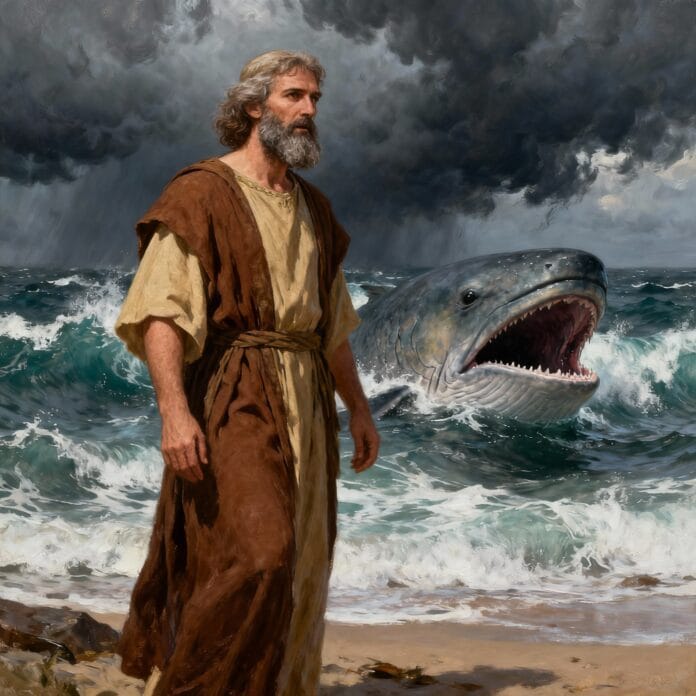
1° The person and era of the prophet. — Jonah, whose Hebrew name (Yônah) means dove, was the son of’Amittai (Vulg., Amathi) (cf. 1, 1). The fourth book of Kings in the Vulgate (= 2e The Book of Kings in the New Vulgate promulgated in 1979), ch.14 v.25, tells us that he was from Gath-Hepher (Hebr.: Get-hahéfer; Vulg., Gath-Opher), small town located in the tribe of Zebulun (Joshua 19, 13), north of Nazareth, on the site of the present village of El-Meched.
According to this same passage in Kings, Jonah lived and prophesied during the reign of Jeroboam II; therefore, between the years 824 and 772 BC. He made a very comforting prediction to this prince, promising him, on behalf of God, that he would reclaim from his enemies the provinces they had taken from his predecessors. Jonah was thus a contemporary of Amos (cf. Amos 1:1) and Hosea (cf. Hosea 1:1). It is even probable that his prophetic ministry began before theirs, as it seems to date back to the very early years of Jeroboam's reign.
Apart from this detail and the remarkable episodes contained in the book that bears his name, we know nothing else of his life. His tomb is shown in two different places: at El-Meshad and at Nineveh, on the hill called Nebi-Younous ("Prophet Jonah") by the Arabs. Perhaps neither of them possessed it.
2° The nature of the Book of Jonah and its prophetic symbolism. This book has a very special character among the prophetic writings. In both content and form, it resembles the pages of the historical books of the Bible that recount the lives of Elijah and Elisha much more than those of the major and minor prophets. It does not consist of one or more prophetic discourses; but is entirely devoted to the account of a religious mission that Jonah was charged with fulfilling in Nineveh, and the extraordinary events that accompanied this mission. Nevertheless, if the compilers of the biblical canon have classified it among the literary works of the prophets, it is evidently because it, too, contains prophetic truths, which are not difficult to discover.
The first of these truths is that, contrary to the false ideas that were increasingly taking hold among the Hebrews, the Gentiles were capable of being saved; indeed, God was calling them directly to redemption. The sending of an Israelite prophet to Nineveh demonstrates in the most manifest way the reality of this call, and the prompt conversion of the inhabitants of the guilty city was, for Jews of all times, a "sign" (this is the word of Jesus Christ himself. Cf. Luke 1129-32. "It is for the condemnation of Israel that Jonah is sent to the Gentiles, for Nineveh will repent, but Israel persisted in its wickedness." (Saint Jerome) and a remarkable lesson.
But there is another, even more important truth, which is symbolized by a special passage in the story of Jonah: it is the great event of the resurrection of Our Lord Jesus Christ. We have as our guarantor the clear and explicit testimony of the Savior himself: «Just as the prophet Jonah was three days and three nights in the belly of a huge fish, so the Son of Man will be three days and three nights in the heart of the earth.» (Matthew 12:40). It is probable that the divine Master also alluded to the prophecy of Jonah when he told his disciples (Luke 24:46) that it was «written» that Christ would rise again on the third day; indeed, no other passage in the Holy Scriptures specifies the precise day of the resurrection of the Savior.)
3° Fiction or reality? — The book of Jonah is so full of wonderful things that the pagans were already mocking it ("Try to keep these kinds of questions (like the one about the fish) from being ridiculed by the pagans") Saint Augustine(Ep. 52, quaest. 7). From the pagans, the sarcasm passed to the rationalists, whose first rule of hermeneutics, when it comes to Holy Scripture, consists in the negation of the supernatural. Thus, to rid themselves of such extraordinary and inconvenient miracles, they resorted to the "most adventurous interpretations" (a very apt observation by Reuss, one of the most renowned members of the so-called critical school), viewing this narrative sometimes as complete fiction, sometimes as a mixture of novel and reality (see the details and refutation in F. Vigouroux, Holy Scriptures and Rationalist Criticism, Paris, 1890, t. 4, p. 358 et seq.), mixture in which all the miraculous elements are legendary.
But the historical character of the book is demonstrated by the application that Our Lord Jesus Christ made of it. If the miracle of the fish, which is the most surprising of all, had been merely an allegory or a legend, how could the Savior have cited it as a formal type of his resurrection? It is also certain that the ancient Jews, so strict in their treatment of the Bible, would not have placed the Book of Jonah among the prophetic writings if they had not fully believed in the objective truth of the events it recounts; at most, they would have classified it, in that case, among the hagiographa (Tobit 14:4–6:15 (Greek text); Josephus, Ant. 9, 10, 2.). Christian tradition has also been consistent and general on this point. Finally, the narrative itself, in its details as well as in its overall form, produces, in anyone who reads it without preconceived ideas, the profound and powerful impression that the narrator intended to present real events throughout, and not invented stories. As he said Saint Augustine (Loc. Cit., quaest. 6), « Either one should not believe in divine miracles, or there is no reason not to believe in them.. [In 2022, the majority of Catholic exegetes favored the thesis of literary fiction. Nevertheless, we emphasize that this question falls under the purview of theological opinion: no act of the Magisterium has definitively ruled one way or the other. Personally, we believe that the truly extraordinary and miraculous nature of the storm and its sudden cessation caused a great stir among the sailors and subsequently in Nineveh. This would be one of the reasons why the inhabitants of Nineveh so readily believed Jonah's preaching. The story of the near-shipwreck and the eventual rescue of the ship and its crew must have reached the ears of the king of Nineveh. Editor's note]
4° The author and the style. — Given the historical objectivity of the book bearing the name of Jonah, there is no serious reason not to admit that the prophet personally composed it. It is true that objections are raised to this view on the following grounds: 1) the use of the third person instead of the first in the course of the narrative; 2) the remark "Nineveh was a great city" (3:3), which seems to imply that this city had ceased to exist, or at least had considerably lost its importance, at the time the book was composed; 3) the Aramaicisms in the language; 4) in the prayer of chapter 2, some reminiscences of psalms that are claimed to be relatively recent.
But these objections are easily refuted. The impersonal form given to the narration is more natural, more modest, and also more common in analogous passages of the Holy Books (particularly in the Pentateuch, in the historical parts of the book of Jeremiah and of Daniel. Our opponents would not have failed to see the use of the first person as proof of inauthenticity. Nineveh was, in fact, a very large city when Jonah came to preach there. The Aramaic expressions, whose importance has been exaggerated, are explained by the prophet's nationality: the Galileans had a number of Aramaic expressions in their language. As for the borrowings from the Psalter, they come from poems older than that of Jonah, or else the authors of the Psalms themselves are the borrowers. It is therefore without reason that various exegetes have pushed back the composition of the Book of Jonah to the time of the exile, and even beyond.
Stylistically, this book is written in simple prose, with the exception of the hymn of thanksgiving (2:2-10). The descriptive section is very vivid and dramatic; the poem is not lacking in either power or beauty.
5° The division. — Four parts, which roughly correspond to the four chapters: 1° the disobedience and punishment of Jonah, 1, 1-2, 1; 2° the prayer of the prophet and his deliverance, 2, 2-11; 3° the preaching of Jonah in Nineveh and its admirable result, 3, 1-10; 4° Jonah, dissatisfied with the pardon granted to the Ninevites, is rebuked by the Lord, 4, 1-11.
The best Catholic commentaries are: in antiquity, Theodoret of Cyrrhus, Narrations in duodecim Prophetas and Saint Jerome, Commentaria in Prophetas minores. In modern times: F. Ribera, In librum duodecim Prophetarum commentarii, Antwerp, 1571; Sanchez, How. In Prophetas minores and Baruch, Lyon, 1621.
Jonah 1
1 The word of the Lord came to Jonah, son of Amathi, saying: 2 «Arise, go to Nineveh, the great city, and preach against it, for their wickedness has come up before me.» 3 And Jonah arose to flee to Tarshish from the presence of the Lord. He went down to Joppa and found a ship going to Tarshish, and having paid the fare, he went down on board to go with them to Tarshish, from the presence of the Lord. 4 But the Lord caused a great wind to blow upon the sea, and there was a great storm on the sea, so that the ship threatened to break up. 5 The sailors were afraid, they each cried out to their god and threw the cargo that was on the ship into the sea to lighten their load. And Jonah had gone down into the hold of the ship, lain down, and slept soundly. 6 Then the crew leader approached him and said, "Why are you sleeping? Get up, call upon your God, perhaps God will think of us and we will not perish."« 7 And they said to one another, «Come, let us cast lots, so that we may know whose fault is this.» They cast lots, and the lot fell on Jonah. 8 Then they said to him, "Tell us, on whose account has this misfortune befallen us? What is your profession? Where do you come from? What is your country? And what people are you from?"« 9 He answered them, «I am a Hebrew and I worship the Lord, the God of heaven, who made the sea and the land.» 10 The men were filled with great fear and said to him, «What have you done?» for the men knew that he was fleeing from the presence of the Lord, because he had told them so. 11 They said to him, "What shall we do to you, that the sea may calm down for us?" For the sea continued to rise higher and higher. 12 He replied, "Take me and throw me into the sea, and the sea will calm down for you, for I know that it is because of me that this great storm has come upon you."« 13 The men rowed to reach land, but they could not because the sea continued to rise up more and more against them. 14 Then they cried out to the Lord, saying, «O Lord, do not let us perish for this man’s life, and do not burden us with innocent blood, for it is you, O Lord, who have done as you pleased.» 15 And taking Jonah, they threw him into the sea, and the sea calmed his fury. 16 And the men were filled with great fear for the Lord, and they offered a sacrifice to the Lord and made vows.
Jonas 2
1 And the Lord brought a great fish to swallow Jonah, and Jonah was in the belly of the fish three days and three nights. 2 And from the belly of the fish, Jonah prayed to the Lord his God. 3 He said: «From my distress I called upon the Lord and he answered me; from the belly of Sheol I cried out: you have heard my voice. 4 You threw me into the abyss, into the heart of the seas, and the currents surrounded me. All your waves and all your surges swept over me. 5 And I said: I am driven from before your eyes, yet I will still behold your holy temple. 6 The waters had enveloped me to the soul, the abyss surrounded me, seaweed encircled my head. 7 I had descended to the roots of the mountains, the earth's locks were drawn upon me forever, and you brought my life up from the pit, Lord, my God. 8 When my soul fainted within me, I remembered the Lord and my prayer reached you, to your holy temple. 9 Those who cling to futile vanities abandon the author of their grace. 10 But I, with praise, will offer you a sacrifice; the vow I have made, I will fulfill. Salvation belongs to the Lord. 11 The Lord spoke to the fish, and the fish vomited Jonah onto the earth.
Jonas 3
1 The word of the Lord came to Jonah a second time, saying: 2 «Get up, go to Nineveh, that great city, and preach to it the message I will tell you.» 3 And Jonah arose and went to Nineveh according to the word of the Lord. Now Nineveh was a great city in God's sight, three days' journey away. 4 Jonah began to enter the city, a day's walk, and he preached, saying, "In forty days Nineveh will be destroyed."« 5 The people of Nineveh believed in God, they proclaimed a fast, and they put on sackcloth, from the greatest to the least. 6 When the news reached the king of Nineveh, he rose from his throne, took off his robe, covered himself with sackcloth, and sat down in ashes. 7 And a cry went out in Nineveh, and by decree of the king and his nobles, these words were spoken: «Neither man nor beast, oxen nor sheep, shall taste anything, nor feed, nor drink water, 8 Let them cover themselves with sackcloth, both men and animals, let them cry out to God with strength, and let each one turn away from his evil ways and from the violent acts that his hands commit. 9 Who knows if God will not repent and turn from his fierce anger, so that we do not perish?» 10 God saw what they were doing, how they turned away from their evil ways, and God relented from the punishment with which he had threatened them.
Jonas 4
1 Jonah was deeply grieved and angered. 2 He prayed to the Lord and said, «Ah, Lord, is this not what I said when I was still in my own country? That is why I first fled to Tarshish, for I knew that you are a merciful and gracious God, slow to anger, abounding in grace, and relenting from sending calamity. 3 Now, Lord, take my soul from me, for it is better for me to die than to live.» 4 And the Lord answered, «Do you have a right to be angry?» 5 And Jonah went out of the city and sat down to the east of the city, there he made himself a shelter and sat under it in the shade until he saw what would happen in the city. 6 And the Lord God made a castor oil plant grow up over Jonah to give shade over his head, to deliver him from his suffering, and Jonah was very glad because of the castor oil plant. 7 But the Lord brought a worm at daybreak the next day, which attacked the castor oil plant and it withered. 8 And when the sun rose, the Lord brought a scorching wind from the east, and the sun beat down on Jonah's head, so that he fainted. He asked to die and said, "It is better for me to die than to live."« 9 Then God said to Jonah, «Do you have a right to be angry about the castor oil plant?» He replied, «It is right for me to be angry, even to the point of death.» 10 And the Lord said, «You grieve over the castor oil plant, for which you did not labor and which you did not make grow, which came up in a night and perished in a night, 11 And I would not grieve over Nineveh, that great city, in which there are more than 120,000 people who do not know their right hand from their left, and also a great many animals.»
Notes on the Book of Jonah
1.2 Nineveh, It is located on the left bank of the Tigris River in Iraq, in the suburbs of Mosul. From the reign of Sennacherib onward, it was the last of the Assyrian capitals. At the height of its power in the 7th century BC, it covered 775 hectares and was protected by a 12-kilometer-long wall.
1.3 Isaiah 2, 16. ― Joppé, today Jaffa, a seaport on the Mediterranean, west of Jerusalem.
2.1 See Matthew 16:4; Luke 11:30; 1 Corinthians 15:4. Jonah in the belly of the fish is a figure of Jesus Christ in the tomb. Cf. Matthew, 12:40. — We are dealing here with a truly miraculous narrative. Why seek a purely supernatural action from natural agents? God, who saved Jonah, could easily have found in his wisdom a way to accomplish his will. But this way is impossible for us to know. This miracle currently leads the majority of exegetes to deny any historical basis to the Book of Jonah. It is impossible, they say, for a man to live three days and three nights without air. This argument only holds water for those who do not believe in miracles. Jesus himself declared this when he told the Jews that they would have no other miracle than that of Jonah (cf. Matthew 12:39).
2.3 See Psalms, 119, 1.
2.6 See Psalms, 68, 2.
2.9 vanities ; That is to say, to idols.
3.3 three days of walking, that is to say, it took three days to walk through the streets and announce the Lord's threats.
3.5 See Matthew 12:41; Luke 11:32.
3.6 To the King of Nineveh. The name of this king is not known for certain; it could be Rammannisar, a contemporary of Jonah, who reigned from 810 to 782 BC.
3.9 See Jeremiah 18:11; Joel 2:14.
4.2 See Psalms 85:5; Joel 2:13.
4.9 I am right to be so irritated that I wish I were dead. According to St. Jerome, Jonah is dejected because he saw the future of Israel: failing to welcome the Messiah and losing the monopoly of divine election to all the pagan nations (Ephesians 3:5).
4.10-11 An incomparable episode, one of the most beautiful in Scripture, and to which this other saying of the Lord in Hosea would fit well as an epilogue: «I will not give vent to my anger, nor will I destroy Ephraim, for I am God, and not a man.” Cf. Hosea 11:9.
4.11 One hundred and twenty thousand men, etc. It was calculated that, based on this figure of 120,000 children, there must have been approximately 600,000 inhabitants in Nineveh. who cannot distinguish their right from their left, who have not reached the age of reason.