












1° His name and his place in the biblical canon.— This little book is sometimes called by the Jews ‘'Ekah, according to his first word, sometimes Qînôt, or lamentations, and it is on this second name that the names of Θρήνοί were based, Threni Or Lamentations, Greeks and Latins (David's elegy on the death of Saul and Jonathan also bears the name of qînah (cf. 2 Samuel 1:17); likewise various complaints inserted in the prophetic books (cf. Jer. 7:29 and 9:19; Ezek. 2:10; 11:1, 14; 26:17, etc.; Am. 5:1 and 8:10).
In the Hebrew Bible, he is one of the five Megillôt or rolls, themselves arranged among the Ketubim or Hagiographers; there he occupies the third rank, between Ruth and the’EcclesiastesIn the Vulgate as in the Septuagint, it was quite naturally linked to the works of Jeremiah, and it seems certain that this was also its original place in the Hebrew text; we have Origen as guarantors of this fact (In Ps. 1), Saint Epiphanius (Adv. Haer., 8, 6), Saint Hilary (Prologue. In Psalms. 15), Saint Jerome (Prolog. galeatus), which, listing the scriptural books whose authenticity the Jews admitted, mention as a single writing the prophecy of Jeremiah and the Lamentations.
2° Its poetic form. — The Lamentations is therefore an elegiac poem, composed of five cantos, which correspond exactly to the five chapters of this small book. The first four cantos are alphabetical or acrostic («Jeremiah wept for the ruins of his city with a fourfold alphabet,» said Saint Jerome, Praef. In Jerem.), with the difference that, in the first, second, and fourth, each verse begins in turn with one of the twenty-two letters of the Hebrew alphabet, while, in the third, each letter is placed at the beginning of three consecutive verses. This is why the Vulgate and the Septuagint have retained, at the beginning of the verses, the names of the Hebrew letters: aleph, beth, ghimel, daleth, etc. (in chapters 2, 3 and 4, the letter phe precedes the ‘'ain, which she should follow regularly; the reason for this transposition is unknown). One might have expected that such a non-spontaneous artistic process… would have brought more obstacles to the expression of feelings… (However) this form could be maintained with enough ease not to embarrass a well-gifted poet… Assuredly, these are less passionate complaints than painful meditations, returns to the past, descriptions. The didactic element appears more than once, and this kinship with the genre of poetry that pursues the same goal probably led to the choice of the alphabetical form, appropriate for expressing a series of proverbs (compare in the Hebrew text Psalms 25, 34, 112, 119 (Vulg. 118), and Proverbs 31:10-31). Perhaps it was like a dam the poet had deliberately built for himself, to limit and control his sorrow. In any case, this alphabetical order in no way hinders the natural expression of feelings; it resembles the narrow bed of a river that determines the course of the waters; through the rocks that constrict the bank, the freshest and swiftest waves burst forth. The fifth canto is not an acrostic, undoubtedly because it contains a prayer, and reflection gives way there to the freer expression of feelings.
Another peculiarity of the Book of Lamentations in terms of external form: the first and second cantos are composed of long verses with three members (1, 7 and 2, 19, the verses have four members, exceptionally), each member of which is cut by a caesura into two unequal parts; the verses of the fourth canto have only two members, cut in the same way; those of the third canto have only one member, with a caesura; those of the fifth have two members, without a caesura.
We are struck, when studying this poem, by seeing that the third canto (chapter 3) is the main piece, around which the other four revolve, so to speak; it is truly the summit and culminating point of the whole piece, both by its position and by its greater richness in terms of thoughts, and its more careful arrangement.
These various features demonstrate the brilliance of literary art in the Book of Lamentations; it is almost unique in this respect within the Old Testament. The parallelism of the clauses, which constitutes the principal element of Hebrew poetry, is, however, less regular here than elsewhere; it is more frequently rhythmic and synthetic than synonymous and antithetical.
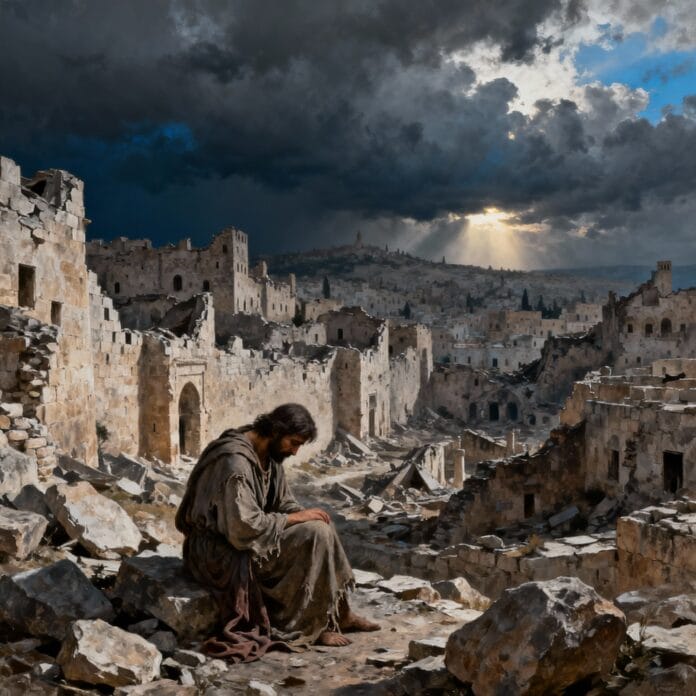
3° The subject and purpose of the book. — The purpose of Lamentations is to sing of the events recounted in summary in chapter 25 of the Second Book of Kings (compare Jeremiah 39 and 52), namely, the total destruction of the kingdom of Judah by Nebuchadnezzar, the devastation of the land, the capture, plunder, and ruin of Jerusalem, the misfortunes of the people taken into captivity; in short, the most painful and moving scenes of the final catastrophe. Each canto encompasses all these various points as a whole, for the central idea of the poem does not branch out distinctly in each chapter. However, the first elegy alludes more directly to the state of abandonment and the humiliations of Jerusalem; the second, to the terrible role played by the Lord himself in the ruin of the unfortunate city; the third explains to the people how their sufferings should lead them to repentance and hope; the fourth speaks primarily of the punishment of the ruling classes. The fifth demands the restoration of the nation.
It is quite wrong to have sometimes seen in Lamentations a prophecy in the strict sense. No, the Qînôt They do not predict the future ruin of the Jewish state; they describe events already accomplished; their author is an eyewitness, recounting what happened before his eyes. As for the applications that have been made of either the entire book or some of its parts to Our Lord Jesus Christ and the Blessed Virgin Mary... Married and to the Catholic Church, they are simply spiritual and accommodating.
The poet's aim is clearly expressed in the following lines: To gradually lead the Jews, so deeply afflicted, to a true understanding of their many sins, and consequently to genuine lament and true sorrow; to transform their savage grief into prayer…: this is what the author set out to do. Or again: In such calamities, the human heart withers or melts; it becomes insensitive or abandons itself to despair. The poet's intention is to protect his compatriots from both of these extremes. He wants them to weep with him, but in his own way.
4° The author of Lamentations. Jewish and Christian tradition has consistently identified the prophet Jeremiah as the author of this admirable poem. The Septuagint acted as interpreters of the Jewish belief on this point when they placed, at the beginning of the book, the short historical introduction that we also read in the Vulgate (the words and animo amaro suspirans and ejulans are found only in our Latin version), and, in a completely abbreviated form, in the Chaldean paraphrase («Dixit Jeremias propheta et sacerdos magnus» [translation: «The Word of Jeremiah, prophet and high priest»]. The Hebrew text begins abruptly, without anything like it): but this testimony takes us back at least two hundred years before the Christian era, and it presupposes a much older tradition. We need not dwell on the Christian tradition, as it is so evident.
The intrinsic arguments are so much in agreement with this extrinsic proof that exegetes, usually so bold, have only rarely tried to deny Jeremiah the glory of having composed the Lamentations (see their reasons in Knabenbauer, Comment. In Danielem…, Lamentat. and Baruch, (Paris, 1891, pp. 367-374): everything recalls his style, his thoughts, his language, his character as a man and as a writer. "Jeremiah's style is revealed, so to speak, on every line; they are the same descriptions..., the same images, the same vehemence of feelings." (Fulcran Vigouroux, Bible Manual, vol. 2, no. 1015. See in Knabenbauer, lc.(pp. 370-372, the list of principal stylistic similarities). The vivid and lively details that appear at every turn are explained by the author's presence in Jerusalem, amidst the terrible and gloomy scenes he describes. This latter circumstance demonstrates that Jeremiah must have composed his Lamentations shortly after the capture and burning of Jerusalem. A cave is shown to the west, not far from the Jewish capital, where he is said to have secluded himself to write Lamentations.
5° Their literary beauty and their liturgical use. Bossuet said, regarding the Lamentations: «Jeremiah is the only one who has equated lamentations with calamities.» And indeed, «in the entire realm of human suffering expressed in words, from the most tragic lamentations of classical Hellas to the complaints of Ossian and the Nibelungen, It would be difficult to find anything comparable to these sacred elegies, both in the depth of their pathos and in the grandeur and nobility of their language.»
This much-admired poem has long played a special role in both Jewish and Christian liturgy. Jews sing it in their synagogues on the 8th ab (a month corresponding to part of July and part of August), the day on which they celebrate the anniversary of the destruction of the two temples. They are also advised to read it privately whenever death brings mourning to their families. The Latin Catholic Church has incorporated a significant portion of it into the office for the last three days of Holy Week: the poet's laments are then spiritually placed "on the lips of Christ, of whom Jeremiah was a figure, and in the mouth of the Church, which mourns… the sufferings of the Savior and the sins of his children.".
Lamentations 1
ALEPH. 1 What is she like? seat The once-populated city is lonely. She who was great among the nations has become like a widow. She who was queen among the provinces has been subjected to tribute. BETH. 2 She weeps bitterly through the night, tears covering her cheeks; not one consoles her. Of all her lovers, all her companions have betrayed her; they have become her enemies. GHIMEL. 3 Judah went into exile, wretched and condemned to hard labor; he dwells among the nations, finding no rest; his persecutors have overtaken him in narrow passes. DALETH. 4 The roads of Zion mourn, for no one comes to her feasts anymore; all her gates are in ruins, her priests groan, her virgins grieve, and she herself is in bitterness. 5 Her oppressors prevail, her enemies prosper, for the Lord has afflicted her because of the multitude of her offenses; her grandchildren have gone into captivity before the oppressor. VAV. 6 And the daughter of Zion has lost all her glory; her princes are like deer that find no pasture and wander off without strength before the pursuer. ZAÏN. 7 Jerusalem remembers, in the days of her affliction and her wandering life, all the precious things she possessed from days of old. Now that her people have fallen into the hand of the oppressor and no one comes to their aid, their enemies see her and laugh at her abandonment. HETH. 8 Jerusalem has multiplied her sins, therefore she has become defiled; all who honored her despise her, for they have seen her nakedness; she herself groans and turns away her face. TETH. 9 Her defilement was visible beneath the folds of her dress; she had not considered her end. And she fell in a strange way, and no one consoled her. "See, Lord, my misery, for the enemy triumphs." JOD. 10 The oppressor has stretched out his hand over all her treasures, for she has seen the nations enter her sanctuary, the nations concerning which you had given this command: «They shall not enter your assembly.» CAPH. 11 All her people groan, searching for bread; they give their jewels for food, which gives them life. "See, Lord, and consider the abjection into which I have fallen." LAMED. 12 «O all you who pass by on the road, look and see if there is any sorrow like the sorrow that weighs upon me, whom the Lord has struck down on the day of his fierce anger. MEM.”. 13 «"From on high he hurled a fire into my bones that devoured them, he spread a net before my feet, he made me retreat, he threw me into desolation, I languish all day long. NUN.". 14 «The yoke of my iniquities has been bound in his hand; they are bound together like a bundle on my neck; he has made my strength falter. The Lord has delivered me into hands I cannot resist. SAMECH.”. 15 «The Lord has taken away all the warriors who were in my midst; he has summoned an army against me to crush my young men; the Lord has trodden the virgin daughter of Judah in the winepress. Ain.”. 16 «That is why I weep, why my eye overflows with tears, for there is no one near me to comfort me, to restore my life; my children are in desolation, for the enemy prevails.» PHÉ. 17 Zion stretched out her hands. No one could comfort her. The Lord summoned his enemies against Jacob, who surrounded him; Jerusalem became like a defiled thing in their midst. TZADÉ. 18 «The Lord is truly just, for I have rebelled against his commands. Oh, listen all you peoples and see my sorrow: my virgins and my young men have gone into exile.” QOPH. 19 I called to my lovers, they deceived me; my priests and elders perished in the city, searching for food to revive their lives. RESCH. 20 «Look, Lord, at my anguish. My bowels are in turmoil, my heart is troubled within me, because I have been very rebellious. Outside, the sword slays my children, inside, it is death. SIN.”. 21 «My groans are heard, but there is no one to comfort me. All my enemies, hearing of my misfortune, rejoice at what you have done. You will bring about the day you have announced, and they will become like me. Thav.”. 22 «Let all their wickedness be before you, so that you may treat them as you have treated me, because of all my offenses. For my groans are many and my heart is sick.»
Lamentations 2
ALEPH. 1 How the Lord, in his anger, has covered the daughter of Zion with a cloud! He has cast down from heaven to earth the splendor of Israel; he has not remembered the footstool of his feet in the day of his anger. Beth. 2 The Lord has mercilessly destroyed all the dwellings of Jacob; in his fury he has overthrown the strongholds of the daughter of Judah, he has thrown them to the ground; he has profaned the kingdom and its princes. GIMEL. 3 In the heat of his anger, he shattered all the strength of Israel; he drew back his right hand before the enemy; he kindled in Jacob a blazing fire that consumed on all sides. DALETH. 4 He drew his bow like an enemy, his right hand was raised like that of an assailant, and he slaughtered all that was pleasing to the eye; in the tent of the daughter of Zion, he poured out his wrath like fire. HEY. 5 The Lord was like an enemy; he destroyed Israel, he destroyed all its palaces, he demolished its citadels, he heaped pain upon pain upon the daughter of Zion. VAV. 6 He has violated its enclosure, like a garden, he has destroyed its sanctuary. The Lord has put an end to the solemnities and Sabbaths in Zion; in the heat of his anger, he has rejected king and priest with contempt. ZAÏN. 7 The Lord detested his altar, abhorred his sanctuary; he handed over the walls of his fortresses to the enemy; there was shouting in the house of the Lord, as on a day of celebration. HETH. 8 The Lord plotted to overthrow the walls of the daughter of Zion; he stretched out the measuring line; he did not withdraw his hand until he had destroyed them; he made the wall and the forewall mourn; they lie sadly together. TETH. 9 Its gates are sunk into the ground; he has broken down and shattered its bars. Its king and princes are among the nations; there is no longer any law, not even its prophets receive visions from the Lord. JOD. 10 They sit on the ground in silence, the elders of the daughter of Zion; they have thrown dust on their heads; they are clothed in sackcloth; they bow their heads to the ground, the virgins of Jerusalem. CAPH. 11 My eyes are consumed with tears, my heart is in turmoil, my liver pours out on the ground, because of the wound of the daughter of my people, when children and infants faint in the city squares. LAMED. 12 They say to their mothers, «Where is there bread and wine?» And they fall as though struck by a sword, in the city squares, and their souls die in their mothers’ arms. MEM. 13 What can I say to you? Who is like you, daughter of Jerusalem? To whom can I compare you, virgin daughter of Zion, to comfort you? For your wound is as deep as the sea: who can heal you? NUN. 14 Your prophets have seen for you vain and foolish visions; they have not revealed your iniquity to you, so as to avert exile from you, but they have given you visions of lies and deceit. SAMECH. 15 They clap their hands over you, all who pass by on the road; they hiss and shake their heads at the daughter of Jerusalem, “Is this the city that was called perfect in beauty?” joy "of all the earth?" PHÉ. 16 They open their mouths against you, all your enemies; they hiss, they gnash their teeth, they say: "We have swallowed it up. This is the day we were waiting for; we have arrived at it, we see it." AÏN. 17 The Lord has done what he planned, he has fulfilled his word, which he spoke from of old; he has destroyed without pity, he has made the enemy rejoice over you, he has exalted the horn of your oppressors. TZADÉ. 18 Their hearts cry out to the Lord. O wall of the daughter of Zion, let your tears flow like a torrent, day and night; give you no respite, let your eyes have no rest. QOPH. 19 Arise, cry out in the night, at the beginning of the watches; pour out your heart like water before the face of the Lord. Lift up your hands to him for the lives of your little ones, who faint from fear because of hunger, at the corners of every street. RESCH. 20 «Look, Lord, and consider: whom have you ever treated like this? What, women eat the fruit of their wombs, the little children they cherish? SIN. What. They are slaughtered in the sanctuary of the Lord, the priest and the prophet.”. 21 «They lie on the ground in the streets, the child and the old man, my virgins and my young men have fallen by the sword, you slaughtered in the day of your anger, you sacrificed without pity. THAV.”. 22 «You summoned my terrors from every side, as on a day of celebration; on the day of the Lord’s anger, there was no one who escaped or fled: those whom I had cherished and exalted, my enemy has exterminated.»
Lamentations 3
ALEPH. 1 I am the man who has seen affliction under the staff of his fury. 2 He led me and made me walk in darkness and not in light, 3 He turns his hand over and over against me alone all day long. BETH. 4 He has worn away my flesh and skin, he has broken my bones. 5 He built against me, he surrounded me with bitterness and boredom. 6 He has made me dwell in darkness, like those who have long been dead. GHIMEL. 7 He surrounded me with a wall so I couldn't get out, he made my chains heavy. 8 Even when I cry out and plead, he shuts off all access to my prayer. 9 He has walled my paths with hewn stones, he has disrupted my ways. DALETH. 10 He was like a bear lying in wait for me, like a lion in ambush, 11 He has turned my ways aside and torn me to pieces; he has left me desolate., 12 He strung his bow and placed me as the target of his arrows. HEY. 13 He drove the threads of his quiver deep into my loins, 14 I am the laughingstock of all my people, their song all day long., 15 He filled me with bitterness, he gave me absinthe to drink. VAV. 16 And he made my teeth grind gravel, he plunged me into the ashes, 17 And my soul is violently torn from safety; I have forgotten happiness., 18 And I said, «My strength is lost, and so is my hope in the Lord.» ZAÏN. 19 Remember my affliction and my suffering, the wormwood and the bitterness. 20 My soul constantly remembers it and is dejected within me. 21 This is what I will remember in my heart and this is why I will hope: HETH. 22 It is a grace from the Lord that we are not destroyed, for his mercies are not exhausted. 23 They are renewed every morning; great is your faithfulness. 24 «The Lord is my portion,» says my soul, “therefore I will hope in him.” TETH. 25 The Lord is good to those who hope in him, to the soul who seeks him. 26 It is good to wait in silence for the Lord's deliverance. 27 It is good for a man to bear the yoke from his youth. JOD. 28 Let him sit apart, in silence, if God requires it of him. 29 Let him put his mouth in the dust: perhaps there is hope. 30 Let him turn his cheek to the one who strikes him, let him be filled with shame. CAPH. 31 For the Lord does not reject forever, 32 But if he causes suffering, he has compassion, according to his great mercy., 33 For it is not willingly that he humiliates and afflicts the children of men. LAMED. 34 When all the captives of the country are trampled underfoot, 35 when a man's rights are violated, in the face of the Most High, 36 When someone is wronged in their cause, the Lord would not see it. MEM. 37 Who spoke and it was done, without the Lord having commanded it? 38 Do not both good and evil proceed from the mouth of the Most High? 39 Why should a man complain while he lives? Let each one complain of his sins. NUN. 40 Let us examine our ways and scrutinize them and return to the Lord. 41 Let us lift our hearts, with our hands, to God in heaven: 42 «We have sinned, we have rebelled, and you have not forgiven.» SAMECH. 43 «"You were consumed by your anger and you pursued us, you killed without sparing, 44 You have covered yourself with a cloud, so that the prayer would not pass away, 45 You have made us like rubbish and scum among the peoples.» PHEA. 46 They open their mouths against us, all our enemies. 47 Terror and the pit were our lot, as well as devastation and ruin. 48 My eyes melt into a stream of tears, because of the ruin of the daughter of my people. AÏN. 49 My eye weeps and does not stop, because there is no respite, 50 until he looks down and sees the Lord from heaven. 51 My eye aches, my soul, because of all the girls in my city. TSADÉ. 52 They hunted me down like a sparrow, those who hate me without cause. 53 They wanted to destroy my life in the pit and they threw a stone at me. 54 The waters were rising above my head, I said, "I am lost." QOPH. 55 I called upon your name, Lord, from the deep pit, 56 You heard my voice: "Do not close your ear to my sighs, to my cries."« 57 You drew near on the day I called upon you and you said, «Do not be afraid.» RESCH. 58 Lord, you took up my cause, you saved my life. 59 You have seen, Lord, the violence they are doing to me, grant me justice. 60 You saw all their resentment, all their plots against me. SIN. 61 You have heard their insults, Lord, all their plots against me, 62 the words of my adversaries and what they plot against me all day long. 63 When they sit down or stand up, look: I am the subject of their songs. THAV. 64 Lord, you will repay them what they deserve, according to the work of their hands., 65 You will give them blindness of heart; your curse will be upon them. 66 You will pursue them in anger and you will exterminate them from under your heaven, Lord.
Lamentations 4
ALEPH. 1 How did the gold tarnish, how did the pure gold become debased, how were the sacred stones scattered to every street corner? BETH. 2 The noblest sons of Zion, valued at the weight of fine gold, how could they be counted as earthen vessels, the work of a potter's hands? GHIMEL. 3 Even jackals offer their teats and suckle their young, but the daughter of my people has become cruel, like ostriches in the desert. DALETH. 4 The infant's tongue sticks to the roof of his mouth because of thirst; little children ask for bread, and no one gives it to them. HEY. 5 Those who feasted on delicacies are now starving in the streets, those who were worn in purple are now embracing dung. VAV. 6 And the iniquity of the daughter of my people was greater than the sin of Sodom, which was overthrown in an instant, without any hand being raised against it. ZAÏN. 7 Her princes surpassed snow in brilliance, milk in whiteness; their bodies were more crimson than coral, their faces like sapphires. HETH. 8 Their appearance is darker than black itself; they are no longer recognizable in the streets. Their skin is stuck to their bones, dry as wood. TETH. 9 Happier are the victims of the sword than the victims of hunger, which are slowly wasting away, wounded, for lack of produce from the fields. JOD. 10 Compassionate women cooked their children with their own hands; they served them as food, in the disaster of the daughter of my people. CAPH. 11 The Lord has exhausted his fury; he has poured out the heat of his anger and kindled a fire in Zion that has devoured its foundations. LAMED. 12 Neither the kings of the earth, nor all the inhabitants of the world, believed that the adversary, the enemy, would enter the gates of Jerusalem. MEM. 13 It was because of the sins of her prophets, the iniquities of her priests, who shed the blood of the righteous within her walls. NUN. 14 They wandered like blind people through the streets, covered in blood, so that their clothes could not be touched. SAMECH. 15 «Get away! He’s unclean!» they shouted at them. «Get away! Get away! Don’t touch him!» They wandered about, and it was said among the nations, «Let them not stay here.» PHEAS. 16 The Lord's angry face scattered them; he no longer looked upon them. The enemy had no respect for the priests, nor pity for the elders. AÏN. 17 And we, our eyes still burning with anticipation of vain help, from the top of our towers, we gazed towards a nation that cannot save. TSADÉ. 18 They spied on our every move, preventing us from walking in our own places. Our end is near, our days are fulfilled, yes, our end has come. QOPH. 19 Those who pursued us were swifter than the eagles of the sky; they chased us over the mountains, they set ambushes for us in the desert. RESCH. 20 The breath of our nostrils, the Lord's anointed, was taken from their pits, he of whom we said: "In his shadow we shall live among the nations." SIN. 21 Rejoice and be glad, daughter of Edom, who dwells in the land of Hus. The cup will pass to you also; you will become drunk and undress. TABH. 22 Your iniquity has ended, daughter of Zion; he will no longer send you into exile. He will punish your iniquity, daughter of Edom; he will expose your sins.
Lamentations 5
1 Remember, Lord, what has happened to us, look and see our disgrace. 2 Our heritage has passed to strangers, our homes to unknown people. 3 We are orphans, without a father, our mothers are like widows. 4 We pay money to drink our water, and wood only comes to us for a wage. 5 Our persecutors are pressing us from behind, we are exhausted, there is no more rest for us. 6 We reach out to Egypt and Assyria, to fill ourselves with bread. 7 Our fathers sinned, they are no more, and we bear their iniquities. 8 Slaves rule over us; no one will deliver us from their hands. 9 We earn our bread at the risk of our lives, before the sword of the desert. 10 Our skin is burning hot like an oven, due to the heat of hunger. 11 They have dishonored women in Zion, the virgins in the cities of Judah. 12 Chiefs were hanged by their hands, the faces of the old men were not respected. 13 Teenagers carried the haystack, children staggered, laden with wood. 14 The old men stopped going to the door, the young men stopped playing their lyres. 15 Joy The dancing in our hearts has ceased, our dances have turned to mourning. 16 The crown has fallen from our head, yes, woe to us, for we have sinned. 17 This is why our hearts are sick, why our eyes are dimmed: 18 It is because Mount Zion is desolate and jackals roam there. 19 You, Lord, sit enthroned forever; your throne endures from age to age. 20 Why would you forget us forever, abandon us for so many long days? 21 Bring us back to you, Lord, and we will return; renew our days as before. 22 For would you have completely rejected us, would you be exceedingly angry with us?
Notes on the Book of Lamentations
The words Aleph, Beth, etc., are the names of the letters of the Hebrew alphabet, which are twenty-two in number, arranged in their natural order.
1.1 The 1er This verse sets the tone for the entire piece. The thought that strikes the prophet's mind is the solitude in which he finds himself. The one who was queen, is now seat lonely, like the Judea captive ofRoman medals. Her children were taken from her and she is plunged into the deepest misery.
1.2 See Jeremiah 13:17.
1.7They laugh at his unemployment.The pagans usually reproached the Jews for their laziness because of the Sabbath.
1.10 The enemy carried, etc. Jeremiah is speaking here of what happened at the capture of Jerusalem, when the Chaldean soldiers carried their sacrilegious hands into the sanctuary (see Lamentations, 2, 7).
1.15 The Lord has trodden the winepress ; to let the wine of his anger flow. cf. Isaiah, 63, 2-3; Joel, 3, 13; Apocalypse, 14, 19-20; 19, 15. ― the virgin, etc.; to intoxicate the virgin, etc. It is the people of Judah, in this passage as in many others, who are designated by the name of a virgin and a daughter.
1.16 See Jeremiah 14:17.
1.18 The Lord is truly just. ; in the suffering he has inflicted upon me.
1.20 Outside the city, in the countryside, the Jews were killed by the Chaldeans; in the city they died from famine and plague.
2 Aleph. For this word and others like it, which are at the beginning of the following verses, see the beginning of the notes.
2.1-22 The second elegy primarily depicts the destruction of the holy city and the temple, just as the first had depicted its present solitude. It traces the relationship from effect to cause.
2.1 covered in a cloud, In the Bible, darkness often signifies misfortune, calamity, and great affliction. The stepladder at his feet ; that is to say, his ark of the covenant, his temple.
2.3 the intensity of his anger. See Jeremiah, 4, 8. ― The horn ; strength, power.
2.6 He destroyed his sanctuary, that is, his temple.
2.7 the place he dedicated himself to, his sanctuary.
2.8 The forewall ; the small wall that was placed in front of the rampart has fallen.
2.10 Signs of mourning and desolation.
2.11 My liver, etc.; hyperbole, to express great pain. cf. Job, 16, 14.
2.12 During the siege, the children are dying of hunger; they ask their mothers for food and they cannot give it to them.
2.14 Your prophets deceived you by presenting as false the prophecies that foretold misfortunes to you, by predicting that your enemies would be driven out of Judea.
2.16 This verse begins with Phe, and the following by Ain, contrary to alphabetical order. This inversion, which is also noticeable in the following two chapters, probably stems from the fact that some writer, seeing that the verse Phe It was better connected by meaning than by verse Ain, to the one who begins with Samech, believed he could afford this trip.
2.17 See Leviticus 26:14; Deuteronomy 28:15.
2.18 See Jeremiah 14:17; Lamentations 1:16.
3 Aleph For this word and others like it which are at the beginning of the following verses, see the beginning of the notes.
3.1-66 Chapter 3 deals primarily, though not exclusively, with the desolation of the Prophet himself.
3.1 the Lord's affliction.
3.6 the darkness; the prison where it was placed during the siege of Jerusalem (see Jeremiah, 38, 6-7 cf. Psalms, 48, 12 ; 142, 3.)
3.9 He blocked my path with a wall, thus preventing me from fleeing and reaching safety.
3.13 The threads of his quiver ; his arrows.
3.15 He filled me up with absinthe.. Proverbs 5, 4.
3.29 prostrate your face to the ground.
3.33 God punishes men, forced to do so by their sins. Ezekiel 18, vv. 23, 32; 33, 11.
3.37 See Amos 3:6. — Who would dare say that anything happened without the Lord's command?
3.39 Often in Scripture sin is used to represent the penalty, the punishment for sin.
3.46 Contrary to alphabetical order, the word Phe is put before Ain (see verse 49). See Lamentations, 2, 16.
3.51 The girls from my town ; that is to say, the virgins of Jerusalem (see Lamentations, 1, vv. 4, 18; 2, vv. 10, 21), or the cities of Judah of which Jerusalem was like the mother.
4.1-22 Chapter 4e initially appears to reproduce the paintings of the 1er and of the 2e, but it is to shine a ray of hope, by showing in divine punishment the very source of regeneration.
4.1 the real gold that shone in Jerusalem and the stones from which the sanctuary was built; or, according to others, this gold represents the princes of Israel (see verse 2), and the stones of the sanctuary, the priests.
4.3 ostriches. It is said that she abandons some of their eggs in the desert, see Job, 39, 16.
4.6 Sodom perished only by fire from heaven. See Genesis, 19, 24-25.
4.12 The enemy and the adversary. See Lamentations, 2, 17.
4.16 Phe. See, regarding the shift in meaning of this word, Lamentations, 2, 16.
4.19 Those who pursued us; an allusion to the Chaldeans, who pursued King Zedekiah with incredible speed and rapidity as he fled from them. cf. 2 Kings 25, 4-5; Jeremiah, 39, 5 ; 52, 8-9.
4.20 the Lord's anointed ; This is understood literally as referring to Zedekiah, king of God's people, but in a higher sense, it should be understood as referring to Jesus Christ, the true anointed one, the only Son of God, taken and delivered to death because of our sins.
4.21 Daughter of Edom ; This is the nation of the Idumeans. country of Hus ; Idumea.
5.1-22 A prayer in which Jeremiah implores God's help to put an end to so many evils.
5.2 Our heritage ; That is to say, the promised land that you gave to our fathers, and which we possessed by hereditary right. Foreigners ; the Chaldeans and neighboring peoples.
5.6 We made an alliance, but in vain, with Egypt and the Assyrians, from whom we expected help, in order to secure our survival. Bread, this word is used in the Bible for all kinds of food.
5.8 Slaves, etc.; according to some, these were the Chaldeans and Egyptians, also descended from Ham, whose descendants had been condemned to be slaves to Shem (see Genesis, 9, 26); according to others, the Idumeans, the Moabites and the Ammonites, peoples formerly subject to the Jews; finally, according to others, they were the very slaves of the Chaldeans, because it was the custom in houses where there were a certain number of slaves, that one of them should command the others.
5.9 Bread. See verse 6. Desert ; also applies in biblical language to plains and countryside. The meaning of this verse therefore appears to be: We risked being killed if we went to seek out fruits or wild herbs in the deserted countryside for food, because the land was full of enemies and plunderers.
5.10 The pangs of hunger ; The Arabs say the fire of hunger, The Greeks, a burning hunger.
5.12 The Chaldeans, after beheading the princes of Judah, hung them by their hands from poles.
5.13 Under the woods with which they were charged, or with which they were struck.
5.14 The door of the city, where the assemblies of judges were held.
5.16 The crown, etc. At parties, weddings and feasts, people crowned themselves with flowers.