











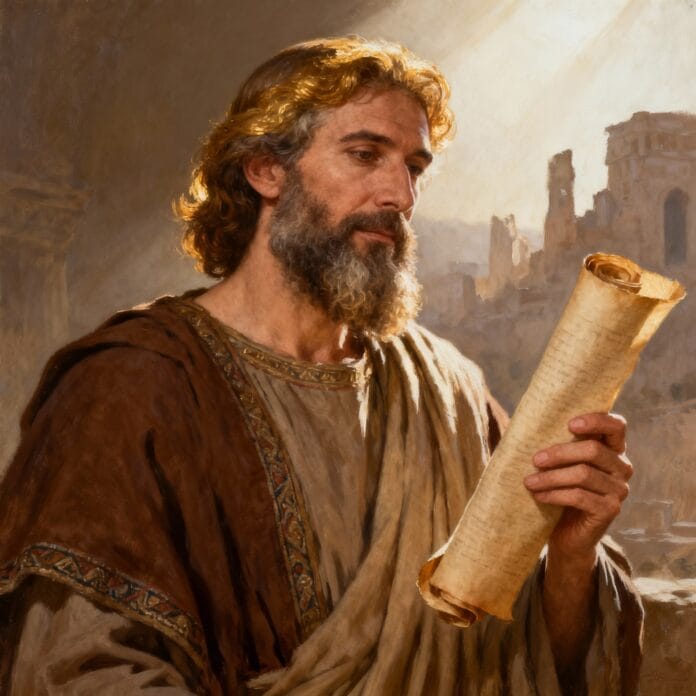
1. The person of the prophet. — Micah's Hebrew name was Mikah, short form of Mikayah (Jeremiah 26:18 uses this full form when speaking of our prophet. Micah himself seems to allude to the meaning of his name; cf. 7:18), «Who is like God?» The Septuagint renders it Mίχαιας, and the Vulgate Michaeas. This name was quite common among the Hebrews, as can be seen from its relatively frequent appearance in the Old Testament.
The prophet Micah himself tells us, from the very first line of his book, that he was originally from Moreshet (cf. 1, 6. Vulgate: Morasthiten), a small town located in the coastal plain or Šefélah, in the kingdom of Judah, not far from Geth, and very close to the border of the Philistines.
He should not be confused, as has sometimes been done, with his famous namesake who prophesied during the reign of Ahab, about a century before him (cf. 1 Kings 22:8 ff.). Absolutely nothing is known about his life.
2° The time of Micah This is also indicated in the title of his book. He prophesied during the reigns of the three kings of Judah: Jonathan (758-741 BC), Ahaz (741-727 BC), and Hezekiah (727-698 BC); therefore, if we take the earliest and latest dates, from 758 to 698 BC. Two facts confirm this chronological data from the title: Micah lived before the fall of Samaria (in 722 BC), which he predicted (cf. 1:6-7); Jeremiah quotes an oracle from him, which he connects to the reign of Hezekiah (Jer. 26:18). He was thus a contemporary of Hosea and Isaiah; but these two prophets had begun their ministry during the reign of Uzziah, father of Jonathan (cf. Isa. 1:1; Hos. 1:1). Micah has more than one trait in common with Isaiah, whose worthy collaborator he was; "he has before his eyes the same moral and social picture, and he censures the same disorders (compare the following coincidences, which are like reciprocal echoes: Mic. 2, 11 and Is. 28, 7; Mic. 3, 5-7 and Is. 29, 9-12; Mic. 3, 12 and Is. 31, 13; Mic. 4, 1-3 and Is. 2, 2-5; Mic. 5, 2-4 and Is. 7, 14; 9, 15; Mic. 5, 9-14 and Is. 2, 6-17; Mic. 7, 7 and Is. 8, 17; Mic. 7, 12 and Is. 11, 11, etc.).
3° The subject and division of the book. – The book of Micah, written in a single burst and remarkable for its unity, is merely a summary of a long prophetic activity. The prophet appears to have composed it towards the end of his career, under Hezekiah, arranging and organizing everything according to a logical order.
The subject is expressed in general terms at the beginning of the book: Word of the Lord (…) concerning Samaria and Jerusalem. (1, 1). Micah thus addresses all of Israel, the two kingdoms represented by their capitals; nevertheless, his prophecies concern the kingdom of Judah more particularly, for it is only in passing, and by way of example, that he deals with the schismatic kingdom of the ten tribes. After announcing Samaria's imminent ruin at the beginning of his writing (1, 2-8), he ceases to concern himself with it entirely, and speaks thereafter only to Jerusalem and Judah.
What he foretells to the inhabitants of Jerusalem and the subjects of the legitimate kingdom is the punishment that their many crimes will bring upon them from the justly angered Lord; but he also prophesies that the hour of mercy And forgiveness will follow, and the remnants of the people, spared by heavenly vengeance, will form a seed from which the theocratic nation will be reborn, holy and vigorous, to enjoy the happiness brought by the Messiah. The punishment of guilty Israel, and its future restoration: such is the theme of the book of Micah. From a strictly prophetic perspective, it unfolds within this threefold horizon: the Assyrians will destroy Samaria; the Chaldeans will destroy Jerusalem; the Messiah will come to repair all these ruins.
The book of Micah is commonly divided into three parts or discourses, which begin with the same expression., Listen (cf. 1:2; 3:1; 6:1), and which conclude with promises of happiness (cf. 2:12-13; 5:2 ff.; 7:14-20). The first discourse (1:2-2:13) develops this idea: Samaria will be destroyed, and the cities of Judah will mourn because of the sins of their inhabitants. The second discourse (3:1-5:14) announces that Zion, after suffering the deepest humiliations, will be raised to great glory. The third (6:1-7:20) describes, in prophetic terms, in a kind of dialogue between God and his people, the path by which the Jews can attain salvation. In the first part, the threat predominates; in the second, the promise. The third chapter has a distinct character (which is why some rationalists have quite vehemently attacked the authenticity of chapters 6 and 7; but their evidence is "so weak that their opinion is not worth considering" (Kaulen)); it lies somewhere between the other two. As menacing as the beginning of the book is, its final lines are gentle and graceful.
4° The literary genre of Micah. Micah is generally a remarkable writer. His simple and energetic style, usually very pure, attests to the golden age of prophetic literature. He sometimes achieves the majesty of Isaiah and the richness of imagery of Joel. He is often dramatic in his exposition. His parallelism is quite skillful. Paronomasia (cf. 1:10-15; 2:6; 4:14; 7:4, 11, etc. in the Hebrew text) and bold apostrophes frequently appear in his writing. He handles irony admirably. Like Hosea, he is sometimes a little obscure due to his conciseness; he, too, moves from one image to another without the slightest transition (cf. 6:16; 7:14, 15, 17, etc.). While some passages are marked by great severity due to the threats God had charged him to utter, others are exquisitely tender, describing the happiness of messianic times and divine mercy. He is therefore one of the foremost of the minor prophets, both in form and content.
The best Catholic commentaries are: in antiquity, Theodoret of Cyrrhus, Narrations in duodecim Prophetas and Saint Jerome, Commentaria in Prophetas minores. In modern times: F. Ribera, In librum duodecim Prophetarum commentarii, Antwerp, 1571; Sanchez, How. In Prophetas minores and Baruch, Lyon, 1621.
Micah 1
1 The word of the Lord that came to Micah of Moresh in the days of Johanan, Ahaz and Hezekiah, kings of Judah, of whom he had a vision concerning Samaria and Jerusalem. 2 Listen, all you peoples. Pay attention, earth, with all that fills you. The Lord God will testify against you, the Lord, from the temple of his holiness., 3 for behold, the Lord will come out of his dwelling place, he will come down, he will walk on the heights of the earth. 4 The mountains will melt beneath his feet, the valleys will split like wax before the fire, like water poured down a slope. 5 All this because of Jacob's transgression and the sins of the house of Israel. What is Jacob's transgression? Is it not Samaria? And what are the high places of Judah? Is it not Jerusalem? 6 I will make Samaria a heap of stones in a field, a place to plant vines; I will roll its stones down into the valley and lay bare its foundations. 7 All her statues will be broken and all her wages consumed by fire; I will make ruin of all her idols, for she has amassed them with the wages of prostitution, and they will become again the wages of prostitution. 8 Because of this, I will wail and howl, I will walk stripped and naked, I will wail like a jackal and complain like an ostrich. 9 For his plague is deadly, for it comes to Judah, it reaches the gate of my people, to Jerusalem. 10 Do not proclaim it in Geth, do not weep in Acco. In Beth-Aphra I roll in the dust. 11 Pass by, inhabitant of Sapphire, in shameful nakedness. The inhabitant of Zoanan has not gone out; the mourning of Beth-Haetsel deprives you of her shelter. 12 The woman of Maroth is in distress because of her possessions, for calamity has come down from the Lord upon the gate of Jerusalem. 13 Harness the chariot to the steed, inhabitant of Lachish, for the daughter of Zion was first guilty of sin when the iniquities of Israel were found in you. 14 That is why you will renounce possessing Moresh of Geth, the houses of Achzib will be a disappointment to the kings of Israel. 15 I will bring you a conqueror, inhabitant of Maresah; the nobility of Israel will go as far as Odollam. 16 Pluck out your hair, shave it off, because of your beloved children, make yourself bald like the vulture because they are going into captivity far from you.
Micah 2
1 Woe to those who plot iniquity and prepare evil on their beds. At daybreak they carry it out when it is within their power. 2 They covet the fields and seize them, the houses and take them; they do violence to man and his house, to the master and his inheritance. 3 Therefore this is what the Lord says: “I am planning an evil against this generation from which you will not be able to escape, and you will no longer walk with your heads held high, for it will be an evil time.”. 4 On that day a proverb will be spoken about you and a lament sung: «It is done,» they will say, “we are utterly devastated: he alienates the portion of my people. How can he take it from me? He distributes our fields to the infidels?” 5 Therefore, you will have no one to stretch out the measuring line in your house for a share of the inheritance in the assembly of the Lord. 6 "Stop prophesying," they say. "If we do not prophesy to these people, their disgrace will not depart.". 7 You who are called the house of Jacob, is the Lord without patience? Are these his works? Are not my words kind to him who walks uprightly? 8 Yesterday my people rose up as adversaries: you tear off the robe from under the robe, those who pass by without trusting, you treat as enemies. 9 You hunt women from my people, from their beloved homes, from their little children you take away my glory forever. 10 Get up. Leave, for this land is not a place of rest, because of the defilement that will torment you and a cruel torment. 11 If there was a man running after the wind and uttering lies, saying, "I will prophesy wine and beer to you," he would be the prophet of this people. 12 I will gather all of you, O Jacob, I will gather the remnant of Israel, I will group them together like sheep in a fold, like a flock in the midst of its pen, they will be a noisy multitude of men. 13 The one who breaks through goes up before them; they break through, they go through the gate and out through it; their king goes before them, and the Lord is at their head.
Micah 3
1 I said, “Listen now, you leaders of Jacob and officials of the house of Israel. Is it not for you to know the law?”, 2 You who hate good and love evil, who tear the skin from their bodies and the flesh from their bones? 3 They devour the flesh of my people: they tear the skin off their bodies, they break their bones, they cut them to pieces like what is in the pot and like meat in a cauldron. 4 Then they will cry out to the Lord, but he will not answer them; he will hide his face from them at that time, according to the wickedness they have put into their actions. 5 Thus says the Lord concerning the prophets who lead my people astray, who, as long as their teeth have something to bite into, proclaim peace and to anyone who puts nothing in their mouths, declare the war : 6 «"Therefore you will have night instead of visions and darkness instead of divination; the sun will set for the prophets and the day will grow dark for them. 7 The seers will be confounded and the diviners will blush with shame; they will all cover their beards because there will be no more answer from God.» 8 But I am filled with power, with the spirit of the Lord, and with judgment and courage to denounce to Jacob his transgression and to Israel his sin. 9 Listen to this, you leaders of the house of Jacob and officials of the house of Israel, who abhor justice and pervert what is right:, 10 building Zion with blood and Jerusalem with iniquity. 11 Its leaders judge for bribes, its priests teach for a fee, and its prophets practice divination for money; yet they rely on the Lord, saying, «Is not the Lord among us? No harm can come upon us.» 12 Therefore, because of you, Zion will become a plowed field, Jerusalem a heap of ruins, and the temple mount a wooded high place.
Micah 4
1 In the last days the mountain of the Lord’s house will be established as the highest of the mountains and exalted above the hills, and the nations will stream to it. 2 And many peoples will come and say, «Come, let us go up to the mountain of the Lord and to the house of the God of Jacob, he will teach us his ways and we will walk in his paths,» for out of Zion will go forth the law and the word of the Lord from Jerusalem. 3 He will be the arbiter of many nations and the judge of mighty peoples far and wide. They will beat their swords into plowshares and their spears into sickles; nation will not lift up sword against nation, nor will they learn the war. 4 They will remain seated each under his vine and under his fig tree, with no one to disturb them, for the mouth of the Lord of hosts has spoken. 5 For all peoples walk each in the name of their god, but we walk in the name of the Lord our God, always and forever. 6 On that day, declares the Lord, I will gather those who are lame, I will assemble those who were scattered and whom I had harmed. 7 And I will make of those who are lame a remnant and of those who are far off a mighty nation, and the Lord will reign over them on Mount Zion from then on and forever. 8 And you, tower of the flock, hill of the daughter of Zion, it will come to you, it will return to you, the former dominion, the kingdom that belongs to the daughter of Jerusalem. 9 Why do you cry out now? Is there no longer a king in you, and has your advisor perished, that pain has seized you like a woman in childbirth? 10 Be in pain and labor, daughter of Zion, like one who is in labor; for now you will go out of the city and dwell in the fields and you will go to Babylon; there you will be delivered, there the Lord will redeem you from the hand of your enemies. 11 And now many nations have gathered against you, saying, «Let her be desecrated, and let our eyes behold Zion.» 12 But they do not know the thoughts of the Lord and they do not understand his plans: knowing that he has gathered them like sheaves of wheat on the threshing floor. 13 Arise and throng, daughter of Zion, for I will make your horns iron and your hooves bronze, and you will crush many peoples, and I will dedicate their gains to the Lord and their riches to the Lord of all the earth. 14 Now, daughter of troops, gather your troops. They have laid siege to us, they strike the judge of Israel on the cheek with sticks.
Micah 5
1 And you, Bethlehem Ephrathah, though small among the thousands of Judah, out of you will come for me one who is to rule over Israel, and his origins will be from of old, from days of eternity. 2 Therefore he will give them up until the time when she who is to give birth has given birth, and the rest of her brothers will return to the children of Israel. 3 He will stand firm and shepherd his sheep in the strength of the Lord, in the majesty of the name of the Lord his God, and they will dwell securely, for now he will be great, to the ends of the earth. 4 He is the one who will be peaceWhen the Assyrian comes into our country and his foot treads upon our palaces, we will raise up against him seven shepherds and eight princes of the people. 5 They will rule the land of Assyria with the sword, and the land of Nimrod within its gates. He will deliver us from the Assyrian when he comes into our land and his foot treads upon our territory. 6 And the remnant of Jacob will be in the midst of many peoples like dew from the Lord, like raindrops on the grass, which waits for no one and does not hope in the children of men. 7 And the remnant of Jacob will also be among the nations, in the midst of many peoples, like a lion among the beasts of the forest, like a young lion among flocks of sheep when it passes through, tramples and tears, no one will deliver. 8 May your hand be raised against your adversaries and may your enemies be exterminated. 9 On that day, declares the Lord, I will exterminate your horses from among you and I will destroy your chariots. 10 I will ruin the cities of your country and demolish all your fortresses. 11 I will remove the spells from your hand, and there will no longer be any soothsayers in your house. 12 I will destroy your idols and your pillars from among you, and you will no longer worship the work of your hands. 13 I will uproot your sacred pillars from among you and I will destroy your cities 14 And in my anger and fury, I will take vengeance on the peoples who did not listen.
Micah 6
1 Listen then to what the Lord says: Arise and pour out your quarrel before the mountains, and let the hills hear your voice. 2 Listen, mountains, to the Lord’s quarrel with you, unchanging foundations of the earth, for the Lord has a quarrel with his people and will plead his case against Israel. 3 My people, what have I done to you? How have I caused you pain? Answer me. 4 For I brought you up from the land of Egypt, I redeemed you from the house of bondage, and I sent before you Moses, Aaron and Married. 5 My people, remember therefore the advice that Balak, king of Moab, gave and what Balaam, son of Beor, answered him; remember Setim as far as Gilgal, so that you may know the righteous acts of the Lord. 6 With what shall I come before the Lord, and bow down before the God of heaven? Shall I come before him with burnt offerings, with calves a year old? 7 Will the Lord be pleased with thousands of rams, with myriads of rivers of oil? Shall I give my firstborn for my sin, the fruit of my womb for the sin of my soul? 8 He has shown you, O man, what is good, and what the Lord requires of you: to do righteousness, to love mercy and to walk humbly with your God. 9 The voice of the Lord cries out to the city, and it is wise to heed your name: Listen to the announcement of the punishment and to him who has commanded it. 10 Are there still in the house of the wicked wicked treasures and a diminished, abominable ephah? 11 Would I be pure with unfair scales and false weights in the bag? 12 The rich of this city are full of violence, its inhabitants utter lies, and their tongue is nothing but deceit in their mouths. 13 I, in turn, will strike you with deadly blows, I will devastate you because of your sins. 14 You will eat, but not be satisfied, for your hunger will be within you; you will carry away, but save nothing, and what you save, I will give to the sword. 15 You will sow, but you will not reap. You will press the olives, but you will not anoint yourself with oil; the grape juice, but you will not drink the wine. 16 You observe the ordinances of Amri and all the practices of the house of Ahab, and you walk according to their advice, so that I may deliver you to destruction and the inhabitants of the land to jeering, and that you may bear the reproach of my people.
Micah 7
1 Alas, I am like after the harvest of summer fruits, like after the gleaning of the grape harvest: not a bunch to eat, not one of the first figs that my soul desires. 2 The pious man has disappeared from the earth, and there is no longer a righteous man among mankind. They all lie in wait to shed blood; each hunts down his brother and lays a net for him. 3 Evil has hands to do good; the prince demands, the judge sets his price, and the great man displays his greed; that is how they plot together. 4 The best of them is like a thorn, the most upright, worse than a bramble hedge. The day announced by your watchmen, the day of your punishment has come; now they will be in confusion. 5 Do not believe a friend, do not trust a close confidant before the one who rests at your breast; guard the words of your mouth. 6 because the son calls his father a madman, the daughter rebels against her mother, the daughter-in-law against her mother-in-law, each person has as enemies the people of his own household. 7 And I will look to the Lord, I will hope in the God of my salvation; my God will hear me. 8 Do not rejoice over me, O my enemy, for though I have fallen, I shall rise again; though I am seat In the darkness, the Lord is my light. 9 I will bear the Lord’s wrath because I have sinned against him, until he takes up my cause and establishes my right; he will bring me out into the light, I will behold his righteousness. 10 Let my enemy see it and let shame cover her, she who said to me, "Where is the Lord your God?" My eyes will behold her, now she will be trampled underfoot like the mud of the streets. 11 The day will come when your walls will be rebuilt, on that day the decree will be revoked. 12 On that day, people will come to you from Assyria and from the cities of Egypt, from Egypt to the river, from sea to sea and from mountain to mountain. 13 The country will become a desert because of its inhabitants: this is the result of their actions. 14 Shepherd your people with your shepherd's staff, the flock of your inheritance that dwells alone in the forest, in the midst of Carmel, that it may find its pasture again in Bashan and Gilead as in days of old. 15 Just as on the day you came out of the land of Egypt, I will show him wonders. 16 The nations will see it and be ashamed of all their power; they will put their hands over their mouths, their ears will be deafened. 17 They will lick the dust like a snake, like the reptiles of the earth they will come out in terror from their hiding places, they will come trembling to the Lord our God and they will fear you. 18 Who is a God like you, who pardon iniquity and forgive transgression from the remnant of your inheritance? He does not always retain his anger, but delights to show mercy. 19 He will again have pity on us, he will again trample our iniquities underfoot. You will cast all their sins into the depths of the sea, 20 You will show Jacob your faithfulness, Abraham mercy that you swore to our fathers from days of old.
Notes on the Book of Micah
1.1-16 1. In the first discourse, chapters 1 and 2, Micah announces the punishment for the sins of Israel, chapter 1, verses 2-5; the ruin of Samaria, verses 6 and 7; the devastation of Judah and the deportation of its inhabitants, verses 8-16, because of the violence of the nobles, chapter 2, verses 1-11. God will, however, treat the remnants of his people with kindness, verses 12 and 13.
1.1 of Moreseth ; a town of the tribe of Judah, in the vicinity of Hebron.
1.2 See Deuteronomy 32:1; Isaiah 1:2.
1.3 See Isaiah 26:21.
1.5 Samaria, where Jeroboam established the worship of golden calves. ― The highlights ; the mountains on which sacrifices were made to false gods.― Jerusalem, from which idolatry, which had first been introduced there, spread throughout the country. Cf. 1 Kings 14, 15 ; 15, 26 ; 2 Kings 16, 10; 23, 4.
1.6 a pile of stones, etc. When planting a vine in stony ground, the stones were removed and piled up. Cf. Isaiah, 5, 2. Thus Samaria will be reduced to a heap of stones which will be thrown into the valley, and in the very place which it occupied, a vineyard will be planted.
1.8 Naked. See, for the true meaning of this word, Isaiah, 20, 2. — jackal, whose bark at night is mournful, as is the cry of the ostrich. See Job, 30, 29.
1.9 His wound ; the plague of Samaria, mentioned in verse 5. ― It extended as far as Judah. After devastating the kingdom of Israel under the reigns of Phul, Teglath-pileser, and Shalmaneser, the Assyrians advanced into the kingdom of Judah under the reign of Sennacherib, who came to besiege Jerusalem.
1.10 Don't announce it, This prophecy. The Prophet makes this recommendation so as not to give the enemies cause for joy. Cf. 2 Samuel 1, 20. ― Geth ; city of the Philistines. ― Beth-Aphra, in Benjamin's tribe.
1.13 Lachis ; southern city of Judah which Sennacherib attacked before besieging Jerusalem (see 2 Kings 18, v.13 and following). ― The daughter of Zion. See, for the meaning of this expression, Isaiah, 1, 8. ― At your place ; These are words addressed to the daughter of Zion herself. This sudden change of person is very common in prophetic style.
1.15 Marésa ; city of Judah (see Joshua, 15, vv. 21, 44). ― the nobility of Israel ; is used here ironically to mean shame and ignominy.
1.16 Pluck out your hair, shave it off ; as the law (see Leviticus, 19, 27; Deuteronomy, 14, 1) forbade the Jews to use this practice which was common among the Pagans to express their grief, the Prophet's intention is not to order them to act in this way; but only to predict that their grief will be excessive, and that they will not be able to find signs of mourning vivid enough to express its violence.
2.3 like a yoke from which you cannot free yourself.
2.4 a proverb and we will sing. See Jeremiah, 24:9 — The Assyrian will return to seize your lands and divide them among his people. This is addressed to the false prophets and flatterers who said that the Assyrians would abandon the land of Israel without causing much harm.
2.5 The cord, the rope used to measure for dividing inheritances.
2.8 From above, etc. This could be understood as referring to the cruelty inflicted by the Israelites on their fellow inhabitants of Judah during the reigns of Phacah, king of Israel, and Ahaz, king of Judah (see 2 Chronicles 28, v.6 and following).
2.9 You hunt, etc. During the reign of Ahaz, the Israelites abducted two hundred thousand people from Judah, including women, girls, and small children (see 2 Chronicles 28, 8). ― you remove forever, etc. The children, thus taken captive and stripped of all the possessions that aroused their gratitude, uttered only cries of pain and complaint, instead of celebrating the praises of the Lord, as they did in the tranquility of their homes.
2.12-13 Saint Jerome and several exegetes understand these two verses to refer to the future reunion of the remnants of Israel with the Gentiles in the Church of Jesus Christ, who is himself their king and their God.
3.1-12 2. In the second discourse, from chapter 3 to chapter 5, the Prophet elaborates at greater length, in chapter 3, on the sins of princes, false prophets, unjust judges, and wicked priests, and he foretells the ruin of Zion and the temple against them; but he focuses especially on the promise of the restoration of Israel, in chapter 4; this promise occupied only two verses in the first discourse, chapter 2, verses 12 and 13; here it fills both chapters 4 and 5. Micah announces the conversion of the Gentiles, the birth of the Messiah in Bethlehem, ch. 5, v.2, see Matthew, 2, 6; Jeans, 7, 42, and the triumph of God's people.
3.2 Their, that is, of my people, of Judah and Israel (see v.1 and 3).
3.5 Jeremiah, 6, 4.
3.11 See Ezekiel 22:27; Zephaniah 3:3.
3.12 Zion, etc. This prophecy was quoted by Jeremiah (see Jeremiah, (26, 18). — Saint Jerome wrote about this prophecy: «We see fulfilled all that was foretold; our eyes show us the truth of this oracle and the appearance of the places attests to the accuracy of the prophecy.»
4.1-3 The prophecy contained in these three verses can be found in Isaiah (see Isaiah, 2, 2-4), where we have given the meaning.
4.1 See Isaiah 2:2.
4.7 See Zephaniah 3:19; Daniel 7:14; Luke 1:32. — one stay ; That is to say, posterity.
4.8 Tour of the herd ; according to most exegetes, this is Jerusalem, commonly called daughter of Zion, because it was at the foot of and around that mountain; and according to the same authorities the name of herd tour It is given to it here, because it is considered to have been ruined by the Chaldeans and reduced to the state of shepherds' huts, which Scripture represents to us as the most wretched dwellings (see 2 Kings 17, 9; 18, 8). ― Daughter of Zion. See, regarding this expression, Isaiah, 1, 8.
4.13 that your horn be of iron, etc. I will make you strong like a bull with iron horns and hooves of’bronze.
5.1 Ephrata ; is the ancient name for Bethlehem (see Genesis,(35, 19; 48, 7); this word distinguishes it from another Bethlehem located in the tribe of Zebulun. — According to Saint John (7, 42), it was only a village. — Among the thousands of Judah. The Hebrews were formerly divided into various classes, one of which consisted of a thousand men (see Exodus, 18, v.21 and following). When Saint Matthew (see Matthew, 2, 6) says that Bethlehem is not the least among the principal cities of Judah, It is clear that he is not referring to its size and population, but rather to its importance as the birthplace of the Messiah. This is no less evident from the passage in Saint Matthew (see Matthew, 2, v.1 and following) that in the time of Jesus Christ, the Jews themselves saw the Messiah in the prophecy of Micah.
5.4 The Assyrian is placed here for the enemies in general of God's people. seven shepherds and eight princes, a phrase which means a large number.
5.5 Assyria, whose capital was Nineveh. ― The land of Nimrod, Babylonia, where Nimrod began to reign (see Genesis, 10, 10).
6.1 and following 3. The third discourse, chapters 6 and 7, is a dialogue between God and his people; it dramatically depicts the latter's ingratitude. The Prophet, in chapter 6, verses 1 and 2, announces the discussion; verses 3-5, God reminds Israel of the blessings he has bestowed upon them; verses 6 and 7, the people, unable to deny their unfaithfulness, ask how they can appease divine wrath; verse 8, Micah shows them the way of salvation and answers that it is by doing good; verses 9-16, woe to the children of Jacob if they continue to live in injustice, the punishment will be terrible! After uttering this threat, which the Lord charged him to deliver in his name to Judah, the Prophet asks God for forgiveness for the guilty, chapter 6. 7, v.1 to 14. God is moved, he promises to renew the wonders of the past, v.15 to 17, and Micah ends by thanking him for his goodness and mercy, v.18 and 20.
6.3 See Jeremiah 2:5.
6.4 Married was Moses' sister.
6.5 See Numbers, ch. 22-24. ― Setim, a place where the Israelites practiced idolatry with the Moabites. ― Galgala, the first encampment of the Israelites in the land of Canaan (see Joshua, 4, 19).
6.8 walk humbly with your God, to conduct oneself in a manner consistent with the divine will.
6.9 the city, Jerusalem or Samaria, capital of the kingdom of Israel; for it appears, by verse 16, that the prophecy contained in this chapter concerns the ten tribes.
6.10 a diminished ephah. See Amos, 8, 5.
6.11 In ancient times, among the Hebrews, each person carried on them a small bag containing stones which served as weights for weighing money.
6.12 the rich of Jerusalem, or of Samaria. See verse 9.
6.13 In this verse and the following ones, God is addressing Samaria.
6.15 See Deuteronomy 28:38; Haggai 1:6.
6.16 Amri, king of Israel, and Ahab his son, were evil princes (see 1 Kings 16, v.25 and following). ― whistles, the laughingstock.
7.1 the first figs, which are excellent.
7.3 The judge He gets paid, he demands gifts from his clients. Cf. Micah, 3, 11.
7.6 See Matthew 10:35-36.
7.8 It is Samaria speaking to Babylon.
7.11 You will be freed from the law of the victor.
7.12 from one sea to the other, probably the Mediterranean to the west and the Dead Sea to the east. mountainthat is to say, from the mountains of Petraean Arabia to those of the Lebanon to the north.
7.14 The herd, etc.; these are the Israelites returned from captivity. Freed from the captivity of their enemies, able to support themselves without the help of others, they graze freely and without fear in the midst of their land, and in the fertile Carmel. Basan. See Numbers, 21, 33. ― Gilead. See Numbers, 32, 1.
7.16 They will put their hands over their mouths to show that astonishment and admiration render them speechless.
7.17 Licking the dust, That's crawling.
7.18 See Jeremiah, 10, 6; Acts of the Apostles, 10, 43.