












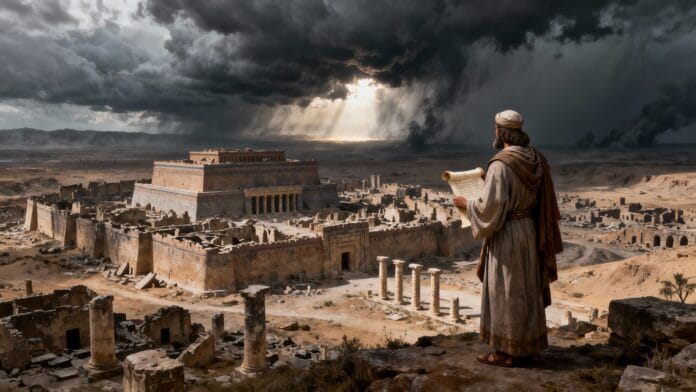
1° The person and era of the prophet. — The personality of Nahum has been left completely in the shadows by the Holy Spirit, like those of Joel, Ezra, and Malachi. All we know of him is that his name was Nahum (that is, the one who was consoled – cf. 1.1), and that he was originally from’Elqoš (Elcesaei of the Vulgate corresponds to the Hebrew ha'Elqošt, inhabitant of’ Elqoš) a small village in Galilee, whose ruins could still be seen in the time of Saint Jerome (Comm. In libr. Nahum, Prolog). Several «dialectical expressions» used by Nahum are perfectly consistent with his Galilean origin (cf. 1, 3 śeârah, instead of seârah; 1, 2, qannô'’ instead of qannâ'’; 2, 14, mal'âkékeh instead of mal'âkékâ).
The period in which he lived is relatively easy to determine, at least approximately. 1° On the one hand, he quotes several passages from Isaiah (cf. Nah. 1:4 and Isa. 33:9; Nah. 1:15 and Isa. 52:7; Nah. 3:5 and Isa. 47:3, 9; Nah. 3:10 and Isa. 29:16); on the other hand, Jeremiah imitated him quite frequently (cf. Nah. 1:13 and Jer. 30:8; Nah. 3:5, 13, 17, 19 and Jer. 13:12 ff.; 50:37; 51:30 etc.): he therefore lived between these two great prophets. 2. When he wrote his book, Nineveh was still in all its splendor (cf. 1:12; 2:12; 3:16), and the Assyrians had just severely humiliated the kingdom of Judah (cf. 1:12-13. Possible allusion to Sennacherib's invasion of Judea during the reign of Hezekiah. cf. 2 Kings 18:15-16). Above all, the famous city of Thebes in Upper Egypt had recently been conquered and sacked by the Assyrian armies (cf. 3:8-10). Now, cuneiform inscriptions tell us that this conquest took place in 664 or 663 BC. It was therefore between the destruction of Thebes and that of Nineveh in 608 BC that Nahum exercised his prophetic ministry. Jewish tradition places him during the reign of Manasseh, son and successor of Hezekiah (698-643 BC)
2° The subject, the organization, and the purpose of the book. This small book, whose authenticity no one has seriously questioned, clearly states its subject from its very first line, when it is entitled: oracle on Nineveh. He predicts, in fact, the ruin of this great city and the total destruction of the Assyrian Empire in the near future. The threat, initially general, becomes increasingly specific, and soon acquires a terrible clarity. Jonah, too, had prophesied against Nineveh; but the guilty city had repented, and God had forgiven it. Here, no forgiveness is offered; Nahum merely proclaims, in the name of God, a decree of annihilation.
This passage is developed as follows, according to an arrangement remarkable for its unity. 1. The divine plan concerning Nineveh, a terrifying plan with regard to the Assyrian capital, but entirely merciful toward the Jews, whom Assyria had made suffer so much (1:2-15). 2. The complete execution of this plan: Nineveh is stormed, plundered, and overthrown (2:1-13). 3. The causes and the immutable nature of God's plan (3:1-19).
The purpose of Nahum's prophecy is indicated either at the end of the first chapter (1:11-15) or at the beginning of the second (2:2). The Lord intends to take revenge on the proud and cruel Assyrians, who had mistreated his chosen people and who wanted to exterminate them. The kingdom of God will therefore be maintained despite the efforts of his powerful enemies in the east, and it is they who will perish. This idea, as we see, is messianic in its entirety, and it is precisely because of this that the book of Nahum has been included among the biblical writings.
3° In relation to the style, Nahum deserves nothing but praise, for he was admirably gifted as a writer, and he has left us a true poetic masterpiece. What is striking about him is the vividness of his brushstrokes, the strength of his colors, the purity of his language, the rarity of many of his expressions, and the originality and verve that distinguish his entire prophecy. His sentences are generally short, vigorous, and highly dramatic. There is much artistry and also much naturalness in his descriptions.
The best Catholic commentaries are: in antiquity, Theodoret of Cyrrhus, Narrations in duodecim Prophetas and Saint Jerome, Commentaria in Prophetas minores. In modern times: F. Ribera, In librum duodecim Prophetarum commentarii, Antwerp, 1571; Sanchez, How. In Prophetas minores and Baruch, Lyon, 1621.
Nahum 1
1 Oracle concerning Nineveh. Book of the Vision of Nahum of Elkosh. 2 The Lord is a jealous and vengeful God; the Lord is vengeful and knows wrath. The Lord takes vengeance on his adversaries and bears a grudge against his enemies. 3 The Lord is patient and great in power, and he does not allow impunity. The Lord walks through the storm and the hurricane, and the cloud is the dust of his feet. 4 He threatens the sea and dries it up, and he makes all the rivers run dry. Bashan and Carmel wither, the vegetation of Lebanon. 5 The mountains tremble before him and the hills melt; the earth heaves before his face, the world and all who dwell in it. 6 Who can stand before his fury? Who can withstand the heat of his anger? His wrath spreads like fire, and the rocks are shattered before him. 7 The Lord is good, a refuge in times of trouble, and he knows those who trust in him. 8 With an overflowing flood he will completely destroy this place and pursue his enemies into the darkness. 9 What are your thoughts on the Lord? He will bring about ruin, and distress will not arise twice. 10 For, entwined like thorns and drunk with their wine, they will be consumed like dry straw. 11 From you came one who plots evil against the Lord, one who devises wicked schemes. 12 This is what the Lord says: Though they are intact and numerous, they will be harvested and disappear. I have humbled you, but I will humble you no more. 13 And now, O Judah, I will break his yoke from you and I will shatter your bonds. 14 As for you, this is what the Lord has commanded: There shall be no more offspring of your name, I will destroy from the house of your God the carved images and the cast images, I am preparing your tomb because you have been frivolous.
Nahum 2
1 Here on the mountains are the feet of a messenger of good news who announces peaceCelebrate your festivals, O Judah, fulfill your vows, for he will not pass through your land again; the wicked are utterly destroyed. 2 A destroyer is coming against you; guard the fortress, watch the way, strengthen your loins, gather all your strength. 3 For the Lord restores the glory of Jacob, as well as the glory of Israel, because plunderers plundered them and destroyed their vines. 4 His warriors' shields are dyed red, his men-at-arms are dressed in scarlet, in the fire of steel his chariots appear, on the day he prepares for battle and the lances are waving. 5 In the streets, the tanks rush furiously; they hurtle into the squares. Their appearance is that of flames, of flashing lightning. 6 He remembers his nobles; they stumble in their march. They rush towards the walls; preparations are underway for the defense. 7 The river gates open and the palace collapses. 8 It is done, she is stripped naked, she is led away and her servants groan, like the lament of doves; they beat their breasts. 9 Nineveh has been like a pool of water since its beginning. They flee. Stop. Stop. Not one of them looks back. 10 Plunder the silver, plunder the gold. For there is no end to his riches, to the heap of all his precious objects. 11 Emptied, looted, drained dry. Hearts fail, knees tremble; every loin is in anguish, every face is livid. 12 Where is it, the lions' den, which was a place of pasture for young lions; where the lion, the lioness, and the cub retreated, without anyone frightening them? 13 The lion took what his cubs needed, he strangled for his lionesses, he filled his caves and dens with prey. 14 Here I am against you, declares the Lord of hosts; I will reduce your chariots to smoke; the sword will devour your young lions; I will tear your prey from the land, and the voice of your messengers will no longer be heard.
Nahum 3
1 Woe to the city of blood, full of fraud and violence, and which never ceases its plundering. 2 We hear the sound of the whip, the clatter of wheels, the gallop of horses, the bouncing of carts. 3 Horsemen charging forward, flaming swords, lightning lances, a multitude of wounded, a mass of dead, corpses stretching to infinity, we stumble over their corpses. 4 It was because of the many acts of prostitution of the prostitute, full of charms, skilled in enchantments, who sold nations through her prostitution and peoples through her enchantments. 5 Here I am against you, declares the Lord of hosts; I will lift up the skirts of your robe over your face, I will show your nakedness to the nations and your shame to the kingdoms. 6 I will throw garbage on you, and I will humiliate you and make a spectacle of you. 7 Whoever sees you will flee from you and say, "Nineveh is destroyed." Who will mourn her? Where can I find comforters for you? 8 Are you better than No-Amon, who was seat on the rivers, which were surrounded by waters, which had the sea for a rampart and whose wall was the sea? 9 Ethiopia was his strength, as was Egypt, and they were countless; Phut and the Libyans were his auxiliaries. 10 Yet she went into exile, she was held captive; her grandchildren were also crushed, at the corner of every street; lots were cast upon her nobles and all her great men were loaded with chains. 11 You too will be intoxicated and disappear; you too will seek refuge from the enemy. 12 All your strongholds are like fig trees with ripe figs; shake them and they fall into the mouth of whoever wants to eat them. 13 Behold, your people are like women in your midst; before your enemies the gates of your land shall be opened wide; fire shall devour your bars. 14 Draw water for yourself in preparation for the siege, rebuild your forts, knead the clay and tread the clay soil, seize the brick mold. 15 There the fire will devour you, the sword will destroy you, it will devour you like a locust, even though you are as numerous as a locust, as numerous as a grasshopper. 16 You have multiplied your merchants, more than the stars of heaven; the locust spreads its wings and flies away. 17 Your watchmen are like locusts and your leaders like a swarm of grasshoppers; they settle on the hedges on a cold day; as soon as the sun appears, they flee and their whereabouts are no longer known; where are they? 18 Your shepherds are asleep, king of Assyria; your valiant men are lying down, your people are scattered on the mountains and there is no one to gather them. 19 Your wound is incurable, your injury is grievous; all who hear of your fate will clap their hands over you, for on whom has your wickedness not passed without respite?
Notes on the Book of Nahum
1.1 Elqosch, a village in Galilee, according to Eusebius and Saint Jerome. Nineveh cf. Jonas 1, 2.
1.4 Basan. See Numbers 21, 33. ― The Carmel And THE Lebanon They are named after Basan because of their rich vegetation.
1.10 Like thorns, etc. When fire takes hold of tightly intertwined thorns, everything is consumed so that not a single part can be saved; so it will be with the Assyrians gathered together in their feasts.
2.1 See Romans 10:15. Here on the mountains, etc. See Isaiah. 52, 7.
2.4 «What in secular antiquity can compare to Nahum seeing, from afar in his mind’s eye, the magnificent Nineveh fall beneath the onslaught of a countless army? One seems to see this army, one seems to hear the sound of weapons and chariots; everything is depicted in such a vivid manner that it seizes the imagination: it leaves Homer far behind.» (FENELON.)
2.7 An inscription of Sennacherib, known as the Bellino inscription, speaks of the damage and devastation caused by a flood in a royal palace in Nineveh. Open the river gates, This means breaking down the dikes and giving free rein to the waters. The Syrian historian Barhebraeus says that when the Persian Arbaces took the city, he broke down the gates of the Tigris and thus flooded Nineveh.
2.14 I will make it so that you can no longer plunder the earth, or I will take from your land everything you have taken from others. We will no longer hear, etc.; allusion to the impious and threatening speech of Rabsaces, Sennacherib's messenger. See 2 Kings 18, v.17 and following; 2 Chronicles 32, v.9 and following; Isaiah, 36, v.2 and following.
3.1 See Ezekiel, 24, 9; Habakkuk, 2, 12.
3.3 That is to say, the soldiers will fall and will not be able to advance, so great will be the number of dead bodies of the Ninevites.
3.5 See Isaiah 47:3.
3.8 No-Amon, that is, Thebes, capital of Upper Egypt, situated on the banks of the Nile, was sacked by the Assyrians during the reign of Nahum. Ashurbanipal, king of Nineveh, having defeated the troops of Urdaman, successor to Tharaca, king of Egypt, near Memphis, Urdaman retreated to Thebes. The Assyrian army pursued him there and plundered this wealthy city, the pharaoh having fled at the approach of the enemy, around the year 665.
3.9 enumeration of the nations that could be his allies. ― Ethiopia was his strength. Tharaca, Urdaman's father, had first been king of Ethiopia and had united that country with Egypt. Africa, in Hebrew Phut, ― Libya, west of Egypt.
3.14 The walls and houses of Nineveh were made of brick.
3.19 Your wound is incurable., Nineveh fell around the year 606 under the combined blows of the Medes and Babylonians, and it never recovered from its ruin.