












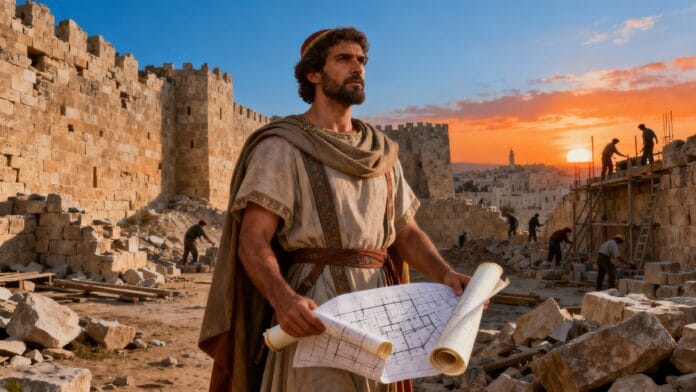
1° The name and author of the book. – We explained the words above (see page 239) who and Esdrae secundus dicitur, added to the main title in the Vulgate, Liber Nehemiae, by way of sub-liter.
This main title, which Saint Jerome appears to have been the first to use (Epist. Ad Paulinam) indicates both the author and the hero of the book. There is no doubt, in fact, that Nehemiah (in Hebrew: Nehemiah) did not himself compose the pages of the Bible that bear his name. The first line makes this clear: Verba Nehemiae, filii Helchiae (Neh. 1:1). The last line, Memento mei, Deus meus, in bonum (13, 31), which reproduces a pious aspiration often inserted into the narrative (cf. 5, 19; 6, 14; 13, 14, 22, 29, 31), expresses it very clearly as well, and it has rightly been considered "the author's signature." And a great many of the details contained between these two lines, presented in the form of autobiography and, so to speak, memoirs, provide identical proof. Thus, it is universally accepted that Nehemiah is the author of the first seven chapters, and at least of a considerable portion of the last three (11-13). As for the doubts that have been raised, especially concerning chapters 8, 9, and 10, they are not based on very solid grounds. We do not hesitate to claim the composition of the entire book in favor of Nehemiah. 1. The writer's style and genre are the same in all parts of the text. 2. The successive use of first- and third-person pronouns has no more significance here than in the Book of Ezra. 3. If, in chapters 8-10, Ezra plays the leading role, while Nehemiah takes a secondary position, this is self-explanatory: was it not customary for the layperson, whatever their official title, to defer to the priest? It is true that the priestly list inserted in chapter 12, verses 1 ff., includes some names (verses 10-11, 22-23) (see the commentary) that predate the time in which Nehemiah lived; but the best exegetes admit that these verses were added later to the list by someone else. 5° Critics who do not accept the complete composition of the book by Nehemiah cannot agree on which passages, according to their hypothesis, are not by him.
2° Subject matter, purpose, divisionn. – This work consists of various narratives describing how Nehemiah contributed, for his part, to the restoration of the theocracy after the Babylonian captivity, and how he completed the work so successfully begun by Zerubbabel and continued by Ezra. Zerubbabel had restored worship and rebuilt the temple; Ezra had instilled with all his might the faithful practice of Mosaic law; Nehemiah's work consisted above all in rebuilding the walls of Jerusalem and renewing Israel's covenant with its God. His book is thus very closely linked to that of Ezra (see page 239), opening where the latter ended, after an interval of only thirteen years, and recounting, like it, the principal episodes of the reconstitution of the Jewish people in Jerusalem and Palestine after the exile. The period covered by the sacred writer is only about twelve years: from the twentieth to the thirty-second year of Artaxerxes Longimanus (Comp. 1.1), that is, from 445 to 433 BC. These are isolated accounts, as we mentioned earlier, for here too, history is far from complete. Nehemiah, like his predecessors, relates only those events that directly address his purpose: the principal events of the first year, along with a few more recent occurrences. This purpose is also to demonstrate the fulfillment of God's promises through the restoration of Jerusalem and sacred worship.
Three main sections: 1° Nehemiah's first journey to Jerusalem, and the rebuilding of the city walls (1, 1-7, 3); 2° some religious and political reforms, in order to ensure, in all forms, the prosperity of the people (7, 4-12, 42); 3° Nehemiah's second journey to Jerusalem, and new measures to consolidate the previous reforms (12, 43-13, 31).
3° The character The Book of Nehemiah is generally the same as that of the Book of Ezra, both in content and style. The narrative is interesting, picturesque, and sheds vivid light on the state of Jerusalem and the Jewish people at that time, as well as on the Samaritan race and the administration of the Persian provinces. Throughout, there is an admirable candor, which is a living guarantee of the narrator's veracity. Everything is written in Hebrew, with a number of expressions and turns of phrase characteristic of Nehemiah (the works to consult are the same as for the... Book of Ezra).
Nehemiah 1
1 The words of Nehemiah, son of Helkiah. In the month of Casleh, in the twentieth year, while I was in Susa, in the castle, 2 Hanani, one of my brothers, arrived with some men from Judah. I questioned them about the Jews who had been delivered, who had escaped captivity, and about Jerusalem. 3 They answered me, "The survivors, those who escaped captivity, are there in the province, in great misery and disgrace; the walls of Jerusalem have been demolished and its gates burned with fire."« 4 When I heard these things, I sat down and wept, and I mourned for several days. I fasted and prayed before the God of heaven, 5 saying: “Ah Lord, God of heaven, great and awesome God, you who keep the covenant and mercy towards those who love you and keep your commandments, 6 that your ear may be attentive and your eyes open, so that you may hear the prayer of your servant, which I now pray to you night and day for your servants, the children of Israel, confessing the sins of the children of Israel, which we have committed against you, for I and my father’s house have sinned. 7 We have acted very badly towards you; we have not observed the commandments, the laws, and the ordinances that you prescribed to Moses, your servant. 8 Remember the word that you commanded Moses, your servant, to speak, saying: If you transgress my statutes, I will scatter you among the peoples, 9 But if you return to me and observe my commandments and put them into practice, even if your exiles are at the ends of the earth, from there I will gather them and bring them back to the place I have chosen to make my name dwell there. 10 They are your servants and your people, whom you have redeemed by your great power and your strong hand. 11 "Oh Lord, let your ear be attentive to the prayer of your servant and to the prayer of your servants who delight in fearing your name. Deign today to grant success to your servant and grant him favor in the sight of this man." I was then the king's cupbearer.
Nehemiah 2
1 In the month of Nisan, in the twentieth year of King Artaxerxes, when the wine was before him, I took the wine and offered it to the king, and I tried not to be sad in his presence. 2 The king said to me, "Why is your face sad, since you are not ill? It can only be sadness of heart." I was very frightened. 3 And I answered the king, «Let the king live forever! How can my face not be sad, when the city where my fathers» tombs are lies devastated and its gates are burned with fire?” 4 And the king said to me, «What do you want to ask for?» I prayed to the God of heaven, 5 And I answered the king, «If it pleases the king and if your servant is acceptable to you, I ask that you send me to Judah, to the city of my ancestors» tombs, so that I may rebuild it.” 6 And the king told me, the queen being seat near him: "How long will your journey last and when will you return?" It pleased the king to send me and I set a time for him. 7 Then I said to the king, «If it pleases the king, let letters be given to me for the governors beyond the river, so that they may let me pass through until I reach Judah, 8 and a letter to Asaph, the keeper of the king’s forest, so that he may provide me with timber to put up beams for the gates of the fortress that is near the temple, for the city wall, and for the house where I will retire.» And the king gave me these letters, for the favorable hand of my God was upon me. 9 So I went to the governors beyond the river and gave them the king's letters, but the king had sent military commanders and horsemen with me. 10 When Sanaballat the Horonite and Tobias the Ammonite servant learned of it, it seemed very bad to them that a man should come to procure the good of the children of Israel. 11 I arrived in Jerusalem and, after spending three days there, 12 I got up during the night, with a small group of men. I told no one what my God had put in my heart to do for Jerusalem. I had no other beast of burden with me except my own mount. 13 I went out at night through the Valley Gate, heading towards the Dragon Spring and the Dung Gate, and I considered the demolished walls of Jerusalem and its gates consumed by fire. 14 I continued towards the Source Gate and the King's Pond, and there was no room for the mount to pass under me. 15 I climbed up into the ravine at night and considered the wall, then I returned through the Valley Gate and went home. 16 The magistrates did not know where I had gone or what I wanted to do. Until that moment I had not told the Jews, the priests, the nobles, the magistrates, or the rest of the people who were to take care of the work. 17 Then I said to them, «You see the misery we are in, Jerusalem lies devastated and its gates have been burned with fire. Come, let us rebuild the wall of Jerusalem, and we will no longer be a disgrace.» 18 And I told them how the favorable hand of my God had been upon me, and also what words the king had spoken to me. They replied, «Let us rise up and build.» And they courageously set to work on this good project. 19 When Sanaballat the Horonite, Tobias the Ammonite servant, and Gosem the Arab heard about it, they mocked and despised us. They said, «What are you doing? Are you rebelling against the king?» 20 I answered them and said, «The God of heaven will give us success. We, his servants, will begin to rebuild, but you have no portion, no right, no memorial in Jerusalem.»
Nehemiah 3
1 Eliashib the high priest and his fellow priests began to build the Sheep Gate, they consecrated it and set up its doors, they repaired the wall and consecrated it as far as the Tower of Meah and as far as the Tower of Hananel. 2 Nearby the men of Jericho were building, and nearby Zechariah, son of Amri, was building. 3 The sons of Asnaa built the Fish Gate, they put up beams and installed its doors, bolts and bars, 4 and next to it, Marimuth, son of Uriah, son of Accus, was repairing; and next to it, Mosollam, son of Barachiah, son of Mesezebel, was repairing; and next to it, Zadok, son of Baanah, was repairing., 5 and nearby the Thecuites were making repairs, but their leaders did not lend their support to their Lord's work. 6 Jehoiada son of Phaseah and Mosollam son of Besodias repaired the Old Gate, putting in beams and installing the doors, bolts and bars. 7 And nearby, Meltias the Gibeonite, Jadon the Meronathite, and the men of Gibeon and Maspha were repairing the area, near the court of the governor beyond the river., 8 And nearby, Eziel son of Araias, chief of the goldsmiths, was repairing his work, and nearby, Ananias, of the perfumers' guild, was repairing his work. They left Jerusalem as far as the broad wall. 9 Next to them was making repairs Raphaias, son of Hur, ruler of half the district of Jerusalem. 10 Next door, opposite his house, Jedaiah, son of Haromaph, was repairing, and next door, Hattus, son of Haseboniah, was repairing. 11 Melchias, son of Herem, and Hasub, son of Phahath-Moab, repaired another part of the wall and the Tower of the Furnaces. 12 Nearby, Sellum, son of Alohes, ruler of the other half of the district of Jerusalem, was repairing with his daughters. 13 Hanun and the inhabitants of Zanoé repaired the Valley Gate, they built it and put in its leaves, bolts and bars, they also made a thousand cubits of wall up to the Dung Gate. 14 Melchias, son of Rechab, ruler of the district of Bethacharam, repaired the Dung Gate, he rebuilt it and set up its doors, bolts and bars. 15 Sellun, son of Cholhoza, ruler of the district of Maspha, repaired the Fountain Gate, he built it, covered it, and set its doors, bolts, and bars; he also made the walls of the Pool of Siloam, near the King's Garden, as far as the steps that go down from the City of David. 16 After him, Nehemiah, son of Azboch, ruler of half the district of Beth-zur, repaired as far as the tombs of David, as far as the reservoir that had been built, and as far as the house of the Heroes. 17 After him the Levites made repairs, under the leadership of Rehum, son of Benni; beside him, Hasebias, head of half the district of Ceilah, made repairs for his district. 18 After him their brothers made repairs, under the leadership of Bavai, son of Enadad, chief of the other half of the district of Ceilah. 19 Next to him, Azer, son of Joshua, chief of Maspha, repaired another section of the wall, opposite the ascent to the arsenal, at the corner. 20 After him, Baruch, son of Zechariah, zealously repaired another section, from the corner to the door of the house of Eliashib, the high priest. 21 After him, Merimuth, son of Uriah, son of Haccus, repaired another portion, from the gate of Eliashib's house to the end of Eliashib's house. 22 After him, the priests and the men of the Jordan plain made repairs. 23 After them, Benjamin and Hasub made repairs opposite their house. After them, Azariah, son of Maasiah, son of Ananiah, made repairs next to his house. 24 After him, Bennui, son of Hénadad, repaired another portion, from the house of Azarias to the corner and to the turn. 25 Phalel, son of Ozi, was repairing opposite the corner and the high tower that projects in front of the king's house, near the courtyard of the prison. After him, Phadaias, son of Pharos, repaired the damage. 26 The Nathinaeans remained on Ophel, as far as opposite the Water Gate, to the east, and the projecting tower. 27 After him, the Thecuites repaired another section, opposite the large projecting tower, up to the Ophel wall. 28 Above the Horse Gate, the priests were making repairs, each in front of his own house. 29 After him, Zadok, son of Emmer, repaired in front of his house, after him, Semaias, son of Shecheniah, keeper of the eastern gate of the temple, repaired. 30 After him, Hananiah son of Selemiah and Hanun, the sixth son of Seleph, repaired another section of the wall. After him, Mosollam son of Barachiah repaired it in front of his house. 31 After him, Melchias, of the goldsmiths' guild, repaired as far as the dwelling of the Nathinaeans and the merchants, in front of the gate of Miphcad, and as far as the upper chamber of the turning. 32 And, between the upper chamber at the turning and the Sheep Gate, the goldsmiths and merchants were repairing their work. 33 When Sanballat learned that we were rebuilding the wall, he became angry and very irritated. He mocked the Jews. 34 He spoke before his brothers and the troops of Samaria, saying, «What will the helpless Jews undertake? Will they be allowed to do it? Will they offer sacrifices? Will they complete it in a single day? Will they revive the stones buried under heaps of dust and consumed by fire?» 35 And Tobias the Ammonite, who was beside him, said, "Let them just build. If a fox jumps up, it will knock down their stone wall."« 36 Listen, O our God, for we are despised. Turn their insults back on their own heads and deliver them up like prey to a land of exile. 37 Do not forgive their iniquity and do not let their sin be blotted out from your sight, for they have caused a stumbling block to those who are building. 38 We rebuilt the wall and the enclosure was restored in its entirety to half its height because the people took heart to this work.
Nehemiah 4
1 When Sanaballat, Tobias, the Arabs, the Ammonites, and the Azotians learned that the repair of the walls was progressing and that the breaches were beginning to close, they were very angry. 2 They all joined forces to attack Jerusalem and cause trouble there. 3 We prayed to our God and set up a guard against them, day and night, to protect ourselves from them. 4 But Judah said, "The strength of the bearers of burdens is lacking, and there is so much rubble that we cannot rebuild the wall."« 5 And our enemies said, "They will know nothing, they will see nothing, until we come into their midst, we will massacre them and put an end to the work."« 6 But when the Jews who lived near them came, they warned us ten times about all the places from which our adversaries were returning against us. 7 So I placed the people in the lowest places, behind the wall, in open areas, by families, all with their swords, their spears, and their bows. 8 Having looked, I stood up and said to the nobles, the officials, and the rest of the people: «Do not be afraid of them. Remember the Lord, who is great and awesome, and fight for your brothers, for your sons and daughters, for your wives and for your homes.» 9 When our enemies learned that we had been warned and that God had thwarted their plan, we all returned to the wall, each to his work. 10 But from that day on, half of my people worked on the work and the other half held spears, shields, bows and breastplates, and the leaders were behind all the house of Judah. 11 Among those who were building the wall, some, those who carried the burdens and took them on, worked with one hand on the construction, while the other held a weapon, 12 The others, those who were building, each had their sword girded around their waist while they were building, and the one who sounded the trumpet stood near me. 13 And I said to the nobles, the magistrates, and the rest of the people: "The work is considerable and over a vast area; we are scattered along the wall, far from one another. 14 From wherever you hear the sound of the trumpet, gather around us; our God will fight for us.» 15 And we worked at the work, half of us holding spears from the breaking of dawn until the appearance of the stars. 16 At that same time, I also said to the people, «Each of you, with your servant, should spend the night in Jerusalem, to serve as our guard during the night and to work during the day.» 17 But neither I, nor my brothers, nor my people, nor the men of guard who followed me, took off our clothes; each one removed them only for ablution.
Nehemiah 5
1 And a great complaint arose from the common people and their wives against their Jewish brothers. 2 There were those who said, "We, our sons and daughters, are many; let us receive grain so that we may eat and live."« 3 Some were saying, "We are mortgaging our fields, our vineyards, and our houses to receive wheat during the famine."« 4 There were some who said, "We borrowed money from our fields and vineyards to pay the king's tribute. 5 And now our flesh is like the flesh of our brothers, our children are like their children, and behold, we are subjecting our sons and daughters to servitude, and there are some of our daughters who are already servants, and we can do nothing about it, for our fields and our vineyards belong to others.» 6 I was very irritated when I heard their complaints and those words. 7 And after reflecting on this, I rebuked the nobles and officials, saying, «You each lend at interest to your brother.» And having gathered a large assembly on their behalf, 8 I said to them, «We have redeemed, to the best of our ability, our Jewish brothers who were sold to the nations, and you would sell your own brothers, and they would be sold to us.» They were silent, finding nothing to answer. 9 I added, «This is not a good thing you are doing. Shouldn’t you walk in the fear of our God, to avoid the reproach of the nations, our enemies?” 10 My brothers and servants, we too have lent them money and grain. Let us forgive this debt. 11 "Give them back today their fields, their vineyards, their olive groves, and their houses, and one-hundredth of the money, new wine, and oil that you demanded from them as interest."» 12 They replied, "We will return it and ask nothing more of them; we will do as you say." Then I called the priests and made them swear that they would act according to this word. 13 And I shook out my cloak, saying, «May God so shake out of his house and possessions every man who has not kept this word, and may that man be shaken out and left empty.» The whole assembly said, «Amen,» and praised the Lord, and the people acted according to this word. 14 From the day the king appointed me governor over the land of Judah, from the twentieth year until the thirty-second year of King Artaxerxes, for twelve years neither I nor my brothers ate the governor's bread. 15 The former governors who preceded me oppressed the people and received from them bread and wine, besides forty shekels of silver; their servants even oppressed the people, but I did not act in this way, out of fear of God. 16 And indeed, I applied myself to the work of this wall; we did not buy any fields, and all my people were there gathered for the work. 17 I had at my table one hundred and fifty men, Jews and magistrates, besides those who came to us from the surrounding nations. 18 This is what was prepared for each day: an ox, six choice sheep, and poultry were prepared at my expense, and every ten days, all the necessary wine was provided in abundance. Despite this, I did not claim the governor's bread, because the workload was too heavy for these people. 19 Remember in my favor, O my God, all that I have done for this people.
Nehemiah 6
1 When it became known to Sanaballat, Tobias, Gosem the Arab, and the rest of our enemies that I had rebuilt the wall and that no breach remained in it until that time, however, I had not put the gates in place., 2 Sanaballat and Gosem sent word to me: "Come and let us meet together in the villages in the valley of Ono." They intended to harm me. 3 I sent messengers to them to say, “I am undertaking a great task and cannot come down. Why?” the work Would it be interrupted because I would leave him to come down to you? 4 They made me the same offer four times and I gave them the same answer. 5 Sanaballat sent me his servant in the same way a fifth time, who held an open letter in his hand. 6 It was written there: "The rumor is spreading among the nations and Gosem says that you and the Jews plan to revolt and that is why you are rebuilding the wall and, according to these reports, you want to become their king. 7 And you have even appointed prophets to proclaim this about you in Jerusalem: »There is a king in Judah.” Now, let us inform the king of this matter. Come then, let us consult together.” 8 And I sent word to him: «Nothing like these things you say has ever happened; you are inventing them in your own mind.» 9 For they all wanted to frighten us, saying, «Their weak hands will be unable to complete the work, and it will not be finished.» Now, O my God, give strength to my hands. 10 I went to Shemaiah, son of Dalaiah, son of Metabeel. He had shut himself in and said, «Let us go together to the house of God, into the inner sanctuary, and shut the doors of the temple, for they are coming to kill you; they will come to kill you during the night.» 11 I replied, "A man like me fleeing... And how could a man like me enter the temple and remain alive? I will not enter."« 12 And I paid attention and behold, it was not God who sent him; he had spoken a prophecy over me because Tobias and Sanaballat had bought him. 13 They bought it so that I would be afraid, so that I would act according to its advice and sin, and that would have been a pretext for them to give me a bad reputation and cover me with shame. 14 Remember, O my God, Tobias and Sanaballat according to these evil deeds. And also Noadiah the prophet and the other prophets who sought to frighten me. 15 The wall was completed on the twenty-fifth day of the month of Elul, in fifty-two days. 16 When all our enemies learned of it, all the nations around us were filled with fear, they experienced great discouragement and recognized that it was through the help of our God that this work had been accomplished. 17 At that time also, the great men of Judah multiplied their letters to Tobias, and Tobias's letters reached them. 18 For many of the great men in Judah were bound to him by oath, because he was the son-in-law of Shecheniah, son of Areah, and his son Johanan had married the daughter of Mosollam, son of Barachiah. 19 They even spoke of his good qualities in front of me and reported my words to him. Tobias sent letters to frighten me.
Nehemiah 7
1 When the wall was rebuilt and I had put the gates in place, the gatekeepers, the singers, and the Levites were put in charge of guarding it. 2 I gave authority over Jerusalem to Hanani my brother and to Ananias, commander of the citadel, because he was a faithful man and feared God more than many others. 3 And I said to them, «The gates of Jerusalem shall not be opened until the heat of the sun has come in the evening, while the watchmen are still at their posts. The gates shall be shut and bars put in place, and during the night watchmen shall be appointed from among the inhabitants of Jerusalem, each at his post and each in front of his house. 4 Now the city was spacious and large, but there were few inhabitants in the middle of it and not all the houses had been rebuilt. 5 My God put it into my heart to gather the nobles, the magistrates, and the people, to take a census of them. I found a genealogical register of those who had gone up first, and I saw the following written on it: 6 These are the people from the province who returned from exile, those whom Nebuchadnezzar, king of Babylon, had taken captive, and who returned to Jerusalem and Judah, each to his own city, 7 who returned with Zerubbabel, JoshuaNehemiah, Azariah, Raamiah, Nahamani, Mordecai, Belshan, Meshpharath, Begoai, Nahum, Baanah: Number of the men of the people of Israel: 8 the sons of Pharsus, two thousand one hundred and seventy-two, 9 the sons of Saphatias, three hundred and seventy-two, 10 the sons of Area, six hundred and fifty-two, 11 the sons of Phahath-Moab, sons of Joshua and of Joab, two thousand eight hundred and eighteen, 12 the sons of Elam, one thousand two hundred and fifty-four, 13 the sons of Zethua, eight hundred and forty-five, 14 the sons of Zechariah, seven hundred and sixty, 15 the sons of Bannui, six hundred and forty-eight, 16 the sons of Bebai, six hundred and twenty-eight, 17 the sons of Azgad, two thousand three hundred and twenty-two, 18 the sons of Adonicham, six hundred and sixty-seven, 19 the sons of Béguaï, two thousand sixty-seven, 20 the sons of Adin, six hundred and fifty-five, 21 the sons of Ater, son of Hezekiah, ninety-eight, 22 the sons of Hasem, three hundred and twenty-eight, 23 the sons of Besai, three hundred and twenty-four, 24 the sons of Hareph, one hundred and twelve, 25 the sons of Gibeon, ninety-five, 26 the people of Bethlehem and of Netopha, one hundred and eighty-eight, 27 the people of Anathoth, one hundred and twenty-eight, 28 the people of Beth-Azmoth, forty-two, 29 the people of Cariatharia, Cephirah, and Beroth: seven hundred and forty-three, 30 the people of Ramah and Geba, six hundred and twenty-one, 31 the people of Machmas, one hundred and twenty-two, 32 the people of Bethel and Hai, one hundred and twenty-three, 33 the people of the other Nebo, fifty-two, 34 the sons of the other Elam, one thousand two hundred and fifty-four, 35 the sons of Harem, three hundred and twenty, 36 the sons of Jericho, three hundred and forty-five, 37 the sons of Lod, Hadid, and Ono, seven hundred and twenty-one, 38 the sons of Senaa, three thousand nine hundred and thirty. 39 Priests: the sons of Idaiah, of the house of Joshua, nine hundred and seventy-three, 40 the sons of Emmer, one thousand fifty-two, 41 the sons of Phashur, one thousand two hundred and forty-seven, 42 the sons of Arem, one thousand seventeen. 43 Levites: the sons of Joshua and of Cedmiel, of the sons of Oduyah, seventy-four. 44 Singers: the sons of Asaph: one hundred and forty-eight. 45 Gatekeepers: the sons of Sellum, the sons of Ater, the sons of Telmon, the sons of Accub, the sons of Hatita, the sons of Sobai, one hundred and thirty-eight. 46 Nathineans: the sons of Soha, the sons of Hasupha, the sons of Tebbaoth, 47 the sons of Ceros, the sons of Sia, the sons of Phadon, 48 the sons of Lebanah, the sons of Hagaba, the sons of Selmai, 49 the sons of Hanan, the sons of Geddel, the sons of Gaher, 50 the sons of Raaias, the sons of Rasin, the sons of Necoda 51 the sons of Gezem, the sons of Aza, the sons of Phasea, 52 the sons of Beseus, the sons of Munim, the sons of Nephusim, 53 the sons of Bacbuc, the sons of Hacupha, the sons of Harhur, 54 the sons of Besloth, the sons of Mahida, the sons of Harsa, 55 the sons of Bercos, the sons of Sisara, the sons of Tema, 56 the sons of Nasia, the sons of Hatipha. 57 Sons of Solomon's servants: the sons of Sothai, the sons of Sophereth, the sons of Pharidah, 58 the sons of Jahala, the sons of Darcon, the sons of Jeddel, 59 the sons of Shaphatias, the sons of Hatil, the sons of Phochereth-Ashebaim, the sons of Amon. 60 Total of the Nathanaeans and the sons of Solomon’s servants: three hundred and ninety-two. 61 These are those who went from Tel-Melah, Tel-Harsah, Cherub, Addon, and Emmer, and who could not make known their ancestral house and their race, to show that they were of Israel: 62 the sons of Dalaias, the sons of Tobias, the sons of Necod, six hundred and forty-two. 63 And among the priests: the sons of Habiah, the sons of Accos, the sons of Berzelai, who had taken as his wife one of the daughters of Berzelai the Gileadite and was called by their name. 64 They searched for their titles attesting to their genealogies, but they could not be found. They were declared impure and excluded from the priesthood., 65 and the governor forbade them to eat most holy things until the priest rose to consult God through the Urim and Thummim. 66 The entire assembly consisted of forty-two thousand three hundred and sixty people, 67 not counting their male and female servants, who numbered seven thousand three hundred and thirty-seven, among them were two hundred and forty-five male and female singers. 68 They had seven hundred and thirty-six horses, two hundred and forty-five mules, 69 four hundred and thirty-five camels and six thousand seven hundred and twenty donkeys. 70 Several heads of families made donations to the cause. The governor gave to the treasury a thousand gold darics, fifty cups, five hundred and thirty priestly tunics. 71 Several heads of families gave twenty thousand gold darics and two thousand two hundred silver minae to the treasury of the work. 72 What the rest of the people gave was twenty thousand darics of gold, two thousand minas of silver and sixty-seven priestly tunics. 73 So the priests and Levites, the singers, the gatekeepers, the common people, the Nathanaeans, and all Israel settled in their cities.
Nehemiah 8
1 When the seventh month arrived and the Israelites were settled in their towns, all the people gathered together as one in the square in front of the Water Gate. They told Ezra the scribe to bring the Book of the Law of Moses, which the Lord had commanded Israel. 2 And the priest Ezra brought the law before the assembly, the men and women and all those who were intelligent enough to understand it: it was the first day of the seventh month. 3 He read from the book, from morning until midday, in the square in front of the Water Gate, in the presence of men and women and those who were intelligent enough to understand, all the people listening to the reading of the book of the law. 4 Ezra the scribe stood on a wooden platform, erected for the occasion, and beside him stood, on his right, Mattathias, Shemeias, Anias, Uriah, Helkiah and Maasiah, and on his left, Phaedaias, Misael, Melchiah, Hasum, Hasbadana, Zechariah and Mosollam. 5 Ezra opened the book in the sight of all the people, for he was raised above all the people, and when he had opened it, all the people stood up. 6 Ezra blessed the Lord, the great God, and all the people responded by raising their hands: "Amen. Amen." And they bowed down and prostrated themselves before the Lord with their faces to the ground. 7 And JoshuaBani, Serebiah, Jamin, Accub, Septhai, Odiah, Maasiah, Celitah, Azariah, Jozabed, Hanan, Pilaiah and the Levites instructed the people in the law and everyone remained in their place. 8 They read distinctly in the book, in the law of God, and they gave the meaning, and what was being read was understood. 9 And Nehemiah the governor, Ezra the priest and scribe, and the Levites who instructed the people, said to all the people, «This day is holy to the Lord your God; do not mourn or weep.» For all the people were weeping when they heard the words of the law. 10 And Nehemiah said to them, “Go, eat rich food and drink sweet drinks, and send portions to those who have nothing prepared, for this day is holy to our Lord. Do not grieve, for joy "In the Lord is your strength." 11 The Levites calmed all the people, saying, «Be quiet, for this is a holy day; do not grieve.» 12 And all the people went away to eat and drink, to send portions, and to celebrate with great joy. For they had understood the words that had been revealed to them. 13 On the second day, the heads of families of all the people, the priests and the Levites gathered around Ezra the scribe, in order to learn more fully about the words of the law. 14 And they found written in the law which the Lord had prescribed through Moses, that the children of Israel should dwell in tents during the feast of the seventh month, 15 and that they were to proclaim and publish a proclamation in all their towns and in Jerusalem, saying, «Go to the mountain and bring back olive branches, wild olive branches, myrtle branches, palm branches, and leafy branches to make tents, as it is written.» 16 So the people went there and they brought back branches and they made tents for themselves, each on his roof, in their courtyards, in the courts of the house of God, in the square of the Water Gate and in the square of the Ephraim Gate. 17 The whole assembly of those who had returned from captivity made tents and lived in them. From the days of Joshua, son of Nun, until that day the children of Israel had done nothing like it. And there was very great rejoicing. 18 They read from the Book of the Law of God every day, from the first day to the last. They celebrated the festival for seven days, and on the eighth day there was a solemn assembly, according to the prescribed rite.
Nehemiah 9
1 On the twenty-fourth day of the same month, the children of Israel assembled for a fast, wearing sackcloth, with dust on their heads. 2 Those who were of the race of Israel, having separated themselves from all the sons of the foreigner, stood up and confessed their sins and the iniquities of their fathers. 3 When they had risen in their place, they read from the book of the law of the Lord their God for a quarter of the day, and for another quarter they confessed their sins and worshiped the Lord their God. 4 JoshuaBani, Cedmiel, Sabaniah, Bonni, Sarebiah, Bani and Chanani, having gone up onto the platform of the Levites, cried out with a loud voice to the Lord their God. 5 And the Levites JoshuaCedmiel, Bani, Hasebnias, Serebiah, Odaiah, Sebniah, and Phathahiah said: “Stand up and bless the Lord your God from everlasting to everlasting. Blessed be your glorious name, which is exalted above all blessing and praise.” 6 It is you alone, Lord, you who made the heavens, the highest heavens and all their host, the earth and all that it bears, the sea and all that it contains, it is you who give life to all these things and the host of heaven worships you. 7 It is you, Lord God, who chose Abram, who brought him out of Ur of Chaldea and gave him the name Abraham. 8 You found his heart faithful before you, and you made a covenant with him to give to his descendants the land of the Canaanites, Hittites, Amorites, Perizzites, Jebusites, and Gergesites, and you have kept your word, for you are righteous.» 9 «You saw the affliction of our fathers in Egypt and you heard their cries by the Red Sea. 10 You performed signs and wonders against Pharaoh, against all his servants, and against all the people of his land, because you knew that they had acted arrogantly against our fathers, and you made a name for yourselves, as is still seen today. 11 You divided the sea before them, and they passed through the midst of the sea on dry ground, but you hurled their pursuers into the depths, like a stone into many waters. 12 You guided them by day with a pillar of cloud and by night with a pillar of fire, to light the way before them that they should follow. 13 You came down on Mount Sinai, you spoke to them from heaven and gave them just ordinances, true laws, excellent precepts and commandments. 14 You made known to them your holy Sabbath and you prescribed for them by the word of Moses, your servant, commandments, precepts, and a law. 15 You gave them bread from heaven for their hunger, and you brought forth water from the rock for their thirst. And you told them to go in and take possession of the land you had sworn to give them.» 16 «But our ancestors were proud, stiff-necked, and did not obey your commands.”. 17 They refused to listen and did not remember the wonders you had done for them. They stiffened their necks and, in their stubbornness, appointed a leader to return to their slavery. But you are a forgiving, compassionate, and gracious God, slow to anger and abounding in love, and you have not abandoned them. 18 Even when they made themselves a molten calf and said, "This is your god who brought you out of Egypt," and when they committed great blasphemies against you, 19 According to your great mercy, you did not abandon them in the desert, and the pillar of cloud did not depart from them, guiding them by day in their way, nor the pillar of fire, illuminating them by night on the road they were to follow. 20 You gave them your good spirit to make them prudent, you did not withhold your manna from their mouths, and you provided them with water for their thirst. 21 For forty years you provided for them in the desert, and they lacked nothing; their clothes did not wear out, and their feet did not swell.» 22 «You gave them kingdoms and peoples, and you divided their territories among them, and they possessed the land of Sihon, the land of the king of Heshbon, and the land of Og, king of Bashan. 23 You multiplied their children like the stars of heaven and brought them into the land which you had told their fathers they would enter to possess. 24 And their sons came to take possession of the land, and you subdued the inhabitants of the land, the Canaanites, before them, and delivered them into their hands, as well as the kings and peoples of the land, so that they might treat them as they pleased. 25 They seized fortified cities and fertile lands, they possessed houses filled with all kinds of goods, cisterns dug out, vineyards, olive groves, and abundant fruit trees. They ate, they were satisfied, they grew fat, and they lived in luxury because of your great kindness.» 26 «Nevertheless they rebelled and revolted against you. They cast your law behind their backs, they killed your prophets who testified against them, to turn them back to you, and they committed great blasphemies against you. 27 So you abandoned them into the hands of their oppressors, who oppressed them. But in the time of their oppression, they cried out to you, and you heard them from heaven and, in your great mercy, you gave them saviors who saved them from the hand of their oppressors. 28 When they had rest, they again did evil in your sight, and you abandoned them to their enemies, who prevailed over them. But they cried out to you again, and you heard them from heaven, and in your great mercy you delivered them many times. 29 You bore witness against them, to bring them back to your law, but they persisted in pride and did not listen to your commandments; they transgressed your ordinances, although the one who practices them finds life in them; they put forward a rebellious shoulder, they stiffened their necks and did not listen. 30 You were patient with them for many years, and you testified against them by your spirit and through your prophets, but they did not listen. So you handed them over to the peoples of the lands. 31 But, in your great mercy, you did not destroy them nor did you abandon them, for you are a compassionate and merciful God.» 32 “And now, O our God, the great, mighty, and awesome God, you who uphold the covenant and mercyDo not consider as insignificant all the sufferings that have befallen us, our kings, our leaders, our priests, our prophets, our fathers, and all your people, from the time of the kings of Assyria until this day. 33 You have been just in everything that has happened to us, for you have acted faithfully, but we have done wrong. 34 Our kings, our leaders, our priests, and our fathers did not put your law into practice, nor did they heed your commandments or the testimonies you gave against them. 35 In their kingdom, amidst the many blessings you bestowed upon them, in the vast and fertile land you had given them, they did not serve you and they did not turn away from their evil deeds. 36 And now we are slaves. We are slaves on the land you gave to our ancestors to eat its fruits and enjoy its bounty. 37 She multiplies her produce for the kings you have set over us because of our sins. They dispose of our bodies and our livestock as they please, and we are in great distress.»
Nehemiah 10
1 As a result of all this, we entered into a sacred covenant which we put in writing and our leaders, our Levites and our priests affixed their seal to it. 2 These are the ones who affixed their seal: Nehemiah, the governor, son of Helkiah. 3 Zedekiah, Saraiah, Azariah, Jeremiah, 4 Phashur, Amarias, Melchias, 5 Hattus, Sebenias, Melluch, 6 Harem, Merimuth, Obadiah, 7 Daniel, Genthon, Baruch, 8 Mosollam, Abias, Miamin, 9 Maazias, Belgai, Séméïas, priests. 10 Levites: Joshua, son of Azaniah, Bennui of the sons of Henadad, Cedmiel 11 and their brothers, Sebeniah, Odaiah, Celitah, Phalaaiah, Hanan, 12 Micha, Rohob, Hasébias, 13 Zachur, Sérébias, Sabanias, 14 Odaïas, Bani, Baninu. 15 Chiefs of the people: Pharos, Phahath-Moab, Elam, Zethu, Bani, 16 Bonni, Azgad, Bébaï, 17 Adonias, Bégoai, Adin, 18 Ater, Hezekiah, Azur, 19 Odaias, Hasum, Besai, 20 Hareph, Anathoth, Nebai, 21 Megphias, Mosollam, Hazir, 22 Mésizabel, Sadoc, Jeddua, 23 Pheltias, Hanan, Anaïas, 24 Hosea, Ananias, Hassub, 25 Alohès, Phaléa, Sobec, 26 Rehum, Hasebna, Maasias, 27 Echias, Hanan, Anan, 28 Melluch, Harim, Baana. 29 The rest of the people, the priests, the Levites, the gatekeepers, the singers, the Nathanaeans, and all those who had separated themselves from the peoples of the countries to follow the law of God, their wives, their sons, and their daughters, all those capable of knowledge and understanding, 30 They joined their brothers, their nobles, and promised with an imprecation and an oath to walk in the law of God, which had been given through Moses, the servant of God, to observe and to put into practice all the commandments of the Lord our God, his ordinances and his laws. 31 We promised, in particular, that we would not give our daughters to the people of the country and that we would not take their daughters for our sons 32 that, if the people of the land brought any goods or foodstuffs to sell on the Sabbath day, we would not buy anything from them on the Sabbath day and on the feast days, that we would let the land rest in the seventh year and that we would not demand payment of any debt. 33 We imposed upon ourselves the obligation to pay a third of a shekel each year for the service of the house of God, 34 for the showbread, for the daily offering, for the daily burnt offering, for the Sabbath sacrifices, for the new moon sacrifices, for the feasts, for the consecrated things, for the sin offerings, to make atonement for Israel and for all that is done in the house of our God. 35 We cast lots, priests, Levites and people, concerning the offering of wood, so that it might be brought to the house of our God, each of our families in turn, at appointed times, year after year, to be burned on the altar of the Lord our God, as it is written in the law. 36 We made a commitment to bring each year to the house of the Lord the first fruits of our land and the first fruits of all the fruit from all the trees, 37 to bring to the house of our God, to the priests who minister in the house of our God, the firstborn of our sons and of our livestock, as it is written in the law, and the firstborn of our oxen and of our sheep. 38 Likewise, we would bring to the priests, in the chambers of the house of our God, the firstfruits of our dough and our set-apart offerings, as well as the fruit of all the trees, the new wine and the oil, and we would give the tithe of our land to the Levites. And the Levites themselves would collect the tithe in all the towns near our fields. 39 The priest, son of Aaron, shall be with the Levites when the Levites collect the tithe, and the Levites shall bring the tithe of the tithe to the house of our God, into the chambers of the storehouse. 40 For the children of Israel and the sons of Levi shall bring into the chambers the offering of grain, new wine, and oil; there are the articles of the sanctuary, and there stand the priests who minister, the gatekeepers, and the singers. Thus we shall not neglect the house of our God.
Nehemiah 11
1 The leaders of the people settled in Jerusalem. The rest of the people cast lots, so that one out of ten would come to live in Jerusalem, the holy city, the other nine remaining in the other cities. 2 The people blessed all those who decided of their own accord to reside in Jerusalem. 3 These are the heads of families from the province who settled in Jerusalem. In the towns of Judah, each settled in his own property, in his own town: Israel, the priests and Levites, the Nathanaeans, and the sons of Solomon's servants: 4 In Jerusalem settled descendants of Judah and descendants of Benjamin. Among the descendants of Judah were Athaijah, son of Aziam, son of Zechariah, son of Amariah, son of Shaphatiyah, son of Malaliel, and descendants of Perez., 5 and Maaziah, son of Baruch, son of Cholozah, son of Haziah, son of Adaiah, son of Jehoiarib, son of Zechariah, son of Sela. 6 The total number of Peres' sons who settled in Jerusalem was four hundred and sixty-eight valiant men. 7 These are the sons of Benjamin: Shellum, son of Mosollam, son of Joed, son of Phaedaiah, son of Colaiah, son of Maaziah, son of Etheel, son of Jesse, 8 and after him Gebbai-Sellai: nine hundred and twenty-eight. 9 Joel, son of Zechariah, was their leader, and Judah, son of Senua, was the second leader of the city. 10 Priests: Idaea son of Jehoiarib, Jachin, 11 Saraias, son of Hilkiah, son of Mosollam, son of Zadok, son of Meraioth, son of Ahitob, prince of the house of God, 12 and their brothers who were the work in the house: eight hundred and twenty-two, Adaias, son of Jeroham, son of Pheleias, son of Amsi, son of Zechariah, son of Pashur, son of Melkiah, 13 and his brothers, heads of families: two hundred and forty-two, and Amasai, son of Azreel, son of Ahazi, son of Mosollamoth, son of Emmer, 14 and their brothers, valiant men: one hundred and twenty-eight. Zabdiel, son of Hagdolim, was their leader. 15 Some Levites: Shemeiah, son of Hasub, son of Azaricam, son of Hasabiah, son of Boni, 16 Sabbathai and Jozabed, who were in charge of the external affairs of the house of God, were among the leaders of the Levites., 17 Mathanias, son of Micah, son of Zebedee, son of Asaph, the leader who sang the song of praise at the prayer, Bebeciah, the second among his brothers, and Abda, son of Samua, son of Galal, son of Idithun. 18 Total number of Levites in the holy city: two hundred and eighty-four. 19 And the gatekeepers: Accub, Telmon and their brothers, guardians of the gates: one hundred and seventy-two. 20 The rest of Israel, the priests, the Levites, were in all the other cities of Judah, each in his own property. 21 The Nathinaeans settled in the district of Ophel; Siha and Gaspha were in charge of the Nathinaeans. 22 The leader of the Levites in Jerusalem was Azzi, son of Bani, son of Hasabiah, son of Mattaniah, son of Micah, one of the sons of Asaph, the singers in charge of the service of the house of God. 23 For there was a royal decree concerning them, and a fixed salary was granted to the singers for each day. 24 Phathahias, son of Mesezebel, one of the sons of Zerah, son of Judah, was the king's commissioner for all matters concerning the people. 25 As for the villages and their territories, the sons of Judah settled: in Cariath-arbe and its dependent towns, in Dibon and its dependent towns, in Cabseel and its villages, 26 to Jesus, to Molada, to Beth Phalet, 27 in Hasersual, in Beersheba and in the towns under its jurisdiction, 28 in Siceleg, Mochona and the towns under its jurisdiction, 29 at En-Remmon, at Saraa, at Jerimuth, 30 to Zanoé, to Odollam and their villages, to Lachis and its territory, to Azéca and its dependent towns. They settled from Beersabée to the valley of Ennom. 31 Some of Benjamin's sons settled from Geba, in Machmas, in Hai, in Bethel, and in the towns surrounding it, 32 to Anathoth, to Nob, to Anania, 33 in Asor, in Ramah, in Gethaim, 34 to Hadid, to Seboim, to Neballat, 35 in Lod and Ono, in the Valley of the Workers. 36 Among the Levites, there were divisions belonging to Judah who joined Benjamin.
Nehemiah 12
1 These are the priests and Levites who returned with Zerubbabel, son of Shealtiel, and with Joshua : Saraias, Jeremiah, Ezra, 2 Amarias, Melluch, Hattus, 3 Sechenias, Rehum, Merimuth, 4 Addo, Genthon, Abias, 5 Miamin, Maadias, Belga, 6 Semeiah, Jehoiarib, Idaiah,
7 Sellum, Amoc, Helcias, Idaïas. These were the leaders of the priests and their brethren in the time of Joshua. 8 Levites: JoshuaBennui, Cedmiel, Sarébiaz, Judah, and Mattanias, who, along with his brothers, was in charge of singing praises, 9 Becbécias and Hanni, their brothers, formed the opposing choir in the service. 10 Joshua Joakim was the father of Joakim, Joakim was the father of Elijah, Elijah was the father of Joiada. 11 Jehoiada begat Jonathan, and Jonathan begat Jeddoa. 12 These were the priests, heads of families, in the time of Jehoiakim: for Saraiah, Maraiah; for Jeremiah, Ananias, 13 for Ezra, Mosollam, for Amarias, Johanan, 14 for Milicho, Jonathan, for Sebenias, Joseph, 15 For Haram, Edna; for Maraïoth, Helci., 16 for Addo, Zacharie, for Genthon, Mosollam, 17 for Abias, Zechariah, for Miamin and Moadias, Phelti, 18 for Belga, Sammua, for Semeias, Jonathan, 19 For Joiarib, Mattanai; for Jodaiah, Azzi, 20 for Sellai, Selai, for Amok, Heber, 21 for Helcias, Hasébias, for Idaïas, Nathanaël. 22 In the time of Eliashib, Jehoiada, Johanan and Jedoah, the Levites, heads of families and priests were registered, during the reign of Darius the Persian. 23 The sons of Levi, heads of families, were recorded in the book of Chronicles, until the time of Johanan, son of Eliashib. 24 Leaders of the Levites: Hasebius, Serebius and Joshua, sons of Cedmiel, charged, with their brothers opposite them, to celebrate and praise God, according to the order of David, man of God, one group alternating with the other group. 25 Mathanias, Becbecias, Obadiah, Mosollam, Telmon and Accub, gatekeepers, stood guard at the thresholds of the doors. 26 They lived in the time of Joakim, son of Joshua, son of Josedec and in the time of Nehemiah, the governor, and of Ezra, the priest and scribe. 27 At the dedication of the walls of Jerusalem, the Levites were summoned from all the places where they lived, to come to Jerusalem, in order to celebrate the dedication with joy, with praise and song, to the sound of cymbals, lyres and harps. 28 The sons of the singers gathered from the countryside surrounding Jerusalem, from the villages of the Netophathites, 29 from Beth-Galgal and the territory of Geba and Azmaveth, for the singers had built villages around Jerusalem. 30 The priests and Levites, after purifying themselves, purified the people, the gates, and the wall. 31 I brought the princes of Judah up onto the wall and formed two large processional choirs. The first choir marched towards the right side, on the wall, towards the Dung Gate. 32 Behind them marched Osaiah and half the princes of Judah, 33 Azariah, Ezra, Mosollam, 34 Judah, Benjamin, Shemeias and Jeremiah, 35 sons of priests with trumpets: Zechariah, son of Jonathan, son of Shemeiah, son of Mattaniah, son of Micah, son of Zeshur, son of Asaph, 36 and his brothers, Shemaiah, Azareel, Malalai, Gilalai, Maai, Nathanael, Judah and Hanani, with the musical instruments of David, the man of God. Ezra the scribe was in front of them. 37 At the Fountain Gate, they went up opposite them the steps of the City of David, by way of the wall, above the house of David, to the Water Gate, toward the east. 38 The second choir set off from the opposite side; I was behind them, with the other half of the people, on the wall. From above the Furnace Tower, we went as far as the broad wall, 39 Then, from above the Ephraim Gate, the Old Gate, the Fish Gate, the Tower of Hananel, and the Tower of Meah, to the Sheep Gate, and they stopped at the gate of the Prison. 40 The two choirs stopped in the house of God, as did I and half of the magistrates who were with me, 41 and the priests Eliakim, Maazim, Minamin, Micah, Elioenai, Zechariah, and Ananias, with trumpets 42 and Maasiah, Shemeiah, Eleazar, Azzi, Johanan, Melchiah, Elam, and Ezer. And the singers made themselves heard, with Jezreiah, their leader. 43 They offered great sacrifices that day and gave themselves up to rejoicing, for God had given them great cause for joy. Women And the children rejoiced also, and the shouts of joy from Jerusalem were heard far away. 44 At that time, men were appointed to oversee the chambers that served as storehouses for the offerings collected, the firstfruits, and the tithes, and they were charged with collecting from the territory of the cities the portions assigned by the law to the priests and Levites, for Judah rejoiced to see the priests and Levites in their posts., 45 observing the service of their God and the service of purifications, and likewise the singers and the gatekeepers, according to the ordinance of David and Solomon, his son. 46 For formerly, in the days of David and Asaph, the chief musician, there were songs of praise and thanksgiving to God. 47 All Israel, in the days of Zerubbabel and Nehemiah, gave daily portions to the singers and gatekeepers, the holy offerings were given to the Levites, and the Levites gave their portion to the sons of Aaron.
Nehemiah 13
1 At that time, the book of Moses was read aloud to the people, and it was found written there that the Ammonite and the Moabite should never enter the assembly of God, 2 because they had not come to meet the children of Israel with bread and water and because they had paid Balaam to curse them, but our God had turned the curse into a blessing. 3 When this law was heard, all the foreigners were separated from Israel. 4 Before that, the priest Eliasib, who was in charge of the chambers of the house of our God and who was an ally of Tobit, 5 had arranged for the latter a large room where previously were placed the offerings, the incense, the utensils, the tithe of wheat, new wine and oil, the tax of the Levites, the singers and the gatekeepers and what was levied for the priests. 6 When all this happened, I was not in Jerusalem, for in the thirty-second year of Artaxerxes, king of Babylon, I had returned to the king. After some time, I obtained permission from the king. 7 to return to Jerusalem and I noticed the harm that Eliasib had done, in favor of Tobias, by arranging a room for him in the courtyards of the house of God. 8 I felt great sorrow and I threw all the furniture from Tobie's house out of the room. 9 Then I ordered that the rooms be purified and I replaced the utensils of the house of God, the offerings and the incense. 10 I also learned that the Levites' portions had not been delivered and that the Levites and singers in charge of the service had fled, each to their own land. 11 I addressed a rebuke to the magistrates and said, «Why is the house of God abandoned?» And I gathered the Levites and the singers and put them back in their place. 12 Then all Judah brought to the stores the tithe of grain, new wine, and oil. 13 I entrusted the management of the storehouses to Selemiah the priest, Zadok the scribe, and Phaedaiah, one of the Levites, and I appointed Hanan son of Zechariah, son of Mattaniah, to assist them, because they were known to be faithful. It was their responsibility to distribute the goods to their brothers. 14 Remember me, O my God, for this, and do not blot out from your memory the acts of piety that I have done for the house of God and for its service. 15 At that time I saw men in Judah treading winepresses on the Sabbath, bringing in sheaves, loading wine, grapes, figs, and all kinds of loads onto donkeys, and bringing them to Jerusalem on the Sabbath day, and I gave them warning when they sold their produce. 16 Likewise, the Tyrians living in Jerusalem brought fish and all kinds of merchandise and sold them on the Sabbath day to the sons of Judah and in Jerusalem. 17 I addressed a rebuke to the nobles of Judah and said to them, «What is this evil deed that you are doing, profaning the Sabbath day? 18 Isn't that how your ancestors acted, and isn't that why our God brought all these disasters upon us and this city? And you are adding to his anger against Israel by profaning the Sabbath.» 19 Then, as soon as it got dark at the entrances to Jerusalem, before the Sabbath, I ordered the gates to be closed and I ordered that they not be opened until after the Sabbath. Moreover, I stationed some of my men at the gates so that no burden would enter on the Sabbath day. 20 So the merchants and sellers of all kinds of goods spent one or two nights outside Jerusalem. 21 I warned them and said, «Why are you spending the night in front of the wall? If you do it again, I will lay hands on you.» From that time on, they no longer came during the Sabbath. 22 And I commanded the Levites to purify themselves and come and guard the gates to keep the Sabbath day holy. Remember me again, O my God, for this, and spare me according to your great mercy. 23 At that same time, I also saw Jews who had taken in Aztec, Ammonite, and Moabite women. 24 Half of their sons spoke Azotian but could not speak Judean, and the same was true for the language of this and that other people. 25 I rebuked them and cursed them, I struck several of them, I pulled out their hair and I adjured them in the name of God, saying: «You shall not give your daughters to their sons and you shall not take any of their daughters for your sons or for yourselves. 26 Wasn't this the sin of Solomon, king of Israel? There was no king like him among the many nations; he was beloved by his God, and God had made him king over all Israel, but women Foreign women also led him into sin. 27 Did we then have to learn that you are committing this great crime and sinning against our God by bringing foreign women into your homes?» 28 One of the sons of Jehoiada, son of Eliashib the high priest, was the son-in-law of Sanaballat the Horonite; I drove him out of my presence. 29 Remember them, O my God, concerning this profanation of the priesthood and the sacred obligations of the priests and Levites. 30 I purified them of everything foreign and reinstated the regulations concerning the priests and Levites, each in his ministry, 31 and what concerned the offering of wood at specific times, as well as the first fruits. Remember them for me, O my God, for my good.
Notes on the Book of Nehemiah
1.1 Casleu. See 1 Ezra, 10, 9. ― In the twentieth year of the reign of Artaxerxes Longimanus, the year 450 BC. ― Susa, capital of Susiana, on the Ulai River.
1.3 The wall of Jerusalem has fallen. We know nothing of the fourteen years following Ezra's arrival before Nehemiah's arrival in Palestine. This verse assumes either that in that interval the enemies of the Jews had torn down the walls of Jerusalem and burned its gates, at least partially rebuilt, or, as many commentators have said, that Nehemiah believed that the capital of Judea had been completely rebuilt from its ruins since the return from captivity, and that he learns with sorrow that it is still in the state in which Nebuchadnezzar's army had left it.
1.5 See Daniel 9, 4.
1.9 The name of God is taken here, as sometimes elsewhere, for majesty, divine essence, God himself.
1.11 The king's cupbearer. See 1 Ezra, 2, 63. ― Nehemiah makes known the functions he performed with Artaxerxes to explain why he could not leave Susa without royal permission.
2.1 In the month of Nisan, March-April, in the twentieth year, in 450 BC. As what is recounted in chapter I had taken place in the month of Casleu (November-December) of the same twentieth year, it follows that Nehemiah does not begin the year in the month of Nisan, according to the ancient Hebrew custom, but in autumn, according to a widespread practice in the East.
2.6 The queen did not eat publicly with the king, but she ate with him in private, as we see in the Book of Esther and as the ancient monuments attest to us. ― I marked the time for him, twelve years, as is evident from what is said further on, see 2 Ezra, 5, 14; 13, 6.
2.8 From the king's forest, in the Hebrew text; from paradise, that is, the royal park. Several commentators have suspected that this royal park was the gardens of Etham, watered by the ponds called Solomon's Pools, south of Jerusalem. — The gates of the tower of the house. These words are obscure. They refer either to the gates of the Temple courtyard, or to the gates of the fortress that stood north of the Temple and was known in the time of the Maccabees, who rebuilt it, under the name of Bâris; this name recalls that of Birâh, which is found here in the original and which is translated Bâris in the Greek.
2.10 Sanaballat was probably the leader of Samaria. He is called the Horonite because he came from Horonaim, a Moabite city, or rather from one of the two Bethorons, upper or lower, which belonged to the tribe of Ephraim. — Tobit is referred to as the Ammonite servant, either because he was of Ammonite origin or because he had been a slave among the Ammonites.
2.13 The Valley Gate, which led to the Valley of Benhinnom, must have been west of the city of Jerusalem, roughly where the Jaffa Gate stands today. — In front of the Dragon Fountain. This fountain is mentioned by this name only in this passage. It is probably the fountain now called Bir-Eyub, which was called the Dragon Fountain in the time of Ezra because of some large serpent that was likely found in its vicinity. — The Dung Gate or Sterquiline Gate was south of Jerusalem. It still exists under this name, but in a different location, and leads to the Valley of Hinnom. There is also much dung in the surrounding area.
2.14 At the Fountain Gate. This was probably a gate located south of Mount Zion that led to the Fountain and the Pool of Siloam. — The King's Aqueduct is doubtless the underground aqueduct hewn from the bedrock, which carries water from the Fountain of the Virgin to the Fountain and the Pool of Siloam, or the so-called Lower Aqueduct. — There was no place… The way was blocked by the accumulated ruins and rubble.
2.15 By the Kidron Valley.
3.1 The Sheep Gate is the present-day St. Stephen's Gate, or at least it was located in its vicinity, to the northeast of the city, north of the Temple. It was through this gate that sacrificial victims were brought to the Temple, and even today Bedouins often bring in sheep through this gate before selling them in the city. — The Hundred Cubit Tower, in Hebrew the Hammeah Tower, whose name means one hundred. It must have been situated between the Sheep Gate and the northwest corner of the city. — The Hananel Tower was located between the northeast and northwest corners of the wall of Jerusalem.
3.2 The men of Jericho… This verse and the following ones list the names or place of origin of those who contributed to the rebuilding of the city walls, beginning with the inhabitants of Jericho.
3.3 The Fish Gate probably took its name from the proximity of the fish market, where the Tyrians sold sea fish, as is said later, see 2 Ezra, 13, 16. This gate is also mentioned, see 2 Ezra, 12, 38; 2 Chronicles, 33, 14; Zephaniah, 1, 10. Its position is not known with certainty, but it can be assumed that it was to the north of the city.
3.5 They did not submit, etc.; that is to say, they did not want to submit, to lower themselves to work.
3.6 The old gate, at the northeast corner.
3.7 For the chief; Hebraism for the throne, or the seat, the governor's tribunal.
3.8 And they left, etc.; they did not rebuild the part of Jerusalem that extended to the wall, etc., because it had not been destroyed.
3.15 The walls of the pool of Siloam. On the pool of Siloam, see John note 9.7.
3.16 Bethsur. See 2 Chronicles 11:7. — The pool that was built with great labor and as far as the house of the strongmen. The proper names, that of the pool which was called Asuiah, and that of Beth-Gibborim.
3.22 Men; Hebraism, for inhabitants.
3.26 Ophel. See 2 Chronicles, 27, 3. ― The Water Gate, east of Jerusalem.
3.28 From the Horse Gate, to the east on the side of the Temple.
3.30 His treasury; that is, the lodging he occupied as treasurer. — The Gate of the Judges. The Septuagint translated the Maphekad Gate. It was not a city gate, but a temple gate. — The Corner Chamber was the upper room of a tower, probably located at the southeast corner, where the Ophel Wall ended.
3.31 At the gate of the flock. This is where they had begun to build, as the first verse of the chapter says. The wall was thus complete around the city.
4.10 Of the one who carries; of those who carry the earth and the stones.
4.23 To wash, for reasons of cleanliness, or of submission to the law, which imposed purifications in certain circumstances.
5.1 Against their brothers, the Jews, who, being rich, gave them no help.
5.11 Give it for them. In compensation for the usury you demand from them, pay for them the hundredth of silver, etc., that they owe the king as tribute.
5.13 My garment. The Hebrew term as well as the Latin word of the Vulgate properly means breast, chest, and by extension the part of the garment that covers them.
5.14 From the year twenty to the year thirty-two of King Artaxerxes, from 450 to 438 BC.
6.2 In the countryside of Ono, in the tribe of Benjamin, north of Jerusalem.
6.9 I strengthened, etc., that is to say, I applied myself to the work with even more courage and ardor.
6.10 Shemaiah was of the priestly race (see 1 Chronicles 24:18); but a false prophet, sold to Sanaballat and the Samaritans (see verse 12).
6.11 Like me; a leader of the people like me. — And what man, being a layman like me, could enter the temple without being punished with death for his recklessness? Those who claim that Nehemiah was a priest understand this passage to mean: What man in my position would seek refuge in the temple to save his life?
6.14 Considering, etc.; literally: With regard to Tobias and Sanaballat, according to their deeds such as these.
6.15 Elul began at the new moon in August.
7.1 See Ecclesiasticus 49, 15.
7.5 To assemble; literally and by Hebraism, and I assembled.
7.6 See 1 Ezra 2:1. — The sons of the province, etc. See 1 Ezra 2:1.
7.8 See, for this verse and the following ones, 1 Ezra, 2, 3.
7.33 From another Nebo; that is, different from the other city of Nebo mentioned in Numbers 32:3; Isaiah 15:2, etc.
7.61 Thelharsa, etc. See 1 Ezra, 2, 59.
7.64 Their writing, their inscription.
7.65 Concerning Athersatha, and most holy things. See 1 Ezra, 2, 63.
8.1 The seventh month began at the new moon of September. ― The Water Gate, east of Jerusalem.
8.9 Athersatha. See 1 Ezra, 2, 63.
9.1 In fasting, etc., that is, fasting, clothed in hair shirts, and having dust on their heads.
9.2 Of every foreign son; Hebraism, for of every foreigner.
9.3 They confessed. This is the true meaning of both the Vulgate and the Hebrew. Only the expression "their sins" is implied here, whereas it is explicitly stated in the preceding verse.
9.5 From eternity, etc.; from age to age, forever. ― The name of your glory; Hebraism, for your glorious name.
9.7 See Genesis 11:31. — Fire. According to a Jewish tradition, the Chaldeans wanted to burn Abraham alive. Saint Jerome seems to have initially rejected this tradition as fanciful, but he later accepted it. However, the Chaldeans' fire is commonly understood here to refer to the city of Ur or Our, which in Hebrew does indeed mean fire, flame. — The name of Abraham. See Genesis 17:5.
9.10 Signs and wonders concerning Pharaoh through the plagues of Egypt, as told in the Exodus, and by all miracles who accompanied the exodus from Egypt and the stay in the Sinai desert.
9.14 You showed them, etc. You taught them that the Sabbath was consecrated to honor your holy name.
9.16-17 Inflexible; refusing to bear the yoke; image taken from an untamable animal.
9.18 A calf cast in molten metal, the golden calf.
9.22 Hezebon. See Numbers 21:25. ― Bashan. See Numbers 21:33.
9.27 Saviors, the judges of Israel, who delivered the people from oppression.
9.32 From the days of Teglath-pileser, king of Assyria, and his successors who took the Israelites into captivity.
9.33 You have fulfilled the truth by keeping your promises.
9.35 Great kindness, etc. Others translate according to the Hebrew: Abundant goods, or abundance of goods.
9.37 They dominate our bodies through the drudgery they demand of us.
10.1 Athersatha. See 1 Ezra, 2, 63.
10.31 A sanctified day; dedicated to some religious festival. — We shall forsake, etc.; that is to say, during each seventh year we shall not cultivate the land, we shall not sow, etc. See Leviticus 25:4 and following. — We shall forsake, etc.; that is to say, we shall not demand from any hand that it pay what is due to us. Compare Deuteronomy 15:2.
10.33 The sanctified things; probably oil, incense, etc.; according to others, these are the peace offerings, or the other festivals. — For sin. The expiatory sacrifice for sin.
10.34 For the offering of wood needed for sacrifices in the temple. Before the captivity, the Gibeonites or Nathinaeans were responsible for providing the wood for the needs of worship, but now they were no longer numerous enough and the Jews were obliged to supply it in turn.
10.35 We promised and we swore. These two verbs, expressed in verse 29, are implied here. They could not depend on us casting lots (see verse 34), because the offering of firstfruits referred to here was expressly ordained by the law.
10.38 And the priest, etc.; that is to say, there will always be a priest charged with inspecting the tithes that the Levites receive, in order to take a tenth part for the priests, according to what is prescribed by Moses (see Numbers 18:26-27). — By the place where the treasury is kept, a place often simply called the treasury, is meant a kind of storehouse or warehouse in which all the holy things and all those consecrated to the service of the temple were kept.
11.5 Of the Silonite. The definite article in the Hebrew text does not allow for any other translation. This was undoubtedly a man from Shiloh, well-known enough that the sacred writer did not need to refer to him by his proper name.
11.13 The princes of the fathers; that is to say, the princes of the families.
11.21 In Ophel. See 2 Ezra, 4, 26.
11.25 As we have already noted, the daughters of a city are usually the towns, the villages that depend on it.
11.33 Asor, near Jerusalem, to the north.
11.35 The Valley of the Workers. See 1 Chronicles, note 4.14.
11.36 Levites, etc. A number of Levites had their possessions in the tribes of Judah and Benjamin.
12.22 Darius, the Persian, Darius II, surnamed Nothus, who reigned from the year 424 to the year 404 BC.
12.30 They purified themselves, etc., according to the prescriptions of the law. See Numbers, 8, 6-7.
12.31 Towards the Dung Gate, south of Jerusalem.
12.35 His brothers; that is, the brothers of Zechariah. ― At the Fountain Gate, southeast of Jerusalem.
12.38 The Ephraim Gate, north of Jerusalem. — The Old Gate, at the northeast corner. — The Fish Gate, to the north. — The Sheep Gate, to the northeast. — The Gate of the prison, to the east.
12.46 In Hebrew, to sanctify properly means to separate an object from common, profane use in order to employ it for a sacred and divine purpose. However, by employing hypallage, the sacred writer here attributes to the person a meaning that belongs to the thing. Thus, instead of saying that the people of Israel sanctified the tithes for the Levites, he says that he sanctified the Levites. From this it follows that the meaning of this passage is that the people of Israel gave to the Levites what was due to them of the holy things according to the law (see Numbers, chapter 18), and that the Levites, in turn, gave to the priests a portion of what they received, also according to Mosaic law.
13.1 See Deuteronomy, 23, 3.
13.4 Before; this is the meaning of super, explained by the Hebrew.
13.5 He made for him, literally he made himself. The Hebrew can mean both; but from verses 7 and 8, we see that it was Eliasib who made a treasure for Tobias.
13.6 After a certain time, literally at the end of days. The absence of the definite article in the Hebrew text precludes any tradition contrary to ours. — I begged the king to allow me to return to Jerusalem.
13.9 Treasures. See, on this word, 2 Ezra, 10, 38.
13.14 My mercies, that is to say, my acts of kindness, my good works.
13.15 All the works listed here are forbidden on the Sabbath day.
13.19 On the Sabbath day. According to the Hebrew and the Septuagint: before the Sabbath; that is to say, the evening which preceded the Sabbath.
13.24 The language of Azotus; the language of their mothers, a dialect of Hebrew. — The Jewish language; pure Jew. — The language of Azotus must have been the language of the Philistines, that is to say, essentially an Aryan language, since the Philistines were of Aryan descent, and consequently very different from the Hebrew and Aramaic languages, at least originally. Over time, it must have adopted many Semitic words.
13.26 See 1 Kings, 3, 1; 11, vv. 1, 4.