












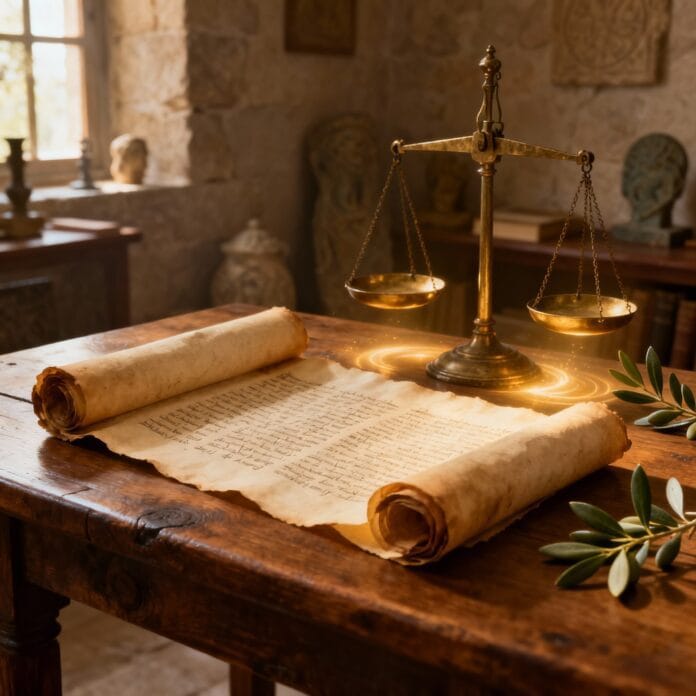
1° The title. – In the Vulgate, Liber Sapientiœ ; according to the Septuagint, Σοφία Σαλωμώντοζ, Wisdom of Solomon. Syriac and Arabic paraphrase these names: "The Great Wisdom of Solomon" and: "Book of the Wisdom of Solomon, son of David, who reigned over the children of Israel." The Greek Fathers of the Church sometimes refer to this book as Proverbs : ή πανάρετος σοφία, the wisdom that bestows all virtues; or: ή θεία σοφία, divine wisdom. These different terms express very well the dominant thought of the text, which deals, in fact, with wisdom, its origin and its effects.
2° CanonicityThe Book of Wisdom is not part of the Hebrew Bible; it is therefore deuterocanonical. But there is no doubt that it has long been accepted in the synagogue as an integral part of the Holy Scriptures, since it is contained in the Septuagint, intended for Greek-speaking Jews. The writers of the New Testament do not quote it directly; but they often and clearly allude to it, and this is a very serious argument in favor of its divine authority, for it is quite evident that the apostles would not have treated a profane and apocryphal book with such honor (several rationalists admit the strength of this reasoning). Compare 8:5 ff., and John 1, 1; 9, 1, and John 1, 3; 16, 5 et seq., and John 3, 14-15; 11, 16, and Rom. 1, 21; 15, 7, and Rom. 9, 21; 12, 20-21, and Rom. 9, 22-23; 3, 8, and 1 Cor. 6, 2; 9, 15, and 2 Cor. 5, 4; 5, 18-20, and Eph. 6, 13-17; 3, 18, and 1 Thess. 4, 13; 7, 25, and James. 3, 15; 3, 5-7, and 1 Peter 1, 6-7; 7, 26, and Hebr. 1, 3; 7, 22-24, and Hebr. 4, 12-13. Etc). The Churches, both Greek and Latin, have never hesitated on this point, as is evident from the testimonies of the Church Fathers and the Councils. Already the pope Saint Clement, in his first letter to the Corinthians, 27, quoted two passages from Wisdom (11:22 and 12:12). Saint Irenaeus, Saint Hippolytus, Clement of Alexandria, Origen, Tertullian, Saint Cyprian, Lactantius, Saint Hilary of Poitiers, Saint Jerome, etc., attribute to it entirely the authority of an inspired book and regard its author as a "prophet." veneration of divine authority,” he said Saint Augustine, summarizing the entire tradition (From Praedestinat. Sanct., 1, 14).
It is entirely wrong to attack the canonicity and inspiration of the Book of Wisdom in our time, claiming to find historical or philosophical errors, meaningless legends, and the systems of Plato or the Alexandrian school within it. These false assertions collapse of their own accord upon careful and impartial examination of the texts in question.
3° The author and the period of compositionBy attaching Solomon's name to the title of the book, the Septuagint, Syriac, and Arabic texts in no way intended to attribute its composition to this prince. The Syriac translator made formal reservations on this point, openly denying that Solomon was the true author. It is therefore a pseudonym, but a clear, "transparent" one, designed to deceive no one, and which very few were fooled by even in antiquity (nevertheless, some writers, such as Clement of Alexandria, Tertullian, Saint Cyprian, etc., considered Solomon to be the true author). Saint Irenaeus, Origen, Saint Jerome, and Saint Augustine are as clear as possible on this point: "It's not Solomon, the doctors have no doubt about that."» said this last Father expressly (De civit. Dei, 17, 20). And elsewhere (From Doctor Christ., 2, 8): "There are three books of Solomon: Proverbs, the Song of Songs, and theEcclesiastesIt is said that Wisdom and Ecclesiasticus are by Solomon, because of a certain resemblance. Therefore, everyone agrees, it is in a very broad sense that the Councils held in the West and papal documents sometimes mention five books of Solomon (Proverbs, the Song of Songs, theEcclesiastes, Wisdom and Ecclesiasticus): simple abbreviation formula, based on a very old custom, but which does not define anything on the question of authorship.
The last line of Saint Augustine The reason we have just cited indicates why the forever unknown sacred writer to whom we owe the Book of Wisdom probably placed Solomon's name at the beginning of his work himself; he wanted to show that he was going to treat a subject worthy of the king renowned above all for his wisdom, and similar to those that had actually served as themes for Solomon in his authentic writings (this is why he sometimes features him and has him speak directly. Cf. 7:1-21; 8:10 ff.; 9:7-8). Could we not go further and think, with renowned exegetes (among others Bonfrère, Bellarmine, Lorin, Cornelius a Lap., Haneberg, and Cornely), that the author made use of notes left by the great king, so that Solomon had a real part in the composition of the book? The fact is not impossible in itself, and it would explain the dual current that formed from the time of the Church Fathers on this delicate point; but unfortunately it is only a conjecture without solid foundation.
It is also on the basis of simple, but certainly erroneous, hypotheses that the Book of Wisdom has been attributed, in ancient or modern times, sometimes to Jesus, son of Sirach, author of Ecclesiasticus (Saint Augustine, From Christian doctrine., 2, 8, who later abandoned this sentiment. Cf. Retract., 2, 4), sometimes to the famous Jewish theosophist Philo («some ancient writers» already held this opinion in the time of Saint Jerome. On its falsity, see the Biblical Man de Fulcran Vigouroux, t. 2, n. 868. The similarities between Philo's theories and the book of Wisdom are purely superficial), sometimes to Zerubbabel returned from Babylon, sometimes to some Christians, notably Apollos.
In the absence of a definitive tradition, we can at least present some intrinsic arguments that lead to a very serious and fairly widely accepted conclusion. These arguments are drawn from the style and literary genre of the book. In this respect, Wisdom presents two features that appear contradictory but are perfectly reconciled. On the one hand, one often notices a very pronounced Hebrew character (phrases borrowed from Hebrew (cf. 1:1: «You who judge the earth, in kindness, in the simplicity of heart; 2:9: this is our portion. 2:15: «"«His ways are strange.» ; 4, 15, etc.), parallelism of the members (cf. 1, 1; 2, 1-6; 7, 17-21; 11, 9-10, etc.), sentence construction sometimes a little heavy, etc.). On the other hand, as Saint Jerome rightly affirmed, "its style shines with a truly Greek eloquence" to a degree unheard of in the rest of the Septuagint Bible (frequent use of very classical expressions, and especially compound words; assonance, alliteration, and other wordplay that presuppose a fairly thorough knowledge of Greek (1:1: άγαπήσατε…, φρονήσατε… έν άγαθότητι χαί άπλότητι… ζητήσατε. 1:2: πειράζουσιν… άπιστούσιν. 1, 4: ούς…χαί θρούς. Etc.); familiarity with Greek customs (cf. 1, 14; 4, 2, 3; 7, 22; 10, 12; 11, 17; 19, 20, etc. in the Greek text) and theories (cf. 1, 16; 2, 2-3; 5, 10; 8, 5-9; 12, 3-8, etc.)). This work is therefore remarkable from a literary point of view. But everything is easily explained if we accept that it was composed, for his coreligionists in Egypt, by a Jew from Alexandria, very familiar with the language and Hellenic matters, and who also knew thoroughly, if not Hebrew, at least the Septuagint translation of the Bible, which is full of Hebraisms. Hence the twofold coloring of his style (this style is far from "always being equal: very elevated and sublime in some parts, as in the portrait of the Epicurean (2), in the picture of the Last Judgment (5, 15-24), in the description of wisdom (7, 26-8, 1), incisive and biting in the painting of idols (13, 11-19), it is diffuse and overloaded with epithets… in other passages."« Man. Bibl, t.2, n. 868).
Regarding the time of composition, the only thing that can be stated with certainty is that the book is significantly earlier than Christianityand later than the Septuagint, since he quotes their version several times (cf. 2:12, and Isaiah 3:10; 15:10 and Isaiah 44:20, etc.). He alludes to some rather harsh trials which the Jews were then going through (cf. 6:5; 12:2; 15:14): a circumstance which could be appropriate to the reign of either Ptolemy Philopator (222-205 BC) or Ptolemy Physcon (145-117 BC).
4° The subject, the goal, the division. This book is essentially a long discourse, a kind of manifesto addressed to contemporary Jews and pagans, intended to contrast the false principles and wicked conduct suggested by human wisdom with the perfection of faith and life, as recommended by true wisdom. But it is the Jews of Egypt whom it particularly targets, and this for a threefold purpose: 1) to console and encourage them amidst the suffering they endured at the hands of their enemies; 2) to attack those among them who had cowardly apostatized and who did not hesitate to persecute their brethren, in concert with the pagans; 3) to attack paganism itself and demonstrate its ignominy and folly.
The division is very clear. Two parts: the first, general and theoretical (chapters 1-9), considers wisdom in its essence and its beneficial effects; the second, more specific and historical (chapters 10-19), examines the admirable works of wisdom in a number of events in Hebrew history. Two sections in the first part: 1. Wisdom, the source of true happiness and immortality, 1:1-5:24; 2. Wisdom, the surest guide in human life, 6:1-9:19. Three sections in the second part: 1. The power of wisdom to save or to punish, 10:1-12:27; 2. Wisdom demonstrates that idolatry is a criminal folly, 13:1-14:31; 3. The contrast between pagans and the worshipers of God, 15:1-19:22.
5° The importance of the Book of Wisdom is recognized even by those who treat it as an apocryphal text. Its significance lies primarily in the fact that "it leads us to the threshold of Christianity" through the ideas it expresses and the language it uses to express them. And among these ideas, the principal one concerns the origin and nature of Wisdom, this divine hypostasis, which is synonymous with the Logos of the New Testament (see the Fulcran Vigouroux's Bible Manual, (vol. 2, no. 874). Nothing could be clearer or more striking; thus, Saint John and Saint Paul employ similar phrasing to describe the attributes of Our Lord Jesus Christ as the Incarnate Word, Son of the Father. Other dogmas are also clearly taught in these pages, especially those of the immortality of the soul and the Last Judgment (cf. 2:23; 3:1 ff.; 4:2, 7 ff.; 5:1 ff.; 8:17; 15:3, etc.). They therefore truly occupy a place of honor in the history of the Preparation for the Gospel.
6° Catholic commentators. Lorin, Cornelius a Lapide, Jansenius of Ghent (Annotationes in librum Sapientiœ), Bossuet, Calmet. Lesêtre, the Book of Wisdom (Paris, 1880).
Wisdom 1
1 Love justice, you who are the judges of the earth; let your thoughts about the Lord be upright, and seek him with a sincere heart., 2 for he allows himself to be found by those who do not tempt him, and he reveals himself to those who trust in him. 3 Indeed, perverse thoughts separate us from God, and his power, when tested, condemns the foolish. 4 Wisdom does not enter a soul that meditates on evil, nor does it dwell in a body enslaved by sin. 5 The Holy Spirit, educator of men, flees from cunning, he distances himself from thoughts devoid of intelligence and withdraws when iniquity approaches. 6 Indeed, Wisdom is a spirit that loves men and does not leave the blasphemer unpunished for his words, for God is the witness of his loins, the true scrutinizer of his heart, and he hears his words. 7 For the Spirit of the Lord fills the universe, and he who contains all knows all that is said. 8 Therefore, he who speaks impious words cannot remain hidden, and vengeful justice does not forget him. 9 For there will be an investigation into the plans of the wicked, and the rumor of his words will reach the Lord for the punishment of his iniquities. 10 A jealous ear hears everything and the sound of whispers does not escape it. 11 Therefore, guard against useless murmuring, and preserve your tongue from blasphemy, for the most secret word does not go unpunished, and the mouth that lies brings death to the soul. 12 Do not rush towards death through the errors of your life, and do not bring destruction upon yourself through the works of your hands. 13 For God did not make death, nor does he rejoice in the destruction of the living. 14 He created all things for life; the creatures of the world are beneficial; there is no principle of destruction in them, and death has no dominion over the earth. 15 Because justice is immortal. 16 But the wicked call for death with gesture and voice, regarding it as a friend, they are passionate about it, they make an alliance with it, and they are indeed worthy to belong to it.
Wisdom 2
1 They said to each other, reasoning incorrectly: "The time of our life is short and sad, and when the end of a man comes, there is no remedy, no one is known to deliver from the abode of the dead. 2 Chance brought us into existence and, after this life, we will be as if we had never been; the breath in our nostrils is smoke and thought, a spark that springs forth with the beat of our heart. 3 When it dies, our body will turn to ashes and the spirit will dissipate like light air. 4 Our name will fade into oblivion with time, and no one will remember our deeds. Our life will pass like a cloud's trail, it will dissipate like mist, chased away by the sun's rays, and condensed into rain by the heat. 5 Our life is the passage of a shadow, its end is irreversible, the seal is affixed and no one returns. 6 «Come then, let us enjoy the present blessings, let us use creatures with the ardor of youth, 7 Let us intoxicate ourselves with precious wine and perfumes, and let us not let the flower of spring pass us by. 8 Let us crown ourselves with rosebuds before they wither. 9 Let none of us miss our orgies, let us leave traces of our revelry everywhere, for that is our share, that is our destiny. 10 «Let us oppress the righteous who are poor, let us not spare the widow, and let us have no regard for the white hair of the aged man.”. 11 Let our strength be the law of justice; what is weak is deemed worthless. 12 Let us therefore hunt down the righteous, since he inconveniences us, since he is contrary to our way of acting, since he reproaches us for violating the law and accuses us of contradicting our education. 13 He claims to possess the knowledge of God, and calls himself the son of the Lord. 14 It is for us the condemnation of our thoughts; its very sight is unbearable to us. 15 because his life is unlike anyone else's and his ways are strange. 16 In his thinking, we are impure dross, he rejects our way of life as a defilement, he proclaims the final fate of the righteous as blessed and boasts of having God as his father. 17 Let us see if what he says is true and examine what will happen to him after he leaves this life. 18 For if the righteous one is a child of God, God will defend him and deliver him from the hand of his adversaries. 19 Let us subject him to insults and torments, so that we may know his resignation and judge his patience. 20 Let us condemn him to a shameful death, for, as he says, God will care for him.» 21 Such are their thoughts, but they are mistaken; their malice has blinded them. 22 Ignorant of God's secret designs, they do not expect any reward for holiness and they do not believe in the reward of pure souls. 23 For God created man for immortality, and he made him in the image of his own nature. 24 It was through the devil's desire that death came into the world., 25 Those who belong to him will experience it.
Wisdom 3.
1 The souls of the righteous are in the hand of God and torment will not touch them. 2 In the eyes of fools, they appear to be dead, and their departure from this world seems a misfortune. 3 and their departure from our midst is an annihilation, but they are in peace. 4 Even though they have suffered punishments before men, their hope is full of immortality. 5 After a slight trial, they will receive a great reward because God has tested them and found them worthy of Him. 6 He tested them like gold in the furnace, and accepted them as a perfect burnt offering. 7 At the time of their reward, they will shine, like sparks, they will run through the stubble. 8 They will judge the nations and rule over the peoples, and the Lord will reign over them forever. 9 Those who have placed their trust in him will understand the truth; his faithful ones will dwell with him in love, for grace and mercy are for its elected officials. 10 But the wicked will receive the punishment they deserve for their perverse thoughts, for they have despised the righteous and turned away from the Lord. 11 For whoever rejects wisdom and correction is doomed to disaster; their hope is in vain, their efforts are fruitless, and their works are unprofitable. 12 Their wives are foolish, their children full of malice, and their offspring are cursed. 13 Therefore, blessed is the barren and spotless woman, whose bed knows no defilement. She will bear her fruit in the visitation of souls. 14 Blessed is the eunuch who has not done wrong with his own hand, nor conceived any evil thoughts against the Lord. He will receive a rich reward for his faithfulness and will have the most desirable place in the temple of the Lord. 15 For the work of good works yields glorious fruit, and the root of prudence does not perish. 16 But the children of adultery will not reach their end, and the race born of a criminal bed will disappear. 17 If their lives are long, they will be counted for nothing, and their old age at the end will be without honor. 18 If they die quickly, they will have no hope or consolation on the day of judgment. 19 For an unjust race always has a tragic end.
Wisdom 4
1 Sterility is better with virtue; her memory is immortal, for she is known to God and to men. 2 When we have her before our eyes, we imitate her; when she is no longer there, we miss her; crowned in eternity, she triumphs, having won the victory in battles without blemish. 3 But the numerous offspring of the wicked are of no use; they come from bastard offspring, they will not put down deep roots or establish themselves on a secure foundation. 4 Even though they would be covered for a time with green branches, fixed to the ground without solidity, they will be shaken by the wind and uprooted by the violence of the hurricane. 5 Their branches will be broken while still tender, their fruits are useless, too green to be eaten and unfit for any use. 6 Because children born of impure sleep are witnesses to the crime against their parents when questioned. 7 But the righteous man, even if he dies before his time, finds rest. 8 An honorable old age is not that which comes from a long life, nor is it measured by the number of years. 9 But prudence is like white hair for a man, and old age is a spotless life. 10 Being pleasing to God, he was loved by him and, as he lived among the fishermen, He was transferred. 11 He was taken away for fear that malice might alter his intelligence, or that cunning might corrupt his soul. 12 For the enchantment of vice obscures good, and the vertigo of passion perverts a mind without malice. 13 Having reached perfection in a short time, he enjoyed a long career. 14 Because his soul was pleasing to the Lord, therefore the Lord hastened to remove him from the midst of iniquity. 15 The people see it without understanding it, not putting it into their minds that God's grace and mercy are with his chosen ones and that he cares for his saints. 16 But the righteous man who dies condemns the wicked who survive, and youth, having so quickly reached perfection, condemns the long old age of the unjust man. 17 They will see the end of the wise man, but without understanding God's plans for him, nor why the Lord has made him safe. 18 They will see and mock, but the Lord will laugh at them. 19 And after that they will be a dishonorable corpse, they will be among the dead in reproach forever. The Lord will crush them and silence them, he will cast them down, he will shake them from their foundations and they will be destroyed to the last one, they will be in pain and their memory will perish. 20 They will come filled with terror at the thought of their sins and crimes, standing before them, and will accuse them.
Wisdom 5
1 Then the righteous will stand with great confidence, in the presence of those who persecuted him and despised his labors. 2 At this sight, they will be filled with horrible terror, they will be in awe at the revelation of salvation. 3 They will say to one another, full of regret and groaning in the tightness of their hearts: "So this is the one who was once the object of our mockery and the target of our insults. 4 Foolishly, we regarded his life as madness and his end as a disgrace. 5 How is he counted among the children of God, and is his portion among the saints? 6 So we have strayed far from the path of truth; the light of justice has not shone upon us, and the sun has not risen upon us. 7 We have been filled with the ways of iniquity and destruction; we have walked in pathless deserts and have not known the way of the Lord. 8 What good has pride done us, and what has wealth and pretension brought us? 9 All these things passed like a shadow, like a fleeting rumor, 10 like a ship that cuts through the turbulent waves, without leaving a trace of its passage, nor the mark of its keel in the midst of the waves, 11 or like a bird crossing the air, leaving no trace of its path, but beating the light air with its feathers, tearing through it with a powerful surge, making its way through it by flapping its wings, then no sign of its passage can be seen, 12 or as, when the arrow has been launched towards its target, the air it has pierced immediately returns upon itself and one no longer knows where it has passed: 13 "So we ourselves were born and ceased to be, and have no trace of virtue to show; and in our iniquity, we were cut off."» 14 Indeed, the hope of the wicked is like down that the wind carries away, like light frost that the hurricane scatters, like smoke that a breath dissipates, like the memory of a day's guest that vanishes. 15 But the righteous live forever; their reward is with the Lord, and the Almighty cares for them. 16 That is why they will receive from the Lord’s hand the magnificent kingdom and the splendid diadem, for he will protect them with his right hand, with his arm, he will cover them as with a shield. 17 He will seize his zeal as armor and he will arm creation to take revenge on his enemies. 18 He will put on justice as his breastplate and take sincere judgment as his helmet. 19 He will take holiness as an impregnable shield. 20 From his inexorable anger he will make a sharp sword and the universe will fight with him against the fools. 21 Well-directed lightning bolts will depart and, from the heart of the clouds, like from a well-strung bow, will fly to the marked target. 22 His anger, like a catapult, will launch a mass of hail, the water of the sea will rise up against them, and the rivers will rush forth in fury. 23 The breath of divine power will rise against them and scatter them like a whirlwind, and thus iniquity will make the whole earth a desert, and malice will overthrow the thrones of the powerful.
Wisdom 6
1 Listen then, O kings, and understand; listen to the instruction, you who judge the ends of the earth. 2 Listen closely, you who rule over the multitude, who are proud to command crowds of people. 3 Know that strength has been given to you by the Lord and power by the Most High, who will examine your works and search your thoughts. 4 Because, being ministers of his kingdom, you have not judged fairly, nor observed the law, nor walked according to the will of God, 5 terrible and sudden, it will fall upon you, for a severe judgment is exercised upon those who command. 6 The little ones are forgiven out of pity, but the powerful are powerfully punished. 7 The sovereign of all will not back down from anyone, he will not stop out of respect for any greatness, for he has made the great and the small and he takes care of both as well. 8 But the powerful will be subjected to a more rigorous test. 9 Therefore, it is to you, O kings, that my words are addressed, so that you may learn wisdom and not fall. 10 Those who faithfully observe the holy laws will be sanctified, and those who have learned them will have something to answer for. 11 Therefore, place your delight in my words, desire them, and you will have instruction. 12 Wisdom is brilliant and its radiance does not dim; it is easily perceived when one loves it, and easily found when one seeks it. 13 She warns those who seek her and reveals herself to them first. 14 He who rises early to seek it has no difficulty, he finds it seat at his door. 15 For to think of her is the perfection of prudence, and he who watches over her will soon be free from worries., 16 She herself goes in all directions to seek those who are worthy of her, she shows herself friendly to them in their ways and assists them in all their designs. 17 Indeed, its most certain beginning is the desire for education. 18 But the care of education leads to love, love makes one obey its laws, and obedience to its laws ensures immortality. 19 and immortality grants a place close to God. 20 Thus the desire for wisdom leads to kingship. 21 Therefore, O kings of the peoples, if you find your pleasure in thrones and scepters, honor wisdom, so that you may reign forever. 22 But I will explain what wisdom is and its origin, without hiding the mysteries of God from you. I will go back to the beginning of creation, I will bring to light what concerns it, and I will not deviate from the truth. 23 Far be it from me to follow a path driven by consuming desire. It has nothing in common with wisdom. 24 The large number of wise people brings salvation to the earth, and a wise king brings prosperity to his people. 25 Therefore, receive instruction from my words and you will be well.
Wisdom 7
1 I am myself a mortal, like all others and a descendant of the first one who was formed from earth. 2 I was formed in the flesh in my mother's womb, for ten months taking shape in the blood, from the seed of man, during sleep's rest. 3 I too, at my birth, breathed the air common to all, I fell on the same earth and, like everyone else's, my first cry was a groan. 4 I was raised in swaddling clothes and with endless care. 5 No king has had any other beginning of existence. 6 There is only one way for everyone to enter life and to leave it. 7 That is why I prayed and prudence was given to me, I invoked and the spirit of wisdom came into me. 8 I preferred her to scepters and crowns, and I considered riches worthless compared to her. 9 I have not matched her with the most precious stones, for all the gold in the world is but a little sand compared to her, and silver, beside her, must be valued as mud. 10 I loved her more than health and beauty, I preferred to possess her rather than light, for her flame never goes out. 11 With her came all good things to me, and countless riches are in her hands. 12 And I rejoiced in all these blessings, for wisdom brings them with her, yet I did not know that she was their mother. 13 I learned it without ulterior motives, I share it without envy, and I do not hide its treasures. 14 For it is an inexhaustible treasure for men; those who use it share in the friendship of God, to whom they are commended by the gifts acquired through education. 15 May God grant me to speak of it as I wish and to conceive thoughts worthy of the gifts I have received, for it is He who guides wisdom and directs the wise. 16 We are in his hands, we and our speeches and all the prudence and know-how. 17 It was he who gave me the true science of beings, enabling me to understand the structure of the universe and the properties of the elements., 18 the beginning, the end, and the middle of time, the periodic returns of the sun, the vicissitudes of time, 19 the cycles of the years and the position of the stars, 20 the nature of animals and the instincts of beasts, the power of spirits and the reasoning of men, the different species of plants and the virtue of roots. 21 I have learned everything that is hidden and everything that is revealed., 22 For wisdom, the worker of all things, has taught me this. In her, indeed, there is an intelligent, holy, unique, manifold, immaterial, active, penetrating, spotless, infallible, impassive, loving good, lively, knowing no obstacle, beneficent, 23 good for men, unchanging, assured, tranquil, all-powerful, watching over everything, penetrating all minds, the intelligent, the pure and the most subtle. 24 For wisdom is more agile than any movement; it penetrates and infiltrates everywhere, because of its purity. 25 She is the breath of God's power, a pure emanation of the glory of the Almighty, therefore nothing defiled can fall upon her. 26 She is the radiance of eternal light, the spotless mirror of God's activity, and the image of his goodness. 27 Being unique, it can do all things, remaining the same, it renews all things, spreading itself, through the ages, into holy souls, making them friends of God and prophets. 28 Indeed, God loves only those who dwell in wisdom. 29 For it is more beautiful than the sun and the harmonious arrangement of the stars. Compared to light, it surpasses it., 30 For light gives way to night, but evil does not prevail against wisdom.
Wisdom 8
1 Wisdom reaches powerfully from one end of the world to the other and arranges everything with gentleness. 2 I loved her and sought her from my youth, I sought to have her as my wife and I was enamored of her beauty. 3 She displays the glory of her origin in that she dwells with God, and the master of all things loves her. 4 For it is she who initiates us into the science of God and who chooses from among his works. 5 If wealth is a desirable good in this life, what is richer than wisdom, which makes all things possible? 6 If prudence governs work, who better than wisdom is the craftswoman of all that exists? 7 Do we love justice? The labors of wisdom produce virtues; it teaches temperance and prudence, justice and strength, which are most useful to men during life. 8 Is a wide-ranging science desired? It knows the past and conjectures the future, it penetrates subtle discourses and solves enigmas, it knows in advance the signs and wonders, it knows the events of times and epochs. 9 Therefore, I resolved to take her as my life companion, knowing that she would be a counselor in all good and a consolation in my worries and sorrows. 10 Through her, I told myself, I will have glory in the assemblies and, while still young, honor among the old men. 11 My insightful judgments will be recognized, and the great will be filled with admiration before me. 12 If I remain silent, they will wait for me to speak; if I speak, they will keep their eyes fixed on me; and if I prolong my speech, they will put their hands over their mouths. 13 Through it, I will obtain immortality and leave an eternal memory to posterity. 14 I will rule over peoples, and foreign nations will be subject to me. 15 When they hear of me, fearsome kings will fear me: I will show myself good among the people and valiant in the war. 16 Upon my return to my home, I shall rest beside her, for her company causes no bitterness, nor her dealings any trouble, but contentment and joy. 17 Meditating on these thoughts within myself and reflecting in my heart that immortality is the fruit of union with wisdom, 18 that there is noble enjoyment in his friendship and in inexhaustible riches in the works of his hands, that one acquires prudence in his assiduous company and glory in taking part in his conversation: I went everywhere, seeking the means to have him with me. 19 I was a kind-hearted child and I had been blessed with a good soul., 20 or rather, being good, I came to a body without defilement. 21 But, knowing that I could not obtain wisdom unless God gave it to me, and it was already prudent to know from whom this gift came, I addressed the Lord and invoked him and said to him from the bottom of my heart:
Wisdom 9
1 «God of fathers, Lord of mercy, who made the universe by your word, 2 and who, by your wisdom, established man to rule over all the creatures you made, 3 to rule the world in holiness and justice and to exercise dominion in uprightness of heart, 4 Give me the Wisdom that is seat near your throne and do not reject me from the number of your children. 5 For I am your servant and the son of your handmaid, a weak man, of short life, and little able to understand judgment and laws. 6 Even if anyone among the children of men were perfect, if they lacked the wisdom that comes from you, they would be considered as nothing. 7 You have chosen me to rule over your people and to judge your sons and daughters. 8 And you told me to build a temple on your holy mountain and an altar in the city where you dwell, on the model of the holy tabernacle which you prepared from the beginning. 9 With you is Wisdom, who knows your works, who was there when you made the universe, and who knows what is pleasing in your eyes and what is right according to your commandments. 10 Send her from your most holy heavens, send her from the throne of your glory, so that she may assist me in my labors and that I may know what is pleasing to you. 11 For she knows and understands all things, and she will guide me prudently in my works and keep me by her glory. 12 And so my works will be pleasing to you, I will rule your people with justice, and I will be worthy of my father's throne. 13 For what man can know the counsel of God, or who can fathom the will of the Lord? 14 Men's thoughts are uncertain and our opinions are unstable. 15 For the body, subject to corruption, weighs down the soul, and its earthly dwelling burdens the mind with its many thoughts. 16 We can scarcely fathom what is on earth, and we find with difficulty what is under our hand: who has penetrated what is in heaven? 17 Who has known your will, if you have not given him wisdom and sent your Holy Spirit from on high? 18 Thus the ways of those on earth were made straight, and men learned what is pleasing to you, and they were saved by Wisdom.»
Wisdom 10
1 It was wisdom that preserved the first man formed by God, to be the father of humankind, the only one created., 2 She drew him from his sin and gave him the power to rule all creatures. 3 Having distanced himself from her in his anger, the unjust man perished with his fratricidal fury. 4 When, because of him, the earth was submerged, wisdom saved it, guiding the righteous man onto worthless wood. 5 When the nations were confounded in their common iniquity, wisdom recognized the righteous and preserved him blameless before God and kept him invincible against His tenderness for His son. 6 It was she who, in the midst of the ruin of the wicked, saved the righteous, who fled from the fire that came down on the five cities. 7 As a testament to their perversity, this desolate land continues to smoke, the trees bear their fruit out of season, a monument to an unbelieving soul, a column of salt remains standing there. 8 Having neglected wisdom, they not only deprived themselves of the knowledge of good, but they left to the living a monument to their folly, so that their crimes could not fall into oblivion. 9 But wisdom delivered her faithful from misfortune. 10 It was she who led the righteous man fleeing from his brother's wrath by straight paths, who showed him the kingdom of God and gave him knowledge of holy things, she enriched him in his arduous labors and made his work fruitful. 11 She assisted him against avaricious oppressors and helped him acquire wealth. 12 She guarded him against his enemies and protected him from those who laid traps for him; she gave him victory in a tough battle, to teach him that piety is more powerful than anything. 13 She did not abandon the righteous man who had been sold, but preserved him from sin., 14 She went down with him into the pit and did not leave him in chains, until she had procured for him the royal scepter and power over his oppressors, she convicted those who had accused him of lying and gave him eternal glory. 15 She delivered from the nations that oppressed her the holy people and the blameless race. 16 She entered the soul of the servant of God and, through signs and wonders, she stood up to formidable kings. 17 She gave the saints the reward for their labors, she led them along a path strewn with wonders, and was for them a shade during the day and like the light of the stars during the night. 18 She led them across the Red Sea and guided them through the great waters. 19 She overwhelmed their enemies, then cast them back from the depths of the abyss. 20 That is why the righteous removed the spoils of the wicked and sang your holy name, Lord, and together praised your hand which fought for them. 21 For wisdom opened the mouths of the mute and made the tongues of children eloquent.
Wisdom 11
1 She made their works succeed through the hand of a holy prophet. 2 They traveled through an uninhabited desert and pitched their tents in areas without roads. 3 They resisted their enemies and took revenge on their adversaries. 4 They experienced thirst and called upon you, and water was given to them from a steep rock and a stone, quenching their thirst. 5 What had been the punishment of their enemies became a blessing for them in their distress. 6 Indeed, while the waters of an inexhaustible river were troubled by impure blood, 7 As punishment for the decree that condemned children to death, you gave your faithful, against all hope, abundant water, 8 showing them, by the thirst they then felt, what punishment you were inflicting on your adversaries. 9 After this ordeal, although punished with mercy, they knew how the wicked were tormented when judged in anger. 10 You tested some like a father who warns, and you punished others like a severe king who condemns. 11 Whether absent or present, they were equally tormented. 12 A double sorrow seized them and they groaned at the memory of what had happened. 13 For when they learned that their own torments were turning to the advantage of the fugitives, they recognized the hand of the Lord. 14 The one they had once exposed and rejected with contempt, they admired at the end of events, when they had suffered a thirst quite different from that of the righteous. 15 As punishment for the extravagant thoughts of their perversity, which led them astray and caused them to worship reptiles without reason and vile animals, you sent them as chastisement a multitude of stupid beasts: 16 to teach them that one is punished in the very way one has sinned. 17 It was not difficult for your all-powerful hand, which made the world from formless matter, to send against them a multitude of ferocious bears or lions, 18 or newly created beasts, full of fury and unknown, breathing fiery vapor, exhaling foul smoke, or shooting terrible lightning from their eyes, 19 capable not only of killing by wounding, but of striking fear down with their mere appearance. 20 And, even without that, they could have perished by a mere breath, pursued by justice and scattered by the breath of your power. But you have ordered everything with measure, with number, and with weight. 21 For the sovereign power is always at your command, and who could resist the strength of your arm? 22 The whole world is before you like the atom that tips the scales, like the drop of morning dew that falls on the earth. 23 ²But, because you can do all things, you have pity on everyone and you overlook the sins of men so that they may repent. 24 For you love all creatures and you hate nothing that you have made; if you had hated something, you would not have done it. 25 And how could a being subsist if you did not will it, how could it preserve itself if you had not called it into existence? 26 But you forgive everyone, because everything is yours, Lord, who loves souls.
Wisdom 12
1 For your incorruptible spirit is in all beings. 2 That is why you moderately punish those who fall, and when they sin, you warn them and rebuke them, so that, renouncing their malice, they may believe in you, Lord. 3 You hated the former inhabitants of your holy land, 4 because they engaged in detestable works of magic, in unholy ceremonies, 5 and to the cruel murders of children, devouring human flesh and drinking blood. These initiates into abominable mysteries, 6 These parents, murderers of defenseless beings, you wanted to destroy them by the hand of our fathers., 7 so that this land, which you honor above all others, might receive a worthy colony of God's children. 8 However, because they were men, you showed mercy and sent hornets as advance guards of your army to gradually kill them off. 9 Not that it would be impossible for you to bring down these impious people in a pitched battle, under the hand of the righteous, or to exterminate them at once by ferocious beasts, or by a strict order, 10 But, by exercising your judgments gradually, you gave them cause to do penance, even though you knew full well that they were a perverse race, that their malice was innate, and that their thoughts would never change., 11 for they were a cursed race from the beginning. Nor was it out of fear of anyone that you were lenient toward their sins. 12 For who could say to you, «What have you done?» Who could oppose your judgment? Who would accuse you of destroying the nations you have created? Who would come to plead against you the cause of ungodly men? 13 For there is no God besides you, who take care of all things, to show that you do not judge unjustly. 14 There is no king or tyrant who can rise up against you in defense of those whom you have punished. 15 But, because you are just, you settle everything justly and you consider it contrary to your power to condemn also the one who does not deserve punishment. 16 For your power is the foundation of justice, and it is because you are Lord of all that you show mercy to all. 17 It is to those who do not believe in your omnipotence that you show your strength, and you confound the audacity of those who know it. 18 Master of your strength, you judge with gentleness and you govern us with great indulgence, for power is with you when you will it. 19 By acting in this way, you have taught your people that the righteous must be humane and you have inspired in your children the joyful hope that, if they sin, you grant them time to repent. 20 If, indeed, you have punished the enemies of your servants with such leniency and indulgence, even though they deserved death, giving them time and opportunity to repent of their malice, 21 With what circumspection do you judge your children, whose fathers received from you oaths and covenants, joined with magnificent promises. 22 When you correct us, you lash our enemies a thousand times harder, to teach us, when we judge, to think of your goodness and, when we are judged, to hope in your mercy. 23 That is why you tormented the unjust, who lived in madness, with their own abominations. 24 For they had sunk so far into the ways of error that they regarded the vilest animals as gods, having allowed themselves to be deceived like children without reason. 25 Just as you would treat children without reason, you first gave them a derisory punishment. 26 But those whom a derisory correction has not reformed will suffer a punishment worthy of God. 27 Punished by those they took for gods, they were exasperated by their sufferings and, seeing Him whom they had once refused to know, they recognized Him as the true God, which is why the supreme condemnation fell upon them.
Wisdom 13
1 Foolish by nature are all men who have ignored God and who have not been able, by visible goods, to see Him who is, nor, by consideration of His works, to recognize the Worker. 2 But they looked upon the fire, the wind, the moving air, the circle of stars, the rushing water, the torches of heaven, as if they were gods ruling the universe. 3 If, charmed by their beauty, they mistook these creatures for gods, let them know how much the Master surpasses them, for it is the Author of beauty himself who made them. 4 And if they admired their power and effects, let them conclude how much more powerful is the one who made them. 5 For the greatness and beauty of creatures reveal, by analogy, the One who is their Creator. 6 These people, however, incur less reproach, for they may go astray in seeking God and wanting to find him. 7 Engrossed in his works, they make them the subject of their research and relate to their appearance, so beautiful is what they see. 8 On the other hand, they are not excusable either., 9 For if they acquired enough knowledge to come to know the world, how could they not more easily come to know the Master? 10 But they are truly wretched, and they place their hope in lifeless things, those who have called God the works of human hands, of gold and silver worked with artistry, of animal figures, or of useless stone, the work of an ancient hand. 11 Here is a craftsman who cut down a tree that was easy to work with, he skillfully removed all the bark and, shaping it with dexterity, he made a piece of furniture useful for everyday use. 12Having finished his work, he uses what remains to cook his food and satisfies his hunger. 13 As for the last scraps, which are no longer of any use, twisted and full of knots, he takes them, carves them to occupy his leisure time and, by skillful work, gives them a shape: he makes them resemble a man. 14 Or he makes it into the image of some animal, paints it vermilion, covers the surface with a red color and makes all the stains disappear under a coating. 15 Then, having prepared a suitable dwelling for him, he placed him against the wall and fixed him with iron. 16 He is careful not to fall, knowing that the god cannot help himself, because he is only a statue that needs support. 17 However, he prays to Him concerning his possessions, his marriages, and his children, and he is not ashamed to speak to that which has no soul. He asks for health from that which is without strength., 18 life to what is dead, help to what can render no service, a happy journey to what cannot use its feet. 19 To ensure his profits, his businesses, the success of his work, he demands energy from those with the most inefficient hands.
Wisdom 14
1 Here is another who is thinking of going to sea and preparing to travel on the raging waves: he invokes a wood even more fragile than the ship that carries him, 2 because this ship was invented by the passion for profit and built by the skill of the craftsman. 3 But, O Father, it is your providence that governs it, you who have even opened a way in the sea and a safe path in the midst of the waves, 4 showing by this that you can deliver from all peril, so that even without the science of navigation, one can go to sea. You do not want the works of your wisdom to remain useless; therefore, men, entrusting their lives to a fragile piece of wood, 5 They cross the waves on a raft and escape death. 6 And long ago, when the proud giants perished, the hope of the universe escaped on a boat and, guided by your hand, left the world the seed of posterity. 7 For blessed is the wood that is used for a just purpose. 8 But the idol, the work of human hands, is cursed, both it and its creator: the latter because he made it, the former because, being perishable, it is called a god., 9 for God also hates the wicked and their wickedness 10 and both the work and the worker will be punished equally. 11 That is why the idols of the nations will be visited, because, being creatures of God, they have become an abomination, a stumbling block to the souls of men, a snare for the feet of fools. 12 The idea of making idols was the principle of fornication, and their invention led to the loss of life. 13 There weren't any originally, and there won't always be any. 14 It is the vanity of men that introduced them into the world, therefore their imminent end is decreed in the divine mind. 15 A father overwhelmed by premature grief shaped the image of a son who was taken from him too soon, and this child who had died, he began to honor as a god, and he instituted pious rites and ceremonies among the people of his house. 16 Then, this impious custom, becoming stronger with time, was observed as a law and, on the order of the princes, the statues were worshipped. 17 When they could not be honored face to face because they lived too far away, their distant figure was imagined and a visible image of the revered king was fashioned, in order to pay homage to the absent one as eagerly as if he had been present. 18 And, for the success of the superstition, those who did not know it were led to it by the ambition of the artist. 19 Indeed, wanting to please the powerful master, he exhausted all his art in embellishing the portrait. 20 And the crowd of men, seduced by the elegance of the work, regarded as a god the one who was formerly honored as a man. 21 It was a trap for the living that men, under the influence of misfortune or tyranny, had given the incommunicable name to stone or wood. 22 Soon it was not enough for them to wander in the notion of God, living in a state of violent struggle; as a result of their ignorance, they called such evils by the name of peace. 23 Celebrating murderous ceremonies for their children or clandestine mysteries and indulging in the unbridled debauchery of strange rites, 24 They have lost all sense of modesty in their lives and in their marriages. One kills the other through betrayal, or outrages the other through adultery. 25 Everywhere it is a mixture of blood and murder, theft and deceit, corruption and infidelity, revolt and perjury, 26 of persecution of good people, forgetfulness of good deeds, defilement of souls, crimes against nature, instability in unions, adultery and impurity. 27For the worship of nameless idols is the beginning, the cause, and the end of all evil. 28 Their amusements are foolish joys and their prophecies are lies; they live in injustice and perjure themselves without scruple. 29 Because they place their trust in lifeless idols, they expect no harm from their perjury. 30 But a just punishment will strike them for this double crime: because, by attaching themselves to idols, they have had perverse thoughts about God, and because they have treacherously made oaths against justice, in contempt of the holiest laws. 31 It is not the power of the idols by which they swore, but the punishment due to sinners that always reaches the prevarication of the impious.
Wisdom 15
1 But you, O our God, are good, faithful and patient, and you rule all things with mercy. 2 Even when we sin, we are yours, knowing your power; yet we do not want to sin, for we know that we are numbered among you. 3 To know you is perfect justice, and to know your power is the root of immortality. 4 We were not led astray by the invention of a fatal art, nor by a figure daubed with various colors, the vain work of a painter 5 objects whose appearance excites the passion of the madman, who falls in love with the inanimate figure of a lifeless image. 6 Fond of evil, they are worthy of such hopes, both those who make them and those who love or adore them. 7 Indeed, here is a potter who laboriously kneads the soft clay, he shapes each vase for our use and from the same clay he makes vases which are intended for noble uses and others for completely contrary uses, without distinguishing at all what use each of them should serve: it is the potter who is the judge. 8 Then, through impious work, from the same clay, he fashions a vain divinity, he who, once made of earth, will soon return to the place from which he was taken, when his soul, which had been lent to him, is demanded back. 9 Yet he is not concerned that his strength is failing, nor that his life is short, but he competes with those who work with gold and silver, he imitates those who work with bronze, and he boasts of performing deceptive figures. 10 His heart is like ashes, his hope is more vile than the earth, and his life is worth less than clay. 11 Because he does not recognize the one who made him, who inspired in him an active soul and put into him a breath of life. 12 He views our existence as an amusement, life as a marketplace where people gather for profit, because, they say, "one must acquire by any means, even by crime."« 13For he knows full well that he is more guilty than all the others, who, from the same earth, fashions fragile vessels and idols. 14 But they are all very foolish and more wretched than the soul of a child, the enemies of your people who hold them in oppression. 15 For they have regarded as gods all the idols of the nations, which cannot use their eyes to see, nor their nostrils to breathe air, nor their ears to hear, nor their fingers to touch, and whose feet are unable to walk. 16 It was a man who made them, and it was he to whom breath was given who fashioned them. There is no man who can make a god like him., 17 because, being mortal, he only produces dead works with his impious hands; he is better than the objects he worships, for at least he has life and they never had it. 18 They worship the most odious animals, which, judged according to their stupidity, are worse than the others. 19 There is nothing good in them that arouses affection; like other animals, they escape God's praise and blessing.
Wisdom 16
1 That is why they were justly punished by similar creatures and tormented by a multitude of beasts. 2 In place of these plagues, you have bestowed blessings upon your people, and to satisfy their ardent desire, you have prepared for them a marvelous food: quail. 3 so that some, despite their desire to eat, at the repugnant appearance of the insects sent against them, even took aversion to their natural appetite, while others, after a slight deprivation, tasted a new food. 4 Because it was necessary that an inevitable famine should afflict the first group, the oppressors, and that only then should the others be shown how their enemies were tormented. 5 Indeed, when they suffered from the fury of cruel beasts and perished from the bite of twisting serpents, your anger did not last to the end, 6 They were troubled for a while, for the sake of their correction, and they received a sign of salvation, to remind them of the precepts of your law. 7 For whoever turned to him was healed, not by the thing he saw, but by you, who are the savior of all. 8 But by doing so, you have also taught our enemies that it is you who deliver from all evil. 9 Indeed, the bite of the grasshoppers and gnats caused them to perish, and no way could be found to save their lives, because they deserved to be punished in this way. 10 Your children were not overcome by the teeth of venomous snakes, for your mercy came to their aid and healed them. 11 It was so that they would remember your words that they were wounded and quickly healed, lest, by forgetting them entirely, they would be excluded from your blessings. 12 It was neither a herb nor a medicine that healed them, but your word, Lord, which heals all. 13 For you have power over life and death; you lead to the gates of Hades and you bring back from there. 14 Man, in his wickedness, may well give death, but not bring back the spirit once it has departed, nor deliver the soul that Sheol has received. 15 But it is impossible to escape your hand. 16 The impious who claimed not to know you were scourged by the strength of your arm, extraordinary waters, hail and inexorable rains tormented them and fire consumed them. 17 What was most strange was that, in the water that extinguishes everything, the fire was only more ardent, because the universe fights for the righteous. 18 Sometimes the flame would subside, so that the animals sent against the wicked would not be consumed and so that the latter, at this sight, would recognize that a judgment of God was pursuing them. 19 Sometimes it burned within the water itself, with more force than the nature of fire allows, in order to destroy all the products of an ungodly nation. 20 Instead, you have fed your people with the food of angels and given them from heaven, without labor, a ready-made bread, providing all enjoyment and suitable for all tastes. 21 This substance, sent by you, showed gentleness that you have towards your children and this bread, adapting itself to the desire of the one who ate it, was changed into what he wanted. 22 The snow and ice withstood the violence of the fire without melting, so that they would know that the fire, which burned in the hail and sparked in the rain, destroyed the crops of their enemies. 23 and that he then forgot his own virtue, for the sake of the righteous. 24 For the creature, subject to you, its Creator, exerts its energy to torment the wicked and relaxes itself to bring good to those who trust in you. 25 Therefore, submitting to all these changes, she was at the command of your grace, which nourishes all things, according to the will of those who were in need., 26 so that your children whom you love, Lord, may learn that it is not the different kinds of fruit that nourish men, but that it is your word that preserves those who believe in you. 27 For what resisted the destructive action of fire melted easily, heated by the slightest ray of sunlight: 28 in order to teach everyone that they must rise before the sun to give thanks and worship you from the sunrise. 29 As for the ungrateful one, his hope will melt like winter ice and flow away like useless water.
Wisdom 17
1 For your judgments are great and difficult to explain, so the uneducated souls have gone astray. 2 While the wicked had convinced themselves that they could oppress the holy nation, chained by darkness and prisoners of a long night, locked under their roof, they lay there, themselves fleeing from your ceaseless providence. 3 While they imagined they would remain hidden with their secret sins, under the thick veil of oblivion, they were scattered, seized by a horrible terror and frightened by ghosts. 4 The small rooms where they hid did not protect them from fear: frightening noises resounded around them and specters appeared to them with gloomy faces. 5 There was no fire capable of giving light, and the bright flames of the stars could not illuminate this horrible night. 6 Only sometimes did a mass of fire appear to them, ignited by itself, frightening, and, terrified by this vision whose cause they could not perceive, they judged these apparitions even more terrible. 7 The ludicrous art of the magicians was exhausted and their claim to wisdom shamefully convicted of falsehood. 8 They, who boasted of driving terror and turmoil from sick souls, were themselves sick with a ridiculous fear. 9 For although there was nothing terrible to frighten them, the passing of animals and the hissing of snakes terrified them, 10 and they were dying of fright, refusing to see that look from which no one can escape. 11 Because perversity is fearful, condemned as it is by its own testimony, pressed by its conscience, it always exaggerates evil. 12 Fear, in fact, is nothing other than the abandonment of the help that reflection would bring. 13 Since hope is less in the depths of one's heart, one is all the more frightened by not knowing the cause of one's torments. 14 They, during that night of powerlessness, emerging from the depths of impotent Sheol, asleep in the same sleep, 15 They were sometimes agitated by terrifying specters, sometimes overcome by the failing of their souls, for a sudden and unexpected terror had spread over them. 16 Likewise, all the others, whoever they might be, falling there powerless, were held as if locked in a prison without locks. 17 The plowman, the shepherd, the worker engaged in the arduous tasks of the countryside, surprised by the plague, were subject to the inevitable necessity, 18 for all were bound by the same chain of darkness. The whistling wind, the melodious song of birds in the thick branches, the sound of rushing waters, 19 The crash of rolling stones, the invisible race of leaping animals, the howls of ferocious beasts, the echo reverberating in the cavities of the mountains, all of this paralyzed them with terror. 20 For while the entire universe was illuminated by a brilliant light and carried on its work without hindrance, 21 A heavy night stretched over them alone, an image of the darkness that was to receive them, but they were even more of a burden to themselves than the darkness.
Wisdom 18
1 However, a great light shone for your saints; the Egyptians heard their voices without seeing their faces, and despite their past sufferings, they proclaimed them blessed. 2 And because, after being mistreated, they did not seek revenge, they gave thanks and asked for forgiveness for having treated them as enemies. 3 In place of this darkness, you have given your saints a pillar of fire, a guide on an unknown path, a harmless sun for their glorious pilgrimage. 4 They deserved to be deprived of light and imprisoned in darkness, those who held your children locked up, through whom the incorruptible light of your law was to be given to the world. 5 They had resolved to destroy the children of the saints, and when one of them was exposed and delivered, you took away their multitude of sons as punishment and engulfed them all together in the rushing waters. 6 This night had been known beforehand by our fathers, so that, knowing well what promises they had believed, they might have greater courage. 7 And so your people awaited the deliverance of the righteous and the extermination of their enemies. 8Just as you punished our adversaries, at the same time you glorified us by calling us to you. 9 Indeed, the pious children of the saints offered their sacrifice in secret and made this divine pact by common agreement, that the saints would share in the same blessings and the same dangers, already singing in advance the hymns of their fathers. 10 To echo them, the discordant cries of the enemies resounded, and lamentations could be heard over the children who were being mourned. 11 The slave and the master were punished with the same penalty, and the common man suffered the same fate as the king. 12 They all had, in a single kind of death, countless dead, and the living were not enough for the funerals, for their noblest offspring had been exterminated in an instant. 13 They had refused to believe because of their sorcery, but when the extermination of the firstborn came, they recognized that this people were children of God. 14 While a profound silence enveloped the entire country and night had arrived in the midst of its rapid course, 15 Your all-powerful Word sprang forth from the heavens, from its royal throne, like a merciless warrior, into the midst of a land doomed to extermination, 16 bearing your irrevocable decree like a sharp sword, she was there, filling everything with death, she touched heaven and stood on earth. 17 Immediately, visions of frightening dreams troubled them, and unexpected terrors befell them. 18 Thrown to the ground here and there, half-dead, they revealed the cause for which they were dying. 19 For the dreams that troubled them had revealed it to them, so that they would not die without knowing why they were so severely afflicted. 20 The trial of death also befell the righteous, and there was destruction of the multitude in the desert, but your anger did not last long. 21 For a blameless man hastened to fight for the guilty, taking up the weapons of his ministry, prayer and atoning incense, he resisted divine wrath and put an end to the plague, showing that he was your servant. 22 He overcame this sedition, not by physical force, nor by the power of arms, but by words he subdued the one who punished them, by reminding them of the oaths made to the fathers and the covenants. 23 When the dead had already fallen in heaps one on top of the other, intervening, he stopped the fury and closed the Exterminator's path to the survivors. 24 For on the robe that fell to the ground was the whole universe, the glorious names of the fathers were engraved on the four rows of precious stones and your majesty on the diadem of her head. 25 Faced with these symbols, the Exterminator withdrew, frightened by them, for the mere experience of your anger was sufficient.
Wisdom 19
1 But wrath without mercy pursues the wicked to the end, for God knew beforehand what their conduct would be. 2 That after allowing the righteous to leave and insisting on their departure, they would regret it and would pursue them. 3 Indeed, they had not yet finished their mourning and were still lamenting at the tombs of their dead, when they embarked on another mad scheme and pursued like fugitives those whom they had urged to leave. 4 A just necessity drove them to this end and made them forget what had just happened to them, so that they might fully suffer the punishment that was still lacking in their previous torments., 5 and that, while your people enjoyed a glorious passage, they met a strange death. 6 For the whole creation was transformed in its nature, obeying the particular commandments given to it, so that your children might be kept safe from all harm. 7 Thus a cloud was seen to cover the camp with its shadow, where there had previously been water, dry land appeared, the Red Sea opened a free passage and the impetuous waves were changed into a field of greenery. 8 They passed through there, an entire nation, protected by your hand, having marvelous wonders before their eyes. 9 Like horses grazing, like leaping lambs, they glorified you, Lord, their deliverer. 10 For they still remembered what had happened during their stay in the foreign country: how, instead of other animals, the earth had produced mosquitoes and the river, instead of fish, a multitude of frogs. 11 Later, they saw yet another strange production of birds, when, driven by greed, they asked for some delicacy: 12 To satisfy them, quails came up towards the sea. 13 But the punishment fell upon the fishermen, not without being signaled in advance by violent flashes of lightning. They suffered justly for their crimes, 14 because they had shown the most odious hatred for the foreigner. Others had refused to receive people who did not know them; these had enslaved foreigners who had done them good. 15 There is more, for here is another consideration in favor of the former: They received these foreigners as enemies, 16 On the contrary, they welcomed your people with celebrations and, after admitting them to the enjoyment of their rights, subjected them to cruel suffering. 17 So they were struck with blindness, like those who besieged the gate of the righteous, when, enveloped in deep darkness, they each sought the entrance to the gate. 18 Because the elements exchanged their properties, just as in the psaltery the sounds change rhythm while maintaining the same pitch. This can be clearly seen from the events that took place. 19 Land animals became aquatic, and those that swim moved onto land. 20 Fire exceeded its natural power in water, and water forgot its property of extinguishing. 21 On the other hand, the flame did not reach the flesh of the frail animals scattered all around and did not melt this celestial food, similar to frost and fusible like it. 22 In all things, Lord, you have glorified your people, you have honored them and you have not despised them, at all times and in all places you have assisted them.
Notes on the Book of Wisdom
1.1 See 1 Kings 3:9; Isaiah 56:1.
1.2 See 2 Chronicles 15:2.
1.5 The Holy Spirit, which has entered the soul of a man, will leave it when that man gives himself over to iniquity.
1.6 See Galatians 5:22; Jeremiah 17:10. Witness ; sees, knows. ― Kidneys ; is often taken in Scripture to refer to the inside of the body, and by extension, to the most secret thoughts.
1.7 See Isaiah 6:3. — The spirit of the Lord, poured out throughout the whole universe and, consequently, being present in all places, hears and knows all words, even the most secret.
1.13 See Ezekiel 18:32; 33:11.
2.1 See Job 7:1; 14:1.
2.5 See 1 Chronicles 29:15. The seal is in place ; this is an allusion to an ancient custom of placing bodies in caves, the entrance of which was precisely sealed by putting a seal on it.
2.6 See Isaiah 22:13; 56:12; 1 Corinthians 15:32.
2.12 Everything said in this verse and the following ones, until the end of the chapter, expresses the feelings of the wicked against the righteous in general; but represents so perfectly the fury of the majority of the Jewish leaders against Jesus Christ, that the Church Fathers regarded it as a prophecy of his Passion.
2.13 See Matthew 27:43.
2.14 See John 7:7.
2.18 See Psalms 21:9.
2.20 See Jeremiah 11:19. — If his words are true, God will take care of him. Matthew, 27, 43.
2.23 See Genesis 1:27; 2:7; 5:1; Ecclesiasticus 17:1.
2.24 See Genesis 3:1.
3.1 See Deuteronomy 33:3; Wisdom 5:4.
3.3 that is to say, they enjoy complete happiness, perfect bliss. This is why Scripture usually refers to the state of holy souls after their death by the word peace. 2 Kings 22, 20; Ecclesiastical 44, 14, etc.
3.5 Romans, 8, 18; 2 Corinthians, 4, 17.
3.7 See Matthew 13:43.
3.8 See 1 Corinthians 6:2.
3.12-13 Insane ; That is to say, debauched, dissolute. In Scripture, fools are often considered wicked. During the visit, etc.; when God visits the holy souls, on the day of death and judgment.
3.14 See Isaiah 56:4.
3.18 Judgment Day ; literally recognition ; That is to say, where everything will be known; expressions which obviously refer to God's judgment after death. It must be noted that everything said here about the children of adulterers should only be understood as referring to those who imitate the disorderly conduct of their parents and who live, like them, in sin; for otherwise, the sin of their parents is not imputed to them in God's judgment; and it may very well happen that one born of a criminal union is saved, and that children of saints are condemned.
4.2 that is to say, sustained fighting without the slightest stain.
4.4 See Jeremiah 17:6; Matthew 7:27.
4.7 rest ; enjoyment; literally in the refreshment. Wisdom, 2, 1.
4.10 See Hebrews 11:5. — pleasant farewell ; this is the just named in verse 7, verses 8 and 9 forming a parenthesis.
4.12 Obscures the good ; literally the good things ; That is to say, it blinds us, so that we know only dimly or not at all what is good and just.
4.16 that is to say, the righteous man taken from him in the flower of his youth is the condemnation of the wicked man who, in a long life, has not attained the perfection of a young man.
5.1 SO ; that is, during the judgment of the wicked, which is discussed in the previous chapter.
5.4 See Wisdom, 3, 2.
5.9 See 1 Chronicles 29:15; Wisdom 2:5.
5.10 See Proverbs, 30, 19.
5.15 See Psalms 1:4; Proverbs 10:28; 11:7.
5.18 See Psalms 17:40; Ephesians 6:13.
5.21 Lightning bolts. The author, like other sacred writers, views lightning as arrows from a bow.
6.1 See Ecclesiastes, 9, 18.
6.4 See Romans 13:1.
6.7-8 See Deuteronomy 10:17; 2 Chronicles 19:7; Ecclesiasticus 35:15; Acts of the Apostles10:34; Romans 2:11; Galatians 2:6; Ephesians 6:9; Colossians 3:25; 1 Peter 1:17.
6.10 Those who will keep, etc.; those who faithfully observe justice in all their actions will be treated as righteous.
7.2 See Job 10:10. within ten months. The Hebrew year consisted of months of 29 and 30 days. The birth of a child usually occurred around the middle of the tenth month, and the month already begun was counted in the calculation we have here, according to a fairly common practice in the East. Thus, it is said that Jesus Christ remained three days in the tomb, although he was only laid there on Friday evening and rose again on Sunday morning.
7.6 See Job 1:21; 1 Timothy 6:7.
7.7 I prayed, etc. 1 Kings, 3, 9-11.
7.8 And I preferred it, etc. Proverbs, 8, vv. 10-11, 15-16.
7.9 See Job 28:15; Proverbs 8:11.
7.11 See 1 Kings 3:13; Matthew 6:33.
7.20 The instincts of animals. The instincts of animals. The different species of plants, the science of botany. ― The virtues of roots, knowledge of remedies.
7.22 The wisdom referred to in this verse and those that follow is uncreated Wisdom, as theologians teach, and as is proven by comparing the language of our book with that of the’Ecclesiastical, 24, verse 4 and following, and with Hebrews, 1, 3.
7.25 a pure emanation like a fragrance emanating from divine virtue.
7.26 See Hebrews 1:3.
7.29 the harmonious arrangement of the stars ; that is to say, superior in beauty to the already beautiful arrangement of the stars in the firmament.
8.6 If it is human intelligence that produces so many excellent works, to create everything that exists, did a far superior intelligence not have been necessary? Wisdom, 7, 12-21 ; Proverbs, 8, 22.
8.12 They will wait ; that I speak. ― their eyes ; as if filled with admiration for the wisdom of my words. They will lay hands, etc. Job, 29, 9-10.
8.18 Wealth. See under this word, Wisdom, 7, 11.
8.19 I received a share ; literally by fate that is to say, by a pure effect of kindness of God.
8.20 This misunderstood verse has led many to believe that the author favored the pre-existence of souls, a system condemned by the Fifth Holy Roman Empire.e general council held in Constantinople. When the Sage says that he came in a body without defilement, he does not mean at all the moment of creation, when his soul was joined to his body; he means only that having received from God a soul full of favorable dispositions for good (see verse 19), he cultivated them carefully, so that his body was free from the defilements which are an obstacle to the study of wisdom, which he himself recognizes (see verse 21) to be a special gift from God.
9.1 God of my fathers, etc. This is the prayer mentioned in the previous chapter; it continues throughout the rest of the book. It can be considered a paraphrase of the one found in 1 Kings, 3, verse 6 and following. The author here expands upon Solomon's thought and adds several things that relate to his purpose, which is to instruct kings, to inspire them love of wisdom, virtue, justice, and to keep them away from violence, injustice, and disorder.
9.5 See Psalms, 115, 16.
9.7 See 1 Chronicles 28:4-5; 2 Chronicles 1:9.
9.8 on the model ; Solomon's temple was built on the plan of the tabernacle that Moses erected in the desert. Compare 1 Kings, chapter 6 with Exodus, chapters 25 to 30.
9.9 See Proverbs, 8, vv. 22, 27; John, 1, 1.
9.13 See Isaiah 40:13; Romans 11:34; 1 Corinthians 2:16.
10.1 See Genesis 1:27. the first man formed by God Adam.
10.3 See Genesis 4:8. the unjust ; That is to say, Cain. fratricidal fury, Abel.
10.4 See Genesis 7:21. Because of him ; because of his sins, which his descendants imitated. Worthless wood. Noah's ark, referred to here as the righteous one, appeared, in fact, contemptible in the eyes of his impious contemporaries.
10.5 See Genesis 11:2. The righteous ; Probably Abraham, who remained pure in the midst of idolatrous peoples, and even in the midst of his father's family, who worshipped idols. And kept it. This perfectly suits Abraham, who, as Saint Ambrose remarks, showed himself to be wise in believing in God, who spoke to him, and in not preferring his love for his son to the orders of his God; just, in returning to the creator what he received from his liberality; finally, strong and generous, in repressing the feelings of nature, in offering to God a whole sacrifice of all that he held most dear in the world, and of all that he felt most vividly and tenderly.
10.6 See Genesis 19:17, 22. A just ; it's Lot. ― The Pentapolis ; that is to say the five cities: Sodom, Gomorrah, Adam, Seboim and Segor; the latter was preserved by the prayers of Lot.
10.7 out-of-season fruits ; which do not ripen. This is the opposite of fruits that come in their season, as the Psalmist says (see Psalms, 1, 3), and which thereby reach perfect maturity. ― A column of salt, etc. See Genesis, 19, 24-26. ― There is always very strong evaporation on the Dead Sea; it is sufficient to compensate for the contribution made to it by the Jordan.
10.10 See Genesis 28:5, 10. the righteous ; Jacob, brother of Esau. enriches him. See Wisdom, 7, 11. For other details concerning Jacob, and included in verses 11 and 12, one can compare to Genesis, chapters 31 to 33.
10.13 See Genesis 37:28. ― This verse and the following one outline the main features of the story of Joseph, son of the patriarch Jacob.
10.14 See Genesis, 41, 40; Acts of the Apostles, 7, 10. ― The royal sceptre. Moses says that Pharaoh placed Joseph in charge of his entire household and gave him absolute authority over all Egypt; this is sufficient to justify the expression royal sceptre, especially considering that in the land of Canaan, the name king was given to all those who governed a city or who were raised to great honors, and that Abraham and Moses are called kings by Justin, Nicholas of Damascus, and the historian Josephus. ― those who had accused him ; that is to say, those who sought to dishonor him with false accusations, like Potiphar's wife.
10.15 See Exodus 1:11. The people, etc. The Israelites could be called without reproach, compared to the Egyptians whom they had never offended and who had reduced them to the cruellest servitude, and even a holy people Since this people was chosen by God to be consecrated to Him, and since from then on they served and worshiped the God whom their fathers had served and worshiped, and since, moreover, the first fruits of this people were consecrated to God in the persons of the ancient patriarchs and the other righteous men who had succeeded them in this same people. This is what Saint Paul says when speaking of this nation: If the first fruits are holy, then the whole batch is also holy; and if the root is holy, then the branches are also holy. (see Romans, 11, 16).
10.16 From the servant of God ; of Moses. ― Formidable kings. Moses appeared only before Pharaoh; but, as we saw in verse 14, in those days the name of king was given to the great and the princes.
10.18 See Exodus 14:22.
10.19 See Exodus 12:35. Moses explicitly states that after crossing the sea on dry land, the The children of Israel saw the Egyptians dead on the shore (see Exodus, 14, 31).
10.20 See Exodus 15:1.
11.1 See Exodus 16:1. From a holy prophet ; that is to say, of Moses, indeed called prophet in several passages of Scripture. See Numbers 12, 6-7; Deuteronomy 18, 15; 34, 10.
11.2 A desert, in the Sinai.
11.3 See Exodus 17:13. their enemies ; the Amalekites (Exodus (chapter 17), the Canaanites (Numbers Chapter 21), the Midianites (Numbers (chapters 25 and 26), Og, king of Bashan, and Sihon, king of the Amorites (Numbers Chapter 21; Deuteronomy, (chapters 3 and 29).
11.4 was given, etc. Exodus, chapter 27; Numbers, Chapter 20.
11.5-6 The Egyptians were tormented by thirst, because all the waters of their land were turned to blood by Moses and Aaron (see Exodus, 7, 19-20), while the Israelites rejoiced to have an abundance of drinkable water.
11.7 Themselves ; the Israelites. ― They were well treated ; because the Lord gave them water whenever they lacked it.
11.11 Absent, etc. They were tormented, not only by the plagues with which God struck them, while the Israelites were still among them, but also by the pain which they continued to feel, even after their departure, because of the great losses which they had suffered.
11.15 Their thirst is not like that of the righteous ; The Egyptians' persecution in their own land lasted a long time and decimated them; the Hebrews' persecution ceased in the desert as soon as they asked the Lord for water. The one they ridiculed is Moses.
11.15 See Wisdom 12:24. — The Egyptians worshipped all kinds of animals which they kept in their temples: oxen, cats, crocodiles, etc.
11.18 See Leviticus 26:22; Wisdom 16:1; Jeremiah 8:17.
11.22 What tips the scales ; the slightest weight, a light grain.
12.2 gradually, little by little and not all at once, like those who fear that their enemies will escape them.
12.3 See Deuteronomy 9:2, 12, 29; 18:12. These former inhabitants, etc.; that is to say, the Canaanites.
12.4-5 The author of Wisdom cannot be accused of falsehood in the details he provides here concerning the crimes of the Canaanites, crimes with which the ancient Scriptures do not attribute this people. It is known that several Canaanite tribes sacrificed their own children to false gods. It is also known that in most sacrifices, the custom was to eat some part of the offered victim; it is therefore very likely that those who sacrificed human victims went so far as to eat some part of these victims. Thus, although in other passages of Scripture, where Canaanites are mentioned, nothing is said of this abominable custom of eating human entrails and devouring blood, this is not sufficient reason to reject the testimony of the author of this book when he affirms this abomination and this horror.
12.4 in which they sacrificed their children to the idol of Moloch. Compare the following verse and Leviticus, 18, 21.
12.7 Palestine was, in fact, a land consecrated to God, ever since He had sworn to give it to the descendants of Abraham and to establish there the seat of the true religion. That is why it is still called Holy Land (see verse 3), and land that you honor above all others (see verse 7).
12.8 you sent, etc. Exodus, 23, vv. 28, 30; Deuteronomy, 8, 20.
12.10 See Exodus 23:30; Deuteronomy 7:22. exercising your judgments. We have already noted that in the biblical style, judge salso signified the consequences of the judgment, as to condemn, to punish, to chastise. ― By parts ; by degrees, little by little. Compare to verse 2.
12.13 See 1 Peter 5:7.
12.18 From your strength ; that is to say, to exercise your power, to use your might.
12.23 by their own abominations. The Egyptians worshipped snakes; the Philistines, and probably also the Canaanites, worshipped Beelzebub, the fly-god or god of flies, who is often mentioned in Scripture. Thus, to punish them with the very things they worshipped, God sent an army of flies against them to hunt and torment them.
12.24 See Romans 1:23.
12.25-26 Punishment ; literally judgement. Compare to verse 10.
12.27 They recognized him as the true God ; But they stopped there; they were among those pagans of whom Saint Paul speaks., who, although they knew God, did not glorify him as God (see Romans, 1, 21). ― This is what finally brought down upon them the last misfortunes; they were exterminated.
13.1 See Romans 1:18. The one who is ; by itself, the necessary Being. Exodus, 3, 14.
13.2 See Deuteronomy 4:19; 17:3. — Enumeration of the creatures that were deified and worshipped by idolaters. The Persians worshipped fire, as well as the winds ; the Canaanites, the sun, there moon and the stars; the Egyptians also worshipped the sun under the name of Ra, the Nile, etc. The Greeks also worshipped all the creatures that the author of Wisdom names here.
13.7 See Romans 1:21.
13.10-14.13 A beautifully literary description of the idolater's madness.
13.10 But they are very unhappy. The sacred writer distinguishes between two kinds of idolaters: those who seek God in nature and worship the things of nature instead of God; and those who make idols of themselves to worship. The former, mentioned in the preceding verses, are indeed blameworthy, since they could easily have risen from the beauty of creatures to the Creator; but the latter, discussed from verse 10 until the end of the chapter, are even more blameworthy.
13.14 vermilion. The ancients held vermilion in extraordinary esteem, and used it only as something very precious.
14.2-7 These verses form a parenthesis, in which the author shows how, with God's permission, navigation was invented by men in order to demonstrate his omnipotence and how God used it in the flood to spread his blessings on humankind.
14.3 See Exodus 14:22. — Some believe that the Sage is referring here to the crossing of the Red Sea; but most understand it to mean the art of navigation.
14.5 Perhaps the sacred writer is alluding to some earlier event known to the Hebrews, but which history does not mention.
14.6 Noah and his family, who gave birth to the new world. Genesis, 6, 4 ; 7, 7.
14.7 Blessed is the wood, etc.; a mysterious expression in which the Church Fathers discovered the wood of the Savior's cross, which, contributing to his sacrifice, procured for the world the gift of justice that he merited for us by his blood. This sacred wood is represented by the very wood of the Ark that saved Noah and his family.
14.8 See Psalms 113:4; Baruch 6:3.
14.11 the idols of the nations, etc.; that is to say, they will not be spared, but overthrown and destroyed. This is what the prophets had foretold. See Isaiah, 2, 20; Jeremiah, 10, 5; Ezekiel, 30, 13; Zacharie, 13, 2. Compare to verse 13.
14.12 TO DO idols ; This was the first attempt to make them. However, this first attempt was followed by fornication, which became part of idol worship. fornication, Some exegetes understand idolatry itself, which is often called by that name. Their invention, etc. Once discovered and established, idol worship introduced the corruption, that is to say, besides fornication, all sorts of dreadful depravities among men.
14.13 Idols did not exist, in fact, when the first man was created, who knew and worshipped only one God, his creator. Consequently, idolatry, which was introduced only in later times by perverse men, far from being in accordance with human nature, is entirely opposed to it. not always. The prophets had predicted it (see verse 11), and the preaching of the Gospel confirmed their prediction; for since the coming of the Messiah, who dealt it a mortal blow, idolatry has continued to decrease.
14.14 The sacred author is undoubtedly alluding to the destruction of the world by the flood, or to some other event prior to his time, but of which history has left us no mention.
14.15 One of the causes of idolatry was excessive grief caused by the loss of children or loved ones. See 2 Maccabees 11, 23. ― He instituted pious rites. This was particularly the case in Egypt.
14.16 on the order, etc. See Daniel, 3, 1-22.
14.17 Kings were deified in various countries. In Egypt, the Ptolemies regularly paid sums intended to render divine honors to their predecessors.
14.21 The uncommunicable name, the name of God, Jehovah, which is not communicated to creatures, like some others, for example Elohim, Adonai. The Jews, out of respect, never pronounce it; they subsist on it. Adonai, which the Septuagint and the Vulgate have consistently translated as the Lord.
14.23 See Deuteronomy 18:10; Jeremiah 7:6. homicides of their children. See Wisdom, note 12.4-5. This barbarous practice still existed in Carthage when the author of Wisdom was writing. ― Or making clandestine sacrifices, allusion to the mysteries, such as those of Eleusis, etc. ― unbridled debauchery, in the orgies of the cult of Bacchus, see 2 Maccabees, 6, 4; Romans, 13, 13; Baruch, 6, 43.
14.26 This resulted in confusion regarding the birth of children, whose true origin could not be ascertained amidst such appalling corruption of marriages.
14.31 Among the pagans, there were some who believed that the gods sometimes punished perjurers; the Sage shows them here that, if this happens, it is not to these false divinities that it should be attributed, but to the sovereign Lord.
15.7 See Romans 9:21.
15.8 When his soul is demanded of him again, etc.; when God demands back the soul which he had only given him for a time, and which, consequently, the idol maker owes him as a true debt.
15.12 plural which relates to lovers of bad things from verse 6.
15.14 The enemies of your people, The Egyptians, who worship the gods mentioned in verse 18. According to some, this is an allusion to Ptolemy IV Philopator (222-204), who, after being driven out of Jerusalem around 217, treated the Jews of Egypt with great cruelty. According to others, whose opinion is more likely, the sacred author is referring here to the mistreatment inflicted upon the Jews, as reported by Josephus, by Ptolemy VII Physcon (170-117).
15.15 See Psalms 113:5; 134:16. — The Greeks of Alexandria identified their gods with those of other peoples and honored foreign idols as their own. Rome, under the Empire, did the same.
15.16 to whom it was lent. See verse 8. Similar to him ; that is to say, alive and intelligent as he himself is.
15.18 Animals, etc.; these are the snakes, dogs, crocodiles, etc., worshipped by the Egyptians in particular.
15.19 Nothing good ; but it is important to note in the biblical style the word Good, especially when combined with a verb that denotes eye movement, more often expresses the beauty that the goodness. ― They escape, etc. They were not the object of God's praise and blessings as the first animals were after their creation (see Genesis, 1, 21-22); they were rather cursed, like the serpent that the devil used to tempt Eve (see Genesis, 3, 14).
16.1 Wisdom, 12, 25 and Exodus, 8, vv. 2-3, 16, 21; 10, vv. 4-6, 12-15. ― They ; the Egyptians. ― By a multitude of beasts, frogs, flies, locusts of the plagues of Egypt.
16.2 Quails. Exodus, 16, 13; Numbers, 11, 31.
16.3 some ; the Egyptians. ― Because, etc. Because of the unclean and disgusting animals that God had sent them (see Exodus, (8, 3), the Egyptians had an aversion even to the most essential meats. the others ; the Hebrews.
16.5 twisting, cunning snakes (see Genesis, 3, 1) ― They were perishing, The Israelites, by the fiery serpents, see Numbers, 21, 6.
16.6-7 A sign of greeting ; That is to say, the bronze serpent, a figure of Jesus Christ our Savior on the cross. See Numbers, 21, 8-9; Jeans, 3, 14-15.
16.9 See Exodus 8:24; 10:4; Revelation 9:7. Grasshoppers They ravaged all of Egypt to punish its inhabitants who refused to let the Hebrews leave, see Exodus, 10, 5-15.
16.10 While the Egyptians perished, verse 9, by animals that generally do not kill, the Israelites are saved even from venomous snakes.
16.13 See Deuteronomy 32:39; 1 Samuel 2:6; Tobit 13:2.
16.16 See Exodus 9:23. New waters ; Unusual rains and storms: an allusion to the seventh plague, see Exodus, 9, 22-25.
16.17 the fire was only burning brighter ; The lightning and thunder were more terrible in the midst of the storm rain, which filled the Egyptians with astonishment.
16.18 This verse refers to events that are not recorded in the ExodusCornelius and other commentators believe that fire The sacred author here refers to fires that the Egyptians lit, but in vain, to rid themselves of insects sent against them to punish them.
16.20 the manna and the quails that God sent to the Israelites in the desert; in a spiritual sense, the food of angels is the figure of the saint Eucharist. Exodus, 16, verse 14 and following; Numbers, 11, verse 7 and following; Psalms, 77, verses 23 and following; Jeans, 6, verse 31 and following.
16.22 See Exodus 9:24. Snow and ice ; name given to manna, because of its resemblance to white frost, see Exodus, 16, 14.
16.26 See Deuteronomy 8:3; Matthew 4:4.
16.27 The fire cooked the manna and hardened it so that it could be made into small loaves that were eaten like bread; but the slightest ray of sunlight made it melt. See Numbers, 11, 8; Exodus, 16, 21.
16.28 The Israelites, in fact, collected the manna, a blessing or gift from God.
17 This chapter contains several facts concerning the Egyptians; to better understand them, it is necessary to compare them with the book of the’Exodus.
17.1 Souls without instruction, without education refer to the Egyptians.
17.2 See Exodus 10:23. Fleeing, etc.; an allusion to runaway slaves, whom their masters burden with chains and lock in a dark dungeon. — Description of the ninth plague of Egypt, the plague of darkness (from chapter 17, verse 1 to chapter 18, verse 4). It was brought about by the wind called khamsin, which darkens the air and fills it with an impalpable dust that penetrates everywhere. The Egyptians flee the storm in locking themselves inside their roofs.
17.3 Seized by a horrible terror. The storms of khamsin, especially when they are taken to an extraordinary degree, as in the miracle of the ninth plague, produce great unease and consequently great terror.
17.4 Ghosts appear to the Egyptians, feverish from the storm.
17.5 the light the sun completely veiled by the impalpable sand that fills the atmosphere during the storms of khamsin.
17.6 This fire, kindled of its own accord and flashing like lightning, allowed them to glimpse objects, but not to observe them at leisure and distinctly. It was this sudden and interrupted vision that, instead of reassuring them, increased their terror, and thereby made them judge things to be more dreadful and terrible than they actually were. The atmosphere, ablaze with the khamsin is reddish like the glow of a fire.
17.7 See Exodus 7:22; 8:7.
17.12 Abandonment, etc.; the lack, the deprivation of the help that thought can offer.
17.14 Impotence. This night is so called, either because it rendered the Egyptians powerless to act, or because it could neither be avoided nor illuminated.
17.15 prison without locks. the very darkness that surrounded them on all sides. Compare to verse 17. ― When the khamsin is unleashed with violence, we lie down in our coats and do not move, to escape as much as possible from the impalpable and burning dust that penetrates everywhere.
17.16 inevitable necessity ; that of being unable to leave the place where he had been caught by darkness and fear.
17.19 They could hear the animals howling, but they couldn't see them.
17.21 Picture, etc. The sacred writer alludes to the eternal misery that awaited the Egyptians after their death, using the image of a profound night. This is how hell and damnation are represented to us in the Gospel and in the writings of the Apostles. See Matthew, 8, 12; 22, 13; 2 Pierre, 2, 17; Jude, 1, 13, etc.
18.1 See Exodus 10:23.
18.3 See Exodus 14:24; Psalms 77:14; 104:39. You gave, etc. The pillar of fire served as their sun. ― From your good hospitality ; that is to say the desert, where the Lord treated the Israelites so well, giving them, besides the pillars of fire and cloud, manna, quail, etc.
18.4 the plague of darkness holding the Egyptians captive in the places where it had surprised them. See above, Wisdom, 17, 16-17.
18.5-22 Tenth plague: the exterminating angel kills the firstborn of the Egyptians.
18.5 See Exodus 1:16; 2:3; 14:27. impetuous waves ; the Red Sea.
18.6 Tonight, etc. Moses had predicted to the Israelites what would happen to them on the night of their departure from Egypt, and during which the firstborn of Egypt were killed by the destroying angel. Exodus, chapters 11 and 12. ― What promises?, etc. God had promised on oath to the ancient Hebrews that he would deliver them from Egypt, and that he would give them the land of Canaan as their possession.
18.11 See Exodus 12:29.
18.13 The Hebrews were God's people.
18.18 here and there : one throw here, another there.
18.20 The author is alluding here to what happened to the Israelites in the desert after the rebellion of Korah, Dathan, and Abiram. See Numbers, 16, verse 46 and following.
18.21 See Numbers 16:46. A man ; Aaron the high priest. Without reproach ; in the present circumstance. See verse 20. The author does not recall Aaron's sin when he allowed the people to worship the golden calf, because this ancient sin had been erased long before.
18.23 the angel of death (see verse 25). Aaron must have suffered greatly seeing his people exterminated.
18.23 by placing themselves between the fire, which had already devoured many Israelites, and those who were still alive.
18.24 See Exodus 28:6. the dress, etc. This robe of the high priest was of fine linen, sky blue, and from the edge hung golden bells intertwined with purple pomegranates. Now the color blue represented the sky and the air; the linen, the earth; the gold, fire; and the pomegranates, the sea. The glorious names ; The Septuagint say the glories, These are the names of the twelve patriarchs, sons of Jacob (see Exodus, 28, verse 17 and following). ― Your Majesty, etc. The high priest wore the inscription on a gold plate encircling his forehead: "Holiness belongs to the Lord" (see Exodus, 28, 36-38.).
19.1 the godless ; that is to say, the Egyptians.
19.3 That is to say, their bereavement was very recent. Exodus, 14, 5.
19.5 This is the submersion of the Egyptians by the Red Sea.
19.6 It was as if we were witnessing a new creation, so novel and extraordinary did the elements appear in their effects. Fire no longer burned, or burned in water, water became solid, the sea opened up, etc.
19.7 Some regarded what is said here as an unrealistic hyperbole; but others believe that these expressions are exactly true and justified by the very nature of the bottom of the Red Sea.
19.9 Like horsesThis is an allusion to joy that the Israelites experienced when God sent them manna in the desert. they glorified you, etc.; another allusion to the song of thanksgiving sung by the Hebrews after the crossing of the Red Sea, see Exodus, chapter 15.
19.11 Compare Wisdom, 16, 2; Exodus, 16, 13; Numbers, 11, 31. ― Delicate food, the quails.
19.12 Not without being reported. God, by the thunderbolts and fire from heaven that fell upon Sodom, had long before made known to the Egyptians the misfortunes that threatened them, since they imitated and even surpassed the inhabitants of Sodom in their inhumanity towards foreigners, as the following verses prove.
19.14 Someetc.; the inhabitants of Sodom refused thehospitality to strangers, such as the angels sent to Lot (see Genesis, chapter 19). ― The others, etc.; the Egyptians unjustly oppressed the Hebrews who had only done them good.
19.16 Received with joy. Genesis, 45, 18-20. ― These, the Egyptians.
19.17 See Genesis 19:11. struck blind. The Sage is referring to the darkness of Egypt that lasted three days, which he has already mentioned (see Wisdom, (chapter 17), and which he recalls here in this very verse. Like those who ; the Sodomites.― At the door of the righteous ; of Lot. ― When having been, etc. This entire last part of the verse refers to the Egyptians, whose blindness or inability to see came from the darkness spread over Egypt, while that of the Sodomites had another cause, which Scripture does not tell us (see Genesis, 19, 11); so that we do not know precisely what this blindness consisted of. Many exegetes think that it was a kind of vertigo or dazzling light.
19.18 When the elements, etc. The elements truly changed their functions or properties when, for example, water did not extinguish fire; when fire itself destroyed neither snow nor hail; when water stopped flowing and became solid like a wall. And all this occurred without disturbing the general laws of nature in their overall harmony.
19.19 Animals, etc. The flocks of the Hebrews passed through the Red Sea, while the frogs covered Egypt like flocks, spreading over all the dry land and even into the houses.
19.20 etc. Wisdom, 16, 17-19 and 27.