













The Burgundian peasant woman who kept the secret of a Marian mission for 46 years.
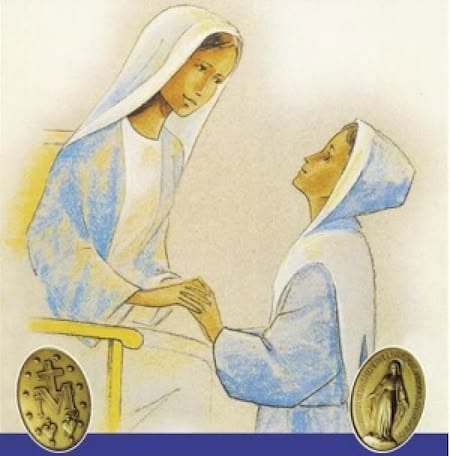
Paris, 1876. A nun dies in the anonymity of a hospice. Her fellow sisters nicknamed her "the henhouse sister." No one knows that she is the originator of the Miraculous Medal, which has been distributed in millions of copies since 1832. Catherine Labouré lived a dual fidelity: to the secrecy surrounding the apparitions of Married She was born on rue du Bac in 1830, and dedicated herself silently to the service of the poor. Her story reconciles mysticism and the everyday, visionary and servant. It reminds us that no mission, however extraordinary, can exempt us from the ordinary work of each day.
The farm girl turned messenger
Early childhood and responsibilities
Catherine was born on May 2, 1806, in Fain-lès-Moutiers, a small village in Burgundy. The eighth of ten children, she lost her mother at the age of nine. The scene remains etched in her memory: the child climbs onto a chair, kisses the statue of the Virgin Mary, and whispers, "Now you are my mother." She went to live with an aunt in Saint-Rémy before returning to the farm in 1818.
At 12, Catherine became a de facto farmhand. She gave orders to the servants, managed the bakehouse, the orchard, the stable, and the henhouse. Up before dawn, she prepared the workers' meals, milked the cows, and herded the flock. She looked after a disabled brother and welcomed her father back from the fields. No complaints, no self-pity: she did what needed to be done.
The call in the silence
Catherine spends long hours in the church of Fain, before an empty tabernacle. The Revolution decimated the clergy The priest only comes for weddings and funerals. In this silence, a yearning arises. One night, she dreams of an old priest. During a visit to the Sisters of Châtillon (1824-1826), she recognizes him. Saint Vincent de Paul In a picture: it was him.
Her father wants to marry her off. She refuses. He then sends her to Paris, to his brother who owns a restaurant. Catherine becomes a servant, discovers working-class poverty, the work children in factories. Her decision crystallizes: she will serve the poor as Daughter of CharityHis father finally gives in.
Rue du Bac: three appearances
On April 21, 1830, Catherine entered the seminary at the Mother House on Rue du Bac. Four days later, the relics of Saint Vincent were transferred to the chapel on Rue de Sèvres. Great joy for the young novice.
Night of July 18-19, 1830. Eve of the feast of Saint Vincent. A mysterious child awakens Catherine: "Come to the chapel, the Holy Virgin awaits you." She hesitates, then follows. Married He appears and sits in the director's chair. Catherine kneels and places her hands on his knees. An intimate two-hour conversation ensues. Married The harbinger of misfortune: revolution, violence. Ten days later, the Three Glorious Days erupt (July 27-29).
On November 27th at 5:30 PM, a second apparition occurred during the common prayer. Catherine saw Married Standing, dressed in white, her hands radiant. Around her is written: "O Married "Created without sin, pray for us who have recourse to you." The inner voice commands: "Have a medal struck according to this model." The image turns around: an M surmounted by a cross, two hearts (Jesus and Married), twelve stars.
December 1830: third appearance, similar to the second. Married She specifies: "You will no longer see me, but you will hear my voice in your prayers." Catherine obeys, remains silent, and resumes her ordinary life.
46 years of erasure
In February 1831, Catherine left the school on Rue du Bac. Her headmistress's assessment: "Strong, average height. Can read and write on her own. Her character seemed good. Her wit and judgment are not outstanding. Sufficient means. Pious, works to perfection." A lukewarm assessment for a visionary.
She was assigned to the hospice in Enghien, near the Place de la Nation (12th arrondissement of Paris). Her confessor, Father Aladel, initially skeptical, eventually had the medal struck in 1832. Healings multiplied. People began calling it the "miraculous medal." Catherine remained silent. No one knew the identity of the visionary.
For forty-six years, she served the elderly and immigrants with utter simplicity. She was nicknamed "the sister of the henhouse." No visible ecstasy, no public prophecies. She listened, washed, cared for, and comforted. Her mystical life remained invisible, submerged in the routine.
Final confession and peaceful death
On October 30, 1876, Catherine confided in her superior, Sister Dufès. She was 70 years old and sensed the end was near. She recounted everything: the apparitions, the mission, the secret she had kept. Sister Dufès wrote it down. Catherine died on December 31, 1876, without agony, with a peaceful smile.
That same evening, in the refectory, Sister Dufès read the testimony. General astonishment. The little nun from the henhouse was the messenger of MarriedHer body, exhumed in 1933, was found to be intact. It now rests in a glass reliquary in the chapel on Rue du Bac. Pius XII canonized her in 1947.

When the supernatural embraces the ordinary
Established fact
The apparitions on Rue du Bac are documented by Catherine's own testimony, recorded by her confessor and her superior. The Church recognized them in 1836, four years after the medal was struck. Rapid distribution (several million copies by 1839) and the associated conversions (notably that of Alphonse Ratisbonne in 1842) solidified the credibility of the message. Catherine's incorrupt body, on display since 1933, adds a tangible sign to the spiritual event.
Related legend
Several popular stories elaborate on the mystery. It is said that the child who guided Catherine was her guardian angel, or even the archangel Gabriel. Some later accounts claim that she predicted specific political or ecclesiastical events. These unverified embellishments fuel a piety that is sometimes naive. The essential point remains: Married entrusted a humble girl with a message of trust and protection.
Symbolic significance
Catherine embodies the compatibility between contemplation and action. She sees Marriedbut continues to milk the cows. She receives a universal message, but seeks neither glory nor recognition. Her holiness stems less from the visions than from loyalty daily. It demystifies spectacular mysticism: the true vision is that which illuminates the service of the brother, not that which intoxicates the ego.
Message of the day
Secrecy as asceticism
Catherine remained silent for 46 years. Not out of pride in the mystery, but out of obedience and humilitySecrecy protects the mission: revealing it too soon risks manipulation, unhealthy curiosity, and sterile agitation. Married She doesn't ask for publicity, but a medal and a prayer. Catherine understands that her part is to disappear.
This evangelical discretion resonates with the words of Jesus: “When you give to the needy, do not let your left hand know what your right hand is doing” (Mt 6:3). Authentic holiness shuns the limelight. It prefers the quiet of service to the glare of honors.
Serve without separation
Catherine never separates prayer and work. Her hands, which touched the knees of Married They wash the wounds of the elderly. His eyes, which have seen the rays of grace, tend the henhouse. There is no separation between inner life and manual labor. Everything becomes a place of divine presence: the stable as well as the chapel, the dovecote as well as the tabernacle.
This unity of life responds to Saint Paul's instruction: "Whatever you do, work at it with all your heart, as working for the Lord" (Colossians 3:23). No need for apparitions to sanctify routine: it is enough to infuse it with love.
The image of the discreet sower
Catherine sows without seeing the harvest. The medal spreads, graces pour forth, she is unaware or pretends to be unaware. She resembles the sower in the parable (Mark 4:26-29): he scatters the seed, then sleeps, works, lives. The seed germinates "he does not know how." Catherine plants, God makes it grow. She accepts being only an instrument, not a spectator of her own success.
Prayer
Invocation
MarriedConceived without sin, you who appeared to Catherine in the simplicity of a silent chapel, teach us to welcome your presence in the ordinariness of our lives. May our hands, busy with the tasks of the day, remain open to your grace. May our hearts, distracted by a thousand worries, refocus on what is essential: to love God, to serve our brothers and sisters.
Request for clemency
Lord, give ushumility From Catherine. May no mission, however lofty, distract us from humble service. May no apparent ordinariness prevent us from recognizing your visit. Make our days a long rosary acts of love, discreet and faithful, without expectation of anything in return.
Strength in adversity
When secrets weigh heavily, when misunderstandings hurt, when routine wears us down, give us patience Catherine. For 46 years she kept the memory of a July night, without bitterness or vanity. Teach us this gentle endurance, this unassuming constancy. May our strength not lie in fleeting comforts, but in the certainty of being loved and sent.
Loyalty in service
Oh MarriedMediatrix of all graces, intercede for us with your Son. Obtain for us the grace to see, in every suffering face, Christ who awaits our compassion. May our hands spread your rays of light: listen to the isolated, care for the the sickdignity for the poorMay our whole life become a living medal, a silent witness to your tenderness.
To live
- Prayer of the rosary by meditating on the mysteries of Married Spend 15 minutes reciting at least one ten-line stanza, representing yourself Married leaning towards Catherine. Ask her to help you recognize her discreet presence in your day.
- Anonymous service act Take a concrete action for someone without them knowing it was you: a phone call to a lonely person, a donation to a charity, a note of encouragement slipped in without a signature. Imitate Catherine's self-effacement.
- Self-examination regarding discretion At the end of the day, review your conversations and actions. Did you seek recognition? Did you talk about yourself more than necessary? Ask for forgiveness and renew your commitment to serve God alone, not the image you project.
Memory and places
Chapel of the Miraculous Medal, Paris
140 rue du Bac (Paris 7th arrondissement) is the exact location of the apparitions. The chapel, built in the 19th century, welcomes millions of pilgrims each year. Catherine's body rests in a glass reliquary beneath the right-hand side altar. Next to it is the armchair where Married has seat The night of July 18, 1830. The atmosphere remains simple, almost austere, true to Catherine's discretion. The walls bear the testimonies of graces obtained: plaques of thanks, abandoned crutches, photos of healings.
Fain-lès-Moutiers, Côte-d'Or
The village where she was born still preserves the family home and the church where Catherine prayed before the empty tabernacle. A small museum recounts her Burgundian childhood. The people of Burgundy honor their "little sister of the fields" every November 28th, the date of the apparitions. A bronze statue depicts her in the costume of a Daughter of Charity. Charityholding a medal.
Enghien Hospice, Paris 12th
Near Place de la Nation (Reuilly-Diderot metro station), the hospice where Catherine spent 46 years has become a retirement home. A commemorative plaque marks her time there. The room where she cared for the elderly has been transformed into a chapel. The Daughters of Charity They organize prayer times there on December 31st, the anniversary of his death.
Worldwide distribution
The Miraculous Medal has been minted in over a billion copies. It can be found in shrines all over the world. The conversion of Alphonse Ratisbonne (1842), an atheist Jew who became a priest after a vision of Married identical to that of the medal, it launched his international fame. Churches are dedicated to him in Latin America, in Africa, in Asia. Everywhere, the message remains the same: recourse to Marriedconfidence in his mediation.
Iconography and culture
Catherine is often depicted kneeling before Married Radiant, or holding a medal. The stained-glass windows on Rue du Bac, created in the 20th century, illustrate the three apparitions. The painter Émile Signol established the classic iconography: Catherine in a blue dress from the Daughters of CharityA humble gaze, hands clasped. Films, comics, and children's stories perpetuate her memory. The Daughters of CharityPresent in 94 countries, they continue their work with the sick and the excluded.
Liturgy
- Possible readings : Wis 3:1-9 (the souls of the righteous are in the hand of God); Ps 15 (the Lord is my inheritance); Luke 126-38 (the Annunciation, a model of humble acceptance of Married).
- Entrance chant : Hail Mary of Lourdes Or Oh Married, conceived without sin, repeating the invocation of the medal.
- Hymn of praise : Magnificat (Luke 1,46-55), hymn of Married celebrating God's action for the humble.
- Universal Prayer Intentions For the Girls of Charity and all caregivers; for isolated people and the elderly; for those who carry a difficult secret; for the recognition of the Marian presence in the ordinary.
- Communion hymn : Greetings Married Or Look at the starinviting imitation of Married.
- Sending : MarriedMother of grace, recalling the mission of discreet witness and service in the world.