The first official trip of Pope Leo XIV takes place in Türkiyefrom November 27 to 30, 2025, before continuing at LebanonThe Holy Father is visiting a country where the Christianity is numerically small but where faith is being revived after a century of violence and state pressure. A historic meeting on the occasion of the 1700th anniversary of Council of Nicaea.
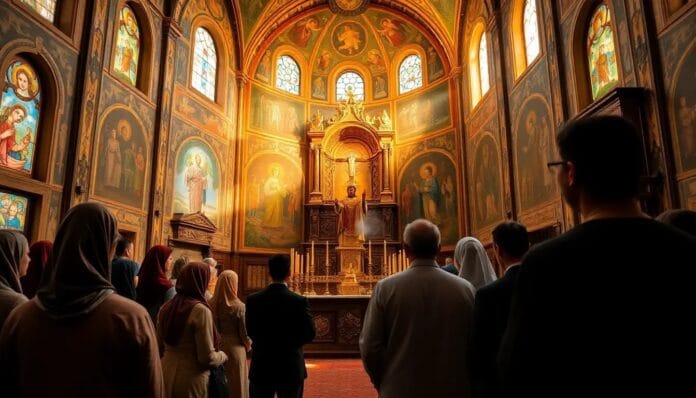
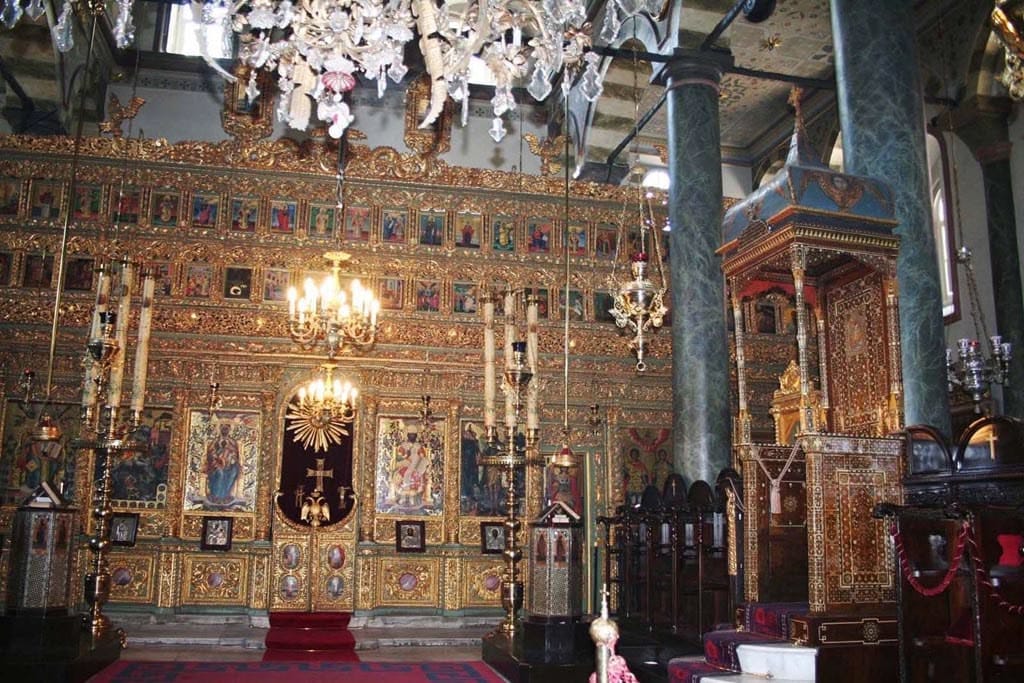
Silence after the Creed. The call to prayer from the surrounding mosques echoes on the other side of the green stained-glass windows. Two women in madras suits take a deep breath. Their voices fill the entire nave. It is the last Sunday in Ordinary Time, but in Istanbul's Cathedral of the Holy Spirit, it is above all the last Sunday before the arrival of the Pope Leo XIV on Turkish soil.
For this tiny Catholic community—barely 33,000 faithful out of 85.8 million inhabitants, or 0.04% of the population—the Pope's visit represents far more than a media event. It embodies the recognition of a discreet yet tenacious existence, of a faith that survives in the shadow of minarets, of a hope that refuses to be extinguished despite a century of tragedies.
Because the Türkiye not just any land for the ChristianityIt's here, at AntiochIt was here, in Tarsus, that the disciples of Jesus were first called "Christians." It was here, in Tarsus, that Saint Paul was born and embarked on the missionary journeys that would change the world. It is here, in Ephesus, that tradition places the final years of the Virgin Mary. MarriedAnd it was here, in Nicaea — present-day Iznik — that in 325, nearly 300 bishops from all over the Roman Empire formulated the Creed that is still recited today by Catholics, Orthodox and Protestants around the world.
A land, the cradle of Christianity, that has become hostile
The legacy of the early centuries
Anatolia — this vast plateau that today constitutes most of Turkish territory — was one of the first centers of Christianity outside of Palestine. The Acts of the Apostles abundant evidence testifies to this. Saint Paul multiplied the communities there, from Galatia to Phrygia, from Cappadocia to Asia Proconsularis. The seven Churches of the Apocalypse — Ephesus, Smyrna, Pergamum, Thyatira, Sardis, Philadelphia and Laodicea — are all located in this territory.
The great Fathers of the Eastern Church were born and taught there. Basil of Caesarea organized a flourishing monasticism there, as evidenced by the rock-cut remains of Cappadocia. Gregory of Nazianzus and Gregory of Nyssa developed a Trinitarian theology there that remains authoritative to this day. Irenaeus of Lyons, although he died in Gaul, was originally from Smyrna, present-day Izmir.
But it's the Council of Nicaea which remains the founding event. In 325, Emperor Constantine, recently converted to ChristianityHe convened an assembly of bishops at his summer palace in this small Bithynian town to resolve a major crisis: the Arian controversy. The priest Arius of Alexandria asserted that Christ, although divine, had been created by the Father and was therefore not eternal. The assembled bishops rejected this doctrine and formulated the famous Nicene Creed, affirming that the Son is "begotten, not made, consubstantial with the Father."
This Creed, completed at the Council of Constantinople in 381, remains the common profession of faith of the three major Christian denominations. Reciting it in Nicaea itself, 1700 years later, takes on considerable ecumenical significance. This is precisely what the Pope Leo XIV comes to fulfill, responding to the invitation of the ecumenical patriarch of Constantinople, Bartholomew I.
The time of massacres and erasure
How could such a deeply Christian land have seen its believing population reduced to a tiny fraction? The answer lies in a century of systematic violence and policies of ethnic and religious homogenization.
At the beginning of the 20th century, Christians They still represented approximately 20% of the population of the Ottoman Empire, or several million people. The Armenians, present for millennia on the Anatolian plateau, numbered between 1.5 and 2.5 million. The Greek Orthodox populated the Aegean and Pontic coasts. The Assyro-Chaldeans and the Syriacs inhabited the Mesopotamian borderlands.
The Armenian Genocide of 1915 constitutes the foundational tragedy. Planned and executed by the Young Turk government during the First World War, it claimed between 800,000 and 1.5 million Armenian victims. The methods were systematic: the arrest and execution of intellectual and religious elites on April 24, 1915, in Constantinople; the disarmament and massacre of Armenian soldiers in the Ottoman army; and the deportation of women, children, and the elderly to the deserts of Syria in "death marches" where hungerThirst and violence decimated the columns of deportees.
Meanwhile, Christians Assyro-Chaldeans and Syriacs suffered a similar fate—the "Sayfo" ("sword" in Aramaic)—with estimates ranging from 300,000 to 700,000 deaths. The Pontic Greeks of northeastern Anatolia also experienced massacres that claimed approximately 300,000 victims.
The advent of the Turkish Republic in 1923 did not end the suffering. The Treaty of Lausanne organized a "population exchange" which forced more than a million Orthodox Greeks from Anatolia to leave their ancestral lands for Greece, while Muslims from Greece were sent in the opposite direction. Istanbul, Constantinople, the cosmopolitan city, two-thirds Christian in 1914, became exclusively Turkish and Muslim.
The following decades saw the erosion continue. The 1955 Istanbul pogrom targeted Greeks and their businesses. Further waves of expulsions took place in 1964. Today, only about a thousand Greeks remain in Constantinople, the cradle of their millennia-long presence, and approximately 60,000 to 65,000 Armenians throughout the country.
A precarious legal status
The Treaty of Lausanne of 1923, the birth certificate of the Türkiye Modern law provided for the protection of "non-Muslim" minorities. But the Turkish state chose to interpret this text restrictively, granting recognized minority status only to Armenian Apostolic (non-Catholic) Christians, Greek Orthodox Christians, and Jews.
The other Christian communities—Latin Catholics, Chaldeans, Syriacs, Protestants—thus find themselves in a legal vacuum. Without legal personality, they can neither own real estate, nor open bank accounts in their own names, nor establish seminaries to train their members. clergyEvery act of church life becomes an obstacle course of administrative hurdles.
Even recognized communities are not immune to obstacles. The Orthodox seminary in Halki, on the island of Heybeliada in the Sea of Marmara, has been closed since 1971 by order of the Turkish authorities. This closure prevents the Ecumenical Patriarchate from training its future priests on Turkish soil, forcing it to recruit foreign clerics subject to the uncertainties of visas and administrative authorizations. Despite repeated appeals from the European Union and occasional promises from successive governments, the seminary remains closed.
Ankara also refuses to recognize the "ecumenical" title of the Patriarch of Constantinople. For the Turkish authorities, Bartholomew I is merely the "İstanbul Rum Patriği," the "Greek Patriarch of Istanbul," a simple administrator of a local cult, and not the primus inter pares of the approximately 300 million Orthodox Christians worldwide.

Living one's faith in the shadow of the minarets
The daily life of an invisible minority
"99% of the population is Muslim in Türkiye ", President Recep Tayyip Erdogan regularly emphasizes. Every time he utters this phrase, Christians People in the country feel the weight of this erasure. When he speaks of "we, the Turks, the Kurds, the Arabs, all brothers," he systematically omits to mention non-Muslim minorities. This omission speaks volumes about their place in the national consciousness.
Christians of Türkiye They have never been truly integrated into the public sphere. Despite the official secularism proclaimed by the Kemalist reforms of the 1920s and 1930s, they have always been perceived as foreign elements within the national body, potential "foreign agents." The word "Armenian" is still sometimes used as an insult.
This mistrust manifests itself in concrete discrimination. Certain civil service positions remain, in practice, closed to non-Muslims, even though no law explicitly prohibits it. Mandatory "religious education" courses in public schools focus exclusively on Sunni Islam, without any representation of Christian perspectives. Representatives of Protestant communities are not invited to interfaith meetings organized by the government.
For many, invisibility has become a survival strategy. An Italian catechist born in Türkiye He testifies: “There’s always someone who looks at me with a mixture of curiosity and suspicion. I admit that when I go to the market, I hide the cross under a shawl, you never know.” Historian Rifat Bali, a specialist in minorities in TürkiyeThis condition is summarized as follows: "We have chosen invisibility to live on this earth."
Conversions that are resuming
Paradoxically, it is in this difficult context that an unexpected phenomenon occurs: conversions to Christianityadmittedly limited in number, but significant by their very existence.
According to some estimates, there are approximately 35,000 private homes in the country secretly used as house churches. Evangelical movements, in particular, have experienced significant growth since the 1980s. New churches—sometimes simply auditoriums—are continually opening in major cities. Istanbul, Izmir, Ankara, Mersin, Diyarbakir.
A Turkish Protestant pastor, Ender Pecker, whose family originated as Muslim, testifies to this quiet vitality: The laity strive to demonstrate a credible, active, and joyful presence. Opportunities might include bringing children from different churches together to paint Easter eggs, or celebrating Sunday in different churches to ensure a regularity that, if lacking, would easily lead to the closure of the place of worship.
These converts live their faith in secrecy. The conversion from Islam to Christianity It is not criminalized under Turkish law, but it remains socially unacceptable. Christians Women of Muslim background risk being disinherited by their families, pressured into divorce, or losing custody of their children. A woman of Muslim origin, secretly baptized, recounts: “Tonight, I am reborn to a new life. I was Muslim by tradition, like everyone else in…” TürkiyeBut I rarely went to the mosque. Then I had a dream, I started to read the BibleI found a priest, and a community.
The symbolism of Hagia Sophia
On July 24, 2020, President Erdogan fulfilled a long-held dream of Islamist-nationalist circles: the reconversion of the Hagia Sophia basilica into a mosque. This jewel of Byzantine architecture, built in the 6th century by Emperor Justinian and dedicated to Divine Wisdom, had become a museum in 1934 under Mustafa Kemal Atatürk, a symbol of a Türkiye secular and open to its diverse past.
Erdogan's decision was perceived as a provocation by Christians from all over the world. Patriarch Bartholomew declared that this transformation risked "turning the Christian world against Islam." The pope Francis said he was "deeply saddened." The Archbishop of Greece called the act "impious," while the bells of Greek Orthodox churches tolled in mourning.
For Christians of TürkiyeHagia Sophia is not just any building. It is the symbolic seat of the Ecumenical Patriarchate, the equivalent for Orthodoxy of what St. Peter's Basilica in Rome represents for Catholicism. Certainly, the building had already served as a mosque from 1453 to 1934, but its transformation into a museum represented an acknowledgment of its multi-religious history. The return to exclusive Muslim worship erases this acknowledgment.
The following year, the Church of the Holy Saviour in Chora, another Byzantine gem renowned for its exceptional frescoes and mosaics, suffered the same fate. These decisions are part of a deliberate policy of re-Islamization pursued by the government, which uses religious symbols to mobilize its conservative and nationalist base for electoral gain.
The hope of a papal visit
Following in the footsteps of his predecessors
Leo XIV is the fifth pope to go to Türkiye in contemporary times. Paul VI paved the way in 1967, meeting with Patriarch Athenagoras in a climate of reconciliation after the mutual excommunications of 1054, lifted in 1965. John Paul II He went there in 1979, celebrating mass at the Cathedral of the Holy Spirit in Istanbul and entrusting the local Catholics with a special mission: "You are called more than others to be the artisans of unity."
Benedict XVI undertook a delicate trip in 2006, a few weeks after his Regensburg address which had provoked outrage in the Muslim world. He made numerous gestures of friendship towards Islam, notably praying barefoot in the Blue Mosque alongside the Grand Mufti. In 2014, Francis continued this diplomacy of dialogue, also visiting Hagia Sophia—then still a museum—and meeting with Patriarch Bartholomew to affirm their shared quest for...Christian unity.
It was François who had planned to go to Iznik for the 1700th anniversary of the Council of NicaeaHis death in April 2025 passed this project on to his successor. Leo XIV, first pope American of history, chose to make this ecumenical trip his first international outing, thus signifying the importance he attaches to dialogue between Christians.
The program for a meaningful visit
From November 27 to 30, 2025, the Pope Leo XIV will cross the Türkiye in several carefully orchestrated stages. The arrival in Ankara, the capital, allows for protocol meetings with President Erdogan and the civil authorities. A delicate moment, given the abundance of sensitive issues: human rights, the situation of minorities, the transformation of Hagia Sophia, the closure of the Halki seminary.
THE pope He will also meet with officials from Diyanet, the Turkish Directorate of Religious Affairs. This state institution, with a budget of $3.8 billion for 2025—exceeding that of several ministries—embodies the growing influence of Sunni Islam within the structures of the state. Dialogue with its representatives is of strategic importance.
The heart of the journey lies in Iznik, the ancient Nicaea. At the archaeological site of the ancient Basilica of Saint Neophytos, the pope will participate in an ecumenical prayer in the presence of Patriarch Bartholomew. A joint declaration will be signed, reaffirming the commitment of both Churches to unity. The Orthodox Churches of the "pentarchy" of the first millennium—Constantinople, Alexandria, AntiochJerusalem — were invited by the Ecumenical Patriarch. The only notable absentee was the Russian Orthodox Church, which broke communion with Constantinople in 2018.
HAS Istanbul, THE pope He will celebrate Mass for the local Catholic community at the Volkswagen Arena, a venue large enough to accommodate worshippers from across the country. He will visit a retirement home run by the Little Sisters of the Poor, where Christians of various denominations live side by side. And he will visit the Sultan Ahmet Mosque, the famous Blue Mosque, continuing the tradition of his predecessors.
A message of unity and peace
The currency chosen by Leo XIV for the Turkish leg — “One God, one faith, one baptism” — summarizes the intention of the journey. In his apostolic letter In unitate fidei, published before his departure, the pope emphasized the "ecumenical value" of the Council of Nicaea and called upon to "walk together to achieve unity and reconciliation".
For Christians of TürkiyeThis visit is a ray of light in an often difficult existence. It tells them: you are not forgotten. Your faith, even if a minority one, matters in the eyes of theUniversal ChurchYour loyalty in the face of adversity is a testament to the entire world.
"This is a great joy for me, the successor of Peter," he declared. John Paul II In 1979, he addressed the Catholics of Istanbul, saying, "I am addressing you today with the very words that Saint Peter addressed nineteen centuries ago to the Christians who were then, as today, a small minority in these lands." Forty-six years later, the situation has hardly changed. But the faith persists.
In the Cathedral of the Holy Spirit, this baroque building erected in 1846 by the French and which became the main Catholic place of worship in Istanbul, a statue of the pope Benedict XV sits enthroned in the garden. The inscription recalls that he was the "benefactor of peoples without distinction of nationality or religion" during the tragic hours of the First World War. This shows how vivid the memory of past suffering remains within these walls.
But the faithful who gather there every Sunday—native Turks, descendants of Latin families, Chaldean refugees from Iraq, European expatriates—refuse to be defined by their misfortune. "You don't need to be many when you love the Gospel," one of them confides. This phrase could sum up the spirit of the Christian community of Türkiye : a minority certainly, but a living, praying, hopeful minority.
After the Türkiye, Leo XIV will fly to the Lebanon, another wounded land where Christians, far more numerous than in TürkiyeThey face immense challenges. The motto of this second stage — "Blessed are the peacemakers" — resonates with particular acuity as Israeli strikes continue to hit the Land of the Cedars despite the ceasefire.
But for Christians of TürkiyeThe present moment belongs to hope. The successor of Peter comes to them, to this land where Peter himself never set foot, but where his companion Paul worked so tirelessly. He comes to celebrate 1700 years of a Creed that unites them with billions of believers across time and space. He comes to tell them that their smallness is not insignificance, that their discretion is not self-effacement, that their faithfulness in adversity is a treasure for the entire Church.
In the nave of the Cathedral of the Holy Spirit, after Sunday Mass, the faithful exchange news, share coffee, and ask about one another. Outside, the call to prayer continues to resonate from the neighboring minarets. Two worlds coexist, separated by a few meters and centuries of tumultuous history. But for a brief moment, in this bubble of shared faith, Christians of Türkiye they know they are part of a family much larger than their small number would suggest.
And perhaps that is the deeper meaning of the visit to the Pope Leo XIV It is important to remember that the Church is not a matter of numbers. It is a communion of believers, bound by a common faith expressed 1700 years ago a few kilometers away, in a small town in Bithynia where bishops from across the Roman Empire dared to affirm that Jesus of Nazareth was "true God, born of true God, begotten, not made, consubstantial with the Father." This faith, Christians of Türkiye They still carry it, against all odds. And that is perhaps their most beautiful testimony.