







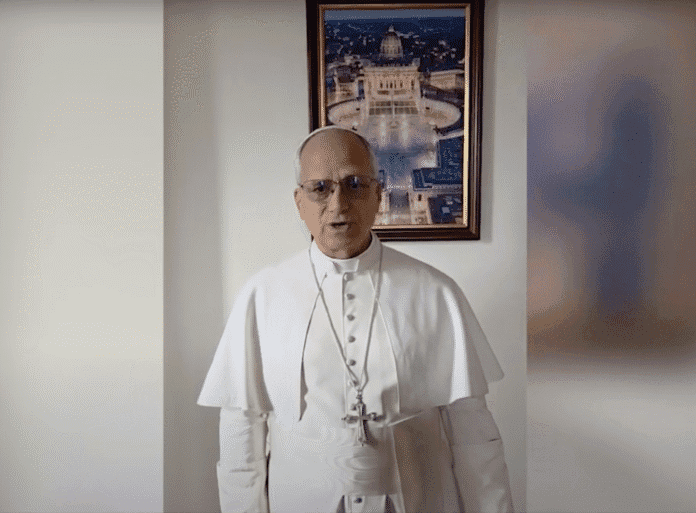
While the COP30 is in full swing in Belém, in the heart of the Amazon, the Pope Leo XIV He launched a powerful call for climate action. In a video message filled with emotion and clarity, the Pope urged world leaders to make decisions commensurate with the global challenges. Behind the words lay a certainty: without concrete and coordinated commitment, our common home will falter.
A prophetic voice in the heart of the Amazon
The symbolic setting of Belém: where creation still breathes
The Amazon Museum, where yesterday the words of Pope, is a choice laden with meaning. An emblematic site of biodiversity and the memory of indigenous peoples, it stands like a green cathedral in the midst of a changing world. It is there, thousands of kilometers from Vatican, that the ecclesiastical representatives of the Global South gathered, surrounded by bishops and scientists, to present a deeply symbolic object: a replica of the multicolored net once offered by the Amazonian communities on the occasion of the synod dedicated to their region.
Through this gesture, a message is conveyed: the Amazon is not just a threatened territory, but a mirror of our humanity. Each thread of the net tells the story of a community, a species, a river, a hope. When Leo XIV addressed to the COP30, It is this fabric of life that he defends, in the name of faith and reason.
COP30: Between Realism and Hope
The 30th United Nations Climate Change Conference returns to the Southern Hemisphere, ten years after Paris. A decade that has seen tentative progress but also bitter disappointments. At the opening, several leaders of Southern states reminded the audience that their people are paying a heavy price for global warming for which they bear no responsibility. Floods, droughts, cyclones… the symptoms are worsening.
Faced with this observation, the "prophetic voice" of pope, The movement, as he himself calls it, does not seek to condemn but to mobilize. "I join with my fellow cardinals in telling the world that the Amazon remains a living symbol of Creation," he declared, before thanking the people on the ground "who prefer hope to fear.".
The spiritual meaning of a universal calling
Talking about climate, in the language of pope, It's never just about talking about the weather or the temperature. It's about evoking the link between humankind, God, and nature. "We are the guardians of creation, not rivals for its spoils," he insists. This sentence alone sums up the Christian vision of...«integral ecology Nature is not a field of exploitation, but a space of relationship.
Through Leo XIV, THE Vatican extends the legacy of Laudato si', the encyclical of pope François published in 2015. Ten years later, the tone has hardened. The situation, he writes Leo XIV In his previous messages, the focus was no longer on a simple emergency, but on a tipping point. In Belém, his words sought to awaken consciences slumbering in the face of the statistics.
Faith, science, and politics: a single struggle for our common home
When the Churches of the South speak out
Three cardinals — Jaime Spengler (Latin America), Fridolin Ambongo (Africa) and Filipe Neri Ferrão (Asia) — joined their voices to advocate for concrete climate justice. Their message, delivered to the plenary session of the COP30, denounces a double divide: economic and environmental.
The cardinals point out that while populations in the Global South are among the lowest emitters of greenhouse gases, they are also the most vulnerable to disasters. According to UN data, one in three people now lives in an area of "high climate vulnerability." These figures, Leo XIV He cites them, not to alarm, but to humanize the debate. "For them, climate change is not a distant threat," he insists.
Through this alliance between churches of the Global South, a new language is emerging: that of global solidarity. Climate becomes the common ground where science, spirituality, and justice converge.
Science in the service of active faith
The message from pope He doesn't contradict science—he extends it. He emphasizes, in particular, human responsibility in the current crisis and reiterates the goal of the Paris Agreement: to keep the rise in global temperature below 1.5°C. For him, the boundary between faith and science is not a dividing line, but a bridge of mutual understanding.
Leo XIV He doesn't speak on behalf of researchers; he speaks alongside them. He calls on believers to "walk with scientists, leaders, and pastors of all nations." In his words, this brotherhood takes the form of a shared commitment. Acting for the climate means experiencing science as an act of compassion.
Climate policies: a test of truth
THE pope He admits it bluntly: "It's not the Paris Agreement that's failing, it's our response." A pithy statement, addressed as much to leaders as to citizens. He laments the lack of political will, this global inertia that transforms promises into empty slogans.
For Leo XIV, Climate policies are not a matter of ideology, but of moral imperative. The planet, he says, «is not traded on a market; it must be protected as a common good.» This idea of the common good runs throughout his speech and resonates deeply with the Catholic tradition: every economic decision must benefit the collective good, not individual profit.
Towards a solidarity economy
«Stronger climate action will help create stronger and fairer economic systems,» argues the pope. This conviction is based on an increasingly shared observation: the current model, based on unlimited growth, is reaching its physical and human limits.
Far from condemning prosperity, Leo XIV He calls for a redefinition of wealth. A sustainable economy, he says, must be able to nourish, protect, and pass on. He invites public and private actors to consider the ecological transition not as a burden, but as a moral and social investment.
Towards a global ecological conversion
Everyone's responsibility towards our common home
Beyond the leaders, the pope is addressed to every human being. "To ignore the victims of climate change is to deny our shared humanity." This sentence echoes the universal appeal of brotherhood. The Church, he said, does not want to take over the debate, but to contribute to it: by reminding people that without personal conversion, no public policy will be sufficient.
Ecological conversion, a term already present in Laudato si', refers to this inner transformation through which humanity rediscovers its place in Creation. Recycling, reducing one's footprint, or consuming differently become acts of faith. Sobriety is no longer a deprivation, but a liberation.
Young people, guardians of the future
In his previous messages, Leo XIV He has often turned to young people. In Belém again, he addressed part of his message to them: "You are the generation that can still reverse the course of history." This confidence is reflected in a willingness to listen: interfaith forums, support for ecological schools, encouragement of local initiatives.
Young people from Amazonian communities present at COP21 offered songs, banners, and moving testimonies. One of them confided: «We don’t want to be the survivors of a world that ended, but the builders of a new one.» These words resonated even in the corridors of the Vatican.
Interreligious cooperation and global fraternity
«Let’s walk together,» he repeats. pope. Behind this invitation lies an unprecedented dialogue between faiths. Catholics, Protestants, Jews, Muslims, Buddhists, and representatives of indigenous traditions have all been invited to participate in the discussion. Because the climate, as we recall, Leo XIV, It knows neither borders nor dogmas.
This spiritual rapprochement becomes a form of moral diplomacy. Where political negotiations stall, brotherhood may open new paths. In Belém, several representatives of other faiths welcomed the clarity of the papal message, recognizing in his appeal a voice for all humanity.
A museum that has become a symbol
The Amazon Museum, where this symbolic net was presented, will remain in history as the scene of a powerful message. Leo XIV He hopes it will become "the place where humanity has chosen cooperation rather than division." This image resonates like a parable: in this museum that celebrates the diversity of life, people have chosen to reweave the broken threads of solidarity.
There COP30 will end on November 21st. But the message of pope, He, however, will continue to inhabit our consciousness. For in this planetary crisis, he reminds us of a simple truth: the Earth does not belong to us, we belong to it.
A breath of fresh air for the planet
Leo XIV He spoke not like a head of state, nor like a scientist, but like a father to a world in peril. His message in Belém blended the tenderness of a pastor with the firmness of a prophet. He did not ask for perfection, but for conversion. Not speeches, but commitments.
At a time when humanity anxiously scrutinizes the future, his words resonate as both a warning and a promise:
«"There is still time to act. Together."»