












Gospel of Jesus Christ according to Saint Matthew
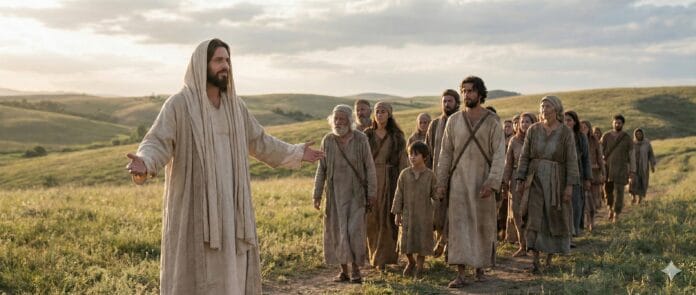
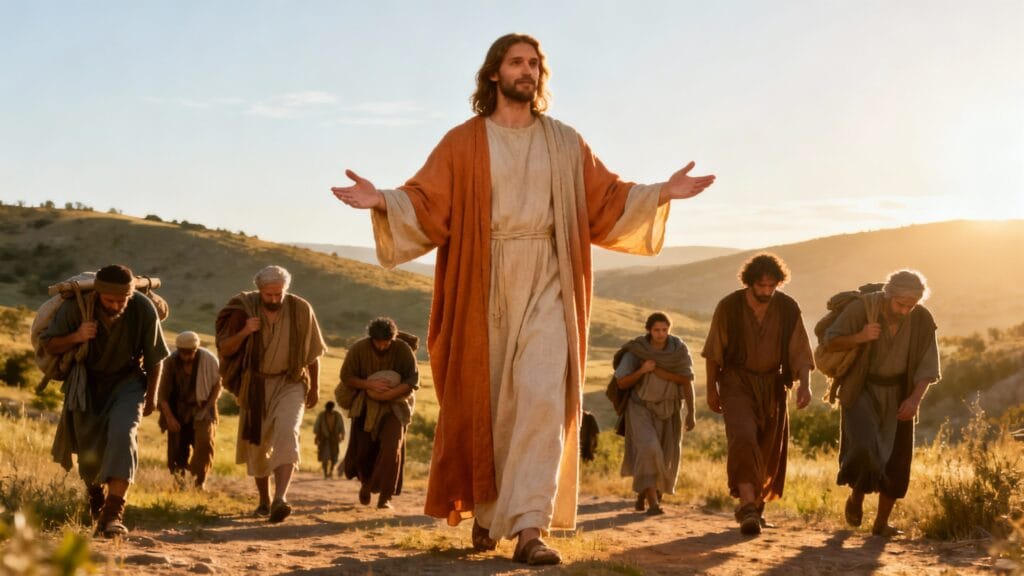
At that time, Jesus said, «Come to me, all you who are weary and burdened, and I will give you rest. Take my yoke upon you and learn from me, for I am gentle and humble in heart, and you will find rest for your souls. For my yoke is easy and my burden is light.»
Receiving the promised rest: Jesus' invitation to the weary
How Christ's call transforms our burdens into a path of liberation and renews our relationship to effort, rest, and spiritual life.
Faced with the exhaustion that characterizes our era, Jesus' call in Matthew 11:28-30 resonates with striking relevance. This invitation to seek rest with Christ does not offer an escape, but a radical conversion of our relationship to the weight of existence. It is addressed to all those who bear burdens, visible or invisible, and offers them a paradoxical exchange: taking on a yoke to find freedom.
This article first explores the context of this passage in the Gospel of Matthew and its roots in biblical tradition, then unfolds the threefold dynamic of the invitation (come, take, find). It then examines its concrete applications in our lives, its resonance with the Christian spiritual tradition, and the contemporary challenges posed by this promise of rest. A liturgical prayer and practical suggestions conclude this meditation.
To place the word within its evangelical context
This passage from Matthew 11:28-30 appears at a pivotal moment in Jesus' ministry. It immediately follows a prayer of thanksgiving to the Father (Matthew 11:25-27) in which Jesus reveals the unique relationship he shares with God and his mission to reveal the Father to the humble. The invitation to rest is therefore the natural extension of this revelation: knowing the Father through the Son opens the way to true rest.
The broader context shows Jesus facing rejection. John the Baptist, imprisoned, doubts (Mt 11:2-6). The towns where Jesus performed miracles refuse to convert (Mt 11:20-24). In this atmosphere of resistance, the appeal to the weary and burdened resonates as an unexpected opening. Jesus is not addressing the wise and the intelligent, but those whom life has broken, whom religious systems have crushed under impossible prescriptions.
The Alleluia preceding the liturgical reading adds an eschatological dimension: «The Lord will come to save his people. Blessed are those who are ready to go out to meet him!» This announcement situates Jesus’ invitation within the messianic expectation. The promised rest is not merely psychological or moral; it is part of the definitive salvation that God is preparing. The coming of the Lord and the invitation to rest form a single movement of salvation.
In Matthew's Gospel, this passage precedes the controversies surrounding the Sabbath (Mt 12:1-14). The connection is clear: Jesus offers the true rest of the Sabbath, not as an outward observance, but as a living relationship with it. Jesus' yoke replaces the crushing yoke of the 613 commandments of the Torah as interpreted by some Pharisees. Matthew constructs a subtle argument: the Son of Man is Lord of the Sabbath because he embodies God's rest offered to humanity.
The vocabulary used reveals rich layers of meaning. The Greek word for "toil" (kopiaō) denotes exhausting work, labor that drains one's strength. The word for "burden" (phortion) evokes a weight one carries, a load that crushes the shoulders. These words are not vague metaphors: they name the concrete reality of lives burdened by hardship. In the ancient Mediterranean world, where the majority lived in precarious conditions, working from dawn till dusk to survive, this language struck at the heart of daily life.
The yoke (zugos) is an agricultural implement, a wooden bar placed across the shoulders of oxen to harness them together or to carry loads. In biblical tradition, the yoke often symbolizes servitude (1 Kings 12:4-14), but also the teaching of a master (Sirach 51:26). Jesus plays on this dual symbolism: his yoke is both a bond of belonging and a school of wisdom. Unlike masters who impose unbearable burdens (Matthew 23:4), Jesus offers a yoke that is "easy to bear" (chrēstos, which also means "good," "kind").
Deciphering Jesus' Threefold Invitation
The invitation unfolds in three movements: come, take, find. This structure is not accidental; it outlines a complete spiritual path, from the initial approach to the transformative experience.
Coming to Jesus The first movement is a physical and spiritual shift. «Come to me» implies interrupting what one is doing, leaving one place to go to another. In the Gospel, coming to Jesus is always an act of faith, an act of recognizing one's own need. Those who come are the sick, the possessed, the fishermen, Parents worried about their children come because they have exhausted their resources and recognize in Jesus a different source of life.
But Jesus doesn't simply say, "Come," he specifies, "Come to me." Rest is not a technique, a doctrine, or an ascetic practice. It is a personal relationship with him. Rest is not found by applying a method, but by establishing a living connection with Christ. This emphasis on "I" is unusual coming from Jesus; it underscores that his very person is the place of rest. Just as the Temple was the place of God's presence where Israel found peace, Jesus becomes the new living Temple where the soul finds its rest.
To take his yoke The second movement seems paradoxical. How can one find rest by taking on a yoke? The yoke evokes effort, constraint, and the limitation of freedom. Yet, Jesus affirms that his yoke brings rest. This apparent contradiction reveals a profound truth: absolute freedom, without direction or structure, does not liberate but exhausts. We need a framework, a direction, a meaning. Jesus' yoke offers precisely this: a clear path, a teaching that structures existence, a sense of belonging that gives identity and purpose.
«Become my disciples» makes explicit what it means to take his yoke upon you. A disciple does not simply listen to teachings; he adopts the way of life of his master. To be a disciple of Jesus is to learn from him a way of being in the world, of relating to God, to others, and to oneself. This school of Christ does not consist of accumulating theoretical knowledge, but of allowing oneself to be formed inwardly by his presence and his example.
Jesus then gives the reason why his yoke is bearable: "for I am gentle and humble in heart.". The gentleness (praus) refers to a controlled force, a power placed at the service of benevolence.’humility The concept of "low heart" (tapeinos tē kardia) is more radical than simple modesty: it signifies a voluntary humility, a refusal of all domination. The master, Jesus, does not crush his disciples under his authority; he puts himself on their level, he washes their feet. His yoke is light because he does not impose it from the outside, but offers it from within, transforming the heart of the one who receives it.
Finding rest The third movement is the fruit of the first two. "You will find rest for your soul." The Greek term anapausis (rest) is the one used by the Septuagint. Genesis 2, 2, to describe God's rest on the seventh day. The rest that Jesus promises is therefore part of God's own rest after creation. It is not simply a pause in effort, but the fulfillment of that for which we were created. When God rests, it is not because he is tired, but because he contemplates his completed work and finds it good. God's rest is contemplation, satisfaction, peace.
Rest is promised "for your soul" (psuchē). Here, "soul" refers to the person in their entirety, their inner life, their deepest being. Rest is therefore not merely physical or mental; it touches the very core of one's identity. A soul at rest is a soul that has found its place, that knows its worth, that no longer needs to constantly prove or defend itself. It is an inner peace that remains even when external circumstances persist.
The final sentence reinforces this promise: «My yoke is easy, and my burden is light.» Jesus doesn’t deny the existence of a yoke and a burden. The Christian life is not a life without responsibility, discipline, or effort. But the quality of this yoke changes everything. It is «easy» (chrēstos) in the sense that it is well-fitted, adapted to our shoulders, not crushing but supportive. The burden is «light» (elaphron) because we do not carry it alone: «I will give you rest,» says Jesus. The secret lies here: in Jesus’ yoke, we are yoked with him. He is the one who bears the essential weight, and we walk beside him, sustained by his strength.
Exploring the dimensions of the human burden
What are these burdens that Jesus speaks of? The answer is multifaceted and touches on different dimensions of human existence.
The religious and moral burden
In Jesus' time, many devout Jews exhausted themselves observing the numerous prescriptions of the Law and their rabbinic interpretations. The 613 commandments, supplemented by complex casuistry, transformed religious life into an anxious accounting. Have I prayed enough? Are my ablutions valid? Have I transgressed the Sabbath by moving this object? This constant vigilance created a perpetual tension, a feeling of inadequacy and guilt.
Jesus repeatedly criticizes the teachers of the Law who "tie up heavy burdens and put them on people's shoulders" without helping them bear them (Mt 23:4). The religious system, instead of drawing people closer to God, becomes an obstacle. Instead of liberating, it alienates. This criticism resonates throughout the ages: how often has the Christian religion itself functioned in this way, crushing consciences under the weight of sin, moral performance, and ritual obligations?
The yoke of Jesus liberates from this tyranny by restoring the Law to its original intention: the love of God and neighbor (Mt 22, (pp. 37-40). The entire Law is summed up in these two commandments. This is not laxity; on the contrary, it is a greater, but internal, radicalism. It is no longer a matter of mechanically obeying external rules, but of allowing love to transform the heart. And love, paradoxically, makes light what seemed heavy. When we love, we don't count, we don't calculate, we give joyfully.
The social and existential burden
Beyond religion, Jesus speaks to all those who struggle under the burdens of existence. In the ancient world, life was harsh for the majority: exhausting manual labor, economic insecurity, incurable diseases, political oppression under Roman occupation, and rigid social structures that allowed for no mobility. Women, the poor, the sick, Foreigners carried specific burdens related to their social status.
Today, burdens have changed shape but not weight. Professional pressure, constant competition, economic insecurity, loneliness in big cities, a bombardment of anxiety-inducing information, contradictory injunctions (succeed, be authentic, be high-achieving, take care of yourself), family breakdowns, mental illness. Modernity has created new burdens: existential anxiety in a world that seems to have lost its meaning, the pressure to build one's own identity without stable points of reference, exhaustion. digital of hyperconnectivity.
Jesus' invitation resonates with these realities. The rest he offers is not an escape from social and economic reality, but a different way of inhabiting it. By coming to him, we do not abandon our concrete situation, but we see it with new eyes. Jesus' yoke connects us to a community of brothers and sisters who bear their burdens together, reminds us that our worth does not depend on our productivity, and anchors us in a hope that endures through crises.
The psychological and inner burden
There are also invisible burdens, those we carry deep inside. Guilt for past mistakes, shame linked to traumas, fear of the future, unhealed emotional wounds, unresolved grief, repressed anger, dashed hopes. These inner burdens are sometimes the heaviest because we have nowhere to put them down; we carry them alone, in silence, and they drain us from within.
Jesus knows these hidden burdens. When he says, «Come to me, all you who are weary and burdened,» he is also addressing those whose suffering is unseen. The rest he promises touches these depths. In relationship with him, in prayer, in receiving his unconditional love, something can be untied. Not necessarily through an instant miracle, but through a process of gradual healing. The yoke of Jesus, his gentleness, and his humility, create a space where it becomes possible to lay down these burdens, to look them in the face, to offer them to his mercy.
Modern psychology has rediscovered the importance of naming one's suffering, sharing it with another who listens without judgment, and reconciling with one's past. Christian spirituality has always known this, even if it has sometimes forgotten it. The sacrament of reconciliation, spiritual direction, and intercessory prayer are places where inner burdens can be laid down. Jesus does not promise that these burdens will magically disappear, but that we will no longer carry them alone, and that in his presence, they will lose their power to destroy us.
Translating the invitation into our concrete lives
How does this saying of Jesus manifest itself in the different spheres of our daily lives?
In professional life Many of us spend the majority of our waking hours at work. It is often there that the burdens are heaviest: unrealistic objectives, strained relationships with colleagues or superiors, job insecurity, and a disconnect between our values and what we are asked to do. Jesus' invitation encourages us to re-examine our relationship with work. Working under his yoke means working with conscience, integrity, and kindness, but without making professional success the ultimate measure of our worth. Peace of mind allows us to maintain inner distance, even in a stressful environment, and to avoid being defined by our position or salary.
In practical terms, this can translate into short prayer breaks throughout the day, a redefinition of our priorities (what truly matters?), the courage to set boundaries when necessary, and the pursuit of a balance between work and personal life. The yoke of Jesus frees us from the idolatry of work: we work to live, we do not live to work. And our dignity comes from being loved by God, not from what we produce.
In family relationships Family can be a source of profound joy but also of considerable burdens. Marital tensions, conflicts with teenagers, the mental load of domestic life, caring for elderly parents or disabled children, wounds inherited from our family of origin. Jesus doesn't offer magic solutions, but a path: to bear these realities within the yoke of his care, that is, with his gentleness and his humility. This means giving up the desire to control everything, accepting the limitations of others and one's own, forgiving again and again, and asking for help without shame.
Rest for the soul within the family also means creating spaces for respite: moments of silence, shared prayer, and spontaneous celebration. It means rejecting the societal pressure for families to be perfect, high-achieving, and Instagram-worthy. It means accepting that each family member carries their own burdens and needs the same rest as we do. The yoke of Jesus teaches us to serve without exhausting ourselves, to love without losing ourselves, to be present without dissolving into nothingness.
In spiritual life Paradoxically, spiritual life itself can become a burden. The proliferation of parish commitments, guilt about not praying enough, and feelings of inadequacy in the face of models of holiness, A persistent spiritual dryness. Here, Jesus' invitation is particularly liberating: the spiritual life is not a performance to be achieved, it is a relationship to be nurtured. The yoke of Jesus is simply to come to him regularly, just as we are, with our weaknesses and distractions, and to trust him.
Finding peace of soul in prayer means ceasing to force oneself, to judge oneself, to compare oneself. It means accepting the spiritual seasons, the periods of fervor and the periods of dryness. It means prioritizing quality over quantity: ten minutes of authentic presence to God are worth more than an hour of formal prayer where the mind wanders. It also means discovering that the yoke of Jesus includes times of true rest, of Sabbaths, where one does nothing spiritually "productive," where one simply exists under God's loving gaze.
Delving deeper into the biblical roots
Jesus' invitation is rooted in a long biblical tradition that runs throughout Scripture.
In the Old Testament, the theme of rest is central from the creation narrative onward. God rests on the seventh day (Gn 2, (2-3), establishing the Sabbath as a fundamental institution for Israel. The Sabbath is not simply a cessation of work; it is a reminder that the world belongs to God, that human beings are not defined by their production, and that life has a contemplative and gratuitous dimension. Observing the Sabbath means trusting God for one's sustenance, rejecting the idolatry of work, and recognizing that one is a creature and not a creator.
THE book of Deuteronomy The Sabbath is linked to liberation from slavery in Egypt (Deuteronomy 5:15). In Egypt, the Hebrews worked tirelessly under the lash of their oppressors. The Sabbath celebrates regained freedom, rest as a sign of liberation. Jesus is part of this tradition: his invitation to rest is a new liberation, an escape from another form of slavery, that of sin, anguish, and the unmerciful law.
The prophet Jeremiah speaks of an iron yoke imposed by oppressors (Jer 28:13-14) and announces a time when God will break this yoke (Jer 30:8). Ezekiel criticizes the wicked pastors who leave the flock exhausted and promise that a shepherd after God's own heart will feed the sheep and give them rest (Ezekiel 34:15). Jesus fulfills these prophecies: he is the good shepherd, he breaks the yoke of oppression, he offers the promised rest.
THE Ben Sira's book (Sirach) presents Wisdom as a yoke to be taken up (Sirach 51:26-27): «Come near to me, you who are uneducated, and sit in my house of teaching. Why do you say that you are deprived of it and that your soul thirsts so greatly?» Jesus takes up this image but radicalizes it: it is no longer abstract Wisdom that must be followed, but him, the incarnate Son, the wisdom of God made flesh.
In the New Testament, the Epistle to the Hebrews develops the theme of rest at length (Hebrews 3-4). It reinterprets the history of Israel as a quest for the rest promised by God. The earthly rest of Canaan foreshadowed a greater rest, the rest of God himself, into which believers are called to enter. «There remains, then, a Sabbath-rest for the people of God» (Hebrews 4:9). This eschatological rest is already accessible through faith: «We who believe enter that rest» (Hebrews 4:3). Jesus is the mediator of this ultimate rest.
Paul develops a theology of liberation that resonates with Jesus' invitation. "Christ has set us free so that we may be truly free" (Gal 5:1). Christian freedom is not the absence of law, but submission to the law of love, which is light because it comes from the heart transformed by the Spirit. "Where the Spirit of the Lord is, there is freedom" (2 Co 3, 17). The yoke of Jesus is life in the Spirit, which produces "love, joy, peace, patience, kindness, goodness, faithfulness, gentleness and self-control" (Gal 5, 22-23).
The Church Fathers meditated extensively on this passage. Augustine saw in the yoke of Jesus the antidote to the concupiscence that binds us to earthly goods and exhausts us in an endless race. The rest of the soul is peace of the heart that has found its dwelling place in God: «You have made us for yourself, Lord, and our hearts are restless until they rest in you.» John Chrysostom emphasizes gentleness Jesus as divine pedagogy: God does not break us, he draws us in. gentleness, He respects our freedom, he convinces us with his love.
Thomas Aquinas distinguishes the imperfect rest of this life, where we already taste peace of God despite tribulations, and the perfect rest of eternal life, where all anxiety will cease. The yoke of Jesus leads us progressively from the first to the second. Teresa of Avila It speaks of an inner peace that remains at the center of the soul even when the external faculties are agitated, like a castle whose keep remains silent despite the tumult in the outer courtyards.
Opening up pathways for practice
How can we concretely enter into this dynamic of rest offered by Jesus? Here is a progressive path of meditation and practice.
First step: recognizing one's burdens. Take a moment of silence. Sit comfortably and breathe slowly. Consciously allow the burdens you carry to rise to the surface. Don't try to analyze or resolve them; simply name them silently: "I carry the burden of…" This could be specific worries, responsibilities, fears, guilt, grief, or anger. Welcome everything that comes, without judgment. You might want to write this list down on a piece of paper to externalize these burdens and see them before you.
Second step: coming to Jesus. Imagine you are walking toward him, burdened with your troubles. See him waiting for you, his gaze benevolent. Hear him say, "Come to me." Let yourself be drawn by this invitation. Draw near to him inwardly, with all that you carry. Don't pretend to be light; come as you are, tired, perhaps even crushed. His promise is not conditional on your state; it is offered precisely because you are tired.
Third step: to symbolically deposit. In your prayer, make the inner gesture of laying your burdens at the feet of Jesus. You can even make a physical gesture: open your hands, raise them upward, relax your shoulders. Say inwardly, "Lord, I give you..." and name each burden. You will not necessarily be freed from these realities immediately, but you place them in his hands; you accept no longer carrying them alone.
Fourth step: receiving one's yoke. Ask Jesus to teach you about his yoke. What does this mean for you today? Perhaps it's a passage from the Gospel that comes to you, an act of kindness to perform, a decision to make with courage, a relationship to heal. Jesus' yoke is always personalized, tailored to your unique situation. Listen in silence to what he suggests. Write it down if it's clear, or simply remain open to what emerges in the days to come.
Fifth step: enjoying rest. Remain in silence for a few minutes, doing nothing, simply present to the Lord. Do you feel any of the peace He promises? Perhaps just a slight relaxation, a minimal lightening of the burden, a deeper breath. Don't seek an extraordinary experience. The soul's rest is often discreet, like a gentle breeze rather than a hurricane. Accept what is given, however small, and give thanks.
Sixth step: come back regularly. This isn't a one-time process. Return to this posture daily: acknowledge, come, lay down, receive, savor. Over time, it becomes second nature. You learn to bear your daily realities in the yoke of Jesus, to no longer be crushed but accompanied. Rest becomes a stable inner attitude, an underlying peace that remains even in the storms.
Addressing contemporary issues
Jesus' invitation raises several legitimate questions in our current context, which it is important to examine honestly.
«"Doesn't this promise seem unrealistic in the face of real suffering?"» Some experience overwhelming hardships: serious illnesses, heartbreaking bereavements, persecution, poverty Extreme. Telling them, «Come to Jesus and you will find rest,» might seem insulting, as if their suffering were being minimized. This objection is serious. Jesus doesn't promise that external circumstances will miraculously change. He doesn't say that illness will disappear, that death will be avoided, or that injustice will cease. He promises rest «for the soul,» that is, an inner peace that can coexist with external suffering.
The saints and martyrs bear witness to this paradoxical reality: a profound peace in the midst of suffering. Paul speaks of a peace "that surpasses all understanding" (Ph 4, 7), precisely because it does not depend on external conditions. This peace is not insensitivity or fatalistic resignation; it is an inner strength that allows one to pass through hardship without being destroyed by it. The yoke of Jesus sometimes includes the cross, but it is a cross carried with him, not alone, and it leads to the resurrection.
«"Isn't this an invitation to passivity and resignation?"» Some fear that the emphasis on rest and gentleness It absolves people of responsibility, prevents commitment to justice, and legitimizes the acceptance of unacceptable situations. This fear deserves attention. Jesus' rest is not resignation but a renewal for righteous action. The biblical prophets, who vigorously denounced injustice, drew their strength from their relationship with God. Jesus himself, gentle and humble of heart, overturned the tables of the merchants in the Temple and courageously confronted corrupt authorities.
The yoke of Jesus frees us from the burdens that paralyze us, making us available for truly important action. Those who have found rest for their souls no longer need to prove their worth through frenetic activism; they can act effectively because they act from a stable center. The gentleness It is not weakness but controlled strength.’humility It is not self-effacement but simply self-perception. These qualities, far from making us passive, enable us to engage in a lasting and fruitful commitment.
«"How can this promise be reconciled with the experience of many believers who remain exhausted?"» It is true that many sincere Christians, committed to prayer and church life, continue to carry immense burdens and do not seem to experience the promised rest. This raises questions. Several possible answers can be offered. First, the rest of Jesus is not automatic; it is a gift to be received in faith, and certain psychological or spiritual wounds can hinder this reception. Therapeutic or spiritual guidance may be necessary.
Furthermore, Jesus' promise concerns rest "for the soul," not the removal of all difficulties. One can bear objective burdens while still having a peaceful soul. Moreover, certain forms of Christianity They have betrayed the Gospel by imposing new burdens: guilt, legalism, and an overload of ecclesiastical responsibilities. In these cases, we must have the courage to denounce these distortions and return to the simplicity of Jesus' invitation.
Finally, the promised rest has an eschatological dimension. It is partially tasted now, "already" but "not yet" fully. We live between the first coming of Christ and his glorious return, in a time of heightened hope. Complete rest will be for eternal life. This does not make the promise illusory, but places it within its proper temporal framework. We taste a foretaste, a prelude, which makes us desire the coming fullness and gives us strength to persevere.
«"Isn't this discourse individualistic, focused on personal well-being?"» In a culture obsessed with personal development and individual well-being, talking about "rest for the soul" may seem to fit into this narcissistic logic. Yet, Jesus' invitation has a community dimension unsurpassable. The yoke is an instrument that harnesses together, that creates a bond. To take the yoke of Jesus is to enter into his body which is the Church, it is to accept being bound to brothers and sisters, to bear with them and to be borne by them.
True rest is not a selfish withdrawal into oneself, but an openness to others from a place of peace. Those who have found rest in Christ become capable of giving rest to others, of welcoming them, listening to them, and sharing their burdens (Gal 6:2). The Christian community should be a place where this word is lived out concretely: a space where the weary find refuge, where burdens are shared, where gentleness Christ's presence is manifested in concrete relationships.
Pray
Lord Jesus Christ, gentle and humble of heart, here we are before you, burdened with our burdens. You know the weight we carry: the worries that haunt our nights, the responsibilities that crush our days, the wounds that never heal, the fears that paralyze us, the guilt that poisons us. You also know the invisible burdens, those we hide even from our loved ones, those we are ashamed of, those that seem too heavy to share.
You say to us, «Come to me.» Lord, we come. We come as we are, exhausted, sometimes discouraged, tempted to doubt your promise. We come with our strength spent and our resources depleted. We come because we have tried to bear it all alone and we can go on. We come because you call us and your voice resonates deep within us like a stubborn hope.
You invite us: «Take my yoke upon you.» Lord, teach us your yoke. We are afraid of losing our freedom, of submitting to a new constraint. But you assure us that your yoke is easy to bear, that your burden is light. Help us to understand that your gentleness is not weakness, that your humility Your yoke is not humiliation, but liberation. Harness us to you so that we may learn to walk at your pace, to bear with you what seemed impossible for us to bear alone.
You promise us: «You will find rest for your souls.» Lord, we thirst for that rest. Not numbness or flight, but peace True peace, the peace that comes from the depths, the peace that remains even in the storm. Grant us a taste now of the rest you fully promise for eternal life. May our soul find in you its dwelling place, its anchor, its source.
Lord, we also pray for all those who carry burdens that are too heavy. the sick who struggle against suffering, for the bereaved who face the void left by absence, for the oppressed who suffer injustice, for the migrants who find no rest on their path of exile, for all those who work themselves to exhaustion to survive, for those imprisoned by anguish or depression. May they hear your call and find refuge and consolation in you.
Make your Church a place where your promise is fulfilled. May our Christian communities be spaces where the weary find welcome, where burdens can be laid down, where your gentleness and your humility manifest themselves in concrete acts of fraternity. Deliver us from the temptation to impose new burdens in the name of religion, to judge those who suffer, to close our doors to those who seek rest.
Teach us to live under your yoke each day. May our work no longer be an exhausting race toward success, but a humble service offered to our brothers and sisters. May our relationships no longer be places of competition or hurt, but spaces of mutual kindness. May our spiritual life no longer be an anxious performance, but a peaceful breathing in your presence. May our commitment to justice no longer be an activism that consumes us, but a joyful witness rooted in the repose of your love.
Lord Jesus, you who carried the cross and experienced agony, you know what unbearable weight means. Through your death and resurrection, you conquered the ultimate burden that crushed humanity: sin and death. Grant us to live in the freedom of your victory. May your Spirit comfort us, strengthen us, and give us life. May your peace, which surpasses all understanding, guard our hearts and our minds.
We entrust to you this day, this week, this stage of our lives. May we walk under your light yoke, attentive to your presence, docile to your grace, trusting in your promise. And may we, at the end of our earthly journey, enter into the complete and final rest of your eternal home, where every tear will be wiped away, where all weariness will have vanished, where we will contemplate face to face your gentle and loving countenance.’humility. Amen.
Summarize the progress made
Jesus' invitation in Matthew 11:28-30 is not a pious formula but a radical offer of transformation. Faced with the exhaustion that marks our time, as it did Jesus' time, this message opens an unexpected path: not to escape burdens, but to bear them differently, in communion with Christ.
We explored how this invitation fits within the Gospel context of rejection and revelation, how it responds to the Messianic expectation of promised rest. We deciphered its tripartite structure: coming to Jesus as a movement of faith, taking his yoke as a school of wisdom, finding rest as an experience of peace of God. We have identified the different dimensions of human burdens: religious, social, psychological.
We have translated this message into the concrete realities of professional, family, and spiritual life, showing that the yoke of Jesus is not an escape but a transfiguration of the everyday. We have delved into the biblical and theological roots of Genesis in the Epistle to the Hebrews, discovering the continuity and newness of Jesus' promise. We have traced a path of spiritual practice in six steps to concretely enter into this dynamic.
Finally, we addressed the legitimate objections raised by this promise: its realism in the face of suffering, the risk of passivity, the experience of exhaustion felt by many believers, and the danger of individualism. Each time, the response does not eliminate the tension but rather maintains it within a deeper and more nuanced understanding of what Jesus truly promises.
The call remains: «Come to me, all you who are weary and burdened.» It is not enough to have intellectually grasped this message; one must respond to it existentially, concretely, anew each day. Peace of mind is not a definitive possession but a gift to be continually received, a relationship to be nurtured, a posture to be constantly rediscovered. It is an art of living that is learned slowly, at the pace of gentleness and of the’humility of Christ.
This rest is not individualistic, for it opens us to others from a place of peace. It is not passive, for it liberates us for just and lasting action. It is not naive, for it does not deny the reality of our burdens but changes their meaning. It is not evasive, for it does not withdraw us from the world but sends us back into it as witnesses to another way of being.
In a world obsessed with performance, speed, accumulation, and self-construction, Jesus' invitation resonates as a radical counter-culture. It reminds us that we are creatures, not creators of ourselves. That our worth does not depend on our productivity. That time spent resting is not wasted time but time saved. That gentleness and the’humility These are strengths, not weaknesses. We have the right to be tired, to be fragile, to need help.
The stakes are vital: in a society that breeds exhaustion, burnout, and widespread anxiety, the rest offered by Jesus is a resource for survival as much as an eschatological promise. Those who learn to live under his gentle yoke can weather storms without being overwhelmed, bear burdens without being crushed, and remain standing when everything is crumbling. Not through their own strength, but through the grace bestowed upon them in their relationship with Christ.
This message meets us where we are, with our specific burdens, at this precise stage of our journey. What is the Lord saying to you today? What burden weighs you down particularly? What aspect of his yoke calls you to explore more deeply? What rest does your soul yearn for? Don't leave these questions unanswered. Take the time to carry them in prayer, to share them with a trusted brother or sister, and to translate them into concrete decisions.
Suggestions for daily application
- Establish a morning handout ritual : every morning, before starting your day, take two minutes to name your concerns inwardly and offer them to Jesus, then ask him for his yoke for that particular day.
- Create contemplative micro-breaks Several times a day, stop for ten seconds, breathe deeply, and simply say "Lord, I come to you" or "Your yoke is easy to bear" to re-anchor yourself in his presence.
- Practice the weekly Sabbath : choose a moment in the week, even a short one, where you forbid yourself all productivity, all screens, all obligations, to simply be, contemplate, rest in God.
- Identify a burden to be deposited Ask yourself honestly what burden you are carrying that is not really yours, what responsibility you are assuming in place of God or others, and consciously decide to let it go.
- Find a yoke-mate : share with a believing friend what the yoke of Jesus means to you, how you try to live this word, and encourage each other to carry together the burdens that crush you.
- Re-evaluate your success criteria Ask yourself what defines a successful life in your mind; if it's criteria of performance, recognition, or wealth, ask Jesus to recalibrate your perspective according to his yoke of gentleness and’humility.
- Apologize for your activism : if you recognize yourself in a tendency towards hyperactivity, even spiritual, confess it as a lack of trust in God, and ask for the grace to learn rest in action.
References and further information
- Matthew 11:25-30 (immediate context) and Matthew 23:1-12 (Criticism of the burdens imposed by the Pharisees) in the Jerusalem Bible with notes.
- Hebrews 3-4 For the theology of God's rest and its fulfillment in Christ, commented on by Pierre Prigent, The Epistle to the Hebrews, Labor et Fides, 1990.
- Sirach (Ben Sira) 51, 23-27 for the sapiential background of the yoke of wisdom, contextualized in the Jewish tradition.
- Augustine, The Confessions, Book I «You have made us for yourself, Lord, and our hearts are restless until they rest in you.»
- Teresa of Avila, The Interior Castle, seventh mansions : peace inner peace in the midst of the ordeal, like rest for the soul in God.
- Henri Nouwen, Where love lives. The three movements of the spiritual life, Bellarmin, 2002 : contemporary meditation on rest and trust in God in the face of turmoil.
- Josef Pieper, Leisure, the foundation of culture, Ad Solem, 2007 : philosophical reflection on rest, the Sabbath and contemplation as foundations of an authentic human life.
- Magisterium Documents : Gaudium et Spes No. 67-68 on the work human ; Laborem Exercens of John Paul II on the dignity of work and rest; ; Laudato Si' of François on the rhythm of life and the Sabbath.