













The communal dimension of early Christianity to the present day is a fundamental subject for understanding the evolution of ecclesial and spiritual life. This dimension is not limited to a simple social organization; it embodies the living expression of love of Christ, the essential driving force of fraternal communion among believers. In the early Christian communities, this love was not an abstract idea, but a concrete reality that shaped every aspect of collective life.
The importance of this fraternal communion is manifested in a profound sharing of possessions, prayers, and responsibilities, thus reflecting a unity inspired by Christ's commandment to love God and neighbor as oneself. You will discover that this communal dynamic has accompanied Christianity throughout its history, adapting to diverse cultural and social contexts while preserving its essence. love mutual that unites the disciples.
This intimate link between love of Christ and life in community offers a valuable key to understanding how Christianity has structured and renewed itself, allowing believers to embody their faith in active and lasting solidarity.
The communal dimension in early Christianity
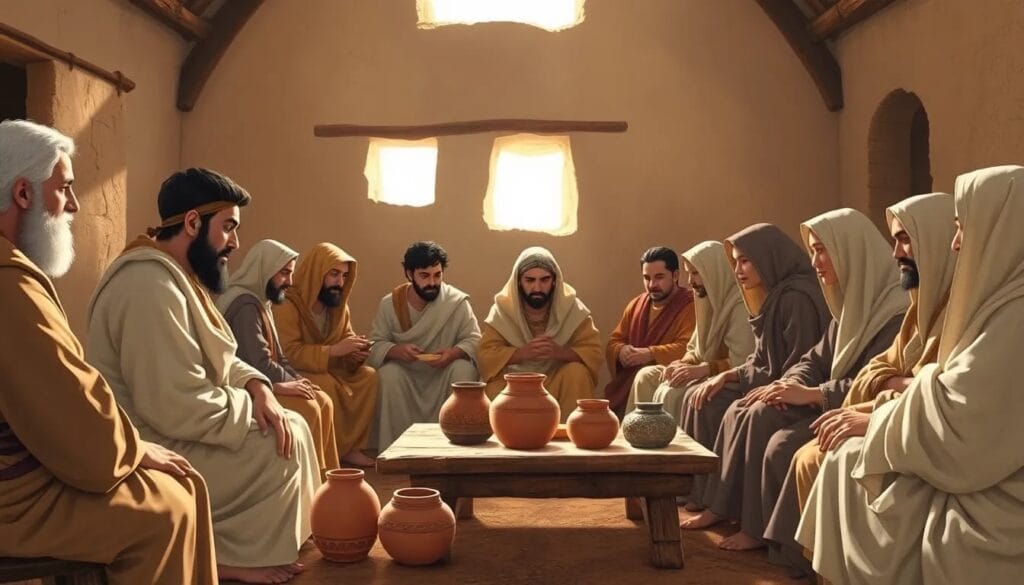
The first Christians formed close-knit groups, animated by an intense fraternal life that reflected love of Christ. These communities were not limited to a simple religious gathering, but constituted a true way of life centered on ecclesial communion and mutual support. Daily life was marked by the sharing of goods, common prayer, and constant attention to the needs of the most vulnerable members.
The influence of Jewish traditions This community organization is evident. The first disciples, mostly from a Jewish background, adopted and adapted practices such as the synagogue as a meeting place or the notion of "brotherly friendship" (chesed in Hebrew) which expresses a faithful and committed love. This Jewish imprint has made it possible to structure a community life founded on spiritual and material solidarity.
In these assemblies, fraternal communion went beyond mere social bonds to become a concrete expression of love mutual, commanded by Christ. The Acts of the Apostles They describe how the believers "had everything in common," selling their possessions to provide for everyone's needs, especially widows and orphans. This radical sharing demonstrated a profound desire to embody the Gospel in every action.
Several elements characterize this communal dimension among the first Christians:
- Collective prayer : powerful moments when the presence of the resurrected Christ was experienced among them.
- The Eucharist : central celebration reinforcing their spiritual unity.
- The mutual service : care for the sick, welcoming foreigners, support for the poorest.
- Apostolic teaching : continuous transmission of teachings received directly from the apostles.
This fraternal life was not without challenges. It sometimes required overcoming social, cultural, or economic differences to build true spiritual equality. Love Mutual support then became the cement that maintained this unity despite the inevitable tensions.
The communal dimension in early Christianity is not simply a historical legacy; it constitutes the foundational model of a Church called to live in communion, to love without boundaries, and to bear witness together to the faith received. This deep root explains why, even today, community life remains at the heart of Christian identity.
Historical evolution of the Christian community dimension
The history of Christianity reveals a profound evolution of community life under the impact of multiple cultural, social, political and theological changes. These transformations have shaped the ways in which fraternal communion is expressed and redefined the role of communities in the Church and in society.
Social and political changes over the centuries
The early persecutions, the official recognition of Christianity by the Roman Empire, and then the gradual construction of ecclesiastical institutions profoundly altered the nature of Christian communities:
- From marginalized communities to recognized institutions The transition of Christianity from a persecuted sect to a state religion led to a more structured organization with a rigorous hierarchy. This sometimes limited the original fraternal spontaneity in favor of an institutional order.
- Local socio-political influences : Adaptation to regional cultural realities has given rise to diverse forms of community life, sometimes incorporating elements of power and authority specific to surrounding societies.
- Reform movements Crises such as the Protestant Reformation in the 16th century highlighted tensions between community life and ecclesiastical authority. These movements often valued a return to a simpler community, centered on Scripture and brotherhood direct.
Major theological developments
Doctrinal reflections on the nature of the Church have profoundly influenced the meaning given to the Christian community:
- The notion of "people of God" has gradually emerged as a key concept, emphasizing the active participation of all the baptized in the ecclesial mission.
- The importance of the sacrament of the Eucharist has been affirmed as a central moment of spiritual and liturgical communion.
- The development of charisma, inspired by the Holy Spirit, encouraged harmonious diversity within the communities themselves.
The Second Vatican Council: A Decisive Turning Point
The council Vatican Council II (1962-1965) occupies a central place in the contemporary redefinition of ecclesial community life. This council highlighted several essential points:
«"The Church is the people of God who journey through history towards their full perfection" (Lumen gentium).
- A renewed vision of the Church The council emphasizes the active role of the faithful in church life, going beyond the traditional clerical model to promote a living communion among all.
- The community dimension as an expression of the Eucharistic mystery Participation in the Eucharist is presented as the primary foundation of all fraternal life.
- Promoting charisma and specific missions : The diversity of spiritual gifts is recognized as a richness that energizes groups and apostolic calls.
- A call for a more authentic shared life Religious are invited to live their vocation in a truly communal spirit, a concrete reflection of love evangelical.
This new direction paves the way for a profound renewal where communities are no longer merely places of belonging but also dynamic spaces for missionary and fraternal engagement. The post-conciliar perspective thus lays the foundations for a vibrant community life that seeks to combine fidelity to Christian roots with appropriate responses to modern challenges.
The role of religious communities after Vatican II
The council Vatican He profoundly renewed the understanding and place of religious communities within the Catholic Church. These communities are no longer perceived solely as cloistered or isolated groups, but as living expressions of ecclesial communion. They embody the mystery of the Church as a body united in diversity, where each member makes their specific contribution.
A living expression of the Church
Religious communities play an essential role in the concrete manifestation of Christian life. They bear witness to a life shared around strong spiritual values, where love Fraternalism is expressed through daily communion. This ecclesial communion goes beyond mere social ties to be rooted in a shared vocation to live the Gospel in depth.
This communal dimension, inherited from early Christianity, is found in a renewed form: community life becomes a privileged space for experiencing collective holiness, making visible the inner unity of the Church. The apostolic mission is closely linked to this, as these communities are called to radiate their charism throughout the world.
The Importance of Religious Charisms
Each community is distinguished by a particular charism—a specific grace received by its founder to serve the Church and the world. These charisms shape community life and guide the apostolic mission specific to each religious institute.
- Contemplative charisma : seeking a deep union with God through prayer and silence.
- Active Charisma : direct involvement with the poor, the sick, or in education.
- Mixed charisma combining contemplation and apostolic action according to the needs of the time.
The recognition and respect of these charisms enrich ecclesial communion by offering a multiplicity of gifts in service to the whole body. Each community thus becomes a living home where a unique facet of love of Christ.
Apostolic mission in community life
The apostolic dimension is inseparable from post-conciliar community life. Mission is not merely an external activity, but a natural extension of a fraternal life rooted in Christ. Members live together in order to better bear witness together to others.
This dual dynamic — community life And assignment — invites us never to separate personal faith from concrete commitment. Religious communities then become spiritual laboratories where new ways of being Church are experimented with, taking into account contemporary challenges while remaining faithful to their original identity.
«"The community dimension of early Christianity to the present day" is thus fully revealed through these living realities which continue to inspire the faithful and build up the whole Church.
Contemporary adaptations to societal challenges
Religious communities have had to adapt to the profound transformations that have marked contemporary societies, in particular the’social emancipation and the politics of individuals. These developments have challenged traditional structures, requiring a constant re-evaluation of Christian community life.
Responses to political and social emancipation
The rise of civil rights, the rise of democracy, and the struggles for legality have profoundly changed the relationship between religious institutions and society. Religious communities have responded to these upheavals with several initiatives:
- Engagement in concrete social actions : increased involvement with marginalized populations, defense of human rights, support for the excluded.
- Review of internal governance methods, with an openness towards more participation and dialogue between members, reflecting the prevailing democratic spirit.
- Promoting an embodied spirituality, which is not limited to prayer but engages in the transformation of the world according to Gospel values.
These adaptations demonstrate a desire to harmonize fidelity to Christian tradition with new requirements linked to the human dignity and to the social justice.
Seeking inclusive approaches to cultural diversity
Globalization has given rise to considerable cultural diversity within Christian communities themselves. The phenomenon of’inculturation has become a major issue in order for the Church to be truly universal without erasing local particularities.
With this in mind, the intercultural dialogue Strengthening this faith becomes essential. This implies an openness to diverse customs, languages, and spiritual expressions, so that each culture can live its faith authentically.
- Adaptation of liturgical rituals and practices : integration of cultural elements specific to the people concerned while respecting the essence of the Christian message.
- Promoting diverse charisma, which allow each community to express its specific vocation while contributing to the overall ecclesial richness.
This quest for inclusivity goes hand in hand with a heightened awareness of the issues related to multiculturalism, immigration, and identity tensions. Communities are thus seeking to overcome ethnic and social barriers to build an open and welcoming fraternity.
«Living together in diversity is not an obstacle but an opportunity to deepen our mutual understanding and enrich our experience of faith,» he often reminds us. the work contemporary pastoral care.
Societal challenges therefore invite religious communities to renew themselves without losing their essence: to bear witness to love of Christ in a constantly changing world.
Impact of new technologies on community relations
THE means of communication Modern technologies have profoundly altered community life within Christian groups. The widespread use of the internet, social networks, video conferencing platforms, and mobile applications has redefined how community members interact, share their experiences, and organize their spiritual lives.
Influence of modern technologies
- Instantaneity and expanded connectivity Technology allows geographically dispersed communities to maintain strong ties, fostering spiritual communion despite physical distance. It also opens the door to exchange with other international church groups, thus enriching the diversity of perspectives.
- Increased accessibility to training and catechesis Online resources facilitate access to religious teachings, meditations, and virtual spiritual retreats. This encourages more active and autonomous participation in community life.
- Risk of relationship fragmentation Virtualization can create emotional distance between members, where interaction digital It sometimes replaces real human contact. This can weaken the fraternal fabric based on concrete presence and daily sharing.
Resistance to consumerism through spiritual renewal
Faced with the constant pressure of a consumer society amplified by digital media, some Christian communities are developing a strong spiritual response:
- Reaffirmation of Gospel values : by prioritizing simplicity, poverty voluntary and happy sobriety, they implicitly challenge the materialistic models conveyed through technologies.
- Creating disconnected spaces : times dedicated to silent prayer, digital fasting or retreats without electronic devices are established to recreate a climate conducive to contemplation and brotherhood real.
- Involvement in collective projects : using technological means to coordinate concrete social actions — such as aid to the poor or environmental awareness — reflects a responsible use that goes beyond simple entertainment or passive consumption.
«"« Technology "It is not an enemy of faith; it becomes an opportunity for renewal if it is put at the service of the true bond between brothers," emphasizes a community leader.
The balance between technological openness and maintaining an authentic community life remains a constant challenge. Vigilance against individualistic or superficial excesses requires collective reflection on the conscious use of modern tools. This dynamic invites each member to cultivate not only their personal relationship with God but also their concrete commitment to brotherhood experienced on a daily basis.

Current trends in Christian community forms
The communal dimension of early Christianity to the present day reveals a marked evolution towards a preference for small communities more locally engaged. These communities are distinguished by their ability to create close and personalized links, fostering an intense fraternal life, similar to that of the first Christian assemblies.
Characteristics of small communities
- Relational proximity The small size facilitates mutual understanding and personalized spiritual guidance for each member. This intimacy allows for a full experience of fraternal communion, the foundation of early Christianity.
- Local commitment These groups often focus on concrete actions in their immediate environment: helping people in difficulty, social or pastoral initiatives adapted to local realities. Their local roots are a key factor in their vitality.
- Organizational flexibility Less institutionalized than large structures, these communities can better adapt to the specific needs of their members and to societal changes. They often favour a collegial governance, where every voice counts.
Resonance with early Christianity
The return to small communities recalls the experience of the first Christians, where communal life was centered on prayer, material sharing, and active solidarity. This approach responds to a deep need for authentic relationships in the face of growing individualism.
Examples
- THE new communities, which appeared in the 20th century, embody this model by combining community life and evangelizing mission in a flexible framework.
- Some house churches revive the apostolic tradition of a faith lived in small groups, fostering spiritual growth through constant mutual support.
- THE basic movements This dynamic is also being developed in several countries, reflecting a renewed desire for proximity and simplicity.
Practical and spiritual benefits
- To foster a family atmosphere where listening and trust are strengthened.
- To allow active involvement of each individual according to their gifts and charisms.
- Keeping the sacramental dimension alive while integrating contemporary challenges.
Small communities thus appear as a lever for renewing church life. Their dynamism illustrates how the communal dimension of early Christianity to the present day continues to evolve, adapting to current needs while remaining faithful to its original essence.
Tensions between traditional community life and apostolic commitment
Christian community life is rooted in sharing, prayer, and fraternal communion. However, the call to’social intervention spending time with the poor, the marginalized or the excluded sometimes generates a real tension with the time devoted to this classic community life.
Priority is given to engaging with the most disadvantaged.
Many communities feel an urgent need to address the concrete needs of their time. Social intervention then becomes imperative:
- Visits to the sick, support for the homeless, assistance to refugees.
- Educational and integration initiatives to combat inequalities.
- Commitments in support of people excluded from the social fabric.
These activities often require a significant investment of time and energy that encroaches on traditional moments of community gathering, such as communal prayer or times of shared reflection.
Risk of bursting of the community cohesion
When apostolic mission consumes most of one's daily life, fraternal bonds can weaken:
- The increasing number of personal commitments reduces opportunities for regular meetings.
- The diversity of locations for action disperses members across different areas.
- Physical and mental fatigue related to intensive service limits the attention paid to internal relationships.
This phenomenon is pushing some communities to rethink their organization so as not to sacrifice the quality of fraternal life, while continuing their vocation of concrete help.
Seeking a balance between mission and community
Several avenues are emerging to reconcile these requirements:
- Incorporate short but regular periods dedicated to communal living.
- To promote a fraternal sharing of experiences in social intervention.
- Developing new forms of prayer adapted to an active lifestyle.
- Revaluing mutual support as a source of energy for external service.
These efforts help to foster a dynamic where commitment to the most vulnerable is not only an external mission, but also an opportunity to strengthen internal communion.
«" Serve the poor is not just a concrete action; it is also a path that strengthens our unity and testifies to love of Christ among us.»
The challenge remains constant: how to keep this dual dimension—service and fraternity—alive without one stifling the other? Current tensions invite each community to invent original ways of fully living out this complex vocation. For example, for those considering a expatriation In regions like Tunisia where local religious practices can vary, it is crucial to understand these differences in order to better integrate while continuing to serve and support one's community.
The contemporary perception of religious work and its impact on fraternity
The way in which the work The perception of religion today is undergoing a notable evolution, marked by a tendency to consider the professional personal work as an activity distinct from the spiritual vocation. This transformation profoundly alters the dynamics of fraternal relations within Christian communities.
Religious work: profession or vocation?
Historically, the work In a religious context, it was intimately linked to an inner calling, to a spiritual mission lived in communion with brothers and sisters. professional personal work It was therefore a concrete expression of this vocation, fully integrated into community life. Today, this relationship is becoming more complex.
There contemporary society highly values the work as a profession, with its demands for performance, efficiency, and sometimes individualism. This logic tends to prevail in religious circles as well, where the work may be perceived less as a service rendered to God and others than as a professional task to be accomplished.
This shift has several consequences for the community fraternity :
- Detachment from the spiritual dimension : The work sometimes becomes a mere job, devoid of its sacred and evangelical dimension.
- Individualization of commitments : Each member can carry out their professional activity separately from the rest of the community.
- Pressure on community time The pace imposed by professional responsibilities reduces the time devoted to fraternal life.
Fraternity: obstacle or functional tool?
Faced with these changes, brotherhood Within religious communities, community life faces a dual challenge. It can be perceived as an obstacle if it slows professional efficiency or imposes relational constraints deemed burdensome in a context where time is limited. Some then see traditional community life as incompatible with the modern demands of work.
However, this fraternity remains a essential tool to support and enrich the very meaning of religious work. A vibrant community allows:
- To strengthen spiritual identity around a common project,
- To provide a framework conducive to sharing human and spiritual experiences,
- To help each individual reconcile their professional responsibilities with their inner growth.
Authentic fraternity should not be reduced to a mere functional instrument but should remain a vibrant source of inspiration and mutual support. In this way, it helps to overcome the risk of an overly utilitarian view of religious work.
This questioning of the place of work in religious life invites each community to revisit its priorities and modes of organization in order to promote a harmonious integration between professional commitment and fraternal life.
This reflection naturally leads to current trends in Christian community forms that emphasize structures more adapted to contemporary realities.
Summary: Reconciling individuality and Christian community life today
There new conception of the person The post-conciliar approach values the individual in their uniqueness, recognizing their rights, autonomy, and inner freedom. This evolution marks a significant turning point in how the communal dimension of early Christianity is experienced today. The traditional approach, often centered on communion and collective solidarity, gives way to a search for balance between respecting each person and maintaining an authentic community life.
Contemporary Christian communities are integrating this dynamic by prioritizing:
- The recognition of personal charisms, which enrich the community without diluting individual identity.
- Active participation where each member is invited to get involved according to their talents and aspirations.
- An opening to dialogue allowing for a reconciliation of diverse opinions and spiritual unity.
This model fosters a more flexible community life, capable of responding to the expectations of a pluralistic world while remaining faithful to the spirit of Christ. The tension between individuality and communion thus becomes a driving force for renewing fraternal practices. In this way, the community is not reduced to a mere social group but becomes the living place where this is manifested. love mutual rooted in the Christian faith.
Conclusion
The communal dimension of early Christianity to the present day testifies to a Christian continuity essential for the vitality of the contemporary Church. This life in community is not merely a historical tradition; it remains a spiritual foundation, a privileged place where it is manifested love of Christ through brotherhood, sharing and mission.
You are invited to recognize that this community dimension remains of paramount importance in the face of current challenges. The journey we have undertaken demonstrates that a balance between individuality and community life is not only possible, but essential. Each member contributes their personal richness while engaging in a collective dynamic, a source of spiritual growth and evangelical witness.
Some key points to remember:
- Community life nourishes faith, supports the mission, and reveals the mystery of communion proper to the Church.
- The post-conciliar valorization of the individual must coexist with genuine fraternal solidarity.
- A balanced approach between these two dimensions helps to meet the demands of a changing world.
This call for a balanced practice invites every Christian and every religious community to perpetuate this community dimension, a true legacy of early Christianity, while adapting it with discernment to contemporary realities.
Frequently Asked Questions
What is the importance of the community dimension in early Christianity?
The communal dimension was fundamental in early Christianity, marked by an intense fraternal life inspired by Jewish roots. The first Christian communities valued ecclesial communion and mutual love as essential expressions of their faith.
How has the Christian community dimension evolved historically?
Over the centuries, the Christian community has been influenced by cultural, social, political, and theological changes. The council Vatican He played a central role in redefining ecclesial community life to better meet contemporary challenges.
What role do religious communities play in Christian life after Vatican II?
After Vatican Secondly, religious communities have become living expressions of the Church, highlighting religious charisms and the apostolic mission. They thus embody the communal dimension of early Christianity adapted to current realities.
How are Christian communities adapting to contemporary societal challenges?
Faced with political and social emancipation as well as cultural diversity, religious communities are seeking inclusive forms of inculturation. In doing so, they respond to societal challenges while preserving their communal vocation.
What is the impact of new technologies on Christian community relations?
Modern technologies are changing community lifestyles and internal relationships by offering new means of communication. They also foster a spiritual renewal that resists consumerism, thus strengthening cohesion within communities.
What are the current trends in Christian community forms?
Today, there is a preference for small, locally engaged communities that foster authentic fraternal life. This trend reflects a balance between valuing individuality and the need for a vibrant ecclesial communion.