












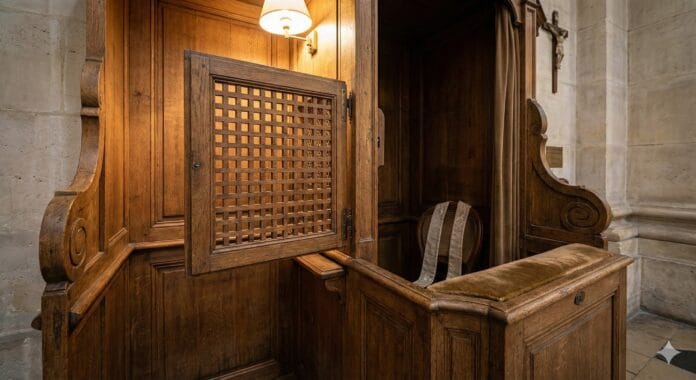
In the confessional of the Saint-Louis d'Antin church in Paris, something has changed. The traditional grille that once separated the priest from the penitent is no longer a dusty relic of the past. Today, it is being pulled down by young Catholics who are demanding it, an unexpected symbol of a broader movement: confession is making a strong comeback in the Church in France.
This practice, which many believed was dying out after Vatican It is experiencing a surprising revival. Not massive or spectacular, but real. And this return to favor says something profound about the evolution of contemporary French Catholicism.
A sacrament long shunned that is regaining its vibrancy
The freefall of the 1970s-2000s
Let's begin with an observation: for decades, confession has suffered a monumental decline in popularity. Baby boomers largely abandoned this practice, often seeing it as a guilt-inducing and outdated exercise. Confessionals remained empty, the bars dusty, the priests idle.
This crisis was not insignificant. For many, confession embodied everything they rejected in a Catholicism they considered too rigid: the obsession with sin, the surveillance of consciences, the power of the clergy. In the collective imagination, it had become synonymous with a repressive religion from which they had to break free.
The numbers spoke for themselves. In the 1960s, the majority of practicing Catholics went to confession regularly. By 2010, they were few and far between. Seminaries themselves were training future priests less in listening to confessions, as if this sacrament were destined to disappear.
The first signs of a turnaround
However, for the past ten years or so, the tide has been turning. Discreetly at first, then more visibly. Parishes are reporting an increase in requests for confession, especially before major holidays. Young adults, often new to the faith or returning to religious practice after years of absence, are rediscovering this sacrament with curiosity.
The anecdote of Father Pimpaneau at Saint-Louis d'Antin is revealing. These young, somewhat traditional people who prefer the gate are not nostalgic for a past they never knew. They consciously choose a form of confession they consider more authentic, more respectful of an intimacy that, paradoxically, is conveyed through the symbolic distance of the gate.
This revival is part of a broader movement to reclaim traditional practices. Novenas are making a comeback, Eucharistic adoration is attracting more people, and pilgrimages are on the rise. Confession is following this trend, benefiting from a renewed interest in all things spiritually enriching.
The establishment of diocesan penitentiaries
The Church in France has acknowledged this movement by creating penitentiaries in each diocese. These structures, modeled on those already existing in major pilgrimage shrines, offer increased availability for confessions and expertise in supporting complex situations.
In practical terms, what is a diocesan penitentiary? It's a designated place where trained priests are available at set times to hear confessions. Some urban parishes now offer daily office hours, sometimes during lunch breaks for working people.
This organization addresses a genuine need. Many Catholics would like to go to confession but don't know how. The penitentiary simplifies the process: no need to make an appointment, no embarrassment in front of a priest you know personally, and discretion is guaranteed.
Understanding the driving forces behind this renewal
The need for recognition of sin in a permissive society
Let's be frank: our era celebrates the liberation from all guilt. "Do what you want as long as you don't hurt anyone" has become the contemporary mantra. The very notion of sin is outdated, associated with a repressive morality that had to be discarded.
Except that this total liberation doesn't live up to its promises. Many people, including non-believers, vaguely sense that something is missing. How do you name this inner unease when you've acted in ways you know, deep down, are contrary to what is right? How do you find peace When someone has been hurt, even without intending to harm?
Confession provides a framework for naming this reality that our culture refuses to call "sin," but which nonetheless exists. It allows us to say aloud: "I did something wrong, and I am suffering for it." In a society that constantly encourages us to relativize our actions, this possibility of clear acknowledgment paradoxically becomes liberating.
Young Catholics who return to confession are not seeking to be made to feel guilty. On the contrary, they are seeking to escape a pervasive guilt that never finds resolution. The sacrament offers them a process: to recognize, to name, to receive forgiveness, to share out.
The quest for authenticity in relationships
Father Pimpaneau's observation on the "right distance" and the preference for the grid is fascinating. At first glance, one might think that younger generations, accustomed to face-to-face interaction and the direct expression of emotions, would reject this traditional filter. The opposite is true.
The grid creates a protective framework that allows for greater authenticity. By preserving visual anonymity, it liberates speech. One can confess things one would never dare say while looking someone in the eyes. This is particularly true for sins related to sexuality, which remain difficult to verbalize despite the liberalization of morals.
This search for the "right distance" also responds to a need for the sacred. In a world where everything is becoming horizontal and familiar, where even the most intimate relationships are exposed on social media, confession behind bars reintroduces a form of mystery and transcendence. One does not confess one's sins to a well-meaning friend, but to God through the ministry of a priest.
There is also a generational dimension. These young Catholics grew up with #MeToo and the debates surrounding consent. They are hypersensitive to issues of boundaries and respect for personal space. The grid appears to them as a healthy safeguard, preventing any ambiguity in their relationship with the priest.
The desire for structuring rituals in a fluid society
Our era is characterized by liquidity, to borrow the expression of sociologist Zygmunt Bauman. Everything is becoming fluid: identities, careers, relationships, values. This constant plasticity generates a deep-seated anxiety, a feeling of never being able to put down roots anywhere.
Confession, with its precise liturgy and ritual words, offers a counterweight to this fluidity. The process is always the same: one kneels or sits, begins with "Bless me, Father, for I have sinned," enumerates one's faults, receives counsel and penance, recites an act of contrition, and receives absolution. This repetition is not monotonous; it is reassuring.
Young Catholics rediscovering this sacrament particularly appreciate its codified nature. They know what to expect; they have a supportive framework. In a life where everything is constantly being negotiated, this age-old rite offers welcome stability.
This search for rituals is also evident in other areas of social life: secular sponsorship ceremonies, corporate rituals, and personalized celebrations to mark life transitions. Humans need ritual to find meaning. Confession is part of this profound anthropological dynamic.
The influence of the charismatic and traditional renewal
The return of confession does not occur in a vacuum. It accompanies the emergence of two seemingly opposed Catholic currents that converge on this point: the charismatic movement and the traditionalist movement.
Charismatics, with their emphasis on personal conversion and encountering the living Christ, have restored a powerful experiential dimension to the sacrament of reconciliation. Confession is no longer a routine chore but a moment of grace where one truly experiences divine forgiveness. Spiritual retreats offered by these new communities systematically include times for confession.
For their part, Catholics of a traditionalist persuasion value regular confession as a spiritual discipline. For them, frequent confession (some do so weekly) is an integral part of a serious Christian life. They appreciate the rigor of the sacrament and its moral demands.
These two perspectives, despite their theological and liturgical differences, converge in restoring confession to a central place. They create a ripple effect: when committed Catholics publicly promote this sacrament, others are encouraged to try it or rediscover it.
The Church's pastoral adaptation in the face of this renewal
Training priests in listening and discernment
While the demand for confession is increasing, priests must be ready to respond. However, an entire generation of priests ordained between 1970 and 2000 were not primarily trained for this ministry. Seminaries had other pressing concerns: the renewal of the liturgy, community leadership, and social engagement.
Diocesan leaders have understood this: confession training must be reinstated. This involves several dimensions. First, a solid understanding of moral theology, which is too often neglected. A priest must be able to discern the gravity of the acts confessed and offer appropriate spiritual guidance.
Then there's the whole psychological aspect. Listening to a confession requires particular attention, an ability to refrain from judgment, and sensitivity to what is left unsaid. Some dioceses organize training sessions where Christian psychologists work to help priests develop their listening skills.
Finally, priests must learn to manage delicate situations: confessions from people with irregular immigration status (divorced and remarried individuals, cohabiting couples), admissions of addictive behaviors, and revelations of abuse. These cases require specific support that goes beyond the sacrament itself.
Rethinking places and schedules
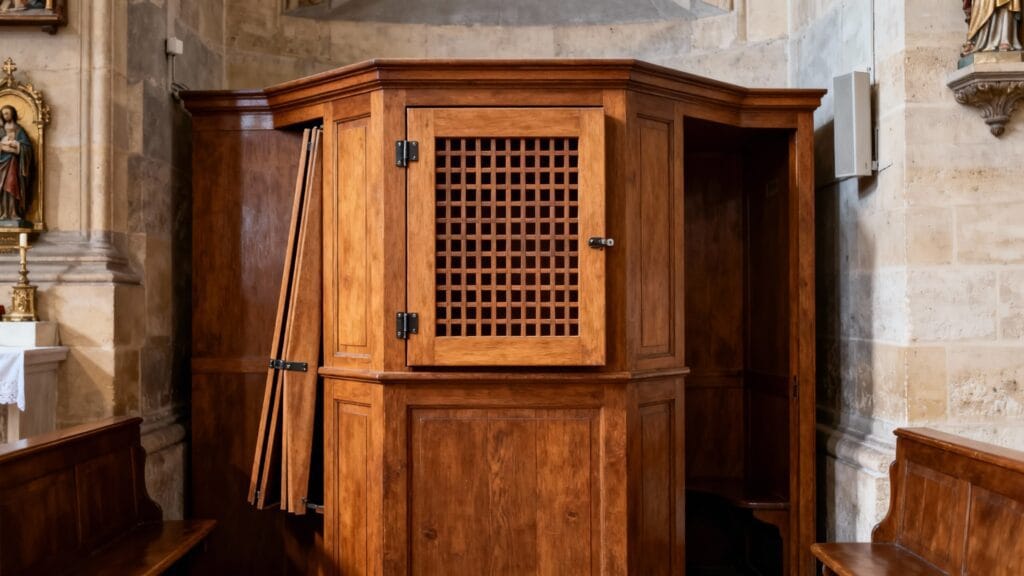
The practical organization of confession was long designed for another era. The traditional confessional, better suited to a rural society where people attended church regularly, is no longer necessarily appropriate for busy city dwellers who want to confess during their lunch break.
Some parishes are innovating. In Paris, several churches in the city center now offer weekday confession sessions from 12:15 to 1:45 pm. Modern desks have replaced the old-fashioned confessionals, offering a choice between the traditional screen and face-to-face confession. The lighting is well-designed, and the welcome is warm.
Other parishes focus on special evenings. Once a month, they organize a "night of mercy »Several priests are available from 6 p.m. to 10 p.m., with times of adoration and praise between confessions. The atmosphere is reverent but not somber, with candles and music gentle.
The major pilgrimage sanctuaries show the way. At Lourdes or Paray-le-Monial, the penitentiaries operate all day with priests speaking different languages. Dozens of people benefit from them every day, proving that a well-organized system generates attendance.
Communicating about the sacrament differently
For a long time, the Church communicated about confession defensively, as if apologizing for an awkward sacrament. There was talk of a minimum annual obligation, of preparation for major feast days, but rarely of joy of the forgiveness received.
Communication is evolving. Dioceses now speak of the "sacrament of reconciliation" rather than confession, a term considered too loaded. They emphasize the liberating aspect: it is not a tribunal but an encounter with mercy divine. Diocesan campaigns use modern visuals and testimonies from young Catholics.
Social media plays an important role. Priest influencers publish candid posts about confession, answer questions, and demystify the sacrament. Dedicated Instagram accounts share quotes from popes on forgiveness, humorous comics about preparing for confession.
Some dioceses have even created apps. These offer a guided examination of conscience, explanations of the process, and geolocation of places to confess. The idea is obviously not to confess via smartphone, but to make the process easier for those who are hesitant.
Articulating confession and spiritual guidance
One of the major pastoral challenges is to avoid reducing confession to a one-off act disconnected from a sustained spiritual life. The Church now emphasizes the importance of more comprehensive accompaniment.
Ideally, confession takes place within a relationship of spiritual direction. The person has a priest or trained layperson who accompanies them regularly, who knows their spiritual journey, their recurring struggles, and their progress. Confession then becomes a special moment in ongoing accompaniment.
For those not ready for such a commitment, the Church offers intermediate solutions. Life review groups provide an opportunity to share about one's Christian life in a small setting. Programs of spiritual formation include times of collective confession (where each person confesses individually but within a community setting).
This distinction is crucial to avoid two pitfalls. On the one hand, there's routine confession, where the same sins are recited mechanically without genuine conversion. On the other, there's psychotherapy-like confession, where one recounts their life while forgetting the sacramental dimension. We must find the right balance between ritual and relationship, between sacrament and the path of growth.
Taking complex situations into account
The return of confession also raises delicate pastoral questions. What should be said to a divorced and remarried person who wishes to confess but cannot receive absolution as long as they remain in that situation? How can we support a gay Catholic who lives with a partner and refuses to consider their relationship sinful?
The Apostolic Exhortation Amoris Laetitia of pope François It has opened up avenues without resolving everything. It encourages priests to discern on a case-by-case basis, to provide long-term support, and to acknowledge even incomplete efforts. But it also maintains traditional doctrine, creating a pastoral tension that each confessor must manage.
Some priests take a flexible approach: they grant absolution, considering that the person is doing their best in an objectively sinful situation from which they cannot immediately escape. Others remain stricter, refusing absolution but offering spiritual guidance and communion.
This diversity of approaches sometimes creates confusion. The same person may receive different answers depending on the confessor consulted. The Church is still searching for its position on these issues, trying to reconcile mercy and truth, acceptance and evangelical demands.
The return to confession among French Catholics is a minority but significant phenomenon. It does not concern the mass of baptized but not very practicing Catholics, but rather a committed and often young segment who are rediscovering this sacrament with a fresh perspective.
This resurgence says something important about our times. In a society that relativizes everything, that refuses to name evil for fear of guilt, many feel the need for a place where they can frankly acknowledge their wrongdoings and receive unconditional forgiveness. Confession offers what neither psychotherapy nor friendly confidences can: a word of absolution in the name of God.
The Church is adapting to this movement, creating penitentiaries, training its priests, and rethinking its practical arrangements. But it also continues to face major pastoral challenges, particularly in accompanying complex situations where doctrine and mercy seem to be in conflict.
It remains to be seen whether this renewal will extend beyond already convinced circles. Perhaps the real challenge lies there: how to introduce this sacrament to those who have not attended church for a long time but who often unknowingly harbor a deep need for reconciliation and forgiveness?