












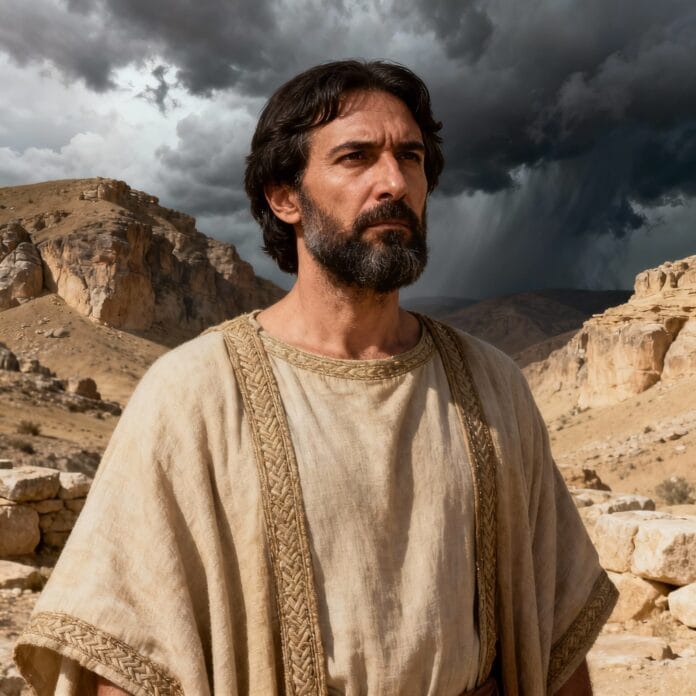
1° The person of the prophet Her name is almost entirely unknown to us, due to a lack of historical documents. Her Hebrew name, ‘'Obadyah, derived from two words (‘'ébed Yah) which mean: Servant of God. The most common Latin form is the one we read in the Vulgate; but we also find, in ancient writings, the forms "Obdia, Obadia, Obdias, Obedia". Similarly, in the Septuagint manuscripts, we sometimes read ’Οβδίας, sometimes 'Abdias. This name was relatively common among Jews, probably because of its beautiful meaning (for a similar reason, many Muslims are given the name Abdallah, servant of GodHe appears at least eleven times in the genealogical lists of the Bible, at various periods in Jewish history (cf. 1 Chron. 3:21; 7:3; 8:38; 9:16, 44; 27:19; 2 Chron. 17:7; 34:12; Ezra 8:9; Neh. 10:5 and 12:25), not to mention the pious steward of Ahab, who saved the lives of a hundred prophets whom this impious prince wanted to put to death (1 Kings 18:3-4. See also 2 Kings 1:13-16). Attempts made, both in ancient times and in our own, to identify our minor prophet with one or another of his namesakes are without serious basis. At most, we can assume that he belonged to the kingdom of Judah, because he is mainly concerned with Jerusalem.
2° The era The period in which he lived has given rise to endless discussions. It is "very difficult to determine. Some consider Obadiah the earliest of the minor prophets, others place his life during the time of the captivity. The brevity of his prophecy, which not only lacks a title (apart from the two words 'Vision of Obadiah') but also contains no sufficiently precise allusions, explains these considerable discrepancies. One can nevertheless, without stating the fact as certain, consider the prophet Obadiah the earliest of all those whose writings have been preserved for us. — 1. There is a very great resemblance between his prophecy and that of Jeremiah against Idumea (cf. Jer. 49:7-22); it is so striking that one is forced to admit that one of the two had the work of the other before him, and everything leads one to believe that it was Jeremiah who imitated Obadiah. See Vigouroux, Bible Manual, (t. 2, n. 1085, note 2). The minor prophet thus prophesied before the major one. But how long before? It is impossible to give a definitive answer to this question. Obadiah reproaches the Edomites for having applauded the misfortunes of Judah during the capture of Jerusalem by foreigners (Obadiah 11-14); however, he does not tell us who these foreigners were. Hence the difficulty. Jerusalem, before being destroyed by Nebuchadnezzar, had been captured and plundered five times since it had become the capital: 1) by the king of Egypt, Shesak, under Rehoboam (cf. 1 Kings 14:25); 2) by the Philistines and the Arabs, under Joram (2 Chronicles 21:16); 3) by King Joash of Israel, under Amaziah (2 Kings 14:13); 4th by the Chaldeans, under Jehoiakim (2 Kings 24:1); and 5th under Jeconiah (2 Kings 24:10). Obadiah cannot speak of the first capture of Jerusalem, by Shesak, because the Edomites were then subject to the kingdom of Judah. Nor can he allude to the fourth and fifth captures, which are contemporary with Jeremiah; nor to the third, since he expressly states that the capital of Judea was then ravaged by foreigners, which cannot apply to the northern Israelites, but perfectly suits the Arabs, and especially the Philistines, whose name the Septuagint generally translates as ἀλλοφύλοι, foreigners (compare Obadiah 11 and 19, in this version). It was therefore during the reign of Joram (between 889 and 885 BC) that Obadiah lived and prophesied, at the time when the Edomites threw off the yoke of the king of Judah (cf. 2 Kings 8:20-22; 2 Chronicles 21:8-10), and when they applauded the ravages of the Philistines and the Arabs of Arabia Petraea (cf. 2 Chronicles 21:17). — 2. We arrive at the same conclusion by comparing the prophecy of Obadiah with that of Joel. The connection between these two sacred writers is generally accepted. Joel, despite his undeniable originality, imitated Obadiah (cf. Joel 2:32 and Obadiah 17. Compare also Joel 3:3 and Obadiah 11; Joel 3:4-7 and Obadiah 15; Joel 3:14 and Obadiah 15; Joel 3:17 and Obadiah 17; Joel 3:10 and Obadiah 10), just as Obadiah imitated the prophecies of Balaam in some respects (cf. Numbers 24:18, 21 and Obadiah 4:18 ff.). Obadiah must therefore date from the end of the reign of Joram (Man. Bibl., t. 2, n. 1085).
3° The style Obadiah's writings also bear a striking resemblance to antiquity. They are vigorous, concise, almost harsh; not a single word suggests a recent era. The prophet's language resounds as if it were emerging from the fissures of a rock; his speech is full of harshness; we find in him no flower of expression, no ornament of exposition. It is as if he carved his prophecies from the very stones of Sela (the capital of Idumea, modern-day Petra in Jordan). Nevertheless, they are very poetic, very vivid.
4° The subject and division of the book. — This book, the shortest of all the Old Testament books, deals directly and immediately with the relationship between Idumea and the people of God. It begins by proclaiming the impending ruin of the Idumeans, which God will surely bring about, despite the strength of their citadels built on the rocks. It then indicates the cause of this harsh fate: the shameful conduct of the descendants of Esau toward their Israelites, their brothers, while the latter were being outraged by cruel conquerors; far from coming to the aid of the Hebrews, the Idumeans had cowardly joined forces with their enemies to plunder Jerusalem. But, Obadiah continues, the day of the Lord is near; God will take revenge himself and avenge Israel, striking either the Idumeans or the other pagan nations. The Israelites, on the contrary, will be blessed; They will seize the territory of their oppressors, and then God will reign gloriously and forever in Zion.
Thus, this writing has three parts: 1° God's terrible and immutable decree against Idumea, verses 1-9; 2° the reason for this decree, verses 10-16; 3° the marvelous deliverance of Zion, verses 17-21.
While Idumea is, as we have said, the direct object of Obadiah's prophecy, it is not its sole focus, exhausting his thought in itself. Having taken it as his starting point, Obadiah soars on the wings of inspiration and ascends to the heights of the Messianic era, which is described in the final verses. For him, the ruin of Edom is not merely a special, isolated event; this judgment of God against a guilty nation is, in his eyes, like a preliminary act of the general judgment of all peoples (cf. verses 15-16). The ruin of the Edomites thus represents for him the ruin of all the enemies of the true religion, just as the restoration of the Israelites to Palestine, after their defeat, is the type of the final establishment of the kingdom of God throughout the earth.
The best Catholic commentaries are: in antiquity, Theodoret of Cyrrhus, Narrations in duodecim Prophetas and Saint Jerome, Commentaria in Prophetas minores. In modern times: F. Ribera, In librum duodecim Prophetarum commentarii, Antwerp, 1571; Sanchez, How. In Prophetas minores and Baruch, Lyon, 1621.
Obadiah
1 The vision of Obadiah. Thus said the Lord God to Edom: We have received a message from the Lord and a herald has been sent among the nations: «Arise! Let us rise up against him to fight!» 2 Behold, I have made you small among the nations, and you are an object of utter contempt. 3 The pride of your heart has led you astray. He who dwells in the hollows of the rocks, whose home is the heights, says in his heart: «Who will bring me down to the ground?» 4 Though you soar as high as the eagle, and build your nest among the stars, I will bring you down. This is the Lord’s oracle. 5 If thieves had broken into your house, if night raiders had entered, wouldn't they have taken only what they needed, now that you are devastated? If grape harvesters had entered your house, wouldn't they have left nothing to glean? 6 Just as Esau was searched, so too were his hidden treasures sought. 7 They chased you to the border, all your allies; they deceived you, they prevailed over you, those who enjoyed your friendship; those who ate your bread laid a snare for your feet. There is no intelligence in him. 8 Will I not on that day, declares the Lord, take away the wise men from Edom and the understanding from the mountain of Esau? 9 Your warriors, O Teman, will be terrified so that every man will be cut off from the mountain of Esau. 10 Because of the violence against your brother Jacob, shame will cover you and you will be cut off forever. 11 On the day you stood before him, on the day his army was taken away by enemies, and foreigners entered his gates and cast lots for Jerusalem, you too were like one of them. 12 Do not look with pleasure on your brother's day in the day of his misfortune, do not rejoice over the children of Judah in the day of their ruin, and do not utter insolent words in the day of distress. 13 Do not enter the gate of my people in the day of their calamity; do not take pleasure in seeing their misfortune in the day of their calamity, and do not extend your hand over their riches in the day of their calamity. 14 Do not stand at the crossroads to massacre its fleeing inhabitants; do not hand over its survivors in the day of distress. 15 For the day of the Lord is near for all nations. As you have done, so it will be done to you. Your actions will return upon your own head. 16 For just as you drank on my holy mountain, so all nations will drink continually. They will drink and swallow, and they will be as though they had not been. 17 But on Mount Zion there will be survivors. It will be a holy place, and the house of Jacob will return to its possessions. 18 The house of Jacob will be a fire, the house of Joseph a flame, and the house of Esau will be reduced to stubble. They will set it ablaze and consume it, and there will be no survivors from the house of Esau, for the Lord has spoken. 19 Those of the Negev will possess the mountain of Esau, and those of Shephelah, the land of the Philistines, will possess the territory of Ephraim and the territory of Samaria, and those of Benjamin will possess Gilead. 20 The captives of this army of the children of Israel will possess the land of the Canaanites as far as Zarephath, and the captives of Jerusalem who are in Sepharad will possess the cities of the Negev. 21 And deliverers will go up to Mount Zion, to judge the mountain of Esau, and the kingdom will be the Lord's.
Notes on the Book of Obadiah
1.1 Said. Jeremiah 49, 14. ― To Edom Or touching Edom ; that is to say, Idumea. We, prophets. Besides Obadiah, Isaiah (see Isaiah, (ch. 34), Jeremiah, (see Jeremiah, 49, 7-22), Ezekiel (see Ezekiel, 25, 12-14), and the author of the Psalm, 136, 7, prophesied against Edom.
1.3 The inhabitants of Petra, the capital of Idumea, had dwellings carved into the rock.
1.6 Esau, which was also called Edom (see Genesis, (25, vv. 25, 30), is placed here for his descendants, the Edomites. In this verse and the following ones, the verbs are in the past tense, although they express future events. This enallage of tense is very common in the style of the prophets.
1.8 See Isaiah 29:14; 1 Corinthians 1:19.
1.10 See Genesis 27:41.
1.16 All nations, etc. Cf. Jeremiah, 25, v.15 and following; 49, 12.
1.17 a holy place ; by the temple that will be rebuilt there.
1.18 Jacob's houseetc. After their return from Babylon, the Jews were like a fire to the house of Esau, or to the Idumeans, to whom they often made the warThis may therefore relate to the Maccabean expeditions against the Idumeans (1 Maccabees 5, 3), but it was only long after that the house of Esau was completely extinguished.
1.19 Gilead ; That is to say, the land beyond the Jordan. In the plains of the Sephelah. See Judges 15, 5.
1.20 Children of Israel ; Israelites from the ten tribes. ― The Canaanites are placed here for the Phoenicians, because they were Canaanites by origin. ― Sarepta ; city in the territory of Sidon.
1.21 Liberators, That is to say, the Maccabees and the Hasmonean princes, but in a higher sense, this prophecy concerns Jesus Christ. The kingdom belongs to the Lord, a promise that will only be fully realized on the last day, when, all power being destroyed, God alone will reign over his saints and with his saints for eternity (1 Cor. 15, 24; Apoc. 11, 15).