










1° The person and era of the prophet. His real name was Haggaï (from the root hag, (feast). The Latin form 'Aggœus' was modeled on 'Aggaios' of the Septuagint. Haggai gives us no details whatsoever about his family. We don't even know for certain whether he was born before or during the exile, in Judea or Babylon, although the latter is more likely. He tells us only that he served as a prophet in Jerusalem during the second year of the reign of Darius, son of Hystaspes (520 BC) (the events recounted in this book took place during the short interval of three months and twenty-four days. Cf. 1:1 and 2:11, 21). Haggai thus opens the series of three post-exilic prophets. Zechariah was his contemporary; Malachi carried out his ministry about ninety years later. As we learn from the first six chapters of Ezra, the time of Haggai and Zechariah was difficult, even painful, because the theocracy encountered many obstacles from the men in emerging from its ruins; discouragement had even reached the Jews from a religious point of view: it was precisely to revive their energy that God sent them his messengers, who succeeded in their mission.
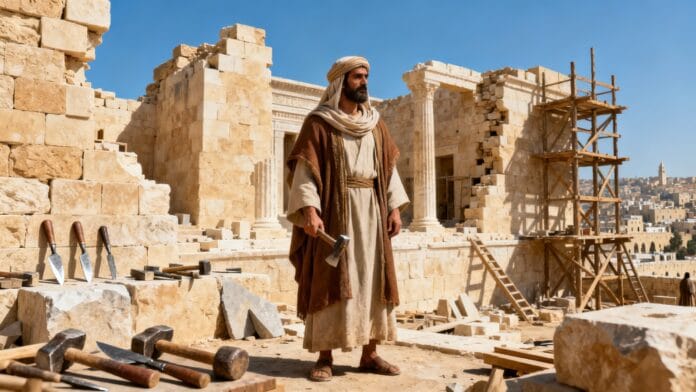
2° The subject and division of the bookTwice in succession, Ezra mentions the very large part that the prophets Haggai and Zechariah played in the rebuilding of the Temple in Jerusalem (cf. Ezra 5:1-2, and 6:14-15); now, what precisely characterizes the book of Haggai is that everything in it is linked to this rebuilding, which even forms its center and main theme. This fact is so striking that no one has thought to attack the authenticity of Haggai's prophecies. The necessity of restoring the Temple was evident, for the prophet, from the considerable place that the sanctuary occupied in the life of the privileged nation. It was, in fact, the authorized sign of the covenant concluded at Sinai between God and Israel, the symbol of His dwelling among His people. The destroyed Temple must therefore represent, in a visible form, the rupture of this covenant, the more or less complete cessation of the relationship that united the Lord to the entire nation. and the reconstruction of the sanctuary thus became, in the eyes of the prophet, a sacred obligation above all others, which had to be imposed on the conscience of contemporaries.
The historical and chronological introductions, very clear in their concision, which Haggai himself placed before each of his predictions (cf. 1:1; 2:2, 11, 21), divide his book into four short speeches, delivered on as many distinct occasions, but all pursuing the same goal and closely related to one another. The first (1:2–2:1) severely rebukes the Jews for their slowness in rebuilding the temple and attributes to this serious negligence the drought that had destroyed a significant portion of the harvest. The second (2:2–10) announces that the new temple, so humble in its beginnings, will have a glory far greater than that of the first, built by Solomon and destroyed by the Chaldeans [Iraqis]. The third (2:11–20) encourages, by the promise of great fertility, the work of the people, who were zealously pursuing the restoration of the sacred edifice; However, he condemns the purely external fulfillment of the law. The fourth (2:21-24) foretells the glorious restoration of the kingdom of David.
Two of these speeches, the second and the fourth, are messianic, for they clearly predict, on the one hand, the relatively imminent arrival of the Messiah, who was to honor the new sanctuary with his presence, and, on the other hand, the magnificent splendor of his reign.
3° The type of writer Haggai. His language rarely rises above simple prose. He has ardent, lofty feelings, but he doesn't bother to clothe them in a beautiful style. Nevertheless, he succeeds at times in giving more life to his speeches through the use of rhythm, repetition (cf. 1, 6, 9-11; 2, 5, 23, etc.), and questions (cf. 1, 4, 9; 2, 3, 12, 13, 19) which accentuate his thoughts. One also notices passages of vigorous concision, following a somewhat diffuse introduction (cf. 1, 2).b ; 12b; 2, 5b, 19b): which has led to the saying that it hides a small but intensely rich core beneath a somewhat thick rind. Aggée has something extraordinarily attractive and touching about it.
The best Catholic commentaries are: in antiquity, Theodoret of Cyr, Enarrationes in duodecim Prophetas and Saint Jerome, Commentaria in Prophetas minores. In modern times: F. Ribera, In librum duodecim Prophetarum commentarii, Antwerp, 1571; Sanchez, How. In Prophetas minores et Baruch, Lyon, 1621.
Aggée 1
1 In the second year of King Darius, in the sixth month, on the first day of the month, the word of the Lord came through Haggai the prophet to Zerubbabel son of Shealtiel, governor of Judah, and to Jesus son of Jehoshid the high priest, saying: 2 Thus says the Lord of hosts: This people says, «The time has not yet come, the time for the house of the Lord to be rebuilt.» 3 And the word of the Lord came through Haggai the prophet, saying: 4 Is it time for you others to live in your wood-paneled houses, when that house is in ruins? 5 And now this is what the Lord of hosts says: Consider carefully your ways. 6 You have sown much and reaped little; you eat, but not until you are satisfied; you drink, but not as much as you want; you are clothed, but not until you are warm; and the wage earner receives his wages for a purse full of holes. 7 Thus says the Lord of hosts: Consider carefully your ways. 8 Go to the mountain, bring back wood and build the house; I will take pleasure and glory in it, says the Lord. 9 You counted on much, and now it has dwindled to little; you brought in your harvest, and I blew it away. Why, declares the Lord Almighty? Because my house lies in ruins while each of you carefully tends to your own house. 10 That is why the heavens have withheld the dew for you, and the earth has withheld its fruits. 11 I called for drought on the land and on the mountains, on the grain, on the new wine, on the oil and on what the ground can produce, and on man and on beasts and on all the work of hands. 12 Then Zerubbabel son of Shealtiel and Jesus son of Josedec, the high priest, and all the rest of the people, listened to the voice of the Lord their God and to the words of Haggai the prophet, according to the mission which he had received from the Lord their God, and the people feared before the Lord. 13 And Haggai, sent by the Lord, spoke to the people at the Lord's command, saying, «I am with you, declares the Lord.» 14And the Lord stirred up the spirit of Zerubbabel son of Shealtiel, governor of Judah, the spirit of Jesus son of Jehoshid, the high priest, and the spirit of all the remnant of the people, and they came and labored on the house of the Lord of hosts, their God, 15 the twenty-fourth day of the sixth month, in the second year of King Darius.
Aggée 2
1 In the seventh month, on the twenty-first of the month, the word of the Lord came through Haggai the prophet, saying: 2 Therefore, speak to Zerubbabel son of Shealtiel, governor of Judah, to Jesus son of Jehoshid, the high priest, and to the rest of the people, saying: 3 Which of you survivors saw this house in its former glory, and in what state do you see it now? Does it not appear to you as nothing? 4 And now, take courage, Zerubbabel. This is the Lord’s declaration. Take courage, Jesus son of Josedec, the high priest. Take courage, all you people of the land, this is the Lord’s declaration, and act, for I am with you, this is the Lord Almighty’s declaration. 5 There is the covenant I made with you when you came out of Egypt, and my Spirit remains among you: do not be afraid. 6 For thus says the Lord of hosts: Once again, and it will be soon, I will shake the heavens and the earth, the sea and the continent. 7 I will shake all nations and the treasures of all nations will come, and I will fill this house with glory, says the Lord of hosts. 8 The silver is mine, the gold is mine, declares the Lord of hosts. 9 Great shall be the glory of this house, the last more than the first, and in this place I will put peace, oracle of the Lord of hosts. 10 On the twenty-fourth day of the ninth month, in the second year of Darius, the word of the Lord came through the prophet Haggai: 11 Thus says the Lord of hosts: Ask the priests for a decision in these terms: 12 Here is a man carrying consecrated meat in the fold of his garment; he touches with that fold bread, boiled food, wine, oil, or any other food: shall it be consecrated? The priests answered and said: No. 13 And Haggai said: if a man defiled by contact with a dead person touches all these things, will they be defiled? The priests answered and said: they will be defiled. 14 Then Haggai spoke again, saying: This is the people, this is the nation before me, declares the Lord, this is all the works of their hands: what they offer there is defiled. 15 And now, look back to this day, before they laid one stone upon another in the temple of the Lord. 16 So, when you came to a pile of twenty measures, there were only ten; when you came to the press to draw fifty measures, there were only twenty. 17 I struck you with rust, mildew, and hail; I struck all the work of your hands, and you did not return to me, declares the Lord. 18 Therefore, turn your attention back from this day, from the twenty-fourth day of the ninth month, to the day on which the temple of the Lord was founded; turn your attention. 19 Was the seed still in the barn? Even the vine, the fig tree, the pomegranate, and the olive tree produced nothing: but from this day forward, I will bless. 20 The word of the Lord came a second time to Haggai on the twenty-fourth day of the month, saying: 21 Speak to Zerubbabel, governor of Judah, saying: I will shake the heavens and the earth, 22 I will overthrow the thrones of kingdoms, I will destroy the power of the kingdoms of nations, I will overthrow the chariots and those who ride in them, the horses and their riders will fall by each other's sword. 23 On that day, declares the Lord of hosts, I will take you, Zerubbabel son of Shealtiel, my servant, declares the Lord, and I will make you like a signet ring, for I have chosen you, declares the Lord of hosts.
Notes on the Book of Haggai
1.1 See Ezra 5:1. Darius, son of Hystaspes, king of Persia. ― In the sixth month. See Ezekiel, 8, 1. ― Jesus is the same as Joshua, son of Josédec, mentioned in Ezra 3, 2, etc. ― Darius Ier reigned from 523 to 485 BC.
1.4 That house ; the temple of the Lord.
1.6 See Deuteronomy 28:38; Micah 6:15.
2.2 In the seventh month of the sacred year, and first of the civil year. It began at the new moon of September, according to the rabbis; but it was more probably at that of October.
2.7 and 9 See Hebrews 12:26. These verses and those that follow undoubtedly contain a prophecy of the Messiah, as well as divine gifts and spiritual treasures with which he enriched his Church.
2.11 From the ninth month of the sacred year, and third of the civil year. It began at the new moon of November, according to the rabbis; but it was more probably at that of December.
2.13 Will they be soiled? Leviticus, 6, 27-28; Numbers, 19, 22, he who is defiled will defile everything he touches.
2.18 See Amos 4:9.
2.19 From the ninth month. See v.11.
2.24 See Ecclesiasticus 49:13. — According to most exegetes, these promises addressed to Zerubbabel do not refer literally to his time or his person, but only to Jesus Christ, who was to come from his descendants. However, some relate them to the first coming of the Savior, and others, including Saint Jerome, to the second. I will make you into a pill. ; That is to say, I will take the greatest care of you. This image is borrowed from the care with which seals were preserved. The seal has always been considered by the Hebrews as a precious and dear thing. It is also known that the Orientals guard seals with the greatest care, because of the potential misuse they could suffer if they were to fall into foreign hands.