












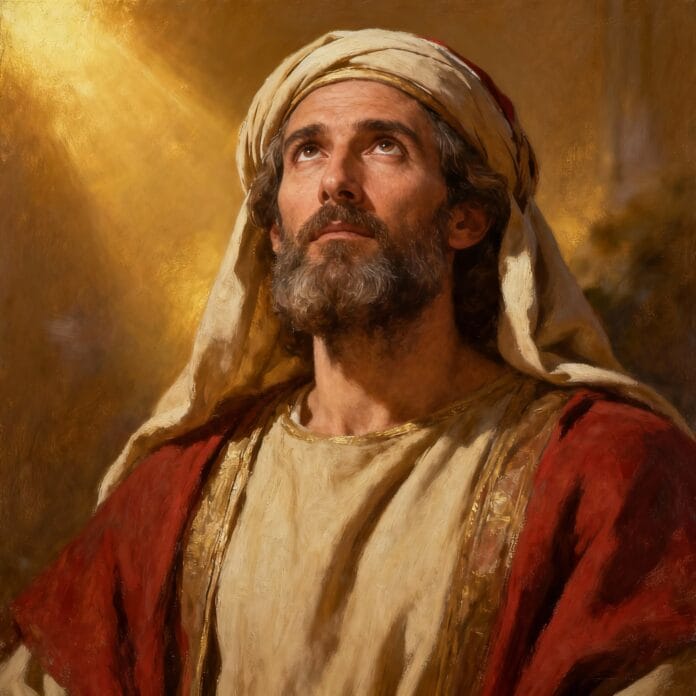
1° The person of the prophet. — His name appears to have meant: God is my judge, i.e., my defender (less accurately, according to some exegetes: Judge of God, i.e., he who judges in the name of God. The Old Testament mentions two other figures named Daniel. Cf. 1 Chronicles 3:1; Ezra 8:2; and Nehemiah 10:6). The book attributed to him provides us with considerable information about his life. He was born in Palestine, of noble origin (cf. Daniel 1:3), and even of royal lineage if we are to believe the historian Josephus (Ant.(Dan. 10:10, 1. This feeling is far from certain). He was only a teenager when he was deported to Babylon by the famous Chaldean king Nebuchadnezzar, right at the beginning of the Jewish captivity, in the third year of the reign of Jehoiakim (606 or 605 BC) (cf. Dan. 1:1). There, he was instructed in the sciences and the Chaldean language, along with some other young Israelites; then he entered the king's service.
His intelligence, and especially the success with which, thanks to divine guidance, he interpreted two dreams of Nebuchadnezzar (2:1 ff.; 4:1 ff.), earned him, until the death of that prince, great honors and almost royal power (cf. Dan. 2:46-49). Later, during the reign of the impious Belshazzar, he briefly regained his high office after explaining to the king the mysterious symbols that prophesied the ruin of the Babylonian empire (5:1 ff.). We find him again in power under Darius the Mede, who was particularly pleased with him (6:1 ff.). Thus, in Chaldea, bringing glory to his God and good to his people, he played a role similar to that which Joseph had once fulfilled in Egypt. But this very thing created for him many bitter enemies, who did everything they could to destroy him, and whose traps he could only thwart through the very special protection of the Lord (cf. Dan. 6, 4 and ff.; 14, 27 and ff.).
He reached a great age, since he was still alive in 534, three years after Cyrus's capture of Babylon (cf. 10:1. Assuming he was about ten years old when he came to Babylon, he lived to be over eighty). He therefore witnessed the end of the captivity. His tomb, whether authentic or not, which is shown near ancient Susa, has always been the object of great interest. veneration.
It has rightly been said of Daniel that he is "one of the greatest figures to appear in the last centuries of the Old Covenant." Josephus (Ant.(Hebrews 10:11, 7) offers him magnificent praise, and regards him as "one of the greatest among the prophets." In the midst of honors as in adversity, he always remained admirably faithful to his God and to the precepts of the Mosaic religion (cf. 1:8 ff.; 6:5, 10, etc. Hebrews 11:33). The wisdom he displayed, from his youth, on the occasion of Susanna's judgment (cf. 13:1 ff.), rightly made him famous; it is also praised by Ezekiel, his contemporary, who compares him to Noah and Job in terms of holiness (cf. Ezekiel 14:14, 26; 28:3). The Talmud (Tractate Ioma, 69, b) considers Daniel as a type of the Messiah, because of his courageously endured suffering.
2° The subject and division of the book. — The inspired writing which bears the name of Daniel recounts the providential role that this holy person played in Babylon, and the grandiose visions that God revealed to him concerning the future of the theocratic kingdom.
This book is divided into two roughly equal parts, quite distinct in terms of subject matter. The first (1:1-6:28) is primarily historical (though it does contain some very important prophecies, ch. 2:4-5), and recounts the principal events in Daniel's life during the reigns of Nebuchadnezzar (ch. 1-4), Belshazzar (ch. 5), and Darius the Mede (ch. 6). It contains six narratives, the first of which serves as an introduction to the entire book: 1. Daniel and three of his friends are deported to Babylon and admitted to the king's court (1:1-21); 2. Daniel explains Nebuchadnezzar's dream concerning the gigantic statue (2:1-49); 3. Daniel's three friends in the fiery furnace (3:1-97); 4. Nebuchadnezzar's dream concerning the great tree, and its interpretation by Daniel (3:98–4:34); 5. Belshazzar's feast and the explanation of the three mysterious words (5:1–31); 6. Daniel in the lions' den (6:1–28). The second part (7:1–12:13) is exclusively prophetic. It announces, in four remarkable visions, the successive destinies of the great pagan empires, considered either in themselves or in their relations with the people of God: 1. The four animals that symbolize the succession of pagan monarchies and the advent of the kingdom of God (ch. 7); 2. The ram and the goat (ch. 8); 3. The seventy weeks of years (ch. 9); 4. The calamities that God's people will have to suffer at the hands of the pagans before their glorious restoration (chapters 10-12). The order followed in each of these two parts is chronological. A historical appendix (13, 1-14, 42), whose interesting narratives belong to various periods, recounts the story of Susanna and the episodes of Bel and the dragon.
In all this reigns perfect unity (the rationalists themselves unanimously reject the hypotheses of their most ancient colleagues, according to which the book of Daniel is composed of fragments written by various authors). "It is everywhere the same spirit; everywhere, although in different forms, we find the same ideas about the future," the same general foundation, the same style (note, among other details, identical formulas that resonate throughout the entire book. Cf. 3, 4, 7; 5, 19; 6, 25; 7, 14, etc.).
3° Its purpose and importance. The purpose of the book of Daniel was evidently, according to the divine plan, to preserve the faith of the Jews, not only during the painful and discouraging period of exile, but also during the even more difficult era of persecution that awaited them before the appearance of the Messiah. In the narratives and revelations of Daniel, God's people possessed an authentic document that clearly promised them final deliverance through the Messiah; they knew that the pagan kingdoms, however powerful they might be, would not succeed in destroying them, and that the triumph of the true religion over the world was a certainty.
From both a historical and Christological perspective, the importance of these pages cannot be overstated. They have preserved for us details of the later Chaldean period and the beginnings of the Persian monarchy that we would otherwise have known only imperfectly. As for the kingdom of the Messiah, they marvelously unfold its prospects throughout the ages, and not only do they speak clearly of the promised Liberator, but they also uniquely determine the precise time of his coming. It has been quite rightly said of the prophetic section of the book that it is one of the best proofs that exist in favor of the truth of revealed religion.
4° The place it occupies in the canon is not the same everywhere. In ancient Greek, Latin, etc., translations, and generally in all Christian versions of the Holy Scriptures, it is placed between the writings of Ezekiel and Hosea, following the major prophets and preceding the minor prophets. In the Hebrew Bible, it is ranked among the Ketubim or Hagiographers, between the books of Esther and Ezra. It is not that the Jews ever disputed Daniel's title of prophet (cf. the words of Josephus); but, he had exercised "a special mission, outside the ordinary mission of the prophets; he had played a role in the history of Babylon, and his work thus took on a particular character, of which no other book of the Old Testament offered the prototype" (Vigouroux, Biblical Manual, (t. 2, n. 1056). Moreover, even in the Hebrew Bible, "he appears to have originally figured in the series of prophets," as shown by the place assigned to him in the Septuagint. "He even appears before Ezekiel in the authentic descriptions of the Jewish canon left to us by two famous writers of the 1st and 3rd centuries, Melito of Sardis and Origen." (cf. L. Wogue (Israelite writer), History of the Bible and biblical exegesis up to the present day, Paris, 1881, p. 74). We can conclude from this that it was only around the 4th century AD that the Talmudists classified him among the Hagiographers.
5° The Hebrew text, the Greek versions and the Vulgate. The Book of Daniel, like the Book of Ezra, is unique in that it was written in two different languages, Hebrew and Aramaic. The beginning, 1:1–2:4a, and chapters 8–12 were composed in Hebrew; from 2:4b to 7:28, everything is Aramaic, except for the deuterocanonical fragment 3:24–90, which has come down to us only in Greek. We also possess only the Greek translation of chapters 13 and 14, which are also deuterocanonical. It is in the Aramaic response to Nebuchadnezzar by his magicians (2:4b) that this language is used for the first time by the author. He continues to use it throughout the rest of the historical section; but it is unknown why he wrote his first vision in Aramaic.
«"The Hebrew of this book bears the greatest resemblance to that of Habakkuk and Ezekiel. The Aramaic, like that of Ezra, has a more archaic form than that of the other oldest documents we possess in this language, such as the Targums" (Vigouroux, Biblical Manual, vol. 2, no. 1054. "The Aramaic part of Daniel is generally called Chaldean. This last expression is inaccurate and can be misleading, suggesting that the language used by Daniel in this part of his book is the language of the Chaldeans; it was, as the original text states, the dialect of the inhabitants of Aram or of the Syria, ‘'arâmît συριστί, Syriac). Daniel reserves the name lingua Chaldaeorum for that which was written with cuneiform characters. See 1, 4 » (Ibid.).
There are two Greek versions of the Book of Daniel: the Septuagint and the Theodotion. The former was abandoned by the Greek Churches as early as the 3rd century, probably because of its many imperfections (see Saint Jerome, in Dan. 4, 6), and the second was substituted for it. For the protocanonical part, the Vulgate was made directly from the Hebrew text; for the deuterocanonical passages, Saint Jerome followed Theodotion, as he says several times in the course of the book.
6. The authenticity of the Book of Daniel was fiercely attacked from ancient times by the Neoplatonist Porphyry (in the 3rd century AD), who provided most of the arguments for modern rationalists. He attributed the composition of this work, as does the so-called critical school, to a Jew contemporary with Antiochus Epiphanes (this impious prince reigned from 175 to 164 BC), who supposedly resorted to this subterfuge to bolster the courage of his coreligionists, shaken by the tyrant's persecutions:
«"To reject the authenticity of the book of Daniel, unbelievers rely first on the supernatural events it contains, which they treat as fabulous and impossible: miracles (They say) are incredible; the prophecies are too detailed to have been written before the events (this is, in truth, the main reason for their denial; they admit it quite frankly). We do not dispute that a miraculous intervention of God was necessary to bring about some of the events in question and to reveal the future to a mortal; but we believe in miracles, and we do not reject a text because it could only have been composed through revelation. The possibility and existence of miracles are as certain for every Christian as the existence of God who produces them. The Lord saw fit to multiply wonders to manifest Himself to the Gentiles and put an end to the captivity, in the time of Daniel, as He had done in the time of the exodus to deliver his people from the bondage of Egypt, and as he later did to found his Church. — To these objections a priori, Then, minor objections are added, which are no more valid. 1. The author of Ecclesiasticus did not name Daniel among the prophets; therefore, it is claimed, he did not know him. This conclusion is false. In the Hebrew canon, Daniel is placed among the writings, not among the prophets; hence the omission of Jesus son of Sirach, who also omits Ezra, although the name of this scribe is found in the Jewish canon. 2. The Greek names of musical instruments found in chapters 3, 5, 7, and 10 are also cited against the authenticity of the Book of Daniel, and these, it is argued, could only have been known in Asia at a later date than that of Cyrus. This objection is unfounded. There existed, either direct or indirect, relations between Greece and Asia Minor long before the time of Daniel; It is therefore not surprising that Greek names of musical instruments and these instruments themselves were known in Babylon (Vigouroux, Biblical Manual, vol. 2, no. 1056). 3° The objections that our opponents draw upon from history, chronology, doctrine, and certain specific expressions will be faithfully cited in the commentary, which will, we hope, demonstrate their lack of foundation (they can be found grouped and expertly refuted in the following works: F. Vigouroux, Holy Books and Rationalist Criticism, t. 4, p. 310-342 of the 2nd edition; Fabre d’Envieu, the Book of the Prophet Daniel, t.1, passim. 4° Can we consider as a serious argument that which is drawn from the praise bestowed here and there upon Daniel (cf. 1:17; 5:11; 6:4; 9:13, etc.)? Do the praises that Saint Paul gives himself in the letters to the Corinthians prove that he could not be the author of these letters? Moreover, the consistently calm and impartial nature of the narration inspires complete confidence in the unbiased reader.
Positive evidence, both extrinsic and intrinsic, abounds to demonstrate the authenticity of the Book of Daniel. It suffices to mention the principal pieces here. "1. The testimony of the New Testament (cf. Matthew 24:15; Mark 13:14; Hebrews 11:33-34). 2. That of Josephus; he recounts (Jewish Antiquities 11, 8, 5) that the prophecies of Daniel were shown to Alexander the Great when that prince visited Jerusalem. 3° The First Book of Maccabees, which is almost contemporary with the events it recounts, presupposes the existence of the Book of Daniel; moreover, it presupposes knowledge of the Greek version of this book (1 Macc. 2:60. Compare also 1 Macc. 1:54, and Dan. 9:27; 1 Macc. 2:59, 60, and Dan. 3 (see the Greek text). See also Zech. 2:1-4, and Dan. 7:7-8; 8:3-9); consequently, it had been written quite some time before this period. 4. The inclusion of Daniel in the Jewish canon can only be explained by considering it as an authentic work. This canon was closed before the time of the Maccabees; From which it follows that all the writings it contains are of an earlier date ("It cannot be admitted that, in this era of zeal for traditions and hatred for religious novelties, the synagogue would have wished to receive among the Holy Scriptures a book of recent composition." L. Wogue, lc., p. 76). 5. The author's meticulous knowledge of Chaldean customs, traditions, history, and religion is proof that he was a contemporary of the events he recounts; after the ruin of Nebuchadnezzar's empire by the Persians and Medes, no one could have been initiated into so many secondary details, the complete accuracy of which is confirmed by modern discoveries. 6. The language is that of a man who lived during the captivity. He was accustomed to speaking both Hebrew and Aramaic; by the time of the Maccabees, only Aramaic was spoken. The use of certain words of Aryan, not Semitic, origin can only be explained by Daniel's residence at the court of the Persian kings; a Jew writing in Palestine would never have used such expressions.Biblical Man, vol. 2, no. 1055. For the development of these proofs, see F. Vigouroux, the Bible and modern discoveries, t. 4, p. 421-576 of the 5th edition.
7° The deuterocanonical parts. — The Latin text of the Book of Daniel, like that of Esther, contains several fragments not found in the Hebrew Bible, and which are therefore called deuterocanonical. These are: 1) the song of the three young men in the fiery furnace (3:24-90); 2) the story of Susanna (chapter 13); 3) the episodes of Bel and the dragon (chapter 14). In terms of authority and inspiration, they differ in no way from the protocanonical part of the book, as defined by the Councils of Trent (Session 4) and of Vatican I (Sess. 3, c.2). Their presence in the Septuagint and Theodotion translations shows that they were originally part of the canon of Holy Scripture among the Jews. The Syriac, Arabic, and Armenian versions also contain them, as does the Vulgate. While their canonicity was sometimes debated in the early Church, it is certain that a great many Fathers and Doctors accepted them as integral parts of the Bible, to the same degree as the rest of the book (see Vigouroux, Manuel Biblique, vol. 1, n. 33). Origen, in Ep. Ad Afric., vigorously refutes Julius Africanus, who had expressed the opinion that the story of Susanna was apocryphal; he reminds him that his view was new and went against the universal opinion, which had always prevailed in the Church. The paintings in the catacombs, which depict the three young men in the fiery furnace, Daniel in the lions' den receiving his food from Habakkuk, and the story of Susanna, are other precious guarantors of Christian tradition. These various fragments, in detail as well as in their entirety, have a character identical to that of the proto-canonical passages: they describe the same Daniel, the same Chaldean or Persian court, the same historical setting, and miracles of the same nature. Although we no longer possess the Hebrew or Aramaic original, an examination of the Greek text proves that these fragments must have originally been composed in one of these two languages, since Aramaic expressions abound in them (see, for the development of this evidence, F. Vigouroux, Holy Books and Rationalist Criticism, t. 4, p. 343-355 of the 2nd edition.
Several Catholic exegetes (among others, Cornelius a Lapide) believe, however, that these passages were not part of the original text, but were composed by a contemporary of Daniel and later inserted into the book. But other commentators see no reason not to attribute these passages to the prophet himself; a view which seems preferable to us.
8. The best Catholic commentators on the Book of Daniel are the following: in antiquity, Theodoret of Cyrrhus and Saint Jerome; in the Middle Ages, Albertus Magnus; in modern times, Pererius (Rome, 1587), and C. Sanchez (Lyon, 1612); in the 19th century: J. Fabre d'Envieu (the Book of the Prophet Daniel, Paris, 1888-1889).
Daniel 1
1 In the third year of the reign of Jehoiakim king of Judah, Nebuchadnezzar king of Babylon came against Jerusalem and besieged it. 2 The Lord delivered into his hands Jehoiakim, king of Judah, and some of the vessels from the house of God, and he carried them to the land of Sennacherib, to the house of his god, and he deposited the vessels in the treasury of his god. 3 The king told Asphenez, chief of his eunuchs, to bring from among the children of Israel, of the royal line or of the nobility, 4 young men without any defect, handsome, endowed with all kinds of talents, educated and intelligent, full of vigor, so that they might stand in the king's palace and be taught the literature and language of the Chaldeans. 5 The king assigned them for each day a portion of the royal food and wine which he drank, so that, having been raised for three years, they would stand at the end of that time before the king. 6 Among them were, from among the children of Judah, Daniel, Ananias, Mishael, and Azariah. 7 The chief eunuch gave them names; he called Daniel Baltassar, Ananias Sidrac, Misaël Misac, and Azarias Abdénago. 8 Daniel resolved in his heart not to defile himself with the king's food and the wine he drank, and he asked the chief of the eunuchs not to force him to defile himself. 9 And God caused Daniel to find favor and compassion in the sight of the chief of the eunuchs. 10 The chief of the eunuchs said to Daniel, «I fear the king, my master, who has set your food and drink ordinances. Why should he see your faces more disfigured than those of young men your age? You would endanger my life with the king.» 11 Then Daniel told the steward that the chief eunuch had appointed Ananias, Misael, and Azariah over Daniel: 12 «Please, make a trial with your servants for ten days and give us vegetables to eat and water to drink. 13 After that, you will look at our faces and the faces of the young men who are eating the king's food, and according to what you see, you will act with your servants.» 14 He agreed to their request and tested them for ten days. 15 After ten days, they found themselves to have a better appearance and more plumpness than all the young men who ate the king's food. 16 And the head waiter would take away the food and wine they were to drink and give them vegetables. 17 To these four young men, God gave knowledge and skill in all literature and in all wisdom, and Daniel had understanding of all kinds of visions and dreams. 18 At the end of the time set by the king for bringing them, the chief of the eunuchs brought them before Nebuchadnezzar. 19 The king spoke with them and no one was found among them like Daniel, Ananias, Mishael and Azariah, so they were admitted into the king's service. 20 On all subjects that required wisdom and intelligence, and on which the king questioned them, he found them ten times superior to all the scholars and magicians in his entire kingdom. 21 Daniel remained so until the first year of King Cyrus.
Daniel 2
1 In the second year of Nebuchadnezzar's reign, Nebuchadnezzar had dreams, his mind was troubled, and sleep departed from him. 2 The king summoned the scholars, magicians, enchanters, and Chaldeans to interpret his dreams to him; they came and stood before the king. 3 The king told them, "I had a dream, and my mind is troubled, seeking to understand the dream."« 4 The Chaldeans answered the king in Aramaic: «O king, live forever. Tell your servants about the dream and we will make known its interpretation.» 5 The king answered the Chaldeans, saying: «This is a matter I have decided. If you do not tell me the dream and its meaning, you will be cut into pieces and your houses will be reduced to sewers. 6 But if you tell me the dream and its meaning, you will receive gifts, presents, and great honors from me; so tell me the dream and its meaning.» 7 They replied a second time, saying, "Let the king tell his servants the dream, and we will make known its meaning."« 8 The king replied and said, "Truly, I know that you are trying to gain time, because you see that this is something I have decided. 9 Since you haven't told me the dream, it's because you only have one thought: to concoct a false and deceptive speech to present to me until times change. So tell me the dream, and I will know that you can reveal its true meaning to me.‘ 10 The Chaldeans answered before the king, saying: "There is no man on earth who can reveal what the king asks. Never has any king, however great and powerful, asked such a thing of any scholar, astrologer, or Chaldean.". 11 The thing the king asks is difficult, and there is no one who can reveal it to the king except the gods, whose abode is not among mortals.» 12 At this the king became angry and furious and gave the order to put to death all the wise men of Babylon. 13 The sentence having been published, the wise men were put to death and Daniel and his companions were sought out to be killed. 14 Then Daniel gave a prudent and sensible answer to Arioch, the commander of the king’s guards, who had gone out to put the wise men of Babylon to death. 15 He spoke up and said to Arioch, the king's commander, "Why this harsh sentence from the king?" And Arioch explained the matter to Daniel. 16 Then Daniel entered the palace and begged the king to grant him a delay so that he might make known to the king the meaning. 17 Immediately Daniel went to his house and informed Ananias, Misael, and Azariah, his companions, of the matter., 18 urging them to beg mercy from the God of heaven concerning this mystery, so that Daniel and his companions would not perish with the rest of the wise men of Babylon. 19 Then the secret was revealed to Daniel in a vision during the night, and Daniel blessed the God of heaven. 20 Daniel spoke up and said: «Blessed be the name of God, from eternity to eternity, for to him belong wisdom and strength. 21 It is he who changes times and seasons, who overthrows kings and raises up kings, who gives wisdom to the wise and knowledge to the intelligent. 22 He is the one who reveals deep and hidden things, who knows what is in the darkness, and the light remains with him. 23 »It is you, God of my fathers, whom I praise and commend, for you have given me wisdom and strength, and for now you have made known to me what we asked of you, by making known to us the king’s case.” 24 Therefore, Daniel went to Arioch, whom the king had charged with putting the wise men of Babylon to death. He went and spoke to him thus: «Do not put the wise men of Babylon to death; bring me before the king, and I will explain the meaning to the king.» 25 Arioch quickly brought Daniel before the king and spoke to him thus: «I have found among the captives of Judah a man who will explain the meaning to the king.» 26 The king spoke and said to Daniel, whose name was Baltasar, "Are you able to tell me the dream I had and its meaning?"« 27 Daniel answered in the presence of the king and said: «The secret that the king asks for, neither wise men, nor magicians, nor scholars, nor astrologers are able to make known to the king. 28 But there is a God in heaven who reveals secrets, and he has shown King Nebuchadnezzar what will happen in the end times. Your dream and the visions of your mind that you had while lying on your bed are these: 29 You, O king, your thoughts rose in your mind on your bed concerning what would happen after this time, and he who reveals secrets has made known to you what must happen. 30 And it was not through wisdom which might be in me, superior to that of all the living, that this secret was revealed to me, but it was so that its meaning might be made known to the king and that you might know the thoughts of your heart. 31 You, O king, were looking, and behold, a great statue. This statue was immense and of extraordinary splendor; it stood before you, and its appearance was terrifying. 32 This statue had a head of fine gold, a chest and arms of silver, and a belly and thighs of bronze., 33 Legs of iron, feet partly of iron and partly of clay. 34 You watched until a stone was cut out, not by a hand, and struck the statue on its feet of iron and clay and broke them. 35 Then the iron, the clay, the bronze, the silver, and the gold were all broken to pieces and became like chaff that rises from the threshing floor in summer, and the wind carried them away without leaving a trace of them; and the stone that struck the statue became a great mountain and filled the whole earth. 36 This is the dream, its meaning, we will tell it before the king. 37 You, O king, king of kings, to whom the God of heaven has given dominion, power, strength, and glory, 38 into whose hands he has given, wherever they dwell, the children of men, the beasts of the field, the birds of the air, and whom he has made ruler over them all: you are the head of gold. 39 After you, another kingdom will arise, inferior to you, then a third kingdom of bronze, which will rule over all the earth. 40 A fourth kingdom will be strong as iron, just as iron crushes and breaks everything, and like iron that shatters, it will crush and shatter all of them. 41 If you saw the feet and toes partly of potter's clay and partly of iron, it will be a divided kingdom; it will have the strength of iron, just as you saw iron mixed with clay. 42 But just as the toes of the feet were partly iron and partly clay, this kingdom will be partly strong and partly fragile. 43 If you saw the iron mixed with the clay, it is because they will be united by marriage, but they will not hold together, just as iron cannot be combined with clay. 44 In the days of those kings, the God of heaven will set up a kingdom that will never be destroyed, nor will its dominion be given to another people; it will crush and annihilate all those kingdoms, and it itself will endure forever., 45 "For you saw that a stone was cut out of the mountain, not by human hands, and that it broke the iron, the bronze, the clay, the silver, and the gold to pieces. The great God has shown the king what will happen in the future; the dream is true and its interpretation certain."» 46 Then King Nebuchadnezzar fell on his face and prostrated himself before Daniel, and he ordered that offerings and incense be presented to him. 47 The king then spoke to Daniel and said, «Truly your God is the God of gods, the lord of kings, and the revealer of secrets, since you were able to reveal this secret.» 48 Then the king promoted Daniel and gave him many rich gifts, and made him governor over all the province of Babylon and chief chief over all the wise men of Babylon. 49 At Daniel's request, the king appointed Shadrach, Meshach, and Abednego to oversee the affairs of the province of Babylon, and Daniel remained at court.
Daniel 3
1 King Nebuchadnezzar made a golden statue, sixty cubits high and six cubits wide, and set it up in the plain of Dura in the province of Babylon. 2 And King Nebuchadnezzar summoned the satraps, the prefects and the governors, the chief judges, the treasurers, the lawyers, the judges and all the magistrates of the provinces, to come to the dedication of the statue that King Nebuchadnezzar had erected. 3 Thus the satraps, the stewards and the governors, the chief judges, the treasurers, the lawyers, the judges and all the magistrates of the provinces assembled for the dedication of the statue that King Nebuchadnezzar had erected, and they stood before the statue that Nebuchadnezzar had erected. 4 A herald cried out in a loud voice: "This is what is being told to you, peoples, nations, and languages: 5 When you hear the sound of the trumpet, flute, lyre, harp, psaltery, bagpipes and all kinds of instruments, you will fall down to worship the golden image that King Nebuchadnezzar has set up. 6 Anyone who does not bow down and worship the statue will be thrown immediately into the midst of the blazing furnace.» 7 Therefore, when all the peoples heard the sound of the trumpet, flute, lyre, harp, psaltery, and all kinds of instruments, all peoples, nations, and languages fell down, worshiping the golden image that King Nebuchadnezzar had set up. 8 At that very moment, some Chaldeans approached and spoke ill of the Jews. 9 They spoke and said to King Nebuchadnezzar, "O king, live forever!"« 10 You, O king, issued a decree ordering that every man who hears the sound of the trumpet, flute, lyre, harp, psaltery, bagpipe, and all kinds of instruments, must bow down to worship the golden statue, 11 and whoever does not bow down to worship him will be thrown into the midst of the blazing furnace. 12 But there are Jews whom you have appointed over the affairs of the province of Babylon—Shadrach, Meshach, and Abednego—whom these men do not respect you, O king; they do not serve your gods, nor do they bow down before the golden image that you have set up.» 13 Then Nebuchadnezzar, angered and furious, ordered Shadrach, Meshach and Abednego to be brought in, and these men were brought before the king. 14 Nebuchadnezzar spoke up and said to them, «Is it intentional, Shadrach, Meshach, and Abednego, that you do not serve my god or worship the golden image that I have set up? 15 Now, if you are ready, when you hear the sound of the trumpet, flute, lyre, harp, psaltery, bagpipes, and all kinds of musical instruments, fall down and worship the image I have made. But if you do not worship it, you will be thrown immediately into the blazing furnace, and what god will be able to rescue you from my hand?» 16 Sidrach, Misach and Abdenago answered the king and said: «Nebuchadnezzar, on this point we do not need to give you an answer. 17 If indeed our God whom we serve is able to deliver us, he will deliver us from the blazing furnace and from your hand, O king. 18 Otherwise, let it be known to you, O king, that we will not serve your gods and that we will not bow down before the golden image that you have set up.» 19 Then Nebuchadnezzar was filled with fury, and his expression changed toward Shadrach, Meshach, and Abednego. He spoke again and ordered the furnace to be heated seven times hotter than had been deemed necessary., 20 and he commanded some of the strongest soldiers in his army to bind Sidrach, Meshach and Abednego and throw them into the blazing furnace. 21 Then these men, with their tunics, robes, cloaks, and other garments, were bound and thrown into the blazing furnace. 22 As the king's order was urgent and the furnace extraordinarily heated, the flame of fire killed those men who had thrown Sidrac, Misac and Abdénago into it. 23 And these three men, Sidrac, Misac and Abdenago, fell in the midst of the burning furnace, all bound together. 24 And they walked in the midst of the flame, praising God and blessing the Lord. 25 And Azariah, rising, offered this prayer, opening his mouth in the midst of the fire, he said: 26 Blessed be you, Lord, God of our fathers, your name is worthy of praise and glory forever. 27 For you are just in everything you have done for us, and all your works are true, your ways are right, and your judgments are fair. 28 For you have rendered just judgments in all the evils that you have brought upon us and upon the holy city of our fathers, Jerusalem; it is by just judgment that you have done all this, because of our sins. 29 For we have sinned and committed iniquity by withdrawing from you, and we have failed in all things. 30 We have not listened to your commands and we have not observed them and we have not acted as you commanded us, so that we might be happy. 31 Everything you have brought upon us, everything you have done to us, you have done by just judgment. 32 You have delivered us into the hands of unjust enemies, of apostates who are fiercely opposed to us, and of an unjust king, the most wicked of all the earth. 33 And now we dare not open our mouths, shame and reproach are upon your servants and all those who worship you. 34 Do not hand us over forever because of your name, and do not destroy your alliance. 35 Do not withdraw your mercy from us, for the sake of Abraham your friend, Isaac your servant, and Israel your holy one, 36 to whom you promised to multiply their descendants, like the stars of heaven and like the sand that is on the seashore. 37 For, Lord, we are humbled before all nations and we are today humiliated throughout your earth, because of our sins. 38 At this time there is no longer for us prince, nor leader, nor prophet, nor burnt offering, nor sacrifice, nor oblation, nor incense, nor place to bring before you the firstfruits and find favor. 39 But, Lord, may we be received with contrite hearts and humble spirits, 40 As you receive a burnt offering of rams and bulls, or of a thousand fat lambs, so may our sacrifice be before you today and our submission to you, for there is no shame for those who trust in you. 41 Now we follow you with all our hearts, we fear you, and we seek your face. 42 Do not confuse us, but treat us according to your gentleness and according to the abundance of your mercy. 43 Deliver us by your wonders and give, Lord, glory to your name. 44 May all those who mistreat your servants be confounded, may they be put to shame by the loss of all their power, and may their strength be broken., 45 that they may know that you are the Lord, the only God, and the glorious ruler of all the earth.» 46 However, the king's servants, who had thrown these three men into the furnace, kept heating it with naphtha, tow, pitch, and vine shoots. 47 The flame rose forty-nine cubits above the furnace, 48 And, having rushed forward, she burned the Chaldeans whom she met near the furnace. 49 But the angel of the Lord had gone down into the furnace with Azariah and his companions, and he was removing the flame of fire from the furnace. 50 And he made the middle of the furnace such that as if a dew-like wind had blown through it, and the fire did not even touch them, it did not injure them or cause them the slightest harm. 51 Then these three men, as if with one voice, praised, glorified, and blessed God in the furnace, saying: 52 You are blessed, Lord, God of our fathers, worthy to be praised, glorified, and exalted forever. Blessed is your holy and glorious name, worthy of supreme praise and exaltation forever. 53 You are blessed in the temple of your holy glory, worthy of supreme praise and glory forever. 54 You are blessed on the throne of your kingdom, worthy of supreme praise and exaltation forever. 55 Blessed are you whose gaze penetrates the depths and who sit upon the Cherubim, worthy of supreme praise and exaltation forever. 56 You are blessed in the firmament of heaven, worthy of praise and glory forever. 57 Bless the Lord, all works of the Lord, praise him and exalt him forever. 58 Angels of the Lord, bless the Lord, praise him and exalt him forever. 59 Heavens, bless the Lord, praise him and exalt him forever. 60 Waters and all that is above the heavens, bless the Lord, praise him and exalt him forever. 61 All you powers of the Lord, bless the Lord, praise him and exalt him forever. 62 Sun and moon, bless the Lord, praise him and exalt him forever. 63 Stars of heaven, bless the Lord, praise him and exalt him forever. 64 Rains and dews, bless the Lord, praise him and exalt him forever. 65 Winds that God unleashes, bless the Lord, praise him and exalt him forever. 66 Fires and heat, bless the Lord, praise him and exalt him forever. 67 Cold and heat, bless the Lord, praise him and exalt him forever. 68 Dews and frosts, bless the Lord, praise him and exalt him forever. 69 Frost and scorching winds, bless the Lord, praise him and exalt him forever. 70 Ice and snow, bless the Lord, praise him and exalt him forever. 71 Night and day, bless the Lord, praise him and exalt him forever. 72 Light and darkness, bless the Lord, praise him and exalt him forever. 73 Lightning and dark clouds, bless the Lord, praise him and exalt him forever. 74 May the earth bless the Lord, may it praise and exalt him forever. 75 Mountains and hills, bless the Lord, praise him and exalt him forever. 76 Plants that grow on the earth, bless the Lord, praise him and exalt him forever. 77 Fountains, bless the Lord, praise him and exalt him forever. 78 Seas and rivers, bless the Lord, praise him and exalt him forever. 79 Monsters and all that stirs in the waters, bless the Lord, praise him and exalt him forever. 80 Birds of the sky, bless the Lord, praise him and exalt him forever. 81 Wild beasts and flocks, bless the Lord, praise him and exalt him forever. 82 Children of men, bless the Lord, praise him and exalt him forever. 83 May Israel bless the Lord, may they praise and exalt Him forever. 84 Priests of the Lord, bless the Lord, praise him and exalt him forever. 85 Servants of the Lord, bless the Lord, praise him and exalt him forever. 86 Spirits and souls of the righteous, bless the Lord, praise him and exalt him forever. 87 Holy and humble of heart, bless the Lord, praise him and exalt him forever. 88 Ananias, Azariah and Misael, bless the Lord, praise him and exalt him forever for he has brought us out of Sheol and delivered us from the power of death, he has saved us from the midst of the burning furnace and brought us out of the midst of the fire. 89 Give thanks to the Lord, for he is good; his mercy endures forever. 90 All you pious men, bless the Lord, the God of gods, praise him and celebrate him, for his mercy endures forever. 91 Then King Nebuchadnezzar was astonished and rose up in haste. He addressed his advisors, saying, «Did we not throw three men bound into the midst of the fire?» They answered and said to the king, «Certainly, O king!» 92 He continued, saying, "Well, I see four men unbound, walking in the midst of the fire and unharmed; the appearance of the fourth is like that of a son of the gods."« 93 Then Nebuchadnezzar approached the door of the blazing furnace, and he spoke and said, «Shadrach, Meshach, and Abednego, servants of the Most High God, come out and come here.» So Shadrach, Meshach, and Abednego came out of the midst of the fire. 94 The satraps, the stewards, the governors and the king's advisors, having gathered together, looked at these men and saw that the fire had had no power over their bodies, that the hair of their heads had not been burned, that their tunics had not undergone any change and that they did not smell of fire. 95 Nebuchadnezzar spoke up and said: «Blessed be the God of Shadrach, Meshach and Abednego, who sent his angel and delivered his servants who trusted in him, who transgressed the king’s command and gave up their bodies, to serve and worship no god except their own God. 96 I have given orders that any man, of whatever people, nation, or language he belongs to, who speaks ill of the God of Shadrach, Meshach, and Abednego shall be cut into pieces and his house shall be reduced to a cesspool, because there is no other god who can save in this way. 97 Then the king made Shadrach, Meshach and Abednego prosper in the province of Babylon. 98 «"King Nebuchadnezzar to all peoples, nations, and languages that dwell throughout the earth: peace may it be given to you in abundance. 99 It seemed good to me to make known the signs and wonders that the Most High God has worked for me. 100 How great are his signs and how mighty his wonders! His kingdom is an everlasting kingdom, and his dominion endures from generation to generation.
Daniel 4
1 I, Nebuchadnezzar, was at peace in my house and flourishing in my palace. 2 I had a dream that terrified me, and my thoughts on my bed and the visions in my mind troubled me. 3I issued a decree to summon all the wise men of Babylon before me to explain the meaning of the dream. 4 Then came the scholars, the magicians, the Chaldeans, and the astrologers; I told the dream in their presence, but they did not tell me its meaning. 5 Finally, Daniel, whose name is Baltasar, after the name of my god, and who has in him the spirit of the holy gods, appeared before me, and I told him the dream: 6 «"Baltassar, chief of the scholars, as I know that the spirit of the holy gods is in you and that no mystery puzzles you, explain to me the visions I saw in my dream and their meaning. 7 These were the visions of my mind on my bed: I saw, and behold, in the midst of the earth, a tree whose height was great. 8 The tree grew and became strong, its top reached to the sky and it could be seen from the ends of the earth. 9 Its foliage was beautiful and its fruits abundant, and there was food on it for all; under its shade the beasts of the field found shelter, in its branches the birds of the sky dwelt, and from it all flesh was nourished. 10 I contemplated these visions of my mind on my bed, and behold, a watcher, a saint, descended from heaven. 11 He shouted loudly and spoke thus: Cut down the tree and cut off its branches, shake off its leaves and scatter its fruit, let the animals flee from under it and let the birds leave its branches. 12 However, leave the stump of its roots in the ground, but in chains of iron and bronze, in the middle of the grassy fields. Let it be drenched with the dew of heaven and let it share the grass of the earth with the animals. 13 May his heart no longer be a human heart, but may he be given the heart of an animal, and may seven times pass over him. 14 This sentence rests on a decree of the watchers and this matter is an order of the saints, so that the living may know that the Most High rules over human kingship, that he gives it to whomever he wants and that he raises up the humblest of men. 15 This is the dream I, King Nebuchadnezzar, saw. And you, Belshazzar, tell me its meaning, for all the wise men of my kingdom cannot reveal its meaning to me, but you can, for the spirit of the holy gods is within you.» 16 Then Daniel, whose name was Belshazzar, remained for some time perplexed and troubled by his thoughts. The king spoke again and said: «Do not let the dream and its interpretation trouble you.» Belshazzar replied, saying: «My lord, let the dream be for your enemies and its interpretation for your adversaries.”. 17 The tree that you saw, which grew and became strong, whose top reached to the sky and which could be seen from all the earth, 18 whose foliage was beautiful and fruit abundant, where there was food for all, under which the animals of the field sheltered and in whose branches the birds of the air dwelt, 19 This tree is you, O king, who have grown great and strong, whose greatness has increased and reached to the heavens, and whose dominion extends to the ends of the earth. 20 If the king saw a watcher, a saint, coming down from heaven and saying, "Cut down the tree and destroy it, yet leave the stump of its roots in the ground, but in iron and bronze chains, in the midst of the grassy field, let it be drenched with the dew of heaven and let it do its portion with the beasts of the field, until seven times have passed over it: 21 Here is its meaning, O king. It is a decree of the Most High that will be fulfilled upon my lord the king: 22 They will drive you away from among men and your dwelling will be among the beasts of the field; they will give you grass to eat like the ox and let you be drenched with the dew of heaven; and seven times will pass over you, until you know that the Most High rules over the kingdom of men and gives it to whomever he pleases. 23 And if it was commanded that the stump of the tree's roots be left, it is because your kingdom will be restored to you when you acknowledge that heaven has dominion. 24 Therefore, O king, let my advice be accepted in your sight: redeem your sins through righteousness and your iniquities through mercy towards the unfortunate, if your prosperity is to continue.» 25 All these things happened to King Nebuchadnezzar. 26 After twelve months, as he strolled on the terraces of the royal palace of Babylon, 27 The king spoke and said, «Is not this Babylon the great, which I have built as a royal residence by the might of my power and for the glory of my majesty?» 28 The words were still in the king's mouth when a voice came down from heaven: "King Nebuchadnezzar is told that your kingdom has passed away from you. 29 »You will be driven away from among men and your dwelling will be with the beasts of the field; you will be given grass to eat like the ox, and seven times will pass over you until you acknowledge that the Most High rules over the kingdoms of men and gives them to whomever he pleases.” 30 At the same time, the word was fulfilled concerning Nebuchadnezzar; he was driven out from among men, he ate grass like oxen, and his body was drenched with the dew of heaven, until his hair grew like the feathers of eagles and his nails like those of birds. 31 But at the end of days, I, Nebuchadnezzar, raised my eyes to heaven and my sanity returned. I blessed the Most High and praised and glorified Him who lives forever, whose dominion is an everlasting dominion and whose kingdom endures from generation to generation. 32 All the inhabitants of the earth are considered as nothing before him; he does as he pleases with the army of heaven and with the inhabitants of the earth, and there is no one to strike him on the hand and say, «What are you doing?» 33 At the same time, my reason returned to me and, for the glory of my kingship, my majesty and splendor returned to me, my advisors and my nobles recalled me, I was restored to my kingship and my power increased even more. 34 Now I, Nebuchadnezzar, praise, exalt, and glorify the King of heaven, whose works are all true and whose ways are just, and who is able to humble those who walk in pride.»
Daniel 5
1 King Baltasar held a great feast for a thousand of his princes and in the presence of these thousand he drank wine. 2 Excited by the wine, Belshazzar had the gold and silver vessels brought in which Nebuchadnezzar, his father, had taken from the temple which is in Jerusalem, so that the king and his princes, his wives and his concubines, could use them to drink. 3 Then they brought in the golden vessels that had been taken from the temple of the house of God which is in Jerusalem, and the king and his princes, his wives and his concubines used them to drink. 4 They drank wine and praised the gods of gold and silver, of bronze, iron, wood and stone. 5 At that moment, human hand fingers appeared and were writing, opposite the candelabra, on the lime of the wall of the royal palace, and the king saw the tip of the hand that was writing. 6 Then the king changed color and his thoughts troubled him, the joints in his back loosened and his knees knocked together. 7 The king loudly called for the magicians, the Chaldeans, and the astrologers to be summoned, and the king spoke and said to the wise men of Babylon: «Whoever reads this writing and tells me its meaning will be clothed in purple and have a gold chain placed around his neck, and he will be third in command in the kingdom.» 8 Then all the king’s wise men came in, but they could not read what was written, nor make its meaning known to the king. 9 Then King Baltasar was very frightened, he changed color and his princes were dismayed. 10 The queen, upon hearing the words of the king and his princes, entered the banquet hall. The queen spoke and said: «O king, live forever. May your thoughts not trouble you and may your colors not change.”. 11 There is a man in your kingdom in whom the spirit of the holy gods dwells. In the days of your father, he was found to possess light, understanding, and wisdom like the wisdom of the gods. Therefore, King Nebuchadnezzar, your father, the king, your father, appointed him chief of the scholars, magicians, Chaldeans, and astrologers., 12 Because a superior mind, knowledge, and understanding to interpret dreams, to explain riddles, and to solve difficult questions were found in him, in Daniel, whom the king had named Belshazzar. So let Daniel be summoned, and he will explain the meaning to you.» 13 Then Daniel was brought before the king. The king spoke and said to Daniel, «Are you this Daniel, one of the captives from Judah, whom the king, my father, brought from Judah? 14 I have heard it said about you that the spirit of the gods is in you, that extraordinary light, intelligence, and wisdom reside within you. 15 The wise men and magicians have just been brought before me to read this writing and tell me its meaning, but they have not been able to tell me the meaning of these words. 16And I have heard that you can interpret and resolve difficult questions. If you can read what is written and tell me its meaning, you will be clothed in purple, have a gold chain placed around your neck, and become third in command in the kingdom.» 17 Then Daniel spoke up and said before the king, «Your gifts should be yours, and give your presents to another. However, I will read to the king what is written and explain its meaning to him.”. 18 O king, the Most High God had given to Nebuchadnezzar, your father, kingship and grandeur, glory and majesty, 19 And because of the greatness he had given him, all peoples, nations, and languages were in fear and trembled before him; he put to death whom he wanted and gave life to whom he wanted; he exalted whom he wanted and he humbled whom he wanted. 20 But his heart having become proud and his spirit hardened to the point of arrogance, he was brought down from the throne of his royalty and his greatness was taken from him. 21 He was driven from among the children of men, his heart became like that of the beasts and his dwelling was with the wild donkeys, he was fed with grass like the oxen and his body was drenched with the dew of heaven, until he acknowledged that the Most High God rules over the kingdom of men and raises up over them whomever he pleases. 22 And you, his son, Baltasar, have not humbled your heart, although you knew all these things. 23 But you have risen up against the Lord of heaven; the vessels of his house were brought before you, and you, your princes, your wives, and your concubines drank wine from them; you praised the gods of silver and gold, of bronze, iron, wood, and stone, who do not see, nor hear, nor know anything; and the God who holds your breath in his hand and from whom all your ways originate, you have not glorified him. 24 It was then that this piece of hand was sent from him and that what is written there was traced. 25 Here is the writing that was traced: MENÉ MENÉ. THEQEL. OUPHARSIN. 26 And this is the meaning of these words. Mené [counted]: God has numbered your reign and brought it to an end. 27 Theqel [weighed]: you were weighed on the scales and found to be light. 28 Peres [divided]: your kingdom will be divided and given to the Medes and the Persians.» 29 Then, on the order of Belshazzar, Daniel was clothed in purple, a gold chain was put around his neck, and it was proclaimed that he would be third in command in the kingdom. 30 That same night, Baltasar, king of the Chaldeans, was killed.
Daniel 6
1 And Darius the Mede received the kingship, being about sixty-two years old. 2 Darius was pleased to establish one hundred and twenty satraps throughout the kingdom. 3 And he placed three ministers over them, of whom Daniel was one, and these satraps were to answer to them, so that the king would not be wronged. 4 Now Daniel surpassed the ministers and satraps, because there was an excellent spirit in him, and the king intended to appoint him over the whole kingdom. 5 So the ministers and satraps sought to find a cause for accusation against Daniel concerning the affairs of the kingdom, but they could find no cause, nor anything to reproach him for, because he was faithful and there was found in him nothing wrong or reprehensible. 6 So these men said, «We will find no grounds for a charge against this Daniel unless we find something against him in the law of his God.» 7 Then these ministers and satraps went noisily to the king and spoke to him thus: «King Darius, live forever. 8 All the ministers of the kingdom, the stewards, the satraps, the advisors and the governors have agreed to issue a royal edict and publish a prohibition stating that whoever, within thirty days, addresses prayers to any god or man, if not to you, O king, shall be thrown into the lions' den. 9 Now, O king, issue the decree and write it down, so that it cannot be deviated from, according to the law of the Medes and Persians, which is irrevocable.» 10 Consequently, King Darius wrote the decree and the defense. 11 When Daniel learned that the decree had been written, he went into his house, which had windows in the upper room facing Jerusalem. Three times a day he got down on his knees, prayed, and praised God, just as he had done before. 12 Then these men came with a great noise and found Daniel praying and calling on his God. 13 So they approached the king and spoke to him about the royal decree: «Did you not issue a decree stating that whoever, for thirty days, prays to any god or man, except you, O king, shall be thrown into the lions» den?« The king answered and said, »The matter is certain, according to the law of the Medes and Persians, which cannot be repealed.” 14 Then they spoke again and said before the king, «Daniel, one of the captives of Judah, has not heeded you, O king, nor the decree that you have issued, but three times a day he prays.» 15 The king, hearing these words, was greatly displeased, while Daniel took it upon himself to deliver him and tried to save him until sunset. 16 Then these men came noisily to the king and said to him, «Know, O king, that it is the law of the Medes and Persians that no decree or edict issued by the king can be deviated from.» 17 Then the king gave orders that Daniel be brought in and thrown into the lions' den. The king spoke and said to Daniel, "May your God, whom you serve continually, deliver you himself."« 18 They brought a stone and placed it over the opening of the pit, and the king sealed it with his signet ring and the signet ring of the princes, so that nothing would be changed with regard to Daniel. 19 The king then went to his palace, he spent the night fasting and did not bring any women to him, and sleep fled far from him. 20 Then the king got up at dawn, at daybreak, and he went with all haste to the lions' den. 21 When he came near the den, he cried out to Daniel in a sorrowful voice. The king answered and said to Daniel, «Daniel, servant of the living God, has your God, whom you serve continually, been able to deliver you from the lions?» 22 Then Daniel spoke with the king: «O king, live forever. 23 My God sent his angel and shut the lions' mouths, and they did me no harm, because I was found innocent before my God, and before you also, O king, I have done no wrong.» 24 So the king was very pleased with him and ordered Daniel to be lifted out of the pit. Daniel was lifted out of the pit and no injury was found on him, because he had believed in his God. 25 At the king's command, these men who had spoken ill of Daniel were brought in and thrown into the lions' den, along with their wives and children. Before they reached the bottom of the den, the lions seized them and broke all their bones. 26 Then King Darius wrote to all the peoples, nations, and languages that inhabit all the earth: «That peace may it be given to you in abundance. 27 Through me is published the decree that throughout the extent of my kingdom people should fear and tremble before the God of Daniel, for he is the living God, who endures forever; his kingdom will never be destroyed and his dominion will have no end. 28 He delivers and saves; he performs signs and wonders in heaven and on earth; he is the one who delivered Daniel from the clutches of the lions.» 29 And this Daniel prospered during the reign of Darius and during the reign of Cyrus the Persian.
Daniel 7
1 In the first year of the reign of Belshazzar, king of Babylon, Daniel, being on his bed, had a dream and visions in his mind. He then wrote down the dream and related the substance of the events. 2 Daniel spoke up and said, «I saw in my vision during the night, and behold, the four winds of heaven were pouring down upon the great sea, 3 And four great beasts came up out of the sea, each different from the others. 4 The first was like a lion and had eagle's wings. I watched until its wings were plucked off and it was lifted from the earth and set on its feet like a man, and a human heart was given to it. 5 And here was another beast, a second one, resembling a bear, which raised one of its sides and had three ribs in its mouth between its teeth, and it was told, «Get up, eat plenty of meat. 6 After that, I looked, and behold, another beast like a leopard, it had on its back four bird's wings, and the beast had four heads, and dominion was given to it. 7 After this I looked in the visions of the night and behold, a fourth beast, terrible, frightening, and exceedingly strong, it had great iron teeth, it devoured and broke in pieces and trampled the rest underfoot, it was different from all the beasts that had preceded it and it had ten horns. 8 I was looking at the horns, and behold, another horn, a little one, arose among them, and three of the first horns were plucked out by it, and behold, this horn had eyes like the eyes of a man and a mouth speaking great things. 9 I watched until thrones were placed and an old man sat down. His clothing was as white as snow, and the hair of his head was like pure wool. His throne was flames of fire, and its wheels were a blazing fire. 10 A river of fire flowed from before him; thousands upon thousands served him, and countless thousands stood before him. The Judge sat down, and books were opened. 11 I watched then, because of the sound of the great words which the horn uttered, I watched, until the moment when the beast was killed and its body destroyed and given over to the flame of fire. 12 The rest of the animals also had their dominion taken away, and the duration of their lives had been fixed until a time and a moment. 13 I was looking in the visions of the night, and behold, with the clouds came one like a son of man, and he came up to the old man and was brought before him. 14 And to him was given dominion, glory, and a kingdom, that all peoples, nations, and languages should serve him. His dominion is an everlasting dominion that shall not pass away, and his kingdom one that shall never be destroyed. 15 For me, Daniel, my mind was troubled within me, and the visions in my head frightened me. 16 I approached one of those who were standing there and asked him something for sure about all this, and he spoke to me to give me the explanation. 17 These great beasts, which are four, are four kings who will arise from the earth, 18 But the Saints of the Most High will receive the kingdom and they will possess the kingdom for eternity, for an eternity of eternities. 19 So I wanted to be certain about the fourth beast, which was different from all the others, exceedingly terrible, with teeth of iron and claws of bronze, which devoured, broke in pieces, and trampled underfoot what remained, 20 and about the ten horns that were on its head and about the other horn that had been lifted up, before which three had fallen, that horn which had eyes and a mouth speaking great things and which appeared to be greater than its companions. 21 I looked and this horn was the war to the Saints and prevailed over them, 22 until the old man came, the judgment was given to the Saints of the Most High, and the time came when the Saints possessed the kingdom. 23 He spoke to me thus: «The fourth beast is a fourth kingdom that will be on earth, different from all the kingdoms, and it will devour the whole earth, trample it down and reduce it to powder. 24 The ten horns signify that from this kingdom ten kings will arise, another will arise after them, who will differ from the previous ones and he will overthrow three kings. 25 He will speak against the Most High, he will oppress the Saints of the Most High, and he will plot to change the times and the law, and the Saints will be delivered into his hand until a time, times, and half a time. 26 And the judgment will be held, and his dominion will be taken away to destroy him and annihilate him forever. 27 And the kingdom, the dominion, and the greatness of the kingdoms under all heaven will be given to the people of the saints of the Most High; his kingdom is an eternal kingdom, and all powers will serve and obey him.» 28 That's the end of the speech. I, Daniel, was very frightened by my thoughts, I changed color, but I kept the thing in my heart.
Daniel 8
1 In the third year of King Belshazzar's reign, a vision appeared to me, Daniel, after the one that had appeared to me before. 2 And I saw in the vision, and it came to pass, as I watched, that I was in Susa, the fortress which is in the province of Elam, and I saw in the vision, and I was by the Ulai River. 3 I lifted up my eyes and I saw: and behold, a ram was standing before the river, it had two horns, the two horns were high, but one was higher than the other, and the higher one came up last. 4 I saw the ram butting its horns westward, northward, and southward; no beast could stand before it, and no one could deliver out of its hand; it did as it pleased and grew. 5 And I was watching carefully, and behold, a young goat was coming from the west across the face of the whole earth, without touching the earth, and the goat had a very prominent horn between its eyes. 6 He came up to the two-horned ram, which I had seen standing before the river, and he ran at it in the heat of his strength. 7 I saw him approach the ram, becoming angry with it, he struck the ram and broke both of its horns, without the ram having the strength to stand before him, he threw it to the ground and trampled it underfoot and no one delivered the ram from his hand. 8 The young goat grew extremely large, and when it had become strong, the large horn broke off, and I saw four horns rise in its place toward the four winds of heaven. 9 From one of them came forth a small horn, which grew greatly towards the south, towards the east, and towards the glorious land. 10 It grew up to the army of heaven, and it cast down some of the army and some of the stars to the ground and trampled them underfoot. 11 She grew up to the head of the army and took away his perpetual worship, and the place of his sanctuary was overthrown. 12 And an army was delivered by infidelity, with perpetual worship and the horn threw truth to the ground, it did it and it succeeded. 13 And I heard a saint speaking, and another saint said to the one who was speaking, «How long will the vision continue concerning perpetual worship, the sin of desolation, and the abandonment of the sanctuary and the army to be trampled underfoot?» 14 He told me, "For 2,300 evenings and mornings, then the sanctuary shall be purified."« 15 While I, Daniel, was seeing the vision and trying to understand it, behold, there stood before me something like a figure of a man. 16 And I heard a man's voice from the midst of the Ulai, calling out and saying, "Gabriel, make him understand the vision."« 17 He then came near to the place where I was standing, and at his approach I was afraid and fell on my face. He said to me, «Understand, son of man, that the vision concerns the time of the end.» 18 As he was speaking to me, I fell facedown to the ground, overcome with drowsiness, but he touched me and made me stand up where I was standing. 19 And he said, «Behold, I will tell you what will happen in the last time of wrath, for it is for the time of the end. 20 The two-horned ram you saw represents the kings of Media and Persia., 21 The hairy goat is the king of Javan and the large horn between his eyes is the first king. 22 If this horn was broken and four horns arose in its place, then four kingdoms will arise from this nation, but not with the same power. 23 At the end of their rule, when the number of infidels is complete, a king with a harsh face and who penetrates hidden things will arise. 24 His power will increase, but not by his own power; he will cause tremendous devastation; he will succeed in his undertakings; he will ravage the powerful and the people of the saints. 25 Because of his cunning, he will make deceit prosper in his hand, he will be proud in his heart, and in peace he will cause many to perish; he will rise up against the prince of princes, and he will be broken without the hand of man. 26 The vision concerning the evening and the morning, which has been revealed, is the truth. But you, hold fast to the vision, for it relates to the distant future.» 27 And I, Daniel, fell ill and was sick for several days, then I got up and attended to the king's affairs. I was amazed at what I had seen and no one understood it.
Daniel 9
1 In the first year of Darius, son of Ahasuerus, of the Mede race, who was established as king over the kingdom of the Chaldeans, 2 In the first year of his reign, I, Daniel, paid attention, while reading the books, to the number of years concerning which the word of the Lord had come to the prophet Jeremiah, and which were to be fulfilled in the ruins of Jerusalem, seventy years. 3 And I turned my face toward the Lord God, preparing myself for prayer and supplication with fasting and with sackcloth and ashes. 4 I prayed to the Lord, my God, and I confessed, and I said, «Ah Lord, great and awesome God, who keeps the covenant and mercy to those who love you and keep your commandments, 5 We have sinned, we have committed iniquity, we have been wicked and rebellious, we have turned away from your commandments and your laws. 6 We have not listened to your servants the prophets, who spoke in your name to our kings, our leaders, our fathers, and all the people of the land. 7 To you, Lord, belongs justice, but to us, shame of countenance, as is the case today, to the men of Judah, to the inhabitants of Jerusalem, and to all Israel, to those who are near and to those who are far away, in all the countries where you have driven them, because of the iniquities they have committed against you. 8 Lord, we, our kings, our leaders, and our fathers, will be ashamed of our faces because we have sinned against you. 9 To the Lord our God belong mercy and forgiveness, for we have rebelled against you. 10 We have not obeyed the voice of the Lord our God, to follow his laws which he has set before us through his servants the prophets. 11 All Israel has transgressed your law and turned away from listening to your voice, so the curse and the imprecation written in the law of Moses, the servant of God, have been poured out on us, because we have sinned against him. 12 He kept the words he spoke against us and against our judges who judged us, bringing upon us such a calamity as never before occurred under heaven like the one that befell Jerusalem. 13 As it is written in the law of God, all this calamity has come upon us, and we have not sought to appease the Lord our God by turning from our iniquities and paying attention to your truth. 14 And the Lord watched over the evil and brought it upon us, for the Lord our God is just in all his works that he has done, and we have not obeyed his voice. 15 Now, Lord our God, who brought your people out of the land of Egypt with your mighty hand and made yourself a name, as it is today, we have sinned, we have done wrong. 16 Lord, may your anger and indignation, according to all your justice, turn away from your city Jerusalem, your holy mountain, for it is because of our sins and the iniquities of our fathers that Jerusalem and your people are a reproach to all those around us. 17 Now, O our God, hear the prayer of your servant and his supplications, and let your face shine upon your desolate sanctuary, for the love of the Lord. 18 My God, incline your ear and listen, open your eyes and see our desolation and the city over which your name has been spoken. For it is not because of our righteousness that we lay our supplications before you, but because of your great mercy. 19 Lord, hear, Lord, forgive, Lord, pay attention and act, do not delay, for your own sake, O my God, for your name has been pronounced upon your city and your people.» 20 While I was still speaking, praying, confessing my sin and the sin of my people Israel, and laying my supplication before the Lord my God, for the holy mountain of my God, 21 As I was still speaking in my prayer, this man, Gabriel, whom I had seen before in a vision, approached me with a swift flight towards the time of the evening oblation. 22 He instructed me, spoke to me, and said: «Daniel, I have come at this time to open your mind. 23 From the beginning of your prayer, a word went forth, and I have come to make it known to you, for you are a man favored by God. Therefore, pay attention to the word and understand the vision. 24 Seventy weeks have been decreed for your people and your holy city to shut up transgression, to seal up sins, to atone for iniquity, to bring in everlasting righteousness, to seal up vision and prophecy, and to anoint the Most Holy Place. 25 Know therefore and understand: from the going out of the word to rebuild Jerusalem until an anointed one, a ruler, there will be seven weeks and sixty-two weeks; it will be rebuilt, with streets and a place to put up, in the distress of times. 26 And after sixty-two weeks, the anointed one will be cut off, and there will be no one for him. And the people of the ruler who will come will destroy the city and the sanctuary, and its end will be in the flood, and until the end there will be war, as decreed concerning the devastation. 27 He will make a firm covenant with many for one week, and in the middle of the week he will put an end to sacrifice and offering, and on the wing of abominations will come a destroyer, and this until destruction and what has been decreed are poured out on the desolate.
Daniel 10
1 In the third year of Cyrus king of Persia, a message was revealed to Daniel, who was called Belshazzar. This message was true and foretold a great war. He understood the message and had insight into the vision: 2 In those days, I, Daniel, was in mourning for three weeks. 3 I ate no delicacies, no meat or wine entered my mouth, and I did not rub myself with any perfumed oil until the three weeks of days were completed. 4 On the twenty-fourth day of the first month, I was on the bank of the great river, which is the Tigris. 5 I lifted my eyes and looked: and behold, a man clothed in linen, with a belt of gold from Uphaz around his waist. 6 His body was like chrysolite, his face had the appearance of lightning, his eyes were like torches of fire, his arms and feet had the appearance of polished bronze, and his voice, when he spoke, was like the voice of a multitude. 7 I, Daniel, alone saw the apparition, and the men who were with me did not see the apparition, but a great fear fell upon them and they fled to hide. 8 And I was left alone and I saw this great apparition and no strength remained in me, my face changed color and decomposed without retaining any strength. 9 I heard the sound of his words and, upon hearing the sound of his words, I fell asleep, my face to the ground. 10 And then a hand touched me and made me rise onto my knees and onto the palms of my hands. 11 Then he said to me, «Daniel, man favored by God, understand the words I am about to speak to you and stand up, for I have now been sent to you.» When he had spoken to me in these words, I stood trembling. 12 He said to me, «Do not be afraid, Daniel, for from the first day that you applied your heart to understand and to humble yourself before your God, your words were heard, and I have come because of your words. 13 But the prince of the kingdom of Persia stood before me for twenty-one days, and behold, Michael, one of the chief princes, came to my aid, and I remained there with the kings of Persia. 14 And I have come to make you understand what will happen to your people at the end of days, for this is still a vision of days to come. 15 While he was speaking to me in these terms, I turned my face towards the ground and remained silent. 16 And behold: as a likeness of the son of man touched my lips and I opened my mouth and spoke, I said to him who stood before me: «My lord, at that appearance anguish seized me and I retained no strength. 17 How can this servant of my lord speak to this lord? Right now, I have no strength left and no breath in me.» 18 Then the one who had the likeness of a man touched me again and strengthened me. 19 Then he said to me, «Do not be afraid, man favored by God, that peace "Be with you. Courage, courage." While he was speaking with me, I regained my strength and said, "Let my lord speak, for you have strengthened me."» 20 He said to me, "Do you know why I have come to you? Now I am going back to fight the leader of Persia, and at the very moment I leave, behold, the leader of Javan will come.". 21 But I will tell you what is written in the book of truth, and there is not one who stands with me against them except Michael, your leader.
Daniel 11
1 And I, in the first year of Darius the Mede, stood by him to support and strengthen him. 2 Now I will tell you the truth. Three more kings will arise for Persia, the fourth will possess greater riches than all the others, and when he is powerful because of his riches, he will stir up everything against the kingdom of Javan. 3 And a mighty king will arise, who will have great power and will do as he pleases. 4 As soon as he rises, his kingdom will break and be divided to the four winds of heaven, not belonging to his descendants and not having the same power he had, for his kingdom will be torn apart and will pass to others. 5 The king of the South will become strong, as will one of his generals, who will become stronger than him and powerful; his power will be a great power. 6 After a few years, they will form an alliance, and the daughter of the king of the South will come to the king of the North to establish a treaty. But she will not retain the support of an arm, for it will not hold; nor will her own arm, and she will be handed over, she and those who brought her, the one who gave birth to her, and the one who supported her for a time. 7 One of the offspring of his roots will rise up in his place, he will come to the army, he will enter the fortress of the King of the North, he will deal with them as he pleases and he will prevail. 8 They will take their very gods, their cast images, and their precious vessels of silver and gold captive to Egypt, and they will prevail for many years over the king of the North. 9 He will enter the kingdom of the South and then return to his own country. 10 But his sons will arm themselves to the war and will gather a great multitude of troops, one of them will come, he will flood, he will invade, then he will return and push hostilities against the fortress. 11 The king of the South will be angry, he will go and fight against him, against the king of the North, he will raise large troops and the troops of the king of the North will be given to him. 12 Faced with the multitude rising up against him, his courage will rise, he will bring down thousands, but he will not be stronger for it. 13 For the king of the North will again gather troops larger than the first and, after a number of years, he will set out with a large army and immense equipment. 14 At that time many will rise up against the king of the South, and violent men from your people will rise up to fulfill the vision, and they will fall. 15 The king of the North will come, he will build terraces and take a fortified city, the arms of the South will not hold, nor will its elite troop, there will be no force to resist. 16 He who marched against him will do as he pleases, and no one will stand before him; he will stop in the glorious land, and destruction will be in his hand. 17 He will decide to come with the strength of his entire kingdom and he will make a deal with him and he will give him a young girl to bring about his downfall, but this will not succeed and this kingdom will not be his. 18 Then he will turn to the islands and take many of them, but a captain will make him stop his insult and, without having received his insult, he will return it. 19 He will turn towards the fortresses of his country, but he will stumble, he will fall, and he will not be found. 20 Another will stand in his place, who will bring an extortioner into the place that is the glory of the kingdom, and in a few days it will be broken, and it will be neither by anger nor by the war. 21 In his place will stand a despised man, to whom royal dignity has not been given; he will come quietly and seize the kingship through intrigue. 22 The forces of the flood will be overwhelmed before him and will be broken, and also the leader of the alliance. 23 Disregarding the alliance made with him, he will act cunningly, he will set out and gain the upper hand with few people. 24 He will come silently into the richest provinces of the country, he will do what his fathers and his fathers did not do, he will distribute plunder, spoils and riches to them, and he will plot against the fortresses, and this for a certain time. 25 He will unleash his strength and courage against the King of the South, at the head of a great army. And the King of the South will engage in the war with a large and very strong army, but he will not hold out, because plots will be formed against him. 26 Those who eat the food from his table will destroy him, his army will be scattered, and many men will fall stricken. 27 The two kings will seek to harm each other in their hearts and, at the same table, they will tell each other lies, but this will not succeed, for the end will only come at the appointed time. 28 He will return to his country with great riches; his heart plots evil against the holy covenant, and he does it, and he returns to his country. 29 At the appointed time, he will arrive again in the South, but this last campaign will not be like the first. 30 Ships from Cetim will come against him and he will lose courage, he will turn back and become angry with the holy covenant and he will act and he will once again make peace with those who have abandoned the covenant. 31 Troops sent by him will stand there, they will desecrate the sanctuary, the fortress, they will put an end to the daily sacrifice and erect the abomination of desolation. 32 Through flattery, he will win over to idolatry those who violate the covenant, but the people who know their God will stand firm and act. 33 Those who are intelligent among the people will instruct the multitude, but they will fall by the sword and by flame, by captivity and plunder, for a time. 34 While they are falling in this way, they will receive a little help, and many will join them, but with hypocrisy. 35 And among these intelligent ones, there will be some who will fall away, so that they may be tested, purified and made spotless, until the time of the end, for the appointed time has not yet come. 36 The king will do as he pleases; he will exalt himself and magnify himself above every god and against the God of gods he will speak wondrous things and he will prosper, until the wrath is completed, for what is decreed must be fulfilled. 37 He will show no regard for the gods of his fathers, nor for the deity dear to women, he will show no regard for any god, for he will exalt himself above all. 38 But he will honor the god of fortresses in his place, the god whom his fathers did not know; he will honor him with gold, silver, precious stones, and jewels. 39 He will attack the ramparts of the fortresses with the foreign god; those who recognize him, he will shower with honors, he will make them rule over the multitude and distribute lands to them as a reward. 40 At the end times, the king of the South will clash with him. The king of the North will rush upon him with chariots, horsemen, and many ships; he will advance inland and sweep through. 41 He will enter the glorious land and many will fall by his blows, but these will escape his hand: Edom and Moab and the flower of the Ammonites. 42 He will stretch out his hand over the countries, and the land of Egypt will not escape. 43 He will take control of all the gold and silver treasures and all the precious things of Egypt, and the Libyans and Ethiopians will follow him. 44 But news from the east and the north will disturb him, and he will set out in a great fury to destroy and exterminate a multitude of people. 45 He will pitch the tents of his palace between the seas, toward the holy and glorious mountain. Then he will come to his end, and no one will help him.
Daniel 12
1 At that time Michael, the great prince who stands for your people, will arise. There will be a time of distress such as has not occurred since nations began until then. And at that time your people will be saved—everyone whose name is found written in the book. 2 And many of those who sleep in the dust will awake, some to everlasting life, others to shame and everlasting contempt. 3 Those who have been wise will shine like the brightness of the firmament, and those who have led many to righteousness will be like the stars, forever and ever. 4 »And you, Daniel, keep the words closed and seal the book until the time of the end. Many will search it, and knowledge will increase.” 5 I, Daniel, looked and behold, two other men were standing, one on one bank of the river, the other on the other bank of the river. 6 One of them spoke to the man clothed in linen, who was above the waters of the river: "How long will these wonderful things last?"« 7 And I heard the man clothed in linen who was above the waters, he raised his right hand and his left hand to heaven and swore by him who lives forever that it would be for a time, times and half a time, and that when the power of the holy people had been completely broken, then all these things would be accomplished. 8 And I heard, but did not understand, and I said, «My lord, what will be the end of these things?» 9 He said, «Go, Daniel, for the words are locked up and sealed until the time of the end. 10 Many will be purified, cleansed, and tested, and the wicked will continue to do evil, and no wicked person will understand, but the intelligent will understand. 11 From the time that the daily sacrifice is discontinued and the abomination of desolation is set up, there will be 1,290 days. 12 Blessed is he who waits and reaches the end of 1,335 days. 13 "Go to your end and rest, and you will rise to receive your inheritance at the end of days."»
Daniel 13
1 There was a man who lived in Babylon, and his name was Joakim. 2 He took a wife named Susanna, daughter of Helcias, who was very beautiful and God-fearing, 3 because her parents, who were righteous, had instructed their daughter according to the law of Moses. 4 Now Joakim was very rich and he had a garden near his house and the Jews flocked to him, because he was the most honorable of all. 5 That year, two elders from among the people were appointed as judges, of whom the Master said: «Iniquity went out of Babylon through the elders who were judges, who appeared to rule over the people.» 6 They frequented the house of Joakim and all those who had disputes went to them. 7 Around midday, when the people had withdrawn, Susanne would enter her husband's garden and walk there. 8 The two old men saw her every day going in and walking around there, and they conceived a burning passion for her. 9 They perverted their senses and turned away their eyes so as not to see heaven and not to remember God's just judgments. 10 They were both wounded by their love for her, but they did not communicate their suffering to each other., 11 because they were ashamed to reveal to each other the passion that made them desire to be with her. 12 They watched her carefully every day to see her, and they said to each other: 13 «"Let's go home, it's dinnertime." And they went out and parted ways. 14 But having retraced their steps, they met and, having wondered the reason for their return, they confessed their passion to each other, then they agreed between themselves on the time when they could find her alone. 15 As they were watching on a suitable day, it happened that Suzanne entered the garden, as she had done the day before and the day before that, with no other company than two young girls, she wanted to bathe in the garden, because it was hot. 16 There was no one there except the two old men, who had hidden themselves and were spying on him. 17 She said to the young girls, "Bring me perfumed oil and ointments, and close the garden gates so that I may bathe."« 18 They did as Suzanne had commanded and, having closed the garden gate, they went out through a back door to bring what had been asked of them; they did not know that the old men were hidden in the garden. 19 As soon as the young girls had left, the two old men got up, ran to Susanne and said to her: 20 «"Look, the garden gates are closed, no one can see us, and we burn with love for you, so consent to our desire and be ours.". 21 If not, we will testify against you and say that a young man was with you and that is why you sent the young women away.» 22 Susanne sighed and said, "Anguish surrounds me on all sides. If I do this, it is death for me, and if I do not do it, I will not escape from your hands.". 23 But it is better for me to fall into your hands without having done wrong than to sin before the Lord.» 24 Then Susanna gave a loud cry and the two old men also shouted at her. 25 And one of them ran to open the garden gates. 26 When the servants of the house heard the shouts coming from the garden, they rushed out the back door to see what was going on. 27 When the old men had explained themselves, the servants were very ashamed, because nothing like that had ever been said about Susanna. 28 The next day, when the people had gathered at the house of Joakim, Susanna's husband, the two old men also came there, full of wicked thoughts against her, in order to cause her to perish. 29 They said before the people, "Send for Susanna, daughter of Helcias, wife of Joakim." And they sent her immediately. 30 She came with her parents, her sons, and all her relatives. 31 But Suzanne had delicate features and great beauty. 32 Because she was veiled, the wicked judges ordered that her veil be removed, so that they could feast their eyes on her beauty. 33 But all her family and all those who knew her were shedding tears. 34 The two old men, rising from among the people, placed their hands on his head. 35 She, weeping, looked towards heaven, for her heart trusted in the Lord. 36 The old men said: "As we were walking alone in the garden, she came in with two young girls and, after having the garden gates closed, she sent the young girls away. 37 And a young man who was hiding came to her and did evil with her. 38 We were in a corner of the garden, and when we saw the crime, we ran to them and saw them in this infamy. 39 We could not capture the young man, because he was stronger than us and, having opened the door, he escaped. 40 But after we took her picture, we asked her who this young man was, and she refused to tell us. That is what we attest to.» 41 The crowd believed them, because they were old men and judges of the people, and they condemned her to death. 42 Then Susanna cried out in a loud voice and said: «Eternal God, who knows what is hidden and who knows all things before they happen, 43 You know they gave false testimony against me, and now I am dying, having done none of the things they maliciously fabricated against me.» 44 The Lord heard his voice. 45 As she was being led to her death, God awakened the holy spirit of a young child named Daniel. 46 He shouted aloud, "As for me, I am innocent of this woman's blood."« 47 All the people turned to him and said, "What does this saying you are about to say mean?"« 48 Daniel, standing in their midst, said: «Are you so foolish, children of Israel, that you should put to death a daughter of Israel without examination, without seeking to know the truth? 49 Go back to court, because they gave false testimony against her.» 50 Then the people returned in haste, and the elders said to Daniel, «Come, sit among us and tell us your opinion, for God has given you the honor of old age.» 51 Daniel said to the people, "Separate them from one another, and I will judge them."« 52 When they were separated from each other, Daniel called one of them and said to him, «You who are old in sin, the sins you committed long ago have now come upon you, 53 you who rendered unjust judgments, who condemned the innocent and released the guilty, when the Lord said: You shall not put the innocent and the righteous to death. 54 "Well, if you saw her, tell me under which tree you saw them talking together." He replied, "Under a sycamore tree."» 55 Daniel said, "You are lying, and this will destroy you, for the angel of God, who has already received the divine decree, will cleave you in two."« 56 After sending him away, he ordered the other to be brought in and said to him: «You are a descendant of Canaan and not of Judah, the beauty of a woman has seduced you and passion has corrupted your heart. 57 This is how you treated the daughters of Israel, and they, fearing you, spoke to you, but a daughter of Judah could not endure your iniquity. 58 "Tell me now, under which tree you found them talking together." He said, "Under an oak tree."» 59 Daniel said to him, «You too have spoken a lie, to your own destruction, for the angel of the Lord is waiting with a sword in his hand, to cut you in two and kill you.» 60 Then the whole assembly gave a loud shout and they blessed God who saves those who hope in him. 61 Then they rose up against the two elders, whom Daniel had convicted by their own mouths of having given false testimony, and they did to them the same harm they themselves had intended to do to their neighbor., 62 in order to fulfill the law of Moses, and so they put them to death, and innocent blood was saved that day. 63 Helcias and his wife praised God concerning their daughter Susanna, with Joakim, her husband and all her relatives, because nothing indecent had been found in her. 64 And Daniel became great in the sight of the people, from that day forward. 65 King Astyages having been reunited with his fathers, Cyrus the Persian received the kingdom.
Daniel 14
1 Now Daniel ate at the king's table and was honored more than all his other friends. 2 Among the Babylonians there was an idol named Bel, for which they spent approximately fifty kilos of flour, forty sheep and two hundred and thirty liters of wine every day. 3 The king also revered her and went to worship her every day, but Daniel worshipped his God. 4 The king said to him, «Why do you not worship Bel?» He replied, «Because I do not worship idols made by human hands, but the living God who made heaven and earth and who has power over all flesh.» 5 The king said to him, "Doesn't Bel seem like a living being to you? Don't you see all that he eats and drinks every day?"« 6 Daniel smiled and replied, "Do not be deceived, O king, for it is clay on the inside and bronze on the outside, and it has never eaten anything."« 7 The angry king summoned the priests of Bel and said to them, "If you do not tell me who it is who is eating these offerings, you will die, 8 But if you prove to me that it is Bel who eats them, Daniel will die, because he has blasphemed against Bel.» 9 Now there were seventy priests of Bel, besides their wives and children. And the king went with Daniel to the temple of Bel. 10 The priests of Bel said: "Here we are going out, you, O king, have the food set and the wine brought in, after mixing it, then close the door and seal it with your ring. 11 And when you come in tomorrow morning, if you don't find that everything has been eaten by Bel, we will die, or else it will be Daniel, who lied about us.» 12 They thought that they had made a secret opening under the table, through which they always entered and came to consume the offerings. 13 When they had gone out and the king had placed the food before Bel, Daniel commanded his servants to bring ashes and they scattered them throughout the temple in the presence of the king alone, then they went out, closed the door by sealing it with the king's ring and left. 14 During the night, the priests entered according to their custom with their wives and children and they ate and drank everything that was there. 15 The king got up at daybreak, and Daniel with him. 16 The king said, "Are the seals intact, Daniel?" He replied, "They are intact, O king."» 17 As soon as he opened the door and looked at the table, the king exclaimed aloud, "You are great, O Bel, and there is not the slightest deceit in you."« 18 Daniel laughed and, stopping the king from going any further, said to him, "Look at the pavement, consider whose footsteps these are."« 19 The king said, "I see the footsteps of men, women, and children," and the king became very angry. 20 So he had the priests, their wives and their children seized and they showed him the secret doors through which they entered and came to eat what was on the table. 21 He had them put to death and handed Bel over to Daniel, who destroyed him and his temple. 22 There was also a great dragon, and the Babylonians worshipped it. 23 The king said to Daniel, «Will you still say that this one is made of bronze? Look, he lives, he eats and drinks. Now you cannot say that he is not a living god.» 24 Daniel replied, «I worship the Lord my God, for he is a living God, but this man is not a living God. 25 "You, O king, grant me permission and I will kill this dragon without sword or staff." The king said, "I grant it to you."» 26 Then Daniel took pitch, fat, and hair, boiled them all together, and made balls of them, which he threw into the dragon's mouth. And the dragon burst. And he said, "This is the one you worshipped!"« 27 When the Babylonians learned of this, they were filled with indignation; they gathered against the king and said, "The king has become a Jew, he has destroyed Bel, killed the dragon, and massacred the priests."« 28 So they came to the king and said, "Give Daniel to us, or we will kill you and your household."« 29 When the king saw that they were violently attacking him, yielding to necessity, he handed Daniel over to them. 30 They threw him into the lions' den and he remained there for six days. 31 In the pit there were seven lions and they were given two bodies and two sheep every day, but then they were given nothing so that they would devour Daniel. 32 But the prophet Habakkuk was in Judea, after cooking porridge and crumbling bread into a vessel, he would go to the fields and deliver it to his harvesters. 33 The angel of the Lord said to Habakkuk «Take the meal you have with you to Babylon, to Daniel, who is in the lions» den.” 34 Habakkuk He said, "Lord, I have never seen Babylon, nor do I know the pit."« 35 Then the angel took him by the top of his head, carried him by the hair of his head, and set him down in Babylon, above the pit, with all the agility of his spiritual nature. 36 And Habakkuk He cried out, "Daniel, servant of God, take the meal that God has sent you."« 37 Daniel replied, «You have indeed remembered me, O God, and you have not forsaken those who love you.» 38 And Daniel got up and ate. And the angel of the Lord immediately gave him back Habakkuk in its proper place. 39 On the seventh day, the king came to mourn Daniel, and having come to the den, he looked and behold, Daniel was sitting in the midst of the lions. 40 He cried out in a loud voice and said, "You are great, Lord, God of Daniel, and there is no other besides you." And he lifted him out of the lions' den. 41 Then he had those who had wanted to destroy him thrown into the pit, and they were devoured before his eyes in an instant. 42 Then the king said, «Let all the inhabitants of the whole earth fear the God of Daniel, for he is the Savior, who performs signs and wonders on the earth, he who delivered Daniel from the lions» den.”
Notes on the Book of Daniel
1.1-21 ID Part: Historical Section, from chapter 1 to chapter 6. — The purpose of this part of the book of Daniel is not to give a summary of the captivity or the life of the Prophet, but to make us aware of the means God used during this period of punishment and desolation to comfort, encourage, and sustain Israel, showing them that God had not abandoned them. — 1. The first chapter forms the introduction to the entire book, telling us how Daniel was raised in the very court of the king.
1.1 the third year, etc. Nebuchadnezzar left Babylon towards the end of that year and came to lay siege to Jerusalem at the beginning of the next (see Jeremiah, 25, 1). ― The third year of Joakim's reign is the year 606 BC. ― On Nebuchadnezzar, see Jeremiah, 21, 2.
1.2 Sennaar's land ; ancient name for Babylonia (see Genesis, 10, 10). ― His god ; Bel or Belus, whose temple was the richest and most sumptuous of all those in Babylon.
1.3 chief of the eunuchs ; That is to say, the head of the court officers. He was commonly called’eunuchs to the officers of the palace of the kings of the East, because ordinarily they were actually eunuchs.
1.4 Young people. Everything said about Daniel and his companions in this chapter and those that follow proves that they were at least adolescents. Moreover, the Hebrew term is used more than once in this sense. The Chaldean script differed from that of the Hebrews. The cuneiform or Assyrian script, which was taught in the royal school, was very complicated and extremely difficult to learn. Furthermore, this school taught an ancient language, necessary for a proper understanding of ancient monuments, grammar, history, geography, astronomy, magic, and so on. This is attested to by the books written on clay tablets, which formed the Assyro-Chaldean libraries, and of which considerable remains have been found.
1.5 in front of the king ; to serve him.
1.7 Changing names was a mark of ownership and authority; masters, upon taking slaves, gave them new names. In Assyrian, Abdenago would have been called Abed-Nebo, meaning "servant of the god Nebo." The exact meaning of Sidrac and Misac is unknown. ― Baltassar. The true Assyrian form is Balatsu-usur, (God) protects his life.
1.8 Daniel resolved, etc. The pagans ate indiscriminately all kinds of meat, and consequently those that were forbidden to the Jews (see Leviticus, chap. 11; Deuteronomy, (chapter 14). Moreover, they dedicated to their gods everything that was served on the table.
1.17 visions, sent by God himself.
1.19 in front of the king ; to serve him.
1.21 cf. Daniel, 6, 28; 10, 1; 14, 1.
2.1-49 2. The second chapter contains the account of a dream of Nebuchadnezzar, in 602 or 603 BC, and the interpretation given by Daniel. The king had seen a statue whose head was of gold, whose chest and arms were of silver, whose belly and thighs were of bronze, whose legs were of iron, and part of whose feet was of iron and the other part of clay. The Prophet explained to the king, as Joseph had once done to Pharaoh, the meaning of the dream. The various parts of the statue represented the empires that were to succeed one another in the world: the head of gold was the empire of Nebuchadnezzar; the chest of silver, the Medo-Persian Empire; the bronze belly, the empire of Alexander and the kingdoms of the Seleucids and the Ptolemies; Syria And Egypt, which originated from it; the iron legs represent the Roman Empire, which breaks and crushes everything; the feet, half clay, half iron, represent that same empire divided into an Eastern Empire and a Western Empire. A small stone detached from the mountain, that is to say, Jesus Christ, overturns the colossus, and God establishes the eternal kingdom of his Church.
2.1 The second year. Probably the second year of Nebuchadnezzar's reign, since the death of his father Nabopolassar (602).
2.2 The Chaldeans ; probably the Chaldean priests devoted to astrology. ― In Babylon, magic was so cultivated that Chaldean became synonymous with magicians.
2.4 From this verse until the end of chapter 7, the original text is written in Chaldean.
2.10-11 The Chaldean magic books, several of which have survived to this day, give the interpretation of the different things that one can see in a dream, but they cannot learn what the dream was about which one consults; God alone can make that revelation.
2.13 According to these words, the king's sentence had already begun to be executed; those in verse 24 do not formally state the contrary.
2.14 Arioch ; in Assyrian: Eriaku, means according to some, servant of the Moon god.
2.23 Wisdom and strength which were necessary for us to deliver ourselves from such great danger.
2.24 the meaning ; the clarification he is requesting.
2.28 the end of days, in the Old Testament, and especially in the style of the prophets, refer to the coming of the Messiah and the establishment of his reign cf. Isaiah, 2, 2.
2.37 king of kings ; a common title also used by the kings of Persia. Nebuchadnezzar was then the greatest king in the world.
2.39 A lesser kingdom, etc.; this is the Medo-Persian kingdom founded by Darius the Mede and Cyrus, which was indeed less than the Babylonian empire, both in duration and in extent and power. A third kingdom, the empire of the Greeks, founded by Alexander the Great.
2.40 The Fourth Kingdom, the Roman Empire, which crushed all the kingdoms that existed before it in Europe, in Africa, and in almost all of Asia.
2.41-43 All of this relates to the later period of the Roman Empire, beginning with Augustus. The former vigor of the Roman Republic weakened under the rule of the emperors, represented by the feet of the statue.
2.44 This eternal kingdom is that of the Messiah who was born under Augustus, the first emperor of the Romans, and who has never passed into the power of another people.
2.45 A stone, etc. It is Jesus Christ, born of a virgin, who established his kingdom on earth without the assistance of any human power. He struck the feet of the colossus, that is to say, the idolatrous empire of the Romans.
3.1-97 In chapter 3, verses 1 to 97, we see how God miraculously saved Daniel's companions from the flames of the furnace, who had refused to worship the statue erected by Nebuchadnezzar; we also read the song by which they thanked God for his protection.
3.1 A golden statue. We know that the Chaldeans made colossal statues out of precious metals, but often the inside was made of wood and they were only plated with gold. Sixty cubits high ; more than thirty meters, but the statue itself was probably placed at the top of a column, as it is depicted in the catacombs.
3.4 Peoples, nations and languages ; that is to say, peoples, tribes of different languages.
3.5 The words of Greek origin that are found here and in several other passages of this book do not in any way prove that it is not authentic.
3.6 In the furnace of a blazing fire. A form of torture common among the Assyrians and Chaldeans, but uncommon among the Jews.
3.21 List of the various pieces that made up the Chaldean costume.
3.46 Highly flammable materials. Naphtha is a mineral oil of the petroleum type.
3.51 One of the young men invited the creatures to praise God, and the other two repeated the refrain. The general order followed in the hymn is that of chapter 1.er of Genesis ; from the general we descend to the particular, from heaven to earth, and to the various species of creatures to end with man.
3.53 the temple of your holy glory ; the sky. The Temple in Jerusalem no longer existed then.
3.54 The throne of your kingdom ; that is to say, the sky.
3.55 You who sit upon cherubim. The cherubim of the Ark of the Covenant.
3.59 See Psalms, 148, 4.
3.61 Powers of the Lord ; That is to say, the stars often named in Scripture, the sky militia. cf. Matthew, 24, 29.
3.82 Children of men poetic expression, simply meaning, men.
3.86 Spirits, etc.; the souls of the saints separated from their bodies.
3.92 a son of the gods ; an angel.
3.94 4. Chapter 3, verses 98 to 94, contains a letter from Nebuchadnezzar, in which this king recounts how Daniel interpreted a dream that foretold he would live seven years like an animal. Everything the Prophet had said came true. The epistolary form is abandoned in chapter 4, verses 25 to 30, and resumed in verses 31 to 34.
3.100 See Daniel 4:31; 7:14.
4.2-7 The visions in my head. See Daniel, 2, 28.
4.4 The Chaldeans. See Daniel, 2, 2.
4.9 All flesh ; an expression which is usually taken from the Bible, either for all men or for everything that has life in general.
4.10 A watchman, a saint. Among the Babylonians, as well as among several other ancient peoples, the angels were considered a company of spirits watching over the heavenly throne and serving as divine messengers. Verse 14 shows that the watchmen judged and decided the fate of men.
4.13 Seven ; according to some simply means several, The Bible provides a number of examples that support this interpretation. Time ; that is to say, years, according to the most common opinion.
4.14 He will establish there ; that is to say, on the kingdom, according to the Chaldean text and the Greek version.
4.20 Seven times, on him. See verse 13.
4.22 See Daniel 5:21.
4.24 See Ecclesiasticus, 3, 33.
4.25 Among the different opinions on the metamorphosis of Nebuchadnezzar, the most followed and the most probable is that this prince, by an effect of the power of God, fell into a madness where he believed himself to be an animal.
4.27 That I built. Here, as in several other passages, build means rebuild, to make expansions and embellishments. Babylon built by Nimrod (Gen. 10, 10), was greatly enlarged and embellished by Semiramis; but Nebuchadnezzar made it the largest and most beautiful city in the East.
4.30 A description of the effects of Nebuchadnezzar's illness, which notably cause him to become shaggy-haired and his nails to curl, as happens when they are not trimmed. He eats grass like oxen, because he believes he has become an ox himself.
4.31 See Daniel, 7, 14.
4.32 The Army of Heaven. See Daniel, 3, 61.
5.1 Baltasar, According to the most probable opinion, he was the son of the last king of Babylon, Nabonidus; at least Nabonidus, in his inscriptions, tells us that he had a son named Baltasar. The latter was not king, but he exercised the power of one, because his father appears to have associated him with the government and entrusted him with the defense of Babylon, from which he was absent when Cyrus seized it.
5.2 Nebuchadnezzar, his father. Baltasar is regarded as the son of Nebuchadnezzar, either because he descended from him through women, or that he was simply considered as his successor in the government.
5.6 The joints of his kidneys ; that is to say, of his loins; for the kidneys properly speaking have neither joints nor articulations.
5.7; 5.11 Chaldeans. See Daniel, 2, 2.
5.7 in third in the kingdom. Baltasar can only give the interpreter of the mysterious writing the third rank in the kingdom, because he himself only occupies the second position, being merely associated with the throne.
5.21 See Daniel 4:22. Children of men ; poetic expression, for men.
5.23 your breath, your life, your soul.
5.25 LED, etc. The king's wise men could not read these words (see verse 8), either because they might be in a character unknown in the country, such as ancient Hebrew, Phoenician, Samaritan, or because, being devoid of vowels, isolated and without sequence, the reading and therefore the interpretation became quite naturally impossible; or finally because they were simply expressed by their initial letters; a hypothesis which is not at all implausible, and which would perfectly express the embarrassment of the king's wise men.
5.31 Darius the Mede ; according to many scholars, the same one that Greek historians call Cyaxare II, son of Astyages; but neither history nor criticism provides sufficient evidence of this identity.
6.2 One hundred and twenty satraps. In Esther's time, when the Persian kingdom had grown considerably through subsequent conquests, there were one hundred and twenty-seven satrapies (see Esther, 1, 1 ; 8, 9).
6.8 Into the lion's den. Along with the furnace, it was one of the tortures in Chaldea.
6.9 so that it cannot be waived.Among the Persians, a law, ordinance, or edict issued with the usual formalities could no longer be revoked, even by the king (see Esther, 1, 19; 8, 8).
6.11 cf. Tobie, 3, 10; Acts of the Apostles, 1, 13. ― Turned, etc. The Jews outside Jerusalem turned their faces, during prayer, towards that city (see 1 Kings 8, 44). ― Three times a day. See Psalms, 54, 18; Acts of the Apostles, 3, 1.
6.13 That it is not permitted, etc. See verse 8.
7 The preceding chapters contain the historical portion of the book of Daniel; this one and those that follow, up to the 12the inclusive, are devoted to prophecies.
7.1-28 1. Prophecy of the four empires represented by four animals. — Chapter 7 contains the account of a prophetic dream of Daniel. In the first year of Belshazzar's reign, he saw the same empires already mentioned in Chapter 2, but under a new symbol; instead of the statue, they are now animals; the Chaldean empire is represented by a winged lion, such as is seen on native monuments; the Medo-Persian empire, by a bear with three rows of teeth in its mouth (the kingdoms of Libya, Egypt, and Babylonia, see Daniel, 6, 2); the Greco-Macedonian, by a leopard that had four wings (Antigonus, Ptolemy, Lysimachus, and Cassander, successors of Alexander); the Roman, by a terrible beast with iron teeth and ten horns, between which grows an eleventh that tears off three of the previous ones. The interpretation of the fourth beast gives rise to disputes. Many believe that it represents the Greek empire, not the Roman, because they consider the Median and Persian empires to be two successive empires; in their view, the ten horns are ten kings of Syria, and the eleventh, Antiochus Epiphanes. This explanation is implausible: it has the flaw of dividing the Medo-Persian Empire in two. The ten horns are ten Roman emperors; as for the eleventh, Catholic commentators generally consider it the emblem of the Antichrist, persecutor of the Church, see 2 Thessalonians, chap. 2.
7.1 Baltasar ; the same one mentioned in chapter 5, verse 1 and following. ― Vision of his head. See Daniel, 2, 28.
7.2 The four winds ; the troubles and unrest that the four empires, of which the Prophet will speak, will cause in the world designated by the great sea.
7.3 Four large beasts ; that is to say four great empires (see verse 17), of which probably the first is the empire of the Chaldeans; the second that of the Medes and Persians; the third, that of the Greeks; the fourth, that of the Romans.
7.6 These four wings and these four heads probably represent the four princes who, after Alexander's death, divided his kingdom among themselves. cf. Daniel, 8, vv. 8, 22.
7.8 Another small horn, etc.; the kingdom of the Antichrist, according to most exegetes; Muhammad, according to some. ― Said great things ; That is to say, in biblical terms, he spoke insolent words, full of pride, blasphemies, and impiety. Compare to verse 25 and Daniel, 11, 36.
7.9 An old man ; This old man is God in the form of Jesus, the eternal judge of the living and the dead. The white hair signifies the eternity and divinity of the Word, who became incarnate in Jesus. God the Father did not become incarnate. He has neither a beard, nor a human head, nor arms, nor legs. God is pure Spirit. Letter to the Colossians (1:15) tells us that Jesus is the visible image of the invisible God (cf. Revelation 1:14: Jesus' white hair). Read François Boespflug's books on The Trinity in Art, Paris, Éditions du Cerf and Bayard.
7.10 See Revelation 5:11.
7.12 a time and a moment ; the period of time determined in divine decrees.
7.13 a son of man ; poetic expression, which, as we have already noted, means a man. But what Daniel says here can only apply literally to Jesus Christ in his second coming. cf. Matthew, 26, 64. ― Old man. See verse 9. Jesus as a man versus Jesus as God.
7.14 See Daniel 3:100; 4:31; Micah 4:7; Luke 1:32. He was given, etc. Expresses the eternal reign of the Savior; it seems that he himself was alluding to this passage when he said, "All authority in heaven and on earth has been given to me." (see Matthew, 28, 18).
7.15 The visions in my head. See Daniel, 2, 28.
7.18 The saints of the Most High God reign with Jesus Christ in heaven since he opened the entrance to them by his glorious ascension; but at the end of the world, when they come with the Savior to the final judgment, they will take possession of the heavenly kingdom in a way that is more complete and more perfect. See Matthew, 25, 34.
7.25 He will utter, etc.; which is suitable not only for the Antichrist (see Apocalypse, 13, 6), but also to Antiochus Epiphanes (see Daniel, 8, 23; 1 Maccabees 1, vv. 23, 43-53; 2 Maccabees 9, 28), and to Muhammad himself, who established his new law by force of arms. ― A time, etc.; that is to say, the period of three and a half years, according to common opinion, which applies this passage to the persecution of the Antichrist (see Apocalypse, 12, 6; 13, 5). The historian Josephus expressly states, in the preface to his History of the war Jews, that Antiochus Epiphanes possessed Jerusalem three years and six months. But in relation to Muhammad, it seems that these times must be viewed differently than for other empires.
7.26 And the judgment, etc. Exegetes relate this to the downfall of the Antichrist and the Last Judgment.
7.27 This part of the prophecy cannot be explained by the empire God gave to the Maccabees and their successors; for their power was neither absolute nor extensive enough to fulfill such great and magnificent promises. Only in the empire of Jesus Christ and his Church is true and real fulfillment found.
8 This chapter and the following ones up to chapter 12e inclusive are written in Hebrew.
8.1-27 2. Prophecy of the Persecution of Antiochus Epiphanes, Chapter 8. — The second vision develops part of the first. In the third year of Belshazzar's reign, Daniel saw the Medo-Persian Empire in the form of a ram, and the Greek Empire in the form of a one-horned goat. The goat triumphs over the ram and grows; then its single horn breaks off and four others grow in its place; from one of these springs a fifth horn that rises to heaven and oppresses the people of the saints for 2,300 days. — The first horn of the goat is Alexander the Great, who destroys the Persian Empire; the four horns are the four kingdoms that arise from the remnants of his empire: Macedonia, in the west; Syria, to the east; from Egypt to the south; and from Thrace to the north. The fifth horn, which puts an end to the perpetual sacrifice, is Antiochus Epiphanes. The 2,300 days amount to six and a half years in lunar years. They can be counted from the year 143 of the Seleucid era, in which Antiochus became master of Jerusalem, see 1 Maccabees 1, 21; until the year 149, which is that of his death, see 1 Maccabees 6, 16.
8.2 Elam ; province of Persia, also called Elymaïs. ― On the door ; on the edge, near. ― Oulaï ; river that separated Susiana from Elymaïs; it is the’Euleus geographers. ― Suse ; capital of Susiana, on the’Oulaï, one of the residences of the kings of Persia.
8.3 A ram. This ram represents the empire of the Persians and the Medes (see verse 20). The higher horn signifies the power of the Persians, superior to that of the Medes, represented by the lower horn.
8.4 The kings of Persia extended their conquests gradually, without encountering any resistance.
8.5 young goat. See the value of this expression., Ezekiel, 43, 22. This goat represents the monarchy of the Greeks; the horn, the first of their kings, Alexander the Great (see verse 21); the speed of the goat's run, the speed of this prince's conquests.
8.9 A small horn ; this is Antiochus Epiphanes, initially powerless. See Daniel, 11, vv. 16, 41; Jeremiah, 3, 19; Ezekiel, 20, vv. 6, 15.
8.10 The Army of Heaven, the Lord's people persecuted; and by the stars overturned, either the Jews who died bravely in persecution, or those who renounced their religion to obey the tyrant's orders (see 1 Maccabees 1, vv. 48, 51 and following; ; 2 Maccabees 4, verse 14 and following). The stars and the stars in general are very often used in Scripture to designate saints, the righteous and the learned.
8.14 That is to say, up to 2,300 days consisting of an evening and a morning. Among the Hebrews, the day began in the evening (see Genesis, 1, vv. 5, 8, etc). These two thousand three hundred days make six and a half years according to the calculation of lunar years of three hundred and fifty-four or three hundred and fifty-five days, and can be counted from the year 143 of the Greeks, in which Antiochus marched against Israel and took control of Jerusalem (see 1 Maccabees 1, 21), until the year 149, which is that of the death of this prince (see 1 Maccabees 6, 16). ― The sanctuary will be purified; he was so after the defeat of Lysias, on the twenty-fifth day of the ninth month of the year 148 of the reign of the Greeks (1 Macc. 4, 52).
8.16 Gabriel. This is the angel of that name in the form of a man.
8.23 Hidden things Psalms, 77, 2.
8.24 THE people of saints ; the people consecrated to the Lord, the Jews, who would suffer bloody persecution under the reign of Antiochus II (see 1 Maccabees 1, v. 53 et seq.).
8.25 without the hand, etc. See 2 Maccabees Chapter 9, the end of Antiochus.
8.26 And the vision affecting the evening and the morning ; That is to say, in which has been shown what should happen in a certain number of ordinary days composed of night and day. narrows the vision. The prophets proclaimed their prophecies, especially those that were soon to be fulfilled, but the angel instructed Daniel to seal it up. Daniel 12:4.
9.1-27 3. Prophecy of the 70 Weeks of Years, Chapter 9. — The third vision develops the Messianic prophecy contained in chapters 2 and 7. In the first year of Darius the Mede's reign, Daniel was thinking about the seventy years of captivity, according to Jeremiah's prophecy, and praying to God to forgive his people their sins. The angel Gabriel then appeared to him and announced the time when the Messiah would come. Daniel wished to know when the seventy years of captivity would end; God revealed to him a far greater deliverance, of which the one Jeremiah had foretold was only a foreshadowing.
9.1 Darius ; the same as the one mentioned in Daniel, 5, 31.
9.2 The books, the divine Scriptures, among which were the prophecies of Jeremiah. ― seventy years, etc. See Jeremiah, 25, 11-12; 29, 10.
9.4 See Nehemiah 1:5.
9.5 See Baruch, 1, 17.
9.11 the law of Moses. Lv. 26; Deut. ch27-29.
9.13 Your truth ; your faithfulness in carrying out your words, whether promises or threats.
9.15 See Baruch 2:11; Exodus 14:22.
9.21 Gabriel. See Daniel, 8, 16.
9.24-27 The abomination was seen in the temple when the Romans, having captured it, planted their standards there, bearing the images of their gods and the Caesars; or else this abomination signifies the infamies, murders, and other sacrileges committed in this holy place by the Jews themselves during the last siege. It should be noted that the desecration of the temple by Antiochus is also foretold, see Daniel, 11:31, but the desecration committed by the Seleucid king is not the fulfillment of the prophecy we have here; the latter undoubtedly refers to the Messianic era. The desecration of the temple by the Syrian king was only partial and temporary, while that of the Romans was complete and definitive. As for the figures given in this prophecy, here is their value: the seventy weeks of years make 490 years. The angel Gabriel divides them into three parts: the first is seven weeks, or 49 years, after which the walls of Jerusalem will be completed; the second is sixty-two weeks, or 434 years, at the end of which Christ will be anointed; the third comprises the seventieth week, in the middle of which the Messiah will be put to death. Determining these dates is not without its difficulties. Most commentators place the seventy weeks of Artaxerxes' edict around the year 445. From that date until the 15the In the year of Tiberius, which is the year of the baptism of Our Lord, 475 years have passed; we thus arrive at approximately the 70the week, in the middle of which the Savior was crucified.
9.24 See John 1:45. Seventy, etc.; that is to say, the time of captivity was shortened and reduced to seventy weeks for the sake of your people and your holy city. These seventy weeks, which are weeks of years (cf. Leviticus, (25:8), and which span four hundred and ninety years, are counted from the order given by Artaxerxes Longimanus for the rebuilding of Jerusalem. This prophecy of Daniel, which begins in this verse and continues in the following three, can have no other object than the Messiah, Jesus of Nazareth. The exegetes who apply it to Cyrus or Alexander have against them all the antiquity and the letter of the sacred text.
9.27 See Matthew 24:15.
10 4. Prophecies concerning the Seleucid period, from chapter 10 to chapter 12. The fourth vision elaborates on the second. In the third year of Cyrus's reign, God foretold to Daniel the events that would be fulfilled under the Seleucids with regard to his people. Chapter 10 forms the introduction to the prophecy; chapters 11 and 12 go into great detail about the period preceding the Maccabees. The 3e In the year of Cyrus, an angel revealed to Daniel, on the banks of the Tigris, the future history of the foreign kings under whose rule Palestine would fall, and he informed him in particular of the persecution by Antiochus Epiphanes to warn faithful Jews in advance against seduction. There would first be four Persian kings; the fourth (Xerxes) would the war against Greece, chapter 11, verse 2. A powerful king (Alexander) will arise, whose kingdom will be divided, but not among his own people, verses 3 and 4. The king of the south (Ptolemy of Egypt) will become strong; however, one of his generals (Seleucus Nicator of Syria), will prevail over him as king of the North, v.5 and 6. Their descendants will become the war, Verses 7-20. A despised prince will ascend the throne of the north; this is Antiochus Epiphanes, the persecutor of the saints, the desecrator of the Temple in Jerusalem, verses 21-45. Saint Michael will deliver the Jews from oppression; he announces the resurrection general and the glory of the saints, chap. 12, v.1 to 4. The trial of Judah, a figure of the persecution of the Antichrist, will last three and a half years, v.5 to 11. Daniel will not witness it during his life, v.12 and 13.
10.4 First month. See Ezekiel, 29, 17.
10.5 A man, etc.; probably the angel Gabriel who had already appeared to Daniel.
10.13 the leader of the kingdom of Persia ; That is to say, according to Saint Jerome, Theodoret, Saint Chrysostom, Saint Gregory the Great, several other Fathers, and most exegetes, the guardian angel of the Persian kingdom. He is called prince, Like the Archangel Michael himself, this Persian prince desired that the Jews remain in Persia as long as possible to spread the knowledge and worship of the true God, while Gabriel and Michael wished to see them return to their homeland to rebuild the city and the Temple. The Archangel Michael's intervention aimed, on the one hand, to convey God's will to the guardian angel of the Persians, and on the other, to persuade the Persian king to let the Jews leave—a task he only succeeded in after Gabriel had completed his mission.
10.16 a resemblance to the son of man, etc. It is the angel Gabriel.
10.18 It's the same angel Gabriel again.
10.21the book of truth that is to say the book in which are written the divine decrees whose fulfillment cannot fail cf. Exodus, 32, 32-33; Psalms, 86, 6; 138, 16; Apocalypse, 3, 5. ― Michel, your boss. All of antiquity recognized Saint Michael as the guardian angel of the synagogue; the Christian Church honors him in the same capacity.
11.1 And me, etc. This is a continuation of the speech of the angel Gabriel.
11.2 Again ; that is, after Cyrus, the first king of the Persians, who reigned at the time when Daniel had this vision (see Daniel, 10, 1). ― Three kings ; Cambyses, Smerdis, and Darius, son of Hystaspes. The fourth ; Xerxes.
11.3 A valiant king, etc. Alexander the Great.
11.4 Will be divided. This is the division of Alexander's kingdom into four large kingdoms. cf. Daniel, 8, vv. 8, 22.
11.5 The King of the South ; the king of Egypt, located indeed to the south in relation to Judea and the Syria. This king is Ptolemy, son of Lagus. One of his generals ; Seleucus Nicator, founder of the new kingdom of Syria.
11.6 The girl, etc.; Berenice, daughter of Ptolemy Philadelphus. ― Will come to marry Antiochus Theus, king of Syria, grandson of Seleucus Nicator; condition of the alliance.
11.7 Ptolemy Euergetes, son and successor of Ptolemy Philadelphus, and brother of Berenice.
11.10 His sons ; Seleucus Ceraunius and Antiochus the Great.
11.11 Ptolemy Philopator, successor of Ptolemy Euergetes.
11.13 The King of the North ; Antiochus.
11.14 See Isaiah 19:16. violent men, the Jews who followed Onias, son of the high priest Onias III, when, having retired to Egypt, he attached himself to the service of Ptolemy Philopator, son and successor of Epiphanes, and obtained from him permission to build in his kingdom a temple similar to that of Jerusalem, claiming to thus fulfill the prophecy of’Isaiah, 19, 18-19.
11.17 Antiochus' daughter, having become Ptolemy's wife, abandoned her father's interests and embraced those of her husband.
11.19 And we won't find it ; it will disappear. Antiochus, having plundered a temple in the province of Elymais, was massacred by the population.
11.20 Antiochus' successor was his eldest son, Seleucus Philopator. Seleucus perished through the machinations of his minister Heliodorus, who wanted to usurp his kingdom.
11.28 He will return ; That is to say, Antiochus Epiphanes. The Holy Covenant ; the divine law of the Jews. 11.28: 1 Macc. 1, 20-24; 2 Macc. 5, 21.
11.30 We know from Livy and Justin that Roman legates put an end to the war and forced Antiochus to leave. These historians note that upon arriving at the island of Delos, the legates found Macedonian light ships there.
11.31 the abomination of desolation. When the Romans captured the Temple in Jerusalem, they had the statue of the emperor worshipped in the Holy of Holies. Or perhaps this abomination consisted of the infamies, murders, and other sacrileges committed in this holy place by the Jews during the last siege.
11.32 See 2 Maccabees 6, 21.
11.33 This mainly concerns Mattathias and his sons, of the tribe of Levi. See 1 Maccabees 2, verse 27 and following.
11.34 a little help ; that of the Maccabean brothers. See 1 Maccabees 2, verse 1 and following. ― Several will join, etc. See 2 Maccabees 8, verse 1 and following.
11.38 the god of fortresses It would be Mars, god of war; or according to the idol of Olympian Jupiter, which Antiochus had placed in the temple of Jerusalem. cf. 1 Maccabees 1, 57; 2 Maccabees 6, 2.
11.39 Antiochus did indeed build a fortress near the temple of the Lord, where he had placed the statue of his God, as if to defend it against any attack.
11.41 the glorious country ; Judea. cf. Daniel, 8, 9; 11, 16.
12.1 At that time ; That is to say, in the time of Antiochus Epiphanes, according to Saint Chrysostom and some commentators; but, according to most of the other Church Fathers and exegetes, in the time of the Antichrist and the end of the world. In prophetic style, in fact, this expression does not always refer to the time just mentioned, but simply to the time to come, which the spirit of God reveals to the prophets, and in which the various events they announce are sometimes separated by several centuries. a time of distress, etc. See Matthew, 24, 21. ― inscribed in the book of life, It is to be predestined by God to glory.
12.2 See Matthew 25:46. Many of those ; That is to say, the whole multitude of those. In biblical style, one frequently puts a lot For the entirety, when this totality comprises a considerable number. ― This verse and what follows clearly show that it is a question of the resurrection general at the end of the world.
12.3 They will shine, etc. cf. Wisdom, 3, 7; Matthew, 13, 43.
12.4 Tightenthe lyrics, etc. See Daniel, 8, 26.
12.5-6 From the river ; of the Tiger. cf. Daniel, 10, 4.
12.6 The man who was dressed in linen. See Daniel, 10, 5. ― The end ; accomplishment.
12.7 See Rev. 10:5. A time: Daniel 7, 25.
12.12 Thousand, etc., which makes forty-five days more than in the preceding verse. Now, according to Saint Jerome and Theodoret, these forty-five days are those that will elapse between the death of the Antichrist, which will occur at the end of 1,290 days, and the final coming of Jesus Christ. Those who apply this to the time of the Maccabees understand it to mean the days that elapsed between the rededication of the temple and the death of Antiochus.
12.13 You ; Daniel. ― Go, etc.; that is to say, wait until you die, you will live in peace and in rest, and you will enjoy your dignities, your high rank until the end of your life; or else, you will die, but you will immediately enjoy a rest that will last until the end of time, when you will be resurrected to enter into possession of eternal bliss.
13.1 Joakim was one of the principal Jewish captives in Babylon.
13.2 Susanne means lily.
13.5 We establish, etc. It is clear from these words that, although in captivity, the Jews were not deprived of the right to judge cases concerning their laws and the affairs of individuals of their nation among themselves. Iniquity, etc. This quotation is not written in the Holy Scriptures; it could have been found in tradition. Some claim that it refers to Jeremiah (see Jeremiah, 23, 14 and chap. 29), where we see indeed a thought analogous to that expressed here by Daniel.
13.32 We see in Mosaic law that a woman accused of adultery by her husband had her face uncovered during the trial (see Numbers, 5, 18). Susanna's accusers undoubtedly used this article of the law as a pretext to make her remove her veil, without which no woman in the East could appear in public.
13.34 customary among the Hebrews, especially in death sentences (see Leviticus, 24, 14).
13.41 stoning : Leviticus 20, 10; Jeans, 8, 5.
13.45 The Holy Spirit ; the spirit of prophecy, to discover the crime of the old men and convince them by their own mouth before the investigation of the case.
13.52 NOW, etc.; it is now that your crimes will fall back upon you, and that you will atone for them.
13.53 You will not, etc. See Exodus, 23, 7.
13.55; 13.59 for your loss ; so that your lie will backfire on you, will turn to your downfall. ― split you in half. It is probable that the two old men were stoned, according to the law of retaliation which dictates that the false accuser suffers the punishment he intended to inflict on the innocent. See verses 61 and 62; Deuteronomy, 19, 18-19.
13.62 See Deuteronomy 19:18-19.
13.65 Astyage ; according to several sources, he is the son of Astyages, Cyaxares II, Darius the Mede, but see Daniel, 5, 31.
14.2 Bel ; former king of Babylon who was elevated to the rank of gods by his subjects after his death.
14.6 in clay. Many statues in Babylon were made of clay, because Chaldea has no stone and wood is scarce there. These clay statues were sometimes covered with precious metal.
14.22 A great dragon ; probably a large serpent sacred to the god Bel.
14.31 Two bodies of men probably condemned to death.
14.32 Habakkuk, etc. It has been claimed that the prophet Habakkuk could not have existed under Cyrus. But there is no proof that this refers to Habakkuk, one of the twelve minor prophets. On the other hand, Habakkuk Since he did not date his prophecies, and having lived, like Daniel, before the captivity, he could very well have lived until the reign of Cyrus, although older than him.
14.35 See Ezekiel 8:3. The angel, etc. If this transport of Habakkuk by the angel were false because of its implausibility and even its absurdity, as unbelievers claim, Daniel would have been careful not to include it in his book. Therefore, if he recounted it, it was because he had proof of its reality. Moreover, such transports are not without precedent in the Old and New Testaments (see 1 Kings 18, 12; Matthew 4, vv. 5, 8; Acts 8, 39-40).
14.38 In its place ; in the place where he had taken it.