












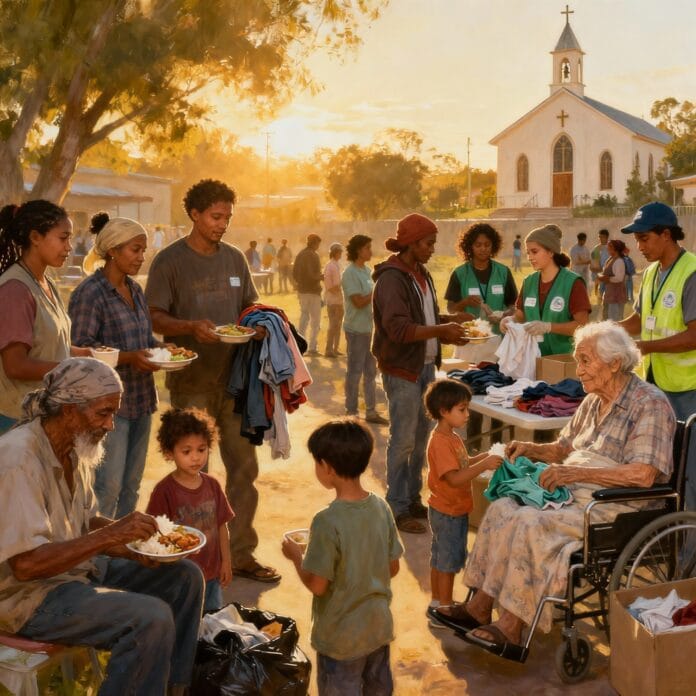
There Christian charity constitutes a fundamental pillar of faith, embodying love of others and solidarity towards the most vulnerable. Living charity Christianity in the 21st century takes on renewed importance in the face of the profound changes in our societies. This concept goes beyond the isolated act of generosity to become a daily commitment, rooted in a comprehensive vision of service and respect for others. human dignity.
Contemporary challenges are disrupting traditional practices of charity :
- Globalization leads to mass migrations that require inclusive and intercultural charity.
- Growing social and economic inequalities reveal new forms of poverty and exclusion.
- The ecological crisis imposes a new moral responsibility, linking love for one's neighbor and respect for creation.
- Societal transformations are changing human relationships, challenging traditional forms of charitable action.
Faced with these challenges, spiritual, community, and organizational resources are available to practice active and appropriate charity. These resources make it possible to combine concrete aid and human support, drawing on biblical wisdom, parish involvement, and collaboration with social actors.
In this article, you will discover the foundations, challenges, and essential resources for embodying this today. charity Christian in its integral dimension.
Biblical and ecclesial foundations of Christian charity
Charity Christian tradition draws its roots from the biblical tradition and the fundamental teachings of the Church, which emphasize the importance of’love of one's neighbor as a pillar of Christian life.
Biblical Origins of Charity
The Bible offers several key passages that form the basis of the practice of charity. The commandment "« You shall love your neighbor as yourself »(Leviticus 19:18)” is echoed by Jesus in the New Testament, particularly in the Gospel of Matthew (22:39), where he establishes this love as the second great commandment, after the commandment to love God. This injunction goes beyond a simple emotion: it commits one to an active, concrete, and selfless love for others.
The story of the Good Samaritan (Luke 10(pp. 25-37) perfectly illustrates this concept: a wounded man is rescued without distinction of origin or belief, thus embodying universal and inclusive charity. charity It then becomes a visible sign of living faith, a testimony of a God who draws near to the most vulnerable.
Church teachings on loving one's neighbor
From its beginnings, the Church has developed a social doctrine that inscribed charity at the heart of its mission. The Church Fathers and the Popes have constantly reminded us that love the next step cannot be reduced to mere one-off assistance. Saint Augustine speaks of "caritas" as an ordered love, a movement that unites the believer to God through service to others.
Modern social encyclicals — such as Rerum Novarum (1891) and Caritas in Veritate (2009) — emphasize the link between social justice and charity. The Church teaches that solidarity must lead to the transformation of unjust structures in order to promote a society where everyone finds their dignity recognized.
The historical role of solidarity in the Christian faith
Historically, charity This translated into concrete actions: the creation of hospitals, orphanages, and hospices; support for the poor and the sick; and a commitment to the rights of the marginalized. These initiatives demonstrate how faith is embodied in concrete actions in the face of human suffering.
Early Christian communities already practiced the pooling of resources (Act 2(p. 44-45), demonstrating a radical solidarity in the face of emerging inequalities. This spirit has persisted through the centuries in different forms but always with the same fidelity to the Gospel commandment.
In this biblical and ecclesial tradition you will find not only a solid moral foundation, but also a call to live an active and renewed charity in the face of current challenges.

Contemporary challenges of Christian charity in the 21st century
Globalization and mass migrations
Globalization is profoundly transforming societies, bringing people closer together while generating new challenges for charity Christian. Migratory flows, often massive and sometimes dramatic, reveal the extent of human suffering and call on the Church to live an ever more inclusive and intercultural charity.
1. Complexity of migration realities
Refugees fleeing conflict, expatriate workers seeking a better life, migrants These economic movements, in search of dignity, require a nuanced understanding of the situations in order to act appropriately. Charity can no longer be uniform; it must adapt to the various cultural, religious and social contexts encountered.
2. Inclusive charity: transcending cultural boundaries
Welcoming the stranger also means recognizing their culture and history. This requires an open-mindedness that goes beyond mere material assistance. Christian practice is enriched by respectful intercultural dialogue, embodying a love of neighbor that rejects all forms of exclusion or discrimination.
3. The challenge of global solidarity
Globalization requires a broader perspective on poverty and injustice. Economic disparities between countries are exacerbated by the movement of goods and people. Living charity Christian solidarity in the 21st century becomes a call for active solidarity that transcends national borders to respond to urgent needs in all regions of the world.
4. Concrete examples of inclusive initiatives
Several parishes and church movements have developed reception programs that integrate language support, psychological support, and social integration. These actions embody a living charity, rooted in unconditional respect for each person.
«Love one another as I have loved you» (John 15:12) guides this commitment to welcoming the other in their difference.
5. Challenges related to cultural coexistence
The coexistence of diverse populations sometimes generates social or religious tensions. Charity Christian faith must be a bridge between these worlds, promoting dialogue and peace rather than a retreat into identity politics.
6. Educational Responsibility
Informing and raising awareness among local communities about the realities of migration helps to dismantle prejudices and build genuine solidarity. This work is essential so that charity goes beyond the immediate emergency and is part of a lasting transformation of human relations.
Globalization and mass migrations are not just economic or political phenomena; they constitute a renewed call to embody a broader, deeper, more universal love of one's neighbor. Charity Christian practice must therefore evolve towards a practice capable of welcoming this human diversity with justice, compassion and respect.
The challenge is immense, but it also reveals the full spiritual richness of the Christian faith when it becomes a concrete presence among the most vulnerable in this globalized world.
Growing social and economic inequalities
Globalization has profoundly transformed economies and societies, often intensifying social and economic inequalities. These disparities create new forms of poverty and exclusion, which represent a major challenge to living charity Christian in the 21st century.
1. New forms of poverty
Poverty It is no longer limited to simple material deprivation. It now includes complex situations such as job insecurity, limited access to healthcare and education, and social exclusion linked to multiple forms of discrimination. These realities demand a charitable response capable of addressing not only immediate needs but also the root causes of these inequalities.
2. Growing social exclusion
The gap between rich and poor has widened, reinforcing cultural and economic barriers that isolate certain populations. Marginalized people often live in degraded urban environments or neglected rural areas, which complicates their social and economic integration.
3. Impact on human relationships
Globalization and migration intensify these social divisions. While migratory flows can be a source of cultural enrichment, they can also increase competition for limited resources, generating tension and rejection. Charity Christian values must therefore become inclusive and open to diversity in order to overcome these challenges.
4. Appropriate response
Live charity Christian service today requires a commitment that goes beyond occasional assistance. It involves working towards a sustainable social justice by supporting initiatives that promote the autonomy of excluded people, for example through professional or educational integration programs run by parishes or Christian associations.
The challenge posed by these inequalities invites every believer to embody an active charity, conscious of the new forms of contemporary poverty while respecting the dignity of each person in a context marked by globalization and its social impacts.
Ecological crisis and Christian responsibility
The ecological challenge is emerging as a major moral issue for charity Christian life in the 21st century. Globalization and migrations are profoundly changing human relationships, but they also highlight the global impact of human activities on the planet. Live charity Christian Christianity in the 21st Century: Challenges and Resources invites us to recognize that solidarity is not limited to people, but includes respect for creation.
L'’integral ecology, a concept promoted by several contemporary popes, closely links environmental protection to the social justice. This link reveals that ecological degradation primarily affects the most vulnerable, who are often victims of the consequences of the overexploitation of natural resources. The ecological crisis thus becomes an urgent call to combine love for one's neighbor with care for our common home.
Some key points to consider:
- Unconditional respect for creation : Charity Christian values are committed to protecting not only human beings but also everything that constitutes the natural world.
- Climate justice as a moral issue : The phenomena linked to climate change exacerbate social inequalities, requiring a charitable response that integrates these dimensions.
- Intergenerational solidarity Christian responsibility extends to future generations, implying sustainable management of earth's resources.
- Community Commitment to the Environment Parishes and church movements play an active role in raising awareness and taking concrete action in support of...’integral ecology.
This approach offers a new perspective on charity Christian, where respect for creation becomes inseparable from service to the poorest. Thus, it is not simply a matter of providing occasional aid in the face of human suffering, but a profound commitment that takes into account ecological issues as an essential moral challenge in a world marked by globalization and migration.
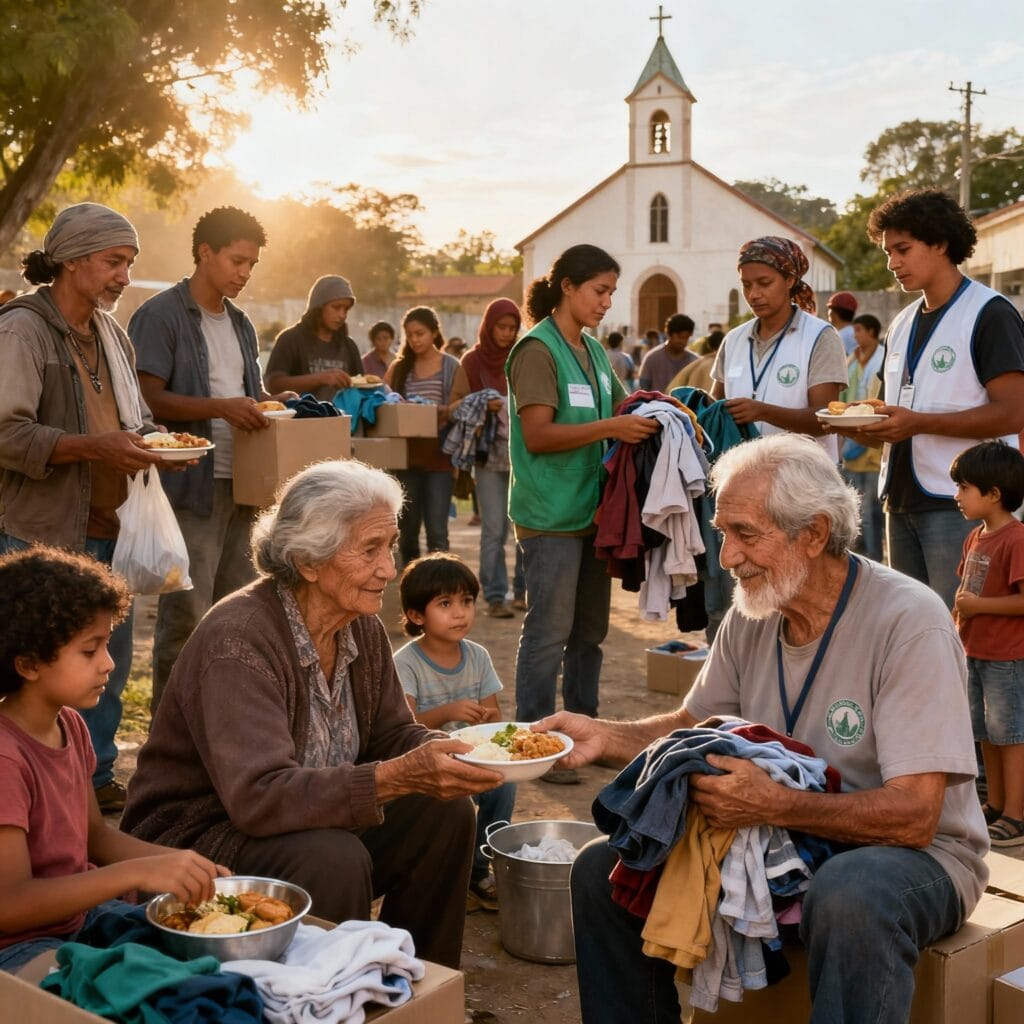
Societal transformations and evolving lifestyles
Globalization and migration are profoundly altering human relationships, introducing new dynamics in living together. These phenomena accelerate cultural exchanges, but they also amplify a feeling of isolation linked to the growing individualism in our contemporary societies.
Impact of societal transformations on charity Christian:
- Reinforced individualism Traditional community ties are weakening in the face of a culture that values personal success and autonomy. This evolution makes solidarity more difficult, as everyone focuses more on their own needs.
- Social media explosion : traditional forms of local solidarity are sometimes replaced by more ephemeral or virtual relationships. Charity Christians must therefore rethink their methods of action in order to reach these fragmented realities.
- Increased cultural diversity Migration creates diverse environments where multiple identities coexist. Living charity Christianity in the 21st century requires an intercultural openness capable of overcoming prejudices and welcoming the other in their difference.
To meet these challenges, charitable practices must adapt by:
- Promoting spaces for interpersonal dialogue that rebuild social bonds despite individualism.
- Promoting inclusive charity that takes into account diverse migratory journeys and multiple cultural heritages.
- By multiplying local initiatives that encourage active cooperation between residents, migrants and church actors.
The challenge is twofold: it requires combining respect for individual differences with a firm commitment to building a vibrant and supportive community. Thus, charity Christianity continues to be an essential lever to counter the destructive effects linked to societal transformations while embodying a love of neighbor adapted to current realities.
Spiritual resources for living charity today
The spiritual richness of the Christian faith
Charity Christianity draws its strength from a rich spiritual tradition that nourishes the daily commitment of believers. This primary source rests on several essential pillars: the prayer, THE sacraments and community life within the parishes.
- Prayer It constitutes a vital foundation. It is not limited to a request for external help, but becomes an act of openness of heart, a willingness to listen and to allow oneself to be transformed inwardly. Through prayer, you develop a deeper love for your neighbor, which motivates you to take concrete action in favor of the most vulnerable.
- THE sacraments, The Eucharist and Reconciliation, in particular, are also powerful sources of grace and renewal. The Eucharist unites the community in one body, reminding us that every person deserves respect and dignity. The Sacrament of Reconciliation invites us to personal conversion, essential for embodying sincere and authentic charity.
- THE local communities, embodied in particular by the parishes, play an irreplaceable role in this charitable dynamic. They are often the first place where this is expressed love of the next generation through concrete actions.
«"The parish is not just a place of worship; it is a family where everyone shares their joys, sorrows, and resources to help the most vulnerable."»
Concrete examples clearly illustrate this vitality:
- In several urban parishes, mutual aid groups have formed around specific missions: food distribution, educational support for disadvantaged children, visits to isolated or sick people.
- Some communities have launched training workshops aimed at raising awareness among the faithful about current social issues while offering practical skills (budget management, literacy), thus enabling charity that liberates sustainably.
- Intergenerational initiatives promote social connection between young and old, combating the growing isolation in our modern societies.
These actions are not merely isolated incidents; they are part of a profound commitment to living solidarity as a way of life rooted in faith. parishes They thus become spaces where spirituality is manifested through concrete service.
You can see that this community dimension It also stimulates personal commitment. By acting collectively, members find support and encouragement to persevere despite the difficulties encountered in their charitable mission.
The spiritual resources offered by the Christian faith promote a balanced commitment between interiority And external action :
- An inner life nourished by regular prayer and the sacraments ;
- External action supported by a vibrant and united community.
This symbiosis is essential to respond effectively to the demands of 21st-century Christian charity. You are therefore invited to draw upon these spiritual resources to renew your perspective on those you accompany and to fully live out this call to love your neighbor.
Community engagement within parishes and ecclesial movements
Community involvement in parishes and church movements is an essential lever for living charity Christian today. Prayer plays a fundamental role as a constant source of support for charitable work. It nourishes faith, strengthens solidarity, and provides moral support to those who dedicate themselves to serving the most vulnerable.
The sacraments, The Eucharist and Reconciliation, in particular, provide essential moral strength. They allow believers to draw upon divine grace to persevere in the face of the challenges of Christian social work. This spiritual dimension gives the commitment a depth that transcends material assistance, by valuing the dignity of each person.
The work Networking is crucial to maximizing the charitable impact of Christian communities. Parishes regularly collaborate with humanitarian organizations and civil NGOs to broaden their scope of action. This cooperation fosters comprehensive support for people in need, combining local resources and specialized expertise.
Several key points illustrate this dynamic:
- Proliferation of local initiatives : sharing groups, integration workshops, visits to the sick.
- Sustainable Partnerships : regular exchanges with NGOs to coordinate field actions.
- Continuing education raising awareness among volunteers of the social doctrine of the Church and contemporary social realities.
This collective commitment within the parishes reflects a concrete desire to embody love of the neighbor at the very heart of Christian communities. It promotes active, structured charity adapted to the challenges of the 21st century, where spirituality and social action combine to transform lives.
Collaboration with humanitarian and social associations
Charity Christian life is enriched by close collaboration between parishes, ecclesial movements, and humanitarian and social organizations. This synergy makes it possible to go beyond occasional assistance to aim for a sustainable social justice founded on sound ethical principles.
THE key principles which guide this collaboration include:
- Respect for human dignity, by welcoming each person without discrimination or judgment.
- Promoting active solidarity, which encourages everyone to contribute according to their abilities.
- Support for sustainable initiatives, promoting autonomy rather than dependence.
- Commitment to transforming unjust structures, in accordance with the social doctrine of the Church.
There prayer plays a central role in this context, providing spiritual support to charitable work. It nourishes patience, The perseverance and hope that are essential in the face of complex social challenges. sacraments offer a profound moral strength, anchoring community engagement in a living spiritual dimension.
Working with civil society organizations also allows access to specialized skills and a better understanding of local and international realities. This cooperation fosters a respectful dialogue between faith and social action, strengthening the overall impact of charity Christian woman in service of the common good.
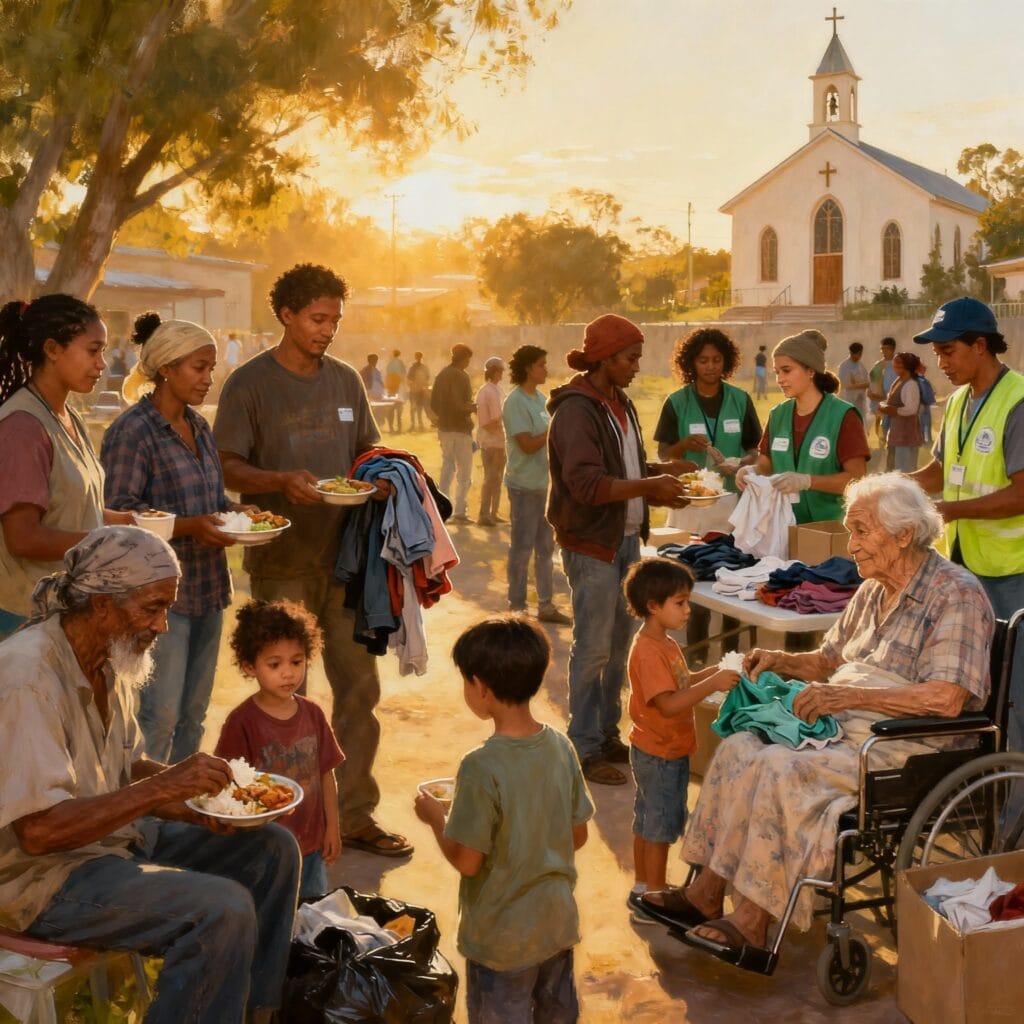
A holistic approach to Christian charity today
Combining material aid and psychological support
Charity Christianity in the 21st century cannot be limited to a simple distribution of material aid. It requires a holistic approach which considers both the physical and emotional needs of each person being helped. This approach is based on the recognition of the human dignity complete, respected unconditionally.
Charitable actions must therefore combine:
- Material aid Food, clothing, shelter, medical care, and access to essential services are fundamental to ensuring the immediate survival and well-being of people in need.
- Psychological support Moral support, attentive listening, a caring presence, and encouragement to regain confidence in oneself and the future. This aspect is crucial in helping people overcome trauma related to poverty, exclusion or precariousness.
This dual approach avoids reducing the individual to a mere recipient of assistance; it restores their role as an active participant in their own life. Assistance then becomes a means of...’empowerment, promoting a path towards autonomy.
«"« Charity A true fish doesn't just give you the fish, it also teaches you how to fish.»
Respect the human dignity integral also implies:
- To adopt an attitude of non-judgment and unconditional acceptance.
- To take into account personal histories in order to better understand the root causes of the difficulties encountered.
- To offer a stable and reassuring presence that demonstrates love fraternalism advocated by the Gospel.
Those working in the charitable sector are often confronted with complex situations where material suffering and psychological wounds are intertwined. Their role therefore goes beyond simple, one-off gestures; they are called upon to become agents of inner and social reconciliation.
Concrete initiatives illustrate this comprehensive approach:
- Parishes are organizing support groups for isolated individuals while also distributing food parcels.
- Pastoral teams combining home visits with personalized spiritual guidance.
- Partnerships between social services and chaplaincies to offer comprehensive support tailored to specific needs.
Live charity Christianity in the 21st century thus requires constant adaptation to diverse human realities, with the ultimate goal of absolute respect for every human being in all their dimensions. This vision invites us to move beyond the traditional model of assistance to build a lasting solidarity based on listening., compassion active and a deep commitment to serving others.
The simultaneous consideration of material aid and psychological support constitutes an essential pillar to meet current challenges while fully embodying Gospel values in our contemporary societies.
Promoting human dignity in all its dimensions
Charity Christian aid is not limited to simply distributing material assistance or providing occasional psychological support. It aims at integral human dignity, that is to say, the recognition and respect of the person in all their dimensions: physical, moral, social and spiritual.
You are invited to live charity on a daily basis, not only through visible actions but also through a consistent attitude of’brotherly love. This implies:
- Comprehensive support for vulnerable people, combining concrete help (food, shelter, care) and attentive listening which values their voices and experiences.
- Taking into account deep, often invisible needs, such as the need for recognition, respect and belonging.
- The refusal to reduce aid to mere occasional assistance; it is rather about supporting towards autonomy and social reintegration.
This holistic approach aligns with Christian teaching centered on the commandment to love one's neighbor as oneself. Living charity Christian life in the 21st century: challenges and resources translate into a daily commitment that transcends institutions and isolated actions. Every gesture, every word can contribute to restoring the dignity of those being helped.
This path requires seeing beyond appearances and immediate needs to understand the person in their entirety. We then understand the promotion of human dignity is a fundamental pillar of any genuine charitable endeavor.
«"« Charity is a love that manifests itself in concrete actions towards those who suffer" — this appeal invites everyone to embody this brotherly love wherever possible.
The balance between material aid and psychological support thus becomes an essential lever for asserting this human dignity integral, cornerstone of a living and responsible charity.
Conclusion
The current challenge of charity Christian faith demands a lasting commitment, founded on a strong alliance between faith and action. You are invited to embody this call in your daily life, going beyond simple, one-off gestures to build a truly united future.
Live charity Christian Christianity in the 21st Century: Challenges and Resources This involves recognizing the complexity of contemporary challenges while drawing on the spiritual and communal richness offered by the Christian tradition. This path requires:
- A constant fidelity to the values of love for one's neighbor and of social justice ;
- A creative adaptation to changing realities such as globalization, migrations or the ecological crisis; ;
- Active collaboration between parishes, church movements and humanitarian associations to maximize impact.
In this way, you can contribute to building a society where every person is respected in their dignity, where solidarity does not remain an abstract ideal but becomes a living practice. This profound commitment is the means by which charity Christian values remain relevant and necessary today.
«"To love is to act": this maxim guides your path towards authentic charity, rooted in hope and turned towards the future.
Frequently Asked Questions
What is Christian charity and why is it important in the 21st century?
Charity Christian faith is the concrete expression of love for one's neighbor, founded on biblical and ecclesial teachings. In the 21st century, it remains essential for responding to contemporary challenges such as globalization, migration, and social inequalities, by promoting active and inclusive solidarity.
What are the main contemporary challenges that Christian charity faces today?
Major challenges include globalization and mass migrations requiring intercultural charity, and growing social and economic inequalities generating new forms of poverty, the ecological crisis which calls for a Christian responsibility towards creation, as well as societal transformations marked by increasing individualism.
How does globalization influence the practice of Christian charity?
Globalization profoundly impacts human relations by increasing migration flows and exacerbating inequalities. It therefore necessitates an adaptation of charitable practices towards greater inclusivity and intercultural openness in order to effectively address these complex realities.
What role does the Christian faith play in supporting charitable work today?
Christian faith offers an indispensable spiritual wealth to charity active. Prayer morally supports charitable engagement, while the sacraments They provide spiritual strength. Furthermore, community involvement within parishes energizes these actions through concrete initiatives.
How do parishes and ecclesial movements participate in living out Christian charity in the 21st century?
Parishes and church movements play a central role in mobilizing their local communities around charitable actions. They foster collective engagement, organize concrete solidarity initiatives, and offer a supportive spiritual framework through prayer and the sacraments.
What does Christian responsibility consist of in the face of the current ecological crisis?
Christian responsibility in the face of the ecological crisis is manifested through respect for divine creation, integrating ecology integral to the practice of charity. This implies a moral commitment to protecting the environment as a concrete expression of love for one's neighbor and for God.