













Reading from the book of Ben Sira the Wise
In those days, the prophet Elijah appeared like a fire, his word burned like a flame. He brought famine upon Israel, and in his zeal reduced them to a few. By the word of the Lord, he withheld the rains from heaven, and three times he made fire fall from them. How awesome you were, Elijah, in your wonders! Who could claim to equal you?
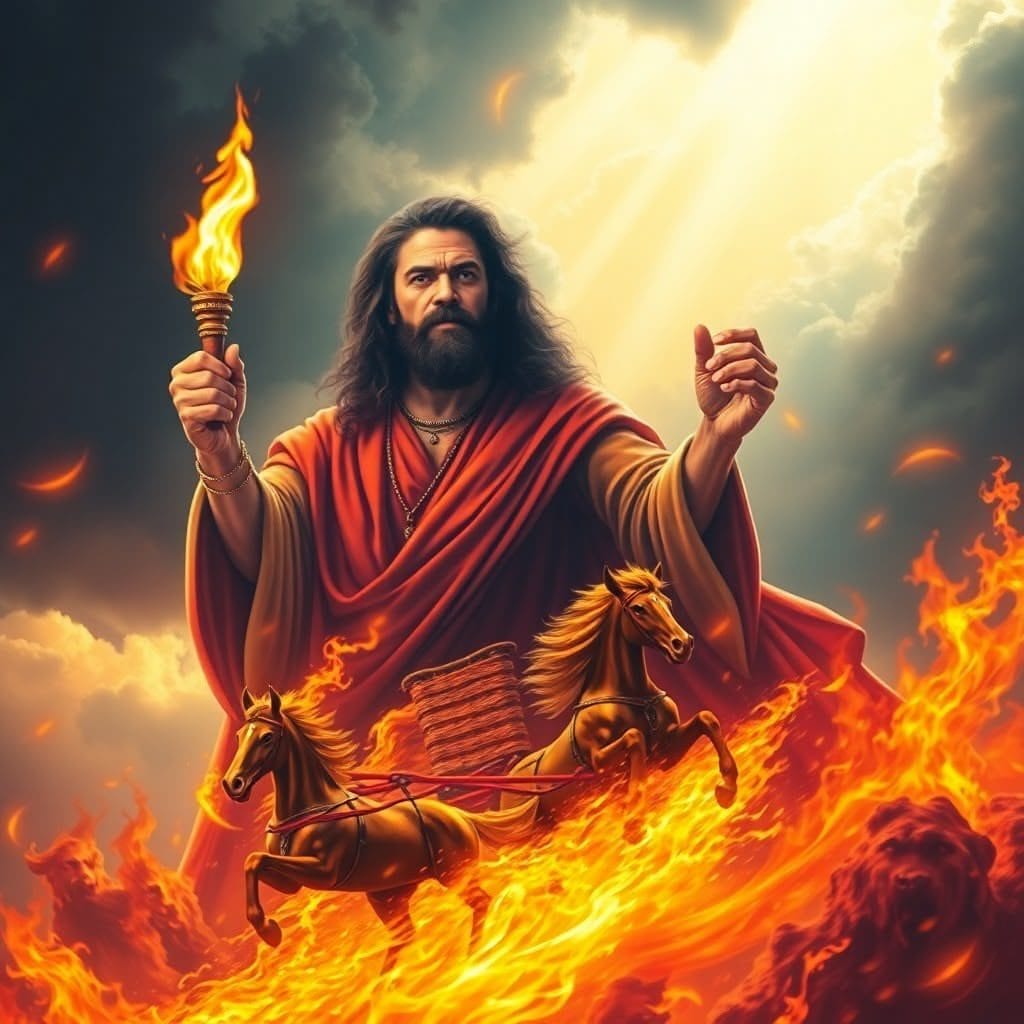
You who were carried away in a whirlwind of fire by a chariot with horses of fire; you who were destined for the end of time, according to what is written, in order to appease the wrath before it explodes, in order to turn the hearts of the fathers to the sons and to restore the tribes of Jacob… blessed are those who will see you, blessed are those who, in love, have fallen asleep; we too shall possess true life.
When the prophet of fire returns to reconcile the world
The return of Elijah in biblical tradition: a promise of restoration to prepare for the end times and reconcile divided generations.
The prophet Elijah occupies a unique place in the biblical and spiritual imagination. Unlike other prophets, he did not die but was taken up to heaven in a whirlwind of fire. This exceptional destiny has fueled the hope for centuries of his return to prepare for the coming of the Messiah. Book of Ben Sira the Wise, Written in the second century BCE, this text celebrates Elijah, a prophetic figure who highlights not only his past miracles but also his future mission. It connects Elijah's prophetic zeal to an eschatological calling: to appease divine wrath, reconcile fathers and sons, and restore Israel. This promise still resonates today for all who seek peace, reconciliation and hope in a divided world.
We will first explore the historical and spiritual context of this text from Ben Sira before analyzing the prophetic figure of Elijah as a purifying fire. We will then delve into three essential dimensions: the mission of intergenerational reconciliation, eschatological preparation, and the link with messianic hope. We will see how the Christian tradition has received this promise through John the Baptist and the Transfiguration, before proposing concrete ways to embody this spirit of fervent reconciliation today.
The Prophet Awakening: Context and Scope of Ben Sira's Text
THE Ben Sira's book, The Book of Sirach, also known as Ecclesiasticus, is one of the last surviving examples of Jewish wisdom before the Christian era. Written around 180 BCE in Jerusalem and later translated into Greek by the author's grandson, this book attempts to maintain loyalty Ben Sira, writing in a context where Jewish identity was threatened by cultural assimilation and internal divisions weakened the community, offered a synthesis of traditional wisdom and reflection on salvation history. His work explores the Torah in the face of the growing influence of Hellenistic culture.
Chapters 44 to 50 of the book form what is known as the Praise of the Fathers, a gallery of portraits of the great figures of Israel from Enoch to the high priest Simon. This section celebrates loyalty God's presence is manifested through the men he chose to guide his people. Elijah appears in this gallery as a transitional figure between the ancient prophets and eschatological hope. His presentation occupies a strategic position because it connects Israel's glorious past to its messianic future.
The text opens with a striking image: Elijah bursts forth like a fire. This metaphor is not merely poetic. It captures the very essence of the prophetic ministry as it appears in the Books of Kings. Elijah embodies the word of God in its most ardent, radical, and transformative form. Faced with the idolatry of King Ahab and Queen Jezebel, who had imported the worship of Baal into Israel, Elijah stands as a bulwark of fire. His word burns like a torch because it tolerates no compromise with spiritual falsehood.
The three wonders mentioned by Ben Sira refer directly to the stories of the First Book of Kings. The famine corresponds to the three-and-a-half-year drought that Elijah announced to King Ahab as punishment for the nation's apostasy. Withholding the waters of heaven demonstrates God's absolute power over creation in the face of Baal, the self-proclaimed god of fertility and rain. Calling down fire three times particularly evokes the episode on Mount Carmel where divine fire consumes the burnt offering and confounds the prophets of Baal, but also the two occasions when Elijah calls down fire from heaven against the soldiers sent to arrest him. These dramatic interventions are not intended to glorify the prophet but to demonstrate the unique sovereignty of the God of Israel.
The phrase "awesome in your wonders" underscores the terrifying dimension of this divine manifestation. Elijah inspires awe because he reveals a jealous God who cannot tolerate the infidelity of his people. This awe is not servile fear but sacred respect before the holiness divine. No one can boast of being Elijah's equal, for his calling transcends all human measure. He is the man of God par excellence, the one whose entire life becomes transparent to the divine will.
The second part of the text marks a decisive temporal shift. Ben Sira moves from past exploits to the future mission. Elijah's ascension in the chariot of fire is not an end but a beginning. The prophet was prepared for the end times. This formulation is based on the final oracle of the prophet Malachi, who foretold the sending of Elijah before the great and dreadful day of the Lord. Ben Sira reiterates this tradition, specifying the threefold mission of the prophet who will return: to appease divine wrath before its unleashing, to turn the hearts of the fathers back to their children, and to restore the tribes of Jacob.
This eschatological calling transforms Elijah into a figure of hope. He returns not merely to judge, but first and foremost to reconcile and restore. The divine wrath in question is not a celestial whim, but God's legitimate response to the evil that is destroying his people. Appeasing this wrath means creating the conditions for genuine conversion, allowing the people to return to their God before it is too late. It is a work of preemptive mercy, a final call to conversion before the judgment.
The text ends on a double beatitude that already engages the reader in messianic hope. Blessed are those who see you, the prophecy. joy of the generation that will welcome the return of Elijah and thus the dawn of the Messianic age. Blessed are those who have fallen asleep in love; this beatitude extends to all the righteous who will have died before that glorious day. The love in question refers to the fraternal charity And loyalty to the covenant. These righteous people are not excluded from the promise, for we too will possess true life. Ben Sira thus affirms a form of resurrection or participation in eternal life for the faithful of all generations.
Prophetic fire as transformative word
The image of fire permeates the entire text of Ben Sira and structures its understanding of Elijah. This incandescent metaphor reveals the very nature of authentic prophetic speech. Fire possesses several properties that illuminate the prophetic mission. It burns away what is corrupt, purifies what can be purified, illuminates the darkness, warms what is cold, and transforms whatever matter it touches. Elijah embodies all these dimensions of spiritual fire.
Elijah's words burn like a torch because they reject lukewarmness and compromise. Faced with the widespread idolatry under Ahab's reign, the prophet offers no weak consensus but issues a radical challenge. On Mount Carmel, he directly addresses the people: how long will you waver between two opinions? If the Lord is God, follow him; if Baal is God, follow him. This stark choice forces everyone to choose sides. The fire that descends from heaven and consumes the burnt offering provides an unequivocal divine answer. The Lord is God; there is no other.
This fiery word brings about a merciless sorting. Ben Sira notes that Elijah reduced Israel to a small number in his zeal. The expression may seem harsh, but it corresponds to the biblical dynamic of the rest. The prophet does not seek quantitative success, but loyalty Qualitative. A small number of true believers is better than a lukewarm and faithless crowd. This forced reduction, brought about by famine and hardship, purifies Israel as fire purifies gold of its impurities. Tragic events become divine pedagogy, bringing the people back to the essence of their calling.
Elijah's fire also manifests God's jealousy. This theological term does not refer to a petty sentiment but to the exclusive love that God demands of his people by virtue of the covenant. Just as a husband cannot tolerate his wife's infidelity, God cannot accept that Israel prostitute itself with idols. Elijah's prophetic anger expresses this divine jealousy. Paradoxically, it reveals the depth of God's love for his people. We only become angry about what truly matters. Indifference would be a sign of definitive abandonment. Elijah's burning anger therefore testifies that God has not abandoned Israel, that he continues to fight for them.
This dimension of purifying fire prepares the eschatological mission announced in the second part of the text. Elijah must return to appease the wrath before it erupts. This formulation seems paradoxical. How could the one who embodied divine wrath appease it? The answer lies in the distinction between two prophetic moments. In his first historical coming, Elijah manifests wrath to provoke conversion. In his eschatological coming, he offers a final chance for conversion before the final judgment. The burning fire becomes a purifying fire. The same prophetic energy changes direction: it no longer comes to consume the rebels but to prepare hearts to receive salvation.
This transformation of the prophetic function is rooted in mercy divine. God does not take pleasure in the death of the sinner but desires that he or she repent and live. Elijah's return before the Day of the Lord manifests this universal will for salvation. Jewish tradition has developed this hope by imagining various ways in which this return might occur. Some rabbinic texts present it as resolving outstanding halakhic disputes, while others describe it as announcing the resurrection Some see him as the one who reunites the opposing factions within the people, while others see him reconciling them. All these traditions converge on the same intuition: Elijah is the agent of final reconciliation, the one who prepares the ground for the coming of the Kingdom.
Elijah's fire challenges our own relationship to prophetic words. Are we capable of hearing words that burn, that disturb, that question our compromises? Or do we prefer a comfortable religion that demands nothing and transforms nothing? The Church has always needed prophetic figures to awaken it from its slumber. The saints who marked their era often carried this spiritual fervor that leaves no one indifferent. François of Assisi embracing poverty radical, Catherine of Siena challenging the popes, Teresa of Avila Reforming the Carmel, Charles de Foucauld making himself the last among the last: so many prophetic fires rekindled by the torch of Elijah.
Reconciling the generations: the prophet's primary mission
Elijah's central task for the end times is to turn the hearts of the fathers back to their sons. This enigmatic formula deserves close attention because it touches on a fundamental dimension of the human crisis. The rupture between generations is a recurring symptom of social and spiritual disintegration. When fathers and sons turn away from one another, the entire transmission collapses, all continuity is broken, and all collective identity is lost.
In Ben Sira's immediate context, this statement resonates with particular force. Second-century BCE Judaism was facing a crisis of transmission linked to Hellenization. The younger generations, seduced by Greek culture, were turning away from ancestral traditions. The fathers, attached to the Torah and customs, no longer understood their sons, drawn to gymnasiums, theaters, and Greek values. This generational divide threatened the very identity of the Jewish people. Ben Sira perceived that only a major prophetic intervention could reverse this deadly dynamic.
The phrase "bringing the hearts of fathers back to their sons" suggests that the initiative for reconciliation will come from the fathers. It is not primarily up to the sons to return to their fathers, but rather for the fathers to turn to their sons. This nuance is extremely important. It implies that elders bear a particular responsibility in this transmission. If the sons turn away, it may be because the fathers failed to transmit what was worth receiving. Perhaps they confused living tradition with mechanical repetition. Perhaps they imposed burdens without showing joy and the freedom that it provides loyalty to the alliance.
The return of the heart does not refer to a simple external correction of behavior but to a profound inner transformation. In biblical anthropology, the heart represents the center of the person, the seat of fundamental decisions and directions. Bringing the hearts of fathers back to their sons therefore means creating the conditions for a true encounter, for mutual listening, for reciprocal understanding. Fathers will have to abandon their rigidity and severity to rediscover tenderness. Sons will have to overcome their rebellion and indifference to rediscover the treasures of tradition.
This mission of intergenerational reconciliation has an eschatological dimension. It aims not only to resolve social tensions but also to restore the order God intended for humanity. Divine blessing has been passed down from generation to generation since Abraham. Each generation receives the inheritance of the promise and must faithfully transmit it to the next. When this chain breaks, the divine plan itself is threatened. The coming of Elijah guarantees that this break will not be permanent, that God himself will intervene to reconnect the threads of this transmission.
Rabbinic tradition has long pondered this mission of Elijah. The Talmud teaches that Elijah will resolve all outstanding issues, arbitrate all unresolved conflicts, and identify questionable lineages. This function of arbiter and reconciler extends his historical role. Already in the Books of Kings, Elijah appeared as the one who decides, who makes the final judgment, who establishes the truth. But while in the time of Ahab he decided by fire and judgment, in the end times he will decide by reconciliation. peace.
This vision of Elijah as a reconciler powerfully resonates with our times. Contemporary generational divides are taking on new forms. Generations succeed one another at an accelerated pace, each with its own codes, references, and modes of communication. Parents often feel overwhelmed by this world. digital of their children. Young people perceive inherited institutions as obsolete and stifling. The generation gap no longer concerns only values but touches upon the very forms of social and cultural existence.
In the ecclesiastical sphere, these tensions manifest themselves with particular intensity. The transmission of faith Christianity is experiencing an unprecedented crisis in Western societies. Many Catholic parents are saddened to see their children abandon all religious practice. Conversely, conversions or spiritual awakenings are occurring among young people whose parents are indifferent or hostile to it. Christianity. These generational divides in faith They raise heart-wrenching questions about transmission, freedom, and parental responsibility.
Bringing the hearts of fathers back to their sons requires a considerable effort of listening and empathy today. The older generations in the Church must accept that younger generations live their faith differently, with different sensitivities and different forms of expression. The new generations of Catholics rediscovering tradition may be tempted by rigidity and judgment toward those who have lived the Vatican II Council unlike them. Elijah's prophecy consists precisely in transcending these sterile oppositions to build bridges between the ages.
Restoring the Tribes of Jacob: Community Restoration
The third mission entrusted to Elijah, according to Ben Sira, is to restore the tribes of Jacob. This task extends and broadens intergenerational reconciliation to a community dimension and national. The twelve tribes of Israel symbolize the original unity of God's people, as it existed in the time of Moses and of Joshua. But this unity had gradually disintegrated. The schism after Solomon had divided the kingdom into two rival entities: Israel in the north and Judah in the south. The Assyrian deportation had scattered the ten northern tribes, who never returned. Only Judah and Benjamin still constituted an identifiable entity in the time of Ben Sira.
Restoring the tribes therefore means reconstituting the broken unity, gathering the scattered, and restoring the communal integrity of Israel. This hope permeates all of prophetic literature. Ezekiel had envisioned the twelve tribes reunited around the rebuilt temple. Jeremiah had foretold the gathering of the exiles from the ends of the earth. This restoration is not a matter of nostalgic yearning for the past, but rather expresses the expectation of divine intervention that will finally and fully fulfill the promises of the covenant.
Elijah's mission is part of this dynamic of eschatological gathering. His return will mark the beginning of the restoration process. This is not simply a return to the old order, but a new recomposition of God's people. The tribes will not be restored identically to what they were in the past, but according to a new order corresponding to the Messianic Reign. This restoration implies both continuity with sacred history and radical newness brought about by the decisive divine intervention.
This hope for communal restoration has several complementary dimensions. First, a political and territorial dimension: the Jewish people will regain their full sovereignty over the promised land, and all the tribes will once again occupy their ancestral territories. Second, a social dimension: internal divisions and conflicts will be resolved, and justice and peace will reign in mutual relations. Finally, a spiritual dimension: the entire people will return to unwavering fidelity to their God; idolatry and infidelity will definitively belong to the past.
Ben Sira, writing in the second century BCE, was obviously unaware that this promise would find an unexpected fulfillment in the messianic community founded by Jesus. But his text prepares for this new development by emphasizing the eschatological and universal nature of the anticipated restoration. The restoration of the tribes of Jacob concerns not only the Jewish people but also foreshadows the gathering of all humanity into the Kingdom of God.
Christian tradition has reinterpreted this promise in the light of the Pascal's mystery. The twelve apostles chosen by Jesus symbolically correspond to the twelve tribes of Israel. They constitute the foundation of the new Israel, the Church assembled from all peoples. Pentecost manifests the beginning of this universal restoration: the poured-out Spirit creates a new people that transcends ethnic, linguistic, and cultural divisions. The tribes of Jacob are restored in and through the community of Christ's disciples, which becomes the new people of God, open to all nations.
This Christian reinterpretation does not nullify the promise made to Israel but fulfills it in an unexpected fullness. The restoration of the tribes finds its ultimate meaning in the reconciliation of divided humanity. What was promised to Jacob is revealed as promised to all of Adam. The particularity of Israel's election served to prepare for the universality of salvation. Elijah, prophet of Israel, thus paradoxically becomes the prophet of Catholic unity, the one who gathers together what was scattered.
This vision of restoration challenges the contemporary divisions that are tearing apart the ecclesiastical body. Christians Divided into multiple denominations, they have not yet visibly achieved the unity desired by Christ. Catholics themselves experience internal tensions that weaken their communion. Theological, liturgical, and pastoral divisions create tribes that sometimes regard one another with mistrust or hostility. Elijah's ministry today would consist of fostering this intra-ecclesial reconciliation, building bridges between diverse sensibilities, and reminding everyone that unity in diversity constitutes the authentic mark of the people of God.
The restoration does not mean uniformity but organic communion. The twelve tribes each retained their own identity, territory, and characteristics. But together they formed one people in the service of the same God. Similarly, the Catholic Church welcomes a legitimate diversity of charisms, spiritual traditions, liturgical expressions, and theological sensibilities. This plurality enriches the ecclesial body, provided it does not degenerate into divisions. The spirit of Elijah urges us both to loyalty uncompromising on the fundamentals faith and to the generous openness towards the diverse expressions of this unique faith.
Appeasing divine wrath: prophetic mediation and mercy
The most mysterious and profound dimension of Elijah's eschatological mission lies in his role of appeasing God's wrath before it erupts. This formulation immediately raises complex theological questions. How can we understand God's wrath without resorting to crude anthropomorphism? In what sense could a prophet appease God? Is not the God of Jesus Christ pure mercy, needing no appeasement?
Divine wrath, in biblical language, does not refer to an irrational passion or a divine whim, but to the legitimate reaction of the holiness God cannot remain indifferent to evil, injustice, violence, oppression, and lies. His anger expresses his absolute rejection of the evil that destroys his creatures. Paradoxically, it manifests his love for humanity. A God who never became angry in the face of evil would be an indifferent God, therefore a God who did not truly love. Divine anger stems from his jealous love for his people and for all humanity.
This anger, however, is never God's final word. Prophetic tradition constantly emphasizes that God does not delight in punishing but always seeks to save. Threats of judgment are intended to provoke conversion, not to satisfy divine vengeance. The day of the Lord's wrath, often mentioned by the prophets, represents the moment when patience Divine power reaches its limits, where accumulated evil calls for radical purification. But even on this dreadful day remains open to mercy for those who convert.
Elijah's mission to appease the anger before it erupts is part of this dialectic between justice and mercy. The prophet acts as a mediator between God and his people. He does not change divine will through some kind of religious magic. Rather, he creates the human conditions that allow mercy to practice. By bringing about the conversion of hearts, by reconciling generations, by restoring the community, Elijah makes it possible forgiveness divine. He appeases anger not by arbitrarily suppressing it but by suppressing its cause, namely the sin and infidelity of the people.
This understanding of prophetic mediation illuminates the figure of Christ as the unique and definitive mediator. Jesus infinitely fulfills what Elijah foreshadowed. He appeases God's wrath not through words or rituals but through the total gift of himself. By taking upon himself the sin of the world and bearing it in his death, he eliminates the cause of divine anger. By rising from the dead, he demonstrates that mercy definitively prevails over judgment. From now on, the day of anger has become the day of grace for all those who welcome the salvation offered in Christ.
But this definitive victory of mercy This does not, however, eliminate the need for ongoing conversion. The Church lives between the "already" and the "not yet" of redemption. She fully benefits from the salvation won by Christ, but she must constantly make it present in history by calling people to conversion. Prophets remain necessary to awaken slumbering consciences, denounce tolerated injustices, and remind people of the demands of the Gospel. The spirit of Elijah remains active in all those who dare to speak the truth, even when it is unsettling.
This authentic prophetic word always combines firmness and mercy. It denounces evil without complacency but calls for conversion with hope. It does not condemn individuals but combats the structures of sin. It manifests God's wrath in the face of injustice while opening the path to reconciliation. This tension constitutes the heart of Christian prophecy. Too much firmness without mercy degenerates into Pharisaical rigorism. Too much mercy without firmness falls into laxity, which allows evil to flourish. Elijah's balance consists of burning like a fire while preparing for appeasement.
The contemporary application of this mission of appeasement concerns many areas. In a society torn apart by polarizations In ideological climates, where each side demonizes the other, the spirit of Elijah would call for reconciliation without relativism. In a Church tempted either by rigid conservatism or by rootless progressivism, Elijah's prophetic message would maintain both loyalty to tradition and openness to the signs of the times. In a world threatened by religious violence, the figure of Elijah could inspire a interreligious dialogue which does not sacrifice either identity or respect for others.
The spiritual legacy: Elijah in the patristic and liturgical tradition
The Church Fathers meditated extensively on the figure of Elijah and developed a rich spiritual and typological interpretation of his mission. For Origen, one of the first great Christian theologians, Elijah represents the contemplative life in its radical form. The prophet who withdraws to the Kerith brook and then to Horeb embodies the Christian who flees the tumult of the world to dedicate himself entirely to God. But this flight is not an escape: it prepares the return to the world with a purified and authentic word. Elijah's solitude thus becomes the model of the monastic life nascent.
Saint Jerome, in his letters, presents Elijah as the prototype of the monk who renounces riches and comfort to embrace poverty radical. Elijah's hair cloak, his frugal diet, his renunciation of family ties foreshadow monastic vows. But Jerome also emphasizes the prophetic dimension of monasticism: monks do not flee the world out of misanthropy but to better challenge it through their witness of life. Like Elijah, they must be salt that gives flavor and light that shines in the darkness.
Saint John Chrysostom develops a moral and ascetic interpretation of Elijah. The prophet's struggle against Jezebel and the prophets of Baal symbolizes the spiritual battle that every Christian must wage against contemporary idols. Idolatry is not limited to the worship of pagan statues but encompasses all forms of disordered attachment to wealth, power, and pleasure. The fire that Elijah calls down from heaven represents the Holy Spirit, which must consume within us all that resists God. Elijah's prayer on Mount Carmel becomes the model of persevering and trusting prayer.
Saint Gregory of Nyssa offers a mystical interpretation of Elijah's ascension. The chariot of fire that carries the prophet symbolizes the soul's ascent to God through contemplation and love. Elijah did not experience death because he had already transcended earthly realities through his union with God. This interpretation inspires the entire Christian mystical tradition, which sees in Elijah's ascension a prefiguration of humanity's divinization, of its progressive transformation until it becomes a participant in the divine nature.
Christian liturgy gives Elijah an important place, particularly in Eastern traditions. The Orthodox Church solemnly celebrates the feast of the prophet Elijah on July 20th. This feast commemorates not only the historical prophet but also anticipates his eschatological return. Liturgical hymns sing of Elijah as the forerunner of Christ, as a model of prayer, and as a powerful intercessor. The Orthodox people readily invoke Saint Elijah during times of drought, remembering his power over the natural elements.
In the Latin tradition, the figure of Elijah particularly inspires the Carmelite order, which claims him as its spiritual father. The Carmelites see in the prophet who withdrew to Mount Carmel the founder of the contemplative life. Their spirituality combines solitude and service, contemplation and action, fidelity to tradition and prophetic openness. Saint Teresa of Avila and holy John of the Cross, The Carmelite reformers of the sixteenth century constantly referred to Elijah as a model. They revived his prophetic zeal in a context of ecclesiastical crisis.
The presence of Elijah in the Transfiguration has inspired countless patristic meditations. Along with Moses, Elijah appears conversing with the transfigured Jesus on the mountain. This scene reveals that the Law and the Prophets, represented by Moses and Elijah, find their fulfillment in Christ. But it also announces that the righteous of the Old Covenant already share in the glory of the Risen One. Elijah and Moses have not vanished into nothingness but live with God. Their presence alongside the glorified Christ prefigures the communion of saints that unites all generations of believers.
This dimension of the Transfiguration illuminates the final promise of the text of Ben Sira. The righteous who have fallen asleep in love are not excluded from eschatological beatitude. Death does not break communion with God or with other believers. All will possess true life, the life that never ends, the life that consists in the knowledge of the one God and of his messenger, Jesus Christ. Elijah, who did not die, becomes the symbol of this eternal life promised to all the faithful.
Walking with the spirit of Elijah: a spiritual journey for today
The promise of Elijah's return is not merely a future event; it engages our present. How can we embody Elijah's prophetic spirit today? How can we participate now in his mission of reconciliation and preparation for the Kingdom? A multi-stage spiritual journey can help us enter into this dynamic.
First step: welcoming the inner fire. It all begins with a personal encounter with the living God who burns without consuming. Silent prayer, daily meditation on the Word, and faithful Eucharistic celebration fuel this spiritual fire. It is not about cultivating fleeting emotional exaltation but about allowing the Holy Spirit to gradually transform our hearts. This fire purifies us of our disordered attachments, burns away our hidden idols, and warms our lukewarmness. It requires time, of patience, perseverance.
Second step: daring to speak the truth. The spirit of Elijah calls us to break free from complicit silence and empty rhetoric. In our families, our communities, our professional environments, situations demand that a voice be raised to name evil, denounce injustice, and recall the demands of the Gospel. This truthful speech does not aim to judge people but to unmask lies, hypocrisy, and compromise. It requires great discernment to distinguish the essential from the trivial, the urgent from the secondary. It is practiced in prayer and charity.
Third step: reaching out to the other generation. In practical terms, this can mean that parents truly listen to their children without immediately judging them, trying to understand their world before criticizing it. For young people, it means acknowledging what their elders have experienced and passed on, even imperfectly. In church communities, it requires creating spaces for intergenerational dialogue where everyone can share their experience of faith without being dismissed. Pastoral projects that bring together several generations bear witness to this reconciliation.
Fourth step: working towards unity without uniformity. The spirit of Elijah urges us to overcome our sterile divisions. In ecumenical dialogue, this means patiently pursuing the visible unity of Christians. In the Catholic Church, it means rejecting the logic of clans and factions. We can have different perspectives on liturgy, pastoral care, and moral theology without excommunicating one another. Unity is built on respect for legitimate diversity and on the recognition of our shared faith.
Fifth step: cultivating eschatological vigilance. To live in the spirit of Elijah is to remain awake, awaiting the coming of the Lord. This vigilance does not consist of calculating the date of the end of the world, but of living each day as if it could be the last. It keeps us from settling comfortably into the temporary and maintains the yearning for the definitive Kingdom. It nourishes the hope that allows us not to despair in the face of failures and the slowness of history. It inspires the commitment to transform the world without falling into the illusion of building paradise.
Sixth step: accepting prophetic solitude. Those who adopt a truly prophetic stance must accept being sometimes misunderstood, marginalized, and criticized. Elijah experienced solitude, flight, and discouragement. The cave of Horeb where he took refuge symbolizes these moments of wandering in the desert that every prophet encounters. But God came to him in this solitude and revealed that he was not alone: seven thousand faithful had not bowed the knee to Baal. The community of believers supported the prophet even when he felt isolated.
Seventh step: maintain hope for final reconciliation. Despite all the divisions, all the violence, all the failures, we believe that God will bring his work to completion. The return of Elijah symbolizes this certainty that nothing is ever definitively lost, that God can always bring about new beginnings. This hope prevents us from sinking into pessimism or resentment. It nourishes our commitment to justice and peace by relieving us of the crushing burden of having to succeed at everything through our own efforts.

The promise that transforms our present
Ben Sira's text on Elijah is not merely a nostalgic evocation of the past nor an idle speculation on the future. It carries a promise that transcends centuries and continues to shape the identity and hope of believers. This promise affirms that God never abandons his people, that he always raises up prophets to remind them of their calling, and that he is preparing a future of reconciliation and peace beyond all present divisions.
For Christians, This promise was mysteriously fulfilled in the coming of John the Baptist, who prepared the way of the Lord with the spirit and power of Elijah. It is fulfilled even more fully in Christ himself, who gathers scattered humanity and reconciles people with God and with one another. But it also remains open to final fulfillment when the Kingdom of God will be fully revealed.
This promise directly concerns us today. It calls us to participate in Elijah's mission by becoming agents of reconciliation and peacemakers ourselves. It invites us to cultivate this prophetic fire that rejects compromise while maintaining openness to mercy. It commits us to working to restore the broken links between generations, cultures, and Christian denominations.
The contemporary world desperately needs this Elijah-like spirit. The divisions and polarizations They threaten the social fabric. Generations understand each other less and less. Religious communities are experiencing tensions that weaken them. Faced with these challenges, the temptation of identity withdrawal or, conversely, syncretistic dissolution looms. The spirit of Elijah keeps us in the difficult balance between fidelity and openness, between demanding standards and mercy, between rootedness and prophecy.
The final beatitude of the text in Ben Sira resonates as both a call and a promise. Blessed are those who will see the return of Elijah, blessed are those who live in brotherly love, for all will possess true life. This beatitude does not concern merely a future event but a quality of presence right now. To live in love, to work for reconciliation, to maintain eschatological hope—this is already to begin to possess this true life that will never end. It is to anticipate the Kingdom in the realities of the present. It is to allow the Spirit of Elijah to breathe once again upon our world to purify and transform it.
Practices for embodying the return of Elijah
- Daily prayer by candlelight, asking for the Holy Spirit to purify and transform our hearts.
- Weekly reconciliation practice: identify a broken relationship and take a concrete step towards reconciliation.
- Continued reading of the Books of Kings to meditate on the stories of Elijah and nourish our prophetic spirituality
- Engagement in intergenerational dialogue: creating a young-older person pair in the parish community to share faith
- Monthly fast to cultivate prophetic radicalism and solidarity with those who hunger for justice
- Participation in ecumenical or interreligious reconciliation initiatives in the spirit of Elijah the unifier
- Regular meditation on the Transfiguration to contemplate Elijah alongside the glorified Christ
References
Book of Ben Sira the Wise, Chapters 44 to 50, praise of the fathers of Israel in the wisdom tradition
First Book of Kings, Chapters 17 to 19 and 21, foundational stories of the Elijah the Tishbite cycle
Book of Malachi, Chapter 3, verses 23-24, promise of Elijah's return before the day of the Lord
Origen, Homilies on the Books of Kings, a spiritual and contemplative interpretation of the prophet Elijah
Saint John Chrysostom, Homilies on Elijah and the Widow of Zarephath, a moral and ascetic reading
Gregory of Nyssa, Treatise on the Life of Moses, a mystical meditation including the figure of Elijah
Carmelite tradition, Book of the Institution of the first monks, Eliac spirituality of Carmel
New Testament, Synoptic Gospels, John the Baptist as a new Elijah and the story of the Transfiguration