












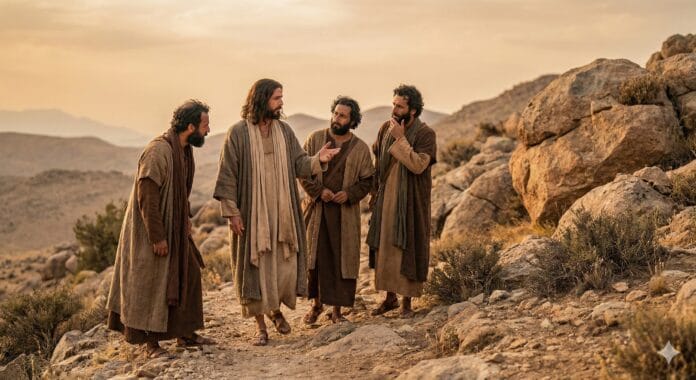
Gospel of Jesus Christ according to Saint Matthew
As they were coming down the mountain, the disciples asked Jesus, «Why then do the scribes say that Elijah must come first?» Jesus answered them, «Elijah does come to restore all things. But I tell you, Elijah has already come, and they did not recognize him, but did to him whatever they pleased. So the Son of Man will suffer at their hands.» Then the disciples understood that he was speaking to them about John the Baptist.
Recognizing the one who prepares the way: when God comes incognito
Or how to discern the hand of God in the ordinariness of our lives and welcome the messengers we do not see.
Jesus comes down from the mountain transfigured, and his disciples ask the unsettling question: Why hasn't Elijah come yet? Christ's answer overturns their expectations. Elijah has already appeared in the guise of John the Baptist, but no one recognized him. This passage from Matthew 17 invites us to examine our own spiritual blindness: How often do we miss God's signs because they don't fit our preconceived narrative?
This reflection explores the mystery of Elijah's coming through John the Baptist and the spiritual mechanisms of recognition. We will first analyze the post-Transfiguration context and messianic expectations, then develop three major themes: the prophetic motif of the reborn Elijah, the dynamics of collective refusal and blindness, and the link between misrecognition of the forerunner and rejection of the Messiah. Finally, we will ground these truths in our daily lives through concrete applications and a meditation on openness to God's unexpected.
The descent from the mountain: a pivotal moment in Matthew's cycle
The passage in Matthew 17:10-13 is part of a narrative sequence of remarkable theological density. Jesus has just experienced the Transfiguration on the mountain (Mt 17:1-9) with Peter, James, and John. These three witnesses saw Christ resplendent in glory, conversing with Moses and Elijah, and hearing the Father's voice proclaim: "This is my beloved Son." As they descended, Jesus instructed them to say nothing about this vision "until the Son of Man has risen from the dead."«
It is in this context of dazzling revelation and the command to remain silent that the disciples' question arises. Their question is not insignificant: it touches on the heart of Jewish eschatology at the time. According to Malachi 3, In verses 23-24, God would send the prophet Elijah before the "great and dreadful day of the Lord" to reconcile hearts and prepare the people. The scribes therefore taught that Elijah should precede the Messiah. Now, Jesus clearly acts as the Messiah, but where is Elijah?
Jesus' response unfolds in two stages. First, he confirms the scriptural teaching: "Elijah will come to restore all things." The future tense used here may seem surprising, but it underscores the ongoing eschatological dimension of the promise. Then, without transition, he adds: "Elijah has already come." This present perfect tense transforms the perspective. The forerunner announced is not a figure to come in the distant future, but a man who has already carried out his ministry. The disciples witnessed his preaching, his baptism, his arrest, and his execution. And they saw nothing.
The identification of Elijah with John the Baptist is not new in the Gospel of Matthew. In 11:14, Jesus already declares, «If you are willing to accept it, this is the Elijah who is to come.» But here, after the Transfiguration where Elijah appeared alongside Moses, the revelation takes on a dramatic dimension. The forerunner was misunderstood, mistreated, and ultimately beheaded. And Jesus adds this chilling prophecy: «So also the Son of Man will suffer at their hands.» The fate of the messenger foreshadows that of the Messiah. John’s misrecognition prefigures the rejection of Jesus.
This passage thus occurs at a pivotal moment. The glory of Tabor still illuminates their minds, but already the shadow of the Cross is spreading. The disciples are beginning to understand: the Kingdom will not come in the triumphant splendor they had hoped for. It comes through kenosis, humility, and denial. And this understanding opens with a painful retrospective: we failed to recognize.
Spiritual Anatomy of Blindness: Why We Cannot See
The central assertion of the passage – «they did not recognize him» – deserves closer attention. The Greek verb epiginōskō It means to fully recognize, to identify with certainty. This is not a matter of factual ignorance: everyone knew John the Baptist. His ministry had caused a sensation. Crowds flocked to the Jordan. Herod himself feared him and listened to him willingly (Mark 6:20). The problem, therefore, is not a lack of information, but a lack of spiritual vision.
Several mechanisms explain this blindness. First, the scribes and Pharisees had constructed a preconceived image of Elijah. They expected a glorious figure, perhaps a physical reappearance of the prophet taken up to heaven in a chariot of fire. John the Baptist, with his camel-hair attire, his diet of locusts, and his message of radical repentance, did not fit the script. He was too harsh, too demanding, too out of step with the expectations of a triumphant return.
Then, Jean himself explicitly refused the title. John 1, In chapter 21, when questioned by the priests and Levites, he replied, «I am not Elijah.» This statement is not a contradiction with Jesus« words, but a matter of perspective. John denies being the literal reincarnation of the prophet, while functionally fulfilling his mission. He comes »in the spirit and power of Elijah” (Luke 1, 17), which is different from a personal identity. But this theological nuance escapes those who seek spectacular outward signs.
The third factor in this blindness lies in the unsettling nature of the message. John preached radical conversion, denounced religious hypocrisy, and called spiritual leaders who came to baptism without sincere repentance a "brood of vipers." His ministry was a living judgment on the establishment. Recognizing him as the promised Elijah would have meant acknowledging the validity of his critique, and therefore questioning an entire religious and social system. It was more convenient to classify him as a visionary, a prophet among others, a dissenting voice to be ignored.
Finally, and perhaps most profoundly, John's ignorance reveals a fundamental misunderstanding of God's ways. Scripture announces a forerunner who will "put all things in their proper place" (apokathistēmi, (a term that evokes complete restoration). Yet, John was imprisoned and then executed. What restoration? What preparation of hearts? In the eyes of his contemporaries, his ministry had ended in failure. The Messiah he foretold had not come in the expected power. The axe had not been laid to the roots of the trees. The purifying fire did not consume the wicked. How could failure be the fulfillment of a promise?
This last question relates to Pascal's mystery himself. God's mode of action does not correspond to the logic of human power. John accomplished his mission not through institutional success, but through loyalty radical, which led him to martyrdom. He paved the way by embodying the truth, even at the cost of his life. And it is precisely this logic of kenosis that the world cannot recognize, because it contradicts all worldly wisdom.
Elijah redivivus, or the return of the prophet in the history of salvation
The tradition of Elijah's return is rooted in the final verses of the prophet Malachi, which conclude the prophetic corpus of the Old Testament. This prophecy was not a marginal speculation, but a central expectation of Second Temple Jewish eschatology. Apocryphal writings, rabbinic literature, and the Dead Sea Scrolls testify to the enduring vitality of this hope. Elijah would return to resolve halakhic disputes, reconcile divided families, purify the priesthood, and announce the arrival of the Messiah.
Why Elijah in particular? Because, according to 2 Kings 2, he did not die but was «caught up in a whirlwind to heaven.» This mysterious disappearance left open the possibility of his return. Moreover, Elijah’s historic ministry marked a moment of major crisis in the history of Israel. Faced with the apostasy of King Ahab and Jezebel, and with the idolatry of Baal threatening to overwhelm Yahwism, Elijah embodied the uncompromising prophet who called the people back to the Covenant. The challenge on Mount Carmel, where he invoked fire from heaven upon the sacrifice, remained etched in the collective memory as the symbol of the decisive choice: «How long will you waver between two opinions? If the Lord is God, follow him; but if Baal, follow him» (1 Kings 18:21).
However, in Jesus' time, many perceived a similar situation. The temple was controlled by a priestly elite compromised by its dealings with Rome. Faith Israel was becoming rigid in its ritualistic observances. The people groaned under pagan occupation. Messianic movements multiplied, all awaiting the day when God would finally intervene to restore Israel. In this context, the coming of Elijah was the long-awaited sign that the countdown had begun.
John the Baptist fulfills this Eliatic role in many ways. Like Elijah, he preaches in the desert, far from the centers of religious power. His camel-hair garment recalls Elijah's mantle (2 Kings 1:8). His message calls for a radical choice: conversion or perish. He practices a baptism of repentance that symbolizes the necessary purification before the coming of the Messiah. And above all, he accomplishes the Malachi mission of "turning the hearts of the fathers to their children" by preparing a people ready for the Lord.
But John also introduces a decisive innovation. The expected Elijah was to restore worship, perhaps rebuild the temple, and reunite the scattered tribes. John, however, announces the one who will "baptize with the Holy Spirit and fire." He points beyond himself to the true restorer, declaring, "He must increase, but I must decrease" (John 3, 30), it fulfills the eliatic function not as an end in itself, but as a passage, a bridge between the old Covenant and the new.
Jesus' recognition of John as Elijah thus effects a profound prophetic hermeneutic. It affirms that the Scriptures are fulfilled, but not necessarily in the expected ways. Scripture is faithful, but our reading of it is often narrow. God keeps his word, but his word transcends our understanding. John is Elijah, not through reincarnation or miraculous reappearance, but through participation in the Eliatic mission, in "spirit and power." This logic of fulfillment "in a different way" will be characteristic of the entire Christian revelation: Jesus is the Messiah, but not the expected political Messiah; he establishes the Kingdom, but not by force of arms; he triumphs, but through the Cross.
The dramatic irony of the passage lies in the fact that the disciples, having just seen Elijah on the Mount of Transfiguration alongside Moses and Jesus, failed to understand that this same Elijah had just fulfilled his earthly mission in John. The glorious vision of Tabor contrasts sharply with the incomprehension of the plain. This shows that revelation alone is not enough: one must also have eyes to see. Elijah's real presence in the economy of salvation permeated both the historical dimension (John the Baptist) and the eschatological dimension (the appearance on the mountain), but only faith illuminated by Christ, it could connect the two.
This tension between fulfillment already accomplished and hope still open characterizes all of Christian eschatology. Elijah «will come» and «has already come»: the two affirmations coexist. The Kingdom is «already here» and «not yet» fully manifested. We live in the time of fulfillment begun, where promises are being actualized in the discretion of faith, while awaiting the final revelation where "every eye will see it." Our task is to discern the signs of this fulfillment in God's today, without letting ourselves be blinded by non-conformity to preconceived patterns.
«"They did whatever they wanted to him," or the dynamics of rejection
The phrase used by Jesus – «they did to him whatever they pleased» – resonates as a damning indictment of human freedom left to its own devices. It describes not an isolated incident, but a pattern, a structure of denial that will be repeated with Christ himself. This «whatever they pleased» encompasses the arbitrary arrest, imprisonment, and ultimately the execution of John on the whim of Herodias and her daughter (Mt 14:1-12).
The accounts of John the Baptist's death in Matthew and Mark present a confluence of factors: Herodias's anger, who could not forgive John for denouncing her adulterous marriage to Herod; Herod's weakness, who respected John but yielded to an imprudent promise; the manipulation of a dance and a deadly demand; and the complete absence of a trial or legal process. It is pure arbitrariness, power granting itself the right to silence a dissenting voice.
This violence against the prophet reveals a profound anthropological truth: humanity, given over to its desires, cannot bear the light of truth. John denounced royal adultery, but symbolically, he denounced all infidelity to the Covenant. He reminded everyone that God's Law is binding even on the powerful, especially on the powerful. This message was intolerable for a power built on compromise and realpolitik.
Jesus' words also underscore the collective dimension of the rejection: "they" refers not only to Herod and his court, but to an entire society that stood by, that did not protest, that accepted the injustice. John's disciples retrieved his body and buried it, then went to inform Jesus (Mt 14:12). But where was the popular uprising? Where was the indignation of the crowds who had listened to John at the Jordan? The collective silence ratifies the crime of the powerful.
By explicitly linking John's fate to that which awaits him—"so the Son of Man will suffer at their hands"—Jesus establishes a prophetic continuity in rejection. This continuity runs throughout biblical history. Prophets have always been persecuted. Elijah himself had to flee from Jezebel, who wanted to kill him. Jeremiah was thrown into a cistern. Zechariah was stoned in the temple courts. Jesus would later bitterly remind them of this: "Jerusalem, Jerusalem, you who kill the prophets and stone those sent to you" (Matthew 23:37).
This pattern of rejection is not accidental. It reveals a systemic resistance to the word of God when it disrupts the established order. Religious institutions, when they become ossified, tend to reject the prophetic voices that call them to conversion. Spiritual comfort, social respectability, investment in power structures: all of this sits uneasily with evangelical radicalism. John, like Jesus, like all authentic prophets, represented a threat to these precarious balances.
But beyond sociological analysis, there is a deeper theological mystery. Why does God allow his messengers to be treated this way? The Christian answer lies in the theology of the Cross. The messenger's rejection is an integral part of his mission. By enduring injustice, John does not experience a failure of his mission, but its fulfillment. He prepares the way for the Messiah not only through his preaching, but through his martyrdom. He proclaims the one who "did not come to be served, but to serve, and to give his life as a ransom for many" (Mt 20:28), and he does so by giving his own life.
This logic runs counter to all human wisdom. The world judges success by visible results: growth. digital, Social influence, measurable impact. The Kingdom of God judges by loyalty radical, even in apparent failure. John dies without having seen the Messiah establish the Kingdom of power he foretold. He even doubts, from his prison, sending someone to ask Jesus, "Are you the one who is to come, or should we..." to wait for another ? " (Matthew 11, 3). Yet, it is precisely in this fidelity to the end, in this perseverance without guarantees, that the Eliatic mission is accomplished.
The phrase "all that they wanted" is then reversed into "all that God allowed for salvation." The evil committed remains evil, inexcusable. But God, in his mysterious providence, uses even refusal and violence to advance his plan. John's death becomes the seed of the Kingdom. His martyrdom testifies that it is better to die faithful than to live in compromise. And for Jesus' disciples, this lesson resonates as both a warning and a promise: a warning that following Christ potentially leads to the same fate, a promise that this fate is the path to glory.
«Then the disciples understood,» or the progressive pedagogy of revelation
The final verse – «Then the disciples understood that he was speaking to them about John the Baptist »" – marks a pivotal moment in the Twelve's consciousness. This understanding is not merely intellectual (identifying John as the prophesied Elijah), but existential: it leads them into the intelligence of the Pascal's mystery, of this Messiah who triumphs through apparent failure, of this Kingdom that comes in weakness.
Note the "then" (tote), which underscores the sudden nature of this illumination. It does not come from laborious reasoning, but from a word of Jesus that opens eyes. This is a constant feature of the Gospel of Matthew: faith arises from the encounter with the word of Christ who deciphers Scripture and history. The disciples had heard John preach, they may have followed him before following Jesus (cf. John 1, (35-37), they had witnessed his arrest, learned of his death. But they had not "understood." Jesus had to connect the dots, articulate John and Elijah, John and the Messiah, the suffering of the forerunner and that which awaits the Son of Man.
This progressive pedagogy characterizes the entire economy of revelation. God does not deliver his truth all at once, in a blinding clarity that would dispense with faith. He distills it, insinuates it, suggests it, through events, words, and signs that demand interpretation. The disciples live with Jesus, see him act, hear him teach, but often only understand afterward. The risen Christ will open their minds to the Scriptures (Lk 24:45), and the Holy Spirit will lead them to all truth (Jn 16:13). But already, in these moments of partial revelation, like that of Matthew 17:13, the light dawns.
The disciples' understanding initially focused on the prophetic fulfillment: yes, Elijah had come in John. But it immediately extended to the trajectory of the Messiah himself. If the forerunner was rejected and killed, the Messiah would suffer the same fate. This projection is terrifying. It shatters the hope of a triumphant Messiah who would overthrow the Romans and establish a kingdom of immediate glory. It forces us to completely rethink what "Messiah," "Kingdom," and "salvation" mean.«
One can imagine the shock felt by the disciples. They had just descended from a mountain where they had seen Jesus transfigured in glory, conversing with the giants of the Covenant, Moses and Elijah, and confirmed by the divine voice. Everything seemed to converge toward a dazzling manifestation. And yet, in a few words, Jesus brought them back to harsh reality: the path led through rejection and death. The glory of Tabor does not erase Calvary; it reveals its ultimate meaning, but it does not circumvent it.
This tension between glorious revelation and prediction of the Passion runs throughout the central section of Matthew. Just before the Transfiguration, Jesus had announced his suffering for the first time, provoking Peter's scandalized reaction: "God forbid, Lord! This must never happen to you!" (Mt 16:22). Just after our passage, as we descended back into Galilee, Jesus reiterated: "The Son of Man is going to be delivered into the hands of men, and they will kill him" (Mt 17:22-23). Jesus' teaching method consists of repeating this difficult truth from different perspectives until it penetrates hearts.
«Then the disciples understood» does not mean that they grasped everything at once, nor that they accepted it serenely. The text says that they «understood that he was speaking of John,» not that they fully absorbed all the implications. Moreover, a few chapters later, James and John will again demand places of honor in the Kingdom (Mt 20:20-28), showing that they have not yet grasped the logic of service and self-sacrifice. Peter will deny Jesus, and they will all flee. True understanding will only come after Easter.
But this "then" nevertheless marks progress, another step on the path to faith As adults, the disciples begin to glimpse that God acts differently than they imagined. They begin to connect present sufferings to ancient promises, not as a contradiction, but as a paradoxical fulfillment. They begin, tentatively, to suspect that martyrdom can be victory, that weakness can be strength, that death can be a passage.
This divine pedagogy directly concerns us. We too live in the space between the revelation that has begun and the understanding that is yet to be perfected. We too have moments of Tabor where everything seems luminous, followed by descents into the plain where nothing seems to make sense. Our faith is built in this alternation, in these flashes of understanding followed by long journeys through the twilight. The important thing is not to have understood everything at once, but to remain on the path, docile to the word that gradually illuminates.
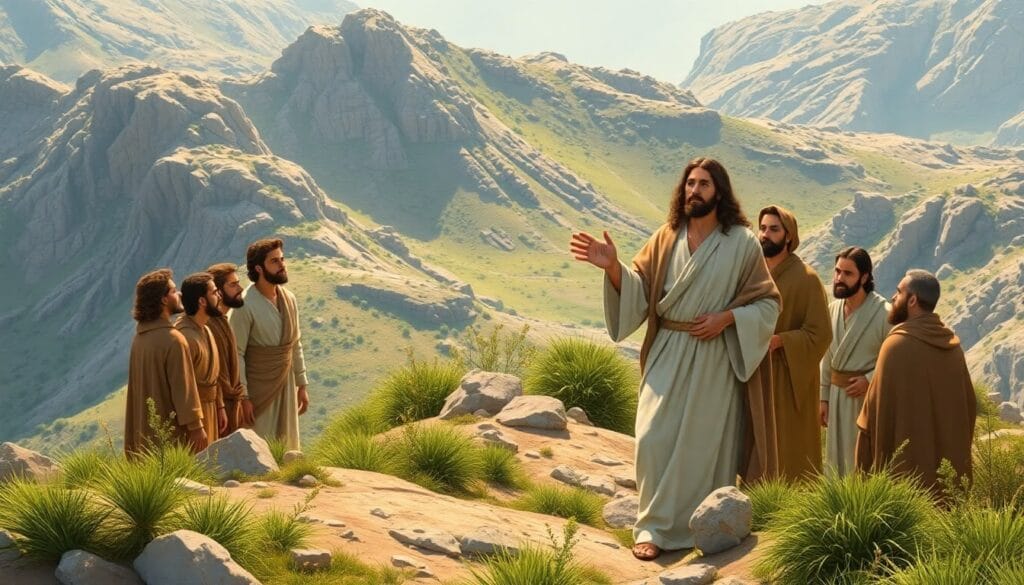
Discerning God's messengers in our daily lives
The lesson of the text immediately translates into practical vigilance. If John's contemporaries failed to recognize the promised Elijah, it was because their interpretive framework was inadequate. They were looking for a spectacular sign, a figure conforming to their expectations. We often do the same. We have preconceived ideas about how God should intervene in our lives, the forms his providence should take, and the people through whom he should speak to us.
In everyday life, this translates into a constant risk of missing God's messengers. The word that calls to us may come from someone we consider spiritually unqualified. The correction we need may come from someone who irritates us. The invitation to change course may arise from a circumstance we deem insignificant. If we always expect God to speak to us in the pomp of an impeccable liturgy or through charismatic figures, we risk missing the essential point.
Let's take the example of our parish communities or our workplaces. Sometimes there are quiet, unassuming, socially marginalized people who nevertheless possess an essential truth. Perhaps a colleague who, without grand rhetoric, lives with an integrity that challenges us. Perhaps a member of our prayer group who, in their simplicity, exposes our compromises. Perhaps even a child who, with a naive remark, brings us back to what truly matters. "They didn't recognize him": the tragedy lies in dismissing them, in not listening, because they don't fit the profile of the "spiritual master" we have chosen.
In couples and families, this dynamic plays out daily. When a spouse makes a disturbing remark about our selfishness, pride, or excesses, are they a pain in the neck or a John the Baptist preparing us to welcome Christ into our lives? When a teenager questions our superficial religious practice, are they a rebel to be subdued or a prophet reminding us that God desires truth in our hearts? Discernment means not rejecting the unsettling words outright, but examining them honestly: what if God is speaking to me through this person, despite their awkwardness, despite their imperfections?
The text also invites us to reflect on our relationship with ecclesiastical institutions. John the Baptist exercised his ministry outside the official structures of the Temple. He preached in the desert, not in Jerusalem. He baptized in the Jordan, not in the ritual baths of the priesthood. This outsider status did not invalidate his mission; on the contrary, it made it prophetically necessary. Similarly today, the voice of God is not limited to official channels. It can arise from movements of renewal, new communities, and isolated voices calling for conversion. Recognizing these voices without falling into systematic criticism of the Church requires a subtle, but necessary, discernment.
Finally, and this is crucial, the text calls us to question our own role. Perhaps we are called, on our modest scale, to be like John the Baptist for those around us. Not by setting ourselves up as moral authorities, but by living a radical evangelical life that challenges us. Our consistency between professed faith and lived experience, our refusal of certain ethical compromises, our availability to the poor: all of this can prepare the way of the Lord in the hearts of those who observe us. But are we ready to pay the price? For "they did to him whatever they pleased" reminds us that loyalty Prophetic pronouncements expose one to rejection, misunderstanding, and sometimes hostility.
Echoes in tradition
The figure of John the Baptist as Elijah reborn profoundly influenced Christian theology and the spirituality of the Fathers. Origen, in his Commentary on Matthew, develops the idea that John came "in spirit and power of Elijah," meaning that he received the same prophetic charism without being the same person reincarnated, since the Church has always rejected metempsychosis. This distinction allows us to understand prophetic fulfillment as participation in a typological mission rather than as a literal repetition.
Saint John Chrysostom, in his Homilies on Matthew, emphasizes that Jesus responds to the disciples by showing that the prophecies are fulfilled differently from what the scribes taught. For Chrysostom, the scribes' error lay not in their reading of Malachi, but in their rigid interpretation. They had transformed the prophetic announcement into an immutable script, unable to accept that God retains his sovereign freedom in the way he fulfills his word. This reflection by the Church Father sheds light on our own temptation to confine God within our theological systems.
Saint Augustine, Augustine, in his *De consensu evangelistarum*, addresses the apparent contradiction between John's declaration, "I am not Elijah," and Jesus' assertion, "Elijah has already come." He resolves the difficulty by distinguishing between person and function. John denies being Elijah in person, but Jesus affirms that he is Elijah in mission. This Augustinian hermeneutic influenced the entire medieval understanding of biblical typology: the figures of the Old Testament find their fulfillment in the New, not through physical continuity, but through spiritual and functional correspondence.
The liturgy of Advent This dynamic is embraced. John the Baptist occupies a central place, particularly during the second half of Advent. The Church invites us to meditate on his figure to prepare us for Christmas, thus reaffirming his role as forerunner. By contemplating John, we are invited to "prepare the way of the Lord" in our hearts, to "make his paths straight" through conversion. The Baptist motto, "He must increase, but I must decrease," becomes a spiritual program: making room for Christ by clearing away our inner burdens.
Theologically, our passage raises the question of eschatological hermeneutics. How should we read the promises of the Old Testament in the light of Christ? Should we to wait for a literal fulfillment of all prophecies, including those that seem unfulfilled? Classical Christology responds with a dialectic of "already" and "not yet." Christ inaugurated the Kingdom, fulfilled the essential promises, but the final consummation remains to come. Similarly, Elijah came in John to prepare for the first coming, and will return (in a perspective that the Apocalypse (It mysteriously evokes the two witnesses of Revelation 11) to prepare for the Parousia. This sustained tension helps avoid two pitfalls: eschatological realization, which would deny all future hope, and futurism, which would ignore present fulfillment.
The theology of martyrdom is also rooted in this text. John dies faithful to his mission, prefiguring the martyrdom of Christ and that of the disciples. Tertullian will say that "the blood of martyrs is the seed of Christians": the rejection and violence suffered become, in the divine economy, a principle of fruitfulness. Martyrdom is not a regrettable accident, but a mysterious participation in the saving Cross. Every time a witness of Christ suffers injustice for the truth, he "completes what is lacking in the sufferings of Christ" (Col 1, 24), not that Christ's sacrifice is insufficient, but because it associates its members with his redemptive work.
Finally, the concept of recognition (epiginōskō) opens onto a theology of faith as enlightened vision. John's contemporaries had eyes but did not see, ears but did not hear (Mt 13:13-15). Faith It does not consist merely in believing statements, but in seeing the active presence of God in history. It is a renewed vision that discerns the signs of the times, that recognizes the Lord's comings and goings, including and especially when they take the paths of humility and kenosis. This theology of recognition will culminate in the accounts of the Easter appearances, where the disciples recognize the Risen One only at the moment he reveals himself (Lk 24:31; Jn 20:16).
Practice exercise: the extended examination of conscience
To integrate this message into our concrete lives, a simple practice can be proposed, broken down into four progressive steps to be completed over a week or during a retreat.
First step Reread your story to identify the unrecognized instances of God's presence. Take a moment of silence, notebook in hand, and ask yourself: "At what points in my life did God intervene without my realizing it at the time?" It might be a seemingly insignificant encounter that changed your course, a failure that turned out to be a blessing, or a word that quietly took root before blossoming. Note these moments, and give thanks for what, in retrospect, you perceive as God's work.
Second step Identify the "John the Baptists" in our lives. Who are the people in our lives who call us to conversion, to truth, to radical change? Not necessarily those with the most theological degrees or the most charismatic, but those who, through their lives or words, challenge us in a beneficial way. Remember these figures, perhaps reconnect with them if we have distanced ourselves from them, and thank them inwardly or outwardly for their prophetic role.
Third step Examine our resistance. How do our preconceived expectations of God prevent us from recognizing his ways? Do we have a "domesticated" image of God, a God who should always comfort us, reassure us, and validate our choices? Or are we open to a God who challenges us, questions us, and calls us to step outside our comfort zones? Confess our rigidities and ask for a docile heart.
Fourth step Practice daily openness. Each evening, for a week, review your day, asking yourself: "Today, when did God try to speak to me? Through whom? Through what?" It could be through a word heard at Mass, a Bible verse that resonates, a conversation, an unexpected event, or an inner feeling. Note these small signs and respond to them with a brief prayer: "Lord, help me to better recognize your presence."«
This practice of mindful attention gradually transforms our perspective. We become more sensitive to the way God enters the ordinary course of our lives, often in unexpected ways. And this heightened awareness prepares us not to miss the Lord's presence when he comes, not in the dazzling glory we expect, but in the quietude of the ongoing Incarnation.
Contemporary challenges and resistance to this message
Our current culture makes it particularly difficult to accept this text. Several contemporary obstacles deserve to be named and addressed.
First, the reign of media sensationalism. We live in a civilization of spectacular images, buzz, and virality. An event only exists if it is seen, liked, and shared. In this context, the idea that God could go unnoticed, that his messenger could be unknown, seems absurd. We expect massive signs, filmed miracles, and resounding conversions. The ministry of John the Baptist, uncouth and marginalized, would not stand a chance against the spiritual influencers of our time. Yet, the text reminds us that it is precisely in discretion, even in social insignificance, that God often accomplishes his work.
Then there's our consumerist individualism applied to religion. We want a spirituality à la carte, one that fulfills us without disturbing us too much. The idea of a forerunner who calls for radical repentance, who refers to people as a "brood of vipers," who demands conversion before baptism, offends our sensibilities. We would prefer a more accommodating messenger, one who validates our choices, who assures us that everything is fine. Recognizing John as God's messenger implies accepting that he might challenge us, confront us with our contradictions, and demand concrete changes.
Third, our difficulty with failure. In a society of performance and success, the idea that a divine mission could be accomplished through apparent failure, rejection, or death is almost unthinkable. If John was truly sent by God, why did he end up beheaded in a prison Why didn't God intervene? These legitimate questions run up against the mystery of the Cross. Yet, our culture has largely lost its understanding of this mystery. It oscillates between naive positivism (God should always fix things) and the nihilism despair (if things don't improve, it's because there is no God). The biblical message of salvation through kenosis remains a scandal and folly (1 Cor 1:23).
Fourth, our crisis of authority and mediation. Who are you, John the Baptist, to tell me what to do? Who is the Church to presume to teach me the truth? Our era values absolute autonomy, the personal construction of meaning, and the rejection of any pronouncement that claims to impose itself from the outside. In this context, the figure of the prophet who comes "from God" with a non-negotiable message becomes suspect, even intolerable. However, the Christianity It rests on a structure of revelation and mediation: God speaks, sends messengers, and reveals himself through words and signs external to ourselves. Recognizing Elijah in John the Baptist implies accepting that God can reach us through another, through a word that comes from elsewhere.
Finally, our relationship to violence. The text evokes the violence inflicted upon John: imprisonment, execution. It foreshadows the violence to come against Jesus. For many today, the violence suffered disqualifies the cause. If God were truly with John, he would have protected him. If Jesus were truly the Messiah, he would not have been crucified. This logic, understandable from a human perspective, misses the logic of the Gospel. God does not promise invulnerability, but victory through and beyond the violence suffered. He does not eliminate persecution, but transforms it into a path of resurrection. This implies a radical conversion of our imagination: ceasing to project our desires for triumphant power onto God, accepting his apparent weakness as the sovereign mode of action.
Faced with these challenges, the answer is not to lament our times or seek refuge in nostalgia for the past. It is to grasp the essence of the message: God often reveals himself in discretion, humility, and apparent contradiction. Recognizing these appearances requires a discerning eye. faith, a willingness to help, a humility who accepts being disturbed. And this remains possible today as yesterday, for those who accept shifting their criteria for judgment from the visible to the invisible, from worldly success to loyalty evangelical.
Prayer
Lord Jesus Christ, you who walked on this earth in the company of men and women who often did not recognize you, open our eyes and our hearts to your hidden presence in the present moment of our lives.
We give you thanks for John the Baptist, your forerunner, voice crying out in the wilderness, unwavering witness to the truth, martyr of integrity. He prepared your ways by calling for conversion, and his shed blood fertilized the soil where your Good News would take root. May he teach us to live this same radical commitment in loyalty daily.
Forgive us, Lord, for all the times we have failed to recognize your messengers. How many times have we dismissed a word that disturbed us, closed the door to the one you sent, judged by appearances rather than by the Spirit? How many times have we preferred our preconceived images of you to your real and disconcerting presence?
Grant us a fresh perspective, a docile heart, and attentive ears. May we discern your hand in the events of our days, your voice in the words of those around us, and your call in the circumstances you allow. Free us from our rigidities, our narrow certainties, and our overly human expectations.
Lord, send us prophets who constantly bring us back to what is essential, who denounce our compromises, who awaken us from our lukewarmness. And give us grace to welcome them, even when their words wound our pride, even when their demands cost us.
We also pray for all those who, today, carry your word in hostile or indifferent contexts. Christians persecuted people who suffer what John and you suffered. For the prophetic voices in the Church and in the world that call for justice, to peace, to ecological and social conversion. Support them in their faithfulness, console them in their trials, and make their testimony bear fruit.
Prepare our hearts, Lord, as John prepared the hearts of his contemporaries. Level the mountains of pride within us, fill the ravines of our inner emptiness, straighten the crooked paths of our hypocrisy. Make us ready for your coming, not only during liturgical highs, but at every moment of our lives.
And since John foretold the one who would baptize with the Spirit and fire, set us ablaze with that Spirit. May it consume within us what is not of you, may it purify our intentions, may it inflame our charity. May we in turn become bold witnesses of your Gospel, not by our own strength, but by the power of your grace.
Finally, Lord, keep us vigilant. May we not miss the day of your visit. May we recognize you when you pass by, in whatever form. And may you, at the end of our lives, say to us: «Enter into joy "of your master, good and faithful servant, for you have recognized me in the least of my brothers."»
Through Jesus Christ, our Lord, in unity with the Holy Spirit, for ever and ever. Amen.
Learning to see with the eyes of faith
In concluding this meditation on Matthew 17:10-13, one conviction emerges: recognizing God's action in history and in our lives is not self-evident. It requires a conversion of perspective, an education of spiritual attention, a humility who accepts being surprised by a God who never fully conforms to our scenarios.
John the Baptist was the awaited Elijah, but in a way no one had foreseen. He did not physically return from heaven in a chariot of fire. He did not restore the kingdom of Israel by force. He preached, baptized, denounced injustice, and he died beheaded. Mission accomplished? In the eyes of the world, a clear failure. In the eyes of God, the perfect preparation for the Messiah's path.
This dissonance between appearances and profound reality runs throughout the Gospel. The Messiah will triumph, but through the Cross. The Kingdom is there, but hidden like leaven in dough. The last will be first., the poor They are blessed; to lose one's life is to gain it. Everything is overturned, transvalued, transfigured by the logic of the Incarnation and of the Resurrection.
Our task, therefore, is to cultivate this evangelical perspective. To cease judging by appearances, measurable successes, and worldly criteria. To seek the signs of God's presence not in the spectacular, but in humble faithfulness, in discreet service, in the costly truth. To welcome the prophets God sends us, even if they do not wear the clothes we expected.
In practical terms, this translates into daily availability. Every encounter, every word heard, every event can be a message from God to me. The colleague who makes a valid but unsettling observation, the friend who calls me to greater consistency, the biblical passage that suddenly resonates with me and speaks to me, the unforeseen circumstance that forces me to revise my plans: all these are potential points of contact for the Lord. It is up to me to cultivate a heart awake enough to recognize it.
And if at times we doubt, if we cannot discern what comes from God and what does not, let us remember the disciples' teaching method. They did not understand everything at once. They progressed by trial and error, through successive corrections, through gradual illuminations. Jesus patiently took up their words again, explained, and waited for understanding to mature. The Holy Spirit continues this educational work within us. The spiritual life is not a sprint, but a long journey where we gradually learn to see, to hear, to recognize.
«Elijah has already come, and they did not recognize him.» This phrase resonates as both a warning and a promise. Warning: let us not miss what is essential. Promise: even if we have missed God’s appearances in the past, he will continue to reveal himself, to speak to us, to call us. He is the God of second, third, and seventh chances. Every day is a new day to welcome him. Every moment offers an opportunity for recognition.
So yes, let us prepare the way of the Lord. Let us make his paths straight. Not through superhuman efforts of asceticism, but through that fundamental openness, that docility of heart which makes us say: «Speak, Lord, for your servant is listening.» In this active listening and loving vigilance lies our participation in the coming of the Kingdom. John the Baptist prepared the way of Christ in his time. We are called to prepare it in our time, in our places, with our own means. It is up to us.
Practical tips: five actions for a week of mindful awareness
Monday: Morning silence. Before checking your phone or messages, take five minutes of silence to ask the Lord: "What do you want to tell me today? Through whom, through what will you speak to me?" Note in the evening if anything resonated.
Tuesday: Rereading a difficult relationship. Identify a person who regularly bothers or criticizes us. Ask yourself sincerely: "What if God wants to speak to me through them? How much truth can I accept in what they tell me?"«
Wednesday: Slow reading of Malachi 3, 1-4 and 3, 23-24. Meditate on the source texts about Elijah the forerunner. What strikes me? What did I expect from God that was not fulfilled as planned, but perhaps in a different way?
Thursday: Revisiting a failure. Reflecting on a project, a relationship, a hope that failed. With hindsight and in prayer, is there something of God's providence that I can discern in this failure? How was God able to prepare me, purify me, redirect me through this?
Friday: A prophetic gesture. To take a concrete act of truth or justice, even if it comes at a cost. This could mean saying something true but difficult, or refusing to compromise. ethics At work, dedicate time to charitable work. Experience what Jean-Baptiste experienced in your own way.
SATURDAY : Eucharist attentive. If possible, participate in Mass, paying particular attention to the readings, the homily, and the liturgical gestures. Ask the Lord to speak to you through these means. After the celebration, note down what resonated most deeply with you.
Sunday: Community sharing. With family or Christian friends, discuss the question: "This week, how did you perceive God acting or speaking to you?" Build up each other's capacity for discernment.
References
Primary biblical sources: Malachi 3, 1-4 and 3, 23-24 (Elijah's promise); 2 Kings 1-2 (Elijah cycle); ; Matthew 3, 1-17 and 11, 2-15 (John the Baptist); Mark 6, 14-29 (death of John); ; Luke 1, 5-25 and 57-80 (announcement and birth of John).
Church Fathers: John Chrysostom, Homilies on the’Gospel of Saint Matthew, homily 56; Augustine, Treatise on the Gospel of John, treatises 4 and 5; Origen, Commentary on Matthew.
Contemporary theology: Joseph Ratzinger / Benedict XVI, Jesus of Nazareth, Volume 1, chapter on John the Baptist; Hans Urs von Balthasar, Glory and the Cross, section on kenosis; René Girard, I see Satan fall like lightning, analysis of the scapegoat mechanism applied to John and Jesus.
Spirituality: Charles de Foucauld, writings on humility and the imitation of Jesus; Thérèse of Lisieux, autobiographical manuscripts, on the little way and the acceptance of apparent failure; Jean Vanier, The Community, a Place of Forgiveness and Celebration, on the recognition of God in the poor and the marginalized.
Master's documents: Second Vatican Council, Dei Verbum (constitution on Divine Revelation), especially nos. 2-6 on the pedagogy of revelation; Evangelii Gaudium of the pope François, no. 169-173 on discerning the signs of the times.