













Reading the Letter to the Hebrews
Therefore, since we are surrounded by such a great cloud of witnesses and have been freed from everything that weighs us down—especially from the sin that so easily entangles—let us run with perseverance the race marked out for us, fixing our eyes on Jesus, the pioneer and perfecter of faith.
Instead of joy which was offered to him, he endured the cross, despising the ignominy of this torture, and he sits at the right hand of the throne of God.
Consider the example of the one who endured such opposition from sinners, and you will not be overcome by discouragement.
Dare to endure: Fix your eyes on Jesus to transform trials into a journey of faith
Committing to true endurance: how the Letter to the Hebrews illuminates our spiritual perseverance in difficult times.
Within the complexities of our times, there are certain biblical passages that seem to have been written to transcend the centuries and inspire our own struggles. Letter to the Hebrews, And in particular, this striking passage on endurance in the face of adversity is one of those texts that resonates deeply with those seeking light and meaning. Whether one is a believer in search of renewal, a weary pilgrim, or simply curious about spirituality, these lines invite a meditation that speaks to all: how to move forward, freed from burdens, with our gaze fixed on Jesus? How to embrace hardship not as an obstacle, but as a race to be run, surrounded by a vast cloud of witnesses? This article offers a profound and embodied exploration of the text, to make it a compass for our personal journeys.
- The context of the Letter to the Hebrews and the power of the message
- Central analysis: endurance, faith, and a focus on Jesus
- Three key areas: solidarity among witnesses, the dynamics of the cross, and ethical involvement
- Tradition, liturgical resonances and classical spirituality
- Meditation prompts and tips for integrating the message into daily life
- References and further reading
Context
There Letter to the Hebrews This work is situated at a pivotal moment: the first generations of Christians were experiencing the tension between their Jewish heritage, the newness of the Gospel, and the concrete experience of persecution and discouragement. The author—whose identity remains mysterious, but whom tradition readily associates with Paul or one of his close associates—addresses a community threatened by spiritual exhaustion, tempted to return to a safer and less risky religious practice. The preceding chapters have developed the figure of Jesus as High Priest, mediator of a new and perfect covenant, whose sacrifice on the cross fulfills all the rites and opens the way to an unprecedented hope.
In chapter 12, the image of the "endurance race" emerges—a true sporting metaphor, accessible to listeners in the Greco-Roman world—which takes on its full meaning in the wake of the chapters on the faith of the ancestors. "So then, we too, surrounded by this immense cloud of witnesses…": the community of believers is invited to recognize itself in a dynasty of seekers of God: Abraham, Moses, the prophets… all of whom have passed through the night, doubt, and trials, but have persevered in faith.
The author urges us: freed from all that weighs us down, and especially from sin that hinders our progress, let us run with endurance the race that is set before us. The image is powerful and concrete: it is a movement, a decision not to give in to discouragement. But this race is not a matter of pure willpower: everything changes when our eyes are "fixed on Jesus, the pioneer and perfecter of faith." Jesus, the model and source of faith, is the one who endured the cross and shame, and now sits at the right hand of the throne of God. The text invites us to meditate on Jesus' example in the face of the hostility of sinners: he did not flee, he did not waver, but he endured the trial in order to joy promise.
This passage, often read in liturgical contexts (Easter vigils, celebrations of saints, times of community crisis) or meditated upon in individual spirituality, serves as a true map for learning to manage discouragement and transform hardship into an opportunity for growth. Its scope extends far beyond physical suffering: it is a genuine call to resilience grounded in faith, sustained by the memory of witnesses and the contemplation of Christ.
Analysis
The key to this passage—and, dare we say, one of the great keys to the Christian life—lies in this shift in perspective: «eyes fixed on Jesus.» In this context, endurance is not primarily a heroic act, but the consequence of a renewed focus on the source and goal of faith. This reorientation changes everything: discouragement doesn't magically disappear, but it loses its grip when one meditates on «the one who endured such hostility from sinners.» This is where the biblical paradox arises: Christ did not merely survive the ordeal; he went through it by renouncing… joy which was offered to him, taking up the cross in place of shame. This shift in meaning – from pain to a new fruitfulness – is the foundation of Christian perseverance.
But this endurance is not solitary. The "cloud of witnesses" inhabits the text like a promise: faith is never lived alone. Believers are sustained by the memory of those who have faced their own race. The ordeal then becomes collective—a dynamic of communion and transmission, where each "witness" plays the role of model, support, and encouragement.
Spiritually, this idea has a luminous significance: suffering, reconsidered in the light of Christ, is no longer simply an inevitability. It becomes a source of fruitfulness, a learning of surrender, a growth in faith. We discover that Jesus, "the origin and the end of faith," transforms endurance into an adventure of seeing: seeing beyond the visible, learning to live for the invisible, to walk in hope, to not let ourselves be overcome by discouragement.
Theologically, this short passage encapsulates an entire vision of salvation: victory is not the elimination of hardship, but the ability to overcome it through shared faith, with the horizon of resurrection. Existentially, the text speaks to contemporary man: how to persevere in times of trial? How to prevent weariness or shame from engulfing our inner selves? By placing Jesus as our compass, we learn to reframe our own endurance, to give it new meaning, and to reintegrate our story into that of a community shaped by faith.
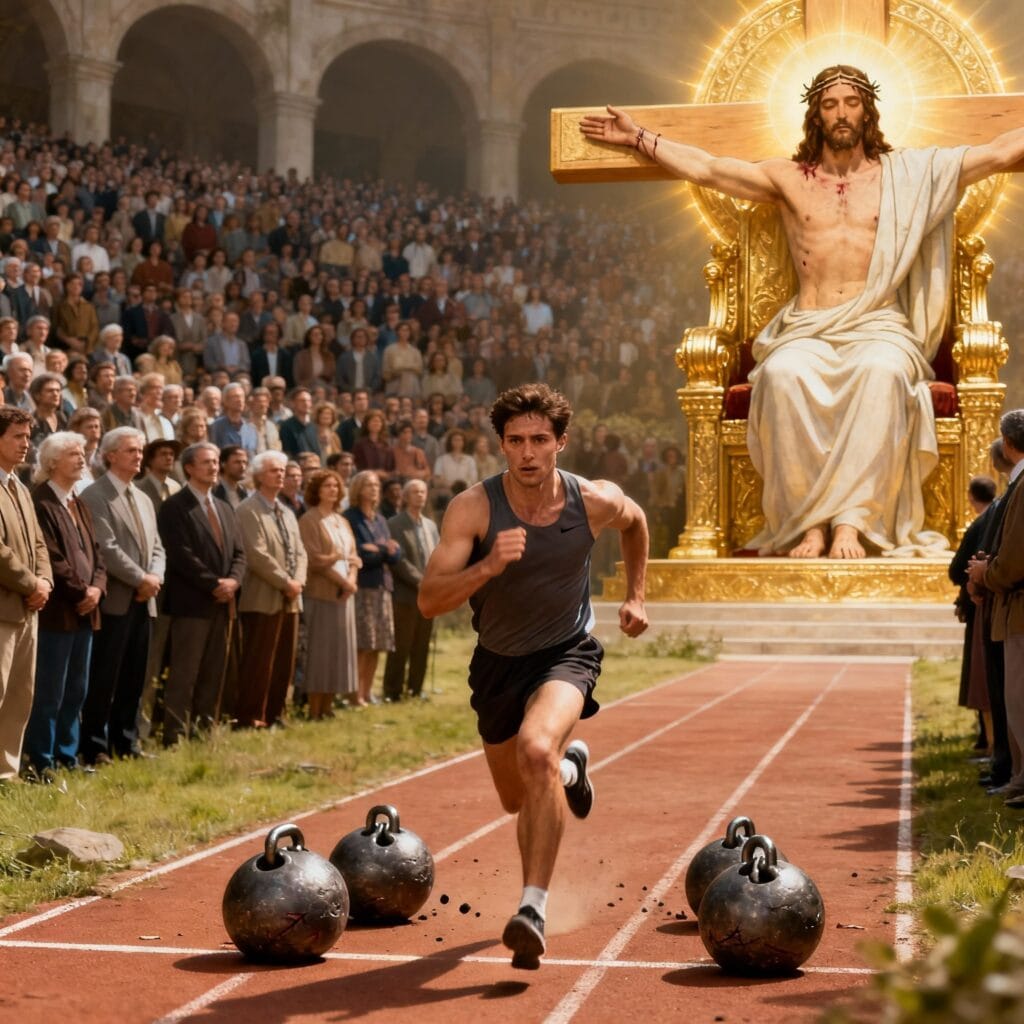
The solidarity of the cloud of witnesses
One of the most powerful contributions of the text—and undoubtedly one of the most underestimated—is the presence of the «cloud of witnesses.» This is not a mere backdrop: the collective memory of believers acts as a catalyst for transformation. This cloud refers to all those who, before us, faced discouragement, persecution, and incomprehension. Abraham, Noah, Moses, Rahab, the prophets… all were mentioned in the previous chapter, all experienced hardship, but none ran alone.
In practice, this raises the question of our own spiritual memory: who are the witnesses around us? Do we have, in our journeys, figures to whom we can cling? This idea of the solidarity of witnesses invites us to open the circle, to read our Christian life as a story that is part of a succession, a community, a tradition.
A concrete path opens up here: in moments of weariness or discouragement, it can be beneficial to reread the lives of those who have walked before us, to make them our companions on the journey, our intercessors. The Christian tradition has not been mistaken: regularly reading the lives of the saints, meditating on loyalty From previous generations, the horizon of the struggle is broadened. We are never truly alone in adversity. Around us, an invisible chain of men and women resisted, believed, and endured the darkness. This memory can sustain and transform our individual resilience.
Endurance and the Cross — The Dynamics of the Paradox
The second axis highlights this ardent dynamic: «Jesus, renouncing joy which was offered to him, he endured the cross, despising the shame.» Here we find one of the great paradoxes of Christianity: joy And suffering is not mutually exclusive; it is traversed in a logic of passage. Christ did not allow himself to be defined by the shame of torture, but by loyalty according to God's plan.
The Christian experience constantly confronts this paradox: how to endure the cross while retaining the capacity for hope? It is not the denial of suffering, but its transfiguration that is sought. Jesus remains the model: he does not flee, he confronts and perseveres, leaving behind him the trace of a possible future for each of his disciples.
In everyday life, this encourages us not to demonize hardship, not to confuse it with abandonment by God, but to see it as a moment where loyalty can be expressed in a new way. Christian endurance is never Stoic: it rests on the deep conviction that every cross will bear fruit, that every suffering endured in faith prepares one for an unexpected resurrection. On an ethical level, this amounts to transforming suffering into a place of commitment: the enduring believer does not accept fate, but chooses to face evil with lucidity, patience, and hope.
Practical implications and ethical appeal
Finally, the text offers a wealth of practical implications and calls for ethical conversion. The phrase "freed from all that weighs us down" invites a form of inner examination. What, in our habits, our choices, our daily lives, "weighs down" our progress? The text specifically targets sin: not simply moral failings, but everything that hinders freedom and the ability to move forward.
A practical approach would be to identify, in one's own life, what is blocking progress—harmful habits, discouraging thoughts, limiting patterns—and to choose to let go of them. Endurance thus becomes a conscious act: choosing to walk lighter, to shed the superfluous, to enter into a renewed dynamic.
This approach goes hand in hand with the call to run "the challenge that is set before us," that is, to take one's own story and challenges seriously, without always seeking to escape or compare oneself to others. The challenge then becomes a place of growth and ethical development: resisting the temptation of discouragement, learning to encourage oneself, and staying the course. Within the community, this opens the possibility of supporting others in their endurance, of not leaving them alone in their ordeal, and of sharing the weariness of the journey.
Living tradition: echoes and legacies
The power of this passage in the eyes of classical authors – the Church Fathers, medieval theology, and contemporary spirituality – stems from its capacity to unite memory and hope. Saint John Chrysostom, in his homilies, emphasizes this «cloud of witnesses» that inhabits the liturgy: each Eucharistic celebration is a living memory, where saints, martyrs, and the community of believers unite with Christ to receive the strength of endurance.
Saint Augustine He sees in running an image of inner progress: we do not run to tire ourselves out, but to grow, to draw closer to God. The Benedictine tradition has often meditated on this text as a call to loyalty stable: resist the temptation to give up, build your life on perseverance.
In the liturgy, this passage is frequently reused during professions of faith, baptisms, and the commemoration of the dead: it reminds us that every Christian existence is a journey towards fullness, a race that ends in the encounter with the glorified Christ.
Even today, in spiritual movements or retreats, the text inspires numerous exercises: meditations on loyalty, invitations to reread one's own story as a key to perseverance, encouragement to integrate the communion of saints into daily prayer.
Suggestions for prayer: meditating on Christian endurance
- Choose an intention for the day each morning, asking for the grace of endurance in the face of discouragement.
- Regularly reread the life of a witness or a saint, immersing oneself in their path of trial.
- Take a moment of silence after each difficulty, to symbolically fix your gaze on Christ.
- Lay down in prayer all that "weighs down" the heart: worries, habits, fears.
- Giving thanks for the "cloud of witnesses" that surrounds me, visible or invisible, through a prayer of intercession.
- To make a concrete resolution to support someone else in their endurance.
- Conclude each day with a meditation on Christ's journey: from the cross to joy, from discouragement to hope.
Conclusion
There Letter to the Hebrews, In this incandescent passage, a revolutionary vision of hardship emerges: fatigue, difficulty, even shame can be overcome with courage, not through physical strength, but through a conversion of perspective. Surrounded by a vast cloud of witnesses, invited to lay down all that weighs us down, we are called to run with endurance, not to win a trophy, but to attain a deeper communion with Christ and with others.
This endurance is not flight or resignation: it becomes courage, paradoxical joy, the ability to cross the night knowing that dawn is coming. Fixing one's eyes on Jesus means learning to reread each trial as an opportunity for growth and tenderness, to welcome the cross as a source of new life.
The message is clear: in moments of discouragement, it is possible to rise again, to walk supported by the memory of those who witnessed it, to transform one's own weariness into a cry of hope. To dare to embrace Christian endurance is to choose to make each trial a place of renewal, a step towards the light.
Practical advice: 7 guidelines for embodying Christian endurance
- Meditate each morning on the text of Hebrews 12:1-3, in connection with your own spiritual journey.
- Reread a chapter from the life of a saint who went through hardship, and draw inspiration from it for your day.
- Take stock of everything that "weighs down" the process and take concrete action to simplify it.
- Make a commitment to support a person in difficulty.
- Participate in a liturgy or community prayer on the theme of perseverance.
- Write a short journal of perseverance each week: successes, setbacks, hopes.
- Take a "look at Jesus" break at every moment of discouragement.
References
- The Bible, Letter to the Hebrews, Chapters 11-12
- John Chrysostom, Homilies on Perseverance
- Augustine of HippoThe Confessions, Books IX-X
- Benedict XVI, Jesus of Nazareth, Volume II
- Catechism of the Catholic Church (official edition)
- François Varillon, Joy of Believing, Joy of Living
- Pierre-Marie Dumont, Weekly Bible Commentaries
- Congregation for Divine Worship, Catholic Liturgical Lectionary