













The relationship between faith and reason This constitutes a major issue for French Christian thinkers. This question raises an essential debate: can we envision a harmonious dialogue between these two dimensions or is it an irreconcilable tension?
The central theme explores how faith, founded on divine revelation, coexists—or sometimes opposes—reason, the product of experience and human reflection. French Christian thought, rich in a profound intellectual tradition, has often grappled with this duality.
The importance of the debate among French Christian thinkers:
- The dialogue between faith and reason has been at the heart of French theological and philosophical reflections since the Middle Ages.
- It allows us to question the capacity of the human mind to reach the truth by combining belief and knowledge.
- This debate also feeds into contemporary issues related to the place of religion in a society marked by rationalism.
The problem thus becomes clear: is dialogue between faith and reason possible, or is this relationship destined for uncompromising tension? French Christian thinkers offer varied answers that deserve analysis to better understand this complex dynamic.
Historical context of reflection on faith and reason in French Christian thought
The relationship between faith and reason has undergone a complex evolution in the’history of Christian thought. From the earliest centuries of Christianity, The question of how these two worlds relate to each other has sparked debate and further exploration. Faith, founded on divine revelation, sometimes seemed to be in tension with human reason, the product of experience and observation. This dialectic has intensified over the centuries, giving rise to a rich intellectual tradition.
Medieval influence with Saint Thomas Aquinas
Saint Thomas Aquinas represents a major turning point in this reflection. A 13th-century philosopher and theologian, he successfully integrated Aristotelian philosophy into Christian doctrine. His approach illustrates how reason can illuminate faith without ever contradicting it. For him, perfect faith reason Where this reaches its limits, faith brings additional light. His monumental work, in particular the Summa Theologica, lays the foundations for a fruitful dialogue between these two dimensions.
«Faith and reason are like two wings that allow the human spirit to rise towards the contemplation of truth,» says Saint Thomas.
Specificities of French Christian thought in the 19th century
The 19th century in France saw a renewed interest in this debate within a context marked by social, political, and philosophical upheaval. French Christian thought distinguished itself by its desire to adapt the dialogue between faith and reason to modern challenges, particularly in the face of critical rationalism and the rise of science. Figures such as Maurice Blondel and Henri Bergson sought to renew this relationship by emphasizing the lived experience of faith and its connection to an open-minded reason.
This period is characterized by:
- An attempt to reconcile medieval heritage and modernity.
- An attention paid to the ethical and spiritual implications of rational knowledge.
- A cultural commitment aimed at preserving Christian integrity in the face of prevailing skepticism.
There French Christian thought It thus fits into a historical continuity while innovating in the face of the specific challenges of its time.
Saint Thomas Aquinas: a bridge between faith and reason
Saint Thomas Aquinas remains a major figure of Thomism, This philosophical and theological school seeks to achieve a harmonious synthesis between faith and reason. Born in Italy in 1225, he joined the Dominican order at a young age. His monumental work, notably the Summa Theologica, stands out as a lasting pillar of Western Christian thought.
One of Saint Thomas's fundamental contributions lies in his ability to integrate the Aristotelian philosophy to Christian doctrine. He takes up and adapts Aristotle's concepts to illuminate the mysteries of faith through reason. This approach allows him to transcend the radical opposition between blind belief and exclusive rationalism. Nature, ethics, and metaphysics thus become areas where philosophical reflection complements and supports divine revelation.
Saint Thomas states that Faith does not contradict reason ; On the contrary, it perfects it. Human reason can grasp certain natural truths independently of faith, but some divine truths surpass its capabilities and require adherence through faith. From this perspective, faith and reason are not opposed but mutually enriching.
- Reason prepares the ground by clarifying concepts and eliminating errors.
- Faith brings knowledge that only revelation can offer.
This concept has profoundly influenced not only the Catholic Church but also the entire French Christian intellectual tradition. Thomism invites a continuous dialogue between science, philosophy, and theology, opening a space where existential questions can be explored rigorously without abandoning a spiritual dimension.
Saint Thomas Aquinas thus embodies a solid bridge between two modes of knowledge essential for the Christianity : that based on rational experience and that based on trust in revealed God.

John Paul II's encyclical "Fides et Ratio": a contemporary vision of the dialogue between faith and reason
The encyclical Fides and Ratio, published in 1998 by the pope John Paul II, This constitutes a major milestone in contemporary reflection on the relationship between faith and reason. This document is addressed not only to theologians and philosophers, but also to all those who question the human quest for truth.
John Paul II present faith and reason as «"two wings"» of the human mind. These two dimensions are essential for achieving a complete understanding of reality and of oneself. Faith provides a light that illuminates rational questions, while reason deepens and structures religious belief. This metaphor underscores their profound complementarity, inviting us to move beyond sterile opposition.
The criticism leveled by the pope It primarily targets modern rationalism when it closes itself off to all transcendence. Relativism, which reduces truth to variable human constructs, and radical skepticism, which doubts all certainty, are identified as intellectual dead ends. These tendencies limit reason's capacity to access higher truths and risk confining humanity to intellectual isolation.
Fides and Ratio launches an urgent appeal for a renewed dialogue between faith and reason, where the latter would not be crushed or marginalized by the former, but on the contrary illuminated by it. This dialogue does not deny the critical demands of rationality; it elevates them by integrating a spiritual and metaphysical dimension that is often forgotten.
This positioning offers a contemporary response to the question, "Faith and reason: possible dialogue or irreconcilable tension among French Christian thinkers?" It demonstrates that the union of these two sources of knowledge is not only desirable but necessary to confront the philosophical and cultural challenges of the 21st century.
Leo XIV's warnings: the necessary balance between critical rationalism and excessive fideism
Leo XIV It occupies an important place in the history of Christian thought regarding the relationship between faith and reason. Its position highlights the risks associated with an unbalanced reading of these two essential dimensions. It invites a critical rationalism, capable of questioning faith without denying it, while denouncing the excesses of fideism which rejects purely and simply any form of reason.
Leo XIV's historical position on faith and reason
For Leo XIV, Reason is a precious gift, a natural instrument given by God to humankind to understand the world. However, it cannot claim complete autonomy from faith. Faith reveals transcendent truths that surpass strictly rational human capacities. Faith thus complements and illuminates reason, without ever directly opposing it.
Danger of excessive reliance on reason alone
The bishop warns against the rationalism This excessive approach, historically embodied by figures such as Pelagius, rejected the significance of original sin and exalted the purely human capacity to achieve moral good. Later, Hegel proposed a dialectical vision in which absolute reason develops independently, without explicit reference to divine revelation. These examples highlight the risk of blind faith in reason alone: it inevitably leads to relativism or the rejection of all transcendence.
Risks of a total rejection of reason in the name of the purity of faith
Conversely, some fideistic currents reject any rational analysis of dogmas, fearing that this would dilute their spiritual essence. Leo XIV He denounces this intellectual isolation which transforms faith into a blind belief, incapable of arguing or engaging in dialogue with the modern world. Such a stance not only undermines Christian credibility but also its cultural influence.
The need for balance to preserve intellectual and spiritual integrity
Leo XIV advocates a middle ground where critical reason And living faith coexist harmoniously. This balance allows:
- to avoid rationalist or fideist excesses,
- to maintain rigorous theological reflection,
- to encourage a fruitful dialogue with contemporary philosophies,
- Finally, to nurture an open and enlightened spirituality.
This warning remains today an essential reference for thinking about the complex relationship between faith and reason among French Christian thinkers.
Epistemological tensions between faith and reason in French Christian thought: a challenge to be met?
THE epistemological tensions The divide between faith and reason is rooted in their fundamental differences regarding methods and sources of knowledge. Faith rests essentially on divine revelation, access to a transcendent truth that surpasses ordinary human experience. It is based on sacred texts, traditions, and a trust in the unseen, often deemed unacceptable by reason alone.
Reason, on the other hand, is based on experience, observation, and logical demonstration. It seeks to understand the world through critical analysis, empirical evidence, and deductive or inductive reasoning. This mode of investigation prioritizes what can be tested or verified, which creates a methodological divide with faith.
In French Christian thought, this opposition has given rise to numerous intense debates:
- Maurice Blondel highlighted that human reason contains an irrepressible desire to transcend its limits, which opens a door to faith without denying the importance of critical reasoning.
- Henri de Lubac He insisted that theology must neither isolate itself in rigid fideism nor succumb to narrow rationalism. For him, it is necessary to recognize a dynamic interaction in which faith illuminates and elevates reason.
- The controversies surrounding the thought of René Descartes also illustrated this tension: some critics accused the Cartesian rationalism its abstract nature, far removed from Christian revelation, while others saw in it an essential tool for structuring a modern apologetics.
These debates reflect profound epistemological questions: can knowledge be reduced to purely rational data? Does faith impose irrefutable truths or does it rather invite a complementary openness? In the French context, marked by a strong Cartesian heritage and a living Catholic tradition, these tensions become a constant challenge but also a fertile source of reflection.
French Christian thinkers continue to explore these differences in order to move beyond simplistic oppositions. Their work consists of inventing ways in which faith and reason coexist without dilution or total antagonism. This intellectual quest reveals how the balance between revelation and human experience remains at the heart of contemporary philosophical and theological dialogue.
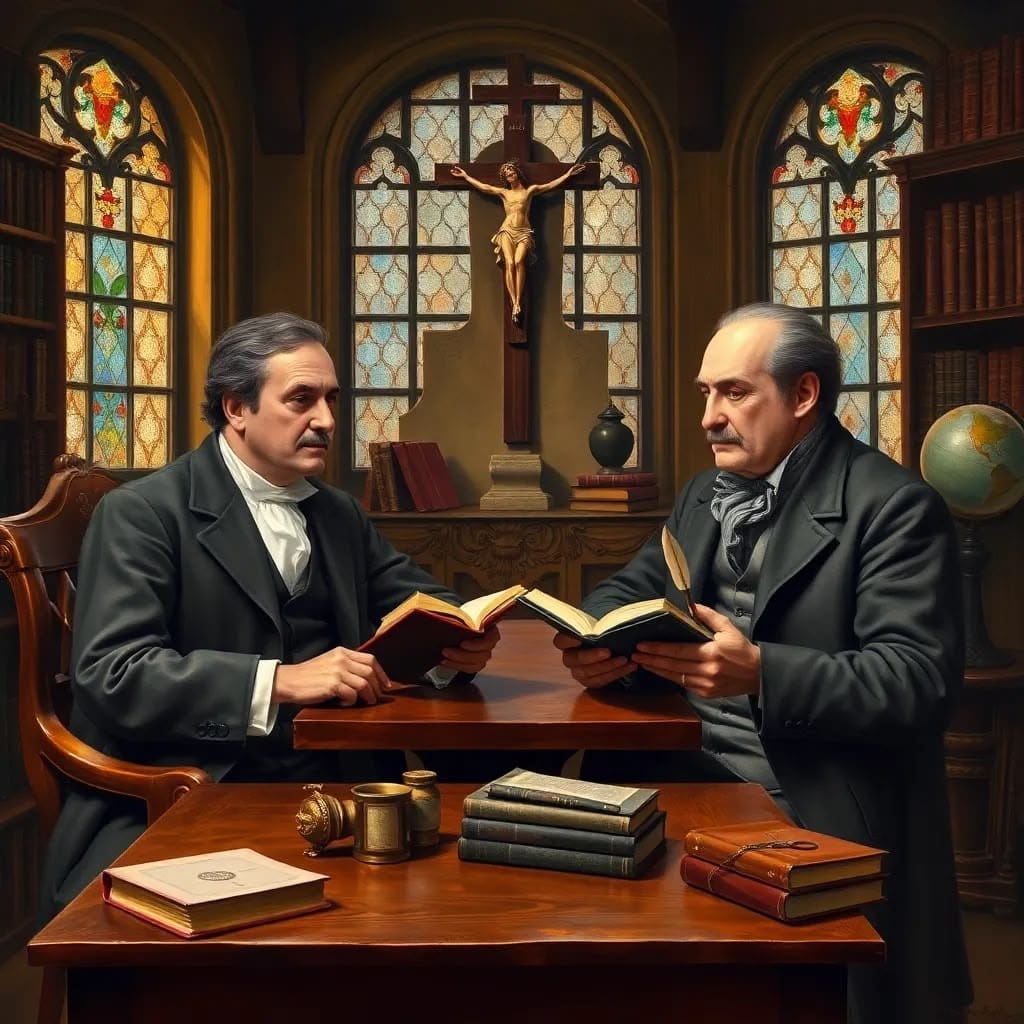
A French tradition in favor of a harmonious dialogue between faith and reason: voices to hope for it!
The question of harmonious dialogue The relationship between faith and reason occupies an essential place in the French Christian tradition. Several French thinkers have emphasized the complementarity of these two dimensions, refusing to see them as irreconcilably opposed.
French authors who advocate complementarity
- Jacques Maritain Maritain is undoubtedly one of the major figures who promoted this synthesis. A neo-Thomist philosopher, he insisted that human reason, although limited, is capable of grasping certain natural truths. Faith, on the other hand, provides a higher illumination and reveals transcendent realities. Maritain wrote that faith and reason are "two distinct but complementary lights," together forming a path to truth.
- Paul Ricoeur, A philosopher and theologian, he explored the relationship between hermeneutics, faith, and critical rationality. He believed that faith should not escape rational examination but rather be enriched by it. His approach opens a space where doubt and intellectual inquiry coexist with spiritual trust.
- Gabriel Marcel, The Christian existentialist emphasizes the importance of lived experience where heart and mind engage in dialogue. He rejects any form of radical separation between these two poles that constitute the human being in its totality.
Cultural and evangelical significance
In the modern context marked by the rise of scientism and relativism, this dialogue takes on new importance:
- It allows French culture to preserve an identity where spirituality and reason coexist without mutual exclusion.
- From an evangelical perspective, it offers a credible answer to contemporary questions about the meaning of life, avoiding the pitfalls of blind fideism or closed rationalism.
- This harmony fosters a coherent testimony, where faith does not retreat into itself but engages in an open dialogue with the intellectual and scientific world.
The debate "Faith and reason: possible dialogue or irreconcilable tension among French Christian thinkers?" thus finds in this tradition a source of concrete hope. Many authors encourage us to move beyond sterile oppositions to build a fruitful exchange, the driving force behind a vibrant and engaged Christian thought.
Contemporary issues in the debate between faith, reason, and modern secular philosophies: a call to action!
THE contemporary issues The dialogue between faith and reason unfolds today in a context marked by the predominance of secular philosophies, often fragmented or closed to transcendence. These currents profoundly influence how religious belief is perceived in relation to scientific and philosophical rationality.
1. Materialist philosophies and scientism
These approaches tend to reduce all reality to the empirical and measurable realm, thus excluding metaphysical or spiritual questions. Limiting knowledge to what is strictly observable often prevents recognition of the transcendent dimension conveyed by faith.
2. Relativism and postmodernism
They question grand explanatory narratives, including religious ones, by emphasizing the plurality of viewpoints. This dispersion values subjective experience at the expense of a universal truth, making a coherent articulation between faith and reason difficult.
3. Closed Rationalisms
Some contemporary philosophical schools adopt a radical critical stance towards anything that goes beyond strictly rational categories, thus rejecting a priori the contribution of revelation or Christian tradition.
Faced with these challenges, French Christian thinkers are actively engaged in:
- Revaluing an open reason : a reason that is not confined to its analytical capacities alone but that opens itself to the fundamental existential questions posed by faith.
- Promoting interdisciplinary dialogue : this dialogue involves philosophy, theology, human and natural sciences in order to overcome artificial divisions between knowledge.
- Recognizing the complementarity of modes of knowledge : faith sheds light on truths that reason alone cannot fully grasp; conversely, reason helps to avoid dogmatic or irrational excesses.
«"Truth is a common quest where faith and reason illuminate each other" — this conviction animates many French thinkers concerned with a responsible intellectual engagement in the face of the challenges of the modern world.
This call for renewed commitment invites us to defend a Christian thought capable of engaging in dialogue with secular philosophies without denying its identity or succumbing to rationalist simplifications. This dynamic is essential to affirming that faith and reason are not enemies but partners in the authentic search for meaning and truth.
To further explore this reflection on the dialogue between faith and reason, It is relevant to explore the implications of materialist philosophies as well as the crucial role of a open rationality in this quest.

Conclusion
The debate on the Faith and reason: possible dialogue or irreconcilable tension among French Christian thinkers? remains at the heart of contemporary intellectual and spiritual issues. A balanced perspective appears essential to avoid the excesses of both closed rationalism and fundamentalist fideism. This approach recognizes the
complementarity faith reasoning, where each enriches the other without confusing or opposing them.
You are invited to continue this reflection, as it nourishes both our philosophical understanding and our spiritual experience. The richness of theological-philosophical dialogue lies in the ability to welcome different, often divergent, but always stimulating perspectives that deepen the search for truth.
Some points to keep in mind:
- Faith sheds light on what reason alone cannot attain, without ever contradicting rational knowledge.
- Critical reason and analysis, ensuring rigor and consistency in the faith received.
- The history of French Christian thought testifies to a constant effort to preserve this fragile balance.
- Current challenges arising from secular philosophies demand a renewed, open, and humble commitment.
This dynamic dialogue promises to illuminate the future of the relationship between belief and rationality. It is up to you to remain curious and open-minded, so that the encounter between faith and reason continues to inspire a shared path toward a deeper understanding of humanity and the divine.
Frequently Asked Questions
What is the central theme of the debate between faith and reason among French Christian thinkers?
The central theme focuses on the relationship between faith and reason, questioning whether a dialogue is possible or whether there is an irreconcilable tension between these two dimensions in French Christian thought.
How does Saint Thomas Aquinas contribute to the dialogue between faith and reason?
Saint Thomas Aquinas established a synthesis between faith and reason by integrating Aristotelian philosophy into Christian doctrine, affirming that faith perfects reason without contradicting it, thus making him a major bridge between these two spheres.
What contemporary vision of the relationship between faith and reason does John Paul II's encyclical 'Fides et Ratio' propose?
‘'Fides et Ratio' presents faith and reason as the two wings of the human mind necessary to seek the truth, criticizing the limits of modern rationalism such as relativism and calling for a renewed dialogue where reason is enlightened by faith.
What historical warnings did Leo XIV give regarding the relationship between faith and reason?
Leo XIV warns against excessive reliance on reason alone (critical rationalism) as well as against a total rejection of reason in the name of the purity of faith (excessive fideism), stressing the importance of a balance to preserve intellectual and spiritual integrity.
What are the main epistemological challenges in the debate between faith and reason within French Christian thought?
The challenges concern methodological differences and sources of knowledge: faith is based on revelation while reason is based on human experience, which generates tensions in their articulation among French Christian thinkers.
How do contemporary French Christian thinkers respond to the challenges posed by modern secular philosophies?
They seek to engage in constructive dialogue with secular philosophical currents that are often fragmented or closed to transcendence, defending the idea of a complementarity between faith and reason to enrich both our philosophical understanding and our spiritual experience.