












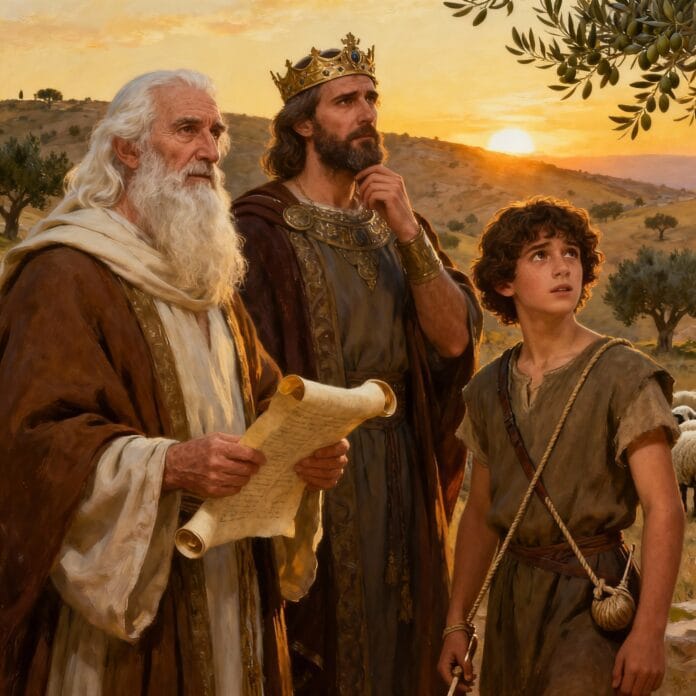
(= 1er (Book of Kings in the Vulgate)
Introduction to 1er and 2d Samuel's book
1° Their unity— The two parts of the Old Testament that we call the first and the Samuel's second book in reality form only one and the same text. Origen (Ap. Euseb., Histor. Eccl., 6, 25) and Saint Cyril of Jerusalem (Cat.( ., 4, 35) attest that, in their time, they were not separated from one another in Hebrew Bibles; this is still true for all manuscript editions (the separation was only introduced in 1518 in printed editions of the Hebrew Bible). The division is nevertheless quite old, since it dates back to the Septuagint, from which the Itala and the Vulgate borrowed it in turn; but the very substance of the narrative, as well as the style, demonstrates the perfect unity of the work. The first lines of the second book connect immediately to the last lines of the first, without the slightest interruption.
2° Their name, and their relationship to the first and second books of Samuel. — The Jews refer to Samuel by the collective name, and, in detail, by the titles First (book) by Samuel, Second (book) by SamuelThe sacred writings that Catholic Bibles up until the 20th century called "First Book of Kings, Second Book of Kings." Then the third and fourth books of Kings became, in their Bible, the first and second of the Melakim, or of the Kings. Saint Jerome partially preserved these designations in the inscriptions he placed at the beginning of the four books: Liber primus Samuelis, quem nos primum Regum dicimus; Liber secumdus Samuelis, quem nos secundum Regum dicimus; Liber Regum tertius, secundum Hebraeos primus Malachim; Liber Regum quartus, secundum Hebraeos Malachim secundusThis other arrangement also comes from the Septuagint, which, adopting the perspective of the Jewish monarchy, whose entire history is recounted in these books, considered them as forming a logical whole (They say: Βασιλείων πρώτη, Βασιλείων δευτέρα, i.e.: First (book) of the reigns, etc. Tertullian Latinized this title as Basiliarum; later, the Latins said: Regnorum, until the Vulgate made the modification that still survives). In this respect, their division is legitimate; but that of the Hebrew Bible is more accurate, since the third and fourth books of Kings constitute a separate work, very different from that which bears the name of Samuel, and much more recent. As for this name, it denotes, like those of Joshua, of Ruth, of Esther, etc., one of the main heroes of the story: the prophet Samuel appears to us, in fact, from the first page, and he played a leading role in the institution of the Israelite kingship, which forms the basis of the narrative.
3° The subject matter and internal organization. — The two books of Samuel recount the continuation of the history of God's people, from the end of the period of the Judges to the final years of David's reign; but, as has just been said, they deal primarily with the origins and definitive establishment of the kingship within the theocratic nation. For a time, the Hebrews are still governed by Judges (Eli, Samuel, the sons of Samuel), as in the preceding period. Various incidents, clustered around Samuel, gradually stir in the hearts of the people the desire to have a true king at their head; Saul is chosen and anointed; however, recognized as incapable before God and men of exercising such high office, he is rejected and replaced by David. The two rivals live together for a few years, the former persecuting the latter and trying to rid himself of him; Then Saul died, and David reigned gloriously over Israel, providing his subjects with strength and glory, both at home and abroad.
The first book opens abruptly: an old man, weakened in body and mind, rules the Hebrews, whom the Philistines harshly oppress. The figure of the young Samuel appears to us simultaneously, as a contrast and as a promise he soon fulfills; we then move on to Saul and David. The first book concludes with the death of the holy prophet and the cursed king. The second deals exclusively with David and his glorious reign.
From this, if we bring together the two books, a very natural division into three parts: 1° the story of Samuel, 1 Samuel 1-12; 2° the story of Saul, 1 Samuel 13-31; 3° the story of David, 2 Samuel 1-24.
But we can also give each book its own division, to make reading even easier. First book. Three parts: 1. The last judges of Israel, 1:1-7:17 (two sections: the judgeship of Eli, 1:1-4:22; the judgeship of Samuel, 5:1-7:17). 2. Saul, king of Israel, 8:1-15:35 (two sections: Saul's elevation to the royal dignity, 8:1-12:25; Saul rejected by God, 13:1-15:35). 3. The Last Years of Saul, the Beginnings of David, 16:1-31:13 (three sections: David at Saul's Court, 16:1-20:43; David's Flight Through the District of Judah, 21:1-26:26; David's Exile Among the Philistines, 27:1-31:13). Second book. Three parts: 1. David reigns in Hebron, 1:1-4:12. 2. David reigns in Jerusalem, 5:1-20:26 (two sections: extracts from the royal annals, describing David's ever-increasing power, 5:1-10:19; David's great crime and its disastrous consequences, 11:1-20:26). 3. The last years of David's reign, 21:1-24:25.
4° Purpose and importance of the first two books of Kings. — The aim is threefold, as we can currently understand it. First, a very general aim: to recount the continuation of the history of the Hebrews, insofar as they were the people of God. Second, a more specific aim: to demonstrate the rights of David and his line to the throne of Israel. Third, a very specific aim: to attest loyalty of God to his ancient promises concerning the Messiah, and describe their progressive fulfillment.
This, of course, is the most essential point. The Lord had once announced to the tribe of Judah that it would exercise a powerful and glorious hegemony over the entire chosen nation, a hegemony that would one day be transformed into the reign of the Messiah himself (cf. Gen. 49:8-11); now he actually places a member of this tribe on the throne of Israel, affirming, in the most solemn terms, that the scepter and crown of David will pass to the last and most august of his descendants (cf. 2 Samuel 7:12-16). Therefore, it is not surprising that the name of Mašiah (.םשוה) or Messiah, now so frequent, so famous, appears for the first time at the beginning of the book of Samuel (1 Samuel 2, 10): he sets the tone for everything else.
But there is more. In this book, in fact, David himself appears to us, in many details of his life, as the figure and type of Christ: a type in his humiliations and sufferings (for example, he too is abandoned and persecuted by his own people; he has his Judas in Ahithophel, etc.); a type in his glories and triumphs. He unites in his person the three great functions of Christ: he is king, and king after God's own heart; he is a prophet in his psalms; he exercises to a certain extent the role of priest, donning priestly vestments (2 Samuel 6:14), giving blessings in the manner of priests (2 Samuel 6:14, 20, etc.). There is truly in him an anticipated likeness of the Messiah; Likewise, he is sometimes called "David" (cf. Jer. 30:9; Ezek. 34:23-24; 37:24-25; Hos. 3:5), just as the holy king bears the name of Christ, anointed.
The dogmatic importance of the narrative is thus indicated. Its historical interest is equally considerable, since it shows us another period of crisis and formation in Israel, a complete change in the form of government. Furthermore, as the monarchy is established, God regularly sends his people an almost uninterrupted succession of prophets to regulate and counterbalance the authority of the kings; these prophets establish schools around them where holiness and sacred knowledge are cultivated together, and the Lord's representatives are thus multiplied for the good of the nation. Moreover, through the complete and detailed organization of worship, the priesthood itself is elevated, so that it can better exercise the influence that is rightfully its own.
5° The author and his sources. — According to a Jewish tradition accepted by several early Church Fathers, Samuel was the author of the first two books by Samuel. But this opinion can only be true insofar as it is restricted to chapters 1 to 24 of the first book, since the rest of the work is subsequent to Samuel's death. Furthermore, the striking unity of content and form that prevails in all parts of the two books presupposes a single historian, thereby excluding Samuel.
This unit also excludes the type of composition to which many heterodox exegetes today attribute the origin of the first and of the Samuel's second bookthat is to say, a pure and simple compilation. The author, whose identity is impossible to determine, managed to maintain his originality while using the fairly numerous documents at his disposal. According to the Bible itself, the written sources he must have used were of three kinds: 1) some accounts from contemporary prophets; for example, "the book of Samuel the Seer," "the book of the prophet Nathan," "the book of Gad the Seer" (cf. 1 Chronicles 29:29); 2) statistical details contained in the fasti regis David (1 Chronicles 27, 24); 3° the poetic collections of this period, such as the "Book of the Just" (cf. 2 Samuel 1, 18), which has already been mentioned in Josh. 10, 13.
In the absence of a name, it is at least possible to indicate an approximate date. According to 1 Samuel 27:6, the city of Shekeleg, which the Philistine leader Achish had given to David, "belonged to the kings of Judah to this day," therefore until the time of the writer. Now, the words "kings of Judah" clearly indicate that the schism of the ten tribes had taken place, and that several monarchs had succeeded one another on the throne of Judah. The reign of Rehoboam fulfills both of these conditions. The style, which is that of the golden age of the Hebrew language, classical and pure, without any mixture of Aramaic words, also suggests a period not far removed from that of David and Solomon.
6° The veracity The validity of our two books has been called into question by several rationalist critics, who base their attacks on contradictions they claim to have discovered within them. Such as the double election of Saul (1 Samuel 10:1 and 10:20-25). The commentary will prove that these antilogies are only apparent (see also Fulcran Vigouroux, Bible Manual, (t. 2, n. 470). The historian's veracity is attested in every way: internally, by the liveliness and simplicity of the narrative, by the meticulousness of the details and their perfect conformity with the customs of the time, by the accuracy of the topography, etc.; externally, by other portions of the Bible, which recount the same events in the same way, and which assume their readers are already familiar with them. See the titles of Psalms 31, 7, 17, 33, 51, 53, 56, 58, 62, 141, and the marginal references that accompany them. Compare also Ps. 77:70; 98:6; ; Isaiah 29, 1; Eccl. 46, 16; 1 Macc. 2, 57; 4, 30. Our Lord Jesus Christ himself quotes a passage from the first book (Matt. 12, 3-4, and parallel passages; cf. 1 Samuel 21, 6); the Blessed Virgin borrows some words from it in her Magnificat (Luke 1, 46-55; cf. 1 Samuel 2, 5 etc.); Saint Peter, Saint Stephen and Saint Paul make other extracts from it (Acts 3, 24; 7, 46; 13, 20-22): proof of the high confidence that the Jews have always had in this writing.
7° Chronology of the two books of Samuel. — The same difficulty arises on this point as with the books of Joshua and of the Judges: we lack sufficient data to determine with certainty the duration of the period encompassed by the entire narrative, and also the dates of the main events. We do find, in 1 Samuel 4:18, forty years for the judicial term of Eli; 2 Samuel 54, forty years for the reign of David; but we do not know how long Samuel and his sons ruled Israel, nor the forty-year period assigned by Saint Stephen to the reign of Saul (cf. Acts 13:31, and Joseph, Antiques, 6, 14, 9), although so clear in appearance, is of little use to us because it does not say whether the two years of Ishbosheth (cf. 2 Samuel 2, 40. Seven and a half years according to others (ibid., 2, 41) are included in this figure, or whether they should be counted separately.
However, we usually allow about one hundred and thirty years for the total duration, and one hundred years for that of the events recounted in the first book.
8° Works to consult. — Among the best Catholic commentators, we will cite Saint Ephrem, In Samuelem, Opera syriaca and Theodoret, In libros Regnorum.
Saint Jerome began his translation of the Vulgate into Hebrew with these books.
1 Samuel 1
1 There was a man from Ramathaim-Sophim, from the hill country of Ephraim, named Elkanah, son of Jeroham, son of Elihu, son of Tohu, son of Suph, an Ephrathite. 2 He had two wives, one named Anne and the other Phenena, and Phenena had children, but Anne had no children. 3 This man went up from his city every year to worship the Lord of hosts and offer sacrifices to him at Shiloh. There were Eli's two sons, Ophni and Phinehas, priests of the Lord. 4 On the day Elkanah offered his sacrifice, he gave portions of the victim to Phenena, his wife, and to all his sons and daughters., 5 and he gave Hannah a double portion, because he loved Hannah, and the Lord had made her barren. 6 Her rival was still causing her great distress, in order to embitter her because the Lord had made her barren. 7 And every year Elkanah did this, every time she went up to the house of the Lord, and Phenena would humiliate her in the same way. So she would weep and not eat. 8 Elkanah, her husband, said to her, «Anne, why are you crying and not eating? Why is your heart sad? Am I not better to you than ten sons?» 9 Hannah got up after they had eaten and drunk at Shiloh. Eli, the high priest, was sitting on a seat before one of the pillars of the temple of the Lord. 10 Her soul filled with bitterness, she prayed to the Lord and shed many tears, 11 And she made a vow, saying, «Lord of hosts, if you will only look on your servant’s affliction and remember me and not forget your servant, and if you will give your servant a male child, then I will give him to the Lord for all the days of his life, and no razor will ever touch his head.» 12 As she remained in prayer before the Lord for a long time, Eli observed her mouth. 13 Anne spoke to herself in her heart and only moved her lips, without her voice being heard. Eli therefore thought that she was drunk., 14 And he said to him, "How long will you remain drunk? Put away your wine."« 15 Anne replied, "No, my lord, I am a woman afflicted in my heart; I have drunk neither wine nor strong drink, but I have been pouring out my soul before the Lord. 16 Do not mistake your servant for a wife of Belial, for it is in the excess of my grief and sorrow that I have spoken thus far.» 17 Eli spoke again and said to him, «Go in peace, and may the God of Israel grant the prayer you have addressed to him.» 18 She said, "May your servant find favor in your eyes." And the woman went on her way and ate, and her face was no longer sad. 19 They got up early in the morning and, having worshiped before the Lord, they returned and went back to their house in Ramah. 20 Elkanah knew Hannah, his wife, and the Lord remembered her. After the time had passed, Hannah conceived and gave birth to a son, whom she named Samuel, "for," she said, "I asked the Lord for him."« 21 Her husband Elkanah went up with all his household to offer the annual sacrifice to the Lord and to fulfill his vow. 22 But Hannah did not go up, and she said to her husband, "When the child is weaned, I will bring him so that he may appear before the Lord and remain there forever."« 23 Elkanah, her husband, said to her, «Do what seems best to you; stay here until you have weaned him. Only may the Lord fulfill his word.» And the woman stayed and nursed her son until she weaned him. 24 When she had weaned him, she took him up with her, bringing three bulls, an ephah of flour and a skin of wine, and brought him to the house of the Lord at Shiloh, the child being still very young. 25 They slaughtered the bull and brought the child to Eli. 26 Anne said, «Forgive me, my lord. As surely as your soul lives, my lord, I am that woman who stood here beside you to pray to the Lord.”. 27 It was for this child that I prayed, and the Lord granted the request I made to Him. 28 I too give him to the Lord; all the days of his life he shall be given to the Lord.» And they worshiped there before the Lord.
1 Samuel 2
1 Hannah prayed and said: My heart rejoices in the Lord, my horn is lifted up by the Lord, my mouth is open against my enemies, for I rejoice in your help. 2 There is no one holy like the Lord, for there is no God besides you, there is no rock like our God. 3 Do not utter such proud words, nor let arrogant speech come from your mouth. For the Lord is a God who knows all things, and the deeds of man do not endure. 4 The bow of the powerful is broken, and the weak have strength as their belt. 5 Those who were full hire themselves out for bread, and those who were hungry are no longer hungry; even the barren woman bears seven children, and she who had many sons withers away. 6 The Lord brings death and gives life; he brings down to the realm of the dead and raises up again. 7 The Lord makes poor and he makes rich, he humbles and he exalts. 8 From the dust he raises the poor, from the ash heap he lifts the needy, to seat them with princes and to inherit a throne of glory. For the pillars of the earth are the Lord's, and upon them he has set the globe. 9 He will guard the steps of his scepters, but the wicked will perish in darkness. For man will not prevail by strength. 10 The Lord will shatter his enemies; from heaven he will thunder against them; the Lord will judge the ends of the earth. He will give strength to his king and exalt the horn of his anointed. 11 Elkanah went to his home in Ramah, and the child remained in the service of the Lord before the priest Eli. 12 But the sons of Eli were men of Belial; they did not know the Lord. 13 And this is how these priests dealt with the people. Whenever someone offered a sacrifice, the priest's servant would come, while the meat was being boiled, holding a three-pronged fork in his hand, 14 He would dip it into the basin, the cauldron, the pot, or the pan, and whatever the fork brought up, the priest would take for himself. This is how they treated all the Israelites who came there to Shiloh. 15 Even before the fat was burned, the priest's servant would come and say to the man offering the sacrifice, "Give me meat to roast for the priest; he will not accept boiled meat from you, only raw meat."« 16 And if the man said to him, "First let the fat be smoked, then you can take what you want," the servant would reply, "No, you must give some now, or I will take it by force."« 17 The sin of these young men was very great in the sight of the Lord, because these men brought contempt upon the offerings of the Lord. 18 Samuel was ministering before the Lord: the child was wearing a linen ephod. 19 Her mother made her a little dress, which she brought to her every year when she went up with her husband to offer the annual sacrifice. 20 Eli blessed Elkanah and his wife, saying, «May the Lord give you children by this woman, in recognition of what she has given to the Lord.» Then they returned home. 21 The Lord visited Hannah, and she conceived and gave birth to three sons and two daughters. And the young Samuel grew up in the presence of the Lord. 22 Eli was very old, and he learned how his sons were behaving toward all Israel and that they were sleeping with women which were used at the entrance to the meeting tent. 23 He said to them, «Why are you doing such things? For I hear from all the people about your wicked deeds. 24 No, my children, the rumor I hear is not good; they are making the Lord's people sin. 25 If a man sins against another man, God intervenes as an arbiter, but if he sins against the Lord, who will intercede for him?» And they did not listen to the voice of their father, for the Lord wanted to put them to death. 26 The young Samuel continued to grow and was pleasing to the Lord and to men. 27 A man of God came to Eli and said to him, «This is what the Lord says: Did I not clearly reveal myself to your father’s house when they were in Egypt in Pharaoh’s house? 28 I have chosen him from among all the tribes of Israel to be my priest, to go up to my altar, to burn incense, to wear the ephod before me, and I have given to the house of your father all the offerings of the children of Israel made by fire. 29 Why have you trampled underfoot my sacrifices and offerings, which I commanded to be offered in my dwelling? And why have you honored your sons more than me, fattening yourselves on the best of all the offerings of Israel, my people? 30 Therefore, this is what the Lord, the God of Israel, says: I promised that your house and your father’s house would walk before me forever. But now, says the Lord, it is no longer so, for I will honor those who honor me, and those who despise me will be despised. 31 The days are coming when I will cut off your arm and the arm of your father’s house, so that there will no longer be an old man in your house. 32 You will see your dwelling humbled, while God will fill Israel with blessings, and there will never again be an old man in your house. 33 I will keep one of your own at my altar so that your eyes may be consumed and your soul may faint, but every offspring of your house will die in the prime of life. 34 And you will have as a sign what will happen to your two sons, to Ophni and Phinehas: they will both die on the same day. 35 And I will raise up for myself a faithful priest, who will act according to my heart and my soul; I will build him a lasting house, and he will always walk before my anointed one. 36 And whoever remains of your house will come and bow down before him, wanting a piece of silver and a piece of bread, and will say, »Please put me in some priestly position, so that I may have a piece of bread to eat.”
1 Samuel 3
1 The young Samuel served the Lord in the presence of Eli. The word of the Lord was rare in those days, and visions were not frequent. 2 At that time, as Eli lay in his place, his eyes began to grow dim and he could no longer see, 3 God's lamp had not yet gone out, and Samuel was lying down in the temple of the Lord, where the ark of God was., 4 The Lord called Samuel, and he answered, «Here I am.» 5 And he ran to Eli and said to him, «Here I am, for you called me.» Eli replied, «I did not call you; go back to bed.» And he went to bed. 6 The Lord called Samuel again, and Samuel got up and went to Eli and said, «Here I am, for you called me.» Eli replied, «I did not call you, my son; go back to bed.» 7 Samuel did not yet know the Lord, because the word of the Lord had not yet been revealed to him. 8 The Lord called Samuel again for the third time. He got up and went to Eli and said, «Here I am, for you have called me.» Then Eli understood that it was the Lord who was calling the child. 9 And Eli said to Samuel, «Go, lie down, and if they call you again, say, »Speak, Lord, for your servant is listening.’” So Samuel went and lay down in his place. 10 The Lord came and stood there and called out as before: «Samuel. Samuel.» Samuel replied: «Speak, for your servant is listening.» 11 And the Lord said to Samuel, «Behold, I am about to do something in Israel which no one shall hear of it without both ears ringing. 12 On that day I will accomplish for Eli all that I have spoken concerning his house, I will begin and I will finish. 13 I told him that I would judge his house forever, because of the crime of which he knew and by which his sons made themselves unworthy without his having reprimanded them. 14 That is why I swore to the house of Eli that the sin of the house of Eli would never be atoned for, neither by sacrifices nor by offerings.» 15 Samuel lay down until morning, then he opened the doors of the house of the Lord. And Samuel was afraid to tell Eli about the vision. 16 But Eli called Samuel, saying, «Samuel, my son.» He answered, «Here I am.» 17 And Eli said, «What is the word that the Lord spoke to you? Please do not hide anything from me. May the Lord deal with you severely if you hide anything from me of all the word that he spoke to you.» 18 Samuel told him everything, hiding nothing from him. And Eli said, "It is the Lord's will; let him do what seems good to him."« 19 Samuel grew up, the Lord was with him, and he let none of his words fall to the ground. 20 All Israel, from Dan to Beersheba, recognized that Samuel was a true prophet of the Lord. 21 And the Lord continued to appear at Shiloh, for the Lord manifested himself to Samuel at Shiloh, by the word of the Lord.
1 Samuel 4
1 Samuel's word came to all Israel. Israel went out to meet the Philistines in battle; they camped near Ebenezer, and the Philistines were camped at Aphek. 2 The Philistines, having drawn up their battle lines against Israel, the battle began and Israel was defeated by the Philistines and they killed about four thousand men in battle line in the plain. 3 The people returned to the camp, and the elders of Israel said, «Why has the Lord defeated us today before the Philistines? Let us bring the ark of the covenant of the Lord from Shiloh to us, so that it may come among us and deliver us from the hand of our enemies.» 4 The people sent to Shiloh, and from that city they brought the ark of the covenant of the Lord Almighty, who sits upon the cherubim. Eli's two sons, Ophni and Phinehas, were there with the ark of the covenant of God. 5 When the ark of the covenant of the Lord entered the camp, all Israel shouted so loudly for joy that the earth resounded. 6 The Philistines heard the sound of these shouts and they said, "What is the meaning of this loud shouting in the camp of the Hebrews?" And they learned that the ark of the Lord had come to the camp. 7 The Philistines were afraid, because they said, "God has come into the camp." And they said, "Woe to us, for nothing like this has ever happened before.". 8 Woe to us! Who will deliver us from the hand of these mighty gods? These are the gods who struck the Egyptians with all kinds of plagues in the desert. 9 »Be strong and act like men, Philistines, or you will be enslaved by the Hebrews as they are enslaved to you. Be men and fight!” 10 The Philistines gave battle and Israel was defeated and everyone fled to their tents, there was a very great defeat and thirty thousand foot soldiers fell on the side of Israel. 11 The ark of God was captured and Eli's two sons, Ophni and Phinehas, perished. 12 A man from Benjamin ran from the battlefield and came to Shiloh the same day, his clothes torn and his head covered in dust. 13 When he arrived, Eli was sitting on a seat by the roadside, waiting, for his heart trembled because of the ark of God. When this man entered the city with this news, the whole city shouted. 14 Hearing the noise of this clamor, Eli said, "What is this tumultuous noise?" And immediately the man came and brought the news to Eli. 15 Now Eli was ninety-eight years old, his eyes were fixed, and he could no longer see. 16 The man said to Eli, "I have just come from the battlefield, and it is from the battlefield that I fled today." Eli said, "What happened, my son?"« 17 The messenger replied, "Israel fled before the Philistines, and there was a great slaughter among the people. Even your two sons, Ophni and Phinehas, are dead, and the ark of God has been captured."« 18 No sooner had he named the ark of God than Eli fell backward from his seat beside the gate, breaking his neck and dying, for he was an old and heavy man. He had judged Israel for forty years. 19 His daughter-in-law, Phinehas' wife, was pregnant and about to give birth. When she heard the news of the capture of the ark of God, and of the death of her father-in-law and her husband, she went into labor and gave birth, for pains came upon her. 20 As she was about to die, women Those who were near her said to her, "Do not be afraid, for you have given birth to a son." But she did not answer and paid no attention. 21 She named the child Ichabod, saying, "Glory is taken from Israel" because of the capture of the ark of God and because of the death of her father-in-law and her husband. 22 She said, "Glory has been taken from Israel, for the ark of God has been captured."«
1 Samuel 5
1 The Philistines, having seized the ark of God, transported it from Ebenezer to Azotus. 2 The Philistines took the ark of God, brought it into the house of Dagon, and placed it beside Dagon. 3 The next day, the Azotians got up early and there was Dagon lying face down on the ground before the ark of the Lord. They took Dagon and put him back in his place. 4 The next day, they rose early in the morning, and behold, Dagon was again lying face down on the ground before the ark of the Lord, his head and his two severed hands lying on the threshold 5 and all that remained was the fish-shaped trunk. That is why the priests of Dagon and all who enter the house of Dagon in Azotus do not set foot on Dagon's threshold to this day. 6 The hand of the Lord weighed heavily upon the people of Azot and afflicted them, striking them with hemorrhoids, in Azot and in its territory. 7 Seeing what was happening, the Azotians said, «Let not the ark of the God of Israel remain with us, for he has laid his hand heavy upon us and upon Dagon our god. 8 And they summoned to their house by messengers all the princes of the Philistines and said, «What shall we do with the ark of the God of Israel?» The princes answered, «Let the ark of the God of Israel be taken to Geth.» So they took the ark of the God of Israel there. 9 But as soon as it was transported, the hand of the Lord was upon the city and there was a very great terror; he struck the people of the city, from the small to the great, and they caught hemorrhoids. 10 So they sent the ark of God to Accaron. When the ark of God entered Accaron, the Accaronites cried out, saying, «They have brought the ark of the God of Israel to us to kill us and our people!» 11 And they summoned by messengers all the princes of the Philistines and said, «Send back the ark of the God of Israel, let it return to its place, so that it does not cause us and our people to die.» 12 For there was a deadly terror throughout the city, and the hand of God was very heavy upon it. Those who did not die were afflicted with hemorrhoids, and the cries of distress from the city rose up to heaven.
1 Samuel 6
1 The ark of the Lord was in the land of the Philistines for seven months. 2 And the Philistines summoned the priests and the diviners and said to them, «What shall we do with the ark of the Lord? Tell us how we should send it back to its place.» They answered: 3 «If you send back the ark of the God of Israel, do not send it back empty, but be sure to make a reparation offering to him, then you will be healed and you will know why his hand has not departed from you. 4 The Philistines said, "What kind of redress offering shall we make to him?"« 5 They replied, «Five gold images of your tumors and five gold mice, according to the number of the Philistine princes, for the same plague has struck you and your princes. So make images of your tumors and images of your mice that are ravaging the land, and in this way give glory to the God of Israel: perhaps he will take away his hand from you, from your gods, and from your land.”. 6 Why should you harden your hearts, as Egypt and Pharaoh hardened theirs? Did they not, when he had punished them, let the children of Israel go? 7 Now then make a new cart and take two suckling cows that have not carried the yoke, hitch the cows to the cart and bring their little ones back to the stable away from them. 8 You shall take the ark of the Lord and put it on the cart, and then, having placed beside it in a chest the gold articles which you have given as a guilt offering, you shall send it away and it shall go. 9 Follow her with your eyes: if she goes up the road to her border, towards Beth-sames, it is the Lord who has done this great harm to us; if not, we will know that it was not his hand that struck us and that it happened to us by chance.» 10 These people did this, having taken two nursing cows, they harnessed them to the cart and they locked their young in the stable. 11 They placed on the chariot the ark of the Lord and the casket with the golden mice and the figures of their hemorrhoids. 12 The cows went straight ahead on the road to Beth-shames, always following the same route, walking and lowing, without turning to the right or to the left. The Philistine princes went after them as far as the border of Beth-shames. 13 The people of Beth-Shamesh were harvesting wheat in the valley. Looking up, they saw the ark and rejoiced when they saw it. 14 The cart arrived in the field of Joshua the Bethsamite and stopped there. There was a large stone there. They split the wood of the cart and offered the cows as a burnt offering to the Lord. 15 The Levites, after taking down the ark of the Lord and the chest that was beside it, containing the gold articles, placed everything on the large stone. The people of Beth-shemesh offered burnt offerings and sacrifices to the Lord that day. 16 The five Philistine princes, having seen this, returned the same day to Accaron. 17 These are the golden hemorrhoids that the Philistines gave to the Lord as a reparation offering: one for Azotus, one for Gaza, one for Ashkelon, one for Geth, one for Accaron. 18 They also offered golden mice according to the number of all the Philistine cities belonging to the five leaders, both fortified cities and unwalled villages: witness the great stone on which the ark of the Lord was placed, which remains to this day in the field of Joshua the Bethsamite. 19 The Lord struck the people of Beth-shames because they had looked into the ark of the Lord; he struck down fifty thousand seventy men of the people. And the people mourned greatly because the Lord had struck them with a great plague. 20 The people of Beth-Sames said, «Who can stand before the Lord, this holy God? And to whom will he ascend when he departs from us?” 21 They sent messengers to the inhabitants of Cariatharia, saying, «The Philistines have brought back the ark of the Lord; come down and bring it up to you.»
1 Samuel 7
1 The people of Cariatharia came and brought up the ark of the Lord, and brought it into the house of Abinadab on the hill, and consecrated his son Eleazar to guard the ark of the Lord. 2 From the day the ark was placed in Cariatharia, a long time passed, twenty years, and all the house of Israel groaned to the Lord. 3 And Samuel said to all the house of Israel, «If you are returning to the Lord with all your heart, then put away the foreign gods and the Ashtoreths from among you, and commit your hearts firmly to the Lord and serve him only, and he will deliver you from the hand of the Philistines.» 4 Then the children of Israel removed the Baals and the Ashtoreths from among them and served the Lord alone. 5 Samuel said, "Assemble all Israel at Masphah, and I will pray to the Lord for you."« 6 And they gathered at Masphah. They drew water and poured it out before the Lord, and they fasted that day, saying, «We have sinned against the Lord.» And Samuel judged the children of Israel at Masphah. 7 The Philistines heard that the Israelites had gathered at Mizpah, and the Philistine leaders came up against Israel. When the Israelites heard this, they were afraid of the Philistines. 8 And the children of Israel said to Samuel, «Do not cease crying out to the Lord our God for us, that he may save us from the hand of the Philistines.» 9 Samuel took a suckling lamb and offered it entirely as a burnt offering to the Lord, and Samuel cried out to the Lord for Israel, and the Lord answered him. 10 While Samuel was offering the burnt offering, the Philistines approached to attack Israel. But the Lord thundered that day with a great roar against the Philistines and routed them, and they were defeated before Israel. 11 The men of Israel, coming out of Maspha, pursued the Philistines and defeated them as far as below Beth-Char. 12 Samuel took a stone and set it up between Maspha and Shen, and named it Ebenezer, saying, «Thus far the Lord has helped us.» 13 Thus humiliated, the Philistines did not return to the territory of Israel; the hand of the Lord was upon the Philistines throughout the life of Samuel. 14 The cities that the Philistines had taken from Israel were returned to Israel, from Acharon to Geth; Israel wrested their territory from the hands of the Philistines. And there was peace between Israel and the Amorites 15 Samuel judged Israel throughout his life. 16 Every year he went out, making his way through Bethel, Gilgal, and Maspha, and he judged Israel in all these places. 17 He then returned to Ramah, where his house was, and there he judged Israel, and there he built an altar to the Lord.
1 Samuel 8
1 When Samuel grew old, he appointed his sons as judges over Israel. 2 His firstborn son was named Joel and the second Abia; they were judges in Beersheba. 3 Samuel's sons did not follow in his footsteps; they turned away from him for gain, accepted gifts, and violated justice. 4 All the elders of Israel gathered together and came to Samuel at Ramah. 5 They said to him, «You are old, and your sons do not follow in your footsteps. Appoint a king to judge us, like all the other nations.» 6 This language displeased Samuel because they were saying, "Give us a king to judge us," and Samuel prayed to the Lord. 7 The Lord said to Samuel, «Listen to the voice of the people in all that they say to you, for it is not you whom they reject, it is me whom they reject, so that I no longer reign over them. 8 As they have always acted towards me from the day I brought them up out of Egypt until now, forsaking me to serve other gods, so they act towards you. 9 And now, listen to their voice, but testify against them and make known to them the rights of the king who will reign over them.» 10 Samuel reported all the words of the Lord to the people who were asking him for a king. 11 He said: «This will be the right of the king who will reign over you: He will take your sons and put them on his chariot and among his horsemen, and they will run before his chariot. 12 He will appoint commanders of thousands and commanders of fifties, and will make them plow his fields, reap his crops, manufacture his weapons of war and the equipment for his chariots. 13 He will take your daughters as perfumers, cooks, and bakers. 14 Your best fields, vineyards, and olive groves he will take and give to his servants. 15 He will take a tithe of your harvests and vineyards and give it to his courtiers and servants. 16 He will take your male and female servants, your best oxen and donkeys, and employ them in his work. 17 He will take a tithe of your flocks and you yourselves will be his slaves. 18 »You will cry out on that day because of the king you have chosen for yourselves, but the Lord will not answer you.” 19 The people refused to listen to Samuel's voice; they said, "No, but there will be a king over us." 20 And we too will be like all the other nations; our king will judge us, he will lead us and wage our wars.» 21 After hearing all the words of the people, Samuel repeated them in the hearing of the Lord. 22 And the Lord said to Samuel, «Listen to their voice and appoint a king over them.» Then Samuel said to the men of Israel, «Each of you should go to your own town.»
1 Samuel 9
1 There was a man of Benjamin, named Cis, son of Abiel, son of Seror, son of Becorath, son of Aphiah, son of a Benjamite; he was a valiant man. 2 He had a son named Saul, young and handsome; none of the children of Israel was more handsome than he, and he towered above all the people. 3 The donkeys belonging to Cish, Saul's father, had strayed, and Cish said to Saul, his son, "Take one of the servants with you, get up, and go in search of the donkeys."« 4 He went through the hill country of Ephraim and through the land of Salisa, but they did not find them; they went through the land of Salim, but they were not there; he went through the land of Benjamin, but they did not find them. 5 When they arrived in the land of Suph, Saul said to his servant who was with him, "Come, let us return, lest my father forget the donkeys and be distressed about us."« 6 The servant said to him, «Look, there is a man of God in this town, a very respected man; everything he says comes true. Let us go there; perhaps he can tell us which way to go.» 7 Saul said to his servant, «If we go, what shall we bring to the man of God? For there is no more food in our sacks, and we have no gift to offer the man of God. What do we have?» 8 The servant answered again and said to Saul, «Look, I find on me a quarter of a shekel of silver; I will give it to the man of God, and he will show us our way.» 9 In ancient times in Israel, when going to consult God, people would say, "Come, let us go to the seer." For the one who is now called a prophet was formerly called a seer. 10 Saul said to his servant, "Your advice is good; come, let us go." And they went to the city where the man of God was. 11 As they climbed the hill leading to the town, they met some young girls who had come out to draw water, and they asked them, "Is the seer here?"« 12 They answered them, saying, «Yes, he is there, he is before you, but go quickly, for he has come to the city today because the people have a sacrifice today at the high place. 13 As soon as you enter the city, you will find him, before he goes up to the high place for the meal, because the people will not eat until he arrives, since he must bless the sacrifice, after which the guests will eat. So go up now; you will find him today.» 14 And they went up to the city. They had entered the middle of the city, and behold, Samuel came out to meet them, to go up to the high place. 15 Now, one day before Saul's arrival, the Lord had revealed something to Samuel, saying: 16 «Tomorrow at this time, I will send you a man from the land of Benjamin, and you shall anoint him to be ruler over my people Israel, and he shall deliver my people from the hand of the Philistines, for I have looked upon my people, because their cry has come to me.» 17 As soon as Samuel saw Saul, the Lord said to him, «This is the man I told you about; he is the one who will reign over my people.» 18 Saul approached Samuel in the middle of the gate and said, "Please tell me where the seer's house is."« 19 Samuel answered Saul, «I am the seer. Come up before me to the high place and you will eat with me today, I will let you go tomorrow and I will tell you everything that is in your heart. 20 As for the donkeys you lost three days ago, don't worry, for they have been found. And whose will be all that is precious in Israel? Will it not be yours and your entire father's household?» 21 Saul replied, «Am I not a Benjamite, from the smallest of the tribes of Israel? And is not my family the least of all the families of the tribe of Benjamin? Why have you spoken such a word to me?» 22 Samuel, having taken Saul and his servant, brought them into the hall and gave them the first place among the guests, who were about thirty men. 23 Samuel said to the cook, "Serve the portion I gave you and told you to set aside."« 24 The cook raised the shoulder with what was on it and served it to Saul. And Samuel said, «Here is the portion reserved; take it from before you and eat, for it was kept for this time when I summoned the people.» And Saul ate with Samuel that day. 25 They then descended from the high place into the city, and Samuel spoke with Saul on the roof. 26 The next day, they got up early in the morning and, as dawn was breaking, Samuel called Saul to the roof and said, "Get up and I will let you go." Saul got up and they both went out, he and Samuel. 27 When they had gone down to the edge of the city, Samuel said to Saul, «Tell your servant to go on ahead of us,» and the servant went on ahead. «Now stop,» Samuel added, “and I will tell you what God has said.”
1 Samuel 10
1 Samuel took a flask of oil and poured it on Saul's head, then kissed him and said, "Has not the Lord anointed you ruler over his inheritance? 2 When you leave me today, you will find two men near Rachel’s tomb in the territory of Benjamin, at Selsah. They will say to you, «The donkeys you went to look for have been found, and now your father has forgotten about the donkeys, but he is worried about you and says, »What should I do about my son?’” 3 From there, continuing on your way, you will come to the oak of Tabor and there you will be met by three men going up to God at Bethel, one carrying three young goats, another three loaves of bread and the other a skin of wine. 4 After they have greeted you, they will give you two loaves of bread, and you will receive them from their hands. 5 After that, you will come to Gibeah of God, where there is a Philistine outpost. As you enter the city, you will meet a procession of prophets coming down from the high place, preceded by lyres, tambourines, flutes and harps, and prophesying. 6 The Spirit of the Lord will come upon you, and you will prophesy with them, and you will be changed into another man. 7 When these signs have been fulfilled for you, do whatever is presented to you, for God is with you. 8 »You will go down to Gilgal before me, and I will come down to you to offer burnt offerings and peace offerings. Wait seven days until I come to you, and I will show you what you must do.” 9 As soon as Saul turned his back to separate from Samuel, God gave him a new heart and all these signs were fulfilled on the same day. 10 When they arrived at Gibeah, a group of prophets came to meet him, and the Spirit of God came upon him, and he prophesied among them. 11 When all those who had known him before saw that he was prophesying with the prophets, they all said to one another, «What has happened to the son of Cish? Is Saul now also among the prophets?» 12 Someone from the crowd spoke up and said, «And who is their father?» That is why it became a proverb: «Is Saul also among the prophets?» 13 When he had finished prophesying, he went to the high place. 14 Saul's uncle said to Saul and his servant, "Where have you been?" Saul replied, "To look for the donkeys, but not seeing them anywhere, we went to Samuel."« 15 Saul's uncle said, "Tell me what Samuel told you."« 16 And Saul answered his uncle, "He told us that the donkeys had been found." But as for the matter of the kingship, he did not tell him what Samuel had said. 17 Samuel summoned the people before the Lord at Maspha, 18 And he said to the children of Israel, «Thus says the Lord, the God of Israel: I brought Israel up out of Egypt and delivered you from the hand of the Egyptians and from the hand of all the kingdoms that oppressed you. 19 And you, today, reject your God, who delivered you from all your afflictions and all your sufferings, and you say to him, »Appoint a king over us.” Now present yourselves before the Lord, by your tribes and by your families.» 20 Samuel brought all the tribes of Israel near, and the tribe of Benjamin was chosen by lot. 21 He summoned the tribe of Benjamin by families, and the family of Metri was chosen, then Saul, son of Cish, was chosen. They looked for him, but he could not be found. 22 Then they asked the Lord again, «Has anyone else come here?» The Lord replied, «Look, he is hidden among the luggage.» 23 They ran to pull him out of there and he stood in the middle of the people, towering above and beyond all the people. 24 And Samuel said to all the people, «Do you see the one the Lord has chosen? There is no one like him among all the people.» And all the people shouted, «Long live the king!» 25 Then Samuel explained to the people the rights of the kingship and wrote them in the book, which he placed before the Lord, and then he sent all the people away, each to his own house. 26 Saul also went to his house in Gibeah, accompanied by worthy men whose hearts God had touched. 27 However, Belial's men said, "Is this the one who will save us?" And they despised him and brought him no gifts. But Saul paid no attention.
1 Samuel 11
1 Naas the Ammonite went up and camped before Jabesh-gilead. All the inhabitants of Jabesh said to Naas, «Make a treaty with us and we will serve you.» 2 But Naas the Ammonite answered them, «I will make a treaty with you on the condition that I put out the right eye of each of you and thus bring disgrace upon all Israel.» 3 The elders of Jabesh said to him, «Grant us a seven-day respite, and we will send messengers throughout the territory of Israel. If there is no one to help us, we will surrender to you.» 4 Messengers came to Gibeah from Saul and told these things in the hearing of the people, and all the people raised their voices and wept. 5 And behold, Saul was returning from the fields behind his oxen, and Saul said, "What is the matter with the people, that they are weeping?" He was told what the men of Jabesh had said. 6 As soon as he heard these words, the Spirit of the Lord came upon Saul, and his anger was kindled. 7 Having taken a pair of oxen, he cut them into pieces and sent messengers throughout the territory of Israel, saying, «Whoever does not follow Saul and Samuel, his oxen will be treated in the same way.» The terror of the Lord fell upon the people, and they set out as one. 8 Saul reviewed them at Bezek: the children of Israel were three hundred thousand and the men of Judah thirty thousand. 9 They told the messengers who had come, «You should also tell the men of Jabesh-gilead: Tomorrow you will receive help, when the sun is in its strength.» The messengers reported this news to the men of Jabesh, and they were filled with joy. 10 And the men of Jabesh said to the Ammonites, «Tomorrow we will surrender to you, and you can treat us as you see fit.» 11 The next day, Saul divided the people into three companies, and they entered the Ammonite camp at dawn and beat them until the heat of the day. Those who escaped were scattered, so that not two remained together. 12 The people said to Samuel, "Who was it who said, 'Shall Saul reign over us?' Hand these people over to us, and we will put them to death."« 13 But Saul said, «No one shall be put to death this day, for today the Lord has brought about the salvation of Israel.» 14 And Samuel said to the people, «Come, let us go to Gilgal, to renew the kingdom there.» 15 All the people went to Gilgal and they installed Saul as king before the Lord, at Gilgal and they offered peace sacrifices there before the Lord and Saul and all the men of Israel rejoiced greatly.
1 Samuel 12
1 Samuel said to all Israel, «Behold, I have listened to your voice in all that you have said to me, and I have appointed a king over you. 2 And now, here is the king who will walk before you. As for me, I am old, I have grown gray, and my sons are among you; I have walked before you from my youth until this day. 3 Here I am, testify about me before the Lord and before his anointed: Whose ox have I taken? Whose donkey have I taken? Whom have I wronged? Whom have I oppressed? From whose hand have I accepted a bribe to turn a blind eye? I will repay you.» 4 They replied, "You have not wronged us, you have not oppressed us, and you have received nothing from anyone."« 5 He said to them, «The Lord is witness against you, and his anointed one is witness this day, that you have found nothing in my hands.» The people replied, «He is witness.» 6 And Samuel said to the people, «Yes, the Lord is witness, he who appointed Moses and Aaron and who brought your fathers up out of the land of Egypt. 7 Now, stand up, I want to call you into judgment before the Lord concerning all the benefits he has bestowed upon you and your fathers. 8 After Jacob came to Egypt, your ancestors cried out to the Lord, and the Lord sent Moses and Aaron, who brought your ancestors out of Egypt and settled them in this place. 9 But they forgot the Lord their God, and he delivered them into the hands of Sisera, commander of Hashor's army, into the hands of the Philistines, and into the hands of the king of Moab, who did to them the war. 10 They cried out to the Lord, saying, «We have sinned, for we have forsaken the Lord and served the Baals and the Ashtoreths; deliver us now from the hand of our enemies and we will serve you.» 11 And the Lord sent Jerobaal and Badan and Jephthah and Samuel, and he delivered you from the hand of your enemies all around you, and you dwelt in your homes in safety. 12 And when you saw Naas, king of the Ammonites, marching against you, you said to me, “No, but a king will reign over us,” even though the Lord your God was your king. 13 So this is the king you have chosen, whom you have asked for; behold, the Lord has established a king over you. 14 If you fear the Lord, if you serve him and obey his voice, if you are not rebellious to the commandment of the Lord, but if you follow both you and the king who reigns over you, the Lord your God. 15 But if you do not obey the voice of the Lord and if you rebel against the commandment of the Lord, the hand of the Lord will be against you, as it was against your fathers. 16 Now stay a while longer and see this great thing that the Lord will do before your eyes. 17 Is it not now the wheat harvest? Well, I will call upon the Lord, and he will send thunder and rain. Then you will know and see how great is in the eyes of the Lord the evil you have done in asking for a king for yourselves.» 18 Samuel called on the Lord, and the Lord sent thunder and rain that same day, and all the people were filled with great fear of the Lord and of Samuel. 19 All the people said to Samuel, «Pray for your servants, Lord your God, that we may not die, for we have added to all our sins the wrong of asking for a king for ourselves.» 20 Samuel said to the people, «Do not be afraid. You have done all this evil, but do not stop following the Lord and serve the Lord with all your heart. 21 Do not turn away from it, for that would be to go to things of nothing, which would give you neither profit nor deliverance, because they are things of nothing. 22 For the Lord will not abandon his people, because of his great name, for it has pleased the Lord to make you his people. 23 Far be it from me to sin against the Lord by ceasing to pray for you. I will teach you the good and right way. 24 Only fear the Lord and serve him in truth with all your heart, for see what great things he has done in your midst. 25 But if you persist in doing evil, you and your king will perish.»
1 Samuel 13
1 Saul was… years old when he became king and he reigned two years over Israel. 2 Saul chose thirty thousand men from Israel: two thousand were with him at Machmas and on the mountain of Bethel, and one thousand were with Jonathan at Gibeah of Benjamin. And he sent the rest of the people away, each to his tent. 3 Jonathan attacked the Philistine outpost at Gabea, and the Philistines heard about it. Then Saul sounded the trumpet throughout the land, saying, «Let the Hebrews hear.» 4 All Israel heard the news: «Saul has defeated the Philistine outpost, and Israel has also made itself odious to the Philistines.» And the people were summoned to Saul at Gilgal. 5 The Philistines assembled to fight Israel; they had thirty thousand chariots, six thousand horsemen, and an army as numerous as the sand on the seashore. They went up and camped at Machmas, east of Beth-Aven. 6 The men of Israel, seeing themselves in great distress, for they were closely pressed, hid themselves in caves, in thickets, in rocks, in holes, and in cisterns. 7 Hebrews also crossed the Jordan to go to the land of Gad and Gilead. Saul was still in Gilgal, and all the people behind him were trembling. 8 He waited seven days, according to the time set by Samuel. But Samuel did not arrive at Gilgal, and the people scattered away from Saul. 9 Then Saul said, "Bring me the burnt offering and the peace offerings." And he offered the burnt offering. 10 As he finished offering the burnt offering, Samuel arrived and Saul went out to meet him to greet him. 11 Samuel said to him, «What have you done?» Saul replied, «When I saw that the people were scattering from me, that you did not reach the appointed time, and that the Philistines were assembled at Machmas, 12 I thought to myself, 'Now the Philistines are going to come down against me at Gilgal, and I haven't sought the Lord's favor. So, forcing myself to offer the burnt offering, I did so.'» 13 Samuel said to Saul, «You have acted foolishly; you have not observed the command that the Lord your God gave you, for the Lord would have established your kingdom over Israel forever. 14 But now your kingdom will not last. The Lord has sought out a man after his own heart and has appointed him to be ruler over his people, because you have not kept what the Lord commanded you.» 15 And Samuel arose and went up from Gilgal to Gibeah of Benjamin. Saul mustered the people who were with him: there were about six hundred men. 16 Saul, Jonathan, his son, and the people who were with them had positioned themselves at Gibeah of Benjamin, and the Philistines were encamped at Machmas. 17 The army of destruction came out of the Philistine camp in three corps: one corps headed towards Ephra, towards the land of Shual, 18 another body took the road to Beth-Horon and the third body, that of the border which overlooks the valley of Seboim, on the side of the desert. 19 No blacksmith could be found in all the land of Israel, for the Philistines had said, "The Hebrews must no longer make swords or spears."« 20 And all Israel went down to the Philistines to sharpen each one his plowshare, his hoe, his axe, or his plow, 21 so that the cutting edges of plowshares, hoes, tridents and axes were often blunt and the goads not straightened. 22 It came to pass that on the day of the battle, there was neither spear nor sword in the hand of all the people who were with Saul and Jonathan, but there were some with Saul and Jonathan, his son. 23 A Philistine outpost went to the crossing at Machmas.
1 Samuel 14
1 One day, Jonathan, son of Saul, said to the young man who carried his armor, "Come, let us cross over to the Philistine outpost, which is over there on the other side." And he said nothing to his father. 2 Saul stood at the edge of Gibeah, under Magron's pomegranate tree, and the people who were with him were about six hundred men. 3 Achias, son of Ahitob, brother of Ichabod, son of Phinehas, son of Eli, priest of the Lord at Shiloh, wore the ephod. The people also did not know that Jonathan had gone away. 4 Between the passes through which Jonathan sought to reach the Philistine outpost, there was a rocky outcrop on one side and a rocky outcrop on the other side, one named Boses and the other named Sene. 5 One of these teeth rises to the north, opposite Machmas, and the other to the south, opposite Gabée. 6 So Jonathan said to the young man who carried his armor, «Come, let us go over to the outpost of these uncircumcised men. Perhaps the Lord will act on our behalf, for nothing can hinder the Lord from saving, whether by many or by few.» 7 His squire replied, "Do whatever you have in mind, go wherever you wish, here I am with you, ready to follow you."« 8 Jonathan said, «Look, we will pass over to these men and show ourselves to them. 9 If they tell us: Stop, until we come to you, we will stay put and we will not go up to them. 10 But if they say, »Come up to us,” we will come up, for the Lord has delivered them into our hands. This will be a sign for us.” 11 They both showed themselves to the Philistine outpost, and the Philistines said, "Here come the Hebrews, coming out of the holes where they had been hiding."« 12 And the men at the post, addressing Jonathan and his squire, said, "Come up to us and we will tell you something." And Jonathan said to his squire, "Come up after me, for the Lord has delivered them into our hands."« 13 And Jonathan went up on his hands and feet, followed by his armor-bearer. The Philistines fell before Jonathan, and his armor-bearer killed behind him. 14 This first massacre carried out by Jonathan and his squire was of about twenty men, over the length of half a furrow of one acre of land. 15 Terror spread through the Philistine camp, through the countryside, and among all the people; the outpost and the army of destruction were also seized with fear, and the earth trembled: it was a terror from God. 16 Saul's watchmen who were at Gibeah of Benjamin saw how the multitude of Philistines scattered and went to one side and the other. 17 Saul said to the people who were with him, «Take a lookout and see who has left us.» They took a lookout, and behold, neither Jonathan nor his armor-bearer was there. 18 And Saul said to Ahijah, «Bring the ark of God near.» For the ark of God was with the Israelites that day. 19 While Saul was speaking to the priest, the commotion in the Philistine camp was growing louder, and Saul said to the priest, «Withdraw your hand.» 20 Then Saul and all the people who were with him gathered together and advanced to the place of battle, and behold, the sword of one was turned against the other, and there was extreme confusion. 21 The Hebrews who had previously been with the Philistines, having gone up with them to the camp all around, also sided with those of Israel who were with Saul and Jonathan. 22 All the men of Israel who had hidden in the mountains of Ephraim, upon learning of the Philistines' flight, also set out to pursue them in battle. 23 That is how the Lord delivered Israel that day. The battle continued as far as Beth-Aven. 24 The men of Israel were exhausted that day. Saul made the people swear an oath, saying, «Cursed be the man who eats any food until evening, until I have taken revenge on my enemies.» And no one tasted any food. 25 All the people came into the forest and there was honey on the surface of the ground. 26 And the people entered the forest, they saw honey flowing, but no one put their hand to their mouth, for the people were afraid of the oath. 27 But Jonathan had not heard when his father had the people take the oath, he put out the end of the staff which he had in his hand and, having dipped it in a honeycomb, he brought his hand to his mouth and his eyes were cleared. 28 Then someone from the people spoke up and said to him, «Your father made the people swear an oath, saying, »Cursed be the man who eats any food today.’ And the people were exhausted.” 29 Jonathan said, «My father brought misfortune upon the people. See how bright my eyes are, because I have tasted a little of this honey.”. 30 "Ah, if the people had eaten today of the spoils taken from their enemies, how much greater would the defeat of the Philistines have been!"» 31 That day they defeated the Philistines from Machmas to Ajalon, and the people were completely defeated. 32 The people rushed upon the plunder and, having taken sheep, oxen and calves, they slaughtered them on the ground and the people ate them with the blood. 33 It was reported to Saul, saying, "Behold, the people are sinning against the Lord by eating the flesh with the blood." Saul said, "You have committed an act of unfaithfulness; roll a large stone toward me at once."« 34 And Saul said, «Scatter among the people and tell them, »Bring me, each of you, your ox and your sheep, and slaughter them here. Then you may eat of them and you will not sin against the Lord by eating with the blood.’” So each of the people brought his ox by hand during the night and slaughtered it there. 35 Saul built an altar to the Lord; this was the first altar he erected for the Lord. 36 Saul said, «Let us go down while it is night, pursue the Philistines, and plunder them until morning, leaving not a single one alive.» They said, «Do whatever seems good to you.» But the high priest said, «Let us come here to God.» 37 And Saul inquired of God: «Shall I go down after the Philistines? Will you deliver them into the hands of Israel?» And the Lord gave him no answer that day. 38 Saul said, «Come here, all you leaders of the people, and search out and see what sin has been committed today. 39 For as surely as the Lord, the deliverer of Israel, lives, even if sin were upon my son Jonathan, he would surely die.» And no one among all the people answered him. 40 He said to all Israel, «You stand on one side, and I and my son Jonathan will stand on the other side.» And the people said to Saul, «Do what seems best to you.» 41 Saul said to the Lord, «God of Israel, reveal the truth.» Jonathan and Saul were chosen, and the people were freed. 42 Then Saul said, "Cast lots between me and Jonathan, my son." And Jonathan was chosen. 43 Saul said to Jonathan, "Tell me what you have done." Jonathan told him, "I tasted a little honey with the end of the staff that was in my hand; here I am, I am going to die."« 44 And Saul said, "May God deal with me, be it ever so severely, if you do not die, Jonathan."« 45 The people said to Saul, «Should Jonathan, who has brought about this great deliverance in Israel, die? Far be it from us! As the Lord lives, not a hair of his head will fall to the ground, for he has acted with God this day.» So the people saved Jonathan, and he did not die. 46 Saul went up to Gibeah, without pursuing the Philistines, and the Philistines returned to their own country. 47 When Saul had taken possession of the kingship over Israel, he did the war around him, to all his enemies, to Moab, to the children of Ammon, to Edom, to the kings of Zobah and to the Philistines, and wherever he turned, he prevailed. 48 He performed mighty deeds, defeated Amalek, and delivered Israel from the hand of those who plundered it. 49 Saul's sons were Jonathan, Jessui and Melchisua, his two daughters were named, the elder Merob and the younger Michol. 50 Saul's wife's name was Ahinoam, daughter of Ahimaaz. The name of the commander of his army was Abner, son of Ner, Saul's uncle. 51 Cis, father of Saul, and Ner, father of Abner, were sons of Abiel. 52 The war was fierce against the Philistines all the days of Saul, and whenever Saul saw a strong and valiant man, he attached him to his service.
1 Samuel 15
1 Samuel said to Saul, «It is I whom the Lord has sent to anoint you as king over his people, over Israel, so listen to what the Lord says. 2 Thus says the Lord of hosts: I have considered what Amalek did to Israel, when he rose up against them on the way, when Israel came up out of Egypt. 3 "Now go, strike Amalek and devote to him all that belongs to him; show him no mercy, and put to death men and women, children and infants, oxen and sheep, camels and donkeys."» 4 Saul informed the people, whom he reviewed at Telaim: he counted two hundred thousand foot soldiers and ten thousand men from Judah. 5 Saul advanced as far as the city of Amalek and he set an ambush in the valley. 6 Saul said to the Kenites, «Go, depart, go down from the midst of Amalek, lest I encircle you with them, for you showed kindness to all the children of Israel, when they came up out of Egypt.» So the Kenites departed from the midst of Amalek. 7 Saul defeated Amalek from Hevilah to Sur, which is east of Egypt. 8 He took Agag, king of Amalek, alive and he devoted all the people to anathema, putting them to the edge of the sword. 9 But Saul and the people spared Agag, as well as the best of the sheep, the oxen, the second-born, the lambs, and everything good; they would not devote it to destruction, and everything that was weak and worthless, they devoted to destruction. 10 The word of the Lord came to Samuel, saying: 11 «I regret that I made Saul king, for he has turned away from me and has not carried out my words.» Samuel was grieved and cried out to the Lord all night. 12 Samuel got up early in the morning to go and meet Saul, and Samuel was told, «Saul went to Carmel and behold, a monument was erected there; then he returned and, passing on further, went down to Gilgal.» 13 Samuel came to Saul, and Saul said to him, «May the Lord bless you. I have done what the Lord has said.» 14 Samuel said, "What is this bleating of sheep in my ears and this lowing of oxen that I hear?"« 15 Saul replied, "They brought them from the Amalekites, for the people spared the best of the sheep and cattle to sacrifice to the Lord your God, but the rest we have devoted to destruction."« 16 Samuel said to Saul, "Enough. I will tell you what the Lord told me last night." And Saul said to him, "Speak."« 17 Samuel said, «When you were little in your own eyes, did you not become the head of the tribes of Israel, and did not the Lord anoint you king over Israel? 18 The Lord sent you on this path, saying: Go and devote these sinners, the Amalekites, to anathema and fight them until they are exterminated. 19 Why did you not listen to the voice of the Lord, and why did you rush upon the plunder and do what is evil in the sight of the Lord?» 20 Saul said to Samuel, «Yes, I have listened to the voice of the Lord and have walked in the way to which the Lord sent me. I have brought Agag, king of Amalek, and I have devoted Amalek to destruction.”. 21 And the people took from the spoil of sheep and cattle the firstfruits of the accursed, to sacrifice them to the Lord your God at Gilgal. 22 Samuel said, «Does the Lord delight in burnt offerings and sacrifices as much as in obeying the Lord’s voice? To obey is better than sacrifice, and to be patient than the fat of rams.”. 23 For rebellion is as guilty as divination, and stubbornness as idolatry and teraphim. Because you have rejected the word of the Lord, he has also rejected you from being king.» 24 Then Saul said to Samuel, «I have sinned, for I have transgressed the command of the Lord and your words; I feared the people and obeyed their voice. 25 Now, I pray you, forgive my sin, come back to me and I will worship the Lord.» 26 Samuel said to Saul, «I will not return with you, because you have rejected the word of the Lord, and the Lord has rejected you from being king over Israel.» 27 And, as Samuel turned to leave, Saul grasped the end of his cloak, and it tore. 28 And Samuel said to him, «The Lord has torn the kingdom of Israel from you today and has given it to your neighbor, who is better than you.”. 29 He who is the glory of Israel does not lie or repent, for he is not a man, that he should repent.» 30 Saul said, «I have sinned. Now honor me, I pray you, in the presence of the elders of my people and in the presence of Israel; return with me, and I will worship the Lord your God.» 31 Samuel returned and followed Saul, and Saul worshiped the Lord. 32 And Samuel said, "Bring me Agag, king of Amalek." And Agag came to him with a joyful expression, Agag said: Surely the bitterness of death is past. 33 Samuel said, “Just as your sword has bereaved women of their children, so will your mother be bereaved of children, between women. » And Samuel cut Agag into pieces before the Lord at Gilgal. 34 Samuel went to Ramah and Saul went up to his house in Gibeah of Saul. 35 And Samuel did not see Saul again until the day of his death. How Samuel wept for Saul, for the Lord had regretted making Saul king over Israel.
1 Samuel 16
1 The Lord said to Samuel, «How long will you mourn for Saul, since I have rejected him from ruling over Israel? Fill your horn with oil and go; I am sending you to Jesse of Bethlehem, for I have chosen among his sons the king I want.» 2 Samuel said, «How can I go? Saul will hear about it and kill me.» And the Lord said, «Take a heifer with you and say, ‘I have come to offer a sacrifice to the Lord.’”. 3 You shall invite Jesse to the sacrifice, and I will show you what you must do, and you shall anoint for me the one I designate to you.» 4 Samuel did as the Lord had said and went to Bethlehem. The elders of the city came to meet him, worried, and said, «Is your arrival for peace ? » 5 He replied: "For peace. "I have come to offer a sacrifice to the Lord. Consecrate yourselves and come with me to the sacrifice." And he consecrated Jesse and his sons and invited them to the sacrifice. 6 When they had entered, Samuel saw Eliab and said, "Surely the Lord's anointed is before him."« 7 And the Lord said to Samuel, «Do not look at his appearance or his height, for I have rejected him. It is not what man sees; man looks at the appearance, but the Lord looks at the heart.» 8 Jesse called Abinadab and brought him before Samuel, and Samuel said, "The Lord has not yet chosen this one."« 9 Jesse led Samhain past, and Samuel said, "This is not yet the one the Lord has chosen."« 10 Jesse presented his seven sons before Samuel, and Samuel said to Jesse, "The Lord has not chosen any of these."« 11 Then Samuel said to Jesse, «Are these all the young men?» He replied, «There is still the youngest, and look, he is tending the sheep.» Samuel said to Jesse, «Send for him, for we will not sit down to eat until he comes here.» 12 Jesse sent for him. Now he was ruddy, with beautiful eyes and a handsome face. The Lord said, «Arise, anoint him, for this is he.» 13 Samuel took the horn of oil and anointed him in the presence of his brothers, and the Spirit of the Lord came upon David from that day forward. Samuel arose and went to Ramatha. 14 The Spirit of the Lord departed from Saul, and an evil spirit from the Lord came upon him. 15 Saul's servants said to him, "Behold, an evil spirit from God has come upon you. 16 Let our lord speak; your servants are before you. They will seek out a man who knows how to play the harp, and when the evil spirit from God is upon you, he will play with his hand, and you will be relieved.» 17 Saul replied to his servants, "Find me a skilled gambler and bring him to me."« 18 One of the servants spoke up and said, «I saw a son of Jesse from Bethlehem, "He knows how to play, he is a strong and valiant warrior, articulate, a handsome man, and the Lord is upon him."» 19 Saul sent messengers to Jesse, saying, "Send me David, your son, who is with the sheep."« 20 Jesse took a donkey, with bread, a skin of wine and a young goat and sent them to Saul by David, his son. 21 When David arrived at Saul's house, he stood before him and Saul took a liking to him and he became his armor-bearer. 22 And Saul sent word to Jesse: «Please let David remain before me, for he has found favor in my eyes.» 23 When the spirit from God was upon Saul, David would take the harp and play with his hand, and Saul would calm down and feel well, and the evil spirit would leave him.
1 Samuel 17
1 The Philistines, having gathered their armies to do the war, They gathered at Socho, which belongs to Judah, and they camped between Socho and Azekah, at Ephes-Dommim. 2 Saul and the men of Israel also gathered together and camped in the Valley of Terebinth, and drew up their battle lines opposite the Philistines. 3 The Philistines were stationed on the mountain on one side and Israel was stationed on the mountain on the other side: the valley was between them. 4 Then a champion came out of the Philistine camps, his name was Goliath, he was from Geth and his height was nearly three meters. 5 A bronze helmet covered his head and he wore a scale cuirass, and the weight of the cuirass was five thousand shekels of bronze. 6 He had a bronze shoe on his feet and a bronze javelin between his shoulders. 7 The shaft of his spear was like the cylinder of a loom and the point of his spear weighed six hundred shekels of iron; the one who carried his shield walked in front of him. 8 Goliath stopped and, addressing the battalions of Israel, he shouted to them: «Why have you come out to draw up in battle formation? Am I not the Philistine and are you not the slaves of Saul? Choose a man who will come down against me. 9 »If he prevails in a fight with me and kills me, we will be your subjects; but if I prevail over him and kill him, you will be our subjects and serve us.” 10 The Philistine added, "I issue this challenge to the army of Israel: Give me one man and we will fight together."« 11 When Saul and all Israel heard these words of the Philistine, they were terrified and greatly afraid. 12 Now David was the son of that Ephrathite of Bethlehem of Judah named Jesse, who had eight sons, this man, in the time of Saul, was old, advanced in years. 13 Jesse's three eldest sons had gone to follow Saul to the war and the names of those three sons who had gone to the war They were Eliab the elder, Abinadab the second, and Samma the third. 14 David was the youngest. The three eldest followed Saul. 15 And David went back and forth from Saul's presence, tending his father's sheep at Bethlehem. 16 The Philistine came forward morning and evening and presented himself for forty days. 17 Jesse said to David, his son, «Take for your brothers this ephah of roasted grain and these ten loaves of bread and run to the camp to your brothers. 18 And these ten cheeses, take them to the leader of their thousand. You will visit your brothers to see if they are well and you will take from them a sign proving that all is well. 19 Saul and they and all the men of Israel were in the Valley of Elah, doing the war to the Philistines.» 20 David got up early in the morning and, leaving the sheep with a shepherd, he took the provisions and set out, as Jesse had commanded him. When he arrived at the camp, the army was leaving the camp to draw up in battle formation, and war cries were being raised. 21 Israelites and Philistines lined up, troop against troop. 22 David placed his luggage in the hands of the baggage handler and ran towards the troop. As soon as he arrived, he asked his brothers how they were doing. 23 While he was talking with them, the champion, whose name was Goliath, the Philistine from Geth, came forward from the ranks of the Philistines, speaking the same words, and David heard him. 24 When they saw this man, all the Israelites withdrew from him in great fear. 25 An Israelite said, «Do you see this man coming forward? He is coming forward to defy Israel. Whoever kills him, the king will reward him abundantly, give him his daughter in marriage, and exempt his father’s family from all burdens in Israel.» 26 David said to the men standing near him, «What will be done for the man who kills this Philistine and removes this disgrace from Israel? Who is this uncircumcised Philistine that he should defy the armies of the living God?» 27 The people repeated the same words to him, saying, "This is what will be done to the one who kills him."« 28 Eliab, his eldest brother, heard him speaking to the men, and Eliab's anger burned against David, and he said, "Why have you come down here, and with whom have you left these few sheep in the wilderness? I know your pride and the malice of your heart; you have come down to see the battle."« 29 David replied, "What have I done now? Isn't it just a word?"« 30 And, turning away from him to address another, he spoke the same language and the people responded to him as before. 31 When they heard the words spoken by David, they reported them to Saul, who summoned him. 32 David said to Saul, «Let no one’s heart fail. Your servant will go and fight against this Philistine.» 33 Saul said to David, "You cannot go out against this Philistine to fight with him, for you are only a youth and he has been a warrior from his youth."« 34 David said to Saul, «When your servant was tending his father’s sheep and a lion or a bear came and took a sheep from the flock, 35 I would go after him, strike him, and snatch the sheep from his mouth; if he stood against me, I would seize him by the jaw, strike him, and kill him. 36 Your servant has killed a lion like a bear, and this uncircumcised Philistine will be like one of them, because he has defied the armies of the living God.» 37 David added, «The Lord who delivered me from the lion and the bear will also deliver me from the hand of this Philistine.» And Saul said to David, «Go, and may the Lord be with you.» 38 Saul dressed David in his own clothes, put a bronze helmet on his head, and fitted him with a breastplate., 39 Then David girded Saul's sword over his armor and tried to walk, for he had never worn armor before. David said to Saul, "I cannot walk in this armor; I am not used to it." And having taken it off, 40 David took his staff in hand, chose five smooth stones from the stream and put them in his shepherd's bag, in his satchel. Then, with his sling in hand, he advanced towards the Philistine. 41 The Philistine gradually approached David, preceded by the man who carried the shield. 42 The Philistine looked, saw David, and despised him, for he was very young, ruddy, and handsome. 43 The Philistine said to David, «Am I a dog, that you come at me with a stick?» And the Philistine cursed David by his gods. 44 And the Philistine said to David, «Come to me, so that I may give your flesh to the birds of the air and to the beasts of the field.» 45 David answered the Philistine, «You come to me with sword, spear, and javelin, but I come to you in the name of the Lord of hosts, the God of the armies of Israel, whom you have insulted. 46 Today the Lord will deliver you into my hands, and I will strike you and lift up your head from you. Today I will give the carcasses of the Philistine army to the birds of the air and the beasts of the earth, and all the earth will know that there is a God in Israel. 47 And all these people will know that it is not by sword or spear that the Lord saves, for to the Lord belongs the war and he delivered you into our hands.» 48 The Philistine got up, moved forward, and advanced to meet David, and David hastened to run towards the front of the troop to meet the Philistine. 49 David put his hand in his bag, took out a stone and slung it, striking the Philistine on the forehead, and the stone sank into his forehead, and he fell face down on the ground. 50 So David, with a sling and a stone, prevailed over the Philistine, and struck the Philistine down. And there was no sword in David's hand. 51 David ran, stopped near the Philistine, and, taking his sword from its sheath, killed him and cut off his head with it. 52 Seeing their hero dead, the Philistines fled. Then the men of Israel and Judah rose up, shouting, and pursued the Philistines as far as the entrance to Geth and the gates of Acharon. The Philistine corpses were scattered along the road from Saraim to Geth and to Acharon. 53 Upon their return from pursuing the Philistines, the children of Israel plundered their camp. 54 David took the Philistine's head and brought it to Jerusalem, and he put the Philistine's armor in his tent. 55 When Saul saw David approaching the Philistine, he said to Abner, the commander of the army, "Whose son is this young man, Abner?" Abner replied, "As surely as you live, O king, I do not know."« 56 The king said to him, "Find out who this young man's son is."« 57 When David returned after killing the Philistine, Abner took him and brought him before Saul, David having the Philistine's head in his hand. 58 Saul said to him, «Whose son are you, young man?» And David answered, «I am the son of your servant, Jesse of Bethlehem. »
1 Samuel 18
1 When David had finished speaking to Saul, Jonathan's soul clung to David's soul, and Jonathan loved him as his own soul. 2 That same day, Saul took David and did not let him return to his father's house. 3 And Jonathan made a covenant with David, because he loved him as his own soul. 4 Jonathan took off the cloak he was wearing and gave it to David, along with his armor, including his sword, his bow, and his belt. 5 Whenever David went out, wherever Saul sent him, he succeeded; Saul put him in command of the fighting men and he pleased all the people, even the king's servants. 6 When they entered, when David returned after killing the Philistine, women They came out from all the cities of Israel, singing and dancing, to meet King Saul with joy, to the sound of tambourines and harps. 7 WomenThe dancers answered each other and said: Saul killed his thousand and David his ten thousand. 8 Saul was very angry and these words displeased him; he said, "They give David ten thousand and me only a thousand. He lacks nothing more than the kingship."« 9 And from that day on, Saul looked upon David with suspicion. 10 The next day, an evil spirit sent from God came upon Saul, and he went into fits of rage in the midst of his house. David was playing the harp, as on other days, and Saul had his spear in his hand. 11 Saul brandished his spear, saying to himself, "I will nail him to the wall," but David turned away from him twice. 12 Saul feared David, for the Lord was with David and had departed from Saul. 13 and Saul removed him from his person and appointed him commander of a thousand men, and David went out and came in before the people. 14 David proved skillful in all his undertakings, and the Lord was with him. 15 Saul, seeing that he was very clever, was afraid of him, 16 But all Israel and Judah loved David, because he went out and came in before them. 17 Saul said to David, «Here, I will give you my older daughter Merob as a wife; only be valiant and fight in the Lord’s wars.» But Saul thought to himself, «Let not my hand be against him, but let the Philistines» hand be against him.” 18 David answered Saul, «Who am I, and what is my life, or my father’s family in Israel, that I should become the king’s son-in-law?» 19 But when it came time to give Merob, daughter of Saul, to David, she was given as a wife to Hadriel of Molathi. 20 Michal, Saul's daughter, loved David. Saul was informed of this and it pleased him. 21 Saul thought to himself, "I will give her to him, so that she may be a snare for him and the Philistines may fall upon him." And Saul said to David a second time, "Today you will become my son-in-law."« 22 And Saul gave this order to his servants: «Speak to David in secret and tell him: The king has taken a liking to you and all his servants love you; therefore, be the king’s son-in-law now.» 23 Saul's servants whispered these words in David's ear, and David replied, "Is it a small thing in your eyes to become the king's son-in-law? I am a poor man of humble origin."« 24 Saul's servants reported to him, saying, "David said this."« 25 Saul said, «Say this to David: The king asks for no bride price, but a hundred Philistine foreskins, to avenge himself on the king’s enemies.» Saul thought that this would make David fall into the hands of the Philistines. 26 Saul's servants reported these words to David, and David was pleased to become the king's son-in-law. 27 Before the days were over, David arose, went with his men, and killed two hundred Philistines. David brought back their foreskins and gave the king the full number, so that he might become his son-in-law. Then Saul gave him his daughter Michal in marriage. 28 Saul saw and understood that the Lord was with David, and Michal, Saul's daughter, loved David. 29 And Saul feared David more and more, and Saul was hostile to David every day. 30 The Philistine princes made raids, and every time they went out, David, by his skill, achieved more success than all of Saul's servants, and his name became very famous.
1 Samuel 19
1 Saul spoke to Jonathan, his son, and to all his servants about putting David to death. But Jonathan, Saul's son, was very fond of David. 2 And Jonathan informed David, saying, «Saul, my father, is trying to kill you. So be on your guard tomorrow morning, stay away and hide. 3 »I will go out and stand beside my father in the field where you are, and I will talk to my father about you. I will see what he says and then I will let you know.” 4 Jonathan spoke favorably of David to Saul, his father, saying, «Let not the king sin against his servant David, for he has not sinned against you. On the contrary, all his actions are for your good.” 5 He risked his life, he struck down the Philistine, and the Lord brought about a great deliverance for all Israel through him. You saw it and rejoiced; why then should you be guilty of innocent bloodshed by putting David to death without cause?» 6 Saul listened to Jonathan's voice and Saul swore this oath: "As the Lord lives, David will not be put to death."« 7 Jonathan called David and Jonathan reported all these words to him, then Jonathan brought David back to Saul and David stood in his presence as before. 8 The war Having started again, David went out against the Philistines and gave battle to them, he inflicted a great defeat upon them and they fled before him. 9 Then the evil spirit of the Lord came upon Saul, while he sat in his house with his spear in his hand, and David played the harp with his hand. 10 Saul tried to strike David and the wall with his spear, but David fled from Saul, who struck the spear against the wall. David escaped and fled during the night. 11 Saul sent messengers to David's house to watch him and kill him in the morning, but Michal, David's wife, informed him, saying, "If you do not escape tonight, tomorrow you will be put to death."« 12 Michol lowered David through the window and David went away and fled and was saved. 13 Michol then took the teraphim and, having placed it in the bed, she put a goatskin over its head and covered it with a garment. 14 And when Saul sent messengers to take David away, she said, "He is sick."« 15 Saul sent the messengers back to David, saying, "Bring him to me in his bed, so that I may kill him."« 16 The messengers returned and behold, the teraphim was on the bed with a goatskin over its head. 17 And Saul said to Michal, «Why have you deceived me like this and let my enemy go, so that he might be saved?» Michal answered Saul, «He said to me, »Let me go, or I will kill you.’” 18 That is how David escaped and was saved. He went to Samuel at Ramah and told him everything Saul had done to him. Then he went with Samuel to live in Naioth. 19 Saul was informed, with the message: "David is at Naioth in Ramah."« 20 Immediately Saul sent messengers to capture David, and they saw the company of prophets prophesying, with Samuel standing at their head. The Spirit of God came upon Saul's messengers, and they also prophesied. 21 This was reported to Saul, and he sent other messengers, and they too prophesied. For the third time, Saul sent messengers, and they too prophesied. 22 So Saul also went to Ramah. When he arrived at the great cistern in Soco, he asked, «Where are Samuel and David?» They answered him, «They are in Naioth in Ramah.» 23 And he went there, to Naioth in Ramah. The Spirit of God was also upon him, and he went about and prophesied until he arrived at Naioth in Ramah. 24 There, having also taken off his clothes, he too prophesied before Samuel, and he remained naked on the ground all that day and all that night. That is why people say, «Is Saul also among the prophets?»
1 Samuel 20
1 David fled from Naioth in Ramah and, having come, he said to Jonathan, «What have I done? What is my crime, what is my sin before your father, that he seeks my life?» 2 Jonathan said to him, "Far from it. You will not die. My father does nothing, great or small, without telling me, so why would he hide this from me? It's not true."« 3 David answered with an oath: «Your father knows that I have found favor in your eyes, and he will have said, »Jonathan must not know, lest he be grieved.’ But as surely as the Lord lives and as you live, there is but a step between death and me.” 4 Jonathan said to David, "Whatever your soul desires, I will do for you."« 5 And David said to Jonathan, «Behold, tomorrow is the new moon and I should be sitting with the king at the meal, let me go and I will hide in the fields until the evening of the third day. 6 If your father notices my absence, tell him: David asked me to let him run an errand at Bethlehem, his city, because that is where the annual sacrifice for his entire family takes place. 7 If he says, "It is good, your servant can be at peace," but if he becomes angry, know that he has truly resolved to do evil. 8 Therefore, show kindness to your servant, since it was by a covenant in the name of the Lord that you drew your servant to yourself. If there is any fault in me, kill me yourself, for why should you bring me to your father?» 9 Jonathan said to him, "Far be it from you to think that. For if I learn that my father has resolved to harm you, I swear I will tell you."« 10 David said to Jonathan, "Who will tell me about this, or about what your father's response would be disastrous?"« 11 Jonathan said to David, "Come, let's go out into the fields," and they both went out into the fields. 12 Jonathan said to David, «The Lord, the God of Israel, I will sound out my father tomorrow or the day after, and if things are going well for David and I do not send word to you, 13 May the Lord deal with Jonathan in all his severity. If it pleases my father to harm you, I will also inform you and send you away, so that you may go in peace and the Lord may be with you, as he was with my father. 14 And if I am still alive, please treat me with kindness of the Lord and, if I die, 15 "Do not ever remove your goodness from my house, not even when the Lord cuts off from the face of the earth every one of David's enemies."» 16 This is how Jonathan made an alliance with the house of David, and how the Lord took revenge on David's enemies. 17 Jonathan once again implored David by the love he had for him, for he loved him as his own soul. 18 Jonathan told him, "Tomorrow is the new moon, we will notice that your place is empty. 19 On the third day, you shall go down quickly and come to the place where you were hiding on the day of the incident, and you shall remain near the stone of Ezel. 20 I will shoot three arrows towards the side of the stone, as if I were aiming at a target. 21 And behold, I will send the boy, saying to him, Go, find the arrows. If I say to the boy, Behold, the arrows are behind you, take them, then come, for all is well with you and there is no danger, the Lord lives. 22 But if I say to the boy, “Look, the arrows are before you; go away, for the Lord is sending you away.”. 23 And as for the word that you and I have spoken, behold, the Lord is between you and me forever.» 24 David hid in the fields. When the new moon arrived, the king took his place at the feast to eat., 25 As usual, the king sat on his seat, on the seat that was near the wall, Jonathan stood up and Abner sat next to Saul and David's place remained empty. 26 Saul said nothing that day, for, he said, "something has happened to him; he is not pure, certainly he is not pure."« 27 The next day, the second day of the new moon, David's place was still empty, and Saul said to Jonathan, his son, "Why didn't Jesse's son come to the meal yesterday or today?"« 28 Jonathan answered Saul, «David earnestly asked my permission to go as far as Bethlehem. 29 He said, »Please let me go, for we have a family sacrifice in the city, and my brother has commanded me to attend. If I have found favor in your eyes, please let me go and see my brothers.” That is why he did not come to the king’s table.» 30 Then Saul's anger burned against Jonathan, and he said to him, "Son of a perverse and rebellious woman, do I not know that you have made the son of Jesse your friend, to your shame and to the shame of your mother's nakedness? 31 For as long as the son of Jesse lives on the earth, there will be no security for you or your kingdom. And now send for him and bring him to me, for he is a son of death.» 32 Jonathan answered Saul, his father, and said to him, «Why should he be put to death? What has he done?» 33 And Saul raised his spear against him to strike him. Jonathan understood that it was decided with his father to kill David. 34 So Jonathan got up from the table in a violent rage and did not eat anything on the second day of the new moon, because he was grieved on account of David, because his father had insulted him. 35 The next morning, Jonathan went to the fields, as agreed with David, accompanied by a little boy. 36 He said to his boy, "Run, find the arrows I'm going to shoot." The boy ran, and Jonathan shot an arrow in such a way as to overtake him. 37 When the boy arrived at the spot where Jonathan had shot the arrow, Jonathan shouted at the boy and said, "Isn't the arrow farther away than you?"« 38 Jonathan shouted again at the boy: "Quickly, hurry, don't stop." And Jonathan's boy picked up the arrow and returned to his master. 39 The boy knew nothing; only Jonathan and David understood. 40 Jonathan gave his weapons to the boy who was with him and said, "Go and take them to the city."« 41 As soon as the boy had left, David got up from the south side and, throwing himself face down on the ground, he prostrated himself three times before Jonathan, then they kissed each other and wept for each other, until David burst into tears. 42 And Jonathan said to David, «Go in peace, now that we have both sworn an oath in the name of the Lord, saying, »The Lord be between me and you, and between my descendants and your descendants forever.’”
1 Samuel 21
1 David got up and left, and Jonathan went back into the city. 2 David went to Nobah, to the high priest Ahimelech, and Ahimelech ran up to David in fear and said to him, "Why are you alone and is there no one with you?"« 3 David answered the priest Ahimelech: «The king gave me an order and said: Let no one know anything about the matter for which I am sending you and I have given you an order. I have assigned my men this meeting place. 4 "And now, what do you have on hand? Give me five loaves of bread, or whatever you can find."» 5 The priest answered David, saying, "I do not have ordinary bread on hand, but there is consecrated bread, provided that your people have abstained from women."« 6 David answered the priest and said, «We have abstained from women for the three days since I left, and the bodies of my men are pure, even though this is a profane expedition. How much more so are they today in a state of holiness.» 7 Then the priest gave him consecrated bread, for there was no other bread there except the bread of the Presence, which had been taken away from before the Lord, to be replaced with fresh bread at the time it was taken away. 8 That same day, there was a man there from among Saul’s servants, detained before the Lord; his name was Doeg, an Edomite, chief of Saul’s shepherds. 9 David said to Ahimelech, «Do you not have a spear or a sword with you? For I have not even brought my sword or my weapons with me, because the king’s command was urgent.» 10 The priest replied, «Here is the sword of Goliath the Philistine, whom you killed in the Valley of Elah; it is wrapped in the cloak, behind the ephod. If you want it, take it, for there is no other here.» And David said, «There is no like it; give it to me.» 11 David got up and fled that same day from Saul; he went to Achish, king of Geth. 12 Achish's servants said to him, "Isn't this David, king of the land? Isn't this the one about whom they sang and danced: 'Saul has killed his thousands, and David his ten thousand'?"« 13 David took these words to heart and was very afraid of Achish, king of Geth. 14 He concealed his reason from their eyes and played the fool in their hands, he beat the drum on the door panels and let his saliva drip onto his beard. 15 Achis said to his servants, "You can see that this man is a madman, why did you bring him to me?" 16 Do I lack enough madmen that you should bring me this one to act madly in front of me? Must he enter my house?»
1 Samuel 22
1 David left there and fled to the cave of Odollam. When his brothers and all his father's household heard about it, they went down to him there. 2 All the oppressed, all those who had creditors, and all those who were bitter, gathered around him, and he became their leader; there were about four hundred men with him. 3 From there, David went to Mizpah of Moab. He said to the king of Moab, «Please let my father and mother stay with you until I know what God will do for me.» 4 And he brought them before the king of Moab, and they stayed with him as long as David was in the stronghold. 5 The prophet Gad said to David, «Do not remain in the stronghold; go and return to the land of Judah.» So David went and went to the forest of Hareth. 6 Saul learned that David and the people who were with him had been recognized. Now Saul was sitting at Gibeah under the tamarisk tree on the hill, with his spear in his hand, and all his servants were lined up before him. 7 Saul said to his servants who were lined up before him, «Listen, Benjamites: will the son of Jesse also give fields and vineyards to all of you, and make all of you commanders of thousands and commanders of hundreds, 8 Why have you all conspired against me? Is it because no one has informed me that my son has made a pact with the son of Jesse, and that none of you cares for me or warns me that my son has stirred up my servant against me to set traps for me, as he is doing today?» 9 Doeg the Edomite, who was the chief of Saul's servants, answered and said, "I saw the son of Jesse come to Nobah, to Ahimelech, the son of Ahitob. 10 Ahimelech consulted the Lord on his behalf and gave him provisions; he also gave him the sword of Goliath the Philistine.» 11 The king sent for Ahimelech the priest, son of Ahitob, and all his father's household, the priests who were at Nobah. 12 They all came to the king, and Saul said, "Listen, son of Ahitob." He replied, "Here I am, my lord."« 13 Saul said to him, «Why have you and the son of Jesse conspired against me? You gave him bread and a sword and inquired of God for him, only to have him rise up against me and lie in wait for me, as he is doing today?» 14 Ahimelech answered the king and said, «Which of all your servants is like David, faithful and proven, the king’s son-in-law, admitted to your councils and honored in your house? 15 Would I have begun to consult God on his behalf today? Far be it from me. Let not the king place a burden on his servant that would weigh heavily upon my father's entire household, for your servant has known nothing of all this, neither little nor much.» 16 The king said, "You will die, Ahimelech, you and all your father's house."« 17 And the king said to the guards who stood near him, «Turn around and put the priests of the Lord to death, for their hand is with David, and knowing full well that he was in flight, they did not inform me.» But the king’s servants would not raise their hands to strike the priests of the Lord. 18 Then the king said to Doeg, «Turn around and strike down the priests.» So Doeg the Edomite turned around and struck down the priests, killing eighty-five men that day who wore the linen ephod. 19 Saul struck again with the edge of the sword Nobah, the priestly city: men and women, children and infants, oxen, donkeys and sheep, were put to the edge of the sword. 20 Only one son of Ahimelech, son of Ahitob, escaped; his name was Abiathar, and he took refuge with David. 21 Abiathar told David that Saul had killed the priests of the Lord. 22 And David said to Abiathar, «I knew that day that Doeg the Edomite, who was there, would not fail to inform Saul. I am the one responsible for the death of your entire father’s house.”. 23 Stay with me, do not be afraid, for whoever seeks my life seeks your life, and with me you will be safe.»
1 Samuel 23
1 David was told, "Look, the Philistines are attacking Ceilah and plundering the threshing floors."« 2 David inquired of the Lord, saying, «Shall I go and defeat these Philistines?» And the Lord answered David, «Go, defeat the Philistines and rescue Ceilah.» 3 But David's men said to him, "Behold, we are afraid in Judah; how much more so if we go to Ceilah against the Philistine troops?"« 4 David inquired of the Lord again, and the Lord answered him, saying, «Get up, go down to Ceilah, for I will deliver the Philistines into your hand.» 5 So David went with his men to Ceilah and attacked the Philistines, capturing their livestock and inflicting a great defeat upon them. Thus David delivered the inhabitants of Ceilah. 6 Now when Abiathar, son of Ahimelech, fled to David at Ceilah, he went down with the ephod in his hand. 7 Saul was told that David had gone to Ceilah, and Saul said, "God has delivered him into my hands, for he has shut himself in by coming to a city that has gates and bars."« 8 And Saul summoned all the people to the war, in order to go down to Ceilah and besiege David and his men. 9 But David, having learned that Saul was plotting evil against him, said to the priest Abiathar, "Bring the ephod."« 10 And David said, «The Lord, God of Israel, your servant, has heard that Saul is trying to come to Ceilah to destroy the city because of me. 11 Will the inhabitants of Ceilah deliver me into his hands? Will Saul come down, as your servant has heard? Lord, God of Israel, please reveal it to your servant.» The Lord answered, «He will come down.» 12 And David said, «Will the inhabitants of Ceilah hand me and my men over to Saul?» The Lord answered, «They will hand you over.» 13 So David and his men, about six hundred in number, set out from Ceilah and wandered about aimlessly. When Saul heard that David had fled from Ceilah, he halted his march. 14 David remained in the desert, in the refuges, and he stayed in the mountains in the desert of Ziph. Saul searched for him every day, but God did not give him into his hands. 15 David learned that Saul had set out to kill him: David was standing in the wilderness of Ziph, in the forest, 16 And Jonathan, son of Saul, arose and went to David in the forest. He strengthened his hand in God and said to him: 17 «Do not be afraid, for the hand of Saul, my father, will not touch you. You will reign over Israel, and I will be second only to you; Saul, my father, knows this well.» 18 They both made a covenant before the Lord, and David stayed in the forest while Jonathan returned home. 19 The Ziphites went up to Saul at Gibeah and said, «David is hiding among us in refuges in the forest, on the hill of Hailah, which is south of the heath. 20 "Come down then, O king, as your whole soul desires; it is for us to deliver him into the king's hands."» 21 Saul said, «Blessed are you of the Lord, for you have had mercy on me.”. 22 Go, I beg you, make sure again, find out and see where he is going and who has seen him there, for I am told he is very cunning. 23 See and learn all the hiding places where he is, then come back to me with reliable information and I will go with you. If he is in the land, I will search for him among all the thousands of Judah.» 24 So they got up and went to Ziph before Saul. But David and his men had withdrawn to the wilderness of Maon, in the plain, south of the moor. 25 Saul and his men went in search of David. When David learned of this, he went down to the rock and stayed in the wilderness of Maon. Saul was informed of this and pursued David into the wilderness of Maon., 26 Saul was walking on one side of the mountain and David with his men on the other side of the mountain, David was hurrying to escape from Saul, while Saul and his men surrounded David and his men to capture them. 27 A messenger came to Saul, saying, «Hurry and come, for the Philistines have invaded the land.» 28 Saul stopped pursuing David and went to meet the Philistines. That is why the place was called Sela-Hammahlekoth.
1 Samuel 24
1 David went up from there and settled in the refuges of Engaddi. 2 When Saul returned from pursuing the Philistines, he was told, "David is in the wilderness of Engaddi."« 3 Saul took three thousand elite men from all Israel and went in search of David and his people as far as the rocks of the wild goats. 4 He came to the sheep pens which were near the road, there was a cave there, where Saul went in to relieve himself and David and his men were sitting at the back of the cave. 5 David's men said to him, "This is the day the Lord spoke of: 'I will deliver your enemy into your hands; do to him as you please.'" David got up and secretly cut off a corner of Saul's robe. 6 After this, David's heart beat fast because he had cut off a corner of Saul's robe. 7 And he said to his men, «The Lord forbid that I should do such a thing as lay a hand on my master, the Lord’s anointed, for he is the Lord’s anointed.» 8 With his words, David restrained his men and prevented them from attacking Saul. Saul got up to leave the cave and continued on his way. 9 After this David got up and, coming out of the cave, he began to shout after Saul, saying, "O king, my lord." Saul looked behind him, and David bowed his face to the ground and prostrated himself. 10 And David said to Saul, «Why do you listen to the words of people who say, ‘Behold, David seeks to harm you?’” 11 Behold, today your eyes have seen how the Lord delivered you, this very day, into my hands in the cave. They told me to kill you, but my eye was moved by your pity, and I said, I will not lay a hand on my lord, for he is the Lord’s anointed. 12 Look, my father, look in my hand at the corner of your cloak. Since I cut off the corner of your cloak and did not kill you, acknowledge and see that there is no wickedness or rebellion in my conduct, and that I have not sinned against you. And you are hunting me down to take my life. 13 May the Lord judge between you and me, and may the Lord avenge me on you. But my hand will not be on you. 14 From wickedness comes wickedness, says the old proverb, so my hand will not be on you. 15 Whom did the king of Israel set out after? Who are you chasing? A dead dog? A flea? 16 May the Lord judge and decide between you and me. May he look upon me and plead my case, and may his judgment deliver me from your hand.» 17 When David had finished speaking these words to Saul, Saul said, "Is that your voice, my son David?" And Saul raised his voice and wept. 18 He said to David, «You are more righteous than I, for you have done me good and I have repaid you evil.”. 19 Today you have shown that you are acting kindly towards me, since the Lord has delivered me into your hands and you have not killed me. 20 If someone meets their enemy, do they let them go on their way in peace? May the Lord reward you for what you have done for me this day. 21 Now I know that you will be king and that the kingdom of Israel will be firmly established in your hands. 22 Swear to me by the Lord that you will not destroy my descendants after me and that you will not blot out my name from my father's house.» 23 David swore to Saul. And Saul went to his house, and David and his men went up to their refuge.
1 Samuel 25
1 However, Samuel died, and all Israel gathered together, mourned for him, and buried him in his home at Ramah. Then David arose and went down to the wilderness of Paran. 2 There was a man in Maon whose property was in Carmel; he was a very rich man, he had three thousand sheep and a thousand goats, and he was in Carmel for the shearing of his sheep. 3 The man's name was Nabal, and his wife's name was Abigail. The woman was intelligent and beautiful, but the man was harsh and wicked in his deeds; he was of the lineage of Caleb. 4 David learned in the desert that Nabal was shearing his sheep. 5 David sent ten young men and said to them, «Go up to Carmel and find Nabal, and greet him in my name.” 6 And you will speak to him thus: For life. That peace be with you, that peace be with your house and that peace be with everything that belongs to you. 7 And now I have learned that you have shearers. But your shepherds were with us; we caused them no trouble, and nothing of the flock was taken from them during all the time they were at Carmel. 8 Ask your servants, and they will tell you. May the young men find favor in your eyes, since we come in a day of joy. Give, I pray you, to your servants and to your son David whatever your hand can find.» 9 When David's young men arrived, they repeated all these words to Nabal in David's name and then they rested. 10 Nabal answered David's servants and said, "Who is David and who is the son of Jesse? Many are the servants who run away from their masters these days. 11 And I would take my bread and my water and my livestock that I slaughtered for my shearers and give them to people who come from I don't know where?» 12 David's young men retraced their steps and returned, and when they arrived, they repeated all these words to him. 13 Then David said to his men, "Each of you should take his sword." And they each took his sword, and David also took his sword. About four hundred men went up after David, and two hundred remained near the baggage. 14 One of Nabal's servants came and brought the news to Abigail, saying, "Behold, David has sent messengers from the desert to greet our master, who has fallen upon them. 15 And yet these people were good to us, they caused us no pain and nothing was taken from us during the whole time we traveled with them, when we were in the countryside. 16 They served as our shield, both night and day, the whole time we were with them, grazing the flocks. 17 "Now recognize and see what you must do, for the evil has been determined against our master and all his house; for him, he is a son of Belial, and no one can speak to him."» 18 Immediately Abigail took two hundred loaves of bread, two skins of wine, five prepared sheep, five measures of roasted grain, one hundred clusters of raisins, and two hundred dried figs, and, having placed them on donkeys, 19 She said to her young men, "Go on ahead of me, I'll follow you." But she said nothing to Nabal, her husband. 20 As she was going down, riding on a donkey, to a sheltered spot on the mountain, David and his men were coming down opposite her, and she met them. 21 David said, "It is in vain that I have watched over all that this man has in the desert, and nothing has been taken from all that he possesses; he repays me evil for good.". 22 May God deal with David's enemies in all his severity. Of all that belongs to Nabal, I will leave nothing alive until daybreak, not even a single male.» 23 As soon as Abigail saw David, she quickly got off the donkey and, falling on her face before David, she prostrated herself on the ground. 24 Then she fell at his feet, saying, «Let the blame be on me, my lord, on me. Allow your servant to speak in your ear and listen to the words of your servant.”. 25 My lord should pay no attention to that man from Belial, Nabal, for he is exactly what his name indicates: his name is The Madman, and madness is with him. But I, your servant, have not seen the men of my lord whom you sent. 26 Now, my lord, as surely as the Lord lives and as your soul lives, the Lord has preserved you from shedding blood and taking revenge with your own hand. And now, may your enemies and those who wish harm upon my lord be like Nabal. 27 Therefore, accept this gift that your servant brings to my lord, and let it be distributed to the young men who follow my lord. 28 Please forgive your servant’s fault, for the Lord will surely make my lord a stable house, for my lord supports the Lord’s wars and no evil will be found in you all the days of your life. 29 If anyone rises up to pursue you and seek your life, the life of my lord will be carefully preserved with the lives of the living with the Lord your God, and the life of your enemies he will sling away. 30 When the Lord has done to my lord according to all the good he has spoken about you, and has appointed you ruler over Israel, 31 It will not be a cause of remorse for you, nor will it be a source of grief for my lord, that he shed blood without cause and took revenge himself. And when the Lord has dealt well with my lord, remember your servant.» 32 David said to Abigail, «Blessed be the Lord, the God of Israel, who has sent you to meet me today. Blessed be your great wisdom, 33 And blessed be you, you who prevented me this day from shedding blood and taking revenge with my own hand. 34 Otherwise, as surely as the Lord, the God of Israel, lives, who has kept me from harming you, if you had not hurried to meet me, Nabal would have had nothing left by daybreak, not even a single male.» 35 David took from Abigail what she had brought him and said to her, «Go up in peace to your house; see, I have listened to your voice and lifted up your countenance.» 36 Abigail returned to Nabal, and behold, he was holding a feast in his house, like a king's feast, and Nabal's heart was joyful and he was completely drunk. She taught him neither little nor much until daybreak. 37 But in the morning, when Nabal came back from his drunkenness, his wife told him these things and his heart received a mortal blow and he became like a stone. 38 About ten days later, the Lord struck Nabal and he died. 39 When David heard of Nabal's death, he said, "Blessed be the Lord, who has pleaded my cause and avenged me against the insult I received from Nabal's hand, and who has kept his servant from doing evil. The Lord has brought Nabal's wickedness back on his own head." Then David sent word to Abigail that he wished to take her as his wife. 40 When they arrived at Abigail's house in Carmel, David's servants spoke to her, saying, "David has sent us to you, to take you as his wife."« 41 She got up and, prostrating herself with her face to the ground, said, "Behold, your servant is like a slave to wash the feet of my lord's servants."« 42 Abigail immediately got up and mounted a donkey, and five of her daughters followed her; she went with David’s messengers and became his wife. 43 David also took Ahinoam of Jezreel, and both became his wives. 44 But Saul had given his daughter Michal, David's wife, to Phalti of Gallim, son of Laish.
1 Samuel 26
1 The Ziphites came to Saul at Gibeah and said, "David is hiding on the hill of Hailah, east of the desert."« 2 Saul arose and went down to the desert of Ziph with three thousand elite men of Israel, to seek David in the desert of Ziph. 3 Saul camped on the hill of Hailah, east of the desert, near the road, while David remained in the wilderness. When David saw that Saul was searching for him in the wilderness, 4 David sent spies and learned that Saul had actually arrived. 5 David got up and came to the place where Saul was encamped. David saw the place where Saul was lying, with Abner, son of Ner, commander of his army: now Saul was lying in the middle of the camp and the people were encamped around him. 6 So David addressed Ahimelech the Hittite and Abishai, son of Zeruiah and brother of Joab, saying, «Who will go down with me to the camp to Saul?» And Abishai replied, «I will go down with you.» 7 David and Abishai came to the people by night and behold, Saul was lying in the middle of the camp and was asleep, with his spear stuck in the ground at his head, and Abner and the people were lying around him. 8 Abishai said to David, «Today God has imprisoned your enemy in your hands; now, I pray you, let me strike him with the spear and pin him to the ground with one blow, without having to return.» 9 But David said to Abishai, «Do not kill him. For who could lay a hand on the Lord’s anointed and go unpunished?» 10 And David said, «As surely as the Lord lives, it will be the Lord who strikes him down, or his day will come and he will die, or he will go down to the war and he will perish., 11 But the Lord forbid that I should lay a hand on the Lord's anointed. Now take the spear that is at his head, along with the jug of water, and let us go.» 12 And David took the spear and the jug of water that were at Saul's head, and they went away. No one saw, no one knew, no one woke up, for they were all asleep, because the Lord had put a deep sleep upon them. 13 David crossed to the other side and stood far away on the mountaintop, a large space separated them. 14 And David called out to the people and to Abner son of Ner, saying, «Will you not answer, Abner?» Abner answered, saying, «Who are you, crying out to the king?» 15 David said to Abner, «Are you not a man? And who is your equal in Israel? Why then have you not guarded the king, your lord? For one of the people has come to kill the king, your lord. 16 What you have done is wrong. As surely as the Lord lives, you have deserved death for not guarding your master, the Lord's anointed. Now look where the king's spear and the water jug that was at his bedside are.» 17 Saul recognized David's voice and said, "Is that your voice, my son David?" And David replied, "It is my voice, O king, my lord."« 18 He added, "Why is my lord pursuing his servant? What have I done, and what crime has my hand committed?" 19 Now let the king, my lord, deign to listen to the words of your servant: if it is the Lord who stirs you up against me, let him accept the incense of an offering; but if it is men, let them be cursed before the Lord, since they have now driven me out, to take away my place from the inheritance of the Lord, saying: Go serve foreign gods. 20 And now may my blood not fall upon the earth, far from the face of the Lord. For the king of Israel has gone out to look for a flea, as one would chase a partridge in the mountains.» 21 Saul said, «I have sinned; return, my son David, for I will not harm you again, since on this day my life was precious in your eyes. Behold, I have acted foolishly and have made a great mistake.» 22 David replied, "Here is the spear, O king; let one of your young men come and take it.". 23 The Lord will repay each person according to their justice and faithfulness, for the Lord had delivered you into my hands today, and I would not lay a hand on the Lord's anointed. 24 »Just as your life has been precious in my eyes today, so my life will be precious in the eyes of the Lord, and he will deliver me from all distress.” 25 Saul said to David, "Blessed be you, my son David. You will certainly succeed in your endeavors." David continued on his way, and Saul returned home.
1 Samuel 27
1 David said to himself, "I will one day perish by the hand of Saul; there is nothing better for me than to flee quickly to the land of the Philistines, so that Saul will give up searching for me any longer in all the territory of Israel, and I will escape his hand."« 2 And David arose, he and the six hundred men who were with him, and they went over to Achish, son of Maoch, king of Geth. 3 David remained with Achish in Geth, he and his people, each with his family, and David with his two wives, Ahinoam of Jezreel and Abigail of Carmel, wife of Nabal. 4 Saul was told that David had fled to Geth, and he did not resume his pursuit. 5 David said to Achish, «If I have found favor in your eyes, let me be given a place to live in one of the towns in the countryside, for why should your servant live with you in the royal city?» 6 And on that day Achish gave him Ziklag, and that is why Ziklag has belonged to the kings of Judah to this day. 7 The number of days that David spent in the land of the Philistines was one year and four months. 8 David and his men went up and raided the Gessurians, the Gerzians and the Amalekites, for these peoples had lived from ancient times in the region of Sur and as far as the land of Egypt. 9 David ravaged the land, leaving neither man nor woman alive, taking away sheep, oxen, donkeys, camels, and clothing, then he returned to Achish. 10 Achish would ask, "Where have you raided today?" And David would reply, "Into the Negev of Judah, into the Negev of the Jerahamelites, and into the Negev of the Kenites."« 11 David left no man or woman alive to bring to Geth, for fear, he said to himself, "that they might report against us, saying, 'Thus David did.'" And this was his way of acting all the time he remained in the land of the Philistines. 12 Achish trusted David and said, "He has made himself odious to his people, to Israel, therefore he will be my servant forever.
1 Samuel 28
1 At that time, the Philistines gathered their troops into a single army to go and fight against Israel. And Achish said to David, «Know that you and your men will come with me to the camp.» 2 David answered Achish, "You will see what your servant will do." And Achish said to David, "And I will appoint you as my guardian forever."« 3 Samuel had died, all Israel had mourned for him, and he was buried in Ramah, his own city. And Saul had removed from the land those who consulted mediums and spiritists. 4 The Philistines having gathered together, came to camp at Shunem, Saul gathered all Israel and they camped at Gilboa. 5 When Saul saw the Philistine camp, he was afraid and his heart was greatly troubled. 6 Saul inquired of the Lord, but the Lord did not answer him, neither by dreams, nor by the Urim, nor by the prophets. 7 Then Saul said to his servants, «Find me a woman who is a medium, so that I may go to her and consult her.» His servants told him, «There is a woman in Endor who is a medium.» 8 Saul disguised himself and put on other clothes and left, accompanied by two men. They arrived at the woman's house at night, and Saul said to her, "Predict the future for me by summoning a dead man, and bring up for me the one I name."« 9 The woman replied, "Now you know what Saul has done, how he cut off from the land those who summon the dead and the soothsayers, why are you setting a trap for me, to kill me? 10 Saul swore to him by the Lord, saying, «As surely as the Lord lives, no harm will come to you because of this.» 11 And the woman said, "Who shall I bring up for you?" He replied, "Bring up Samuel for me."« 12 When the woman saw Samuel, she cried out loudly and said to Saul, "Why have you deceived me? You are Saul."« 13 The king said to her, "Do not be afraid, but what have you seen?" The woman said to Saul, "I see a god coming up out of the earth."« 14 He said to her, "What does he look like?" And she replied, "It is an old man coming up, and he is wrapped in a cloak." Saul realized that it was Samuel, and he fell facedown to the ground and prostrated himself. 15 Samuel said to Saul, «Why have you troubled me by bringing me up?» Saul replied, «I am in great distress; the Philistines are attacking me.” the war And God withdrew from me; he did not answer me through prophets or dreams. I have called upon you to tell me what I must do.» 16 Samuel said, «Why do you consult me, since the Lord has withdrawn from you and become your adversary? 17 The Lord has done as he announced through me: the Lord has taken the kingdom from your hand and given it to your companion, to David. 18 Because you did not obey the voice of the Lord and did not treat Amalek according to the fierceness of his anger, that is why the Lord has acted thus toward you this day. 19 And the Lord will even deliver Israel with you into the hands of the Philistines. Tomorrow, you and your sons will be with me, and the Lord will deliver the camp of Israel into the hands of the Philistines.» 20 Saul immediately fell to the ground from his full height, for Samuel's words had filled him with terror, and moreover, his strength failed him, for he had eaten no food all day and all night. 21 The woman came to Saul and, seeing his great distress, she said to him, «Your servant has obeyed your voice; I have risked my life, obeying the words that you spoke to me. 22 »Now listen to the voice of your servant, and let me offer you a piece of bread; eat it, so that you may have strength as you continue on your way.” 23 But he refused and said, «I will not eat.» His servants and the woman urged him, and he yielded to their entreaties. He rose from the ground and sat on the couch. 24 The woman had a fattened calf at home; she quickly killed it and, taking some flour, she kneaded it and baked unleavened bread. 25 She placed them before Saul and his servants, and they ate. Then they got up and left that same night.
1 Samuel 29
1 The Philistines gathered all their troops at Aphek and Israel was encamped near the spring in Jezreel. 2 While the Philistine princes advanced at the head of hundreds and thousands, and David and his men marched in the rearguard with Achish, 3 The Philistine leaders said, «What are these Hebrews?» Achish answered the Philistine leaders, «Isn’t this David, the servant of Saul, king of Israel, who has been with me for days and years, and I have found nothing wrong with him from the time he came to us until this day?» 4 But the Philistine leaders were angry with Achish and said to him, «Send this man back to where you stationed him. Do not let him go down with us to battle, or he will be an enemy to us in the fighting. And how can he regain his master’s favor except by offering him the heads of these men?” 5 Isn't this the David for whom they sang while dancing: Saul killed his thousand and David his ten thousand?. 6 Achish called David and said to him, «As surely as the Lord lives, you are an upright man, and I look favorably upon all your conduct with me in the camp, for I have found nothing wrong with you from the day you came to me until this day, but you are displeasing in the eyes of the princes. 7 "Go back and leave in peace, so as not to do anything displeasing in the eyes of the Philistine princes."» 8 David said to Achish, «But what have I done, and what have you found in your servant, from the day I came to you until this day, that I have not gone to fight against the enemies of my lord the king?» 9 Achish answered and said to David, «I know that you have been good to me like an angel of God, but the leaders of the Philistines say: he will not go up with us to battle. 10 "So get up early, you and the servants of your master who came with you; get up early, and as soon as it is light, depart."» 11 David and his men got up early, to leave early in the morning and return to the land of the Philistines, and the Philistines went up to Jezreel.
1 Samuel 30
1 When David and his men arrived at Ziklag on the third day, the Amalekites had invaded the Negev and at Ziklag they had attacked and burned it., 2 and they had taken prisoners women and all those who were there, young and old, without killing anyone, and they took them away and set off again. 3 When David and his people arrived at the city, they saw that it was burned down and that their wives, sons, and daughters had been taken captive. 4 And David and the people who were with him raised their voices and wept until they had no more strength to weep. 5 David's two wives had also been taken captive, Achinoam of Jezreel and Abigail of Carmel, wife of Nabal. 6 David was greatly distressed, for the band of men spoke of stoning him, because all the people were bitter in their souls, each concerning his sons and daughters. But David strengthened his spirit in the Lord his God. 7 David said to Abiathar the priest, son of Ahimelech, "Bring me the ephod." Abiathar brought the ephod to David. 8 And David inquired of the Lord, saying, «Shall I pursue this band? Shall I overtake them?» The Lord answered him, «Pursue, for you will surely overtake them and deliver them.» 9 And David set out, he and the six hundred men who were with him. When they came to the brook Besor, the stragglers stopped. 10 And David continued the pursuit with four hundred men; two hundred men had stopped, too tired to cross the Besor stream. 11 They found an Egyptian in the fields, whom they brought to David. They gave him bread, which he ate, and they gave him water to drink., 12 They gave him a slice of dried fig cake and two raisin cakes. As soon as he had eaten, his spirits returned to him, for he had not eaten food or drunk water for three days and three nights. 13 David said to him, "Whose are you and where are you from?" He replied, "I am an Egyptian slave, in the service of an Amalekite, and for three days my master has abandoned me because I was sick. 14 We raided the Negev of the Cerethians, the territory of Judah, and the Negev of Caleb, and we burned Ziklag.» 15 David said to him, "Will you lead me to that band of men?" He replied, "Swear to me by the name of God that you will not kill me and that you will not hand me over to my master, and I will lead you to that band of men."« 16 When he had led him out, behold, the Amalekites were spread out over all the land, eating, drinking and dancing, because of all the great plunder which they had taken from the land of the Philistines and from the land of Judah. 17 David beat them from evening until the following evening and none of them escaped, except for four hundred young men, who fled, riding on camels. 18 David saved everything the Amalekites had taken, and David saved his two wives. 19 They lacked no one, neither small nor great, neither son nor daughter, nor any part of the plunder, nor anything that had been taken from them: David brought it all back. 20 And David took all the flocks and herds, and they set out before the herd, saying, "This is David's plunder."« 21 David returned to the two hundred men who had been too tired to follow him and had been left at the Besor brook. They came forward to meet David and the people who were with him. Approaching them, David greeted them warmly. 22 All the wicked and vile men among those who had gone with David spoke up and said, «Since they did not come with us, we will not give them any of the spoils we saved, except to each man his wife and children, whom he should take with him and leave.» 23 But David said, «Do not do that, my brothers, with what the Lord has given us, for he has protected us and delivered into our hands the band that came against us. 24 And who would listen to you in this matter? The share must be the same for the one who went down to battle and for the one who stayed behind with the baggage: they will share it together.» 25 It was so from that day forward, and David made it a law and a rule that remains to this day. 26 Upon returning to Ziklag, David sent some of the spoils to the elders of Judah, his friends, saying, "Here is a present for you from the spoils of the Lord's enemies."« 27 He sent these dispatches to those in Bethel, to those in Ramoth of the Negev, to those in Jether, 28 to those of Aroer, to those of Sephamoth, to those of Estamo, 29 to those of Rachal, to those of the cities of the Jerahamelites, to those of the cities of the Kenites, 30 to those of Arama, to those of Cor-Asan, to those of Athach, 31 to those in Hebron and in all the places where David and his people had passed.
1 Samuel 31
1 When the Philistines gave battle to Israel, the men of Israel fled before the Philistines and fell mortally wounded on Mount Gilboa. 2 The Philistines pursued Saul and his sons, and the Philistines killed Jonathan, Abinadab, and Melchisua, Saul's sons. 3 The fighting effort was focused on Saul: the archers having discovered him, he was greatly afraid of the archers. 4 Then Saul said to his armor-bearer, "Draw your sword and run me through with it, lest the uncircumcised men come and run me through and insult me." His armor-bearer refused to do it, for he was seized with fear, so Saul took his sword and fell upon it. 5 The squire, seeing that Saul was dead, also threw himself on his sword and died with him. 6 Thus perished together on that day Saul and his three sons, his armor-bearer and all his men. 7 The men of Israel who were on this side of the Plain and those who were on this side of the Jordan, seeing that the children of Israel had fled and that Saul and his sons were dead, abandoned their cities and also fled, and the Philistines came and settled there. 8 The next day, the Philistines came to plunder the dead and they found Saul and his three sons lying on Mount Gilboa. 9 They cut off his head and took away his armor, then they sent and proclaimed this good news throughout the land of the Philistines, in the temples of their idols and among the people. 10 They laid Saul's weapons in the temple of Astarte and fastened his body to the walls of Bethsan. 11 The inhabitants of Jabesh-gilead, having learned what the Philistines had done to Saul, 12 All the valiant warriors arose and, after marching all night, they removed from the walls of Bethsan the body of Saul and the bodies of his sons, and returned to Jabesh, where they burned them. 13 They took their bones and buried them under the tamarisk tree at Jabesh, and they fasted for seven days.
Notes on the 1er Samuel's book
1.1 Ephrathean ; or of the tribe of Ephraim, but only by residence, for by birth he was of the tribe of Levi. Compare to Ruth, 1, 2. ― Ramathaim-Sophim which is identified with Neby-Samouil, north of Jerusalem.
1.2 He had two wives ; which the law tolerated at the time to avoid greater evils.
1.3 Every year ; That is to say, the days devoted to the three great solemnities of the year: Easter, Pentecost, and the Feast of Tabernacles. The Tabernacle had been in Shiloh since the time of Joshua. See Joshua, 18, 1.
1.7 The Lord's house : At the Tabernacle.
1.16 Belial. See Deuteronomy, 13, 13.
1.19 Rama, the same city as Ramathaim-Sophim.
1.27 This is for that child, etc.; that is to say, it is to obtain this child that I prayed.
1.28 I give it to the Lord, etc. I have just offered it to the Lord with the desire that it remain consecrated to Him for the entire time for which I have vowed it, for its whole life. Anne speaks in this way because children were not obliged to fulfill these kinds of vows made by their parents.
2.1 My horn. Among the ancients, the horn was a symbol of strength and power. My mouth is open, to answer her enemies. Phenenna, her rival, had previously insulted her because of her sterility.
2.6 See Deuteronomy 32:39; Tobit 13:2; Wisdom 16:13. At abode of the dead, in Hebrew sheol. See Genesis 37, 35.
2.9 He will keep, etc.; he will guide their steps, he will protect them from snares.
2.10 By her anointed : his Christ, the best exegetes understand the Messiah. ― This is the first time that the name Messiah or Christ appears in Holy Scripture. He will give strength to his king, Jonathan said, and he will multiply the kingdom of his Messiah. This is also explained by David, who was one of the most expressive images of Jesus Christ. Anne, or rather the Holy Spirit, could have had in mind both of these great objectives at the same time: the change of the present state of the Hebrews from patriarchal to monarchical, and the glorious reign of the Messiah. The sentiments expressed by Anne in her canticle are so beautiful that the Blessed Virgin Mary adopted them in part in her Magnificat.
2.12 Belial. See Deuteronomy, 13, 13.
2.18 From an ephod. See Exodus 25, 7.
2.25 But if it is against the Lord, etc. The faults of one man against another are easier to forgive, because they concern God in a way that is, in a sense, less direct; but if we attack him immediately by profaning his name, defiling his mysteries, and rendering his religion and ceremonies contemptible, who will be interested in reconciling us with him? What means will we employ to sway his justice? Thus, although our forgiveness is not impossible in this case, it at least becomes more difficult. The Lord wanted kill them. Because the Lord chose to abandon them to themselves, and did not grant them those extraordinary graces that would have overcome the hardness of their hearts, graces they had rendered unworthy of through their infidelities and by heaping up the full measure of their sins. Compare to Exodus 4, 21; Romans 9, 18.
2.27 A man of God ; that is to say, a prophet. Compare to 1 Samuel 9, 6. ― Your father: Aaron.
2.30 See 1 Samuel 2:27.
2.35 This priest is Zadok, in whose family the supreme priesthood remained constantly. Before my Christ, my anointed one, that is, the king, who was to be anointed with oil. This prophecy announces the institution of the kingship in Israel.
2.36 Will come, like a simple Israelite, ask the priest to pray for him by presenting for his offerings, not an ox, a calf, or a sheep; but a loaf of bread and a small piece of silver like the poorest people.
3.1 Precious Or rare ; That is to say, there were few prophets. There was no clear vision, frequent.
3.3 The lamp of God, the seven-branched candelabra, was not yet extinguished, that is to say, it was not yet daylight ― In the temple, in the tabernacle.
3.7 He did not yet know the Lord. Since it was the first time God spoke to Samuel, the young prophet did not distinguish his voice from that of a man, as he was later able to do.
3.19 Did not let it fall to the ground, did not remain unfulfilled.
3.20 From Dan to Beersheba. See Judges 20, 1.
4.1 Eben-Ezer : the Stone of Help, a locality probably situated between Maspha and Sen-Aphec, probably to the northwest and not far from Jerusalem.
4.3 Let us bring… the ark of the covenant from Shiloh. See Joshua, 18, 1.
4.8 These gods. The Philistines did not know the one God of Israel and believed that the Jews worshipped several gods, like everyone else at that time in human history. Having only one god would have seemed pathetic. The idea was that having several gods increased one's chances of success. The reasoning was that among them, surely one would provide what was needed. Pure monotheism is one of Israel's strokes of genius.
4.12 A man from Benjamin ; that is to say, from the tribe of Benjamin.
4.21 Ichabod, properly means without glory ; It's as if she had said: There is no more glory.
5.1 Eben-Ezer : the stone of Help, See 1 Samuel 4, 1. ― Azot, one of the five major cities of the Philistines, in the plain of Sephelah, north of Ascalon.
5.2 Dagon, is a diminutive of the Hebrew word dâg, fish. Diodorus Siculus, (Book 2, Chapter 4) says that in Ascalon, a famous Philistine city, the goddess was worshipped Derketo in the form of a woman who had the entire lower part of a fish. We know from various figurative monuments of antiquity the form in which Dagon was represented: he was man in the upper part and fish in the lower part.
5.6 See Psalms, 77, 66.
5.10 Accaron, one of the five major cities of the Philistines.
6.6 See Exodus 12:31.
6.8 For sin, which you have committed. Compare to verse 4.
6.12 HAS Beth-Samès, a city of the tribe of Judah. See Joshua, 21, 16.
6.17 Here are the gold hemorrhoids, is for: Here are the names of the five cities that offered the five gold hemorrhoids : a type of ellipsis that is not uncommon in Scripture. ― Azot, Gaza, Ascalon, Geth, Accaron. These were the five principal cities of the Philistines, which formed a kind of confederation governed by five serim or princes.
6.18 The great Abel is the name given to a stone on which the ark was placed, after the death of the Bethsamites recounted in verse 19.
6.19 Because they had watched, with a curiosity forbidden by law under penalty of death (see Numbers, 4, 20). ― He struck… seventy men and fifty thousand men. It is quite commonly believed that the figure of fifty thousand men is an interpolation, because, according to custom, the figure seventy is placed before that of fifty thousand; that, moreover, there was not in Bethsames or around Bethsames a population of fifty thousand inhabitants and that finally there cannot be a question here of an extraordinary gathering of the people, because the ark arrived in an unexpected way, at the time of the harvest.
6.21 Cariathiarim, northwest of Jerusalem, on the road from Jaffa to Jerusalem, in the mountains.
7.1 They consecrated his son Eleazar ; that is to say, they consecrated with holy anointing, or applied to the ministry of the Levites, or simply arranged, prepared Eleazar, by purifying him from external defilements by forcing him to abstain from marital union, to wash his clothes; in short, by subjecting him to all kinds of purifications used in such cases.
7.3 See Deuteronomy 6:13; Matthew 4:10. THE foreign gods and the Astartes. See Judges, 3, 7.
7.5 Masphath or Maspha is probably the present-day Nebi-Samouil, at the westernmost edge of the tribe of Benjamin. It dominates the entire country west of Jerusalem. It is two hours from the latter city and half an hour from Gibeon.
7.10 See Ecclesiasticus, 46, 20.
7.11 See Ecclesiasticus 46:21. Beth-Char, whose name means the house of the lamb, was presumably southwest of Maspha.
7.16 Bethel. See Genesis, 12, 8. ― Galgala, perhaps the one that was near the Jordan, perhaps also a city that was southwest of Shiloh. ― Masphath. See 1 Samuel 7, 5.
8.2 Bersabée. See Genesis, 21.14.
8.4 Rama or Ramathaim-Sophim. See 1 Samuel 1, 1.
8.5 See Hosea, 13, 10; Acts of the Apostles, 13, 21.
8.12 See Exodus, 18, 21.
9.2 From the head ; literally : from above from the shoulder.
9.4 Salisa According to Eusebius, it was 15 Roman miles north of Lydda or Diospolis. Salim, unknown.
9.5 The land of Suph, the country where Ramathaimsophim was located.
9.7 It is an almost universal custom in the East not to appear before a distinguished person without offering them a gift.
9.15 See Acts of the Apostles, 13, 21.
10.1 See Acts of the Apostles, 13, 21. — Kings received holy anointing like priests and prophets. This practice passed into the Christian church, although it was neither uniform nor universal.
10.3 Thabor. See Judges, 4, 6. ― Bethel. See Genesis, 12, 8.
10.5 Gabaa of God was a hill overlooking the city of Gibeah; it was probably named so because there was an altar there, or because the prophets held their assemblies there.
10.7 Do what comes your way., that is to say, everything that will come up as a task.
10.12 See 1 Samuel 19:24. Who is their father? That is to say, the father of the other prophets, or the master who inspires the other prophets? Could not God, who bestows the gift of prophecy, have made Saul a prophet?
10.19 See 1 Samuel 8:19.
10.23 See 1 Samuel 9, 2.
10.24 What is said to 1 Samuel 10:1, that Saul was anointed by Samuel at God's command is not in contradiction, as has been claimed, with 1 Samuel 10, 20-25, where Saul is selected by lot. David was also anointed, first by the same prophet and later recognized by the people. Saul was secretly chosen by God before being publicly chosen in the assembly of the people.
10.25 The book. The definite article in Hebrew marks a particular book; this book has been lost, like many others. Before the Lord ; that is, in the tabernacle or near the ark.
10.26 Gabaa, of the tribe of Benjamin, was not far from Ramathaimsophim.
10.27 Belial. See Deuteronomy, 13, 13.
11.1 Jabez in Gilead. See Judges, 21, 8.
11.4 Gabaah of Saul is the same city as Gabaa by Benjamin, According to some; different, according to others. Gabaa of Saul is certainly the present-day Tell el-Foul, an hour and a half's walk from Machmas; Gabaa on its own (in Hebrew) Geba(with regard to Machmas, see) 1 Samuel 14, 4-5, is certainly the current Djeba. According to several, Benjamin's Gabaa is the same as the latter, and this opinion seems the most well-founded.
11.8 In those ancient times, when it was proclaimed the war, They called up everyone who was fit to bear arms. It should therefore come as no surprise that Saul's army, composed of Israelites who had flocked from all parts of Palestine, had such a large number of fighters. Bézech, today Ibzik, on the road from Shechem to Bethsan.
11.11 The morning before. See Exodus, 14, 24.
11.12 See 1 Samuel 10:27.
11.14 Galgala, probably the city of that name west of the Jordan, east of Jericho.
12.3 See Ecclesiasticus 46:22. In front of his anointed, in front of the king.
12.8 See Genesis 46:5.
12.9 See Judges 4:2. D'Hasor Or Asor. See Joshua, 11, 1.
12.10 The Baals. See Judges, 6.25. ― THE Astartes. See Judges 3.7.
12.11 See Judges, 6, 14.
12.12 See 1 Samuel 8:19; 10:19. — The sacred author here assigns a new reason for Saul's elevation to the kingship. The two reasons why the Hebrews desired a king, namely the greed of Samuel's descendants, see 1 Samuel 8, 3-5, and the threats of invasion by the Ammonites, see 1 Samuel 12, 12-13, do not exclude each other, as has been claimed: they agree perfectly together; only the historian did not feel obliged to make them known at the same time, but when he found the opportunity.
12.17-18 Thunderstorms ; literally voices ; THE thunder is quite often called the voice of God in Scripture.
12.21 Things from nothing ; that is to say, false gods, who have no real existence, and who therefore can do nothing for men.
13.1 Had…years ; literally was a one-year-old son. The otherwise insoluble difficulties presented by this verse will be easily overcome if it is translated, in accordance with the Hebrew, as follows: Saul was a son Or he was one year old in his reign; and he had reigned two years ; and if then we connect the first part to the events reported in the preceding chapters, and the second to what follows in this one; for, in this supposition, the meaning will be: Saul had reigned for one year, when, after the defeat of the Ammonites and the lifting of the siege of Jabesh, he was recognized by all the people at Gilgal; and he had reigned for two years, when he chose three thousand men of Israel, etc.
13.2 Gabaa by Benjamin ; Gabaa of the tribe of Benjamin ― Machmas, northeast of Jerusalem, now Mukmas. ― Bethel. See Genesis, 12, 8. ― Gabaa by Benjamin. See 1 Samuel 11, 4.
13.3; 13.7 By Hebrews, several hear those from beyond the Jordan, according to the original meaning of this word. This interpretation seems quite probable.
13.5 Beth-Aven was east of Bethel.
13.14 See Acts of the Apostles, 13, 22.
13.17 Ephra, east of Bethel. ― Sual, so named probably because of the jackals that were abundant there, has not been found.
13.18 Beth-Horon, a city of Ephraim, on the road that led to the land of the Philistines and to Egypt. ― Seboim, unknown.
14.3 See 1 Samuel 4:21. The ephod. See Exodus 25.7.
14.4-5 Machmas, Gabaa. See 1 Samuel 13, 2. Between Machmas and Gabaa (Djeba), there is a very deep ravine, called today the Wadi Soueimt, and one notices there sheer rocks.
14.12 See 1 Maccabees, 4, 30.
14.16 Gaba by Benjamin. See 1 Samuel 11, 4.
14.19 Remove your hand. The priest prayed with his hands raised and outstretched. Saul thought that the Lord had already sufficiently declared himself in his favor, so that the priest should cease his prayers, and that only a prompt execution was needed.
14.26 No one wore ; did not dare to take honey with her hand, and then put it to her mouth.
14.31 From Machmas to Ajalon, It is at least a five-hour walk. Ajalon, southwest of Machmas, leads to the land of the Philistines.
14.38 See Judges, 20, 2.
14.39; 14.45 See Judges, 8, 19.
14.47 Soba, part of the Syria.
14.48 Amalec, nomadic tribe of the Sinai peninsula, between Mount Sinai and Idumea, in southern Palestine.
15.2 See Exodus 17:8.
15.6 The Kinnaeans, descendants of Jethro, a relative of Moses, had shown great affection for the Israelites. Neighbors of the Amalekites, they had mingled with them; this is why Saul urged them to separate from this people, whom he had orders to exterminate.
15.7 From Hevila until we come to Sur. See Genesis, 25, 18.
15.12 Carmel, a city in Judah, whose still existing ruins have preserved the ancient name, about three hours southeast of Hebron.
15.22 See Ecclesiastes, 4:17; Hosea 6:6; Matthew 9:13; 12:7.
15.27 His coat. See 1 Samuel 28, 14.
15.28 Your neighbor; that is, David. See 1 Samuel 28, 17.
15.33 Agag had been a cruel and bloodthirsty tyrant; God is punishing him here very justly for his crimes.
15.34 A Rama, Ramathaimsophim. See 1 Samuel 1, 1. ― A Gabaa, Tell el-Foul. See 1 Samuel 11, 4.
16.4 Bethlehem. See Ruth 1, 1.
16.7 See Psalms, 7, 10.
16.13 See 2 Samuel 7:8; Psalms 77:70; 88:21; Acts of the Apostles, 7, 46; 13, 22.
16.14 Most Church Fathers and ancient commentators believe that Saul was truly possessed by a demon; but many modern scholars think he was simply afflicted with mania. The former view is more in keeping with the text. However, it can be said that melancholy also played a part in the prince's condition; melancholy being the immediate cause of Saul's illness, music was a suitable means of dispelling it; but the demon could very well stir up and increase this dark mood, to which Saul's temperament seems to have been very prone.
16.20 A kid goat. In almost all descriptions of the’hospitality When given to a passing guest, it is not a lamb, but a kid that is slaughtered for the occasion, and this is still the custom today. The flesh of the goat is not comparable to that of the sheep, but the kid is tender and delicate, especially when boiled in milk.
17.1 Socho of Judah, near the Sephelah where the Philistines lived. ― Azec was also a city of Judah. Ephes-Dommim (In 1 Chronicles 11, 13, Phesdomim), in the valley of Elah or of Terebinth.
17.2 The Valley of Terebinth, the Wadi es-Sumt, near Socho, or a nearby valley.
17.5 Five thousand shekels of bronze. Approximately 60 kilograms.
17.7 Six hundred shekels, approximately 7 kilograms 500 grams.
17.12 See 1 Samuel 16:1.
17.17 An ephemeris, 38 liters 88. ― The Israelites who made the war they had to supply themselves.
17.18 See Exodus, 18, 21.
17.23 Their ; that is to say, those he was questioning.
17.29 Isn't that right?, etc. Is it anything more than a simple word that cannot have any consequences? ― Or rather: Is it not permissible to say something and gather some information?
17.34 See Ecclesiasticus 47:3. The lion or the bear. Fierce animals were once common in Palestine.
17.50 See Ecclesiasticus 47:4; 1 Maccabees 4:30.
17.52 Accaron, Geth, two of the five major cities of the Philistines. ― Saraim, in the original text, probably refers to the gates of Geth and Accaron.
17.54 In Jerusalem. The citadel of this city was still occupied by the Jebusites, but the city was undoubtedly already in the possession of the Israelites.
17.55 As surely as your soul is alive, That is to say, I swear by your soul. Compare to 1 Samuel 1, 26; and Judges, 8, 19. — Although David had already had dealings with Saul, he may not have been recognized by him because of the prince's mental instability. As for Abner, who had also seen David before, he probably pretended not to recognize him so as not to distress Saul by revealing his mental state. — The author himself connects 1 Samuel 17, 12 to 1 Samuel 16, 18-22, saying, in verse 12: David, son of that Ephrathite man mentioned earlier. We can also observe that Saul asks what the family of David, not who he is.
18.7 See 1 Samuel 21:11; Ecclesiasticus 47:7.
18.10 That is to say, agitated by the evil spirit, he imitated the prophets, speaking with a certain enthusiasm.
18.25 Among the Hebrews, it was the husband who gave the dowry to his wife.
19.13 We don't know what this statue was. Theraphim, usually refers to idols; in all cases, it must be taken here in the singular. Two learned rabbis, Abarbanel and Abendana, claim that formerly women They had representations of their husbands in their apartments, so that they would always have them present in a way.
19.18 Rama, Ramathaim-sophim, see 1 Samuel 1, 1. ― Naioth means dwellings and refers to the schools of prophets that had been founded by Samuel.
19.19 ; 19.23 In Rama ; that is to say, near Ramatha.
19.20 Prophesy, to take part in the exercises of the schools of prophets and probably especially in the prayers and praises in honor of God.
19.22 Socho, location unknown.
19.24 See 1 Samuel 10:12. Naked ; that is to say, stripped of his outer garments.
20.1 In Rama. See 1 Samuel 19, 19.
20.5 La new moon (see Numbers, (28, 11-15), a festival that was celebrated with sacrifices and a sacred feast. Until the evening of the third day, Because the second day was the Sabbath, and long journeys were not permitted on that day. On the other hand, David could not have known the king's feelings toward him before that time.
20.14 There goodness of the Lord, that's to say mercy similar to that of the Lord, the greatest possible.
20.15 Compare to Genesis, 9, 5.
20.18 Tomorrow the new moon. See v. 5.
20.25 Close of the wall. The place of honor in the East is opposite the gate.
20.26 It was not permitted to participate in the feast of sacrifices when one had contracted a legal impurity.
20.41 And he prostrated himself ; literally: and he adored. See Genesis, 18, 2.
21.2 Nobé is usually located north of Jerusalem and a short distance from that city, but its position is uncertain.
21.6 See Matthew 12:3-4. The breads of suggestion. See Exodus, 25, 30.
21.11 Geth, one of the five principal cities of the Philistines.
22.1 Odollam, probably today Aid-el-ma. Near the ruins of the ancient city, there is a cave large enough for David to have lived in.
22.3 Maspha in Moab, unknown site.
22.4 In the fortress from Maspha of Moab, according to some, from Odollam, according to others.
22.5 Haret, unknown.
22.6 Gabaa, Tell el-Foul. See 1 Samuel 11, 4.
22.17 Guards ; literally, emissaries ; That is to say, those who served as messengers or runners. Their hand is with David ; That is to say, they lend a hand to David; they help him, they support his views.
23.1 Ceila was in the vicinity of the land of the Philistines. See Joshua, 15, 44.
23.9 Bring the ephod. On the ephod, see Exodus 25.7.
23.16 He strengthened his hand in God, etc. He encouraged him either by reminding him of God's promises or by renewing their covenant made in God's name.
23.19 See 1 Samuel 26:1. A Gabaa, Tell el-Foul. See 1 Samuel 11, 4. ― On the hill of Hachila. She was located between Ziph and Maon. Who is on the right?, that is to say, at midday desert of Ziph.
23.23 Among all the thousands, etc.; that is, among all the men of Judah; or with all the men, all the troops of Judah. The tribes were divided by houses and families, together forming a thousand men.
23.24 Maon. The town of that name, two hours south of Ziph, gave its name to the desert that surrounded it.
23.28 Sela-Hammachleqoth: The Rock that divides, or that divided; because in this place the minds of Saul and his men were divided, torn, as to whether they should go to the aid of their country, or continue to pursue David. Or rather: The Rock that separated, the place where Saul was forced to separate and abandon the pursuit of David; or simply the rock that separated Saul of David, since it was only necessary to pass through him to seize David.
24.1 D'Engaddi, an Amorite city, belonging to the tribe of Judah, west of the Dead Sea. Its surroundings were abundant in vines, palm trees and balsam trees. It was also called Asason-Tamar.
24.2 In the Engaddi desert, near the city. There are many caves in this desert.
24.6 David's heart was beating. David's remorse for cutting the hem of Saul's robe is easily explained when one considers that the Hebrews, and Easterners in general, regarded their kings as direct representatives of the divine.
25.1 See 1 Samuel 28:3; Ecclesiasticus 46:23. Rama, Ramathaimsophim. See 1 Samuel 1, 1.
25.2 Carmel, city of Judah. See 1 Samuel 15, 12. ― Maon. See 1 Samuel 23, 24.
25.8 A day of joy. It was the custom to celebrate at the time of shearing the flocks.
25.17 Son of Belial. See Judges, 19, 22.
25.18 Five measures, Hebrew seim, approximately 55 liters.
25.26 The Lord is alive. See Judges, 8, 19.
25.37 He had recovered from his drunkenness ; literally : Had digested the wine. ― Received a fatal blow, that is to say, he was frozen with terror.
25.40 Carmel, to the city of Carmel, as in verse 2.
25.41 Your servant. Abigail speaks to David's messengers as if he himself had been present.
25.43 Achinoam of Jezreel, a city in the mountains of Judah.
25.44 From Gallim, a city located between Gabaa and Jerusalem.
26.1 A Gabaa, Tell el-Foul. See 1 Samuel 11, 4. Hachila Hill. See 1 Samuel 23, 19.
26.2 Ziph. See 1 Samuel 23, 14.
26.12 A deep drowsiness ; that is, sent by the Lord; or the word Lord he expresses here, like the word God In many places, the superlative; so that the meaning would be a very deep sleep.
27.4 Geth, one of the five principal cities of the Philistines.
27.6 Ciqlag, south of Judah. Its exact location is not known.
27.8 Gessureans, Gerzians They refer to nomads inhabiting the Arabian desert, such as the Amalekites.
27.10 Jeramaelite, of the tribe of Judah. ― Ceni, the country inhabited by the Cineans, south of Judah.
28.3 See Ecclesiasticus 46:23. Samuel was dead. The verb in Hebrew is in the pluperfect tense; moreover, this death has already been reported. See 1 Samuel 25, 1. ― Rama, Ramathaimsophim. See 1 Samuel 1, 1
28.4 Sunam, in the plain of Ezrael, north of Jezreel, south of Nain. ― Gelboé, southeast of Jezreel.
28.7 See Leviticus 20:27; Deuteronomy 18:11; Acts of the Apostles, 16, 16. ― a woman who talks about the dead. See Leviticus 20.27. ― Endor, northeast of Nain, opposite Mount Tabor.
28.12 The Church Fathers, most Jews, and Catholic exegetes maintain that, through a supernatural intervention by the power of God, Samuel actually appeared in person to Saul. This view is also more in line with the letter of Scripture and the entire context.
28.13 I see a god.The word Elôhîm, which properly means the true God, is given to false deities, angels, judges, and magistrates; and although it is plural in its grammatical form, it is used to designate a single person to whom one wishes to give the marks of great honor and respect, as here the soothsayer to Samuel.
28.14 From a coat, the long outer garment worn by the prophets.
28.15 See Ecclesiasticus, 46, 23.
28.18 depending on the intensity of his anger. See 1 Samuel 20, 34.
28.20 It is evident that the author of this story, as well as those for whom he was writing, believed in the existence of the prophet beyond the grave and in a place where souls reunited after death.
29.1 the source, in Jezreel. This is probably the fountain of Ain Harod, described in Judges 7.5. ― Aphec was west of Nain, northwest of Sunem.
29.4 See 1 Chronicles 12:19.
29.6 The Lord is alive! Achis swears by the Lord or God to give David more assurance, or because he recognized the God of the Hebrews, if not as the only divinity, at least as similar to those which were in great number among the pagans.
30.1 See 1 Chronicles 12:20. Ciqlag. See 1 Samuel 27, 6.
30.3 In the city ; that is to say Ciqlag.
30.7 Bring me the ephod, in order to consult the Lord for me. — On the ephod itself, see Exodus 25.7.
30.8 David consulted the Lord ; or by himself, wearing the ephod, or by Abiathar. See verse 7.
30.9 Besor. This torrent was supposed to pass near Ciqlag in the south and flow into the Mediterranean south of Gaza.
30.14 Ceretian, Cretan, Philistine tribe. ― Caleb possessed Hebron and its dependencies.
30.27 Bethel. See Genesis, 12, 8. ― Ramoth, in the Negev or desert of southern Palestine. ― Jether, in the mountains of Judah, a priestly city. See Joshua, 21, 14.
30.28 Aroer of Judah, in the Wadi Ararah. Only a few walls remain. These ruins are three hours southeast of Beersheba. Sephamoth, unknown city. ― Esthamo, also called Esthemo and Isthemo, a priestly city in the Judean mountains south of Hebron. See Joshua, 21, 14.
30.29 Rachal, an unknown city. The Septuagint reads, and probably rightly so, Carmel, the city mentioned several times earlier in the story of Nabal and Abigail. See 1 Samuel 25, 2. ― Jerome, Ceni. See 1 Samuel 27, 10.
30.30 Arama or Horma-Sephaath. See Numbers, 14, 45. ― Cor-Asan. Location unknown. Various manuscripts and versions read Bor or Ber Asan, meaning Asan's well. Athach, unknown.
30.31 Hebron. See Genesis 13.18.
31.1 Gelboé. See 1 Samuel 28, 4.
31.2 See 1 Chronicles 10:2-5.
31.4 See 1 Chronicles 10:4.
31.6 On the causes of this punishment of Saul, see 1 Chronicles 10, 13.
31.10 The temple of’Astarte. See Judges, 3, 7. ― The Philistine Astarte was properly called Atergatis or Derketo, see 1 Samuel 5.2, but it differed little from’Astarte than by form. ― Bethsan, since called Scythopolis, was located to the west and not far from the Jordan River, south of the Sea of Galilee.
31.11 See 2 Samuel 2:4. Jabez in Gilead. See Judges, 21, 8.
31.13 They fasted ; as a sign of mourning. Fasting and mourning were inseparable; ordinary mourning lasted seven days.