












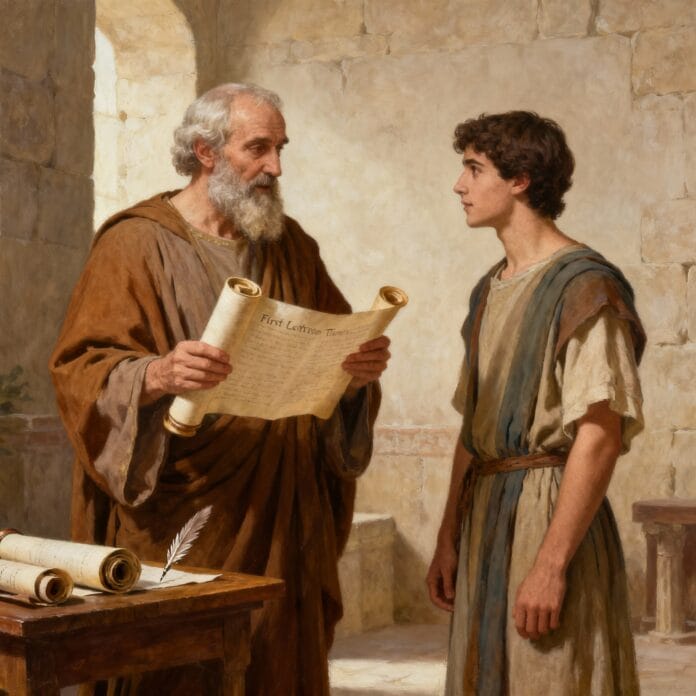
1. The person of Timothy. – His name was not uncommon among the Greeks (cf. 1 Maccabees 5:6; 2 Maccabees 8:30, etc.). It means: he who honors God. Timothy was from Lystra, in Lycaonia (cf. Acts of the Apostles 16, 1-2). He was the product of a mixed marriage, his father being Greek and his mother Jewish (cf. 10 Acts of the Apostles 16, 1; 2 Timothy 1, 5). She raised him devoutly in her religion (cf. 2 Timothy 3, 15); but he was not circumcised, perhaps because his father did not allow it (cf. Acts of the Apostles 16, 3). This was probably when Saint Paul came to Lystra during his first apostolic journey (cf. Acts of the Apostles 16, 6), around the year 47, whom he converted and baptized Timothy. At the time of his second journey, knowing that the young neophyte was highly esteemed by the Christians of Lystra and Iconium, and appreciating his excellent qualities himself, he attached him as an assistant (cf. Acts of the Apostles 16, 1 and following). It is likely that the passages 1 Timothy 1:18 and 4:14, and 2 Timothy 1:6, allude to supernatural insights that Saint Paul received concerning this choice. In any case, he laid hands on him with the priests of Lystra. Before taking him with him, he felt it necessary to circumcise him, lest otherwise his ministry would be rendered impossible among the Jews, who, according to their principles, regarded him as one of their own, since his mother was an Israelite (cf. Acts of the Apostles 16, 3).
Timothy was a faithful companion to Saint Paul, helping him with filial zeal (cf. Philippians 2:22) in Macedonia and Greece (cf. Acts of the Apostles 16 and 17), throughout this second journey of the apostle.
During the third journey, we find him in Ephesus with his master (cf. Acts of the Apostles 19, 22), who then entrusted him with important and delicate missions (cf. 1 Corinthians 4, 17; 16, 10-12) then we see them together in Macedonia (cf. 2 Corinthians 1, 1), in Corinth (cf. Romans 16, 21) and at Troas (cf. Acts of the Apostles 20, 4-5), this time on the way to Jerusalem. The disciple later joined Saint Paul in Rome during his first captivity, for his name is associated with that of the apostle in several of the letters written by the latter at that time (cf. Philippians 1, 1; Colossians 11; Philemon 1; Hebrews 13:23; Philippians 2:19 and following). According to the two letters to Timothy, Paul, when he regained his freedom, joined his disciple in the east and left him in charge of the Church of Ephesus (cf. 1 Timothy 1:3), with almost unlimited powers.
The rest of Timothy's story is only very imperfectly known to us. According to the Apostolic Constitutions, 7, 46 (comp. Eusebius, Ecclesiastical History 3, 46), he would have remained in Ephesus until his martyrdom, which would have taken place under Domitian, when the holy bishop was trying to dissuade the people from taking part in a licentious festival, celebrated in honor of Diana (cf. Nicephorus, Ecclesiastical History (3, 11 and the Acta Sanct. t.3, 176 ff.)
Various details from the letters of Saint Paul tell us that Timothy had an affectionate nature (2 Timothy 1:4), that he was often ill (1 Timothy 5:23), and of a timid character (1 Corinthians 16:10; 1 Timothy 4:12). The apostle loved him as Jesus had loved Saint John: he was his true son (1 Timothy 1:2), his beloved and faithful child (1 Corinthians 4:17; 2 Timothy 1:2), with whom he was of one soul (Philippians 2:20), because he always zealously sought the interests of Jesus Christ (Philippians 2:21).
2. The occasion for the first letter to Timothy is quite clearly determined by the letter's content itself. Shortly before writing it, Saint Paul had been in Ephesus with Timothy. During his rather brief stay among Christians From this city, the apostle had noticed that several administrative, liturgical, moral, etc., details needed to be settled or improved. Not having the time to deal with them then, he had to leave, asking his disciple to stay in Ephesus and to fight there against the false doctrines that threatened to invade the Christian community of the city (1 Timothy 1:3). He does not seem to have given him any other instructions at first, because he hoped to be able to return soon (1 Timothy 3:14 and 4:13); But, feeling himself detained for some time longer, and not knowing when he would be permitted to set out (1 Timothy 3:14-15), he decided to write to Timothy, either to reiterate his oral recommendations against the heretical teachers, or to recommend that he choose good and holy helpers, or finally to give him instructions relating to his conduct as a shepherd of souls.
The main purpose that the apostle intended is clearly marked by the words "so that if I delay you may know how you ought to conduct yourself in the house of God" 1 Timothy 3:15.
3. The plan of the letter. – The preceding lines have roughly indicated the theme of the letter: it is more difficult to determine the division and analysis, because the subjects treated are quite varied and follow one another rapidly. The sequence of ideas is not organized and developed in a systematic way, as, for example, in the letters to the Romans, the Galatians, and the Ephesians.
With several commentators, we will divide the letter into two parts, the first corresponding to chapters 1-3, and the second to chapters 4-6. The first part is generally more general in character; it can be entitled: what the good of the Church requires. The second is more personal; we will give it this title: what a faithful minister of the Church must do.
Here are some details. In the first part, after the initial greeting (1:1-2), we find a first paragraph (1:3-20), which serves somewhat as an introduction and speaks of the good fight that the pastor of souls must wage for Christ and for the Church. A second paragraph (2:1-15) outlines some rules to be followed for public worship to be properly celebrated; the third (3:1-16) contains important instructions concerning the selection of sacred ministers. The second part also contains three paragraphs. The first (4:1-16) concerns Timothy's obligations as a minister of the Church, especially regarding his preaching and conduct. The second (5:1-6:2) indicates his particular duties toward the different categories of people who made up his Church. The third (6:3-21) is a final instruction, which also contains several special pieces of advice from the master to his disciple.
4. The date and place of composition. – The First Letter to Timothy was composed between the years 64 and 66, that is, between the two imprisonments of Saint Paul in Rome. It is not possible to determine the date more precisely. The place of composition is unknown. Some ancient manuscripts mention in their final inscriptions the names of Laodicea, Athens, Nicopolis, and Rome; but these are unfounded conjectures.
1 Timothy 1
1Paul, an apostle of Jesus Christ, according to the command of God our Savior and of Christ Jesus our hope, 2 To Timothy, my true son in the faith: grace, mercy and peace from God the Father and Christ Jesus our Lord. 3 I remind you of the exhortation I gave you when I left for Macedonia, to remain in Ephesus, in order to instruct certain people not to teach other doctrines. 4 and not to dwell on fables and endless genealogies, which are more likely to stir up disputes than to advance the work of God, which is based on faith. 5 The purpose of this recommendation is charity that comes from a pure heart, a good conscience, and sincere faith. 6 Some, having lost sight of these things, have strayed into idle chatter. 7 They claim to be doctors of the Law, yet they understand neither what they say nor what they assert. 8 We know that the Law is good, provided it is used legitimately. 9 And let us remember that it is not made for the righteous but for the wicked and the rebellious, for the impious and the fishermen, for the irreligious and the profane, for those who mistreat their father and mother, for murderers, 10 the debauched, men who sleep with other men, slave traders, liars, perjurers, and anyone who commits any other crime contrary to sound doctrine. 11 This is the teaching of the Gospel of the glory of the blessed God, the Gospel which has been entrusted to me. 12 I give thanks to him who has strengthened me: to Christ Jesus our Lord, because he considered me worthy of his trust, appointing me to his ministry, 13 I, who was once a blasphemer, a persecutor, an insulter, but I obtained mercy because I acted in ignorance, not yet having faith. 14 And the grace of our Lord abounded abundantly with faith and charity which is in Christ Jesus. 15 This is a trustworthy saying that deserves to be believed by all: that Christ Jesus came into the world to save the fishermen of which I am the first. 16 But I received mercy precisely so that in me, the worst of sinners, Christ Jesus might display his immense patience as an example for those who would later believe in him for eternal life. 17 To the King of ages, immortal, invisible, the only God, honor and glory forever and ever, amen. 18 This is my recommendation to you, Timothy, my child, in accordance with the prophecies previously made about you, so that by them you may fight the good fight, 19 keeping the faith and a good conscience. Some, by denying it, have shipwrecked their faith. 20 Among them are Hymenaeus and Alexander, whom I have handed over to Satan, to teach them not to blaspheme.
1 Timothy 2
1 First of all, I urge that prayers, supplications, intercessions, and thanksgivings be made for all people, 2 for kings and for those in authority, so that we may live peaceful and quiet lives in all godliness and holiness. 3 This is good and pleasing in the sight of God our Savior, 4 who wants all men to be saved and to come to the knowledge of the truth. 5 For there is one God and one mediator between God and men, the man Christ Jesus, 6 who gave himself as a ransom for all: this is a fact attested in its time, 7 And it is for this purpose that I was appointed a preacher and an apostle; I speak the truth, I am not lying, a teacher of the nations in faith and truth. 8 Therefore I want men to pray everywhere, raising pure hands to heaven, without anger or agitation of thought. 9 Similarly women be dressed modestly, adorning themselves with decency and simplicity, without braids, gold, pearls, or sumptuous garments, but with good works, 10 as befits women who profess to serve God. 11 Let the woman receive instruction in silence, with complete submission. 12 I do not permit a woman to teach, nor to assume authority over a man, but she must remain silent. 13 For Adam was formed first, then Eve 14And it was not Adam who was seduced, but the woman who, seduced, fell into transgression. 15 Nevertheless, she will be saved by becoming a mother, provided she perseveres in the faith, in charity and in holiness, united with modesty.
1 Timothy 3
1 This saying is certain: if anyone aspires to the office of bishop, he desires an excellent office. 2 Therefore, the bishop must be irreproachable, have had only one wife, be sober, prudent, well-mannered, welcoming, and capable of teaching., 3 that he be neither given to wine, nor violent, but gentle, peaceable, and selfless, 4 that he governs his own house well and keeps his children submissive, with perfect honesty. 5 For if someone does not know how to manage his own household, how will he take care of God's church? 6 Let it not be a new convert, lest, becoming puffed up with pride, he fall into the same condemnation as the devil. 7 He must also enjoy the consideration of those outside, so as not to fall into disgrace and the traps of the devil. 8 Likewise, let the deacons be worthy men, not duplicitous in their speech, nor given to wine, nor greedy for sordid gain. 9 but that they preserve the mystery of faith in a pure conscience. 10 Let them first be tested and then let them carry out their ministry, if they are found without fault. 11 WomenLikewise, they must be honorable, not slanderous, temperate, and faithful in all things. 12 Deacons should be husbands of one wife, and should govern their children and their own household well. 13 For those who fulfill their ministry well obtain an honorable standing and great confidence in the faith of Jesus Christ. 14 I am writing these things to you, although I hope to come to you soon., 15 so that, if I am delayed, you may know how you ought to conduct yourself in the house of God, which is the church of the living God, the pillar and foundation of the truth. 16 And undeniably, it is a great mystery of godliness, he who was manifested in the flesh, justified in the Spirit, beholden by the angelspreached among the nations, believed in the world, exalted in glory.
1 Timothy 4
1 But the Spirit clearly says that in times to come some will abandon the faith and follow deceiving spirits and demonic teachings., 2 taught by hypocritical imposters who bear the mark of disgrace on their own conscience, 3 who forbid marriage and the use of foods that God created so that the faithful and those who have known the truth may use them with thanksgiving. 4 For everything God created is good, and nothing should be rejected if it is received with thanksgiving., 5 because everything is sanctified by the word of God and by prayer. 6 By offering these teachings to the brothers, you will be a good minister of Jesus Christ, nourished by the lessons of faith and good doctrine which you have faithfully followed. 7 As for these profane fables, these old wives' tales, reject them and practice piety. 8 For physical exercise is somewhat useful, but piety is useful in all things, holding promise for this life and for the life to come. 9 This is a certain and worthy statement. 10 for we do not take so much trouble and do not endure insults except because we have placed our hope in the living God who is the Savior of all men, especially of the faithful. 11 This is what you must prescribe and teach. 12 Let no one despise you because of your youth, but set an example to the believers in speech, in conduct, in love, in faith, in chastity. 13 Until I come, devote yourself to reading, exhorting, and teaching. 14 Do not neglect the grace that is in you, which was given you through prophetic action when the assembly of elders laid hands on you. 15 Meditate on these things and be fully present in them, so that your progress may be evident to all. 16 Watch over yourself and your teaching, apply yourself constantly because, by doing so, you will save yourself and those who listen to you.
1 Timothy 5
1 Do not rebuke an old man harshly, but admonish him as a father, and young men as brothers, 2 women Those who are old like mothers, those who are young like sisters, with complete purity. 3 Honor the widows who are truly widows. 4 If a widow has children or grandchildren, let them first learn to practice piety towards their own family and to give back to their parents what they have received from them. 5 As for the one who is truly a widow, who is alone in the world, she has put her hope in God and she perseveres night and day in supplications and prayers. 6 For the one who lives in pleasure, she is dead, although she appears alive. 7 Give them these recommendations, so that they will be beyond reproach. 8 But if anyone does not provide for his relatives, especially those of his family, he has denied the faith and is worse than an unbeliever. 9 A widow, to be registered on the list, must be at least sixty years old and have been the wife of only one husband., 10 that she has a reputation for her good deeds, having: raised her children, practiced thehospitalitywashed the feet of the saints, helped the unfortunate, and undertook all kinds of good works. 11 As for young widows, keep them away, for when the allure of pleasure turns them away from Christ, they want to remarry. 12 and make themselves guilty by failing to fulfill their initial commitment. 13 Moreover, in their idleness, they get used to going from house to house and not only are they idle, but also talkative, curious, talking about things that should not be talked about. 14 Therefore, I desire that young widows marry, have children, manage their households, and give their adversaries no occasion for slander., 15 because there are already some who have gone astray to follow Satan. 16 If any faithful man or woman has widows in his family, let him provide for their needs and let the Church not be overburdened, so that it may assist those who are truly widows. 17 Elders who govern well are worthy of double honor, especially those who labor in preaching and teaching., 18 For the Scripture says, «You shall not muzzle an ox while it treads out the grain,» and, «The worker deserves his wages.» 19 It does not accept accusations against an elder, except on the testimony of two or three witnesses. 20 Those who fail in their duties, rebuke them in front of everyone, so as to inspire fear in the others. 21 I adjure you before God, before Christ Jesus, and before the angels elected officials, to observe these things impartially and to do nothing out of favoritism. 22 Do not lay hands on anyone too quickly, and do not share in the sins of others; keep yourself pure. 23 Don't continue to drink only water, but have some wine because of your stomach and your frequent ailments. 24 There are people whose sins are obvious, even before they are judged, but others are only discovered afterwards. 25 Similarly, good works are obvious, and those that are not obvious at first cannot remain hidden.
1 Timothy 6
1 Let all who are under the yoke as slaves consider their masters worthy of all honor so that the name of God and his doctrine may not be blasphemed. 2 And let those who have believers as their masters not despise them because they are their brothers, but let them serve them all the better, since those who receive their service are brothers and friends. This is what must be taught and recommended. 3 If anyone teaches a different doctrine and does not adhere to the saving words of our Lord Jesus Christ and to the teaching that conforms to godliness, 4 He is a proud, ignorant, and deranged man who occupies himself with questions and disputes over words, from which arise envy, quarrels, insults, and malicious suspicions., 5 the endless discussions of men who have a perverted mind, who, deprived of the truth, see in piety only a means of enriching themselves. 6 Indeed, piety content with what is necessary is a great wealth., 7 because we brought nothing into the world and undoubtedly we can take nothing out of it. 8 So if we have enough to eat and enough to wear, we will be satisfied. 9 Those who want to be rich fall into temptation, a trap, and a host of foolish and harmful desires that plunge people into ruin and destruction. 10 For the love of money is the root of all kinds of evil, and some people, eager for money, have wandered from the faith and pierced themselves with many griefs. 11 But you, man of God, flee from these desires, and instead pursue righteousness, godliness, and faith. charity, patience, gentleness. 12 Fight the good fight of faith, conquer the eternal life to which you were called and for which you made this beautiful confession of faith before a great number of witnesses. 13 I commend you before God, who gives life to all things, and before Christ Jesus, who bore such a good testimony under Pontius Pilate, 14 to keep the commandment spotless and blameless until the manifestation of our Lord Jesus Christ, 15 which the blessed and only Sovereign, the King of kings and Lord of lords, will reveal in his time, 16 who alone possesses immortality, who dwells in unapproachable light, whom no man has seen nor can see, to whom belong honor and eternal power, amen. 17Instruct those who are rich in this present world not to be arrogant, nor to put their hope in wealth, which is so uncertain, but in God, who richly provides us with everything we need for life., 18 to do good, to become rich in good works, to be quick to give generously of what they have, 19 thus accumulating a solid treasure for the future that will allow them to acquire true life. 20 O Timothy, guard the deposit, avoiding vain and profane talk and all that opposes a science that does not deserve the name, 21 Some, by professing this, have erred in their faith. Grace be with you, amen.
Notes on the First Letter to Timothy
1.1 See Acts of the Apostles, 16, 1.
1.3 Other doctrines doctrines different from ours. ― For Macedonia. See Acts of the Apostles, 16, 9. ― At Ephesus. See Acts of the Apostles, 18, 19.
1.4 See 1 Timothy 4:7; 2 Timothy 2:23; Tite, 3, 9. ― Fables consisting of genealogies of imagined intermediary beings between God and the world, already known to Philo as divine powers, and called Aeons by the Gnostics of the 2nd century.
1.8 See Romans 7:12.
1.9 The law, insofar as it threatens, intimidates, and punishes, is not established for the righteous; that is to say, it does not concern him, but only the sinner; because the righteous, obeying it without violence, without constraint, and even fulfilling it with pleasure and love, is in no way subject to the penalties with which it threatens those who violate it.
1.10 Slave traders ; Those who abducted men and sold them into slavery, a crime punishable by death under Mosaic law. See Exodus, 21, 16.
1.15 See Matthew 9, 13; Mark 2:17.
1.20 Hymen and Alexander had been excommunicated by Saint Paul. Hymen is mentioned again, see 2 Timothy, 2, 17. As for Alexander, he must be different from the one mentioned in 2 Timothy, 4, 14, because the latter is described as a bronze worker.
2.5 Although Jesus Christ is the sole mediator of redemption, one can have recourse to the prayers and intercession of the faithful on earth, and of the angels and saints in heaven, to obtain mercy, grace and salvation through Jesus Christ, as Saint Paul himself asks for the help of the prayers of the faithful, without doing any injure to the mediation of Jesus Christ.
2.6 a fact attested to at the time., a testimony that he himself gave, through his death, in the time marked by his Father.
2.9 See 1 Peter 3:3.
2.12 See 1 Corinthians 14:34.
2.13 See Genesis 1:27.
2.14 See Genesis 3:6. — Paul reasons from Genesis, 3, 11-13, where it is expressly stated of Eve, not of Adam, that she was seduced (literally deceived) by the serpent. Satan knew that Adam loved Eve so much that, once Eve was seduced, Adam would easily be drawn into this sin of pride and disobedience. God had told them they would die; they were surprised to see that Eve did not die immediately (cf. St. Robert Bellarmine, Controversies).
3.2 See Tite1.7. — Those who claim that the Apostle only forbids a bishop to have several wives do not believe that this prohibition would be without purpose, since, in his time, polygamy was forbidden even to ordinary believers. Moreover, if this claim were valid, it would also have to be said that Saint Paul permitted widows who were not in the service of the Church to have several husbands (see 1 Timothy, 5, 9); an assertion as false as it is revolting. A widow, in order to be established as a deaconess, must have been "the wife of one man.
3.6 a new convert ; that is, newly baptized.
3.7 Those outside. See 1 Corinthians, 5, 12.
3.11 Women, the deaconesses (see Romans, 16, 1).
3.12 husbands of one wife. See verse 2.
4.1 See 2 Timothy 3:1-2; 2 Peter 3:3; Jude 1:18.
4.3 Saint Paul is speaking here of certain ancient heretics such as the Encratites, the Ebionites, the Manicheans, etc., who maintained that marriage was forbidden as an impure thing, while they themselves permitted the community of women and all the horrors that it entails; and who moreover defended the use of meat, claiming that it came from the principle of evil.
4.7 See 1 Timothy 1:4; 2 Timothy 2:23; Tite, 3, 9.
4.13 Focus on your reading: of the Holy Scriptures.
4.14 through prophetic action ; That is to say, following a prophetic revelation. the assembly of elders, the assembly of bishops and priests, who participate in the ordination of which Saint Paul himself was the principal minister (see 2 Timothy, 1, 6; Acts of the Apostles 6, 6; 13, 3)
5.9 wife of one husband, cf. 1 Timothy, 3, 2.
5.10 washed feetetc. Foot washing has always been considered in antiquity as part of thehospitality.
5.12 Their first commitment ; the vow by which they had committed themselves to Jesus Christ.
5.14 the opponent. It is the demon, as the following verse seems to indicate. Cf. 1 Peter, 5, 8.
5.18 See Deuteronomy 25:4; 1 Corinthians 9:9; Matthew 10:10; Luke 10:7.
5.24 The Apostle means that there are some men whose sins are already known, before the examination that could be made and the judgment that could be made, while there are others whose faults are only discovered as a result of this examination.
6.7 See Job 1:21; Ecclesiastes, 5, 14.
6.8 See Proverbs, 27, 26.
6.12 Fight the good fight ; that is to say, valiantly support the good fight; a kind of repetition which aims to give strength and energy to the speech.
6.13 Christ Jesus, who bore such a beautiful testimony, that is, who confirmed his preaching by his testimony. Cf. Matthew 27:2; John 18:33, 37.
6.15 See Revelation 17:14; 19:16.
6.16 See John 1:18; 1 John 4:12.
6.17 See Luke 12:15.