












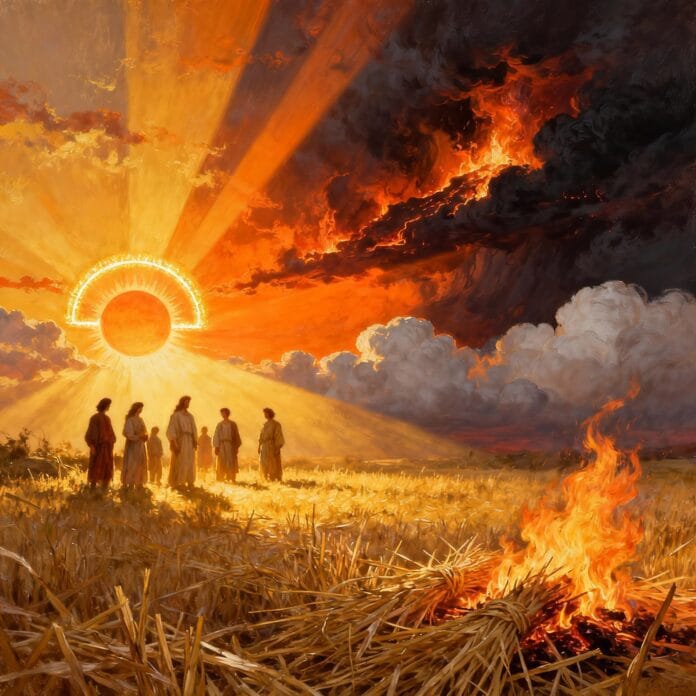
Reading from the Book of the Prophet Malachi
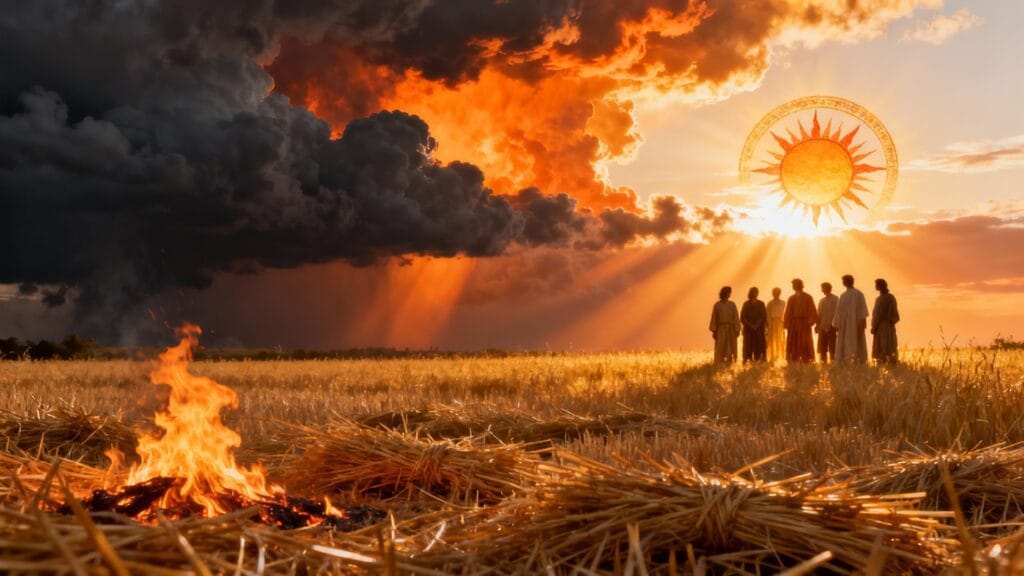
Behold, the day of the Lord is coming, burning like a furnace. All the proud, all who practice ungodliness, will be like stubble. The day that is coming will set them ablaze, declares the Lord Almighty, leaving them neither root nor branch. But for you who revere my name, the Sun of Righteousness will rise with healing in its wings.
The Sun of Righteousness: From the Furnace to Healing, the Hope According to Malachi
An exploration of the prophet Malachi to transform our view of the end times and God's justice.
We live in strange times. The world sometimes seems caught in a spiral of cynicism and arrogance. Injustice is rampant, and those who try to live "justly" often feel small, discouraged, even mocked. We find ourselves whispering the same question as Malachi's people: "Where is the God of justice?" (Malachi 2:17). It is for you, for us—for all those whose hearts are weary from the surrounding impiety and who yearn for true light—that this text resonates today. Malachi offers us a double-edged prophecy: a consuming fire and a healing sun. This article invites you to plunge fearlessly into this paradox, to find there not a threat, but the most beautiful of promises.
- The cry in the lukewarm: First, we will place the prophet Malachi in his context, to understand the urgency of his word.
- Fire and the Sun: Next, we will analyze the central paradox: how can the "Day of the Lord" be both a furnace and a healing?
- Three key areas for today:
- The «fear of the Name»: We will see that it is not fear, but the GPS of the soul.
- The "Sun of Justice": We will unleash the richness of this messianic image.
- The "cure": We will explore the nature of this promised restoration.
- The echo in Tradition: We will listen to how the Church has received and sung this promise.
- To become "heliotropic": Finally, we will outline concrete paths to ensure that this Sun illuminates our lives.
The cry of the prophet Malachi
To grasp the power of the verses in Malachi (3:19-20), one must first understand the context of its time. We are in the 5th century BC, in Judea. The Babylonian exile is over, at least officially. The Temple in Jerusalem has been rebuilt, but the passion is gone. The enthusiasm of the great prophets like Isaiah and Jeremiah seems to have evaporated amidst the difficulties of the reconstruction.
The people have returned, but the promised golden age has not materialized. The province is poor, crushed by the Persian administration. And the worst thing is not the external enemy, but the internal decay. Malachi (whose name means "my messenger") paints a scathing portrait of his society. His book is structured as a series of "disputes" or controversies in which God directly addresses his people: "You say... but I tell you...".
What are the ills? They are terribly banal.
First, a corrupt and contemptuous religious elite. The priests, who should be the guardians of the Covenant, botch the worship. They offer God sick, blind, or lame animals (Malachi 1). They "profane the Name" and teach an easy way out, weary of their own ministry, which they consider a chore.
Next, a glaring social injustice. Marital infidelity is becoming commonplace (Malachi 2), mixed marriages are not a sign of openness but of abandoning one's religious identity. Worse still, the powerful "defraud the worker of his wages, oppress the widow and the orphan, and violate the rights of the foreigner" (Malachi 3, 5).
Finally, and most seriously, there is a widespread spiritual cynicism. Seeing that the "arrogant" succeed and the "impious" prosper, the people come to this desperate conclusion: "It is useless to serve God; what have we gained by observing his precepts?"Malachi 3, 14).
It is in this context of spiritual lukewarmness, moral compromise, and despair that Malachi speaks. He is not a prophet of easy consolation. He is the last prophet of the Old Testament (in the Christian canonical order), and his voice is a shock. He announces that God go to come, but that this coming will not be comfortable. It will be a "Day" of truth.
This is where our text comes in. After announcing the coming of a "messenger" who will prepare the way (often identified with Elijah, or later with John the Baptist), and the coming of the Lord himself who will be "like the refiner's fire" (Malachi 3, 2), he concludes with this striking vision.
«Behold, the day of the Lord is coming, burning like a furnace.» The image is terrifying. It is the language of the apocalypse, of the final judgment. The "arrogant," those same people who succeed so well by flouting justice, and the "wicked," those who live as if God did not exist, will be like "straw." A flash in the pan: an instantaneous, total combustion, leaving no trace. "He will leave them neither root nor branch." It is the image of annihilation, of absolute sterility.
The prophecy could have ended there, on that note of terror. But it is here that Malachi, inspired by the Spirit, effects a masterful reversal, a "but" that changes everything: "But for you who fear my name...".
This text is often read in the liturgy during the time of Advent. It's a perfect preparation. Advent It is not only the sweet anticipation of the Nativity; it is also the time that reminds us of the coming (the advent) of the Lord in glory to judge the world. Malachi compels us to ask ourselves: in which category do I fall? «Arrogant straw» or «fearful of the Name»? His prophecy is not meant to frighten us, but to awaken us, to invite us to change sides before the Day dawns.
A fire that consumes, a sun that heals.
The heart of our passage lies in a luminous paradox. The "Day of the Lord" (a classic expression among the prophets) is an event unique, but he has two effects radically opposed. It's not that there's a day of judgment for the wicked and a day of reward for the good. It's the Same Day, there even came of God, same demonstration of his absolute holiness, which is experienced differently according to the disposition of the heart.
This is a theological idea of immense depth. The presence of God is a fire. The Epistle to the Hebrews will reiterate this: «Our God is a consuming fire» (He 12, 29). This fire is not, in itself, "evil" or "punitive." It is simply… holiness. Absolute love, absolute truth, absolute justice.
Imagine a block of ice and a gold ingot. If you expose them both to a furnace, the fire will have two effects. It will destroy the ice, reducing it to nothing. But it will purify the gold, making it shine with all its brilliance by removing its impurities. The fire is the same; it is the nature of the object that determines the effect.
For Malachi, the "arrogant" and the "wicked" are like "straw" or "ice." Their existence is founded on "self," on illusion, on injustice. Their being has no substance in the face of God's reality. When absolute Truth appears, falsehood cannot persist. Arrogance, which is a rejection of God, cannot coexist with God's presence. Annihilation ("neither root nor branch") is not so much a punishment as an observation: outside of God, there is no true life, no "root.".
But for "you who fear my name," it's quite the opposite. You are not "straw," you are "gold." You are not "ice," you may be a seed frozen by the winter of injustice. The same manifestation of God, this same "fire," is then experienced as warmth and light.
This is where Malachi's image becomes sublime. He doesn't say, "You will be spared from the fire." He says, "For you, the Sun of righteousness will rise." The fiery furnace becomes the fire-Sun.
God's justice, which is a consuming fire for wickedness, becomes a benevolent sun for those who have already aligned themselves with it. It is the same justice! God's justice is that He sets things right. For the arrogant person, who lives "upside down," being set right is destruction. For the one who "fears the Name," who is already trying to live "right" in an upside-down world, it is liberation, healing.
The image of the "Sun of Justice" (Shemesh Tzedakah) is incredibly rich. It merges two fundamental concepts:
- The Sun: A symbol of life, warmth, light, and regularity. The sun rises every morning; it is reliable. It dispels the darkness of night, fears, and cold.
- Justice (Tzedakah) : This Hebrew word does not only refer to legal equity (the court). Tzedakah, It is "rightness," "rectitude." It is the act of God who adjust the world at his will, which restores the broken relationship, which restores The poor man is within his rights. It's a justice that created and who save.
The "Sun of Righteousness" is therefore the victorious manifestation of God who, by His mere presence, dispels the darkness of injustice and warms the hearts of those who hoped for Him. Its effect is not to punish, but to bring "healing in its radiance." God's justice is not a cold scale; it is a healing sun.
This paradox lies at the heart of our faith. Christ on the Cross is the "Day" of the Lord. For those who identify with the arrogance of the powerful, with soldiers, with cynical religious figures, the Cross is madness, destruction. But for the good thief, for Married, For John, for us who "fear his name", the same Cross is the "Sun of righteousness" that rises, bringing healing from our sins in the "rays" of his blood and water.
What does it mean to "fear one's name"? The GPS of the soul
The entire passage revolves around this distinction: "the arrogant" on one side, "you who fear my name" on the other. If we want to be on the right side of the "Day," the question becomes existential: what does it mean, concretely, to "fear his name"?
Let's get rid of a misconception right away. The "fear of God" (in Hebrew Yir'at Adonai) is not fear. It is not the servile terror of the slave who fears his master's whip. That fear, Saint John tells us, "is banished by perfect love" (1 John 4, 18). Ironically, it is the "arrogant" ones who should be afraid, but their arrogance blinds them.
The "fear of the Name" is one of the richest expressions of biblical spirituality. Book of Proverbs defines it as "the beginning of wisdom" (Pr 9, 10). It is a relational concept, a «GPS» for the soul.
1. It's a question of perspective: wonder.
To fear God is, first and foremost, to not think of oneself as God. It is the exact antidote to arrogance. The arrogant person lives in the illusion of self-sufficiency. They are the center of their own universe. The God-fearing person is the one who has decentered their ego to recognize a greater reality: the majesty, holiness, beauty, and love of God.
It is a feeling of wonder, of respect in the deepest sense. It is the feeling one has before a raging ocean, a starry sky, or a newborn baby. It is the acute awareness that "God is God" and that I am his creation. This "fear" does not crush; it liberates. It frees me from the exhausting presumption of having to be my own savior.
2. It's a question of alignment: the moral compass.
The «Name» of God in the Bible is not just a label. It is His revelation, His character, His will. «Fearing His name» means taking seriously who He is and what He has said. It means aligning one's life not with the opinions of the world (the prevailing cynicism of Malachi's time), but with the «compass» of His Word.
That is why, in the Book of Proverbs, The "fear of the Lord" is immediately linked to ethics: "The fear of the Lord is to hate evil. I hate pride, arrogance, the way of evil, and perverse speech" (Proverbs 8:13). The direct link with Malachi is clear!
He who "fears the Name" is not perfect, but he hates injustice. He cannot tolerate corruption, he cannot abide lies. He stands with the widow, the orphan, the foreigner (precisely those whom Malachi defends). His "fear" is a profound sensitivity to justice, for he knows it is the very heart of the "Name" he reveres.
3. It's a question of relationship: loyalty.
In the context of Malachi, the people had broken the Covenant. The priests were unfaithful, and so were the husbands. «To fear the Name» is to be faithful. It is to choose to honor God, not when things are going well, but precisely when things are going badly. This is what the cynical «arrogant ones» refused to do («It is useless to serve God»).
The "God-fearing" person is the "little remnant," the one who continues to pray in a society that mocks, who continues to be honest when fraud pays, who continues to love when hatred is easier.
This "fear" is not a payment for receiving the Sun of Justice. It is the posture that allows one to receive it. It is the act of having kept one's window open in the night, waiting for the dawn. The arrogant man, on the other hand, has not only closed his shutters, but he has bricked up his window, pretending that the sun does not exist.
For us today, this "fear" is an invitation to«humility radical. That is the virtue of anawim, the "poor in spirit" of the Sermon on the Mount. It is the awareness that everything is grace, and that our only "righteousness" comes, not from our merits, but from our capacity to let ourselves be found and warmed by this Sun that we have not deserved.
The "Sun of Justice": An image that changes everything
Let us explore further this extraordinary image of the "Sun of Righteousness." It is so profound that it has nourished centuries of theology, art, and liturgy. Malachi, in forging it, gave us one of the most beautiful keys to understanding the history of salvation.
1. A messianic image par excellence.
In Hebrew, Shemesh Tzedakah. This image is unique. Of course, the Old Testament speaks of God as a "light" (Psalm 27), but associating him with the Sun in this way, in direct opposition to the furnace-fire, is a stroke of genius.
In ancient times, the sun was an object of worship for many peoples neighboring Israel (Ra in Egypt, Shamash in Babylon, later Sol Invictus in Rome). The prophet "baptizes" this image. He does not say that the sun is God. He says that God's action will be like that of a sun, but a sun of a new kind: a sun of Justice.
Tzedakah (righteousness and justice) is the quintessential messianic attribute. The ideal future king, the Messiah, is the one who will "establish justice and righteousness" (Isaiah 9 ; Jeremiah 23).
Malachi thus announces a "Day" when God's Justice will no longer be a cold law written on stone, but a living, radiant, and victorious force, like the sun triumphing over darkness. He announces the coming of a person who will embody this solar justice.
2. Christ, the true «Sun of Justice».
It is not surprising that Christian tradition immediately saw in this prophecy the announcement of Jesus Christ.
The Gospel of Luke is entirely imbued with this image. At the birth of John the Baptist, his father Zechariah, filled with the Holy Spirit, prophesies the coming of the Messiah with words that seem to be a direct commentary on Malachi:
«Thanks to the tender mercy of our God, the rising sun (Oriens) will visit us, to shine on those who dwell in darkness and the shadow of death, to guide our steps on the path of peace. » (Luke 1, 78-79).
«"The star above," the "rising sun," that is he, the "Sun of justice.".
Jesus himself took up this solar theme: "I am the light of the world. Whoever follows me will not walk in darkness, but will have the light of life." (John 8:12).
The early Church quickly adopted this symbolism. This is one of the reasons why the great feast of the Nativity, Christmas, was set on December 25th. The Roman Empire celebrated on this date, close to the winter solstice, the festival of Dies Natalis Solis Invicti, the "Day of the Birth of the Unconquered Sun." By placing the birth of Jesus at this time, the Church made a powerful theological declaration: the true Unconquered Sun, the only one who truly dispels darkness, is not a pagan star, but Christ, the "Sun of Righteousness" foretold by Malachi.
3. A "heliotropic" spirituality.
This identification changes the way we pray. Christian liturgy is profoundly "oriented." For centuries, churches were built "oriented," that is, facing east (ad orientem), where the sun rises. The priest and the faithful would turn together in this direction to pray, signifying that they were awaiting together the return of Christ, the Sun that rose at Easter and will return in glory.
Praying in the morning, at Lauds, is to greet the physical sunrise, seeing in it the symbol of the risen Christ. It is to begin the day by "orienting oneself," by turning one's heart towards the "Sun of Justice.".
The great theologian (and future popeJoseph Ratzinger wrote beautifully about "the spirit of the liturgy," reminding us that the Christianity is a "solar" faith. We are not a religion of night, fear, or secrecy. We are a religion of Revelation, of Light.
To live as a Christian is to become "heliotrope," like a sunflower. It is a life organized around this source of light and warmth, constantly turning towards it to receive life and direction. The alternative is to remain "straw," dry and turned towards the earth, awaiting the furnace. The choice is radical, and it is a daily one.
Healing "in its radiance": a justice that repairs
The "Sun of Righteousness" does not rise for spectacle. It has a purpose, an effect: it "will bring healing in its radiance." In Hebrew, the expression is even more poetic: "healing in its wings" (bi-khenafeha). The image is that of a large bird (like the eagle of God in Exodus) or of the sun itself whose rays are poetically described as "wings" that cover and protect.
This «cure» (marpe) is the direct consequence of the Tzedakah (Justice). What does that mean?
1. A healing from the injustice suffered.
The first healing is social and cosmic. For "you who fear my name," life is hard. You are those whom Malachi describes as wronged: the worker, the widow, the orphan. You are those who see arrogance triumph and suffer it in body and soul. You are... sick from the injustice of the world.
The first action of the "Sun of Righteousness" is to restore you. It is a vindication. The Day of the Lord first heals the scandal of evil. It sets history right. The arrogant who were "above" are reduced to straw, and you, the "little remnant" who were "below," are not only restored, but you will go out "leaping like calves from the stall" (Malachi 3, 20b, the verse that immediately follows!). This is the image of joy Pure, total liberation, renewed energy. God's justice is not a simple rebalancing, it is an explosion of life.
2. A healing from our own sin.
But let's not be too hasty. We are never entirely "God-fearing" and never entirely "arrogant." We are a mixture. We are that gold mixed with dross. The smelter's fire (Malachi 3, 2) and the Sun of Righteousness (3, 20) are therefore also a promise of inner healing.
The "radiance" of this Sun is a heat that melts the ice in our hearts, that burns away the "straws" of our own arrogance, our compromises, our lukewarmness. God's justice, when it touches us, is a healing of our own sin.
Saint Jerome, in his commentary on Malachi, makes a brilliant connection. He notes that the "wings" (khenafeha) of the Sun of Righteousness remind him of the "fringes" (fimbriae) of Jesus' garment (the Jewish tallit). And he recalls the Gospel: what happened when the woman with the hemorrhage, who had been ill for twelve years, touched the "fringe" of Jesus' garment? "At that very moment, she was healed" (Matthew 9).
The "Sun of Righteousness" is Christ. His "rays," his "wings," are the grace that emanates from him, the hem of his garment, his Eucharist, It is his Word. It is enough to touch him with faith (the "fear of the Name") to be healed of our inner "hemorrhages", of what drains us of our life.
3. A healing that makes us agents of healing.
This healing is not an end in itself. The sun does not shine for its own sake; it shines to give life. The God-fearing person who is healed, in turn, becomes a bearer of healing.
By receiving the light and warmth of the "Sun of Righteousness," we become "children of light" (John 12:36). We are called to reflect this righteousness and healing into the world.
The application is incredibly concrete. If we have been healed of injustice, we can no longer tolerate it. We, in turn, become defenders of the widow and the orphan whom Malachi mourned. If we have been healed of our arrogance, we become artisans of’humility and of service. If we have been cured of our cynicism ("it is useless to serve God"), we become witnesses of hope, living proof that the love of God is the only thing that truly "holds.".
The healing of Malachi is not palliative care to wait for the end of time. It is a transfusion of divine life that sets us to work, here and now, to prepare for that "Day" by being ourselves small "wings" of healing for our brothers and sisters.
The Echo of the Sun: Malachi in the Heart of the Church
The prophecy of Malachi did not remain a dead letter. It was immediately seized upon by the Tradition of the Church as a cornerstone of its hope. The image of the Sol Iustitiae has flourished in liturgy, theology, and spirituality.
1. Among the Church Fathers.
The early Christian authors, known as the Church Fathers, saw in this prophecy one of the clearest arguments in the Old Testament announcing Christ.
For authors like Clement of Alexandria and Origen, Christ is the Logos, the Word of God, the true intellectual and spiritual "Sun." He is the one who rises to dispel the darkness of ignorance and paganism. They see in Malachi the announcement that salvation is not simply a law, but an illumination.
Saint Jerome, as we have seen, draws this direct link between the "wings" of the Sun and the "fringes" of Jesus' garment. He insists that this "Day" is terrible for unbelievers but a day of joy and "leaping" for the faithful.
Saint Augustine, In The City of God, he uses this image to contrast the "earthly city" (that of the arrogant) which will collapse like straw, and the "city of God" (that of the "God-fearing") which will shine with the light of its King, the "Sun of Righteousness".
2. In the beating heart of the Liturgy.
Perhaps it is in the prayer of the Church that Malachi resonates most strongly.
Advent This is, above all, the "time of Malachi." We await the coming of the Lord. And one of the most beautiful "Great O Antiphons" (the antiphons sung just before Christmas, from December 17th to 23rd) is a direct echo of our text. It is the antiphon "O Oriens" (O Orient, O rising Sun):
«"O Orient, Splendor of eternal Light and Sun of justice: come, and illuminate those who sit in darkness and the shadow of death."»
The Church takes the words of Zechariah and Malachi and transforms them into an ardent supplication.
Moreover, Morning Prayer (Lauds) is structured around this solar spirituality. Every morning, at daybreak, Christians People from all over the world pray the Canticle of Zechariah (the Benedictus), which ends with the announcement of the "rising sun" (the star from on high). It is a way of choosing anew, each day, to live in the light of Christ rather than in the darkness of our own arrogance.
This "solar theology" also explains, as we have touched upon, the traditional orientation of churches and prayer. Awaiting the return of Christ means awaiting the final rising of the "Sun of Righteousness" at the end of time.
3. In contemporary spirituality.
Today, in a world marked by anxiety, burnout, and a sense of darkness, the promise of Malachi is a balm. It tells us that healing is possible. It tells us that justice will prevail. It gives us an anchor.
Contemporary spirituality is rediscovering the importance of aligning with God's "rhythms," just as the body needs to align with the sun's rhythms (the circadian rhythm). "Fearing the Name" means living in accordance with our "design" as creatures made for the light. Seeking healing in the "rays" of Christ is perhaps the healthiest form of spiritual "light therapy." It means exposing our wounds, our fears, and our arrogance, not to the harsh, accusing light of the world, but to the warm, healing light of the "Sun of Righteousness.".
7 steps to live off the sun
This magnificent prophecy is not simply an object of theological knowledge. It is a call to transformation. How can we, concretely, "expose" ourselves to this Sun of Righteousness so that it may heal us and make us "leap for joy"? Here are some suggestions, 7 steps to becoming a spiritual "heliotrope," a "sunflower" of God.
1. Dawn: Greeting the Sun.
Start your day 5 minutes before your usual alarm. Don't reach for your phone. Go to a window. Look at the daylight (even if the sun is hidden). Simply say: "Lord Jesus, Sun of Righteousness, rise up upon my day. Let your light illuminate me and let your warmth heal my heart." Pray the Benedictus (Canticle of Zechariah, Luke 1, 68-79) is a powerful way to "calibrate" your day to Him.
2. Diagnosing the "Straw": The Arrogance Examination.
Take a moment this evening. Ask yourself: "Where have I been 'straw' today?" Where have I been arrogant, cynical ("what's the point…")? Where have I relied on my own self-importance? Name one thing. Ask the "smelter's fire" to come and purify it, without fear.
3. Calibrate the "GPS": Identify your "fear".
What do I truly "fear" (revere, respect) in my life? What is my compass? The opinions of others? Financial security? Success? Or the "Name" of God—that is, His will, His justice, His love? Decide, for a specific situation in your day, to act according to the "fear of the Name" rather than the "fear of the world.".
4. Identify the "Rays": The healing journal.
The Sun is already up at Easter. It is at work. Keep a small notebook and write down, each evening, a "ray" of healing you saw or received. A kind word, forgiveness given or received, an unexpected moment of peace, beauty in nature. This is proof that the "Sun" is working, even in the fog.
5. Becoming "Wing": The healing agent.
The Sun heals "within its wings." You are the Body of Christ. You are its "wings" in the world. Choose someone in your circle who is living in "darkness" (loneliness, illness, injustice). How can you be a "ray" of light for them today? A call, a listening ear, a concrete act of service, a prayer.
6. The Zenith: The solar pause.
At midday, when the sun (physical or symbolic) is at its highest point, take 60 seconds. Close your eyes. Imagine the "Sun of Justice" shining upon you. Let its warmth envelop you. Breathe. Simply say: "Come, Sun of Justice, warm my heart."«
7. Twilight: Unfailing confidence.
Night falls. Fears and darkness (both internal and external) seem to regain the upper hand. This is the moment for Malachi's faith. See the darkness not as a defeat, but as the preparation for the dawn. Entrust your "straw," your fears, to the Lord, and sleep in the absolute certainty that, whatever happens, for you who "fear his name," the sun will rise.
Waiting for a God who is fire and tenderness
The prophecy of Malachi is a shock. It jolts us out of our lukewarmness and cynicism. It places us before a radical choice that structures all of reality: are we "straw" or "God-fearing"? Are we on the side of self-destructive arrogance, or of...«humility who is open to healing?
This text is not a threat of the end of the world. It is an insightful diagnosis of the world, and a promise of liberation.
The diagnosis: the world is divided. Injustice and arrogance exist, and they are not God's standard. They are "straw," destined for the fire.
The promise: God is coming. His "Day" is coming. And this "Day" is good news for all who hunger and thirst for righteousness.
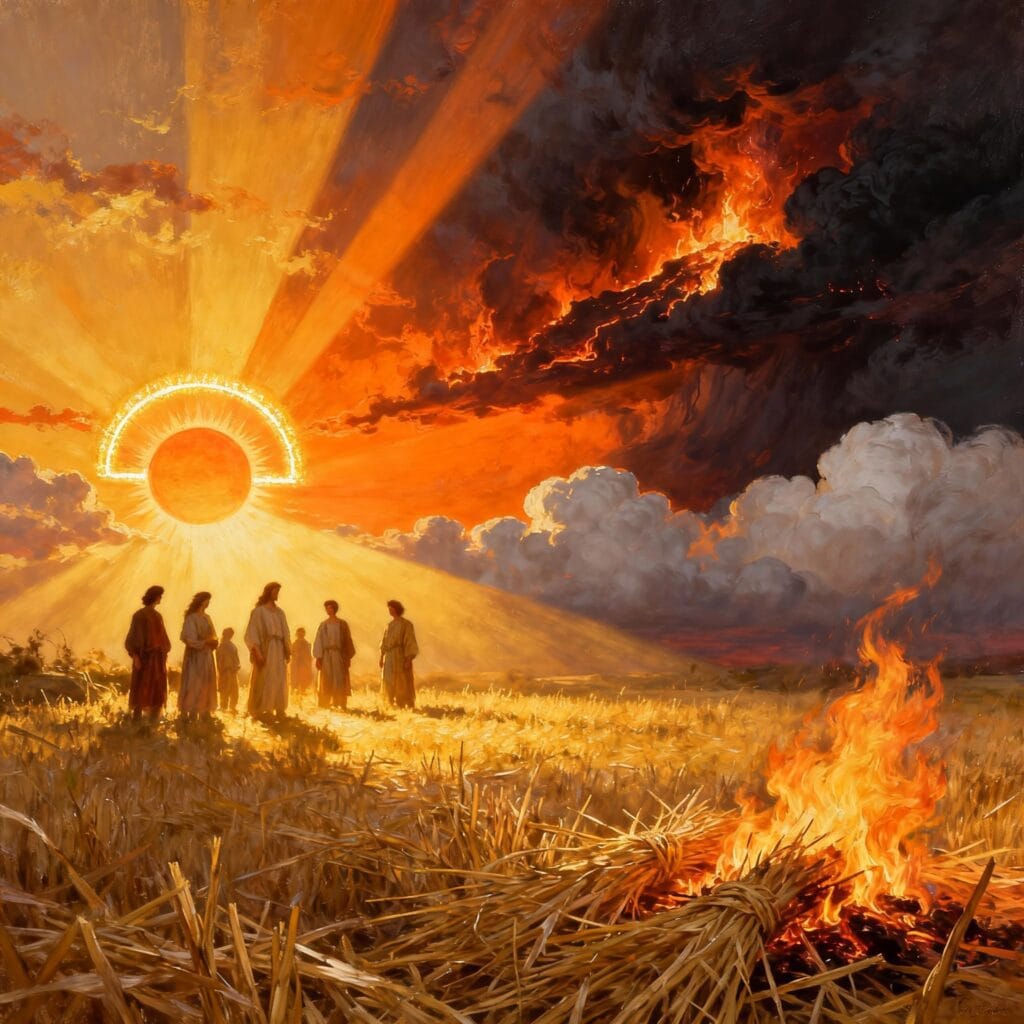
The transformative power of this passage lies in its redefinition of God's justice. God's justice is not a cold sword that punishes; it is a warm sun that heals. The fire that consumes the chaff of arrogance is the even A fire that shines like a Sun of life for the humble. It is the fire of divine Love, unbearable for selfishness, but vital for love.
Malachi's invitation is therefore revolutionary. He doesn't invite us to fear the "Day of the Lord." He invites us to long for it. To long for the coming of justice, truth, and healing. He invites us to live, not like condemned men on borrowed time, but like convalescents awaiting the dawn.
It is the audacity of Advent, The audacity of faith. To live as "sons and daughters of light," as Saint Paul would say, is not to hide from the furnace. It is to learn to dance in the rays of the "Sun of Righteousness," to become so "tanned" by its grace that our lives reflect its warmth and justice.
This is the true "fear": not trembling before the fire, but becoming what one contemplates. Becoming, in our turn, a small spark of that Sun which comes to heal the world.
The 5 essentials of the "God-fearing" person«
- Read THE Book of Malachi in its entirety (4 quick chapters) to get a feel for the "temperature" of its time.
- Identify an «arrogance» (self-sufficiency) within you and an act of «fear» (surrender to God) to replace it.
- To set down a concrete act of Tzedakah (justice/charity) this week, by targeting an injustice that outrages you.
- Meditate the Song of Zechariah (Luke 1, 68-79) each morning to "orient" your day.
- Pray the antiphon «O Oriens» in the evening, asking the Sun of justice to visit a person in the «darkness».
For further reading: Bibliography
- Primary Source: The Bible. (In particular the Book of Malachi, Psalm 27, Isaiah 9, And Luke 1).
- Church Liturgy: Liturgy of the Hours, Morning Prayer (Lauds) and "O" Antiphons of Advent.
- Patristics: Saint Jerome, Commentary on Malachi.
- Patristics: Origen, Homilies on Luke (for the commentary on the Benedictus).
- Patristic Theology: Clement of Alexandria, The Protreptic (on Christ as Light).
- Contemporary Theology: Joseph Ratzinger (Benedict XVI), The spirit of the liturgy, (Chapter on "Orientation").
- Exegesis: A modern biblical commentary on the "Minor Prophets" (for example, in the collection Evangelical Commentary on the Bible Or Anchor Bible).