












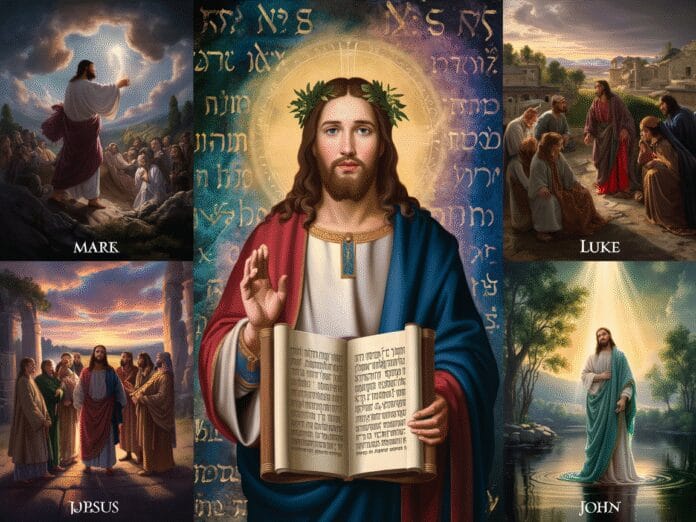
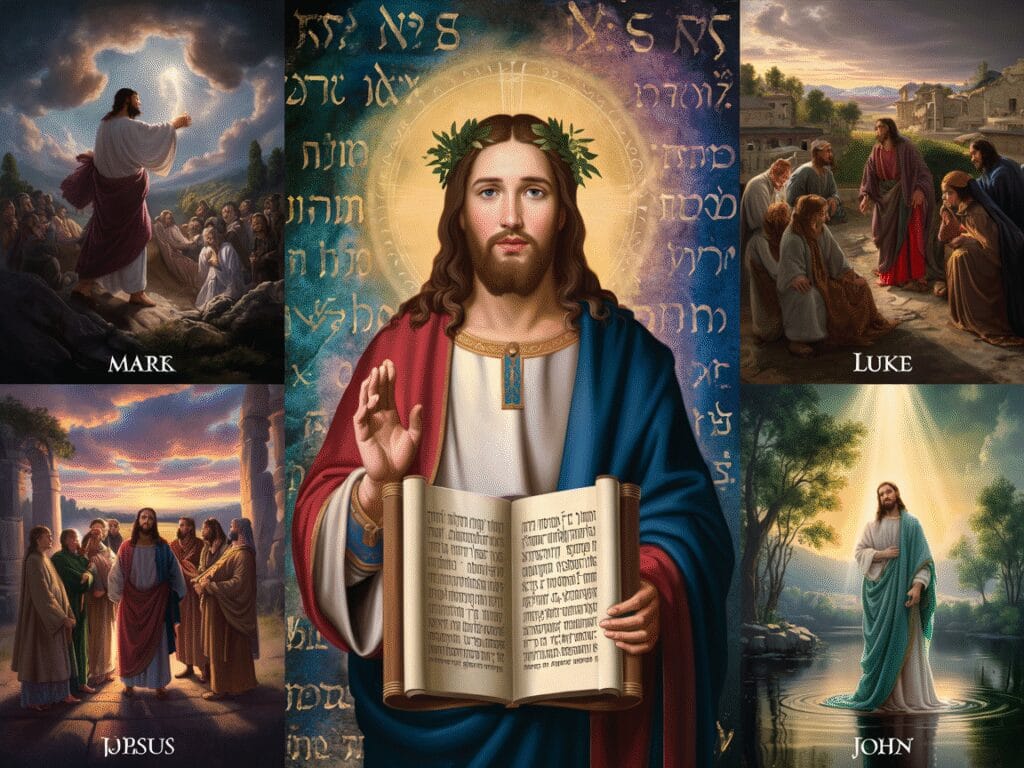
Reading the four Gospels simultaneously is to immerse oneself in a unique reading experience that reveals the plurality of perspectives on Jesus. Each of the four evangelists—Matthew, Mark, Luke, and John—bears witness to the same reality: the life, words, actions, and mission of Jesus Christ, but with nuances, emphasis, and details specific to their inspiration and audience.
This cross-reading allows us to:
- Understanding the different facets of Christ, revealed through complementary perspectives.
- To shed light on obscure or underdeveloped passages by an evangelist with the contribution of others.
- To appreciate the theological and narrative richness of each author.
- Avoid a one-sided or simplistic reading of the Gospel narratives.
- Awakening critical thinking while nurturing faith through apostolic diversity.
Thus, this reading plan helps to see Jesus in all his human and divine depth, through the prism of these cross-testimonies of overwhelming authenticity.
Reading methodology
To get the most out of this plan, it is advisable to adopt a structured and attentive routine:
- Simultaneous reading of the corresponding passages
Each day or session, read side by side in a Bible with the four Gospels open, or in a Gospel synopsis that puts the corresponding texts in parallel. - Compare and observe
Note the similarities and differences: details, wording, order of events, words used. - Think about the possible reasons
Why does this particular evangelist emphasize this point? What audience was he targeting? What theological significance might this have? - Support through prayer and meditation
Let yourself be guided by the Holy Spirit so that reading does not remain merely intellectual but becomes a living encounter with Jesus. - Take notes
Identify the passages that are particularly striking, the questions raised, and the links with other biblical texts. - Continue regularly
The richness of parallel reading is fully revealed through time and perseverance.
Presentation of the four Gospels
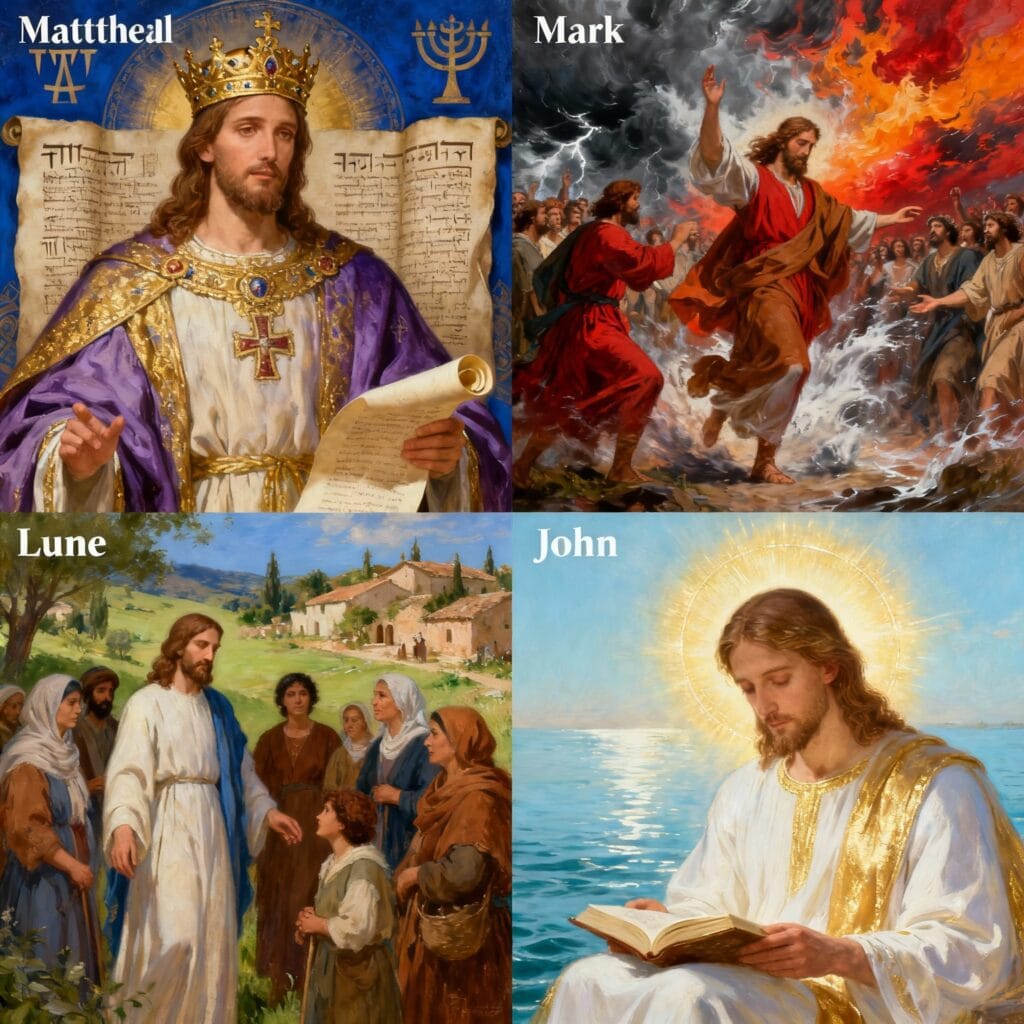
Matthew: The Gospel of the King and of Fulfillment
Matthew presents Jesus as the promised Messiah, the King awaited by Israel, fulfilling the prophecies of the Old Testament. His Gospel emphasizes kingship, the law, and teaching, with major speeches such as the Sermon on the Mount. It primarily targets a Jewish audience, attached to tradition and prophetic revelation. Matthew shows how Jesus renews the Law and inaugurates the Kingdom of God.
Mark: The Gospel of Action and Power
Mark, often considered the oldest Gospel, is the shortest and most direct. It highlights the power of Jesus through his miracles, exorcisms, and immediate actions. Mark also emphasizes the messianic secret, gradually revealing Jesus' true identity. Its dynamic and vivid style invites the reader to follow Jesus in his actions, his struggles, and his journey to the Cross.
Luke: The Gospel of Mercy and Humanity
Luc gives great importance to compassion, has mercy and to the inclusion of the excluded: women, the poor, sinners, Samaritans. His narrative is meticulous in its details and presents a human and empathetic figure. Luke also emphasizes prayer, the Holy Spirit, and the universal dimension of salvation. His gospel is a plea for the social justice and faith in the God who draws near.
John: The Gospel of Divinity and Depth
John unfolds a rich and contemplative theology, highlighting the divinity of Jesus, the Word incarnate from eternity. His narratives are often symbolic or poetic, with long and profound discourses (the “I am” discourse, priestly prayer). John emphasizes love, truth and life eternal, inviting a personal and committed faith in Jesus Christ.
These four perspectives together invite a reading where each gospel illuminates another facet of Jesus, allowing us not to stop at a single angle and to deepen our faith through a pluralistic perspective.
The Birth and Childhood of Jesus
Matthew
- Chapters 1-2: Genealogy (Mt 1:1-17), miraculous birth (Mt 1:18-25), visit of the Magi (Mt 2:1-12), flight into Egypt (Mt 2:13-23)
Marc
- It begins directly with the baptism of Jesus (Mark 1:1-13), no account of the birth
Luke
- Chapters 1-2: Annunciation to Married (Luke 1:26-38), birth of John the Baptist (Luke 1(57-80), birth of Jesus at Bethlehem (Luke 2:1-20), Presentation in the Temple (Luke 2:21-40)
Jeans
- Theological Prologue (John 1(1-18) which presents the eternal Word incarnate without an account of the material birth
How to read?
- Read the accounts in Matthew and Luke, which offer narrative details about the birth, childhood, and prophetic circumstances.
- Note that Mark begins directly with the baptism of Jesus, and John begins with a theological prologue declaring the eternity of the incarnate Word.
- Compare how each evangelist presents Jesus: Matthew emphasizes the fulfillment of the prophecies, Luke the historical and human context, John the divine nature.
Meditation
Consider the profound mystery of the Incarnation: a God who humbly becomes man in a concrete human reality. This step awakens faith in a Messiah who is both heavenly and near.

Beginning of Jesus' Ministry
Matthew
- Chapters 3-4: Baptism by John (Mt 3), temptations (Mt 4:1-11), calling of the first disciples (Mt 4:18-22)
Marc
- Chapter 1: The beginnings of the ministry, baptism, miracles, preaching (Mark 1:1-45)
Luke
- Chapters 3-4: baptism, preparation in the desert (Lk 3:21-22; 4:1-13), beginning of the preaching (Lk 4:14-30)
Jeans
- Chapter 1: Testimony of John the Baptist, the first called disciples (John 1:19-51)
How to read?
- Read in parallel the baptism and temptations of Jesus, then his calling to the first disciples.
- Observe the differences: Mark emphasizes urgency and power, Matthew highlights divine filiation, Luke the support of the Holy Spirit, John's personal call to follow Jesus.
- Also note that the details and order may vary, but the coherence of the basic testimony remains clear.
Meditation
Feel the call to leave behind your old securities to follow Jesus, trusting in his guidance, even in the face of trials.

Teachings and Miracles
Sermon on the Mount and Beatitudes
- Matthew 5-7: Full text of the Sermon on the Mount
- Luke 617-49: Similar sermon but on a plain
- Mark 4:1-34: parables main ones (Sower, lamp under the bushel)
- John 6 : discourse of the Bread of Life, different but fundamental
Key Miracles
- Matthew 8-9: Healings, calming of the storm, a call to faith
- Mark 5-7: Healing of Jairus' daughter, healing of a deaf-mute
- Luke 7-8: Healing of the centurion's servant, calming of the storm
- John 2:11: First miracle at the wedding in Cana, the resurrection of Lazarus
How to read?
- Read the Sermon on the Mount in Matthew alongside the parallel Sermon on the Plain in Luke and the parables at Marc's.
- Compare John's speeches that expound the spiritual nature of the Kingdom.
- For miracles, Note their diversity, their symbolic scope, and their liberating dimension.
- Take some time to meditate on the beatitudes, THE parables and miraculous actions as keys to understanding life under God's rule.
Meditation
Keep in mind that Jesus offers a reversal of values: the last will be first, the humble exalted, and true life comes through love and faith in him.

Entry into Jerusalem and final teachings
Matthew 21-25
- Triumphal Entry (Mt 21:1-11), Discourse on the Vine, parables and warnings (chapters 21 to 25)
Mark 11-13
- Entrance, purifications of the Temple, eschatological discourses
Luke 19-21
- Entrance, parables prophetic discourses on the kingdom
John 12-17
- Entrance, farewell speech, priestly prayer of Jesus
How to read?
- Discover how each evangelist recounts the triumphant entry and prepares readers for Jesus' final discourses.
- Study the parables of the vine, as well as warnings and prophecies about the end times.
- In John, pay particular attention to the dense and profound farewell discourse.
- Note the differences in tone and intentions of the stories, while perceiving the rising tension towards the Passion.
Meditation
Prepare your heart to accompany Jesus on this ascent towards sacrifice, to grasp the greatness of this gift of love that is about to unfold.

Passion, Death and Resurrection
Matthew 26-28
- Last Supper, arrest, trial, crucifixion, resurrection
Mark 14-16
- Complete passion, arrival of the resurrection
Luke 22-24
- Passion and post-resurrection apparitions
John 18-21
- Arrest, trial, crucifixion, resurrection and detailed apparitions
How to read?
- Read the Passion according to Matthew, Mark, Luke and John in parallel, noting the details specific to each evangelist.
- Compare the accounts of the Last Supper, the arrest, the trial, the crucifixion, and finally of the resurrection.
- Note the speeches, the prayers, the expressions of pain and hope.
- Go beyond the narrative: see the Pascal's mystery In its entirety, the victory of life over death.
Meditation
Experience this reading as a spiritual pilgrimage, a witness to love the sacrificial offering of Jesus, the source of inner healing and new life.
Each step, viewed from the perspective of the four, reveals an unexpected richness. This journey requires patience, prayer, and an open heart.
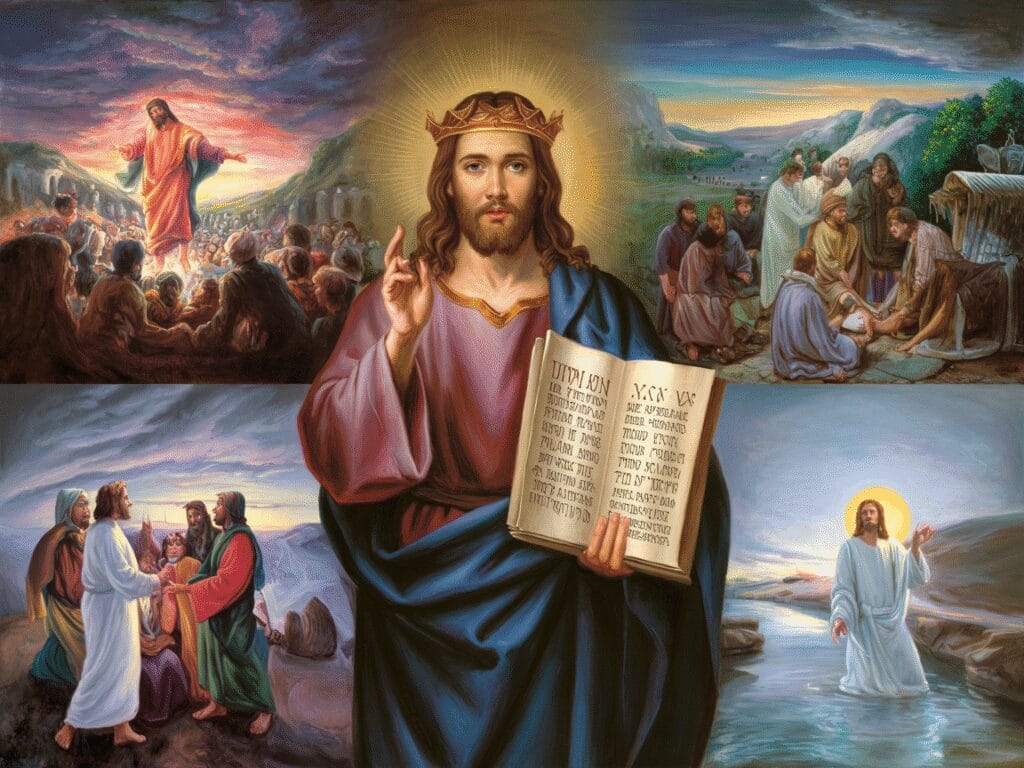
Organize your reading over several weeks for depth and understanding
Immersing oneself in the four Gospels simultaneously is much more than a simple reading. It is a journey to the heart of the Christianity, an exploration of the multiple faces of Christ, which is offered to those who wish to discover him not in a single reflection, but in all his plural richness.
This parallel reading method invites us to compare, meditate on, and engage in dialogue with the texts of Matthew, Mark, Luke, and John, in order to develop a broader perspective on the life of Jesus, his teachings, his actions, and his mission. It illuminates events from different angles, corrects overly simplistic interpretations, and enriches faith through the multiplicity of testimonies.
To ensure that such reading doesn't become a mere intellectual exercise or a rushed and superficial journey, organization is key. This guide offers a reading plan spread over approximately three months, with a logical progression and pauses for deeper reflection and prayer.
Weeks 1-2: Birth and childhood of Jesus — mystery of the Incarnation
Goals
These first two weeks invite you to enter into the fundamental mystery of the Christian faith: God becoming man. The birth of Jesus is much more than a historical event; it is the beginning of salvation, the moment when the eternal Word became flesh.
Guided reading
- Matthew 1-2 Genealogy, promises fulfilled, birth to Bethlehem, The reception of the Magi, the flight into Egypt. Matthew emphasizes the link with the prophets of the Old Testament, reminding us that Jesus is the awaited Messiah.
- Luke 1-2 The Annunciation, the birth in a humble manger, joy Shepherds, the Presentation in the Temple, and the Infancy Narrative. Luke provides a precise historical context and emphasizes the simplicity and’humility.
- John 1:1-18 The great theological prologue that affirms the pre-existence and divinity of Christ. John does not refer to the physical birth, but to the eternal Word incarnate.
Tips for meditating
- Begin each session with a short prayer, asking to open your heart to the Word.
- Reread each passage throughout the day, taking the time to observe what each evangelist wants to tell you about Jesus.
- Keep a spiritual notebook: what amazes you, touches you, or seems mysterious.
- Let the simplicity of the manger and the invisible grandeur of God drawing near resonate within us.
- Incorporate the duality of human and divine thought into your thinking, admiring the faith of the characters in the story: Married, Joseph, the shepherds, the wise men.
Weeks 3-4: Start of the Ministry — Commitment and Appeal
Goals
Now, Jesus begins his public ministry, with his baptism by John, the temptation in the desert, and the calling of the first disciples. These weeks invite us to conversion, to accept his call, and to follow in his footsteps.
Guided reading
- Matthew 3-4, Mark 1, Luke 3-4 offer a dynamic account of the beginning, emphasizing the importance of baptism as a sign of renunciation and new life.
- John 1:19-51 provides a unique testimony through the voice of John the Baptist and the first personal calls.
Meditation and reflection
- Observe how Jesus, fully human, identifies with sinners without committing sin.
- Note the temptations: what are the spiritual and human stakes?
- Reflect on your own vocation and the call that Jesus is giving you.
- Imagine the atmosphere around the Jordan River, the crowds, the prayer, the silence of the desert.
- Meditate on trust, obedience, and the strength to follow Jesus even into the unknown.
Weeks 5-7: Teachings and Miracles — Revealing the Kingdom
Goals
These three weeks are dedicated to exploring the key teachings of Jesus, from the Beatitudes to parables, and to a contemplation of its powerful miracles. These are profoundly spiritual revelations, inscribed in concrete actions.
Guided reading
- Sermons and parables Matthew 5-7, Luke 6:17-49, Mark 4. The Kingdom of God is revealed through the word.
- John 2-6 : Founding miracles (wedding at Cana, multiplication of the loaves) and theological discourses (Bread of life).
Reading recommendations
- Take the time to reread the Beatitudes They encapsulate the ethics of the Kingdom, a radical invitation to peace and to justice.
- Compare the form and content of the speeches of Matthew and Luke.
- For miracles, Don't just accept the fact: question their spiritual significance.
- Note the reactions of the witnesses and what this personally inspires in you.
- Pray asking for the grace to become a living witness to these truths.
Weeks 8-9: Entry into Jerusalem, final teachings — towards the Sacrifice
Goals
The entry into Jerusalem marks the ascent towards the Passion. These weeks allow for a more intense reading of the preparations, speeches and parables which foretell the crucifixion.
Guided reading
- Matthew 21-25, Mark 11-13, Luke 19-21: Triumphal entry, cleansing of the Temple, warnings and parables warning.
- John 12-17: Farewell discourse, priestly prayer, profound revelation of Jesus' mission.
Reading recommendations
- Feel the tension in the air, the proximity of a decisive moment.
- Learn to read beyond words, by immersing yourself in emotions and gestures.
- Visualize, imagine the scene in Galilee and Jerusalem.
- Let these pages awaken in you solidarity with Christ in the face of his adversaries.
- Take time to pray over each parable and discourse, and over their meaning in your life.
Weeks 10-12: Passion, Death and Resurrection — the Paschal Mystery
Goals
These past few weeks have taken the reader to the very heart of the Christian faith: the Passion, the redemptive death, and the victory of the Resurrection.
Guided reading
- Matthew 26-28, Mark 14-16, Luke 22-24, John 18-21: complete accounts of the last supper, arrest, trial, crucifixion, burial and resurrection.
Advice
- Don't read quickly: each verse contains monumental spiritual density.
- Put yourself in the place of the disciples, the witnesses.
- Meditate at length on the Cross, see in it the expression of the greatest love.
- The resurrection is a new light, a promise that transforms all life.
- End each session with a prayer of praise and gratitude.
Practical tips for successfully reading alongside the text
Find a dedicated time each day
Even 15 to 30 minutes is enough, provided that this time is regular and without distractions.
Use a Synoptic Bible or several open Bibles
This facilitates comparison and simultaneous reading.
Keeping a Spiritual Journal
This keeps track of intuitions, questions, prayers, and allows for a fruitful return.
Don't hesitate to reread.
Some passages become clearer and deeper with each reading.
Share in the community
A reading group enriches understanding and maintains motivation.
Conclusion
This multi-week journey is not simply a biblical exploration; it is a school of life, an initiation into an enlightened, embodied, and vibrant faith. The plurality of the Gospels forms a prism that reveals the light of Christ in all its brilliance.
May this reading plan be for you a magnificent adventure, a daily encounter with the Son of God, and a profound source of peace and joy.