









A Navarrese-Basque Jesuit who carried the Gospel to the shores of Japan and died at the gates of China.
December 3rd marks the anniversary of Francis Xavier, the Basque nobleman who became a companion of Ignatius of Loyola and left his Parisian chair to evangelize Asia. Between 1541 and 1552, he traveled through India, the Moluccas, and Japan, baptizing tens of thousands of people. His death at the age of forty-six on the island of Sancian, within sight of inaccessible China, encapsulates a life consumed by the urgency of missionary work. A patron saint of missions along with Thérèse of Lisieux, he continues to challenge our relationship to the universal: how can we carry a message beyond our cultural boundaries without imposing it?
From the Navarrese nobility to the backstreets of Paris
François was born in 1506 at Xavier Castle in the Kingdom of Navarre. His father, Jean de Jassi, belonged to the local minor nobility, proud but impoverished by the wars between Castile and France. The sixth child grew up in a tense political climate: in 1512, Ferdinand of Aragon annexed Upper Navarre. The family lost influence and income. At nineteen, François left for the University of Paris, carrying the family's hopes.
He arrived in 1525 in a vibrant city. The Sorbonne was debating Luther's theses, and Erasmus's humanism was circulating in the colleges. François followed the classical curriculum at the Collège Sainte-Barbe: liberal arts, Aristotelian philosophy, and scholastic theology. A brilliant dialectician, he earned his Master of Arts degree in 1530 and then taught philosophy at the Collège de Beauvais. A promising career, an assured reputation, and firmly established worldly ambitions.
In 1529, a peculiar student shared his room: Ignatius of Loyola, A limping man in his thirties, he converted after being wounded in Pamplona. Francis finds him difficult to accept. This former soldier speaks of renunciation, divine glory, and saving souls. Francis dreams of prestigious pulpits. For three years, Ignatius repeats the Gospel question: "What does it profit a man to gain the whole world, yet forfeit his soul?" The word slowly takes root.
In 1533, Francis had a profound change of heart. Ignatius introduced him to the Spiritual Exercises, a method of discernment through meditation and examination of conscience. In them, Francis discovered a living, demanding Christ who called him to leave everything behind. On August 15, 1534, on the hill of Montmartre, seven companions took their vows of poverty, chastity and to go to Jerusalem or to enter the service of pope. Thus was born the nucleus of the Society of Jesus, an order approved in 1540 by Paul III.
THE pope He then sought missionaries for the Portuguese Indies. Portugal had established trading posts since Vasco da Gama, but evangelization remained limited. Ignatius designated Francis. Without hesitation: "Here I am!" On April 7, 1541, Francis embarked in Lisbon on the Santiago with the title of papal legate. Thirteen months of crossing, storms, illness, and close quarters. He landed in Goa in May 1542.
Goa, the capital of Portuguese India, was a cosmopolitan port where Portuguese, Indians, African slaves, and Arab merchants lived side by side. Francis encountered a superficial Christianity: baptisms without instruction, concubinage, and brutal slavery. He roamed the streets, ringing a bell, gathering children and adults to teach catechism. His method was simple: songs in Portuguese and then in Tamil, repeated prayers, and vivid biblical stories. He visited hospitals and prisons, washed wounds, and buried the dead.
In 1542, he reached the Fishery Coast in southern India, home to the Paravers, pearl divers who had been superficially converted by the Portuguese. Francis learned a few words of Tamil, translated the Creed and the commandments into sung verses, and performed mass baptisms after brief catechism, convinced that grace could replace teaching. The number of conversions reached tens of thousands. Historians and hagiographers disagree: was it genuine collective enthusiasm or conversions under colonial pressure? Francis himself recounts instances of resistance, relapse, and cultural misunderstandings.
In 1545, he set sail for the Moluccas, a Muslim archipelago involved in the spice trade. At Ambon, Ternate, and Morotai, he encountered Islam, a religion already established there. Conversions were less frequent, sometimes fraught with conflict with the local sultans. Francis wrote to Ignatius: "Here, the Moors hate us." He persevered, founding a few fragile Christian communities, but Islam resisted.
In 1549, in Malacca, he met a Japanese man named Anjirō, a fugitive convert. Anjirō described a refined, cultured archipelago, unfamiliar with the Gospel. Francis saw it as a promised land. He landed in Japan in August 1549 with two Jesuits and Anjirō. It was a radical culture shock: a hierarchical feudal society, a complex writing system, and deeply rooted Buddhism and Shintoism. Francis learned a few kanji and negotiated with the daimyos, the local lords. In Kagoshima, Hirado, Yamaguchi, and Bungo, he preached in broken Japanese. Conversions were slow but strong: samurai, merchants, entire families. He estimated that a thousand were baptized in two years.
Francis understood that Japan was culturally dependent on China. To evangelize the archipelago permanently, he needed to reach the Middle Kingdom, a source of intellectual prestige. In 1551, he returned to Goa to organize a Chinese expedition. At the time, China prohibited all access to foreigners except for regulated trade in Canton. Francis negotiated with Portuguese merchants and diplomats. In April 1552, he secretly embarked for Sancian, an island near Canton.
On this desolate rock, he waited for a Chinese ferryman. But the wait dragged on, and tropical fevers struck him down. On December 2, 1552, alone in a fisherman's hut, Francis died at the age of forty-six. His body, miraculously preserved from decay according to witnesses, was repatriated to Goa. Canonized in 1622 along with Ignatius, he became patron saint of the missions in 1927.
Distant miracles and an incorruptible body
One historical fact remains firmly established: Francis baptized tens of thousands of people in ten years. The letters he regularly sent to Ignatius and his companions in Rome describe his methods, difficulties, and hopes. Portuguese, Japanese, and Indian archives confirm his presence, his foundations, and his death in Sancian. There is no doubt about the geographical scope of his apostolate or its frenetic pace.
But from the moment of his death, hagiographic accounts amplified the events. Witnesses from Goa testified under oath that his body, buried for three months in quicklime at Sancian, was found intact, with supple flesh and fresh blood. His right arm, detached as a relic, was said to have bled. Modern doctors suggest that salinity and heat could have slowed decomposition, but the miracle remains central to popular devotion. The Jesuits also collected testimonies of resurrections, instantaneous healings, and miraculous gifts of speech. Francis is said to have preached in Tamil, Japanese, or Malay without having learned them. Historians offer a more nuanced view: he used interpreters, learned only rudimentary languages, and relied on song and gestures.
A legend focuses on the crucifix and the crab. While sailing towards the Moluccas, a storm arose. Francis threw his crucifix into the waves to calm the waters. The next day, on the shore, a giant crab brought him the crucifix in its claws. This symbolic story is found in other saints' lives: nature obeys the servant of God. No contemporary source mentions it; it appears in the seventeenth century in edifying biographies.
What symbolic significance can be removed without artificially cutting corners? Francis embodies the tension between humility Methodical and wondrous in his accounts, his letters reveal an exhausted man, sometimes doubting the effectiveness of his work, criticizing the Portuguese colonizers, and suffering from loneliness. Yet tradition portrays him as a miracle worker, an apostle comparable to Paul. This duality reflects the Jesuit missionary dynamic: pastoral pragmatism and edifying propaganda to inspire vocations and spiritual gifts. Francis himself wrote to his Parisian confreres: "How many souls do not know the path to glory and go to hell because of your negligence!" A dramatic urgency that justifies the hagiographic exaggeration.
Today, Francis Xavier still divides opinion. For some, he remains the courageous pioneer who braved seas, illness, and linguistic barriers to proclaim Christ. For others, he symbolizes an evangelization linked to Portuguese colonization, imposing a European faith without respecting local cultures. The truth is complex: Francis vehemently criticized colonial practices, denounced slavery and the greed of Portuguese merchants, learned local languages, and attempted to inculturate the liturgy. But he also remained trapped by a medieval vision: baptism first, education second, destruction of pagan temples. Missionary theology would evolve, Vatican It will integrate the interreligious dialogue. François remains a transitional figure, ardent and awkward.
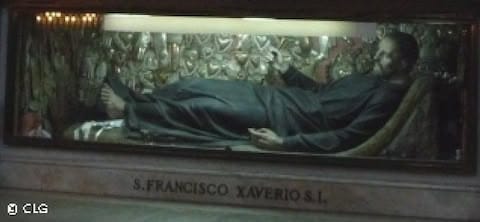
The body still rests in Goa, in the Basilica of Bom Jesus, displayed every ten years. Relics are scattered: the right arm in Rome (Gesú Church), a fragment of skull in Macau, bones in Japan. A map of a Catholic expansion that dreamed of universality but bore the ambiguities of its time. Francis, canonized at the same time as Ignatius, Teresa of Avila And Isidore the farmer illustrates the mystical impulse of the post-Tridentine sixteenth century: internal reform and missionary conquest. His legacy remains alive in the Asian Churches he planted, even if they now have their own theologies, their local saints, their modes of incarnation.
The evangelical urgency as permanent conversion
Francis Xavier questions our relationship to the universal. His life reveals a fruitful tension: reaching out to others without erasing them, proclaiming without imposing, adapting without renouncing. He left behind academic glory and comfort for unknown shores. This radical openness finds an echo in the parable of the rich young man: «Go, sell all that you have, and come, follow me.» Francis sold his Parisian career, his intellectual ambitions, to follow an itinerant Christ.
His teaching methods also shed light on this. He translated the Creed into sung verses, organized processions with children carrying banners, and used music and theater. He understood that the Gospel is conveyed through the flesh, the senses, and collective memory. Saint Paul to the Corinthians: «I have become all things to all people, that by all possible means I might save some.» Francis embodies this missionary flexibility, however imperfect.
The urgency that consumed him challenges our lukewarmness. «How many souls do not know the path to glory!» he wrote. A dramatic statement that may be unsettling, but one that raises the question of our commitment. Do we believe enough in what we carry within us to share it? Francis sought neither fortune nor recognition; he died alone on a rock. A powerful image for an era where everything is for sale, where visibility trumps depth.
Finally, his death at the gates of China resonates symbolically. He could not reach the empire, but his desire paved the way: Matteo Ricci would enter China forty years later. The apparent failure bore fruit. Gospel truth: the seed that falls to the ground dies, but produces much. Francis did not found a Christian empire in Asia, but living communities that still bear witness. The Church in Japan, despite persecution and three centuries of clandestinity, survived. The fruit of that seed sown in Kagoshima in 1549.
Today, invoking Francis Xavier is asking for the grace to step outside our comfortable circles. Not necessarily towards distant Asia, but towards the different neighbor, the colleague from another culture, the recently arrived foreigner. It is daring to speak words that announce hope without imposing it. It is accepting slowness, misunderstanding, even failure, entrusting the outcome to God. Francis preached in broken Japanese, baptized without always catechizing effectively, and sometimes made mistakes. But he tried, he persevered, he loved to the point of exhaustion. His example liberates us from paralyzing perfectionism and invites us to humble boldness.
Prayer to the Apostle of the Borderlands
Lord, through the intercession of Saint FrancisXavier, grant us the grace of inner departure. Like him, we carry legitimate ambitions, necessary security, and dreams of fulfillment. But you sometimes call us to leave everything behind for an uncertain path. Give us the strength to answer "here I am" when your voice draws us out of our ruts. May this "yes" be neither resignation nor escape, but trust in your providence, which opens unforeseen horizons.
François abandoned his Parisian professorship, his reputation as an intellectual, and the comfort of a secure career. Help us to discern what, in our lives, is sterile attachment and what is fruitful fidelity. Teach us to distinguish the stability that nourishes from the stagnation that stifles. May our renunciations, if they come from you, bear fruit for us and for others.
Lord, Francis crossed hostile seas, faced illness and cultural misunderstandings. Support us in our own trials: emotional breakups, career changes, and bereavements that throw us far from our certainties. When the storm threatens and we lose our bearings, be our guiding star. May faith not be insurance against hardship, but a light in the midst of it.
Francis learned a rudimentary form of Tamil, Japanese, and Malay. He stammered through the Gospel with borrowed words and hesitant gestures. Teach us this humility of fragile words. We always want to control, convince, shine. You, you choose sincere stammering. May our testimonies, clumsy but true, touch hearts better than our polished speeches. Give us the disarming simplicity and charity who joins.
Lord, Francis was consumed by the urgency of missionary work. He ruined his health, neglected his rest, and died young. Help us to live out the urgency of the Gospel without destroying ourselves. May our zeal be enduring, our commitment realistic. You do not need exhausted martyrs but faithful servants for the long haul. Teach us the right balance between action and contemplation, between self-giving and respect for our mortality.
Francis died on a rock, his eyes fixed on inaccessible China. He could not complete his dream. Lord, accept our unfinished business. So many aborted projects, broken relationships, thwarted vocations. Teach us that you write straight on our crooked lines. May today's apparent failure mysteriously bear fruit tomorrow. Francis did not live to see the evangelization of China, but his desire paved the way for others. May our aspirations, even unfulfilled ones, prepare paths for those who will come.
Finally, Lord, Francis rediscovered his true glory in serving you. He who dreamed of academic honors discovered a deeper joy: carrying your name to the ends of the earth. Convert our ambitions. May our thirst for recognition be transformed into a thirst to make you known. May our need for fulfillment find its peace in obedience to your will. May our race toward success become a journey toward holiness. By Saint FrancisXavier, apostle to distant nations, make us witnesses who are close, simple, and ardent. Amen.
To live
- Learn three words in a foreign language What does a colleague, a neighbor, or a shopkeeper in your neighborhood speak? François stammered Tamil and Japanese to reach the other person. Making a linguistic effort is a gesture of respect and openness.
- Send a message or make a phone call to someone you've lost touch with for a long time. François wrote regularly to his companions in Paris to maintain contact despite the distance. Reviving a relationship is a way of showing that the other person matters.
- Take ten minutes to lectio divina Regarding Ignatius' question: "What does it profit a man to gain the whole world and forfeit his soul?" Meditate on this Gospel passage that converted Francis. Note down in a notebook what it stirs within you today.
Memory and places of pilgrimage
The body of Francis Xavier rests in Goa, in the Basilica of Bom Jesus, a UNESCO World Heritage Site. This Baroque church, built between 1594 and 1605, houses a Florentine marble mausoleum donated by Ferdinand II of Tuscany. Every ten years, for the solemn exposition, hundreds of thousands of pilgrims converge. The last exposition took place in 2014; the next is scheduled for 2024. The body, naturally mummified according to tradition, still appears remarkably well-preserved despite five centuries. Several medical examinations in the twentieth century confirmed the presence of desiccated tissue, bones, and cartilage, without being able to definitively explain the initial absence of decomposition.
The right arm, detached in 1614, is kept in Rome in the Church of the Gesù, the mother house of the Jesuits. It is displayed every year on December 3, the saint's liturgical feast day. This relic traveled throughout Asia in the seventeenth century to encourage evangelization: Macau, Malacca, Cochin, Colombo. It symbolizes a hand that blessed, baptized, and wrote impassioned letters. A fragment of the skull is in Macau, another Portuguese trading post where Francis traveled several times.
In Japan, several shrines honor his memory. In Kagoshima, the city of his first landing in 1549, a memorial church was built in 1949 for the fourth centenary. A monumental statue depicts him facing the bay, his gaze turned towards China. In Yamaguchi, where he preached before the daimyō Ōuchi Yoshitaka, the Church of St. Francis Xavier was rebuilt in 1998 after a fire, in a bold contemporary style blending Japanese architecture and Christian symbols. Every year on December 3, Japanese Catholics celebrate a solemn mass there, combining Gregorian chants and traditional melodies.
Xavier Castle in Navarre, Spain, has become a place of pilgrimage. Restored in the 20th century, it houses a museum retracing the life of the saint and the history of the Society of Jesus. Every year in early March, the Javieradas bring together thousands of Navarrese walkers who converge on the castle from various villages. This popular tradition, rooted since the 19th century, blends Catholic devotion with regional pride. Francis is celebrated there as a son of the land as much as a universal saint.
In France, the Church of Saint Francis Xavier in the seventh arrondissement of Paris bears his name. Built in the nineteenth century in a neoclassical style, it is a Jesuit parish. The stained-glass windows depict his missionary life. Every December 3rd, a missionary mass is held there, bringing together the pontifical societies and the congregations sent on missions. The neighborhood, once aristocratic, is now home to embassies and government ministries, a cosmopolitan public for a saint of the frontiers.
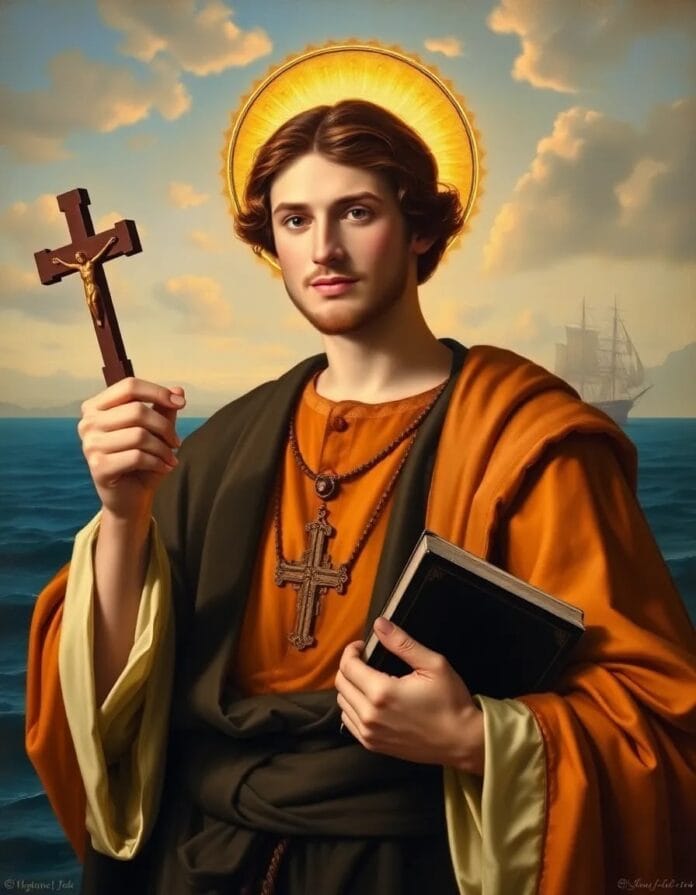
The iconography of Francis Xavier is abundant: Baroque paintings depict him baptizing crowds of Asians, crucifix in hand, haloed with light. Peter Paul Rubens, Murillo, and Andrea Pozzo offered triumphant versions of him. The twentieth century preferred more sober images: the exhausted missionary on the shore of Sancian, alone with his unfulfilled desire. This iconographic tension reflects the theological evolution: from missionary triumphalism to interreligious dialogue.
Finally, his patronage of the missions was officially recognized in 1927 by Pius XI, at the same time as that of Thérèse of Lisieux. A significant choice: Francis the traveler and Thérèse the cloistered woman, united in the same evangelical urgency. The Pontifical Mission Societies, seminaries for foreign missions, and congregations sent ad gentes venerate him as their protector. His intercession is invoked for catechists, biblical translators, fidei donum priests, and all those who cross borders to proclaim the Gospel.
Liturgy
- First reading1 Corinthians 9:16-19, 22-23 — Paul becomes all things to all people in order to win a few. Apostolic urgency, missionary adaptation, freely given service. A direct echo of Francis's method, who learned languages and customs to reach the people.
- Responsorial PsalmPsalm 116 — «Go into all the world and preach the gospel.» A short, missionary, universalist psalm. All nations are called to praise the Lord. Francis lived this mission literally, even to the farthest reaches of his time.
- GospelMark 16:15-20 — «Go into all the world and preach the gospel to every creature.» This is the final verse of Mark, a missionary sending forth, a promise of signs accompanying the preaching. Francis embodied this sending forth with fervor, believing in the miracles that confirm the Word.
- Entrance chant"Go into all the world" or "Missionaries of the Gospel" — sending-off hymns, dynamic tone, direct biblical texts. Avoid saccharine sentimentality, prefer the vigor of the call.
- Communion hymn"I am the living bread" or "Bread of Life" — Eucharistic theme, food for the journey. Francis celebrated Mass daily, even on stormy ships. The Eucharist sustained his race.
- Universal PrayerIntentions for missionaries in difficulty, the Churches of Asia, missionary vocations, the interreligious dialogue, Christians persecuted. Update the’François' legacy in contemporary issues: migration, evangelization digital, inculturation, ecumenism.