








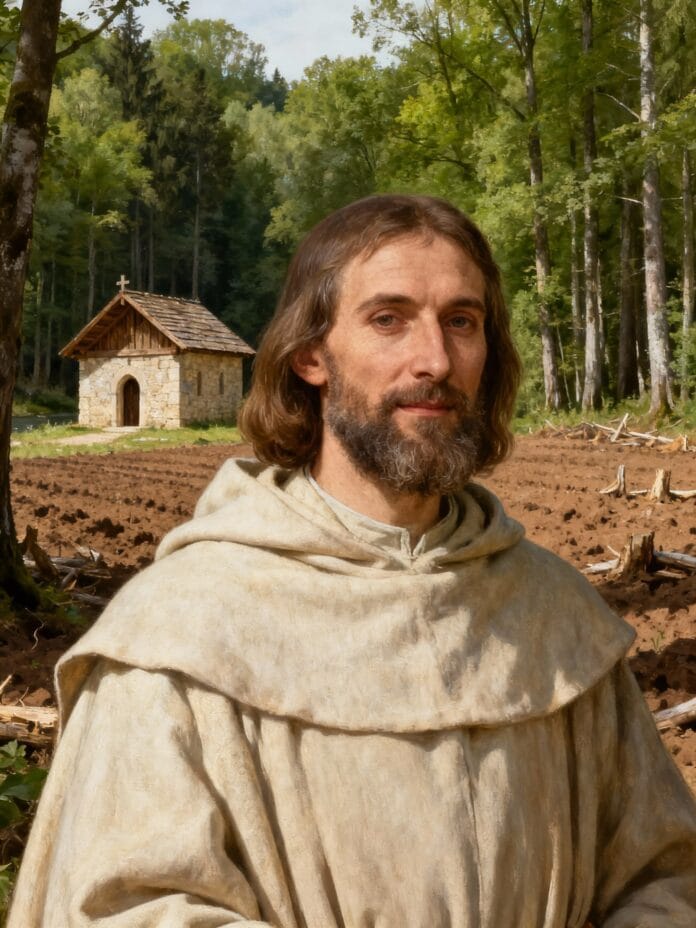
In the heart of the 6th century, a nobleman turned hermit changed the face of a country. Born at the Frankish court, Leonard renounced his privileges to follow the Gospel. In the Limousin forest, he built a chapel, cleared the land, and welcomed prisoners and beggars. From this act of freedom was born a town, Saint-Léonard-de-Noblat, still traversed by pilgrims on the Way of St. James. Today, his name resonates as a call to break our chains of fear, pride, or indifference.
Celebrating Saint Leonard is to meditate on a liberation that transcends boundaries. A hermit in the Limousin region in the 6th century, he was at once a man of prayer, a builder, and a liberator. Where others saw the forests as borders, he saw a place of welcome. His story, interwoven with facts and legends, inspires today all who seek a path of inner liberation and fraternal service.
A nobleman who became a guide for captives
Born into a Frankish family close to Clovis, Leonardo grew up in the circle of Saint Remi, Bishop of Reims. This was the era of the first evangelization of the Frankish kingdom. Witnessing the king's conversion and the kingdom's new unity, the young man early on chose another path: not the court, but the cell of the praying man.
Around 520, he left Champagne and traveled towards Limousin, a region that was then wooded and isolated. He settled near the Vienne River, in solitude and prayer. His reputation as a man of God attracted prisoners seeking rehabilitation; according to tradition, his intercessions led to their release. Many settled around his oratory, working the land and building a village.
At his dead, Probably around 559, his tomb became a place of healing and peace. Centuries later, English, German, and French pilgrims stopped there on their way to Santiago de Compostela. The sanctuary of Noblat, with its large 11th-century Romanesque collegiate church, perpetuates this memory: a saint who liberates humankind through grace and the work.
The chains have fallen
One historical fact remains: the hermit Leonard attracted captives through his example and mercy. Later legend recounts that he obtained permission from a king to free prisoners he deemed worthy of pardon. Hence the image of the saint holding broken chains, a powerful symbol of inner renewal.
This figure of the "liberator" transcends prison walls: it designates each of those who, through prayer and friendship, help another to rise again. Part legend, part truth, it reflects the power of mercy active, capable of opening any locked door.
Spiritual message
To live freely according to God is to emerge from isolation and embrace love. Saint Leonard teaches us to loosen ties before judging, to build instead of fleeing. The image of broken chains reflects our own self-imposed prisons: resentment, fear, inertia. By helping others breathe, we too breathe. Today's Gospel (John 8:36) illuminates this symbol: "If the Son sets you free, you will be free indeed." Christian freedom is not imposed; it is given in service.
Prayer
Lord Jesus,
you who inspired in your servant Leonard the desire to free the captives,
teach us to detach what binds our hearts.
Grant us the generosity to welcome, patience to point out,
And loyalty to love against all odds.
Make us witnesses to your freedom.,
in our families, our professions and our commitments.
Through your Spirit, make us artisans of reconciliation and peace.
Amen.
To live
- To offer a sign of reconciliation to someone kept at a distance.
- Supporting or visiting a local integration or prison.
- Meditate for ten minutes on John 8:36: «" YOU You will be truly free.»
Places
The main shrine is located at Saint-Léonard-de-Noblat, in Haute-Vienne. The Romanesque collegiate church, a UNESCO World Heritage Site as part of the Routes of Santiago de Compostela, houses the saint's relics. In England, in Germany And in northern France, many rural chapels are dedicated to him. In the Middle Ages, prisoners returned their chains as votive offerings. Every November 6th, the city organizes the procession of the keys and the freedmen, perpetuating the symbol of a freedom received in service.
Liturgy
- Readings/psalm: Isaiah 61:1-3; John 8:31-36Freedom given by God.
- Song/Hymn: Freedom of the Heart – responsory song on the theme of Christ the Liberator.