












Gospel of Jesus Christ according to Saint Luke
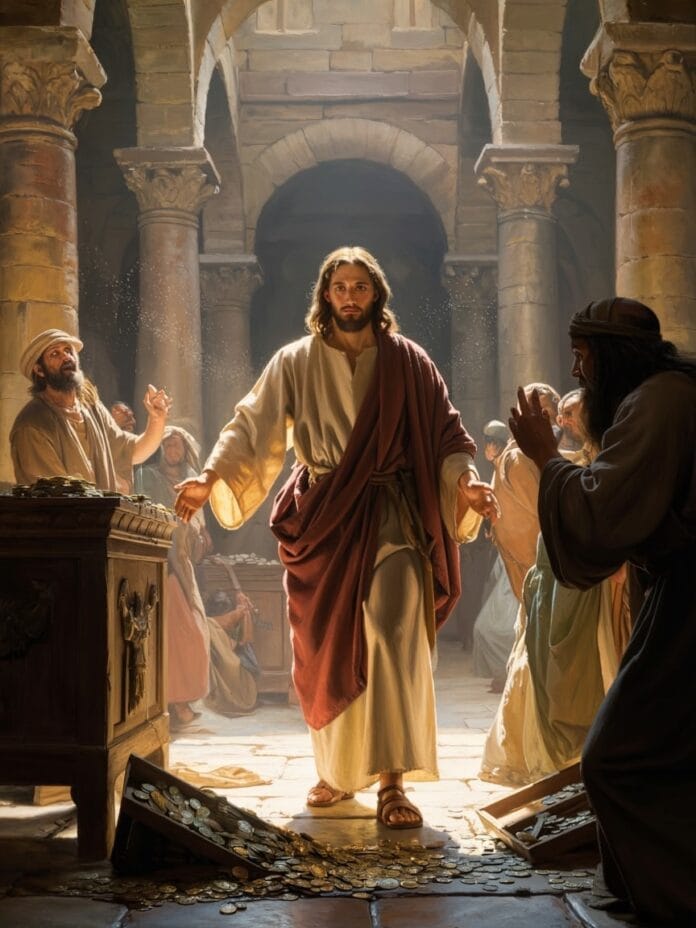
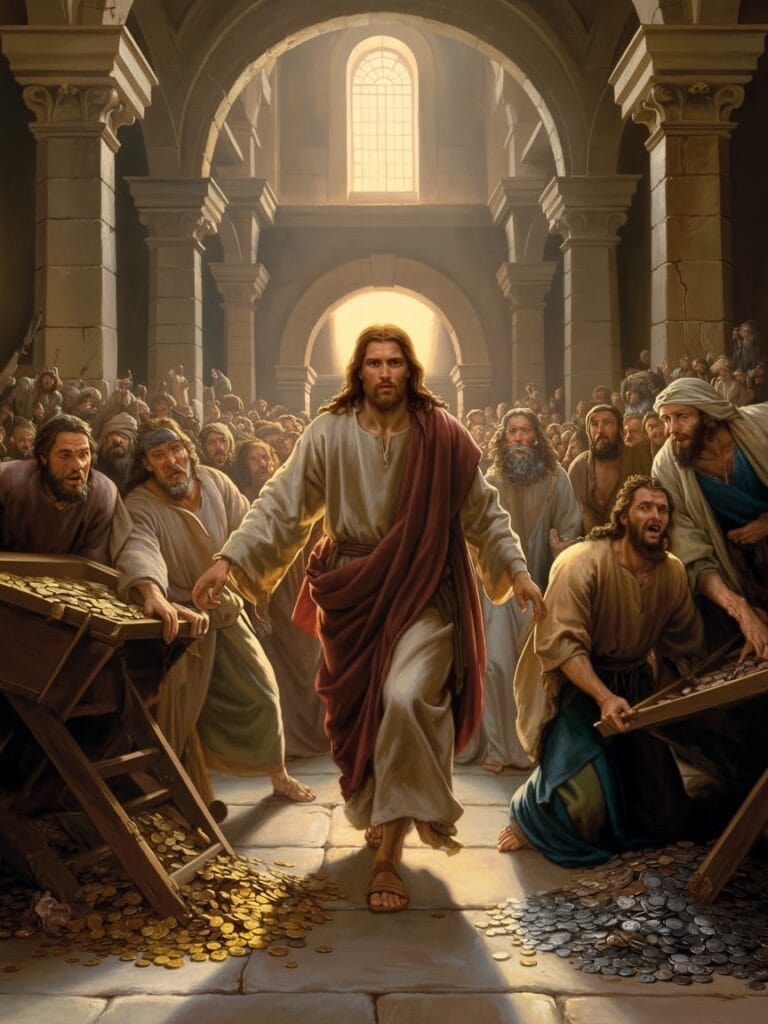
At that time, Jesus entered the Temple and began to drive out the merchants. He said to them, «It is written: »My house shall be a place of prayer,’ but you have made it ‘a den of robbers.’”
And every day he was in the Temple teaching. The chief priests and the scribes, as well as the influential people, sought to remove him, but they did not see how to do it; for the whole people, captivated by his words, listened to him.
Purifying the house of God to restore living prayer
How the Temple episode sheds light on our relationship with the house of God today.
In the’Gospel according to Saint Luke, Jesus drives the merchants out of the Temple, denouncing the desecration of the house of God, which he calls "a den of robbers." This passage challenges every believer on the sanctification of sacred space, the heart of prayer, and underscores the tension between prophecy and human power. This article is for anyone who wishes to explore the spiritual and theological significance of this passage, as well as its practical application in contemporary life.
The text invites us to revisit the original purpose of the Temple as a place of prayer (Context). The theological analysis reveals Jesus' critique of the idolatry of money and his call to spiritual transformation (Analysis). Three main themes explore the significance of the Temple, the prophetic role of Jesus, and the contrast between authentic love and formal religious practices. Finally, we will see how to live out this call in our own lives, through meditation, tradition, and concrete practice.
Purify the house of God
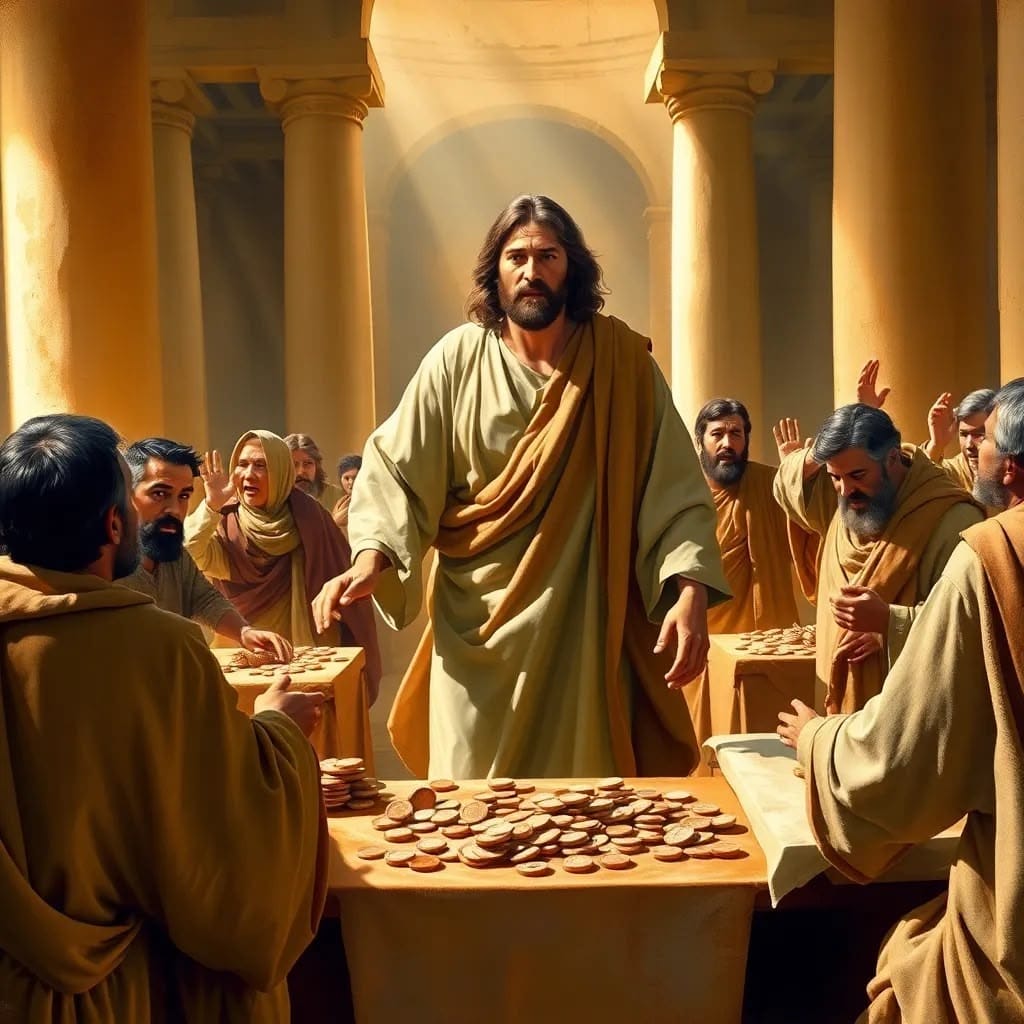
The passage of Luke 19, 45-48 falls within the Synoptic Gospels as a pivotal moment where Jesus publicly demonstrates his zeal for the sanctity of the Temple in Jerusalem. Historically, the Temple is the center of Jewish religious life, a place of worship and encounter with God. Its primary function, as recalled by Mosaic Law, is to serve as "a house of prayer for all nations" (Isaiah 56:7).
But in Jesus' time, this sacred place had been diverted from its original purpose. The practices of merchants and money changers within the sacred precinct transformed the spiritual space into a place of lucrative commerce. Jesus publicly denounced this desecration: "You have made it a den of robbers." This image of a cave evokes fraud, inhospitality, and the betrayal of the sacred for the sake of profit.
Jesus' reaction is also a prophetic act: he challenges the religious authority of his time, embodied by the high priests and scribes, showing that true divine justice transcends corrupt rituals and institutions. Despite their hostility, the people listen to him attentively, highlighting the spiritual power of his message.
This story is set in an eschatological and messianic context: Jesus prepares the renewal of an authentic relationship with God, more focused on prayer and teaching than on formal constraints and material corruption.
The Voice of the Prophet and the Judgment on the Temple
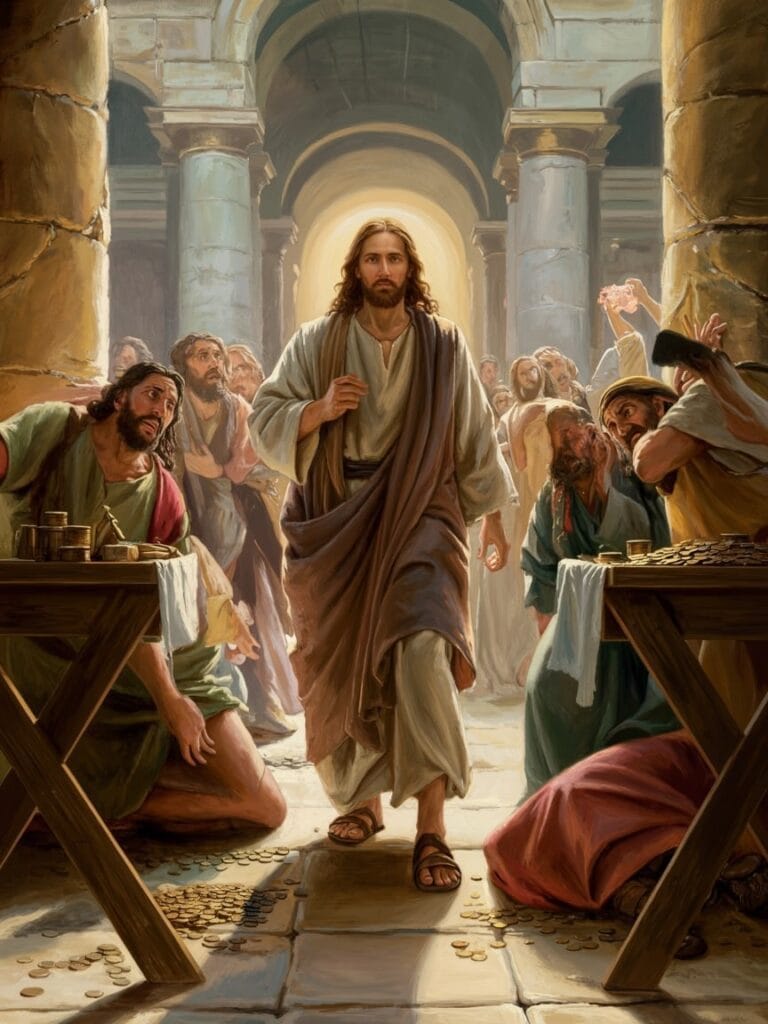
The central idea of the passage is the denunciation of a serious deviation: that of transforming the house of God into a secular space. Jesus quotes Scripture, particularly Isaiah 56:7, "My house will be a house of prayer," to show that the use of the Temple had gravely deviated from its purpose. This condemnation adds a powerful symbolic layer: the house of God must not be a place of economic exploitation or social injustice.
Jesus presents himself continuously each day in the Temple to teach, emphasizing the importance of the living word rather than empty practices. This makes him a true prophet who calls for conversion of heart, for inner as well as outer purification.
The emphasis on the violence of the religious elites who want him killed reveals the conflict between the divine plan and the established social order. This opposition symbolizes the eternal tension between divine truth and often corrupt human power.
This scene also anticipates the coming destruction of the Temple (70 AD), a transition to a new, spiritual worship, embodied by Christ himself and his community.
The Temple, a house of prayer for all nations
The Temple is not merely a specific place of worship, but a place open to all nations, symbolizing the universality of the divine invitation. Jesus reminds us that authentic prayer connects heaven and earth, transcending ethnic boundaries and earthly interests. This renews our understanding of sacred places as spaces of inclusion, peace, and a living relationship with God.
Jesus, prophet and teacher in the Temple
Jesus embodies the prophetic word that vigorously criticizes human failings. His daily teaching in the Temple is not limited to the law but reveals the face of a just, merciful God, close to humanity. His act of purification is an invitation to personal and communal conversion, where listening to the divine voice takes precedence over rituals.
The bandits' cave: a symbol of evil and corruption
Jesus uses a powerful image, a "den of robbers," to characterize the defacement of the sacred by greed. This image also evokes the shadow that evil casts on what should be light. It invites us to discern in our lives what hinders true prayer and an authentic relationship with God, particularly hypocritical practices, injustice, and the commodification of faith.
Live the message
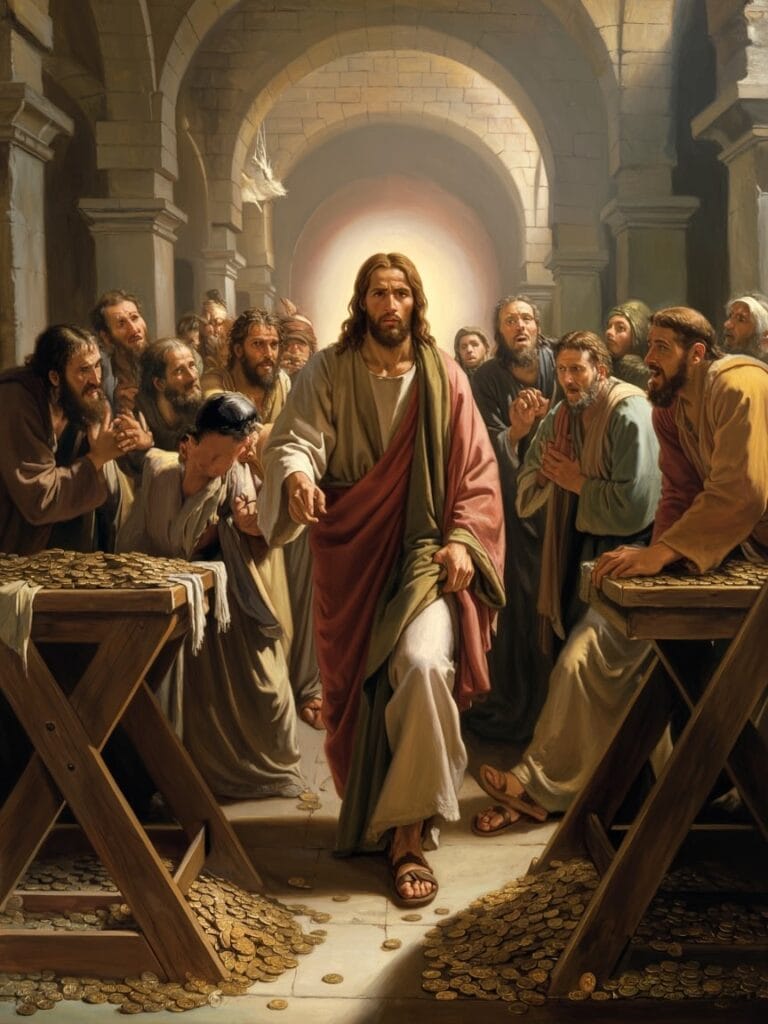
Jesus' denunciation is not limited to the Temple in Jerusalem; it applies to all religious or spiritual expression. Many spheres of life can draw sustenance from it:
- In the life of the Church, it is about ensuring that places of worship remain spaces of prayer, silence, and welcome, and not places of business, entertainment, or power.
- In personal life, it is a call to purify one's own "inner temple" (body and soul), so that prayer is profound, free from all hypocrisy, and a source of peace.
- In society, it is a reminder of justice and ethics in institutions, particularly in the management of material goods and in solidarity with the weakest.
- Finally, in the Christian mission, this episode encourages us to bear witness to a living faith, embodied in charity and a commitment to serving all.
Traditional roots and theological scope
This denunciation echoes the entire prophetic tradition of the Old Testament (Jeremiah, Ezekiel) which rejects worship without justice. The New Testament emphasizes that the true temple is now Christ himself (John 2,19-21) and that the community of believers forms a spiritual sanctuary (1 Corinthians 3,16).
The Church Fathers emphasized inner purification, comparing the expelled merchants to all forms of sin and worldly attachment that disfigure Christian life. Jesus' zeal for the Temple calls us to constant vigilance against the trivialization of the sacred.
On a spiritual level, this passage unfolds the theology of purification and sanctification as a path to an inner sanctuary, a place of divine listening and true worship.
Practical tip: purifying the inner sanctum
- To sit in silence, to recognize what disturbs our inner peace.
- To confess attachments or practices that distance one from true prayer.
- Inviting Jesus to purify his inner spaces, heart and conscience.
- Read slowly Luke 19, 45-48 in meditation, open yourself to his teaching.
- Decide on a concrete conversion action to implement this week.
Current challenges
The risk is seeing the call to purify the Temple as excessive rigorism or a rejection of the material world. Yet, Jesus does not condemn wealth itself, but its use diverts attention from God and humanity. The challenge is to balance spiritual commitment with daily life, avoiding spectacle-driven religion or faith reduced to consumerism.
Faced with the temptation to commodify faith, the answer is to deepen the personal relationship with God, centered on love and truth more than appearances or religious performance.
Finally, this passage calls for collective responsibility to guarantee the integrity of places of worship and the social justice, while avoiding the political or economic temptations that disfigure the Church.
Prayer
Lord Jesus, fervent guardian of your Father's house,
purify our hearts, make us sincere worshippers,
Turn us away from the idolatries of this world,
Teach us to listen to your voice and follow your word,
Give us the strength to bear witness with courage.,
Keep us united in your love.,
and lead us to your eternal peace.
Amen.
Conclusion
The passage of Luke 19, Chapters 45-48 are a timeless call to safeguard the holiness of our lives, our inner sanctuaries, and sacred places. Purification means returning to the essentials: prayer, justice, and listening to the Word. Through this challenge, each person is invited to a sincere conversion and to embody in their actions the God of love and truth, in the image of Jesus' prophetic zeal. May we make this purification a reality so that we may grow in faith and communion.
Practices
- Visit a place of prayer regularly with an open heart.
- Cultivate a daily time of silent prayer.
- Reflect on the inner attachments that need to be transformed.
- To participate with commitment in the community life of the Church.
- Serve the poor and defend the social justice.
- To learn from the Word in order to nourish one's faith.
- To bear witness in a simple and authentic way to those around you.
References
- Bible, Gospel according to Luke 19, 45-48
- Isaiah 56:7
- John 10:27
- John 2, 19-21
- 1 Corinthians 3, 16
- Jeremiah 7:11
- Ezekiel 11:19
- «Biblical Theology» (various authors), contemporary ecclesiastical resources