










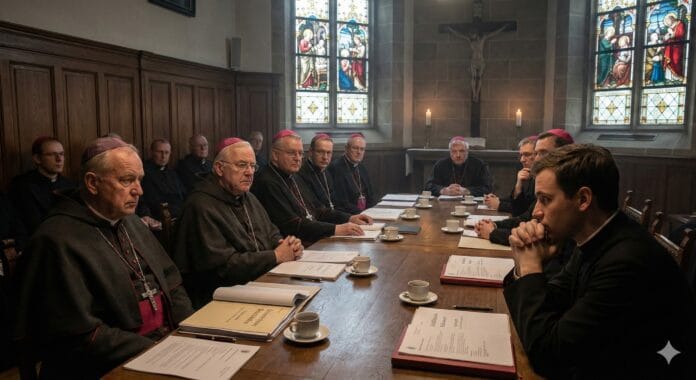
On October 30, 2025, the Education and Schools Commission of the German Bishops' Conference (DBK) published a document for Catholic schools. This document aims to propose a new approach to supporting students on issues of sexual orientation and gender identity. Its objective is to encourage an open and respectful attitude towards the diversity of sexual orientations and gender identities, drawing on contemporary humanities scholarship. Through this guide, the DBK hopes to provide pedagogical and pastoral guidance for better inclusion of LGBT+ youth in Catholic schools, while avoiding discrimination.
This document is led by Bishop Heinrich Timmerevers, Bishop of Dresden-Meissen and Chairman of the Commission for Education and Schools, who emphasizes that it does not claim to provide a complete moral assessment but to serve as guidance adapted to the current realities of students.
Strong criticism and opposition from some German bishops
However, the publication of the document sparked a heated controversy within the German Catholic Church. Several prominent bishops, including Bishop Stefan Oster (Passau), Bishop Rudolf Voderholzer (Regensburg), and Cardinal Rainer Maria Woelki (Cologne), publicly rejected these guidelines. These prelates believe that the guide contradicts traditional Catholic doctrine, which teaches that sexuality belongs to marriage between a man and a woman, that homosexual attraction is ordained to a certain extent, and that God created human beings male and female.
For them, encouraging acceptance of everyone "exactly as God intended," including transgender people wishing to modify their bodies, amounts to a theologization of feelings at the expense of created nature. They denounce the alleged promotion of a subjective vision of identity that undermines Christian anthropology, the doctrine of Revelation, and ultimately the very concept of God. Bishop Oster states that he refuses to endorse this position under his episcopal responsibility, marking a clear rejection by the majority of the episcopal conference.
Issues and implications for the German Catholic Church
This division reflects a deep rift between an episcopal majority that wishes to keep pace with societal changes and a minority seeking to preserve traditional teaching. The debate is symptomatic of broader tensions related to the German "Synodal Way," a process of institutional and doctrinal reforms within the local Church. While Rome observes these debates with caution and concern, the controversy illustrates how issues related to sexuality and gender remain a point of contention.
For German Catholic schools, this controversy has created uncertainty about the educational approach to adopt regarding the support of LGBT+ youth. Despite the criticism, the document officially remains in force. Some bishops emphasize the importance of supporting vulnerable adolescents without trivializing all forms of self-description. This is a major educational, pastoral, and ecclesial issue that raises questions about the role of the Magisterium, the reception of teachings, and the role of schools in the contemporary society.