












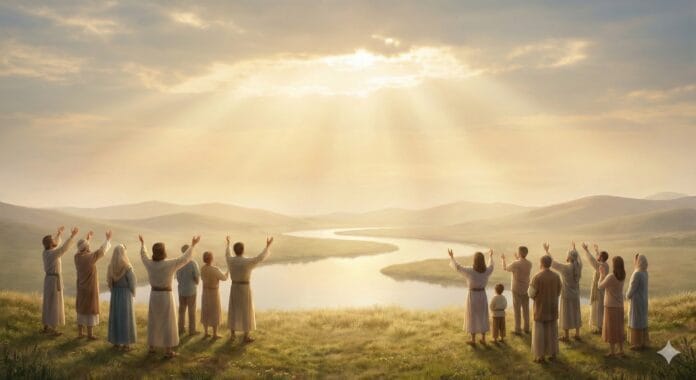
Reading from the Letter of Saint Paul the Apostle to the Ephesians
Blessed be the God and Father of our Lord Jesus Christ! He has blessed us and enriched us with spiritual blessings in the heavenly places in Christ.
He chose us in Christ before the creation of the world, that we should be holy and blameless before him in love.
He predestined us to become his adopted children through Jesus Christ, according to his pleasure and will, to the praise of his glorious grace, which he has freely given us in the beloved Son.
In him we have become God’s own possession, having been predestined according to the plan of him who works out everything that he has purposed: that we, who were the first to put our hope in Christ, should live for the praise of his glory.
Chosen before the creation of the world: to live the revolution of divine election
Discover how our eternal dignity in Christ radically transforms our identity, our vocation, and our way of inhabiting the world..
Imagine being chosen before the world even existed. This mind-blowing reality lies at the heart of the Letter to the Ephesians, In this passage, Paul reveals a dazzling mystery: God chose us in Christ before the foundation of the world. This divine election is neither a matter of chance nor merit, but of a love that precedes all existence. It radically transforms our understanding of ourselves and our very being. Far from being a mere abstract doctrine, this truth engages our daily lives and our mission in the world.
We will first explore the context and richness of the text of Ephesians. Then, we will analyze the central dynamic of divine election. Three thematic axes will develop the scope of this revelation: transformed identity, the vocation to the holiness, and the community dimension. We will also examine the spiritual tradition before proposing concrete avenues for meditation and action.
A cosmic blessing
There Letter to the Ephesians This represents one of the pinnacles of Pauline thought. Likely written during the apostle's imprisonment, it is addressed to the communities of Asia Minor, composed of Christians of Jewish and Gentile origin. The context is that of a nascent Church seeking to understand its own identity in a world riddled with ethnic, social, and religious divisions. Paul writes to reveal God's eternal plan and unite these believers around a shared vision.
The passage we are considering opens the letter with an explosion of praise. The original Greek forms a single, breathtaking sentence, a torrent of blessings that sweeps the reader along in an upward movement. This literary form recalls the Jewish berakoth, the liturgical blessings that punctuate the prayers of Israel. Paul adapts this tradition, directing it entirely toward Christ. The rhythmic and poetic structure of the text suggests that it could be an early liturgical hymn, used in the celebrations of the first Christian communities.
The vocabulary used is striking in its theological density. The terms blessing, election, predestination, adoptive sonship, grace, and glory intertwine to weave a complex tapestry. Each word carries considerable weight in the biblical tradition. Blessing evokes the creative act of Genesis, where God blesses humanity. Election recalls the choice of Israel, a people set apart for a universal mission. Predestination refers to God's sovereign plan that guides history toward its fulfillment.
The text situates this election within a breathtaking temporal framework: before the foundation of the world. This expression propels the reader beyond all human chronology, into divine eternity. God's love for humanity, therefore, does not begin with the Incarnation, nor even with creation. It exists from all eternity, in the mystery of Trinitarian life. This absolute anteriority overturns our usual understanding of the relationship between God and humanity.
The purpose of this election is clear: that we may be holy and blameless before Him, in love. holiness The term "immaculate" here does not refer to an unattainable moral perfection, but to a consecration to God, a radical belonging. The term evokes the sacrificial vocabulary of the Temple, where only spotless victims could be offered. Paul transposes this cultic requirement into the existential realm: we are called to become the living offering ourselves, transformed by love.
Adoptive parentage is another major theme of the passage. In the Greco-Roman world, adoption allowed for the transmission of an inheritance and a name to someone outside the family. Paul uses this legal reality to express the extraordinary grace of God: we become children in the Son, heirs to his glory. This parentage does not stem from nature but from pure divine goodness, manifested in Jesus Christ.
Finally, the text emphasizes the dimension of praise. The phrase "to the praise of the glory of his grace" recurs like a refrain. Divine election is not primarily aimed at our individual happiness, but at the manifestation of God's glory. We are chosen to become the awestruck and dazzling witnesses of his gratuitous goodness. This theocentric perspective reorients our entire existence toward gratitude and celebration.
The paradox of freedom in elections
The affirmation of divine election immediately raises a fundamental tension. How can this prior choice of God be reconciled with human freedom and personal responsibility? This question has permeated the entire history of Christian theology, sparking debates and controversies. Yet, the text of Ephesians never presents election as an overwhelming inevitability, but as a joyful liberation.
The key to understanding lies in the very nature of divine love. God does not choose some to exclude others, but calls all people to enter into Christ. Election does not create a closed circle of privileged individuals, but opens a space of infinite grace where everyone can find their place. In Christ, barriers fall: Jews and Gentiles, slaves and free people, men and women are called to form one body.
This election in Christ constitutes precisely the heart of the paradox. We are not chosen as isolated individuals, according to mysterious criteria of divine predilection. We are chosen in Christ, that is, incorporated into him through faith and baptism. Election then becomes participation in the unique sonship of the Son. It is not arbitrary but Christological: whoever adheres to Christ enters into the movement of eternal election.
This perspective radically transforms our understanding of predestination. Far from being blind determinism, it reveals God's benevolent plan for humanity. God desires to gather all things in Christ, to recapitulate the entire universe under one head. Our individual predestination is part of this universal plan of salvation. We are predestined to become what we are called to be: children in the Son, witnesses of grace.
Human freedom is therefore not denied but embraced and transfigured by divine election. God does not treat us like puppets but as partners in his work. He chooses us so that we, in turn, may choose to belong to him. This reciprocity does not establish equality between God and humanity, but manifests the extraordinary dignity accorded to creation. We are capable of responding to the divine call, of accepting or rejecting grace.
The text also emphasizes the gratuitous nature of this election. It stems from kindness of God, not of our anticipated merits. Nothing within us justifies this choice, no pre-existing quality explains it. This radical gratuitousness disarms all pride and establishes a humility joyful. We can boast of nothing except mercy infinite that has seized us. This awareness dissolves pretensions and sterile comparisons.
Finally, divine election directs our entire existence toward a transcendent goal: to live in praise of God's glory. This doxological purpose is not an external constraint but the blossoming of our deepest being. Created in the image of God, we find our true joy in contemplating and celebrating his splendor. Election reveals to us our fundamental vocation: to be worshippers in spirit and in truth, radiant witnesses of kindness divine.
A new identity: from shame to dignity
Divine election brings about a radical transformation of our identity. Before encountering Christ, human existence is often characterized by a quest for identity marked by uncertainty and fragility. We seek our worth in our accomplishments, our appearance, our relationships, or our possessions. These foundations always prove precarious, subject to the vagaries of time and circumstance. The revelation of our eternal election overturns this situation.
Discovering that we have always been chosen establishes an unshakeable ontological security. Our worth no longer depends on our performance or the opinions of others. It rests on God's prior love, which precedes all existence. This certainty liberates us from the multiple tyrannies that weigh upon contemporary life: the obsession with success, the fear of failure, the constant need for approval. We can finally breathe, knowing that our dignity has been established for all eternity.
This new identity is particularly evident in our relationship to sin and guilt. Contemporary man oscillates between two equally destructive extremes: either an overwhelming guilt that paralyzes all initiative, or a denial of evil that prevents any true conversion. Divine election opens a third way. It acknowledges the reality of sin without confining us to it. We are sinners, certainly, but this reality does not define our deepest being. We are first and foremost the chosen, the beloved, adopted children.
This revelation also transforms our relationship with others. Recognizing that we are chosen allows us to recognize that every human being is as well. Election in Christ has a universal scope: it potentially concerns all of humanity. No one is excluded a priori from this calling. This awareness destroys human hierarchies based on race, social status, or natural abilities. Before God, we are all equally loved, equally called to holiness.
The text emphasizes our vocation to be holy and immaculate in love. This expression deserves particular attention. holiness It does not consist of attaining a moral perfection unattainable by our own strength. It primarily signifies a relationship, an exclusive belonging to God. To be holy means to be set apart for God, consecrated to his service. This consecration is not an escape from the world but a new way of inhabiting it, transfigured by the divine presence.
The immaculate refers to the sacrificial purity required in Jewish worship. Paul transposes this requirement into the ethical and spiritual realm. We are called to become the offering ourselves, to make our entire lives a spiritual act of worship. This offering is not realized in ascetic isolation but in love. holiness Christianity is essentially relational: it unfolds in the love of God and neighbor.
This transformation of identity implies a constant spiritual struggle. The old self, marked by sin and desires, does not disappear instantly. It persists as a tendency, a weight that pulls us downward. The new self, created according to God in righteousness and holiness, It must grow gradually. This growth requires our active cooperation: renouncing dead works, welcoming grace, and practicing virtue. Divine election does not exempt us from effort but gives it meaning and power.

Holiness as a collective vocation
Divine election never concerns isolated individuals but a people. Paul consistently uses "we" in our passage. This collective dimension of election contrasts sharply with contemporary individualism. We are tempted to think of our relationship with God as a strictly personal matter, a private dialogue between the soul and its creator. The biblical perspective is radically different.
God chooses a people to be his special domain, his precious possession. This expression evokes the vocabulary of the covenant with Israel. The chosen people of the Old Covenant prefigured the Church, the new people of God gathered in Christ. This continuity is evident. loyalty divine throughout history. God does not change his mind; he fulfills what he has promised from the beginning.
The ecclesial dimension of election has considerable practical implications. It means that we cannot fully live our Christian vocation in solitude. We need each other to grow in the holiness. The Church is not merely an aggregation of saved individuals, but an organic body where each member contributes to the good of the whole. The gifts and charisms distributed by the Spirit serve the common good.
This spiritual interdependence requires a conversion of mindsets. Modern Western society values autonomy, independence, and self-realization. These values have positive aspects but become toxic when they absolutize the individual. Authentic Christian life, on the contrary, presupposes a joyful recognition of our mutual dependence. We bear one another's burdens, we rejoice together, we suffer together.
There holiness This collective aspect is particularly evident in the liturgy. Christian worship is never a mere juxtaposition of individual prayers. It constitutes the preeminent act of the ecclesial body united to Christ. When we celebrate the Eucharist, We are not a multitude of isolated individuals but a single body offered with Christ to the Father. This sacramental union anticipates the perfect communion of the Kingdom.
Being chosen as a people also implies a missionary responsibility. Israel was chosen to be a light to the nations, a witness to loyalty divine before all peoples. The Church inherits this vocation. We are chosen not to selfishly enjoy spiritual privileges but to proclaim to all creation the wonders of God. Our holiness must radiate and attract, manifesting the transforming beauty of the Gospel.
This mission unfolds first and foremost in the quality of our fraternal relationships. Jesus affirms that all will recognize his disciples by the love they have for one another. Charity Life lived within the Christian community becomes the primary witness to the Gospel. Divisions, jealousies, and mutual judgments therefore constitute a scandalous counter-witness. They contradict in actions what we proclaim in words.
The collective dimension of election also protects us from sectarianism and exclusivism. We are not chosen against others, but for others. Election in Christ has an inclusive dynamic; it tends to gather all humanity into unity. Certainly, not everyone currently responds to this call. But no one is excluded in principle. The Church remains open, welcoming, extending its arms to all who seek truth and life.
The grace that precedes and accompanies
The text of Ephesians powerfully emphasizes the central role of grace in divine election. Paul writes that we are chosen according to kindness of God, to the praise of the glory of his grace. This repeated emphasis underscores that our salvation does not come from our own merits but from pure divine generosity. This fundamental truth runs throughout Scripture and constitutes the heart of the Christian faith.
Grace refers to God's unconditional love for creatures who do not deserve it. It precedes all human initiative, anticipates all goodwill on our part. Even before we sought God, he sought us. Before we loved him, he loved us. This radical priority of grace destroys any spirit of calculation or entitlement in our relationship with God. We cannot present him with any bill, claim any rights. We receive everything from his goodness.
This gratuitousness does not mean arbitrariness. God does not distribute his grace randomly, like a gambler rolling dice. His will to save humanity stems from his very nature: God is love. He cannot act other than by loving, for love constitutes his essence. Creation itself springs from this overflowing love that desires to be shared. The grace of election extends and fulfills the initial act of creation.
Christ appears as the locus and mediator of this grace. Paul specifies that we receive grace in the beloved Son. This Christological formulation is crucial. Grace does not reach us in an abstract or impersonal way. It takes on flesh in Jesus; it is revealed in his concrete existence, his words, his actions, his death, and his resurrection. To contemplate Christ crucified is to measure the unfathomable depths of divine love.
Grace brings about a real transformation of our being. It does not merely declare us righteous while leaving us sinners. It truly sanctifies us, making us partakers of the divine nature. This sanctification progresses throughout the Christian life. It begins at baptism and is strengthened in the sacraments, This is deepened through prayer and works of charity. The Christian gradually becomes what he already is by grace: a child of God.
This cooperation between divine grace and human freedom defines the spiritual life. God does everything, but he wants us to do everything with him. This synergy does not simply add two powers of the same order but unites the infinite and the finite, the creator and the creature. Grace does not eliminate nature but restores and elevates it. It heals our wounds, strengthens our weaknesses, and directs our desires toward true good.
Awareness of this grace engenders’humility and recognition.’humility Christianity is not about despising oneself, but about clearly recognizing the source of all good. We possess gifts, talents, and virtues. But none of this belongs to us in and of ourselves. Everything is grace received, everything comes from kindness Divine. This truth uproots pride at its source while preserving a healthy self-esteem.
Gratitude springs naturally from this awareness. The heart that has grasped the magnitude of the grace received cannot help but overflow with thanksgiving. The Christian life becomes a Eucharist permanent, a continuous celebration kindness Divine. This gratitude transforms one's perspective on everything. Daily events, even the most ordinary, become opportunities to bless God and acknowledge his presence.
Echoes of the great tradition
Meditation on divine election runs throughout the history of Christian spirituality. The Church Fathers extensively commented on this passage from Ephesians, finding in it material to nourish the faith of the faithful. Augustine of Hippo developed a theology of grace that draws heavily on this text. He emphasizes the absolute priority of divine initiative in salvation. Fallen humanity, corrupted by sin, cannot save itself. Only God's prevenient grace enables it to desire and achieve good.
Medieval monastic tradition deeply contemplated the mystery of election. Bernard of Clairvaux reflected on the special love with which God surrounds us. He encouraged monks to marvel at this extraordinary dignity: being chosen by God before the creation of the world. This contemplation did not distance them from the world but made them more available to serve their brothers and sisters. Recognizing one's own election leads to recognizing that of every human being.
Carmelite spirituality, with Teresa of Avila And John of the Cross, This deepens the mystical experience of union with God. This union is not a spiritual feat but the fulfillment of divine election. We are created for God, predestined to be united with him in love. The mystical path is therefore not reserved for a privileged few but represents the natural unfolding of baptismal grace. Every Christian is called to this transforming intimacy with the Lord.
The Protestant Reformation placed the doctrine of election at the center of theological reflection. Luther emphasized justification by faith alone, reminding us that we can add nothing to the work of Christ. Calvin developed a doctrine of double predestination that sparked lively debates. Beyond the controversies, the Reformers reaffirmed an essential truth: salvation proceeds entirely by grace, not by human works.
The Catholic tradition, particularly with Ignatius of Loyola, This awareness of election is integrated into a spirituality of action. We are chosen for a mission, sent into the world as Christ was sent by the Father. This mission is discerned in prayer, illuminated by meditation on Scripture, and confirmed by ecclesial obedience. Divine election is never passive but dynamic and missionary.
Christian liturgy celebrates this mystery of election during the major events of the liturgical year. The Easter Vigil proclaims the passage from darkness to light, from death to life. Baptism incorporates us into the dead and risen Christ, bringing us into the people of the elect. The Eucharist It unites us to the sacrifice of Christ, conforming us to him so that we may live his life. These celebrations do not merely commemorate past events but make present the grace of election.
The great saints concretely demonstrate what it means to live according to divine election. François d'Assisi abandons wealth and security to marry Lady Poverty, Recognizing that God alone suffices, Thérèse of Lisieux discovers the little way of spiritual childhood, surrendering herself completely to merciful love. Charles de Foucauld embraces the hidden life of Nazareth, a silent witness to the divine presence in the heart of the desert. Each embodies, in their own way, the unique call that God addresses to them.
A path of inner life
Meditating on the mystery of divine election requires a gradual and concrete approach. Here are some steps to integrate this revelation into our daily lives.
Let us begin with a time of silence and reflection. Let us find a quiet place, put away distractions, and adopt a posture that encourages contemplation. Let us breathe calmly, allowing tensions to dissipate. Let us invoke the Holy Spirit to open our minds and hearts to the Word. This preparation is not optional but essential for receiving grace.
Let us read the text of Ephesians slowly, several times if necessary. Let the words resonate, let us welcome the images that arise. Let us not immediately seek intellectual understanding, but savor the sentences, relish their beauty. Let us linger on the expressions that particularly touch us. Perhaps the expression of being chosen before the foundation of the world, or that of adoptive sonship, or even that of grace in the Beloved.
Let us then ask the Spirit to help us understand what it truly means to be chosen by God. How does this truth transform our view of ourselves? What fears and insecurities does this revelation soothe? Let us welcome the consolation that springs from this certainty of being loved from the beginning. Let this joy penetrate our areas of doubt and darkness.
Let us be aware of the resistance that may arise. Perhaps a feeling of unworthiness, the impression of not deserving this love. Or, conversely, a subtle pride that would like to claim this election as its own. Let us entrust all of this to God with confidence. Divine election is based neither on our merits nor our demerits, but on the pure goodness of God. Let us receive it humbly, without calculation or claim.
Let us contemplate Christ as the place of our election. Let us look upon him crucified, measuring the extent of his love. Let us look upon him risen, victorious over death and sin. Let us understand that we are chosen in him, incorporated into his Pascal's mystery. Our Christian life consists in allowing ourselves to be conformed to him, in taking on his feelings, in sharing his choices.
Let us ask for the grace to live in accordance with our election. If God has chosen us to be saints, let us ask for the courage to reject sin. If we are predestined to become children of God, let us behave as children of the Father. If our vocation is to live in praise of his glory, let us orient our entire lives toward this end. This prayer for conversion is not a one-off event but should nourish our daily walk.
Let us conclude with thanksgiving, the source and summit of Christian prayer. Let us bless God for the wonders he works in us. Let us praise him for his unconditional goodness, his infinite patience, his inexhaustible mercy. Let us entrust to him our intentions, our plans, our relationships. Let us ask him to make us instruments of his peace, witnesses of his tenderness for the world.
The revolution of eternal love
The mystery of divine election revealed in the Letter to the Ephesians It radically transforms our understanding of ourselves, God, and the world. We discover that our existence is not the result of chance but stems from a loving plan that predates all creation. This revelation transforms our identity, our vocation, and our mission.
Recognizing that we have always been chosen by God establishes our dignity on an unshakeable foundation. Nothing can separate us from this love, neither death nor life, neither angels nor principalities. This certainty liberates us from the many fears that paralyze contemporary existence. We can face trials with confidence, knowing that we are sustained by a grace stronger than anything.
The call to holiness The responsibility that flows from our election is not an overwhelming burden but a joyful invitation. God has predestined us to become conformed to the image of his Son. This transformation takes place gradually, through the cooperation of divine grace and our freedom. Each day offers new opportunities to grow in love, to allow ourselves to be shaped by the Spirit.
The collective dimension of election reminds us that we are not isolated individuals but members of a body. The Church constitutes the people of the elect, gathered from all nations, races, and languages. This communion transcends all human divisions and anticipates the perfect unity of the Kingdom. We are called to manifest this now. universal brotherhood.
Living according to our chosen path requires a concrete, daily commitment. It's not simply a matter of intellectually adhering to a doctrine, but of allowing this truth to transform our entire existence. Our choices, our words, our actions must bear witness to this new identity. We are adopted children, heirs to glory, temples of the Spirit.
This life lived according to our chosen path necessarily radiates outwards into the world. We are not chosen for ourselves, but to become the light of the nations, the salt of the earth. Our holiness It must attract and convert, manifesting the beauty of the Gospel. Each encounter becomes an opportunity to reveal God's love, each gesture a sacrament of his presence.
The ultimate purpose of our election remains the praise of divine glory. We are created, chosen, and sanctified to become worshippers in spirit and in truth. This doxological vocation will be fully realized in eternal life, where we will contemplate the beauty of God face to face. But it begins now, in the earthly liturgy that foreshadows the heavenly liturgy. May our whole life become one Eucharist, a continual thanksgiving for the wonders accomplished in us.
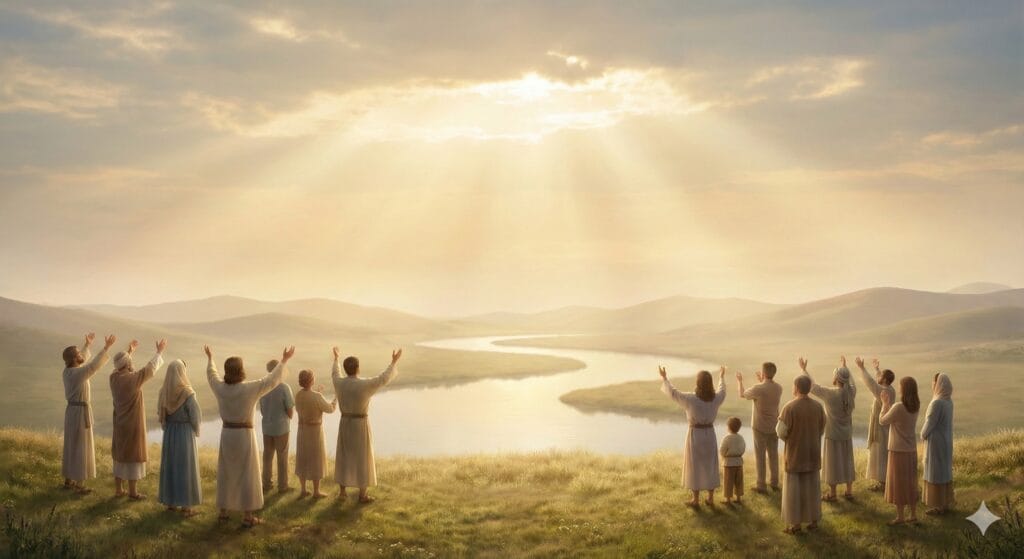
Practical
- Meditate each morning on the phrase "God chose me before the foundation of the world" to anchor my dignity in his eternal love.
- Examine daily whether my choices reflect my identity as an adopted son or whether I am living according to my old habits.
- Praying for a member of my community each day, recognizing that together we form the chosen people.
- Thank God specifically for three graces received, cultivating gratitude as a fundamental attitude of Christian existence.
- Identify an area of my life that resists the holiness and ask for the grace of gradual transformation.
- To actively participate in the Sunday liturgy as an act of the chosen people gathered for the praise of divine glory.
- To give concrete evidence of my election through an act of charity towards a person in need this week.
References
Letter of Saint Paul to the Ephesians, chapters 1 to 3, for the overall context of Pauline theology of election
Letter to the Romans, Chapters 8 and 9, developing the doctrine of predestination and grace
Augustine of Hippo, The City of God and On Grace, major works on the theology of election
Thomas Aquinas, Summa Theologica, Questions on Predestination and Divine Providence
John Calvin, Institutes of the Christian Religion, Book III, Reformed exposition of the doctrine of election
Thérèse of Lisieux, Story of a Soul, spiritual testimony of the little way founded on abandonment to mercy
Hans Urs von Balthasar, The Divine Drama, a contemporary reflection on human freedom and grace
Catechism of the Catholic Church, paragraphs 257-260 and 1426-1429, magisterial teaching on predestination and conversion