












Gospel of Jesus Christ according to Saint Luke
At that time, Jesus told his disciples a parable about the need to pray constantly without losing heart:
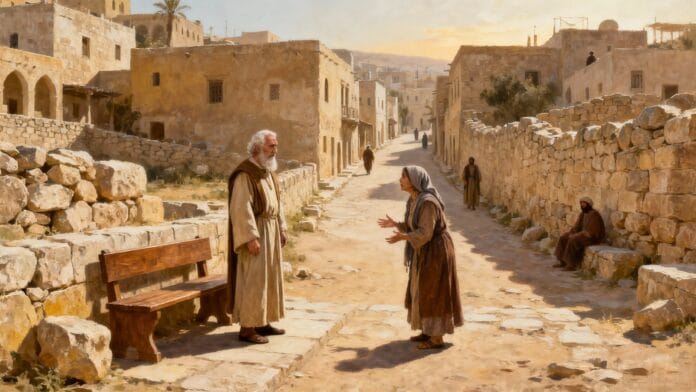
«In a certain city there lived a judge who had no fear of God and no regard for men. In that same city lived a widow who kept coming to him pleading, «Grant me justice against my adversary.»”
For a long time he refused; then he said to himself, «Even though I have no fear of God and no regard for anyone, since this widow is beginning to bother me, I will grant her justice so that she will stop harassing me.»
The Lord continued: «Listen to what this unjust judge says! And will not God bring about justice for his chosen ones, who plead with him day and night? Will he keep them patient? I tell you, he will see that they get justice, and quickly. Yet, when the Son of Man comes, will he find faith on the earth?»
Hold fast in prayer and await God's justice
To believe in loyalty divine when all seems silent and to rediscover the perseverance of the heart.
This text is addressed to those who struggle to understand why God seems to delay his response. It begins with the parable of the unjust judge (Luke 18,(pp. 1-8), it explores patient faith, the promise of divine justice, and the tenacious hope of believers. The meditation unites theology, spiritual psychology, and daily application: how to continue to pray, hope, and act, even when no visible answer comes.
- Context: the parable of the judge and the widow, a mirror of Christian prayer.
- Analysis: God's justice in the face of human injustice.
- Deployment: perseverance, hope, incarnate faith.
- Applications: personal, community and social life.
- Echoes: voice of the Bible and teaching of the Fathers.
- Meditation prompt: the prayer of the night vigils.
- Challenges: the silence of God and a crisis of faith.
- Final liturgical prayer.
- Conclusion: walking in patience active.
- Practical information and references.
«"Would God bring justice?"»
The parable of the judge and the widow (Luke 18,(1-8) is located in the latter part of Luke's Gospel, just before the entry into Jericho. Jesus addresses his disciples, already weary of the prospect of waiting for the Kingdom. He knows how faith weakens when promises are delayed. In this context, he presents a disconcerting image: a heartless judge, indifferent to God and to humanity, facing a stubborn widow demanding justice. The plot hinges on the disproportion—a powerful and unscrupulous man and a defenseless woman—and yet, it is she who triumphs.
In the ancient world, the widow symbolized extreme vulnerability: without a husband, without legal support, without resources. Yet it is precisely through her perseverance that she obtains justice. Jesus draws a spiritual lesson from this: if even an indifferent judge eventually yields, how much more will God, just and loving, listen to his chosen ones who cry out to him day and night. The contrast becomes a theological argument: God's holiness is manifested in his faithfulness to respond, not in the automatic nature of his assistance.
The final question reverses our perspective: «When the Son of Man comes, will he find faith on earth?» The issue is no longer God’s swiftness, but the steadfastness of human faith. Luke frames this question within the tension between the promise of Christ’s return and the weariness of time. The Gospel then becomes a call to persevere, to pray without losing heart, not to sway God, but to remain open to his hidden work.
Thus, divine justice does not oppose apparent delay: it unfolds in history, often in slow and mysterious ways. This parable, brief but dense, encapsulates the entire drama of biblical faith: hoping against all odds.
God faithful to the cry of his people
The heart of the text lies in the reversal of perspective: divine justice is not to be conquered, but received. Jesus demonstrates this by contrast: while the unjust judge ultimately renders justice because of persistence, God acts out of love. The parallelism highlights kindness divine in the face of human harshness. This figure of the judge is not a model, he is the standard of comparison to make shine mercy of God.
Persistent prayer thus becomes an act of trust. By praying without becoming discouraged, the believer acknowledges that God is at work, even invisibly. The widow does not seek to convince the judge of her superior cause; she simply remains rooted in the truth of her need. Thus, to pray is to steadfastly lay bare one's misery, believing that the Father hears the cry.
The word "justice" in the Bible goes beyond mere legal redress. It refers to what God does to restore the rightful relationship between himself and humanity. In the Lucan context, divine justice is not punitive, but restorative. It lifts up the humiliated, restores the excluded to their rightful place, as seen throughout the Gospel: Zacchaeus, the Samaritan, the prodigal son.
Finally, the last question leads us to eschatology: will Christ return to find faith? Not faith as mere intellectual belief, but living faith, embodied in active hope. The test of time becomes the criterion: true faith endures. Jesus invites us to a trust that is not to be confused with impatience. Therein lies spiritual maturity: knowing how to wait without despairing, acting without ceasing to hope.
Praying in God's long silence
Divine silence is not absence; it is a space for listening. The widow does not obtain justice immediately, and this waiting represents the true slowness of our spiritual lives. In the Bible, waiting is always educational: Abraham waits patiently for years before having Isaac; Israel cries out in Egypt for generations. God's slowness purifies faith, freeing it from calculation and bargaining.
Praying without becoming discouraged does not mean using many words, but persevering in faith. In daily prayer, this attitude is expressed by loyalty In times of silence, even devoid of feeling, faith becomes joyful endurance. Christian mystics have often testified to these long spiritual nights when God seems silent, in order to better expand the capacity to love.
Hoping for justice: not vengeance, but reparation
The widow does not ask for vengeance, but for justice. She wants the rightful order to be restored. This distinction is crucial: to pray for justice is to entrust to God what is beyond our power. Divine justice does not crush the adversary; it heals damaged relationships. It manifests itself in tenderness: "God will grant justice to his chosen ones," meaning that he will restore them to their dignity.
This dimension sheds light on social prayer: faced with the injustices of the world, the believer is not passive. They channel their anger into prayer and act to transform reality. God's justice often works through our actions, our commitments, our economic and political choices. Thus, prayer becomes the seed of responsibility.
Holding on to faith when the horizon darkens
Jesus' question—"Will he find faith?"—resonates like a prophecy. In times of crisis, faith can weaken, reduced to an abstract morality. Luke warns us: faith is measured by perseverance. The believer who continues to pray when he no longer sees the light becomes a witness to a hope stronger than logic.
This faith builds communities: it supports the sick, comforts the bereaved relative, and lifts up those who have lost everything. It is not proven by words, but by loyalty silent, day after day. It is this faith that the Son of Man seeks at his return: a humanity inhabited by active trust, not resignation.
Implications and applications: the spheres of life
In personal life, this text calls for cultivating a patient faith. In practical terms, this involves regular times of prayer, even if brief, but consistent. Keeping a spiritual journal helps to revisit the subtle traces of loyalty of God, often perceptible in retrospect.
In family life, "praying without growing weary" means not abandoning tenderness amidst tensions. Prayer becomes an act of unity, like reciting a short prayer together in the evening. Here again, God's justice is manifested through reconciliation.
In community and church life, this gospel invites us to patience towards the long-term nature of institutions. The prayer of the faithful each Sunday becomes an expression of the widow: to ask without ceasing peace, Conversion, truth.
In the social sphere, this parable inspires active hope. Believing that God will bring justice does not absolve us from action. Perseverance becomes a principle of commitment: fighting for the oppressed, defending the dignity of every life.

A beam of voices
This parable is rooted in the entire biblical tradition of the cry heard by God. the Exodus, The Lord said, «I have heard the cry of my people» (Ex 3,7). The Psalms take up this motif: «The poor cried out, and the Lord heard» (Psalm 33:7). Luke follows in this tradition of compassion divine one who bends down to the humble.
The prophets extend this theme: Amos denounces those who "force the righteous to submit"; Isaiah announces the coming of the Servant who "will render justice with gentleness." In the New Testament, justice takes on a face in Christ himself: he is the justice of God made flesh. In him, God does not merely grant reparation: he offers total reconciliation.
The Church Fathers commented extensively on this passage. Augustine saw in it the pedagogy of divine silence: God sometimes delays his response to purify the desire of the one who prays. John Chrysostom emphasizes that the widow represents the Church itself, humble, dependent, but tireless in intercession for the world. Teresa of Avila and holy John of the Cross They will take up this intuition: prolonged prayer hollows out the heart, so that it becomes capable of God.
Thus, the justice God promises is not earthly vengeance, but a transfiguration. The coming Kingdom does not abolish time: it fulfills it. This text is rooted in the hope of a faithfulness that pierces the darkness of the world.
Vigil prayers
- Place yourself in silence, standing or sitting, with your eyes closed.
- Read slowly: «Will not God bring about justice for his chosen ones, who cry out to him day and night?»
- To identify within oneself a situation of injustice, pain or waiting.
- To name this inner cry, without words or justification.
- To entrust it to God, then to remain silent, with an open heart.
- Repeat this evening offering every day at the same time.
This practice reconciles loyalty inner peace and openness to God's justice. Little by little, it transforms anxiety into confidence. It is not mechanical repetition that works, but the stability of a faithful heart.
The silence of God and modern doubt
Our age, marked by immediacy, struggles to understand God's slowness. We want everything, right now: healing, success, answers. God's silence then becomes a scandal. Many stop praying, thinking it's pointless. Yet, the parable reverses this logic: it is perseverance that makes faith mature.
Contemporary crises—wars, injustices, religious scandals—fuel the question: where is God's justice? Jesus' answer invites us to a reversal: God acts, but through our faithfulness. Every act of justice, every prayer offered in the night, is already a sign of his work.
Remaining a believer without immediate guarantees is the spiritual challenge of the 21st century. Christ seeks this kind of mature faith, capable of enduring trials without breaking. Not the faith of habit, but the faith that draws upon the memory of God's past works to confront the silences of the present.
Prayer of the Watchman
Lord Jesus,
you who heard the cry of the poor
and lifted up the widow in her distress,
Teach us the prayer that never tires.
When our words run out,
May your Spirit intercede for us in secret.
When justice is delayed,
Rekindle in us our trust in your promise.
You who will return to judge with gentleness and truth,
found in our hearts
that faith you were asking for.
May your justice descend on our lives
like a light rain in the morning.
Grant that your Church may be a faithful widow,
prayerful in the heart of the world,
and make of each of us
an instrument of consolation.
Amen.
Walking in active patience
The parable of the judge and the widow invites us to redefine strength: it lies not in power, but in perseverance. Faithful prayer becomes a place of justice: by crying out to God, we allow his light to restore inner and social order. Waiting is not about enduring, but about cooperating in a slow work. The believer is not a spectator of God's justice: he becomes its architect.
Let Jesus' question remain open: will he find faith? It is up to each of us to offer him an answer through perseverance, in the coming day, in the silence of vigils, and in hope.
Practical implementation
- Set aside a short, faithful time for prayer each day.
- Review the signs of each week loyalty of God.
- Transforming a complaint into a prayer of trust.
- To offer just action instead of hasty judgment.
- Linking prayer and concrete social engagement.
- Sharing a fulfilled waiting experience within one's community.
- Give thanks, even for the slowness.
References
- Gospel according to Saint Luke, 18,1-8.
- Book of Exodus, 3,7.
- Psalm 33 (34), 7.
- Saint Augustine, Sermons on the Psalms.
- John Chrysostom, Commentary on the Gospel of Luke.
- Teresa of Avila, The Path to Perfection.
- Catechism of the Catholic Church, § 2730–2745.
- Joseph Ratzinger, Jesus of Nazareth, Volume II.