












CHAPTER 11
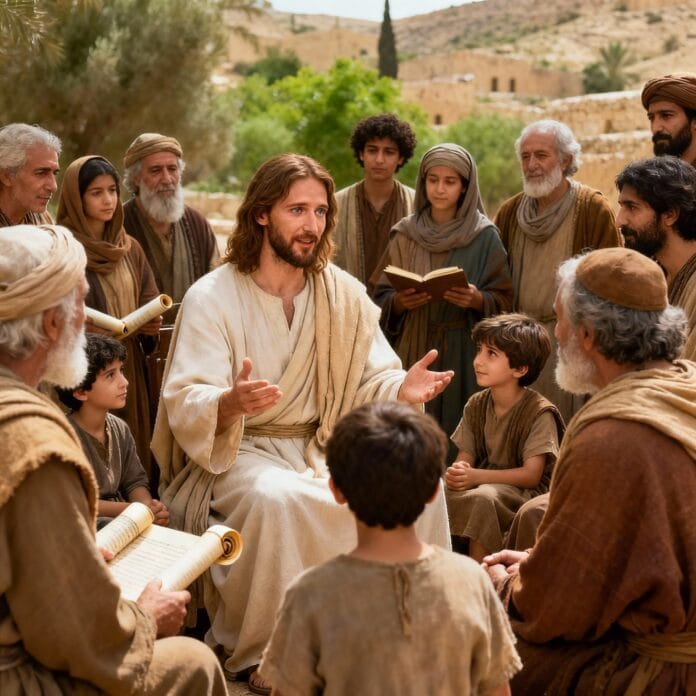
Luke 11.1 One day, while Jesus was praying in a certain place, when he had finished, one of his disciples said to him, «Lord, teach us to pray, "as John taught his disciples."» This is one of the short historical introductions with which St. Luke frequently accompanies Jesus' discourses. The time and place are left vague, as secondary circumstances, or rather, they are determined in a general way by the context. The scene takes place in the vicinity of Bethany (cf. 10:38 and the commentary), probably on the western slope of the Mount of Olives, not far from the summit, southwest of Kefr-el-Tur, as tradition teaches. The time is that of Jesus' great journey to Jerusalem shortly before his Passion, 9:51 ff. He prayed. A new prayer of God made man, mentioned only in the third Gospel. It served as the occasion for the conversation that follows. There is no proof that Jesus said it aloud, as various exegetes (Stier, Plumptre, etc.) have thought. When he had finished A picturesque detail. At the very moment when Jesus, having finished his prayer, approached his disciples, one of them (it must have been one of the Seventy-Two, for the Apostles already knew the Our Father) made this touching request to him: Teach us to pray, That is to say, as is clear from the following words: Teach us a special formula of prayer, which we shall recite in remembrance of you, and which shall contain the best summary of the supplications we can address to God. As John learned…A valuable allusion to a detail in the life of the Forerunner. We do not know what form these prayers were that St. John the Baptist gave to his disciples; but there is reason to believe that they dealt primarily with the manifestation of the Messiah, who was the principal object of the Forerunner's preaching and mission, and with the dispositions of heart and mind necessary to receive him. «May God grant that he come,» we might say with Maldonat. Moreover, it has always been the custom of the Saints, as it was of the former times of famous Rabbis, to leave some characteristic prayer for their friends.
Luke 11.2 He told them, «When you pray, say: Father, hallowed be your name, your kingdom come. Jesus welcomes his followers' request with his customary kindness, and slowly, devoutly, he begins to recite before them the divine formula that has been given his name (the "Lord's Prayer"). It was the second time he had recited it, as most exegetes agree. It had already been an integral part of the Sermon on the Mount, Matthew 6:9-13; he repeats it now, either to better engrave it in the hearts of his disciples and his Church, or to show that no more beautiful prayer could be composed. But, in repeating it, he shortens and slightly modifies it:
Matthew. Our Father, Luke. Father.
Matthew, who art in heaven: omitted by St. Luke
Mth. that your name be hallowed.
Luke, hallowed be your name.
Mth. Thy kingdom come.
Luke, may your kingdom come.
Matthew, thy will be done on earth as it is in heaven: omitted by St. Luke
Matthew. Give us this day our daily bread.
Luke. Give us today the bread we need to live on.
Matthew. Forgive us our debts, as we forgive those who owe us. Luke. And forgive us our sins, for we ourselves forgive everyone who owes us.
Mth. And do not let them enter into temptation.
Luke, and do not lead us into temptation.
Matthew, but deliver us from evil: omitted by St. Luke.
The second Our Father It therefore has only five petitions instead of seven: but are not the third and seventh, which it omits, included in "Thy kingdom come" and "lead us not into temptation," as St. Augustine already pointed out (Enchiridion, c. 116)? Thus, when the Protestant exegete H.W. Meyer sought to conclude from these variants that the early Church did not recite the Lord's Prayer, and that, for this reason, forgetful tradition had given the evangelists two different texts of the Our Father, Another Protestant, Alford, silenced her with this clever question: "If the Apostolic Church did not use the Lord's Prayer as a formula, when did the use of the Our Father, "Since we find it in all known liturgies?" It is from Our Lord Himself that the differences noted above originate. – For a detailed explanation, we refer the reader to our commentary on the first Gospel. We will limit ourselves here to a few brief notes. Let us first recall that the Our Father It is divided into two parts: the wishes and the supplications. In St. Luke's formula, the wishes correspond to the first two requests, and the supplications to the last three. The first part thus concerns God's interests, put forward in a way that is both just and natural, in accordance with the art of prayer, of which we have such beautiful examples in the Psalms; the second relates to our own interests, for in it we implore the Lord, or rather our Father, to provide for our material and spiritual needs. Or again: the fundamental thought of the Lord's Prayer can be reduced to an ardent desire for the kingdom of God. The first request (again, according to St. Luke) sets forth the purpose of this divine reign; the second relates to its fulfillment; the other three urge the Lord to remove the obstacles that prevent the kingdom of heaven from developing here below. Our Father. «"« From the very first words, how many graces! You did not dare to lift your face to heaven, and, all at once, you received the grace of Christ. From a bad servant, you became a good son. Therefore, do not put your trust in your works, but in the grace of Christ… Now lift your eyes to the Father… Say “Father,” as a son does,” St. Augustine, De Verbis Dom. Serm. 27. St. Bonaventure also comments admirably on this first word: “O incredible sweetness, O priceless joy, O ineffable jubilation, honey and sugar in my mouth, when I call you Father, you, my God! O exultation, O wonder, O song that penetrates to the very marrow of my bones: that you are my father. What else can I seek, what else can I say, what else can I hear? You are my father!” Stim. amoris, p. 3, c. 14. cf. John 31. We must therefore first address God with a filial spirit, and consequently with the feeling of the liveliest trust. “What will he not give to his children who ask of him, since he has already granted them to be sons?” St. Augustine May your name be hallowed. This is the first wish we make in honor of our beloved Father. It means, in its oriental form: Be glorified by all men. – Our second wish, that your reign may come, This calls for the spread of the kingdom of God, that is, the Church, throughout the entire world. May there be only one flock and one shepherd.
Luke 11.3 Give us this day the bread we need to sustain ourselves, «There are two kinds of prayer,» says St. Basil (Monastic Constitutions, ch. 1), «one of praise, the other of petition, which is less perfect. Therefore, when you pray, do not rush to ask, otherwise you profane your intention, appearing to be supplicating God out of necessity; but, at the beginning of your prayer, forget every creature, visible or invisible, and praise first Him who created all things.» However, once the praise is finished, we can certainly think about our needs, even material ones, as the Lord Jesus indicated to us by this other petition in his Prayer. This is, moreover, the only temporal request in the Lord’s Prayer: all the others are spiritual. “There is only one sensible request to make: that present things not torment us,” St. John Chrysostom, Hom. 24 in Matthew. Today. Literally: day by day. See our commentary on St. Matthew, 6:11.
Luke 11.4 "Forgive us our trespasses, for we ourselves forgive everyone who trespasses against us, and lead us not into temptation."» The Lord's Prayer in the first Gospel uses a metaphor to express "our debts." The prayer formula Jesus left us, despite its brevity, could not fail to address this unfortunately crucial aspect of our lives. We have all sinned; through sin, our filial relationship with God has been broken, and for it to be restored, we need his merciful forgiveness. To obtain this favor, we suggest to him, instructed by the divine Master, a motive well-suited to touch his heart: since we too are submitting… and we forgive without exception to whomever owes usIn these few words, what an admirable principle of fraternal charity. St. John Chrysostom exclaimed upon reading them: «If we take this seriously, we must give thanks to God for our debtors. If we reflect on it, they are for us the cause of great indulgence; and we find much after having lost little, for we too are great debtors to God.» (Chain of the Greek Fathers, cf. St. Bonavent., Stim. Amor. p. 3 c. 17). This motive for forgiveness, which would in itself constitute a philosophy superior to all those on earth, is expressed with greater force and in a more direct manner in the Gospel of Luke than in that of St. Matthew. Do not lead us into temptation, «That is to say, in the temptation that would cause us to succumb, for we are like the athlete who does not refuse the struggle that human strength can sustain.» St. Augustine of the Word, Lord, Sermon 28. «He whom we should seek to sway with prayers has entrusted to you the standard of supplication,» St. John Chrysostom. This is a great consolation for us, for our heavenly instructor knew better than we did by what art, by what requests, by what expressions we would best touch his heart. But now he teaches us, something no less precious, the conditions of good prayer, which are: 1) a holy boldness producing perseverance (vv. 5–10), 2) complete trust (vv. 11–13).
Luke 11.5 He also said to them, «If one of you has a friend and goes to him at midnight, saying, ‘Friend, lend me three loaves of bread,’, 6 because a friend of mine who is traveling has arrived at my house and I have nothing to offer him., – The first condition is expressed initially by means of a short, familiar parable, vv. 5-8, which is utterly picturesque. If one of you has This question at the beginning of the narrative animates it and piques the reader's attention. But the construction soon becomes quite irregular, for the sentence ends differently than it began, the interrogative phrase disappearing at the end of line 6 to transform into a conditional clause. See line 11, and Matthew 7:9 ff., for other examples of these syntactic breaks (anacoluthons). In the middle of the night. Jesus mentions this hour deliberately, as the least opportune time to obtain a favor from men. The supplicant at least presents his request as clearly as possible. He begins with an emphatic "my friend," which will serve to capture his goodwill. Then he gets straight to the point: lend me three loaves of bread. After all, wasn't it asking a very small favor? Besides, he adds, by way of excuse, that he isn't bothering his friend at such a time for his own benefit; but a guest has arrived unexpectedly, tired and hungry, and he finds himself with nothing to offer, all his provisions having been exhausted since the evening meal. Isn't that reason enough to come knocking, even at midnight, on a friend's door? All the more so since the guest is also a friend of the petitioner, and "the friends of our friends are our friends." – The number three serves only to make the image more concrete. The reader knows that the breads of the East are thin flatbreads, no larger than our plates. It should also be noted that Orientals, to avoid the burning heat of the day, usually travel at night during the beautiful season: this is why the host of the parable arrives so late and causes such great disturbances.
Luke 11.7 and that from inside the house, the other replies: Don't bother me, the door is already closed, my children and I are in bed, I can't get up to give you some: From his bed, where he was resting comfortably, the friend who had been addressed replied with a peremptory refusal, expressed in very harsh terms. One could see, through his language, the man jolted awake in the midst of his first sleep, and filled with ill humor toward the one who had come to disturb him. Thus, there was no polite response to the kind title initially addressed to him; but, immediately, these harsh words, Don't bother me. However, he felt compelled to justify his refusal. Firstly, his house was securely locked; and the heavy pieces of wood or iron used to barricade the doors of the ancients could not be removed in an instant. Moreover, and this seemingly delicate detail contained a perfectly plausible reason, his grandchildren were sleeping beside him; and wouldn't he wake them by rattling the door bars, by opening the cupboards to perform the service requested? Therefore, in conclusion, I cannot get up to give you any. Try to obtain your bread elsewhere. – Several commentators, following St. Augustine, Letter 130, 8, give to children the meaning of servants. So the idea would be: Everyone is asleep, there's no one to help me open the door, or to look for the requested items. But the Greek text uses the diminutive of children, which only applies to the son of the house. – It is not necessary to take the words too literally My children and I are in bed They remain true even if each of the children had rested on their own bed, stretched out on the floor in the common room, next to the father's couch. This interpretation seems more in line with Eastern customs.
Luke 11.8 I tell you, even if he would not get up to give him anything because he is his friend, he will get up because of his shamelessness and give him as much bread as he needs. So, we assume that the petitioner, despite his friend's refusal, continued to knock on the door without losing heart. Jesus uses a forceful expression to characterize this ultimately successful conduct: literally, impudence, audacity. "There is nothing that effrontery cannot wrest from us," wrote Petronius along the same lines. The Greeks also said, proverbially, that impudence is a god. And the Jews said, "Impudence even achieves results in the presence of God.".
Luke 11.9 And I tell you: Ask and it will be given to you, seek and you shall find, Knock and the door will be opened to you. 10 For everyone who asks receives, and everyone who seeks finds, and to the one who knocks it will be opened. – In these two verses, Our Lord draws the conclusion of his narrative. «He shows that pusillanimity in prayer is condemnable,» Cyril (Chain of Greek Fathers). And I tell you. There is great strength in this and me. St. Cyril is right to add that "an oath has power." There is also great power in the three verbs. ask, search, knock, arranged in ascending order, to represent the supplicant's energy, his tireless perseverance, growing with the obstacles and succeeding in overcoming them. Indeed, You will be given, you will find, it will be opened to youThree other verbs correspond to the first. “Because we bring slowness and laziness to prayer, and because we underestimate our Father’s benevolence and expect little from him, he insistently repeats the same thing in three different ways,” Luke of Bruges. Cf. Matthew 7:7 ff., where the same thought is expressed. – Therefore, let us not be afraid to act toward God with holy boldness when we ask for his graces. If persistence in asking triumphs over the hardness of men, how much more will it triumph over kindness of God. Indeed, in the application of the parable, the comparison is all the more apt: “…if a sleeping man is forced to give what is asked of him after being awakened against his will, with what kindness will he who never sleeps and who awakens us so that we may ask him.” St. Augustine, Letter 130, 8.
Luke 11 11 Which of you fathers, if your son asks for bread, will give him a stone? Or if he asks for a fish, will give him a snake instead? 12 Or, if he asks her for an egg, will he give her a scorpion? – Jesus now develops, vv. 11-13, a second condition of prayer, which is trust. When we pray to God, we are addressing a father, and this father cannot fail to listen to us favorably. Thus, after showing us what we can expect from a friend, Our Lord indicates what we have the right to expect from a father, but a heavenly father. See Matthew 7:9-11, this idea previously presented by Jesus. Which of you fathers, if his son asks him for breadJesus chose his comparisons from the world of family life in order to make a greater impact on his listeners and to instill his lessons more deeply. The three parallels he drew were perfectly natural, given the resemblance between the objects mentioned: the bread and the stone, the serpent and the fish, the egg and the scorpion. Indeed, when the scorpion coils up, it has the shape of an egg, even though it is not the same color. The parallel becomes even more striking if Jesus had in mind not the common scorpion, but, as everything suggests, the large white scorpion frequently found in Palestine and in SyriaSee Pliny, Natural History 11, 25. The reader knows that this animal, which belongs to the class Arachnida and the order Pulmonaria, is one of the plagues of the biblical East. It has a venomous stinger at the end of its tail, and its sting, always painful, sometimes causes death. What father would be so inhuman as to put a scorpion instead of an egg in his child's hand?
Luke 11.13 If you then, being evil, know how to give good gifts to your children, how much more will your heavenly Father give the Holy Spirit to those who ask him!» – In the severe, but unfortunately all too accurate, epithet that the Savior addresses to humanity, an ancient commentator rightly finds an "illustrious proof of original sin." Your Father who is in heaven : the Father par excellence, «from whom all things proceed in heaven and on earth» (Ephesians 3:15). He will give you the Holy Spirit For it is indeed He whom we are speaking of. The contrast could not be stronger: men give their children good things, as much as they can; God grants His own His Spirit, what He has and what is most perfect. How could we not implore Him with confidence?
Luke 14-16 = Matthew 12:22-24
Luke 11.14 Jesus was casting out a demon, and this demon was mute. When the demon was expelled, the mute man spoke, and the people were amazed. – Jesus was chasing away a demon is a picturesque circumlocution, beloved by St. Luke. This demon was mute. This expression can refer to deafness as well as muteness, or even both infirmities combined. The context shows that the evangelist was primarily referring to the latter. According to St. Matthew, the demoniac was also blind. The phrase "and this demon was mute," which at first seems surprising, is remarkably psychologically accurate, as it identifies the demon and the possessed person, making them a single moral entity, which perfectly reflected reality. St. Luke thus indicates that the infirmity healed by Our Lord in this instance did not stem from an organic defect, but was a result of demonic possession. The mute man spoke. This change of gender further attests to the almost medical precision of the sacred writer. The demon driven out, only man remained, and resumed all his personal rights: as indicated by the masculine form. THE. – The people were in awe, «And they said, »Could this be the son of David?’” Matthew 12:23. But when did this miracle take place, and consequently, when was the discourse delivered that prompted it? St. Matthew (cf. Mark 3:20 ff.) and St. Luke, in fact, give it a very different date. We dare not, for once, resort, as several exegetes do, to the hypothesis of a repetition, because the resemblance of the two accounts, which often borders on identity, seems to preclude such an opinion. Moreover, none of the evangelists specifies the time precisely here, which leaves us with greater freedom of interpretation. We therefore believe St. Matthew’s arrangement, which is partly corroborated by St. Mark’s, to be more in line with the chronological order, and we place the incident at a later period in the life of Jesus.
Luke 11.15 But some of them said, "It is by Beelzebul, prince of demons, that he drives out demons."« – According to the other two Synoptic Gospels, they were Pharisees and Scribes. It is by Beelzebub… that demons are driven away. On this Philistine god, whose name had become synonymous with Satan among the Jews, see Matthew. There Jesus was accused of complicity with the prince of demons: by such bold and crude slander, his enemies hoped to undermine his authority among the people. The Talmudists reproduced it in a similar way when they claimed that Our Lord performed his miracles using magical formulas, the knowledge of which he had acquired in Egypt. (Bab. Schab. f. 104, 2; 43, 1). An ancient scholar replied: «When complete blindness arrives, impiety follows. There is no work of God so evident that the impious person does not corrupt it.».
Luke 11.16 Others, to test him, asked him for a sign in the sky. This request was addressed to Our Lord, according to the more precise account of St. Matthew (12:38), only after he had refuted the accusation of the Pharisees. St. Luke logically links the two reflections, because each of them prompted part of Jesus' response. "The Jews demand miraculous signs," said St. Paul, 1 Corinthians 1:22, to characterize his former coreligionists. Abusing kindness of God, who had lavished miracles In their favor, they had gradually given in to this unfortunate tendency.
Luke 17-26 = Math 12, 25-37, 43-45 Mc3, 22-30.
Luke 11.17 Knowing their thoughts, Jesus said to them, «Every kingdom divided against itself will be destroyed, and houses will fall one upon another. 18 If Satan is divided against himself, how can his kingdom stand? For you say that it is by Beelzebul that I drive out demons. – The Apology of the Savior is divided into two parts, one negative (vv. 17-19) and the other positive (vv. 20-26). In the first, Jesus simply demonstrates that he is in no way an associate of Beelzebul; in the second, he indicates the true cause of his power over demons. The first contains two arguments, which are two appeals to different experiences. – 1° (vv. 17 and 18). It is a law of history that any kingdom divided against itself will be devastated. The infernal kingdom is no exception to this law. If Jesus casts out demons only with the help of Satan, their leader, then we must say that Satan is working to ruin himself. What an absurdity! – The words have been interpreted in two different ways the houses are falling on top of each other. Some commentators, relying on parallel passages in St. Matthew and St. Mark, understand "divided within itself" after "house," and suppose that Jesus combines the example drawn from politics with another example from family life. But, since St. Luke's phrase seems difficult to interpret, most authors consider it an expansion of "will be devastated." The internal wars of empires soon bring about the separation, and consequently the ruin, of families, which sadly fall one after another. This latter meaning seems to us the most plausible. Because you say… St. Luke alone retained this final reflection from the first line of reasoning.
Luke 11.19 And if I cast out demons by Beelzebul, by whom do your sons cast them out? Therefore they will be your judges. “If you claim that I only succeed in expelling demons by virtue of a pact made with Beelzebul, I will likewise accuse your disciples (your sons) of receiving their exorcist powers from Satan. And what will you be able to say to me? They themselves will prove that you have slandered me.”.
Luke 11.20 But if it is by the finger of God that I drive out demons, The kingdom of God has therefore come to you. – Jesus' negative evidence was irrefutable; but his positive arguments will be even stronger in annihilating the hideous sophistry of his opponents. We find the first in this verse. But if…This hypothetical statement is quite modest, following the victorious arguments that precede it. Nevertheless, Jesus affirms a very evident fact. By the finger of God A beautiful image, reminiscent of the exclamation of the Egyptian sorcerers upon seeing the miracles performed by Moses: "It is the finger of God!" (Exodus 8:19). Jesus uses the expression "the finger of God" to affirm that his actions are accomplished by the divine power of God himself. The version in St. Matthew reads "if it is by the Spirit of God." It is the same thought, minus the image. The kingdom of God has come to you The Messianic kingdom is founded. Our Lord therefore demonstrates, by this argument, that he is the promised Messiah.
Luke 11.21 When a strong and well-armed man guards the entrance to his house, what he owns is safe. 22 But if someone stronger comes along and defeats him, he takes away all the weapons in which he trusted and divides his spoils. – The second positive proof consists of a beautiful allegory, presented by St. Luke in a more complete and vivid manner than by the other two narrators. Perhaps this was partly a reminiscence of Isaiah 99:24-25: «Can a warrior’s plunder be taken away? Can a captive escape from a tyrant? This is what the Lord says: »Surely the captive of the warrior will be taken away, and the plunder of the tyrant will be delivered. I will oppose your adversaries, but I will save your children.’” When a strong man…this man is a determined character, who is none other than Satan. His house, That is to say, figuratively speaking, the world where the devil reigned with greater freedom before the coming of Our Lord Jesus Christ? At peace A Hebraism meaning: safe. But if a stronger one. But "the strongest," as opposed to the prince of demons, is none other than Jesus. Occurs The corresponding Greek verb is used primarily to describe a hostile incursion. who defeats him : swift result of the duel declared to Satan by Jesus. He removes all the weapons… his remains. These words, which conclude the allegory, represent the possessed healed by the Savior.
Luke 11.23 Whoever is not with me is against me, and whoever does not gather with me scatters. – Third positive proof, presented as a deduction from all the preceding argumentation, showing that it is impossible to remain neutral with regard to Jesus in the all-out struggle between him and the demons. The second hemistich, who does not amass…, differs from the first only in the striking metaphor with which it clothes the thought.
Luke 11 24 When an unclean spirit leaves a man, it goes through arid places, seeking rest. Not finding any, it says, “I will return to my house from which I came.”. 25 And when he arrives, he finds it cleaned and decorated. 26 Then he goes away, taking with him seven other spirits more wicked than himself, and they go in and dwell there. And the last state of that man becomes worse than the first.» – Fourth positive argument, in which Jesus refutes the accusation of his enemies and proves to them that they themselves are possessed by the devil. This new allegory contains a perfect summary of Jewish history, from the end of the Babylonian captivity to the time of Our Lord. The man from whom the devil has gone is none other than the theocratic nation, purified, by the sufferings of exile, of the pagan superstitions that had delivered it into the power of Satan. Unfortunately, it had allowed itself to be seized again, and more strongly than ever, by the prince of darkness. Thus, its present state, as evidenced by the feelings of hostility it displayed toward its Messiah, was worse than its previous situation. But it was thereby preparing for itself a punishment even more terrible than the Babylonian exile. See St. Matthew. Apart from a few omitted or slightly modified expressions, the wording of St. Luke is completely identical here to that of St. Matthew; however, our three verses do not occupy the same place in the two accounts. The first Gospel places them, perhaps more explicitly, at the end of the apology for the Savior.
Luke 11.27 As he was speaking, a woman from the crowd raised her voice and said to him, "Blessed is the womb that bore you and the breasts that you suckled."« – Jesus was thus suddenly interrupted in his speech; or at least the heroine of this episode took advantage of a short pause that the divine orator undoubtedly made before moving on to the second point he had to address, to give free rein to the enthusiasm that pressed upon her. Raising his voice“The words have great emphasis. This emphasis reveals a profound emotion and a profound faith in the proclamation. She speaks to the innermost senses of the soul, shouting, so to speak, at the top of her lungs,” Maldonatus. cf. Euthymius, 111. By their atrocious slander, the Pharisees had not succeeded in deceiving this candid soul. But wouldn't one say that they transmitted their feelings of hatred to those Protestant exegetes, unfortunately all too numerous, who see in the humble woman's naive and touching exclamation only an “unintelligent admiration for the marvelous Thaumaturge and preacher,” only “the first example of that spirit of Mariolatry (forgive us for copying these lines) which later penetrated the Church to corrupt it, and which today, in the city of Rome as in many Catholic countries, places the Virgin Married above the Son she carried in her womb.” A woman… from the middle of the crowd. She was probably a mother, as is evident from her language. – Her words, stripped of their figurative language, amount to saying: How happy your mother is. The Talmud and classical works abound with similar praise. «O happy woman, your mother who bore you,» Petronius, 94. Cf. Ovid, Metamorphoses 4, 231.
Luke 11.28 Jesus replied, «Blessed rather are those who hear the word of God and keep it.» – This is Jesus' answer. The Savior does not dispute the truth of the praise addressed to his holy Mother. Married She herself, divinely inspired, had exclaimed in her canticle, 1:48: “From now on all generations will call me blessed,” and every day the liturgical prayers lead us to repeat: Blessed is the womb that bore you. Blessed are the breasts that nursed you. But Our Lord loved to always raise those who listened to him to higher spheres. Thus, already concerning his Mother, 8:20 and 21, he had uttered this sublime phrase: “My mother and my brothers are those who hear the word of God and put it into practice.” Similarly, now, contrasting one fact with another, he affirms that it is better to be intimately united to him through obedience than through purely external relationships. This was to say, in indirect terms, that Married was twice blessed. "The Mother of God, who was blessed because she was made a temporal minister of the Incarnate Word, is even more blessed because she remains the eternal guardian of him who must always be loved," Bede the Venerable, hl Or, as St. Augustine puts it, "Maternal closeness was of no other benefit to her than to have brought forth Christ more fruitfully in her heart than in her body. Married is happier for having accepted the faith of Christ than for having conceived him in her flesh.”
A sign from the sky. Luke 1129-36 = Matthew 12:35-42
Luke 11.29 As the people gathered in crowds, he began to say:« This generation is a wicked generation, She asks for a sign, and she will receive no other sign than that of the prophet Jonah. 30 For just as Jonah was a sign to the Ninevites, so the Son of Man will be a sign to this generation. – The people gathering in crowds This is a dramatic detail, unique to St. Luke. The Greek verb refers to a huge gathering of people and is used only in this passage of the New Testament. He began to say. «Jesus was asked two questions. Some slandered him, accusing him of casting out demons by Beelzebub. He is now answering them. Others, to test him, asked him for a sign from heaven. He is beginning to answer them.». He began It is picturesque: we have often seen St. Luke use this expression to highlight the beginning of Jesus' discourses. Evil generation In the first Gospel, the Savior adds "and adulterer." By this terrible, but all too well-deserved judgment, Our Lord justifies his refusal in advance. Why should he consider the desires of such perverse people, who disregard the many miracles he has performed as a sign of his divine mission? Nevertheless, he solemnly dismisses the Pharisees, as in an earlier instance of his public life (John 2(18 and following), to the dazzling miracle of his resurrection. Such is the sign of the prophet Jonah that he promises them at this moment (cf. commentary on St. Matthew). Jonah was a sign to the Ninevites; Jesus was a sign to the Jews of his time (cf. Matthew 12:40), where the thought of the divine Master is more fully expressed.
Luke 11.31 The Queen of the South will rise at the judgment with the men of this generation and condemn them, because she came from the ends of the earth to hear the wisdom of Solomon: and there is something greater than Solomon here. 32 The men of Nineveh will rise up at the judgment with this generation and condemn it, because they repented at the preaching of Jonah, and something greater than Jonah is here. – Two examples to legitimize the assertion in verse 29: «This generation is wicked.» They are presented by St. Matthew in reverse order, with the Ninevites appearing before the Queen of Sheba, perhaps because Jonah had been mentioned immediately before. It is impossible to say with certainty what the original arrangement was. Will rise : during the ultimate judgment, the great assembly of the end times. Then the Queen of Sheba and the Ninevites will condemn the unbelieving generation that was contemporary with Jesus. – Apart from one word (men, (v. 31) added in the third Gospel, the resemblance of the parallel narratives is absolute at this point. Solomon represents the manifestation of divine wisdom in the Old Testament, Jonah that of divine power: in Jesus Christ, these two attributes are united and manifested with a fullness hitherto unknown. If, therefore, he is greater than Solomon and Jonah, how great must be the sin of Israel, which does not listen to him and does not believe in him, since pagans listened and believed, even though God revealed himself to them to a much more limited extent.
Luke 11.33 No one lights a lamp and puts it in a hidden place or under a basket, but on a lampstand, so that those who enter may see the light. The connection of ideas presents some difficulty here, and commentators are hardly in agreement on how to determine it. Several, relying on the omission of verses 33-36 in the parallel passage in St. Matthew, have not hesitated to suppose that our evangelist had detached them from their original place to insert them here. Without going so far, others simply renounce establishing a connection, believing the attempt futile. We will say 1) that St. Luke linked these words to Jesus' apologetic discourse because Our Lord had actually uttered them then, as a serious warning he gave, at the end, to his entire audience; 2) that verses 33-36 contain general pronouncements, applicable to many subjects, and repeated for this reason on various occasions by the divine Master. Cf. 8:16; Matt. 5:15; 6:22 and St. Mark 4:21; 3° that the sequence, although obscure in reality, can nevertheless be reasonably fixed in the following manner: The resurrection The light of Jesus is a sign destined to spread the brightest light everywhere, vv. 33; but the light shines well only for those whose eyes are in perfect condition, vv. 34; therefore, let each one take care to maintain the good constitution of their spiritual and moral vision, vv. 35 and 36. Nobody turns on… See Luke 8:16 and the commentary. The expressions in a hidden place And under the bushel They provide a new setting for thought. The first has received two slightly nuanced interpretations: a hidden place in general, or an underground place (a crypt). On the second expression, see Matthew 5:15 and the explanation.
Luke 11.34 Your eye is the lamp of your body. If your eye is healthy, your whole body will be full of light; if it is unhealthy, your body will be full of darkness. – Three familiar truths, chosen from the realm of our daily experience, to more powerfully explain higher concepts. First, a fact quite evident and charmingly expressed: our eyes are the lamp that illuminates our body. Second, if our eyes are simple, that is, healthy, our entire physical being will be luminous. Third, if our eyes are diseased, we will walk in darkness. Similarly, in the moral sphere, to recognize the true role of Our Lord Jesus Christ. – See in Matthew the detailed explanation of this verse and the following one.
Luke 11.35 Therefore, beware lest the light that is in you become darkness. – Here we have an application and a deduction of the experiential facts mentioned above. Since the eye is such an important organ for us, we must take great care of it. But it is even more urgent to take care of our inner eye, our moral light; what would become of us if this light, necessary to lead us to Jesus, were transformed by our passions into dark darkness?
Luke 11.36 »If your whole body is in the light, without any mixing of darkness, it will be fully illuminated, as when the light of a lamp shines upon you.” – Resuming, in this verse which is unique to St. Luke, his earlier reasoning (v. 34), Jesus Christ vividly depicts the precious advantages that healthy, clear eyes provide, both literally and especially figuratively. At first glance, however, it seems that the second hemistich merely repeats the thought of the first. Consequently, some superficial readers have cried tautology; Mr. Reuss himself saw in this verse only "a rather cold repetition" (Histoire évangélique, Paris 1876, p. 454). But, without resorting, as has sometimes been done, to unfounded conjectures (deleting a word, changing the punctuation), it is easy to vindicate the Savior's words from this reproach. To do so, it suffices, following Meyer's felicitous suggestion, adopted by most modern commentators, to focus the main idea on All in the first half of the verse, on illuminated in the second, and to consider the words having no dark side as a development of bright. We then arrive at this meaning, which is by no means tautological: If your whole body is full of light, without a speck of darkness, then it will be as bright as if illuminated by a shining lamp. St. Paul gives a sublime explanation of this passage when he writes, 2 Corinthians 3:18: «And we all, with unveiled faces, reflect the glory of the Lord and are being transformed into his image with ever-increasing glory, which comes from the Lord, who is the Spirit.» This is indeed what the Lord Jesus meant.
Luke 11.37 While he was speaking, a Pharisee invited him to dinner at his house, and Jesus went in and sat down at the table. – Through words while he was talking, St. Luke shows, with his usual precision, that this new episode followed very closely the one caused by the Pharisees' shameful slander. A Pharisee invited him to dinner at his home.…The invitation, as events will soon prove, was far from coming from a good and loyal heart. It had undoubtedly been orchestrated by Jesus' enemies during his vigorous defense, as a way to observe him more closely behind closed doors and to compromise him with insidious questions. (cf. 14:1) This "dinner" does not refer to the evening meal, but to lunch, which was eaten around noon, as we do in France, a few hours after breakfast. (cf. 14:12 and 16, where St. Luke distinguishes between these two meals.) Jesus entered and sat down at the table : These two verbs, deliberately juxtaposed by the evangelist, mean that Jesus, having barely entered, sat down at the table without worrying about anything else.
Luke 11.38 But the Pharisee was astonished to see that he had not performed ablution before dinner. – The host does not appear to have outwardly shown his astonishment at Jesus' omission. «The Pharisee thought to himself. He did not utter a sound. Yet the one who read hearts heard him.» He had not performed the ablution.. This was not a full bath, but simply an immersion of the hands and forearms. On this ceremony and the importance the Pharisees attached to it, see commentary on St. Matthew and St. Mark. The Pharisee's scandal must have been all the greater because Jesus was returning from a large crowd and had come into contact with an unclean, possessed man.
Luke 11.39 The Lord said to him, «Now you Pharisees clean the outside of the cup and of the dish, but inside you all is full of greed and iniquity. – The Lord said to him Solemn expression: it is as Lord that Jesus will speak. It has long been noted that his discourse bears a striking resemblance to that recounted in the 23rd chapter of St. Matthew. But each of the narrators establishes the dates so clearly in this double passage, and these dates, as well as the locations, differ so much, that it is impossible not to admit a repetition of the same truths before different audiences. Such was already the opinion of St. Augustine: «According to St. Matthew… the Lord had already arrived from Galilee in Jerusalem; and if one examines the order of events preceding this discourse, one is led to believe that they took place in the latter city. St. Luke, on the contrary, supposes in his account that the Lord was still on the road to Jerusalem. Therefore, I am led to believe that these are two different discourses, quoted, the first by one Evangelist, and the second by another.» Agreement of the Evangelists, Book 2, Chapter 1. 75. Moreover, in the third Gospel, the ideas are less developed, and furthermore, it is not only the Pharisees, but also the Scribes who receive Jesus' curses. (cf. v. 45 ff.) This further difference proves that the two discourses are not completely parallel. The Savior will therefore have first denounced the vices of his enemies before a smaller audience, before launching his great indictment against them in Jerusalem itself, under the porticoes of the temple and in the presence of a huge crowd. (cf. 20:45-47) You Pharisees… Jesus is not addressing himself exclusively to the one who had invited him, but to the guests in general, since they all undoubtedly belonged to the sect. Some have dared to criticize Our Lord for launching such forceful rebukes against a man whose invitation he had accepted.hospitalityAnd this in his own house, at his own table. But Jesus had sufficient reasons to depart on this occasion from the ordinary rules of "good manners." Always kind and condescending toward even the most degraded sinners, he was always severe and inexorable toward the hypocrites who corrupted his people: this king of truth cannot tolerate falsehood, and he has every right to unmask it everywhere, even in a disloyal guest (see verse 37 and the explanation). Thus, Ebrard responded most aptly to Strauss's objection: "I can assure Strauss that if Our Lord were to sit at his table today, he would be just as uncivil." Cf. St. Augustine, De Verbum Dominus, Sermon 38. You clean the outside of the cup…«Jesus takes time into account, and he draws a lesson from what he has at hand. It was mealtime, and he uses a cup and a dish as an example,» St. Cyril, Chain of the Greek Fathers. Thus, nothing is more natural than this beginning and, consequently, nothing more striking. But inside you Your soul, the innermost part of yourselves. What a bold contrast! Dishes and souls. But Jesus was simply describing what he saw. Just as the plates and cups before him on the table, washed and scrubbed ten times a day, sparkled and shone, so too were the hearts of the men around him defiled, for greed (a specific vice) and iniquity (vice in general) filled them to overflowing. Some exegetes derive this other meaning: The inside of the cup and the plate is full of your greed and your iniquity, that is to say: Your meals are the product of injustice. Cf. Matthew 23:25. But this is a forced interpretation.
Luke 11.40 Fools! Did not he who made the outside make the inside also? – Insane. A perfectly chosen epithet, for Jesus will demonstrate, through swift but brilliant reasoning, how unreasonable the Pharisees' conduct was from a moral and religious point of view. – Some commentators (Elsner, Kypke, Kuinoel, etc.) translate: He who has purified the outside is not pure inside for that reason. Nothing justifies this interpretation. He who has purified the outside is God, creator of all things (cf. Genesis 11); the outside here represents the human body, and the inside the human soul. Jesus' thought thus returns to these words of Bede the Venerable: "He who made both natures of man desires that both be purified." Would it not be absurd to attend to the physical cleanliness of the body and neglect the sanctity of the soul? To believe that a well-washed body can make a heart defiled by sin pleasing to God?
Luke 11.41 However, give alms according to your means and everything will be pure for you. For a long time, we, along with many contemporary exegetes, liked to see in this verse a detail of biting irony. It seemed unnatural to us, and not in keeping with the general spirit of the discourse, to suppose that Our Lord would have slipped an isolated exhortation into the midst of such sharp reproaches. The phrase appeared to us to be equivalent to this free translation by Kuinoel: «Therefore, give a pittance to the poor in any case. Then you will no longer have to worry about whether you have obtained food unjustly. Then everything will be pure for you.» But, all things considered, we prefer to return to the view of the ancients, who, taking Jesus« words in their obvious sense, dismiss any ironic allusion. Thus, interrupting himself in the middle of his terrible reproaches, the Savior indicates to the Pharisees, in place of their vain ablutions which were incapable of purifying them, a serious means of erasing their sins. »Give alms,” he told them, “and you will be pure before God.” Holy Scripture abounds in similar texts that highlight the propitiatory nature of almsgiving. Suffice it to cite Daniel 4:24; Tobit 4:11, 12; 1 Peter 4:8. And the Rabbis said in a similar way: “Almsgiving has a value equal to that of all virtues” (Bava bathra, f. 9, 1). Not, of course, that almsgiving alone can expiate every kind of crime. At least, and this was especially Jesus’s thought, it is far more effective at purifying the soul than all the waters of the sea and rivers applied as external lotions (D. Calmet, cf. Maldonat). Depending on your means. According to the wealth and fortune they possess. It is more in keeping with etymology and usage to translate it as "what is inside," that is, the contents of your cup and your plate, therefore: your drink and your food. and everything will be pure : indicates in a picturesque way the promptness with which the result will be produced, no need to rub, polish or dip several times in water.
Luke 11.42 But woe to you!, Pharisees, who tithe mint, rue, and every kind of garden plant, and have no concern for justice or the love of God. These you ought to have done, without neglecting the others. – cf. Matthew 23:23 and the commentary. Up to this point, vv. 39-41, Our Lord Jesus Christ has reproached the Pharisees for their appalling hypocrisy, which led them to believe that a little water passed over their hands was enough to wash away their moral defilement. In three curses that he now pronounces against them, vv. 42-44, he increasingly describes their false and anti-religious spirit. First curse: Woe to the Pharisees who scrupulously practice small, extra-legal details, but who neglect the essentials of divine law. But This connects the previous thought to the following: But I see clearly that it is useless to give you such recommendations; therefore, woe to you. Who pays the tithe…The Pharisees, applying the precept of tithing (Leviticus 28:30 ff.) in the most rigid manner, included within its scope all garden plants in general, and even some medicinal herbs such as mint and rue. The latter, which is not mentioned elsewhere in the Bible, has a stem 6 to 9 centimeters tall, somewhat woody at the base and highly branched at the top, glaucous leaves with a strong and repellent odor, and beautiful yellow flowers in corymbs. It was held in high esteem by the ancients, who used it as a seasoning and as a vermifuge. (cf. Pliny, 2. N., 19, 8; Columella, De Re Rust., 12, 7, 5; Dioscorides, 3, 45; Fred. Hamilton, La Botanique de la Bible, Nice 1871, p. 102 ff.) The Talmud (Shebiyit, 9, 1) nevertheless lists it among the plants not subject to tithes; but Pharisaic formalism held a different view on this point. Don't worry… What a contrast. And, in this contrast, what a grave accusation against the Pharisees: Reversing the natural order, they perform the smallest things with meticulous care, but they omit the most essential ones without shame or remorse; they multiply the practices of supererogation, but they neglect the first duties of religion.
Luke 11.43 Woe to you, Pharisees, who love the best seats in the synagogues and greetings in the marketplaces. – Second curse: Woe to the proud Pharisees who aspire to and seek honors everywhere. Cf. 20:46, where we will see Jesus reiterate this rebuke. The first seats in the synagogues. They therefore carried pride even to the sanctuary. "There are also decrees in the Hebrews concerning how the teachers of the law and the Pharisees were to sit. From this arose the saying that the common people, that is, the people of the earth, were called the footstool of the Pharisees." Greetings in public placesSee Matthew 23:7 and the explanation. In the East, even more so than in the West, etiquette in this regard has always been very strict. According to the Talmud, to fail to give a Rabbi the title due to him is to anger divine majesty. Rabbi Johanan ben Zachai is regarded as a model ofhumility because, even in the public square, he was the first to greet people (Berachoth, f. 27, 1).
Luke 11.44 Woe to you, for you are like unseen tombs, and people walk over them without knowing it.» – Third curse: Woe to the Pharisees who, despite their fine appearance of piety, carry in their hearts the corruption of the tomb. Jewish law explains this comparison, so humiliating for the Pharisees. According to Numbers 19:16, contact with a tomb rendered one legally unclean for eight days, as did contact with a corpse, and this is why tombs had to be made as conspicuous as possible, so that passersby could avoid them. (cf. D. Calmet, hl) The Pharisees were therefore, as a result of their secret vices, tombs hidden beneath the grass. (cf. E. Renan, Mission de Phénicie, p. 809) Saints in appearance, they were in reality nothing but corrupt men. In Matthew 23:27 and 28, the point of comparison is not quite the same, although the general idea is identical. It will be interesting to compare these accusations of the Savior with a vivid description from the Talmud (Sola, f. 22, 2) concerning Pharisaism. We borrow the translation from M. J. Cohen, *Les Pharisiens*, Paris 1877, vol. 2, p. 30. “There are seven kinds of Pharisees: 1. The broad-shouldered; they write their deeds on their backs to gain honor from men; 2. The plodding ones, who go through the streets dragging their feet, striking the ground and hitting the pebbles, to draw attention to themselves; 3. The head-thumpers, who close their eyes so as not to see women, and bang their foreheads against the walls; 4° the humble reinforced, who walk bent double; 5° the calculating Pharisees, who only observe the law for the rewards it promises; 6° the fearful Pharisees, who only do good out of fear of punishment; 7° The Pharisees of duty or the Pharisees of love; these alone are the good ones; among the others, there is not one who is worthy of esteem.” This sad and truthful portrait does not prevent Mr. Cohen from excusing his fellow Jews as much as he can, from turning into an exception what Our Lord Jesus Christ points out as the rule, from even claiming that, apart from "a few stormy incidents and some angry words," Jesus did not have such hostile relations with the Pharisees as is supposed, and, moreover, that he borrowed quite a number of points of his doctrine from them (see chapters 1 and 2 of volume 2). Even today, a Pharisaic sect exists in Jerusalem, living apart from other Jewish communities. Some Jews accuse them of being: "Fanatics, bigots, intolerant, quarrelsome, and fundamentally irreligious; for them, the outward observance of ceremonial laws is everything, theoretical morality little, and practical morality nothing." "Also, the worst insult that a Jew of the sect of the Chassidim (the pious) can utter in a fit of anger is to say: 'You are a Porish.' that is to say a Pharisee.
Luke 11.45 Then a lawyer spoke up and said to him, "Teacher, by speaking in this way you insult us also."« This scribe no doubt hoped to divert, by his interpellation, the storm that had been raging for some time over the heads of the Pharisees. He did indeed divert it, but only to turn it against himself and all his ilk. Master The interruption is polite in form. The Doctor unhesitatingly bestows upon Jesus the title of Rabbi. Moreover, all parties spontaneously paid this tribute to his profound wisdom. cf. 7:40; 10:25; 12:13; 19:39; 20:21, 28, 39, etc. You are insulting us too We, the official doctors; do you not notice that we are also affected by your censures? Indeed, as Luke of Bruges rightly observes, "The Pharisees were nothing more than rigid observers of the doctrine of the scribes. The Pharisee as a Pharisee taught nothing.".
Luke 11.46 Jesus replied, «Woe to you also, teachers of the law! Because you load people down with burdens hard to bear, and you yourselves do not lift a finger to help them.”. «That Scribe was right. Yes, my reproaches also fall upon the Legalists,» replies Our Lord, undeterred, and, addressing them now until the end of his discourse (vv. 46-52), he hurls a threefold, justified curse at them, as he had done to the Pharisees. On the first “Woe” contained in this verse, see Matthew 23:4 and the commentary. You load the men…Charged with interpreting the Law, but adding to its already numerous and often burdensome prescriptions even more numerous and burdensome, they truly burdened humanity with unbearable loads. But what was worse was that they themselves carefully avoided touching it. Was Jesus not right to condemn such conduct forever?
Luke 11.47 Woe to you, who build tombs for the prophets, and it was your fathers who killed them. 48 So you are witnesses and you applaud the works of your fathers, for they killed them and you build tombs for them. – Second curse, the longest of the three, vv. 47-51. Your situation, Jesus tells the Scribes, is no less wrong with regard to the prophets than with regard to the Law. You mistreat the Torah with exaggerated glosses; you likewise mistreat the prophets with a showy cult, which has nothing true or inward about it. Jesus expresses this idea boldly, paradoxically, but all the more forcefully. He first points out a fact (you build the tombs of the prophets) which was then taking place openly and in full view of the entire Israelite world. He then points out a second fact (it was your ancestors who killed them), the truth of which is attested to by many places in Jewish history. Then, bringing them together and drawing an unexpected conclusion, he pretends to see in the work of the children the continuation and open approval of that of the fathers. These put the prophets to death, and those bury them: is this not one and the same act? See the details of the explanation in St. Matthew.
Luke 11.49 That is why the Wisdom of God said: I will send them prophets and apostles, they will kill some of them and persecute others: – Jesus will now show, in verses 49-51, that such a course of action will inevitably bring down the wrath and vengeance of heaven upon the entire nation. The wisdom of God said. These words, so simple in appearance, have given rise to a considerable number of diverse opinions among exegetes. Father Curci and others believe, but without the slightest foundation, that they were not spoken by Our Lord Jesus Christ, and that St. Luke himself inserted them into the discourse. Several authors regard them as a formula of biblical quotation, "wisdom of God" being equivalent, according to them, to "Holy Scripture"; however, they cannot agree concerning the passage quoted, and this is understandable, since the following words of the Savior, I will send them…, do not exist anywhere in an identical form in the writings of the Old Covenant. Mr. Godet refers the reader to Proverbs 1:20-31: “Wisdom cries out in the streets, and makes her voice heard in the public squares… Behold, I will bring my spirit upon you and make my words known to you… But you have rejected my counsel and resisted my reproof. Therefore, when your calamity comes, I will laugh at your misfortune… (and I will say): Let them eat the fruit of their works.” He is careful to also remind the reader that St. Clement of Rome, St. Irenaeus, and Melito give to Book of Proverbs the name of Wisdom. Olshausen, Stier, and Alford prefer to see here a reminiscence of 2 Chronicles 24:18-22: «And they forsook the temple of the Lord, the God of their fathers… and this sin brought the Lord’s anger upon Judah and Jerusalem. (And) He sent them prophets to bring them back to the Lord; but they would not listen to them, even though they protested….» Ewald and Bleek, quite rightly dissatisfied with these comparisons, suppose that the quotation made by Jesus came from a book actually entitled «Wisdom of God,» but now lost. Is it not much more natural, without resorting to so many poorly supported hypotheses, to say that, by «wisdom of God,» Jesus meant nothing other than divine decrees, which are supposed to speak («said») when they are carried out? Later, beneath the temple galleries, the Savior will directly implicate himself: «Therefore, behold, I am sending to you prophets and wise men and scribes…» (Matthew 23:34); proof that he is the eternal wisdom of the Father. Prophets and Apostlesthat is, all preachers of the Gospel. cf. Ephesians 2, 20; 3, 5, where the name of prophet, united with that of apostle, is likewise applied to the dignitaries of the Church of Christ.
Luke 11.50 so that this generation may be held accountable for the blood of all the prophets that has been shed since the creation of the world, 51 from the blood of Abel to the blood of Zechariah, who was killed between the altar and the sanctuary. Yes, I tell you, this generation will be held accountable for it. – It is by virtue of the solidarity that exists between crimes and criminals of all times that Jesus can hold the contemporary Jewish generation responsible for all the unjust homicides committed since the beginning of the world, cf. commentary on St. Matthew. – From the blood of Abel to the blood of Zechariah. Zechariah does not differ, as we have admitted in our explanation of St. Matthew, from the prophet mentioned in second book of Chronicles24:20-22, and this book occupying the last place in the Hebrew Bible, Our Lord Jesus Christ thus signaled the blood shed first and last in a criminal manner according to the sacred canon of the Jews. Furthermore, each of these two murders was made more atrocious by particular circumstances: that of Abel was fratricide, that of Zechariah was compounded by the malice of sacrilege. Between the altar and the sanctuary. The house par excellence, or the temple, as we read expressly in St. Matthew. This meaning of the word house is familiar to the Hebrews and the Arabs. Yes, I'm telling you.… A brief and solemn repetition of the threat that had just been made. Yes, I give my word, this generation will be punished. More than one listener, perhaps a witness to the horrific massacres that caused rivers of Jewish blood to flow throughout Palestine, must then have remembered Jesus and his terrible prophecy.
Luke 11.52 »Woe to you, experts in the law, because you have taken away the key to knowledge; you yourselves have not entered, and you have hindered those who were entering.” – Third curse addressed to the Scribes. See Matthew 23:13. You have removed the key to science. «An elegant formula indicating the role of teaching and explaining the true religion, which opens the mind like a key,» Elsner. The Doctors of the Law thus held in their hands, by virtue of the very functions they performed, the key to religious knowledge, and consequently to salvation and heaven. And yet, instead of opening it, they kept the door closed. You yourself did not enter It was their business; but, an unforgivable crime, you stopped those who wanted to enter. The Sovereign Judge will one day address the same reproach to more than one priest. – There is no proof that the expression "took the key" should be taken in a negative sense, for the Scribes' power was perfectly legitimate. Cf. Matthew 23:2 and 3. The text would rather allude, as some commentators have thought, to an ancient ceremony by which the Jews "used to hand over the key that was to be used by those charged with the duty of teaching." But we prefer to see in this verse only a simple metaphor.
Luke 11.53 As Jesus was saying these things to them, the Pharisees and the scribes began to press him sharply and to overwhelm him with questions, 54 setting traps for him and seeking to catch him in a word to accuse him. This result intensified the hatred of the Pharisees and Scribes. St. Luke vividly describes their immediate efforts to extract some imprudent word from Jesus that would allow them to bring him before the Jewish or Roman courts and hasten his downfall. In the Greek text, all the words that follow are full of energy. To press him : a sharp and hostile pressure, which consisted of all sorts of insidious questions put one after another to Our Lord, so as to force him to speak without preparation and to answer incorrectly, if possible.