












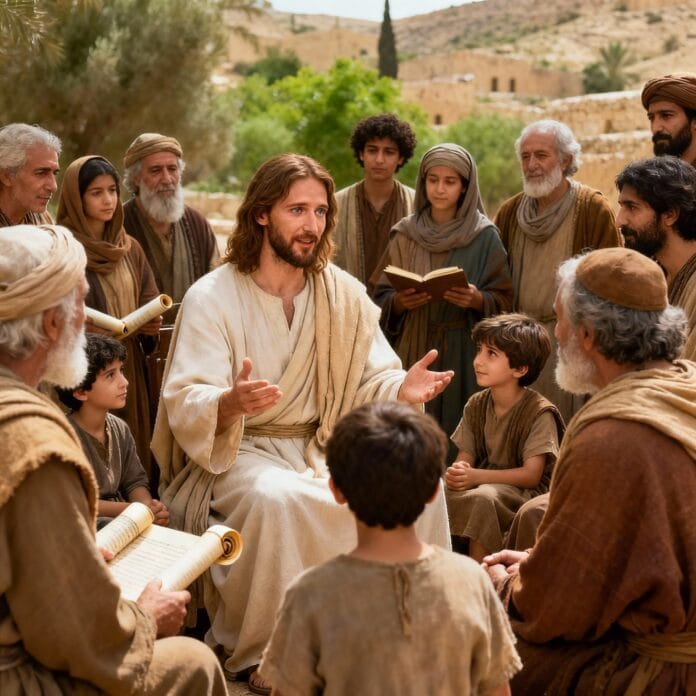
CHAPTER 4
Luke 4, 1-13 (= Matt. 4, 1-11); Mark. 1, 12-13.
Jesus' first act after his messianic consecration was to repair the fall of the first man by triumphing over the devil and his treacherous suggestions. (cf. St. Hilary, in Matthew 3:5; St. Ambrose, Exposition in Luke 4:7). The leader of the new and regenerated humanity, like Adam, the leader of humanity that had fallen into disbelief, went through the ordeal of temptation.
Luke 4.1 Jesus, full of the Holy Spirit, returned from the Jordan and was led by the Spirit into the desert, Verses 1 and 2 contain the preliminary details of the narrative. The first shows us Jesus leaving the Jordan River, in which he had been baptized, and, under a powerful impulse of the Holy Spirit, going into the solitude of the desert. For the place of the temptation, see the notes under Matthew 4:1-11. Filled with the Holy Spirit is special to our evangelist and designates the fullness of the divine anointing received by Jesus, as a man, at his baptism (3:22). As God, Jesus is perfect, and his divinity is not subject to any improvement or change. Jesus, God as man, is perfect, from all eternity and forever, without any change. To his Christ, “God gives him the Spirit without measure.” John 334. Likewise, Satan will find in Jesus only the spirit of God. See Maldonat and Fr. Luc.
Luke 4.2 For forty days, he was subjected to the temptations of the devil. He ate nothing during those days, and when they were over, he was hungry. – At first glance, St. Luke would seem to combine the various accounts of St. Matthew and St. Mark, saying, like the latter, that Jesus was tempted for forty days; and like the former, that, after this time, the Savior underwent three more distinct temptations. But we have seen, in our explanation of the Gospel according to St. Mark, that the vague phrase "he was tempted by Satan" is an abbreviated formula, which must be interpreted according to the more precise and detailed account of St. Matthew. The same applies here. Moreover, it is hardly believable in itself that Our Lord suffered the assaults of the evil spirit for forty days. Cf. Clementine Homilies 19, 2. The prince of demons appeared in person and visibly to Jesus to tempt him. The mention of the Savior's absolute fasting for forty days is specific to St. Luke in this form. The verb "to fast" used by St. Matthew would have been less clear to the readers of St. Luke.
Luke 4.3 Then the devil said to him, "If you are the Son of God, command this stone to become bread."« 4 Jesus answered him, «It is written: »Man shall not live on bread alone, but on every word of God.’” – We now turn to the actual story of the temptation of Jesus. It consists of three consecutive assaults by the devil and three victories for the Messiah. The first evil suggestion of the tempting spirit is cleverly linked to hunger which the divine Master suffered from. Ancient painters, following this detail from the third Gospel, placed a stone in Satan's hand at the moment he first tempted Jesus. Note also the introduction. If you are the Son of God. The devil had more than one reason to suppose that Jesus was the Christ; nevertheless, some doubts may still have remained with him, and that is why "He tempted him to find out if he was the Christ" (St. Augustine, De Civit. Dei, 11, 21). He thought he could thus force him to reveal himself. Jesus answered him. Our Lord was invited to use his supernatural powers to satisfy the pressing need of the person in need. He responded in a way that was both powerful and simple, appropriating a biblical text (cf. Deuteronomy 8:3), that he would be careful not to help himself in this way: he would not perform miracles for personal gain. After all, God knows human needs and, with a single word, he can provide his friends—as sacred history demonstrates—with abundant sustenance. The words not only bread They refer to ordinary bread and, in general, anything that can serve as food for humans. Jesus contrasts this bread with foods miraculously provided by God: of every word of God. St. Matthew quotes the text more fully from the Septuagint; St. Luke only gives a summary.
Luke 4.5 And the devil, having taken him to a high mountain, showed him in an instant all the kingdoms of the earth, – Second temptation vv. 5-8. After trying to make Jesus merely unfaithful to God, Satan pushes him toward complete apostasy. It is here that a divergence arises between our two parallel narratives regarding the external arrangement. St. Matthew, in fact, places only third the temptation that St. Luke would have been the second, and vice versa. Which way does the true sequence of events lie? Everything suggests that it is the first evangelist who most accurately followed the historical order, as St. Ambrose and other Fathers already believed. This is proven by two main reasons, one intrinsic, the other extrinsic. 1. The temptation recounted second by St. Luke was rightly called "the most seductive of the three": it is the strongest in every respect; it is also the one that Jesus rejected with the most horror ("Get away, Satan!"). It was therefore fitting that it should be the last. 2. St. Luke simply juxtaposes the various incidents at this point, without using any of the formulas that indicate a strictly chronological succession. St. Matthew, on the other hand, uses several, which seems to show that he intends to mark a real order. In an instant is a picturesque detail, peculiar to St. Luke. It proves that the perspective in question was not unfolded little by little and successively before the eyes of Jesus, but that it was presented to him instantaneously, by a kind of diabolical phantasmagoria.
Luke 4.6 and said to him, «I will give you all this power and all the glory of these kingdoms, for it has been delivered to me and I give it to whomever I want. – Satan offers Our Lord possession of these kingdoms which he has just shown him. With what artistry he enhances the value of such kingship through emphatic expressions. All the power and glory of these kingdoms… St. Matthew only has him say: “I will give you all this”. Tite Bostra said: Satan told a double lie, for he did not possess that power, and he could not give what he did not have. Indeed, the power of the devil is nil, and God has left this enemy only the sad power to make us the warGod alone rules the world: Proverbs, 8, 15 Through me kings reign and princes decree what is just. 16 Through me rule the chiefs and the great men, all the judges of the earth. — St. Ambrose: It is said elsewhere: “All power comes from God.” Therefore, it belongs to God to give and regulate power, but the ambition for power comes from the devil. It is not power itself that is evil, but the condemnable use made of it. The Gloss: In his arrogance and pride, Satan boasts of doing what is beyond his power, for he cannot control all kingdoms, since we know that a great number of saints have received kingship from the hands of God himself. Although Jesus calls him the Prince of this world (John 12:31; 14:30; cf. 2 Corinthians 4:4); Ephesians 2(2; 6, 12) he is above all the father of Lies because God alone rules the world and gives power to whomever He wills. Even to enter a herd of pigs, Satan is obliged to ask God's permission (cf. Matthew 5:11-12). The Book of JobChapters 1 and 2 show us that in order to do evil, Satan must obtain God's permission. St. Thomas Aquinas teaches that God only permits evil because His goodness knows how to draw a greater good from it.
Luke 4.7 »If you bow down before me, she will be entirely yours.” The devil will not grant the Messiah the power to rule the world for free. He quickly adds a condition to his offer: If you bow down before me, a gesture by which, in the lands of the East, an inferior commonly pays homage to his superior. Satan was therefore proposing to Jesus that he recognize him as his Lord and master. There is still emphasis in she will be all yours.
Luke 4.8 Jesus answered him, «It is written: »You shall worship the Lord your God and him only shall you serve.’” – By this quote (cf. Deuteronomy 643) Jesus opposes the diabolical seductions with the great monotheistic principle. And yet he will be king, but his kingdom will have nothing earthly about it, and it will relate only to God, and to him alone.
Luke 4. 9 The demon led him back to Jerusalem and, having placed him on the pinnacle of the temple, said to him, «If you are the Son of God, throw yourself down from here.” – Third temptation, vv. 9-12. The tempter's first assault aimed to incite Jesus to help himself without sufficient reason, and the second led him to rely on Satan's assistance; by the third, he is driven to demand divine help unnecessarily. He led him to Jerusalem. This proper name was clearer to non-Jewish readers than the purely Hebrew designation of St. Matthew "in the holy city". On the pinnacle of the templeIt was from this same place, according to Hegesippus (ap. Eusebius, Ecclesiastical History 2, 23), that St. James the Just was thrown by the Jews. Regarding the power the devil seems to have wielded in the last two temptations over the sacred body of Our Lord Jesus Christ, St. Gregory the Great writes quite rightly: “It is not surprising that Christ allowed Satan to carry him through the air, he who allowed his members to crucify him.” We should not admire the power of the devil in this, but rather patience of the Savior.
Luke 4 10 For it is written: His angels have been commanded concerning you to guard you 11 and they will take you into their hands, lest your foot strike against the stone.» To lend more weight to his perfidious suggestion, the evil spirit, imitating Jesus, begins to quote Scripture. «He hides his lie by means of Scripture, like all heretics,» writes St. Irenaeus, Haer. 5, 31. He thus cites an admirable passage from the Psalms (11:11-12), from which he claims to conclude that Jesus could safely throw himself down from the top of the temple, God having promised to take special care of his friends. St. Bernard (in Psalm. Qui habitat., Serm. 15) vigorously refutes Satan’s application: «It is written,» he says, “that he commanded his angels concerning you…Pay attention, and see how he has passed over in silence, with malice and deceit, what would render meaningless the interpretation his own malice gives of the text…For, so that they may keep you in all your ways.” "Into precipices? What kind of way is it to throw oneself down from the top of the temple? This is not a way, but a ruin." – This time, it is St. Luke who reports the biblical text in the most complete way.
Luke 4.12 Jesus answered him, «It is written: »You shall not put the Lord your God to the test.’” – You will not attempt… Our Lord clearly indicates by these words the true nature of Satan's last suggestion. To do what was asked of him would be to tempt God: "to use divine power in the service of a whim"; but he will never agree to that.
Luke 4.13 After tempting him in every way, the devil withdrew from him for a time. – Epilogue to the entire story. St. Luke, it is true, does not mention the angels who approached Jesus to serve him as soon as the demon had left; but on the other hand, he provides us with two particular pieces of information that are quite instructive. – First detail: Having overcome all these temptations (Most exegetes translate this as: all forms of temptation.) The three special temptations to which Satan resorted to lead Jesus into sin encompass, in fact, as moralists point out, the germ and the epitome of all others. "They are three in number; and you will find nothing that tempts human greed except the desire of the flesh, the desire of the eyes, and the ambition of the world. It is by these three things that the Lord is tempted by the devil." St. Augustine. Cf. St. Greg. Hom. 16 in Evang.; St. Thomas Aquinas, Summa Theologica, 3a, q. 41, a. 4 - Second detail: He withdrew from him for a while.The expression is significant: Satan only withdraws for a time. When he finds a favorable opportunity, or, according to others, when God allows it, he will certainly return to the attack, for although defeated, he is far from giving up the fight. A saying of Jesus, John 1480 shows us that this "opportune time" refers in particular to the time of his sorrowful Passion. Cf. St. Bonaparte, *De Vita Christi*, 14. May we, in our temptations, always conquer like our Master. "The reason the emperor fights is so that the soldiers may learn." St. Augustine, *Sermon 122*, 2.
Luke 4:14 and 15 = Matthew 4:12-17; Mark 1:14-15; John 4:43-45.
Luke 4.14 Then Jesus returned to Galilee in the power of the Spirit, and his fame spread throughout the surrounding countryside. – Before going into the details of Jesus' Galilean ministry, St. Luke briefly describes here, in a completely new way, its general appearance during its first phase. See, 8:1-3, something similar. Jesus returned to Galilee. The Savior had left his beloved Galilee to be baptized by the Forerunner; he now returns there after an absence of about six months (see St. Matthew). The arrest of John the Baptist was the occasion for this return (cf. Matthew 4:12 and Mark 1:14); but it is in the power of the Spirit that we must seek its determining cause. cf. verse 1. The evangelist, by reiterating this reflection, leads us to understand that, in everything he will henceforth recount concerning Our Lord, we must see the secret workings of the divine Spirit. His fame spread…The beginnings of Jesus' messianic activity in Galilee were magnificent. No sooner had he arrived than his fame filled the whole country. It is possible that this detail is an anticipation of verse 15; but the Galileans' prompt enthusiasm can very well also be explained by the news of the miracles that Jesus had performed, according to the fourth Gospel, either at Cana or in Jerusalem. cf. John 2, 1-11, 23.
Luke 4.15 He taught in their synagogues and they all praised him. When Jesus appeared in person in the places where his reputation had preceded him, his divine teaching confirmed the good opinion people had formed of him, and even won him new acclaim. There was only one voice to sing his praises: They all praised him.. It is true that at that time he was simply proclaiming the good news in general terms, that is, the imminent arrival of the Messiah (cf. Matthew 4:17; Mark 1:15); nothing in his preaching yet offended the people's prejudices: he therefore had only friends at the outset. But the episode in Nazareth will soon show us the seeds of antagonism already stirring against Jesus at that time.
Jesus in Nazareth. 4:16-30
This account was undoubtedly received by St. Luke from some eyewitness. Despite the similarity of the events, we believe in the existence of two visits made by Our Lord Jesus Christ to his fellow citizens of Nazareth. St. Luke recounts the first; St. Matthew and St. Mark relate the second. In both accounts, the chronology is too distinct to allow for a precise identification of the events.
Luke 4.16 Having come to Nazareth, where he had been brought up, he entered the synagogue on the Sabbath day, according to his custom, and stood up to read. – Having come to Nazareth. On this place, no less gracious than it is famous, see St. Matthew. It was there that Jesus was brought up; indeed, we have seen (2:39-52; cf. Matthew 2:23) that the greater part of his childhood and all his youth were spent in Nazareth. He entered, as was his custom,…A valuable detail about the religious life of the God-Man during his long, thirty-year retreat. For we do not believe that the custom mentioned by the evangelist refers only to the beginning of Jesus' public ministry (v. 15). The context requires a longer period. Moreover, children were required to attend synagogues from the age of thirteen. The Sabbath day. On this day and this place specially dedicated to Jewish worship, see Matthew 4:12-17 and commentaries. In the humble town of Nazareth there was only one synagogue, as indicated in the article of the Greek text. He stood up to read. Not only is everything in St. Luke's description vivid, but it is also remarkably accurate, as the archaeological evidence that has survived proves. Initially seated among those present, Jesus rises to read from the Bible, which has always formed the basis of synagogue worship. Indeed, people stood during this reading, out of respect for the inspired word (cf. Nehemiah 8:4-5). Had the synagogue leader explicitly invited him that day to perform the duties of reader, according to custom? Or did he offer himself, as any honorable Israelite could? This second hypothesis seems to us more consistent with St. Luke's account. In either case, Our Lord ascends the steps of the platform located near the small sanctuary of the synagogue.
Luke 4.17 He was given the book of the prophet Isaiah And having unrolled it, he found the place where it was written: Every Saturday, two passages from the Bible were read, and still are read among Jews: the first was called the Parasha; the second, taken from the Prophets, was called the Haftarah. Since the book of Isaiah's prophecies was presented to Jesus, it meant that the Parasha had already been read, and that they had reached the final part of the ceremony, which concluded with the Haftarah (literally, the act of dismissal). Having received the book from the synagogue's sacristan, Jesus opened it, or rather, unrolled it, for Jewish liturgical books have always consisted of parchment sheets sewn end to end and rolled around one or two more or less ornate sticks. This is why they were called Megillah, scroll. This is, in fact, the primitive form of books, although "books" properly speaking, composed of square or rectangular sheets placed one on top of the other (codex) were known even before the time of Our Lord. Biblical scrolls are sometimes enormous, and consequently very cumbersome. To overcome the inconveniences of such weight and size, the "volumes" were often divided into several tomes, each containing a distinct part. Thus, Jesus received a Megillah specifically reserved for Isaiah: from which it follows that the Haftarah for this day was to be taken from the prophecies of the son of Amos. He found the placeDid the Divine Master choose this passage of his own accord? Or was it predetermined for that day's reading? Since Jews currently read it for the Feast of Yom Kippur, or the Day of Atonement, several authors have assumed that this solemnity was then being celebrated. But it is easy to demonstrate to them that the current order of the Haftarahs is far removed from the time of Jesus. Returning to the question posed, it seems more natural to conclude that the expression used by St. Luke, "he found," means that Jesus, while unrolling the volume, providentially came upon a column dedicated to chapter 61, and paused there to read its opening lines. Nothing could have been more appropriate to the occasion, for while a passage concerning the Messiah's royal descent, his judicial prerogatives, and his irresistible power would have been hardly in keeping with the assembly's prejudices, a text that elaborates on his peaceful and humble role, his condescension and gentleness, was, on the contrary, admirably fitting. Now, in the passage Jesus found, Christ the Comforter is vividly portrayed with all his divine kindness, with his predilection for the lowly and the afflicted, as well as with the graces he received from heaven to bring happiness to all. St. Luke quotes these words of Isaiah from the Septuagint translation, but with some notable variations, as almost always happens when a fragment of the Old Testament is inserted into the writings of the New. Jesus read them in Hebrew, and the interpreter probably provided the translation in Aramaic, the language then spoken throughout Palestine.
Luke 4.18 «The Spirit of the Lord is upon me, because he has anointed me to bring good news to the poor, and he has sent me to heal the brokenhearted.”, 19 to proclaim freedom for the captives and recovery of sight for the blind, to set the oppressed free, to proclaim the year of the Lord’s favor.» – From these first words we find, as the ancient authors liked to say, the indication of the three divine persons: the Father, marked by Lord, the Son« on me »", which is no different from the Messiah, and the’Holy Spirit. Who better than Jesus could apply such things to himself? cf. Isaiah 11, 2; 42, 2. This is the fourth time, since the beginning of this chapter, that he is shown to us possessing the fullness of the Spirit of God. That's why… It is in a moral sense that we must understand this anointing of the Messiah: it designates a holy destination, a consecration. Jesus had just received it at baptism. cf. Acts 4:27. The rest of the quotation sublimely characterizes the merciful work of Christ, by means of almost synonymous expressions, whose emphatic repetition is most effective. God therefore sent his Messiah to earth to announce the good news to the poor, generally so neglected; to heal those who have a broken heart, and there are so many in this world, an authentic proposition although it is missing from several important documents, such as manuscripts B, D, L, Z, Sin. and the Coptic, Armenian, Ethiopian, Italian versions; to proclaim to the captives that they are free, to the blind that they see (literally, from the Hebrew, "an opening to the chained": prisoners long plunged into dark dungeons, and finally freed, are likened by the Alexandrian translation to blind people who suddenly regain their sight); and finally, to preach a favorable year, the year most pleasing to God. Isaiah, with these last words, alluded to the Jubilee year, which, by remitting all debts and restoring freedom to all slaves, brought an end to so much suffering. See Leviticus 25:8 ff. The Jubilee of the Gospel is a thousand times more pleasing, for it remits debts far more crushing, it breaks chains far heavier, the debts and chains of sin. – For having taken too literally this «sweet year of the Lord», various ecclesiastical writers of antiquity, such as Clement of Alexandria, Strom. 1; Origen, de Princip. 4, 5; Tertullian, contr. Jud. 8; Lactantius, Instit. Div. 4, 10 (cf. St. Augustine, De Civica Dei, 18, 54), and several heretical sects (the Valentinians and the Alogi) wrongly believed that the public ministry of Our Lord Jesus Christ did not last more than a year. This opinion is easily refuted with the help of tradition and the Gospel texts. See the chapter of our General Introduction relating to the Chronology of the Holy Gospels. The line "to set free those who are broken in chains" is not part of Isaiah chapter 61; but it is found a little earlier, 58:6. St. Luke, quoting from memory, would have inserted it here because of the similarity of thoughts. – Usually, the maphtir He would read 21 verses from the prophets; but sometimes people would simply read three, five, or seven. Jesus took advantage of this flexibility.
Luke 4.20 Having rolled up the book, he returned it to the attendant and sat down, and all in the synagogue had their eyes fixed on him. The details of this verse are all extremely picturesque; it is a living tableau by the painter St. Luke. In the foreground, we contemplate the hero of the scene, and all around, the spectators. Each of Jesus' actions is described: his reading finished, 1) he rolled up the Megillah; 2) he returned it to the minister, who immediately placed it back in the holy ark at the back of the sanctuary; 3) he sat down in the reader's chair, thus showing that he was about to speak and explain the text he had just read. The audience is deeply impressed; all eyes are fixed on Jesus. Each of the onlookers wonders what this young man, who until then had appeared in the region only as a humble carpenter, but who had distinguished himself in the surrounding area by his preaching and miracles, could possibly say about such a remarkable text.
Luke 4.21 Then he began to tell them, «Today your ears have heard the fulfillment of this passage of Scripture.» What a truly divine commentary Jesus must have had on the words of Isaiah! However, it did not please the Holy Spirit to preserve it for us. St. Luke gives only the opening, which must have also been the theme of Our Lord's discourse: Today that promise… has been fulfilled. At the very moment when Jesus was reading Isaiah's prophecy to the inhabitants of Nazareth, it was being fulfilled; the Gospel was being preached by the Messiah.
Luke 4.22 And all bore witness to him, and marveling at the gracious words that came from his mouth, they said, «Is this not the son of Joseph?» The sacred writer powerfully describes the effect produced by Jesus' discourse. Everyone praised the heavenly orator; could it not have been possible not to admire, not to praise? Were not the words that came from the mouth of Our Lord filled, in both content and form, with a supernatural grace that nothing had equaled until then? "Grace is poured upon your lips," the Psalmist prophesied of him, Psalm 44:3, and even his enemies would acknowledge, John 7:46, that no one knew how to speak like him. See on the eloquence of Jesus Christ St. Matthew. Following the discourse they had heard and rightly admired, the congregation should have acclaimed Jesus with one voice as the Messiah. But then, a purely human thought suddenly transformed their feelings: Isn't this the son of Joseph? They remember that the one who has just spoken to them is only the son of the poor carpenter Joseph, that he has received no education, and immediately their nascent faith gives way to utter disbelief. They refuse to acknowledge Jesus' mission from on high simply because he was of humble origins and they have known him all their lives.
Luke 4.23 And he said to them, «No doubt you will cite to me this adage: Physician, heal thyself, and you will tell me: The great things we have heard you did in Capernaum, do them here in your homeland.» Jesus noticed the change in the audience; perhaps he even heard the disdainful remarks circulating about him, as Jews were not shy about expressing their hostility or favor, even within religious assemblies. He spoke again to respond. Our Lord assumed that his dissatisfied listeners would cite the proverb as a form of objection. Physician, heal thyself, which one does not encounter without special interest in the Gospel of the "most dear physician." Moreover, it is frequently used not only by rabbis, but also by Roman and Greek classicists, for the naive and biting truth it expresses belongs to the popular wisdom of all times and all countries. "Instead of going to fight, defend us," Virgil. This saying of the great Latin poet perfectly indicates the meaning that our proverb could have when placed on the lips of the rugged inhabitants of Nazareth. "Do first for your own, if you want them to believe in your mission, what you do so well for others." Furthermore, Jesus himself adds the explanation, continuing to speak on behalf of his fellow citizens: the great things done in Capernaum… St. Luke has not mentioned it anywhere yet miracles that Jesus had accomplished in Capernaum: but this reflection assumes that they existed, bright and numerous.
Luke 4.24 And he added: «Truly I tell you, no prophet is well received in his homeland. – In truth. St. Luke, like St. Mark at times, uses this formula in the middle of Jesus' discourses (cf. 6:39; 12:16; 13:20; 15:11, etc.). It indicates a brief pause, while also serving to highlight a saying of the divine Master. Here, it also introduces Our Lord's response to the tacit objection of his compatriots. No prophet is well received…This is the first part of the answer. To the proverb «heal thyself,» Jesus responds with another proverb. The one he chooses could not have been more apt, since the inhabitants of Nazareth precisely refused to believe in the heavenly mission of the prophet who deigned to communicate with them. The Savior thus explained why he had not performed miracles in his homeland. Is someone who refuses to receive a prophet entitled to complain that the prophet grants him no extraordinary blessing? So the fault lies with you, not with me. «Ungrateful homeland,» says a similar saying of the Latins. The example of Jeremiah at Anathoth (cf. Jeremiah 11:21; 12:6) had shown this all too well. Well received In this context, it means "honored, esteemed." Cf. Matthew 13:57 ff.; John 4:44; Acts 10:35.
Luke 4.25 Truly I tell you, there were many widows in Israel in the days of Elijah, when the heavens were shut up for three and a half years, and there was a great famine throughout the land, – In verses 25-27, the Savior again justifies his conduct with examples drawn from the history of the two most famous prophets of Israel. Elijah and Elisha, in circumstances similar to his own, had performed no miracles for their fellow citizens, while they had performed many for foreigners, and even more for pagans. First example, verses 25 and 26. – «Truly I tell you,” is a phrase favored by St. Luke (cf. 20:21; 22:59; Acts 4:27; 10:30). (St. Mark also uses it twice, 12:14 and 32.) When the heavens were shut: What a beautiful metaphor to describe a long period of drought! (cf. Genesis 7:2; 2 Chronicles 6:26) 7, 13. The drought to which Our Lord alludes is explicitly mentioned in the First Book of Kings, chapters 17 and 18. However, Jesus specifies its duration as three and a half years, while the Old Testament (Luke 18:1) seems to indicate that it was not even three full years: “The word of God came to Elijah.” the third year saying, »Go, show yourself to Ahab so that you may send rain on the face of the earth.” But (even rationalists admit this) there is no true contradiction here; for some time could have passed before Elijah went to Ahab and ended the drought. We therefore have enough leeway to find six or eight months. James 5:17, moreover, cites precisely the same figures as the Savior, proof that Jewish tradition had long since established them. Throughout the earth is a popular hyperbole for referring to Palestine.
Luke 4.26 And yet Elijah was not sent to any of them, but to a widow in Zarephath, in the land of Sidon. An interesting detail, one we would have overlooked were it not for Jesus: while sacred history speaks at length of the widow of Zarephath, it fails to mention that she alone was the recipient of the prophet Elijah's miraculous intervention. Zarephath was a Phoenician settlement built on the shores of the Mediterranean, roughly equidistant from Tyre and Sidon. Its Hebrew name was Zarpat. Not far from its ancient site stands the small village of Sarafend today.
Luke 4.27 Likewise, there were many lepers in Israel in the days of the prophet Elisha, and yet none of them were healed, but Naaman the Syrian was.» – Second example, taken from the life of Elisha. See the details in 2 Kings, chapter 5. – On the large number of lepers at that time, see Ibid. 7, 3 ff. In the time of the prophet Elisha (cf. 3:2; Mark 2:26; Acts 11:28, etc.) Famous prophets, as well as priests and kings, served to mark the main periods of Jewish history. Healed : a theocratic term for the healing of leprosy, a disease that legally rendered those afflicted with it impure. – From this second fact, as well as the first, it was very evident that heavenly favor is by no means restricted to any particular geographical area: it accompanies faith, not nationality. Let the inhabitants of Nazareth believe in Jesus, and he will perform miracles among them as he did in Capernaum.
Luke 4.28 When they heard this, they were all filled with anger in the synagogue. – This verse, like verse 22, indicates the effect produced by Jesus' words; but what a contrast. They were all filled with anger. For, everywhere, "truth breeds hatred." Although Jesus did not directly apply the examples he had given to his listeners, they readily understood the connection. Were we then worth less, they reasoned, than the pagan woman of Zarephath, than the impure Naaman? This thought immediately filled them with rage. It is known that the Galileans were violent, passionate men. Their hearts were stirred by storms as sudden as those that, in an instant, set the surface, calm as a mirror, of their beautiful lake ablaze.
Luke 4.29 And getting up, they drove him out of the city and led him to a craggy edge of the mountain on which their city was built, to throw him down. – Let us admire, in passing, the rapidity of the narrative: it conveys the tragic nature of the events. The synagogue of Nazareth thus witnessed a horrific scene. Two or three voices cry out against Jesus: the entire assembly immediately rallies to this bloodthirsty plan; brutal hands seize Our Lord. Yet, they maintain enough composure not to carry out the dreadful attack on the spot. These madmen drag their victim out of the sacred precinct, then out of the city. Soon they are at the summit of the mountain on which their city was built. The kind of torture they intend to inflict on Jesus is now clear: it was quite common among all peoples of that time, and Jewish history contains a terrible example of it. cf. 2 Chronicles 25:12. The beautiful mountains surrounding Nazareth, especially the Jebel es-Sich, on whose slope the city of Jesus is built, contain more than one sheer cliff perfectly suited to the murderous intentions of the mob. The one known at least since the time of the Crusades as the "Mount of the Fall" presents a magnificent and terrifying aspect. On the road leading there, the pilgrim contemplates with emotion the ruins of the church "del Tremore," once built on the spot where Married She would have rushed there in despair upon learning of the fate reserved for her divine Son. It is true that the "Mount of the Precipice" is located 2,000 meters from the city, a distance that seems rather long given the circumstances. This is why many travelers substitute a perpendicular rock, 15 meters high, which can be seen near the Maronite Church, right on the edge of Nazareth. Regarding these summary executions that Jewish fanaticism was so quick to decree and which a misguided zeal served to justify, see Acts 7:56 and 22:22. It was the equivalent of lynching and the laws of Charles Lynch (1736-1796) in America.
Luke 4.30 But he, passing through the midst of them, went away. – We had just arrived, and the cruel plan was about to be fulfilled; but suddenly Jesus freed himself from the hands of his executioners and, passing through their midst, he went away. What a scene, and how admirably it is described! went away, The phrase, relegated to the end of the sentence, is no less majestic than the Savior's calm demeanor as he walked, without hastening his steps, as if he were passing through the crowded ranks of a harmless throng. What then happened? Did Jesus, using his supernatural power, blind these barbarians? Did he suddenly stiffen their limbs? Did he make himself invisible? Bede: Jesus suddenly changes their disposition, or strikes them with stupor and blindness, and descends from the mountain, because he wants to give them a further opportunity to repent. — St. Chrysostom (hom. 47 on St. John). Our Lord here displays both the attributes of divinity and the signs of his humanity. Indeed, by passing through the midst of those who pursued him, without being able to seize him, he demonstrates the superiority of his divine nature; and by withdrawing from them, he proves the mystery of his humanity or his incarnation. — St. Ambrose: «Understand here also that his Passion was not a forced act, but entirely voluntary. Thus, he was seized when he wished, he escaped his enemies when he wished; for how could a small number of people have held him captive, since he could not be arrested by an entire people? But he did not want such a great sacrilege to be committed by the multitude; and he had to be crucified by a small number, he who died for the whole world. Moreover, his desire was to heal the Jews rather than destroy them, and he wanted the result of their impotent fury to make them renounce designs they could not accomplish.» "The hypothesis that Our Lord took advantage of the narrow, winding streets of the city to escape is simply absurd. Theophylact: if Jesus performed a miracle to avoid death, 'it was not because he feared suffering, but because he was waiting for his hour.'".
Luke 4:31 and 32 (= Mark 1:21 and 22).
Luke 4.31 He went down to Capernaum, a town in Galilee, and there he taught them on the Sabbath days. This expression, found in St. Luke, is perfectly accurate from a topographical point of view, for the difference in elevation between the towns of Capernaum and Nazareth necessitates a descent when traveling from one to the other. Nazareth is built on the high plateau of Galilee, while Capernaum lies in the deep basin containing the beautiful lake about which a rabbi attributed these significant words to God: «I have created many lakes in the land of Canaan; but I have chosen only one, the lake of Gennesaret.» Was Jesus then coming to Capernaum to establish his permanent residence there (cf. commentary on Matthew 4:13), or had he already settled there some time before? The second hypothesis seems more likely to us. In any case, Capernaum would henceforth serve as the Savior's center: this city of Galilee, as St. Luke calls it to better designate it to his readers who were unfamiliar with the geography of the Holy Land, was suited to the actual plan of Our Lord. See St. Matthew. – He taught them. This phrase seems to indicate a general custom of Jesus; but it can also be applied to the special event which will soon be recounted, v. 33 ff.
Luke 4.32 And his doctrine astonished them, because he spoke with authority. – cf. Matt. 7:29. Jesus therefore spoke as an all-powerful Lawgiver, not as a lawyer devoid of authority; his language was spirit and truth, it did not consist of arid conventional formulas.
Luke 4, 33-37. = Mark. 1, 23-28
This miracle, omitted by St. Matthew, is recounted in almost identical terms by St. Mark and St. Luke. For a detailed explanation, we refer the reader to our commentary under St. Mark.
Luke 4.33 There was a man in the synagogue possessed by an unclean demon, who cried out loudly, – A man possessed by an unclean demon : an extraordinary expression, of which there is no other example in the New Testament. On the nature and reality of possessions, see commentary on St. Matthew. A loud cry : This violent cry was wrung from the demon by the instinct of danger with which the holy presence of Jesus threatened him.
Luke 4.34 saying, «Leave me alone, what do we have to do with you, Jesus of Nazareth? Have you come to destroy us? I know who you are: the Holy One of God.» – An exclamation of terror. The demon speaks in the plural, on behalf of all evil spirits (“One for all,” as if to indicate that Christ has delivered the war for everyone.” Maldonat). – The Holy One of God , that is to say the Messiah, cf. John 6, 69 : Hell, despite itself, bears witness to Our Lord.
Luke 4.35 But Jesus said sternly to him, «Be quiet and come out of him.» And the demon threw him to the ground in the midst of the assembly and came out of him without harming him. – But Jesus does not want this testimony. Adopting a stern tone and speaking like a master to whom everything must be obeyed, he gives the demon two orders in quick succession, expressed in brief but forceful terms: Shut up, Then Get out of this man. These last words are remarkable because of the dualism they so clearly presuppose in the phenomenon of possession: there is the possessing spirit to whom Jesus prescribes a swift departure, and the unfortunate possessed person whom the Savior will deliver.
Luke 4.36 And they were all amazed and said to one another, «What is this saying? With authority and power he commands the unclean spirits, and they come out.» 37 And his fame spread throughout the country. These verses recount the effects of the miracle. The eyewitnesses to this miraculous cure were seized with intense fear. The reflections they exchanged as they left the synagogue reveal what had struck them most: he commands with authority and power… This was not how Jewish exorcists expelled demons: they needed long adjurations, a ring, some kind of root, a vessel full of water (see Flavius Josephus Ant. 8, 2, 5; The War (of the Jews, 7:6:3), and even then they did not always succeed. A single word of command was enough for Jesus. His fame spread… The sensation produced by the healing of the demonic was not only local; it was reproduced far and wide throughout the entire region.
Luke 4, 38-41. = Matt. 8, 14-17; Mark. 1, 29-34.
Here again, the narratives of St. Mark and St. Luke are very similar. That of St. Matthew is a simple summary.
Luke 4.38 Then Jesus got up, left the synagogue, and went into Simon’s house. Now Simon’s mother-in-law was suffering from a high fever, and they prayed to him for her. – The new miracle therefore followed very closely the one that had taken place in the synagogue. In Simon's house. St. Peter is mentioned here for the first time in the third Gospel. St. Luke, by not giving any preliminary details about the Prince of the Apostles, assumes that his readers had known him for a long time. A high fever The other two synoptic Gospels simply state that Simon's mother-in-law had a fever. St. Luke naturally uses a medical term, one found in the pathological writings of ancient times. Fevers are quite common near the Sea of Galilee: caused by a simple chill, they quickly become malignant and life-threatening.
Luke 4.39 Bending over the sick woman, he commanded the fever and the fever left her and, having risen at once, she began to serve them. – Bending over the sick woman This is a picturesque and peculiar expression specific to our evangelist (moreover, each of the three narrators adds some particular detail here). The sick woman is lying on her bed; Jesus, standing beside her, bends down to touch and heal her. He commanded the fever. This beautiful personification led St. Basil to say: «St. Luke speaks figuratively, as if giving a command to an intelligent being» (Ct. D. Thom.). cf. 8, 24. She served them. The plural pronoun indicates that Jesus was not alone: we know from St. Mark that his first four disciples, Peter and Andrew, James and John, accompanied him.
Luke 4.40 When the sun had set, all those who had sick people in their homes, whatever their illness, brought them to him, and Jesus laid his hand on each one of them and healed them. – The two miracles performed separately during the day, that is, the healing of a demoniac and a sick woman, were renewed in large numbers in the evening, after sunset, as we learn from verses 40 and 41. – 1° Healing of the sick. Imposing hand expresses the great ease with which Jesus performed healings. heal them mark of the acts frequently repeated during this famous evening.
Luke 4.41 Demons also came out of many, shouting and saying, "You are the Son of God," and he rebuked them to silence, because they knew that he was the Christ. – 2. Healing of the demon-possessed. The demons came out, says St. Matthew, at Jesus' express command. As they withdrew, the demons proclaimed, as they had in the synagogue that morning, Jesus' messianic character. As in the morning, Jesus silenced them. The details, such as "You are the Son of God," are specific to the third Gospel: they add clarity and life to the narrative.
Luke 4, 42-44 = Mark. 1, 35-39.
Luke 4.42 As soon as day broke, he went out and left for a deserted place. A crowd of people went looking for him, and when they came to him, they wanted to keep him from leaving them. The next morning, Jesus left St. Peter's house, where he had spent the night, very early and went to one of the many secluded spots near the Sea of Galilee to devote himself in peace to prayer. Surprisingly, this time it is not St. Luke, but St. Mark, who mentions the Savior's special prayer. The crowd continued its search until they found Jesus. The end of the verse, specific to St. Luke, also contains a touching detail that shows how much Our Lord was loved at that time. It is true that the feelings of these good people were not entirely free from selfishness.
Luke 4.43 But he said to them, «I must proclaim the kingdom of God to the other towns also, because that is what I was sent for.» This is what Jesus shows them in his response: He came for everyone, not just for a privileged area; therefore, he could not remain forever in the vicinity of Capernaum, as they invited him to do. On the kingdom of God, see the commentary on St. Matthew. That's why This is a phrase specific to St. Luke, expressed in this way. We read in St. Mark, "That is why I came out." But in both accounts, it is indeed the same idea: the Incarnation of the Word and his coming among us to save us. Christ, as a man, received his mission from his divinity and he desires to be faithful to it.
Luke 4.44 And Jesus preached in the synagogues of Galilee. – The sentence structure indicates a constant fact, therefore repeated preaching. The whole of Galilee undoubtedly had the good fortune to hear Jesus.