












CHAPTER 8
Luke 8.1 Then Jesus traveled through the towns and villages, preaching and announcing the good news of the kingdom of God. The Twelve were with him, A new period in the life of Jesus, a period of great activity, success, and joy. – He went here and there throughout the region, evangelizing in turn the large and small towns, as they appeared along his route. The imperfect tense marks a habitual action, constantly renewed during the period of which St. Luke gives us a brief summary here. Preaching, expresses a more general concept. The twelve… From Jesus, the evangelist moves on to his entourage. The Twelve naturally formed the main part: the sacred college, constituted for some time in a definitive way, now accompanies Jesus everywhere, apart from rare exceptions, being formed in his divine school.
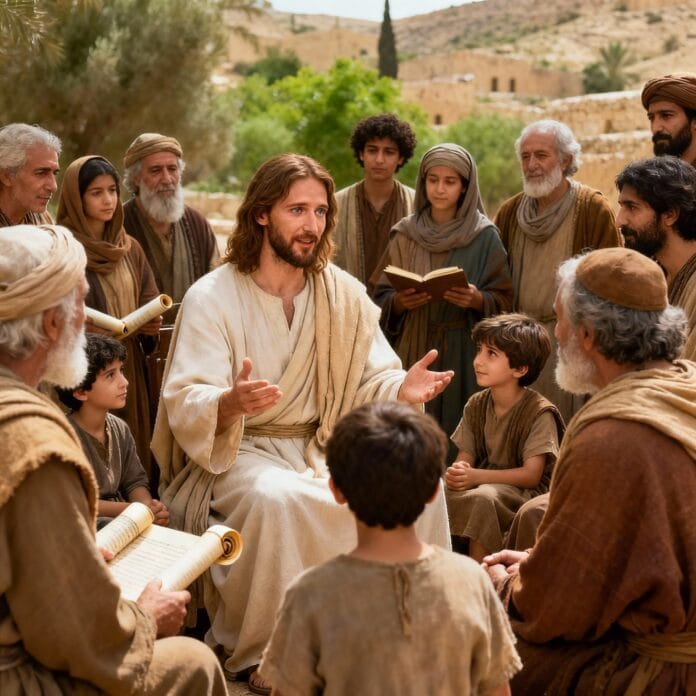
Luke 8.2 as well as some women who had been cured of evil spirits and diseases: Married, known as Magdala, from which seven demons had emerged, 3 Joanna, wife of Chusa, Herod's steward, Susanna, and several others, who supported him from their resources. —a completely new detail, which is quite striking. Just a few words ago (cf. John 4:27), the disciples were astonished to see their Master conversing in public with a woman, and now several women frequently accompany him on his travels. St. Jerome reports, it is true (in Matthew 27:56), that, according to a custom based on an ancient tradition, women Jewish women were fond of providing the Rabbis with clothing and everything necessary for their upkeep; and, in fact, the Talmud strongly encourages these pious practices: “Whoever,” it says, “receives a disciple of the sages into his home, feeds him, gives him drink, and provides him with some of his wealth, does the same as if he were offering a daily sacrifice,” Neveh Shalom, f. 156. But nowhere is it recorded that women followed them in their itinerant preaching. Our Lord Jesus Christ, therefore, innovates in this respect, and he alone could do so on such a delicate matter. With his divine hand, he breaks the narrow circle that the East had drawn around women; he emancipates them in the noblest sense of the word, and opens to them the vast field of good works in the Christian Church. Who had been healed…These words reveal to us the principal motive that had bound these holy women to the person of the Savior: they followed him out of gratitude, for they had received great favors from him, whether he had delivered them from demonic possession or granted them healing from some serious illness or infirmity. Three of these are mentioned separately: 1° Married, called Madeleine. This nickname, Madeleine, has been interpreted in various ways. Origen, Tract. in Matth. 35, sees in it a prophetic allusion to the moral greatness of which Married was to enjoy serving Our Lord Jesus Christ. Others seek the etymology of Magdeleine in Magdala, the name of a small town located on the western shore of the Sea of Galilee (see St. Matthew). Married She was therefore nicknamed Magdeleine because she came from Magdala. St. Jerome, playing on the name Magdala or Migdol, which means tower, wrote: "She was rightly called Magdeleine, a word meaning tower-bearer, because of the constancy of her faith and her love." – The following detail, from which seven demons had emergedThis has similarly divided exegetes. Two explanations exist for it, one literal, the other symbolic. St. Ambrose, and many others after him, believe that Married had actually been possessed by several evil spirits (seven is a round number to denote plurality, according to the Hebrew custom), as punishment for her immoral conduct; St. Gregory (Hom. 33 in Evang.), Bede the Venerable, and a great many authors see in these words a symbol of the conversion of MarriedIt is indeed quite in keeping with the figurative language of the Jews to treat vices as demons incarnate in souls. “Evil was ordained by Satan,” they would say; or again: “Drunkenness… is a demon.” But, on the other hand, the evangelist expressly stated that several of the women who accompanied Jesus had been healed “of unclean spirits,” a circumstance which seems to us to make the first interpretation more plausible. The fact that St. Luke points out is also mentioned in the second Gospel, 16:9, where the direct action of the Savior is more clearly emphasized: “from whom he had cast out seven demons.” – 2. Joanna. The husband of this holy woman, Chusa, Herod’s steward, is identified by some commentators with the royal official whose son Jesus had healed according to St. John 4:46 ff. This, however, is merely a conjecture. We will encounter Saint Joanna again later with Married Mary Magdalene at the tomb of the risen Jesus, 24, 10. 3° Susanna. A famous name in the Old Testament: it means lily; but the holy friend of Jesus who bore it is completely unknown to us. And several others. The rest of Our Lord's life will teach us about some others, for example, Salome. The evangelist does not mean that they all constantly accompanied the Savior: circumstances would not always have allowed it. At least, sometimes these women, sometimes those women, joined him and piously provided for all his needs and those of his disciples: they supported him with their resources. On this special meaning of attendees, see Romans 1525; 2 Corinthians 8:19-20. The Son of God, who deigns to eat the bread of charityLet us pause for a moment to observe the sacred company, whose principal members we have just described, passing before us. Jesus is in the midst of the Twelve, who surround him with affection and respect. Some are in front, others at his sides, the rest behind, but all as close to him as possible, so as not to miss a single one of his heavenly teachings. Most often it is he who speaks; however, he readily allows his apostles to question him informally. At some distance, several veiled women are walking. They carry baskets of provisions and are conversing among themselves. Jesus is at the center; his face is of great beauty. His head is not bare, as custom did not permit it; contrary to the usual depictions by painters, it is covered with a soudar (the kufieh of the Arabs), that is, a handkerchief tied under the chin and hanging loosely over the neck and shoulders. His main garment consists of a long tunic, which covers the entire body, leaving only the hands and feet uncovered. It is grayish in color, streaked with red. Over this tunic, Jesus wears a tallith (coat) blue, whose ample folds barely allow glimpses at times of the kouttoneth (tunic), and the belt that lifts it up to the waist. Finally, his bare feet are shod in sandals. Such was the human form of the divine Word.
Luke 8, 4-15 = Matt. 13, 1-23; Mark, 4, 1-20.
St. Luke is even less complete than St. Mark with respect to parables tell of the kingdom of heaven. He limits himself to relating three: that of the sower, that of the mustard seed, and that of the leaven. These last two will not appear until much later in his narrative, 13:18-21. It is therefore to the first evangelist that the merit belongs for having best presented the first group of parables of Jesus.
Luke 8.4 A large crowd having gathered, and people having come to him from various towns, Jesus said in a parable: – Like the other two Synoptic Gospels, St. Luke first notes the prodigious crowd before which the first parable of the kingdom of heaven was spoken. From each of the towns Jesus passed through, people rushed to follow him, eager to see and hear him again: it was a contingent that kept growing until they reached the shores of the Sea of Galilee; for this, according to St. Matthew and St. Mark, was the setting for the present episode. Jesus said in a parable : On this form of teaching which half conceals heavenly things under a human garment, and which consequently corresponds so well to the Incarnation of the Word, see St. Matthew.
Luke 8.5 «"The sower went out to sow, and as he was sowing, some fell along the path and was trampled underfoot, and the birds of the air ate it up. 6 Another part fell onto the stone and, as soon as it was lifted, it dried, because it had no moisture. 7 Another part fell among the thorns, and the thorns, growing with it, suffocated it. 8 Another part fell on good soil, and when it sprouted, it produced a hundredfold.» Speaking these words, he said aloud, «He who has ears to hear, let him hear.» Seated in a boat, with his large audience gathered on the shore before him (Matthew 13:2; Mark 4:1), Jesus gives his Church a teaching of great importance. He indicates the principal obstacles that the preaching of the divine word encounters in every soul; the seeds sown in the ground by the farmer are the perfect emblem of these obstacles. The physical grain falls on four kinds of soil and, consequently, has four very distinct destinies. 1. There is the soil hardened by the feet of passersby (v. 5); the seed does not even penetrate it, but is entirely lost when it falls there, either because it is soon crushed (a detail specific to St. Luke), or because it serves as food for the birds of the air. For it, therefore, there can be no question of germination; hence the verb lift, repeated in verses 6 and 8, does it not appear in verse 5? 2° There is shallow ground, bedrock, for that is the meaning of "on the rock": the seed germinates quickly at first, but then perishes for lack of moisture (another specific detail; however, St. Matthew and St. Mark better distinguish the two causes of ruin, the aridity below and the heat above). 3° There is ground already occupied by other invasive seeds (among the thorns Good and bad grains grow together; but the good weeds are soon choked out by the bad ones. Ovid, Metamorphoses, 5, 483 ff., listing the various obstacles that thwart the sower's hopes, has more than one detail in common with our parable: "The seeds perish at birth, scorched by the sun's fire, or flooded by torrents of rain. The stars and the winds exert disastrous influences. Greedy birds devour the grains entrusted to the earth; and weeds, thistles, and parasitic plants destroy the harvests."«
4. Finally, there is the well-prepared soil, in which the seed encounters no obstacle: it therefore grows wonderfully and yields a hundredfold. St. Luke is less complete here than St. Matthew and St. Mark, for he only mentions one degree of yield: it is true that he chose the most favorable one. – The formula Let anyone who has ears hear. … which concludes the parable in all three versions, is introduced emphatically: The divine preacher thus drew the attention of the crowd to the important words he had just spoken.
Luke 8.9 His disciples asked him what this parable meant: – We are surprised at first to see that the disciples did not immediately understand the mysteries hidden under the veil of the seed and its different destinies.
Luke 8.10 «To you,” he said, “the knowledge of the mystery of the kingdom of God has been given, while to others it is proclaimed in parables, so that by seeing they do not see and by hearing they do not understand. – To the disciples' specific question, Jesus adds a general explanation, the purpose of which is to indicate the reason why the divine teaching will henceforth resound in the ears of the people in the obscure form of parablesOur Lord distinguishes two categories of people in relation to him: faithful friends, for whom there are no secrets, and then "the others," the enemies or the indifferent. To these, he adds, I will speak in parablesAnd this will be a punishment: so that, though they look, they do not see… See in St. Matthew 13:11-17 the complete thought of the Savior. St. Luke gives it, as does St. Mark, in very condensed terms.
Luke 8.11 This is what this parable means: The seed is the word of God. 12 Those along the way are the ones who hear the word, but then the devil comes and takes it away from their hearts, lest they should believe and be saved. 13 Those in whom the seed was sown on the rock are those who, hearing the word, receive it with joy, but they have no root: they believe for a while and in the hour of testing fall away. 14 What fell on the thorns represents those who, having heard the word, gradually allow themselves to be suffocated by the worries, riches and pleasures of life and they do not reach maturity. 15 Finally, what fell on good soil represents those who, having heard the word with a good and excellent heart, keep it and bear fruit by perseverance. – St. Matthew quotes the words of Our Lord in a much more complete way. Matthew 13:13: That's why I speak to them in parables, because‘'When they see, they do not see, and when they hear, they neither hear nor understand'. » ; see Matthew 13:12-15 and the commentary. We copy here the commentary on the corresponding verses in the Gospel according to St. Mark: «St. Mark at least gives a good summary of it; in a striking form.” So that.— Although St. Mark does not mention the name of the prophet Isaiah, whose words Jesus quoted here (See St. Matthew l. c. and Isaiah 6:8-10):9 He said, «Go and tell this people: ‘Hear but do not understand, see but do not perceive.’. 10 "Weigh down the hearts of this people, harden their ears, and close their eyes, so that they may not see with their eyes, nor hear with their ears, nor turn back and be healed." It is easy to recognize the prophetic passage in this condensed form.. «When God said to Isaiah: ‘Blind the heart of this people,’ it was not only the one who was kindness And even holiness itself may have no part in the malice of man: but he foretells the effect that the preaching of his word will produce in the hearts of the Jews, as if he were saying to them: enlighten this people, make them understand my will; but the light you present to them will only serve to blind them further. They will plug their ears and close their eyes, lest their eyes see, their ears hear, and their hearts be converted. This is why, in these instances, it can be said that all the glory is due to God and the confusion to man; because God only seeks to enlighten and heal man, and man, on the contrary, hardens his heart with the very things that should have led him to conversion. Thus, when an eye, already damaged by a bad temper, is exposed to the sun, it becomes even more diseased. And then the sun is not blamed for this harmful effect; but it is attributed to an eye ailment. » Cf. Isaiah translated into French with an explanation drawn from the Holy Fathers and Ecclesiastical Authors, by Mr. Le Maistre de Sacy, priest, Brussels, p. 49, edited by Eugène Henry Fricx, printer to His Imperial and Catholic Majesty, opposite the Church of the Madeleine, MDCCXXIV [1724]. With [Catholic] Approvals and Privilege of His Majesty. «Mark here draws inspiration from Isaiah 6:9-10, according to the Aramaic text (Targum), which foretold the failure of the prophet whose preaching was to aggravate the sin of the hardened people. This text was taken up again in the early Church concerning the failure of the Christian mission to the Jewish people, whose hardening of heart thus appeared to have been foretold by the prophets and included in God's plan (John 12:39-41; Acts 28:26-28). The phrase inspired by Isaiah is here introduced by a so that which does not express any desire on Jesus' part to hide his message and prevent those outside to convert, but the conformity of his failure with Scripture and God's mysterious plan. The ultimate reason for this plan is not given (see Romans 11, 7-16.29-32) and the idea of God's design in no way diminishes man's responsibility (...); cf. The Bible: Complete Notes, Ecumenical Translation, Notes on Mark 4:12, p. 2177, Paris, co-published by Cerf – Biblio, 12th edition, 2012. On the remarkable variant in St. Matthew, see the commentary on Matthew 13:11. They don't get forgiveness of their sins. Thus, a portion of the people is excluded from salvation because they themselves have rejected it. St. Chrysostom: They see, therefore, and yet do not see; they hear and do not understand. It is by the grace of God that they see and hear; but what they see they do not understand, because they reject this grace, they close their eyes, they pretend not to see, they resist the holy word; thus, far from the spectacle before their eyes and the preaching they hear obtaining a change in their sinful lives, they only become more wicked. Theophilus: God grants light and understanding to those who ask for them, but he leaves others in their blindness, so as not to have to punish more rigorously those who, understanding their duties, have refused to fulfill them. St. Augustine (Question on the Gospel) (Question 14 on St. Matthew) "It is their sins that have deprived them of the gift of intelligence."»
Let us note the particularities of St. Luke. 1° The expressions those who are along the way, v. 12, and those in whom one sows upon the stone, Verse 13, at first glance, seems strange and bold; but they are very accurate, especially in moral matters, the divine word and the heart that must make it bear fruit being one. 2. The various names given to the devil by our three evangelists, the demon (St. Luke), the Devil (S. Matth.), Satan (S. Marc) are an interesting variant to note. Lest they should believe and be saved (v. 12), the pleasures of life (v. 14), with a good and excellent heart And by consistency (v. 15), are details specific to St. Luke. Its redaction also contains several original phrases; while not important in themselves, these details demonstrate the independence of the sacred writers; moreover, they serve to establish the true doctrine concerning the composition of the Holy Gospels. See the General Introduction. – St. Augustine, Sermon 73, 3, draws in very beautiful terms the moral conclusion of the parable of the sower: “Change, if you can, turn over this hardened soil with the plow, scatter the stones from this field, uproot the thorns. Do not have this hardened heart where the word of God dies at once. Do not be this light soil where charity "It cannot sink its roots. Beware of stifling the good seed with the cares and passions of the age... Be good soil."
Luke 8, 16-18 = Mark. 4, 21-25.
See our explanation of the parallel passage in St. Mark. The dominant idea is that Jesus' disciples must listen attentively to his word, since they will be charged with manifesting it to the world.
Luke 8.16 No one, after lighting a lamp, covers it with a vessel or puts it under a bed, but puts it on a lampstand, so that those who enter may see the light. These small lamps with handles, made of clay or bronze, have always been used in the East. When one wishes to do without their light for a moment, one can easily place them under a vase of some size, or under the divans, one or two feet high, used for meals. Some classical authors allude to this custom: "He hid the dagger in the cushion, and concealed the lamp under the bushel," Fulgentius, Myth. 3, c. 6. "If the light was covered by something," Servius in Jn. 6, 724; etc. Instead of vase, St. Mark has bushel, like Fulgentius. – So that those who enter may see the light This is a distinctive feature of our evangelist. Moreover, the writing of this verse has the merit of being the most vivid.
Luke 8.17 For there is nothing hidden that will not be discovered, nothing secret that will not eventually be known and come to light. It's the same idea, but without the imagery, and with a little more explanation, as is clear from the particle "for." Jesus' disciples must place the light of Gospel truths on the lampstand, for it is meant to illuminate the world. Currently, it is true, the Gospel is a secret that many are unaware of; but this secret is meant to be revealed, known to all, brought to light, as Our Lord so beautifully and gradually explains.
Luke 8.18 Therefore, be careful how you listen, for to the one who has, more will be given, and from the one who does not have, even what he thinks he has will be taken away.» – The conclusion of all this is, for future missionaries of Christ, to pay attention to how you listen. Knowing how to truly listen to the word of God—what a precious and rare talent! For to him who has… Jesus gives a compelling reason for the preceding recommendation. Listen carefully, for by listening you will increase the treasury of your spiritual knowledge, and the richer you are, the more God will give you, while otherwise, he would take away the little you thought you had. What he believes he has. In St. Mark and Luke 19:26, we read "who has." These words hold profound psychological truth, since in reality the unfaithful minister in question possesses absolutely nothing: his supposed moral wealth is merely a figment of the imagination, as divine judgment will clearly demonstrate. It has rightly been said of these words that they express one of the deepest laws of the moral world.
Luke 8, 19-21 = Matt 12, 46-50 Mark 3, 31-35.
See the explanation of the parallel passages in St. Matthew and St. Mark, which are more complete.
Luke 8.19 Jesus' mother and brothers came to see him, but they could not get in because of the crowd. – St. Luke seems to assume that this incident only occurred as a result of the parables The other two synoptic Gospels place the kingdom of heaven earlier, and quite a few exegetes prefer their chronology. The mother and the brothers“Those who are called brothers of Jesus according to the flesh are not the sons of the blessed one.” Married Mother of God according to Helvide, nor son of Joseph by another wife, but rather relatives (cousins). Bede the Venerable. Cf. the commentary on St. Matthew, 12:46-50. The word cousin does not exist in Aramaic; the only way to refer to a cousin is to say "brother." And they could not get to him. A picturesque detail from Mark 3:20 shows the extent to which Jesus was then surrounded by the crowd.
Luke 8.20 They came and told him, "Your mother and brothers are outside and they want to see you."« 21 He replied, "My mother and brothers are those who hear the word of God and put it into practice."« The other two evangelists here offer vivid and graphic details. «Then, stretching out his hand, he said…» (Matthew 11:1-12), «Looking around at those who were sitting in a circle around him, he said…» (Mark 11:1-12). Luke, on the other hand, presents Jesus« response in a new light. According to his account, the Savior’s mother and mystical brothers are those who hear the word of God and put it into practice. (Matthew 11:1-12 and Mark 11:1-12: »Whoever does the will of my Father,« or »of God”). There is a clear allusion in these words to the parable of the sower, told by Luke immediately before this episode. How fortunate we should be to be able to become brothers of Jesus in this way.
Luke 8, 22-25 = Matt 8, 23-27 Mark 4, 35-40.
Luke 8.22 One day, Jesus got into a boat with his disciples and said to them, "Let's cross to the other side of the lake." And they set out to sea. – The date given by St. Luke, A day, is quite vague. St. Mark clarifies it by saying that the miraculous calming of the storm took place on the evening of the day the parables of the kingdom of heaven. This verse contains nautical expressions (they got into a boat, they set out, they sailed). Moreover, in chapter 27 of Acts, St. Luke uses similar expressions.
Luke 8.23 While they were sailing, he fell asleep and a whirlwind of wind having struck the lake, their boat filled with water and they were in peril. – The Greek verb corresponding to fell asleep It is very energetic and means: to fall asleep from exhaustion. A whirlwind of wind. Previous travelers had already noted the frequency of hurricanes of this kind in the Lake Gennesaret basin. Having fallen upon the lake : from the sky, or better yet, from the surrounding mountains. It was filling up… they were…: Two imperfect tenses, to better highlight the gravity of the situation. Little by little the boat filled with water, and soon there was a real danger of sinking. Note the distinctly nautical way in which the narrative applies to the passengers what was happening to the boat.
Luke 8.24 So they approached him and woke him, saying, «Master, Master, we are perishing!» He got up and rebuked the wind and the agitated waves, and they calmed down and there was peace. – In Greek, the repetition of the word Master (Special detail in St. Luke) vividly depicts the disciples' anguish. Regarding the slightly different words that the three evangelists here place on the lips of Our Lord, St. Augustine makes this judicious observation: «In anyone’s language, one must consider only the intention that the words are meant to express, and one is not a liar for rendering in other terms what someone meant without using their own expressions. It is certain that, not only in words, but in all other signs of thought, one should seek only the thought itself; and it is wretched to strive, so to speak, for the words and to represent truth as chained to accents.» Agreement of the Evangelists 2:28. Having stood up. The three Synoptic Gospels jointly mention this attitude of the Master; they also all distinguish two commandments of Jesus, one addressed to the wind, the other to the waters of the lake. – The expression the choppy waves is specific to our evangelist.
Luke 8.25 Then he said to them, «Where is your faith?» They were filled with fear and amazement, saying to one another, «Who then is this, that he commands the wind and the sea, and they obey him?» – The Apostles should have remembered that they were with Jesus, and that they were in no danger in his presence. – The astonishment of the spectators is expressed in roughly the same terms by the various sacred writers. The idea of a powerful order imposed upon the forces of nature (it order to the winds) is, however, found only in the third Gospel.
Luke 8, 26-39 = Matt. 8, 28-34; Mark. 5, 1-20.
St. Luke's narration here has many similarities with that of St. Mark (see commentary).
Luke 8.26 They then landed in the country of the Gerasenes, which is opposite Galilee. - They approached : a nautical term, which is not found elsewhere in the accounts of the life of Jesus. The land of the Gerasenes. Regarding this region, the third Gospel presents the same discrepancies as the other two (see commentary on St. Matthew). The field of ruins at Gadara is no less than five kilometers in circumference; yet Oum-Kéis, the village that now stands in place of the "remarkable city" of the Decapolis, as St. Jerome calls it, is barely inhabited by two hundred fellahs. The territory of the ancient city undoubtedly extended to the southeastern end of the lake. A brief geographical note which is opposite Galilee, is special to St. Luke. It proves that his narrative was written for non-Jewish readers.
Luke 8.27 When Jesus stepped ashore, a man from the town who had long been possessed by demons came to meet him; he wore no clothes and had no other dwelling than the tombs. – The demoniac did not come from the city, which he had ceased to frequent, but from the tombs that served as his residence. cf. Matthew 8:28; Mark 5:2. Possessed by demons. For a long time, The detail here and in verse 29 is specific to St. Luke, intended to enhance the grandeur of the miracle. Who wore no clothes (another peculiarity of our evangelist) must be taken literally. This detail and the following one, He remained… in the tombsIt is interesting to compare this with an incident recounted by the English traveler Warburton, *The Crescent and the Cross*, vol. 2, p. 352. “While descending from the peaks of the LebanonI found myself in a cemetery, where the carved turbans (on the tombs) told me I was near a Muslim village. The silence of the night was suddenly broken by fierce cries and howls, which, as I soon recognized, were coming from a completely naked madman fighting over a bone with some wild dogs. As soon as he saw me, he bounded forward, seized my horse's bridle, and almost forced it backward over the rock. According to Jewish belief, tombs served as the usual dwelling place of demons. Cf. Niddah, fol. 17, Chagigah, f. 3, 6. "When a man spends the night in a cemetery, an evil spirit descends upon him."
Luke 8.28 As soon as he saw Jesus, he cried out and came to his feet, saying in a loud voice, «What do you have to do with me, Jesus, Son of God, Most High? Please, do not torment me.» This verse perfectly describes two distinct feelings that agitated the demoniac. He was simultaneously attracted to and frightened by Jesus. Attracted, because he runs up and prostrates himself as a sign of veneration ; terrified, as expressed in his cry of distress and his supplication. The dualism that reigned within him is also very clearly marked. The man comes to meet his Liberator, but the demons are gripped by terror. St. Cyril of Jerusalem: He wandered naked among the tombs of the dead, proof of the fury of the demons who possessed him. Now, God's providence allows some to be thus subjected to the power of demons, to make us consider what they are to us, to make us renounce their tyrannical dominion, and, through the sad spectacle of a single man, a victim of their wickedness, to give everyone a salutary lesson. St. Chrysostom (Hom. 29.) Since the multitude saw in Jesus only a man, the demons come to proclaim his divinity, which the sea itself had proclaimed by calming the fury of its surging waves: “As soon as he saw Jesus, he fell down before him and cried out,” etc. — St. Cyr. Consider what a mixture of extreme fear, audacity, and despair; it is despair, in fact, that dictates these bold words to him: “What have you to do with me, Jesus, Son of the Most High God?” and it is under the influence of fear that he makes this plea: “I beg you, do not torment me.” (Extracts from the Golden Chain of St. Thomas Aquinas on St. Luke).
Luke 8.29 Indeed, Jesus commanded the unclean spirit to come out of the man. Many times the spirit had seized him, and although he was kept bound with chains and shackles on his feet, he would break his bonds and the demon would drive him out into deserted places. This reflection by the evangelist explains why the demon begged Jesus so insistently not to expel him from the body he possessed. Jesus forced the demon to withdraw. For a long time…The preceding description of the demoniac, verse 27, referred to his present state, as it appeared to the Savior and the disciples; this one relates to the past and describes the earlier history of the unfortunate possessed man. Trained… in the deserts : another peculiarity of St. Luke. Deserts have never been lacking in the regions located to the E. and SE of the Sea of Galilee.
Luke 8.30 Jesus asked him, «What is your name?» He said to him, «My name is Legion,» because many demons had entered him. – The Holy Scriptures attribute special names to certain demons in various places; for example, Asmodeus is mentioned in Book of Tobit3:8, of Beelzebub in the Gospels, Matthew 10:25, etc., of Belial in the Second Letter to the Corinthians, 6:15. The Rabbis mention other names for evil spirits, such as Nahash, Azazel, Sammael. Jesus' request is therefore not surprising. Legion. The ancient city of Mageddo was then called Legio, because of the Roman militia garrisoned there. Perhaps the devil hoped to intimidate Jesus when he assumed this pretentious title. Many demons. Sylveira points out a bizarre opinion here: «Some claim that there were at least two thousand demons, since two thousand pigs threw themselves into the Sea of Galilee, each demon entering a different pig.» But he then rightly refutes it. «This explanation is not very convincing, since a single spirit would have sufficed to throw them all into the sea. The only thing that remains certain is that the word »legion’ represents a large number of demons.” It is pointless to try to specify their exact number.
Luke 8.31 And these demons begged Jesus not to command them to go into the abyss. – Like men, demons have their desires and fears. Those who were then in Jesus' presence understood that they would be forced to abandon their prey; they would at least like to remain in the district of Gadara, and they implored Our Lord in urgent terms to allow them to do so (note the imperfect tense; St. Mark says even more strongly: "the unclean spirits begged Jesus"). Do not command them… in the abyss. Their prayer in this form is specific to St. Luke. By the abyss, we should not understand the deep waters of the lake, as some commentators have suggested, but the lower world where demons ordinarily dwell, that is, hell. (cf. Revelation 9:1; 20:3). For evil spirits, leaving the realms where God has allowed them to inhabit and act is tantamount to returning to hell. This is why, in explaining the parallel but slightly different passage in St. Mark (v. 10), we said that the two versions actually express one and the same thought.
Luke 8.32 Now, there was a large herd of pigs grazing on the mountain, and they begged him to allow them to enter, and he allowed them. —cf. commentary on St. Matthew. The demons have already addressed two prayers to Jesus. They asked him, in verse 28, but in vain, to allow them to remain in their current dwelling place, the body of the possessed person. They have just asked him again, in verse 31, to at least allow them to stay in the country. Now they confirm and develop this second request, expressing a desire to enter the pigs. It is quite clear that they did not expect the result that will follow. — St. Athan. (Life of Saint Ant.) If demons have no power over pigs, how much less do they have any power over men, who are made in the image of God; therefore, it is God alone whom we must fear and hold in contempt.
Luke 8.33 So, coming out of the man they went into the pigs and the herd, taking its run, rushed down the steep slopes into the lake and drowned there. – A vivid description of this remarkable fact. «It was asked whether Jesus had the right to dispose of a foreigner’s property in this way. It’s as if one were asking whether Peter had the right to dispose of the lives of Ananias and Sapphira. There are cases where power, by its very nature, guarantees the right.» (Godet).
Luke 8.34 At this sight, the guards fled and carried the news throughout the town and countryside. – We now turn to the immediate effects of the miracle on the swineherds, on the inhabitants of the region, and on the demon-possessed man. The shepherds ran to spread the news in Gadara and in the isolated farms or hamlets along their route.
Luke 8.35 The people went out to see what had happened: they came to Jesus and found the man from whom the demons had gone out, sitting at his feet, clothed and sane in spirit, and they were filled with fear. A large crowd immediately gathered around the scene of the miracle. The effect produced on the possessed man is described by St. Luke in almost the same terms as by St. Mark: the third evangelist simply adds the picturesque words. sitting at his feet, which show us seated at the feet of the Savior, like a docile disciple at the feet of his master, the one who, above, had been represented to us in the most dreadful paroxysms.
Luke 8.36 Those who had witnessed it also told them how the demoniac had been delivered. – The swineherds had at first only spread the general rumor of what had happened: the Gadarenes are now receiving full details about the miracle.
Luke 8.37 Then all the inhabitants of the country of the Gerasenes begged him to leave them, because they were filled with great fear. So Jesus got into the boat to return. – A sad request, revealing the mercantile and vulgar spirit of this population. It is true that they were half-pagan, as the historian Josephus tells us. Meleager and Philodemus, two poets of the Greek Anthology, were born in Gadara around the year 50. The emphatic repetition seized with great fear is a peculiarity of St. Luke.
Luke 8.38 Now the man from whom the demons had gone out begged him to admit him to his side, but Jesus sent him away, saying: 39 «Go back home and tell everyone how much God has done for you.» So he went away and told all over town what Jesus had done for him. This beautiful narrative is filled with prayers addressed to the Savior. (See verses 28, 31, 32, and 37.) But only here do we find a prayer worthy of the name. However, it was not answered, whereas two of the preceding ones (verses 32 and 37) had been. Indeed, Jesus sent him away (in the Greek, he untied him, he set him free), or, as St. Mark says, he did not consent to it. And yet this new friend of Jesus became more than a disciple, since he was immediately invested with the role of apostle and evangelist., Tell us all that God has done for you a role which he fulfilled with the utmost zeal, He left… published. Note here, as in the second Gospel, that Jesus refers to the exorcism he has just performed with the expression: "the great things that God made »"Jesus' power over nature and demons proves his divinity.".
Luke 8, 40-56 = Matt 9, 18-26; Mark 5, 21-43.
St. Luke's account is midway between St. Matthew's and St. Mark's: it nevertheless comes closer to the latter, which is the most complete of the three.
Luke 8.40 When Jesus returned, he was welcomed by the people, for they were all waiting for him. – From the vicinity of Gadara, Jesus returned to Capernaum, from where he had departed the previous evening. He was welcomed by the people. The Greek verb denotes a warm, eager welcome. The context, because everyone was waiting for him (a detail specific to the third Gospel) further reinforces this idea. The people whom Our Lord had charmed the day before by his parables divine, and who had seen him leave with sorrow, were therefore waiting impatiently for him on the beach. Perhaps there was some anxiety surrounding the good Master, for it was known that he had faced great dangers on the lake. What a contrast with the selfish behavior of the Gadarenes.
Luke 8.41 And behold, a man named Jairus, who was a leader of the synagogue, came and fell at Jesus' feet, begging him to come into his house, – Following this dramatic scene, the evangelist recounts the double miracle performed by Jesus immediately after his landing. Jairus, the head of the synagogue. On this name, and on this function which was regarded as very honorable, see the commentary on St. Matthew. throw themselves at the feet of JesusThis is a significant act on the part of an official, especially since the ecclesiastical world of that time was far from sympathetic to Jesus; but misfortune makes even the proudest heads bow. Miracles accomplished by Our Lord at Capernaum (cf. 4, 31 ff.; 5, 12 ff.; 7, 1 ff.) had undoubtedly greatly impressed Jairus, and he remembered the Thaumaturgus as soon as he himself found himself in need.
Luke 8.42 because he had an only daughter, about twelve years old, who was dying. The other two synoptic books use direct language, which gives the narrative more life. Unique This is a peculiarity of St. Luke. This detail effectively highlights the supplicant's pain. St. Mark also mentions the girl's age (she was twelve), but only after recounting the resurrectionThe evangelist-physician places this detail at the very beginning of his narrative. According to verse 43, Jairus' daughter was therefore born around the time when the woman suffering from hemorrhage was experiencing the first symptoms of her illness. Who was dying. The girl was not dead when her father came to Jesus (cf. v. 49), although she was then in agony.
Luke 8.43 As Jesus was walking there and was pressed by the crowd, a woman who had suffered from a flow of blood for twelve years and who had spent all her money on doctors, without any being able to cure her, – He was being pressed by the crowd. Seneca, in Letter 91, uses the same image, "smothered by the crowd." From this point until verse 48, St. Luke moves on to the healing of the woman with the hemorrhage, which he incorporates, in accordance with the facts, into the episode concerning Jairus. He describes the sick woman's condition with less vivid colors than St. Mark, but more fully than St. Matthew. Without anyone being able to cure her The evangelist-physician does not hesitate to make this admission; he will likewise acknowledge later the reality of Jesus' miracle, while so many current doctors refuse to admit the supernatural in healings.
Luke 8.44 She approached him from behind and touched the fringe of his coat. Instantly, his bleeding stopped. At her wits' end, the woman suffering from the hemorrhage also thought of Jesus. But hoping to obtain, without having to make a painful confession, the favor she desired, she seized the opportunity perfectly and managed to touch the fringe of his garment (see, on this expression, St. Matthew). Her trust had not been in vain, for, as St. Luke explains with almost clinical precision, At that moment his blood flow stopped (compare the vague formula of St. Matthew and the elegant phrase of St. Mark).
Luke 8.45 And Jesus said, «Who touched me?» They all denied it, but Peter and those with him said, «Master, the crowd is surrounding you and pressing against you, and you are asking, »Who touched me?’” – Who touched me In St. Mark: «Who touched my clothes?» The first of these two questions is the more natural one. «Christ,» says Tertullian (contr. Mark, Book 4, Chapter 20), “speaks as if he didn’t know, in order to obtain a confession. This is how God questioned Adam.” They all denied it (a purely graphic detail) is a peculiarity of St. Luke; likewise the explicit mention of St. Peter; likewise the use of two synonymous verbs, surrounds you And you press, to better highlight the pressure that was then being placed on the sacred person of the Savior. – Wouldn't it be more accurate, the Apostles seem to be saying, to ask who has not touched you?
Luke 8.46 But Jesus said, "Someone touched me, for I felt power go out from me."« – Jesus insists, but by stating rather than questioning: Someone touched me (Special detail). With these words, he indicates the particular nature of the contact he had spoken of; it was not a mere accident, but a conscious and deliberate act. – Our Lord justifies his assertion: he knows perfectly well what he is talking about, for his divine intelligence revealed to him that a «virtue» emanated from his sacred body. On this astonishing expression, which rationalists have misused, see the commentary on St. Mark. However, St. Mark used it only as a narrator, whereas, according to St. Luke, the Savior himself uttered it.
Luke 8.47 Seeing herself discovered, the woman came trembling and threw herself at his feet and told everyone why she had touched him and how she had been instantly healed. – Beautiful painting, which adds several details to that of St. Mark, notably: seeing… discovery… at his feet… before all the people. This last detail is emphatic and strongly expresses what it must have cost the humble woman to make her confession in the presence of such a large crowd.
Luke 8.48 And Jesus said to her, «Daughter, your faith has saved you; go in peace.» – Having tacitly granted the unspoken request of the woman with the hemorrhage, Jesus now openly bestows his grace upon her. At the same time, he reveals to her the true cause of her success: Your faith saved you. This faith was indeed remarkable. In the same account, we saw Jairus boldly approach the Savior as a man filled with unwavering confidence; yet a certain doubt gripped his heart (cf. v. 50). The woman with the hemorrhage did not dare to present herself directly to Jesus, but deep down she felt not the slightest hesitation, not the slightest distrust. The divine Master could therefore publicly praise her faith.
Luke 8.49 While he was still speaking, someone from the synagogue leader's household came to him and said, "Your daughter is dead; do not trouble the Teacher."« – As he was still speaking. We find the same transitional formula in St. Mark, proof that there was actually no significant interval between the two incidents recounted. Your daughter is dead. The present tense dramatizes the events; the sentence is emphatic.
Luke 8.50 When Jesus heard this, he replied to the father, «Do not be afraid; only believe, and she will be saved.» From this word of encouragement addressed by Jesus to the unfortunate father, it is clear that the latter's faith had been shaken by the message he had just received. Perhaps he, too, thought it was now too late to retain any hope. The Savior sustains him with a joyful promise, She will be saved, which St. Luke alone recorded in explicit terms. "Your faith has saved you," it had been said to the woman with the hemorrhage (v. 48); "your faith will save your child," it is said to Jairus. It was easy for him to make this connection and to place his complete trust in Jesus.
Luke 8.51 When he arrived home, he let no one in with him except Peter, James and John, with the child's father and mother. – He did not allow anyone to enter… is an anticipated detail, whose regular place would be following verse 53. These words indeed designate the entrance into the mortuary chamber.
Luke 8.52 But everyone was weeping and mourning for her, and Jesus said, «Do not weep, she is not dead, but asleep.» 53 And they mocked him, knowing full well that she was dead. – A sort of interlude, with picturesque details. It shows us Jairus's house filled with men and women who they wept and lamented, in the tumultuous and savage manner of the Orient. See St. Matthew. When Jesus tries to calm these official mourners by telling them that the girl is not dead, they laugh at him, knowing that she was dead. This detail about the "dearest doctor" proves the reality of death and the metaphorical meaning of Our Lord's words.
Luke 8.54 But he, taking her by the hand, said aloud, "Child, get up."« – All three Synoptic Gospels recount this event. St. Luke does not quote the Savior's own words in Aramaic, as St. Mark does. Moreover, he is the evangelist who inserts the fewest Hebrew words into his narrative.
Luke 8.55 And her spirit returned to her and she got up at once, and Jesus ordered that she be given something to eat. – His mind returned is a new peculiarity of St. Luke. This expression is frequently used in the books of the Old Testament. cf. 1 Kings 9:1; 17:22; Psalm 75:13; 77:39; 102:16; Ecclesiastes 12, 7, etc. – About the resurrection Regarding the story of Jairus' daughter and other similar events mentioned in the Bible or in history, the question has sometimes been raised as to what became of the soul during its momentary separation from the body. Following various theologians, we believe that its functions were miraculously suspended at that time, so that at the moment of the resurrection She was no more aware of what had happened to her since her death than a person awakened from a deep sleep is aware of what occupied them while they slept. Jesus ordered that he be given something to eat. One doesn't invent small details like these: they are therefore strong proof of authenticity. Jesus, by giving such an order, showed that the young girl now enjoyed perfect health.
Luke 8.56 His parents were overjoyed, but he advised them not to tell anyone what had happened. – It is understandable that the parents of the resurrected woman were beside themselves; but, at first, one understands less the following injunction of the Savior, don't tell anyone…It nevertheless becomes easily explained, as do the precautions Jesus took beforehand to disperse the crowd (v. 51), if we remember that the Galileans' enthusiasm was then very heightened, and that Our Lord wanted to avoid any public display as much as possible. Undoubtedly, he could not prevent the miracle from becoming known (cf. Matt. 8:26). At least, by gradually allowing the multitude that had gathered at Jairus' gate to disperse, he avoided a popular ovation, and his main objective was thus achieved. The present narrative bears the seal of truth, simplicity, and sublimity in almost every detail. This anguish of the father and this timidity of the woman, this agitation of the people and this calm of Our Lord, this astonishment of the disciples and the very precise answer of the Master: Someone has touched me, this laughter of unbelief alongside the transports of pain, this majesty to manifest his miraculous power and this solicitude to conceal it: all this forms such an inimitable whole, that one can grasp the truth in a way with both hands.