












Reading from the Letter of Saint Paul the Apostle to the Romans
Brothers,
Give my greetings to Prisca and Aquila, my co-workers in Christ Jesus, who risked their lives to save me. I am not only indebted to them, but all the Gentile communities as well. Greet also the church that meets at their house.
Greet my dear Epenetus, who was the first convert to Christ in the province of Asia. Greet Married, who has worked so hard for you. Greet Andronicos and Junias, who are my family. They shared my prison. These are renowned apostles; they even belonged to Christ before me.
Greet Ampliatus, who is dear to me in the Lord. Greet Urbanus, our fellow worker in Christ, and my dear Stakys.
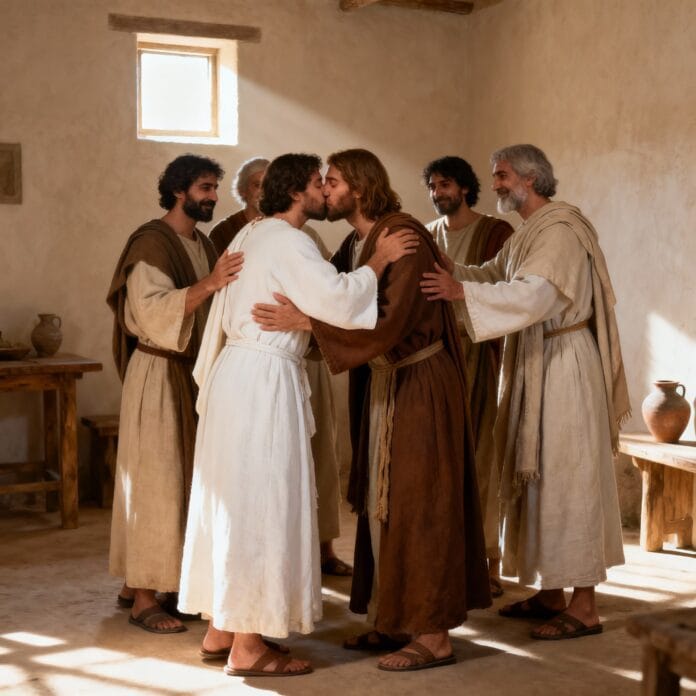
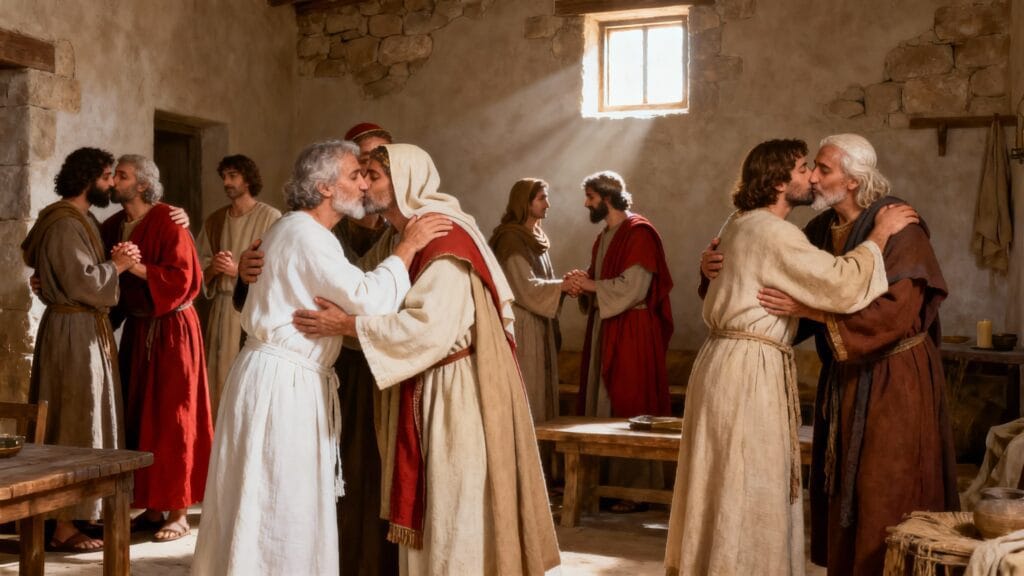
Greet one another with a holy kiss. All the churches of Christ greet you.
I too, Tertius, who put this letter into writing, Greetings in the Lord. Gaius greets you, he who welcomes me and receives the whole Church. Erastus, the city treasurer, and our brother Quartus also greet you.
Now to him who is able to strengthen you according to the gospel I proclaim, proclaiming Jesus Christ, the revelation of the mystery kept secret for ancient times, the mystery now disclosed and made known to all nations through the prophetic writings, according to the command of the eternal God, to lead them to the obedience of faith—to the one wise God, through Jesus Christ, to him be glory forever. Amen.
The kiss of peace: living the fraternal gratitude of the Gospel
Fraternity in action and memory of faces
In a world often anonymous, where human relationships are sometimes reduced to functional exchanges, Paul offers us a picture of names, faces, affection, and shared work. Behind the greetings of the last chapter of his Letter to the Romans, we discover a Gospel lived in concrete terms: a community woven from personal links and spiritual, where the kiss of peace is not an agreed-upon symbol, but a living sign of a brotherhood rooted in Christ.
This article is for those who seek to revitalize Christian community life. Through reading this text, we will explore how fraternal greetings become a path to holiness, a shared memory, and an announcement of... peace of God.
- Context and meaning of Pauline salvation
- The heart of the message: the communion of saints in the ordinary
- Three areas of deployment: memory, service, sacramental link
- Tradition and spirituality of the kiss of peace
- Community meditation practice
- Conclusion and practical applications
Context
There Letter to the Romans He concludes his lengthy doctrinal argument with an unexpected passage: a series of personal greetings. After presenting justification by faith, explaining the role of Israel, and exhorting the fraternal charity, Paul devotes his last chapter to naming, one by one, those who have made this faith visible.
This gesture is not insignificant. It is part of a scriptural tradition where the memory of God's companions endures through the ages: Noah and his sons, Abraham and his servants, David and his warriors, Married and their loved ones. In each case, the human relationship manifests a living alliance. The conclusion of Romans takes up this motif: theology descends into the flesh, into concrete relationships, into expressed gratitude.
Prisca and Aquilas, artisans of leather exiles from Rome, They appear here as figures of apostolic collaboration. They had already met Paul in Corinth and Ephesus, and their home had become a place of domestic church life. This mention immerses us in the reality of a Christianity in the diaspora, where believers gather in homes. Through them, Paul shows how faith becomes hospitality.
Each name mentioned – Sword, Married, Andronicus, Junias, Ampliatus, Urban, Stakys – form a mosaic of brotherhood. Some suffered with him, others gave their time or opened their doors. All embody faith through their bodies: through the work, presence, risk, reception. The passage concludes with these words: «Greet one another with a kiss of peace.» This formula, present in other Pauline letters, was both a prayer and a gesture. It united those who were about to receive communion, as the visible sign of the unity to be restored before the Last Supper.
In the Roman context of the first century, this gesture challenged social distinctions: the master embraced the slave, the man greeted the woman, the Jew welcomed the Gentile. The greeting thus became a proclamation of a new world. This is why Paul adds: «All the churches of Christ send you greetings.» It is not merely a thank you, but an announcement that brotherhood Christianity has already begun to transform human relationships.
Analysis
The central idea of this passage lies in the link between memory and unity. For Paul, faith is not an individual idea, but a relational fabric. Salvation in Jesus Christ takes shape in the gratitude expressed and recognition of others. Naming, greeting, embracing: these are acts of embodied theology.
The paradox of the text then appears: Paul's most doctrinal letter closes on the most concrete of scenes. After speaking of grace, he speaks of faces. Faith without relationship becomes theory; charity Lived experience transforms doctrine into life. The Gospel concludes with first names, as if to say that the Kingdom is played out in interpersonal relationships.
The "kiss of peace" is therefore not a ritual ornament, but a theological language: it unites word and gesture. This kiss between believers already announces the universal reconciliation promised by God. In the liturgy, it precedes communion; in life, it precedes all common work. "Greet one another" becomes a commandment of incarnation: recognizing in the other the presence of Christ.
Spiritually, this passage calls for a twofold conversion: to embrace the memory of those who have been important to our faith, and to become, in turn, bearers of peace. In every community, in every relationship, Paul invites us to an active gratitude: the kind that brings the other into being through words and glances.
Fraternity as a living memory
Paul is not simply conveying greetings; he is awakening collective memory. The names he recites are the living stones of the first Gospel. Christian faith is not born from a system, but from a network of loyalties. Let us remember: in Acts, the Spirit descends upon people gathered together, not upon isolated individuals. Romans 16 is its silent echo.
To name is to acknowledge. In our daily interactions, how many names do we forget? Paul reminds us that faith is woven from the memory of good deeds received. «They risked their lives»: this is not about feats of bravery, but about courageous friendship. Pauline gratitude here becomes a prophetic act: against modern amnesia, it inscribes memory in faith.
In a parish, this attitude can be embodied in simple gestures: publicly thanking a volunteer, mentioning quiet witnesses in a homily, keeping alive the memory of elders. Every community has its Priscas and Aquilas. Remembering them is what makes Church.
Fraternal service as a place of grace
«Working companions»: Paul does not glorify hierarchies, but collaboration. This shared service is the concrete face of grace. In the Christianity In the early days, each person received a mission according to their gifts: to welcome, to teach, to support, to write. The apostle never speaks of moral perfection, but of work for the Kingdom.
Grace does not eliminate effort; it transfigures it. The work for Christ becomes the place where peace manifests itself. "Greet Married, "who has gone to great lengths": this common phrase expresses all the beauty of laborious faith. To serve is to love with one's hands.
In contemporary Christian life, this dynamic can be embodied in volunteer service, community involvement, or simply the daily attention given to loved ones. The kiss of peace then becomes a motivation: if I serve, it is to share this peace.
The kiss of peace, sacrament of bonding
Paul concludes: «Greet one another with a kiss of peace.» This gesture, adopted by liturgical tradition, is far from anecdotal. It expresses a theology of unity. In the early Church, it preceded communion so that no one would approach the Body of Christ in a state of division.
This physical greeting meant: «I recognize in you a reconciled brother.» The kiss of peace was at once forgiveness, welcome, and communion. Through it, social distinctions faded away; cultural differences became an enrichment. This is how Paul concludes his letter: the mystery of faith is revealed in an ordinary gesture.
In our time, restoring meaning to this symbol means reviving the culture of genuine contact: knowing how to look, smile, listen, and forgive before receiving communion. The kiss of peace is not reserved for Mass; it becomes a way of life., a way of inhabiting relationships.
Heritage and spiritual tradition
The Church Fathers They commented a lot on this greeting. Saint Augustine he saw it as a seal of unity, a foretaste of peace heavenly. Saint John Chrysostom reminded us that, without prior reconciliation, this gesture became a lie. Western liturgy has preserved its spirit, even though the kiss has gradually been symbolized by an embrace, an outstretched hand, or a gesture of the gaze.
In Benedictine spirituality, peace Mutual aid precedes all community work. "That peace "Be first and foremost," said the Rule. Similarly, in the Franciscan tradition, the greeting "Pax et bonum" takes up this Pauline impulse: every encounter becomes a place of Gospel.
Even today, many spiritual movements draw inspiration from this gesture to restore to brotherhood a concrete expression: in the monastic life, grassroots communities, secular fraternities. The kiss of peace remains a challenge for all: how to offer true peace when the world values distance and mistrust?
Path to peace: steps to experiencing fraternal greeting
- To remember. To remember each day a person who has supported our faith.
- Expressing gratitude. Saying "thank you" explicitly to those who work behind the scenes.
- Reconcile. Seek forgiveness before the communal prayer.
- Honoring faces. Learning names, looking at the other with gentleness.
- Serve. Transform peace received in concrete gestures of availability.
- Pray for those who are absent. To remember those who have left us in prayer.
- To transmit. Teaching children the spiritual value of greeting and respect.
Conclusion
Brotherhood Christianity is not proclaimed; it is lived in the simplest gestures. Through these final greetings, Paul reveals the very heart of the Gospel: a reconciled humanity where every face becomes a sign of God. The kiss of peace, far from being a rite, is an inner commitment. It is the act by which we confess that peace Christ's work has already begun among us.
In a time of division, this passage from Romans urges us to rebuild relationships: to name faces, to bless memory, to welcome peace and to circulate it. Thus is fulfilled Paul's promise: the glory of the one God, lived in the simplicity of a greeting between brothers.
Practices for embodying the message
- Keep a weekly spiritual gratitude journal.
- Offer a word of appreciation to a member of the community every Sunday.
- Practice personal reconciliation before the Eucharist.
- Make a genuine gesture of peace every day, even if it's symbolic.
- Read chapter 16 of Romans as a family or group.
- Rediscovering the Christian greetingPeace of Christ.".
- Serving together for a common cause as a sign of peace in action.
References
- Letter of Saint Paul to the Romans, chap. 16.
- Acts of the Apostles, chap. 18: Priscilla and Aquila in Corinth.
- Saint Augustine, Sermons on peace of Christ.
- Saint John Chrysostom, Homilies on the Romans.
- Rule of Saint Benedict, chap. 72: Of good fervor.
- Francis of Assisi, Greetings of the virtue of peace.
- Roman liturgy: rite of the kiss of peace before communion.