












Gospel of Jesus Christ according to Saint John
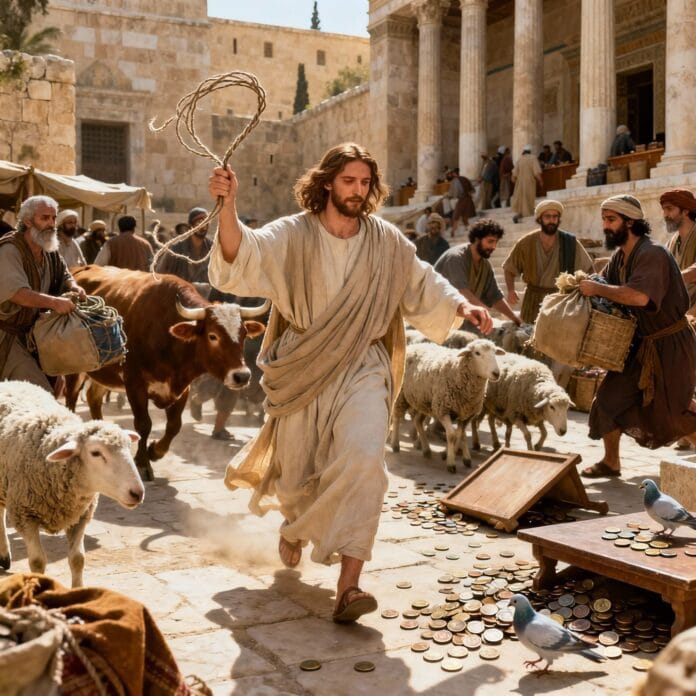
As the Jewish Passover festival approached, Jesus went to Jerusalem. In the Temple, he found the sellers of oxen, sheep, and doves, as well as the money changers who were there.
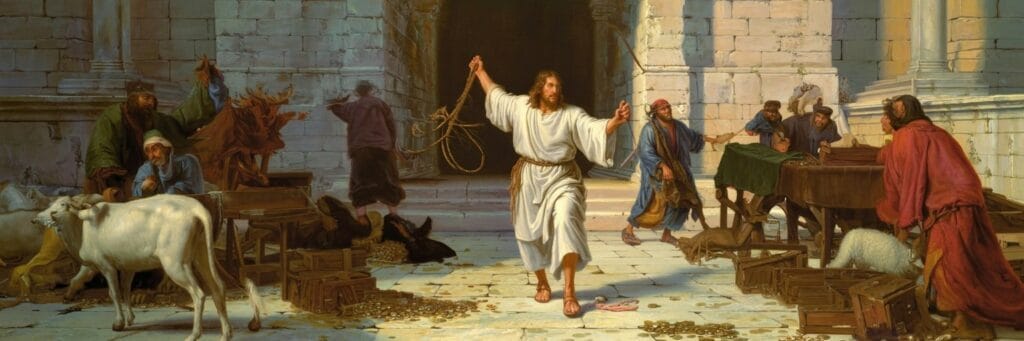
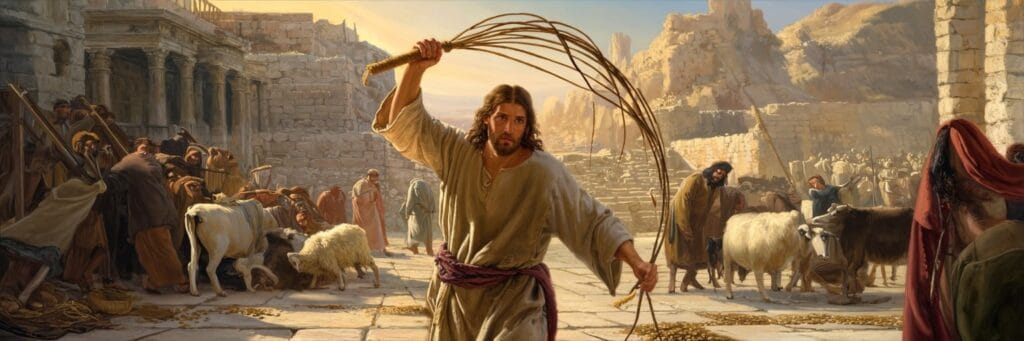
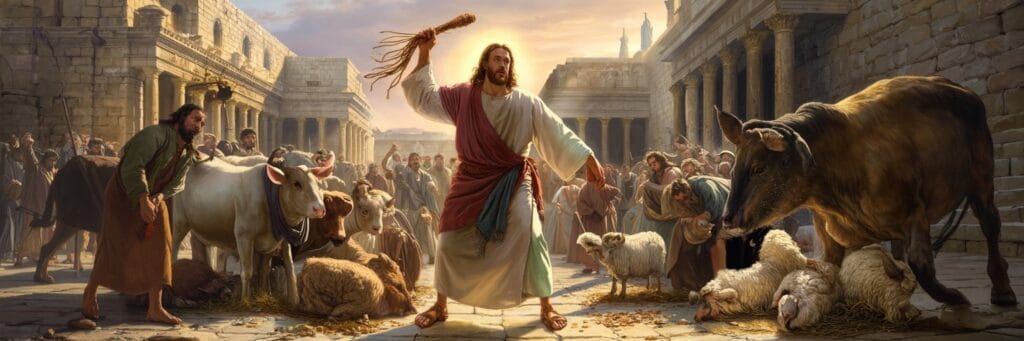
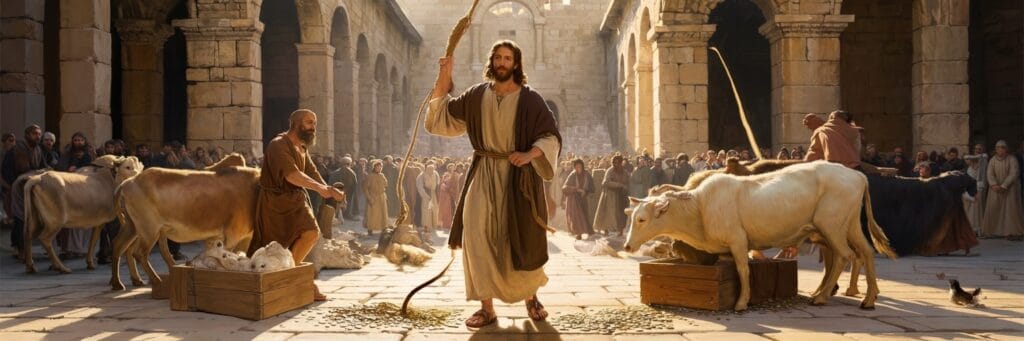
He made a whip out of cords and drove them all out of the Temple, with the sheep and the oxen; he scattered the money of the money changers on the ground and overturned their tables. Then he said to those who sold doves, «Take all these things away. Do not make my Father’s house a place of trade.»
His disciples then remembered what was written: Zeal for your house will consume me.
Some Jews questioned him, saying, «What sign can you show us to justify these things?» Jesus answered them, «Destroy this temple, and I will raise it up in three days.» The Jews replied, «It has taken forty-six years to build this temple, and you are going to raise it up in three days?»
But he was talking about the temple of his body.
Therefore, when he rose from the dead, his disciples remembered that he had said this; they believed the Scripture and the word that Jesus had spoken.
Purifying the Inner Temple: Rediscovering the Body as the Dwelling Place of God
How the episode of the overturned Temple reveals the mystery of Christ and the sanctuary we are called to become.
The story of Jesus driving the merchants from the Temple—and announcing the mysterious resurrection of his own body—is not merely an episode of holy wrath: it is a key to understanding one of the most profound upheavals in the Christian faith. In this shattered sanctuary, God affirms that he now dwells not in buildings, but in the very heart of humanity. This article is for any reader seeking to unify faith, inner life, and incarnation—to rediscover their own body as the locus of divine presence.
- ContextThe Johannine episode of the Temple, a pivotal moment between ancient cult and new revelation
- AnalysisThe Messianic Gesture of Purification: Sign, Scandal, and Prophecy
- Thematic deployment1. The Temple and the Flesh; 2. The Word That Revives; 3. The Fire of Inner Zeal
- ApplicationsHow to live this purification of heart and body today
- Spiritual resonancesFrom Solomon's Temple to the Body of Christ – the dwelling place of God among men
- Practical guide and prayerGuided meditation and call to become a living dwelling
- Contemporary challenges and opennessCommodification of faith, relativism of the sacred, desecrated body
- Conclusion and practical applications: To inhabit the presence, to purify, to raise up
When the Temple becomes a sign of the body
The passage in [Jn 2, 13-22] is located at the beginning of Jesus' public ministry. Unlike the other evangelists who place the cleansing of the Temple at the end of Christ's life, John places it from the outset: not as a moral episode, but as a theological proclamation.
Jesus goes up to Jerusalem, the heart of Jewish worship, for Passover – a time of remembrance of salvation and passage. The Temple, the «House of the Father,» then becomes the scene of a confrontation. The trade in animals and the exchange of money were part of the logistics of religious practice; but Jesus’ action denounces the shift from the sacred to the economic, from offering to profit.
Yet this is not simply a moral gesture. By overturning the tables, Jesus implicitly declares that the time of the stone Temple is over. The physical sanctuary, restored by Herod the Great, had required "forty-six years" of work: a symbol of human, religious, and collective effort. By saying, "Destroy this temple, and in three days I will raise it up," Jesus shifts the focus of worship to himself.
The mention of the "sanctuary of his body" thus effects a fundamental shift: the place of encounter between God and man is no longer a stone edifice, but a body given up and raised up. This is the entire theology of the Incarnation condensed into a single signature: God now dwells in the heart of the flesh.
The act of purification, a sign of a new world
Christ's gesture is not an outburst of anger, but a prophetic act. It manifests the Messiah's zeal for the purity of worship:Love "Your house devours me." This zeal reveals the tension between two logics: that of institutional sacredness and that of living presence.
With this sign, Jesus takes authority over the Temple. The religious leaders ask him for a "sign"—that is, proof of divine origin. But they will only understand the true sign later. the Resurrection: the resurrection in three days. This reversal already foreshadows the final Passover: the destroyed Temple is the crucified body, raised in glory.
Jesus speaks in concrete parables: the destroyed Temple represents the end of the old sacrificial worship, replaced by the total sacrifice of one's own body. The same verb "to raise up" speaks of both reconstruction and the Resurrection. This double meaning illuminates the entire gospel: for Jesus, to purify is to give birth.
For the disciples, this moment would become a key to interpretation. After the Resurrection, «they remembered»: Christian faith is born from this enlightened memory, from this Easter rereading where everything takes on meaning in the light of the Risen One.
The Temple and the Flesh – A New Geography of the Sacred
In the ancient world, the Temple was the place where the infinite met the earth. The sacred space was delimited, protected, reserved. Jesus overturns this geography: he transposes the presence of God into the flesh.
The Incarnation abolishes the wall of the separate sacred. The human body becomes a living temple. From then on, purifying the Temple means purifying the inner spaces where God wishes to dwell.
- The human sanctuary: every believer carries within themselves this place of presence. Saint Paul will echo this: «Do you not know that you are the temple of God?»
- The community sanctuary: the Church, the body of Christ, extends this dwelling.
- The cosmic sanctuary: the whole world becomes a space of worship, for God manifests himself there through beauty and order.
In this transformation, Jesus fulfills the promise of 2 Chronicles 7:16 – «I have chosen and consecrated this house, so that my name may be there forever.» This «name» is now inscribed in the very flesh of the Son.
The word that lifts up – the creative Word in action
When Jesus answers, «In three days I will raise him up,» he uses the word of creation. He speaks as God when GenesisHe speaks, and it happens.
This power to revive Life is not reserved for Easter; it is already at work in our lives. Every word of Christ spoken about death, fear, or sin has this power to revive.
Thus, reading this passage means welcoming within oneself the living word that recreates. Jesus' word is not ideological: it is performative. Where he says, "Arise," something arises. In this dynamic, the act of purification is not a rejection of the world, but a call to renewal: for humanity to become transparent to the light of God.
The fire of inner zeal – to love without consuming
The text quotes: "Love "Your house will be my torment." This fire is that of divine zeal: passion for justice, inner demand for pure love.
But this zeal can be distorted if it becomes human anger. Jesus shows us the right balance: eliminating what profanes without destroying those who are imprisoned by it. True purification is accomplished by the fire of charity: burning away the falsehood to better reveal the truth.
In the spiritual life, this fire acts like breathing: God purifies through inner light, not through violence. This is why Christ does not destroy the Temple—he reveals its true purpose.
This passage calls for discernment: what, in our own "Temple," serves commerce and not prayer? What inner trading posts remain to be overturned?
Experiencing inner purification
This scene in the Temple should not be contemplated merely as a historical event. It describes a spiritual process: purification to allow the true presence to emerge.
In personal life:
- purify one's intentions: recognize the areas of calculation or bargaining with God, and return to gratuitousness;
- purify one's rhythm: restore inner silence to a central place;
- purify one's gaze: see the world as participation in the Temple of the living.
In family and community life:
- to make the home a peaceful welcoming space, free from aggression and opinion-show;
- transforming daily habits (meals, speech, work) into small altars of charity.
In professional and social life:
- to rediscover the meaning of service at the heart of economic activity;
- to dare to make decisions that put dignity before profit.
Thus, the stone Temple becomes a metaphor for all our structures: institutions, businesses, local churches – so many places to purify so that the Presence can circulate again.
From Solomon to Christ, the fulfilled dwelling
The entire Bible recounts the quest for a divine dwelling place. First the Tent of Meeting, then Solomon's Temple, built like a miniature cosmos: gold, wood, light, symbols of the six days of creation. God's glory fills it—but human ambiguities also fracture it.
Jesus' action closes this cycle. His flesh becomes the new Tent where God "pitches his dwelling place" (Jn 1:14). In Him, the divinity dwells bodily (Col 2:9). This body, given up and raised up, is the true Shekinah.
In the spiritual tradition, the Fathers saw in this episode a lesson in asceticism: clearing the heart as one cleans the sanctuary. Origen comments: "Every time I allow traffic or noise to enter my soul, the Lord advances with a whip of words."«
The theological implications are immense: the resurrection The new cult is founded on Christ. The Christian is temple, priest, and offering all at once; and the whole world becomes liturgy. This is the cosmic liturgy foretold by the mystics of East and West – that of a universe praying with the Risen One.
Walking in the inner sanctuary
A suggested five-step prayer:
- Enter: to stand in silence, to breathe slowly, to recognize oneself as a living temple.
- Look: imagine Christ entering your inner Temple: his gaze against your cluttered tables.
- To welcome: let him overturn everything that weighs, hinders, calculates.
- ListenHear his word: "In three days I will raise you up.".
- Remain: reside peace, The Presence that establishes itself. Feel yourself lifted up, recreated.
This meditation allows us to move from a moral act (chasing away disorder) to an act of transformation (letting God establish his dwelling place).
The Temple threatened, the presence forgotten
Our era faces new sellers in the Temple: the commodification of the body, the spectacularization of religion, the relativism of the sacred.
- The body, a place of desire and consumption, is no longer perceived as the dwelling place of God. It becomes a commodity.
- The cult, transformed by the media, risks sliding towards performance rather than encounter.
- Community faith must learn to purify its temples: to restore gratuitousness, beauty, and silence, against the noise of the world.
But every crisis is also an opportunity: the Spirit continues to "restore this sanctuary."«integral ecology, The rediscovery of the body in prayer and the liturgical renewal call for a reconciliation of the sacred and the world. The living Temple is reborn as soon as a believer chooses Presence over appearance.
Prayer: to purify and uplift
Lord Jesus,
You who drove the merchants out of the Temple,
Come today into the hidden corners of our hearts.
Turn our profit tables upside down,
It overflows our certainties, it sets us free.
May your Spirit sweep through our walls,
May He make our bodies sanctuaries of light.
Make us capable of dwelling in your Presence
in every breath, every gesture.
In three days, identify what our mistakes are destroying.,
and let us share in your eternal restoration.
For where you dwell,
The world becomes praise and peace.
Amen.
To become a temple again, for God and for the world
Christ does not destroy the Temple; he fulfills it. By reminding us that his body is the true sanctuary, he reveals that our own flesh, our communities, and all of creation are called to be inhabited by God.
Purification is not about exclusion; it is about making space. The inner Temple is a space that opens, a breath that connects to the Great Breath. Each of us—if we let go of noise, commerce, and illusions—can become a dwelling place of the Presence.
Even today, Christ enters Jerusalem, not to judge but to raise up. To the one who opens the door to him, he replies: "In three days, I will raise you up."«
Personal practices
- Begin each day with three conscious breaths while repeating: "Lord, make me your dwelling place."«
- Read slowly [Jn 2, 13-22] every Sunday morning for a month.
- Keeping a spiritual journal to note the "tables to overturn" in one's life.
- Offering a concrete gesture of purification: tidying up, reconciling, simplifying.
- Participate in a silent liturgy each week.
- Walking ten minutes a day in nature, in silence, as if in a sanctuary.
- Conclude each evening with an act of gratitude: "Today, Lord, you have lifted a stone from my Temple."«
References
- Gospel according to Saint John, 2, 13-22
- 2 Chronicles 7:16
- Origen, Homilies on John
- Saint Augustine, In Ioannis Evangelium Tractatus
- Saint Paul, 1 Corinthians 3:16-17
- Benedict XVI, Jesus of Nazareth
- Hans Urs von Balthasar, Glory and the Cross
- Pierre Teilhard de Chardin, The Divine Middle