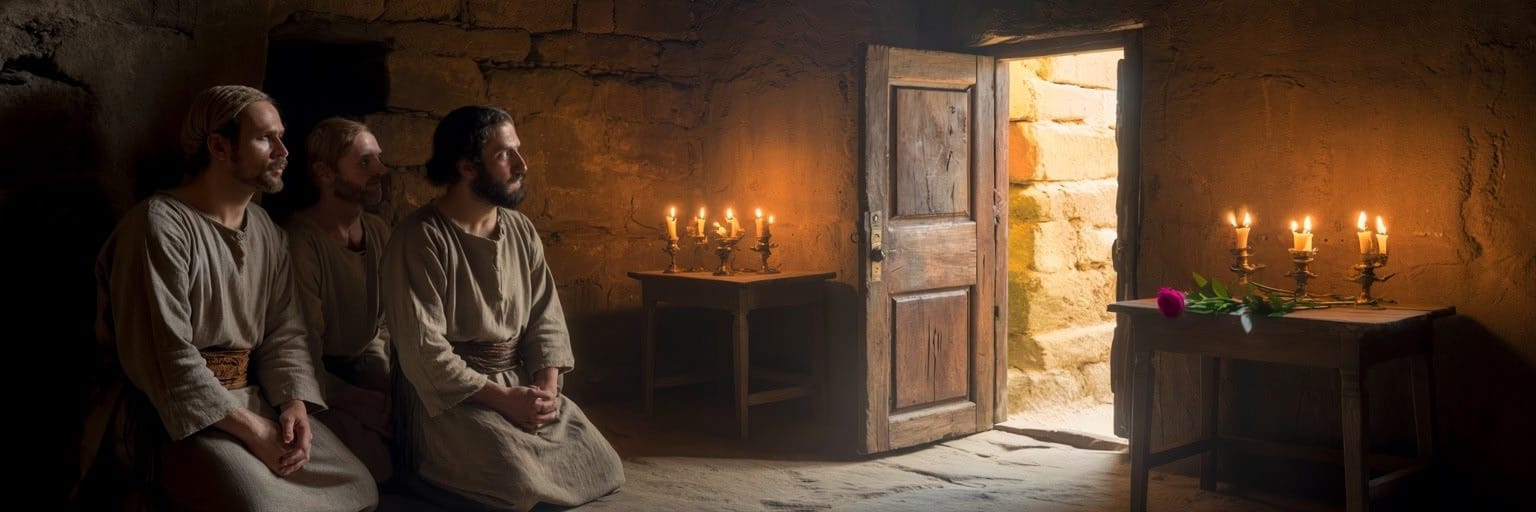


- To receive the rest that God gives to broken hearts
- The Hidden Prayer
- The secret of the yoke
- The divine pedagogy of toddlers: God chooses what the world rejects
- The eschatological rest already present: a two-stage promise
- Transforming everyday life
- Echoes of the centuries — resonances in tradition and theological scope
- Lectio divina
- Stop and breathe
- What the modern world does with rest
- Prayer
- What this speech changes
- To remember
- References
- ✝ Biblical references
Gospel of Jesus Christ according to Saint Matthew

25At that time Jesus also said: «I praise you, Father, Lord of heaven and earth, because you have hidden these things from the wise and prudent, and revealed them to little children. 26Yes, Father, I bless you for it has pleased you so. 27All things have been handed over to me by my Father; no one knows the Son except the Father, and no one knows the Father except the Son and anyone to whom the Son has chosen to reveal him. 28Come to me, all you who are weary and burdened, and I will give you rest. 29Take my yoke upon you, and receive my instruction, for I am gentle and humble in heart, and you will find rest for your souls. 30For my yoke is easy and my burden is light.»
At that time, Jesus said, «Father, Lord of heaven and earth, I thank you that you have hidden these things from the wise and learned, and revealed them to little children. Yes, Father, for this is what you were pleased to do. All things have been committed to me by my Father. No one knows the Son except the Father, and no one knows the Father except the Son and those to whom the Son chooses to reveal him. Come to me, all you who are weary and burdened, and I will give you rest. Learn from me, for I am gentle and humble in heart, and you will find rest for your souls. For my request is easy and my burden is light.»
To receive the rest that God gives to broken hearts
How the gentleness of Jesus transforms the burden of life into a path of inner freedom
There are texts that never grow old. Matthew 11:25-30 is one of them. In just a few verses, Jesus accomplishes something rare: he prays aloud before his disciples, reveals his unique relationship with the Father, then turns to the weary crowd and opens his arms to them. This text speaks to all those who carry a burden—perfectionism, grief, overburdening themselves, an endless spiritual quest—and who have not yet heard that rest is a promise, not a reward. It is for them that this message was written.
This discourse unfolds in four movements: first, the Johannine and Matthean context which sheds light on why Jesus speaks in this way (The Hidden Prayer); then the analysis of the central kerygma — the mutual knowledge of the Father and the Son as the foundation of all invitation (The secret of the yoke); then three thematic axes—the divine pedagogy of "little ones," gentleness as an incarnate divine attribute, and rest as an already present eschatological reality; finally, concrete applications for spiritual, professional, and community life. The common thread: God's gentleness is not a comforting metaphor. It is a theological framework to be lived in.
The Hidden Prayer
To understand Matthew 11:25-30, we must first place these verses within their narrative sequence. Chapter 11 of Matthew is one of the darkest in the Gospel. Jesus has just learned of the impending death of John the Baptist, and he has rebuked the Galilean towns—Zorazin, Bethsaida, and Capernaum—for their impenitence (Matthew 11:20-24). The initial enthusiasm has waned. Miracles have not been enough. The wise men have not understood. It is in this context of apparent failure, missionary weariness, and incomprehension that Jesus looks up and prays.


This is not a prayer of convenience. The Greek term used by Matthew for "spoke,", apokritheis, The word literally means "responder"—as if prayer were an inner response to what Jesus has just experienced. And what he says to the Father is overwhelming: "What you have hidden from the wise and learned, you have revealed to little children" (Matthew 11:25). He doesn't complain. He praises. He finds in apparent failure confirmation of a deeper plan.
This passage belongs to what exegetes call the "Johannine saying" of Matthew—a term coined because these verses more closely resemble the style of the fourth Gospel than the usual Synoptic prose. The same structure is found in John 10:15: "The Father knows me and I know the Father." This is no coincidence. Matthew 11:27 is one of the few explicit affirmations of divine identity in the Synoptic Gospels: "No one knows the Son except the Father, and no one knows the Father except the Son." This verse provides the Christological foundation for everything that follows. If Jesus can promise rest, it is because he knows the Father intimately—and this Father is precisely the God who reveals Him to the little ones.
The final invitation — «Come to me» (Mt 11:28) — is unique in the Synoptic Gospels in this direct and universal form. First-century rabbinism employed the image of the yoke (ol (in Hebrew) to designate the observance of the Torah. Rabbi Nehunya ben Haqqanah had already written: "Whoever takes upon himself the yoke of the Torah is relieved of the yoke of government and the yoke of worldly cares." Jesus takes up this image, but reverses it: it is no longer the yoke of a law, it is the yoke of a person. My yoke. This shift is crucial.
The Catholic liturgy places this text during Ordinary Time, often on weekdays, as a contemplative invitation in the heart of summer. This is not without purpose: the Church offers these verses as an oasis. A text to be reread slowly, not dissected quickly.

The secret of the yoke
What exactly is Jesus saying, and why does it change everything?
The passage is structured in three parts: a doxology (Mt 11:25-26), a Christological declaration (Mt 11:27), and a soteriological invitation (Mt 11:28-30). These three movements are not juxtaposed randomly. They are linked by rigorous theological logic.
Doxology Jesus proclaims the Father's praise precisely because the wise men did not understand. This represents a radical inversion of our cultural categories. In our world, educational failure calls for a revision of methods. In divine logic, it reveals a hidden intention: God deliberately chooses the nēpioi, Infants, young children, as recipients of the revelation. The Greek term nēpioi (Mt 11:25) literally refers to children who do not yet speak well—those who have not yet mastered learned language. This is not a metaphor for intellectual modesty: it is a sociological and spiritual designation of those excluded from knowledge.
The Christological Declaration Matthew 11:27 is a subtle bombshell. Jesus doesn't just claim to have received a revelation—he claims to be the place of mutual knowledge between the Father and the Son. The formula is reciprocal: the Father knows the Son, the Son knows the Father. This reciprocity of knowledge (ginōskō (in Greek, a term for intimate knowledge, not just informational) is the foundation of everything that follows. Why can we trust it? Because it is on the Father's side. Because it knows, from within, what the Father is.
The soteriological invitation This is where theology becomes pastoral. «Come to me» (deute pros me, (Mt 11:28) — this invitation is unconditional. Not by purity, not by competence, not by prior understanding. The conditions of access are precisely those of the excluded: «all of you who labor under the burden.» The Greek term kopiaō (To struggle, to be exhausted) is the same that Paul will use to describe intense apostolic work. hortizō (being burdened with a load) evokes a concrete overload, both physical and spiritual.
What Jesus offers — anapausis
, Rest—this is a loaded term in the Septuagint. It refers to the rest of the seventh day (Genesis 2:2-3), rest in the promised land (Deuteronomy 12:9), and the rest of wisdom (Sirach 51:27—a text that Matthew 11 quotes directly). To promise this rest is to promise the fulfillment of all of Israel's biblical expectations.
The divine pedagogy of toddlers: God chooses what the world rejects
One of the most unsettling claims in this text is that God hidden deliberately instructs the wise and reveals to the simple. Not because the wise are evil, but because their knowledge makes them more receptive. The paradox is as much pedagogical as it is theological.
In biblical tradition, this reversal is a recurring motif. Gideon is the least of his tribe (Judges 6:15). David is the last of Jesse's sons (1 Samuel 16:11). Mary is an unknown woman from Galilee (Luke 1:48). Paul presents himself as "the least of the apostles" (1 Corinthians 15:9). This is not by chance: the biblical God works in the margins, where human structures of power and knowledge fade away. Because there, grace can take root without competition. This choice of the humble is not a romantic rehabilitation of ignorance. It is not about valuing naiveté or discouraging study. The Church has produced Augustines, Thomas Aquinas, Newmans—giants of intellect who were also saints. But all of them, without exception, one day experienced knowing nothing, being brought to their knees before something that surpassed them. It is in this space of surrender that revelation enters. Thomas Aquinas, at the end of his life, after a mystical experience, said of all his work: «It is straw.» This was not contempt for intelligence. It was the discovery that the Father reveals himself where hands are open.


For us today, this first point raises a practical question: what, in my intellectual or spiritual life, prevents me from being a nēpios What knowledge, what certainty, what spiritual reputation can take the place of God?
Second theme — Gentleness as an incarnate divine attribute: what Jesus reveals in describing himself
«I am gentle and humble in heart» (Mt 11:29)—this is one of only two times in the Gospels where Jesus describes himself. The other instance is in Jn 10:11: «I am the good shepherd.» Two self-portraits. In both cases, Jesus doesn’t say «I am powerful,» «I am omniscient,» «I am a judge.» He says: I am gentle. I am a shepherd. What Jesus chooses to reveal about himself when he freely presents himself is illuminating.
The Greek term praus (gentle) is rich. In ancient Greek philosophy, it denotes the virtue of one who possesses strength but also self-control—a balance between raw anger and insensitivity. It is not weakness. It is directed strength. In the Hebrew Bible, the equivalent is anaw (humble, meek) — the term from the psalms of the poor of Yahweh (Ps 37; Ps 149). «The meek shall inherit the earth» (Ps 37:11), a verse that Jesus will quote in the Beatitudes (Mt 5:5).
But here Jesus is not only speaking of gentleness as a moral virtue. He is speaking of gentleness as an ontological characteristic: "I am gentle... in heart."« Kardia, In the Bible, the heart is the center of the person, the place where decisions are made, where one's deepest identity is formed. Jesus said: "At the core of who I am, there is gentleness." This is a theological revelation about God himself. The God that Jesus embodies is not the terrible, demanding, calculating God. He is gentle. His heart is turned toward us with tenderness.
This does not diminish divine holiness, judgment, or truth. But it reveals how God approaches: gently. This is what spiritual tradition has called the God's mercy
, the mercy of God — an attribute extensively commented on by John Chrysostom and Bernard of Clairvaux.

The eschatological rest already present: a two-stage promise
«You will find rest for your souls» (Mt 11:29) — the future here is a promise, not a postponement. In Greek, heurēsete anapausin : YOU you will, in the sense of discovering, encountering. Rest is not something to be manufactured. It is something to be found. This distinction is fundamental to avoid the caricature of a spirituality of effort where one won rest through prayer and asceticism.
There are two parts to this verse. First: «I will give you rest» (Mt 11:28) — anapausō humas, Literally, "I will give you rest," an act of Jesus, an immediate promise. Then: "you will find rest" (Mt 11:29)—the result of a journey, the fruit of the relationship with the gentle master. This rest thus has an immediate dimension and a progressive dimension. We receive its first fruits as soon as we come to Jesus. We discover its depths by bearing his yoke.
The yoke (zygosThis deserves attention. In ancient times, the yoke was the instrument that allowed two oxen to work together—it shared the load. When Jesus said, «Take my yoke,» he wasn’t offering an additional burden. He was offering to place themselves under the same yoke as him. The burden remained real. But it was shared. And it was borne by someone who knew the weight of the human condition because he had borne it himself.
The Epistle to the Hebrews will develop this dimension in Hebrews 4:1-11, where rest (katapausisThe rest that Jesus offers is presented as the promised inheritance, both already accessible through faith and yet awaited in its eschatological fullness. The rest that Jesus offers is a sacramental reality: present but not yet fully realized. This is characteristic of the realities of the Kingdom.
Transforming everyday life
This text is not reserved for contemplatives or theologians. It has direct applications in very concrete spheres of life.
In personal and spiritual life, The first application is the permission to come exhausted. How many Christians don't dare to pray because they feel "too far away," "not fervent enough," "too sinful"? Matthew 11:28 dismantles this logic: it is precisely exhaustion that is the condition of access. We come to Jesus with our burdens, not after having rid ourselves of them. This reversal is liberating. It allows for authentic prayer, free from the pressure of spiritual performance.
In professional and social life, The text questions our relationship to competence and recognition. In a culture where a person's worth is measured by their expertise and productivity, the praise of nēpioi is subversive. This doesn't mean we should value incompetence, but that truth, grace, and what truly matters are not captive to diplomas and positions. An uneducated elderly person, a child, an ordinary person—can perceive what the expert lacks. This intuition must reshape our Christian communities: who has a voice? To whom do we give the microphone?
In community and church life, The gentleness of Jesus is a model of leadership. «I am gentle and humble in heart»—this phrase should be included in every charter of church governance. Communities that crush, overload, and do not allow rest are in direct contradiction with this text. The Church is called to be the place of the light yoke, not of an additional burden.
In family life, The promise of rest touches all those who bear the invisible burden of loved ones—caregivers, parents of sick children, spouses of a suffering partner. Coming to Jesus with This That burden is permitted. That's precisely what the text is aimed at.

Echoes of the centuries — resonances in tradition and theological scope
This text has nourished Christian tradition with remarkable consistency. A few key points.
Origin
(3rd century) comments at length on Matthew 11:27 in his Comment on Matthew. For him, the mutual knowledge of the Father and the Son is the model of mystical knowledge: to know God is to be known by him. Revelation to the little ones is a divine epistemology that overturns all human gnoseology.
Augustin He makes Matthew 11:28-30 the cornerstone of his theology of rest. In the Confessions, The famous phrase — «You have made us for yourself, and our hearts are restless until they rest in you» — is a direct meditation on this text. required Augustinian is the’anapausis Matthean, transposed into an anthropology of desire.
Bernard of Clairvaux devotes several sermons to the gentle yoke (De modo bene vivendiHe emphasizes gentleness as a pedagogy: God does not break, he shapes. mansvetudo For Bernard, this is the fundamental virtue of the disciple, because it opens the way to grace where hardness closes the way.
Thomas Aquinas (Summa Theologica, IIIa, q.36, a.1) comments on the revelation to infants as a manifestation of the providentia divina God deliberately chooses hidden ways so that the glory may be his alone. This is not a contempt for intelligence, but a rejection of self-sufficiency.
In the Rhenish mysticism, Meister Eckhart sees in the gentleness and humility of Jesus the sign of the Gelassenheit — surrender, letting go that allows God to act. The gentle yoke is the path of self-renunciation.
Contemporary theology (Hans Urs von Balthasar, Glory and the CrossHe sees in Matthew 11:25-30 a veiled Trinitarian revelation: the Son's praise of the Father, mutual understanding, the invitation to the lowly—it is the intra-Trinitarian life overflowing into humanity. The rest that Jesus offers is a participation in the life of the Father and the Son.
Lectio divina
«Come to me, all you who are weary and burdened, and I will give you rest.» (Matthew 11:28)
He doesn't say: improve yourself, then come. He says: come—now, even in your exhaustion. The Father hides from the learned what he offers to the little ones, not out of cruelty, but because empty hands receive better. Jesus calls himself gentle and humble of heart—not powerful, not glorious—as if gentleness were his true strength. And you, what burden have you been carrying for too long, convinced that no one can relieve you of it?
Father, you have hidden your light from the self-assured, and I understand why—I have so often preferred my own wisdom to your voice. Teach me to become small, small enough to receive. Jesus, I come to you with my burdens, which I don't always dare name. Lay your hand on this weight I carry. Let your yoke—not mine—shape my shoulders. Give me the rest I seek everywhere except where you offer it.
A child falls asleep in arms bigger than himself, and his clenched fists open slowly in the silence.
Stop and breathe
Here is a four-step path, which can be followed alone or in a group, to inhabit this text rather than just read it.
Step 1 — Name the burden (5 minutes). Take a sheet of paper. Write down, without filter, what you're wearing right now. Not what you should Carry. What you truly carry. Fatigue, anxieties, relationships, unmade decisions, unresolved grief. Name them.
Step 2 — Read the text aloud (3 minutes). Read Matthew 11:28-30 slowly, aloud, mentally replacing "all of you" with your own name. "Come to me, [name], you who are weary and burdened." Let the words resonate with you.
Step 3 — Contemplate the gentleness (10 minutes of silence). Stand in the presence of Jesus. Not to speak to him. To receive what he said of himself: «I am gentle and humble in heart.» Let that gentleness look at you. Resist the urge to produce something.
Step 4 — Identify a yoke to install (5 minutes). What is the TRUE What is the yoke of Jesus in your life right now — that is, what He invites you to, not what you impose on yourself? And what non-Gospel burden are you carrying that it's time to lay down?
This path can be taken in individual lectio divina, in group sharing, or as preparation for sacramental confession.
What the modern world does with rest
This text arrives in a world that has a serious problem with rest. Three challenges deserve to be honestly named.
First challenge: the sacralization of the activity. In our contemporary Western culture, hyperactivity is a social virtue. To be busy means to be important. Rest is suspect—it resembles laziness, a lack of ambition, irresponsibility. In this context, Jesus' invitation sounds almost subversive. To come to him, to take his yoke upon us, to find rest—this implies desacralizing restlessness. It is a cultural act as much as a spiritual one.
The Christian response is not to glorify idleness. It is to propose a different anthropology: human beings are not defined by what they produce, but by their relationship with the Father. This relationship is the fundamental rest from which all activity derives its meaning. The Sabbath is not a pause in real life—it is the truth of life that gives meaning to the week.
Second challenge: spiritual burnout. Recent surveys (including a 2023 Barna Group study on the clergy, and parallel work in France on Catholic activism) show that church people are not immune to burnout. Catechists, community leaders, and priests bear an ecclesiastical yoke that is not always easy. How does Matthew 11:28-30 speak to those who are weary? For Jesus?
The answer is delicate: Jesus is not calling for less commitment. Rather, he is calling for a commitment of which he is the source, not the justification. The difference is subtle but crucial. Gospel action must flow from rest in God, not be its condition. Those who exhaust themselves for God have often confused service to the Kingdom with religious performance. Matthew 11 invites us to return to the source: come to Jesus first, not to get involved for him first.
Third challenge: contemporary distrust of authority and oppression. In a post-#MeToo world and post-church scandals, asking someone to "take on a yoke" and submit to a master is a delicate proposition. Mistrust is legitimate. Yokes have crushed. Masters have betrayed.
The theological response is to return to what Jesus said of himself: «I am gentle and humble in heart.» This is not a yoke of power—it is a yoke of gentleness. The Church, when faithful to its Lord, is not an institution of control: it is a community of the humble who have found rest and bear witness to it. The institutional crisis of the contemporary Church is also an invitation to rediscover this gentle and humble face—the one Jesus himself claimed.
Prayer
Father, Lord of heaven and earth,
We come before you as we are — with our burdens, those we have chosen and those imposed upon us, those we are proud of and those we are ashamed of. We come with projects that go nowhere, relationships that cost us, grief that won't go away, and weariness we show no one.
You have hidden your mysteries from the wise and revealed them to little children. Make us like little children tonight—not through lack of intelligence or ambition, but through that docility of heart which allows truth to enter. Deliver us from the temptation to understand before loving, to analyze before receiving, to deserve before coming.
Jesus, you said you would give us rest. We take you at your word. We come, some exhausted, others discouraged, sometimes angry, sometimes resigned. We come as we are. And we ask you to do what you promised: give us rest. Not tomorrow. Not when we are better. Now.
You are gentle and humble of heart. This truth unsettles us because we are not used to it—neither from you nor from others. We have learned to distrust tenderness, to protect ourselves from gentleness. Teach us to receive yours. Teach us to make it possible for those around us.
Take your yoke upon us. We haven't always known how to choose ours well—the yokes of ambition, fear, the gaze of others, perfectionism, guilt. Free us from these crushing yokes. And if we resist out of habit or fear, if we replenish tomorrow what we lay down tonight, be patient. You are gentle, you said so.
May your rest be the constant foundation of our busy lives—not the absence of effort, but the certainty that you are there, that you carry with us, that the final burden is yours. May we learn, in the small silences of everyday life, to let you do what we cannot do alone.
Father, what you so willed in your benevolence—that the little ones receive what the great lack—do in us tonight. We are your little ones. We claim it as a grace.
Through Jesus Christ, your Son, meek and humble of heart, who lives and reigns with you and the Holy Spirit, now and forever.
Amen.
What this speech changes
There is something unique about Matthew 11:25-30. It is not just a beautiful text. It is a revelation of the face of God. And that face is gentle.
In a Christianity sometimes disfigured by demands, guilt, moral perfectionism, or legalism, these verses resonate like a return to the source. Jesus doesn't say, "Earn rest." He says, "Come and receive it." He doesn't say, "Be wise so that I may reveal the Father to you." He says, "Be humble, and the revelation is already here."«
This reversal should change the way we accompany others, train disciples, and build communities. The question is not: What more does this person need to acquire to be a good Christian? The question is: What prevents her from coming to Jesus as she is?
The gentleness of Jesus is a program. It calls for a gentle Church—not weak, not devoid of truth, but gentle in its approach, its welcome, its correction, its accompaniment. It calls for Christians who have themselves experienced rest before sharing it with others. We cannot pass on what we have not received.
So here's the concrete call: take twenty minutes this week. Open Matthew 11:25-30. Read it slowly. Name your burden. Lay it down. And let Jesus do what he promised: bring you rest.
Not because you deserved it. But because he is gentle and humble of heart.
To remember
- Identify each week a non-evangelical burden and name it explicitly in prayer, so that you can lay it down.
- Read Matthew 11:28-30 aloud during moments of intense exhaustion, as an act of faith rather than as emotional consolation.
- Cultivating the posture of nēpioi by practicing listening to people excluded from knowledge and power in our communities.
- Distinguish the yoke of Jesus (gentle, shared, based on relationship) from the yokes we impose on ourselves (performance, guilt, religious perfectionism).
- Revisiting our community practices in light of Mt 11:29: are we creating rest or additional burden for the people we accompany?
- To incorporate a weekly time of contemplative silence — not productive, not a sustained intercession — simply to receive the sweetness of God.
- Memorize Matthew 11:29b as a spiritual anchor: "I am gentle and humble in heart, and you will find rest for your souls."«
References
Primary Sources
- Matthew 11:25-30, Jerusalem Bible (Cerf, 2000) and Liturgical Translation of the Bible (AELF)
- Origen, Commentary on the Gospel of Matthew, Book XIV, SC 162 (Cerf, 1970)
- Augustine of Hippo, Confessions, I,1 — ed. M. Skutella, CSEL 33 (Vienna, 1900)
- Bernard of Clairvaux, Sermons on the Song of Songs, Sermon XXIII, SC 431 (Cerf, 1998)
- Thomas Aquinas, Summa Theologica, IIIa, q.36, a.1 (leonine ed.)


Secondary sources
- Ulrich Luz, Matthew 8–20, Hermeneia Commentary Series (Fortress Press, 2001) — a standard exegetical commentary on Matthew 11
- Hans Urs von Balthasar, Glory and the Cross, vol. I (Aubier, 1965) — for the Trinitarian reading of the passage
- Christoph Schönborn, The icon of Christ (Cerf, 1986) — on gentleness as a divine attribute in the Eastern tradition
- Geza Vermes, The Religion of Jesus the Jew (SCM Press, 1993) — for the rabbinic context of the yoke of the Torah

✝ Biblical references
1 passage · 1 book
Behold, I am with you always, to the end of the age. (Matthew 28:20)
The Gospel of the King: Jesus, the new Moses, fulfills the Scriptures for Israel and the nations.
→ Explore the Matthew Codex- Women accompanied them and served them, contributing from their own resources (Lk 8:1-3)
- We played the flute, and you did not dance. We sang a dirge, and you did not weep. (Luke 7:31-35)
- They say, but do not do (Mt 23:1-12)
- Herod sent and beheaded John in prison. John's disciples went and told Jesus (Mt 14:1-12)
- To you it has been given to know the mysteries of the kingdom of heaven, but not to them (Mt 13:10-17)
- The pallium and the face of the Church under Leo XIV: 59 archbishops, 27 countries, a refounding gesture
- The pallium and the cross: what Leo XIV said to the world on June 29
- Humanity as a sacred frontier: Magnifica Humanitas and the digital challenge in Latin America
- The Wounded Heart of a Nation: The Consecration of the United States to the Sacred Heart, a Prophetic Act for a Country at a Crossroads


🗺 Map
 IN
 IN
 IN
 IN
 IN
Recommended reading
The greatest American Catholic spiritual writer of the 20th century offers here a vivid and prayerful portrait of Bernard, directly echoing Pius XII's encyclical Doctor Mellifluus, already mentioned on this page. Merton shows how the spiritual peace instilled by Cistercian monasticism remains a relevant source for every Christian, monk or not. A short text…
View on Amazon →
A biography that breaks with the traditional narrative by examining the Confessions themselves as a literary construct rather than a simple testimony. O'Donnell, a renowned scholar who produced the definitive critical edition of the Confessions, offers a more political and ambiguous portrait of the Bishop of Hippo. A stimulating and erudite counterpoint to classic biographies.
View on Amazon →
Praised in the preface by Maurice Wiles as doing for Origen what Peter Brown did for Augustine, this work weaves together biography and thought to make Origen come alive and be accessible to a wide English-speaking audience. Trigg traces the theologian's emergence in Alexandria and then Caesarea, while analyzing his exegetical method and his controversial legacy. A key reference…
View on Amazon →
Considered the definitive scholarly biography in English, this study traces with rare erudition the entirety of Chrysostom's life, from his asceticism in Antioch to his exile and death in Armenia. Kelly, a leading Oxford patrologist, paints a nuanced portrait of an upright yet tragic man, whose own weaknesses precipitated his downfall. A demanding work, but…
View on Amazon →
The definitive English translation of the Confessions, hailed by critics as the most readable and faithful available in modern English. Henry Chadwick, Oxford's eminent patrologist, adds notes of great historical and theological richness. The quintessential Oxford World's Classics edition for discovering this masterpiece in English.
View on Amazon →
The fruit of a lifetime of research, this book poses a question as simple as it is unsettling: what remains of the historical figure once the veneer of hagiographic legend is stripped away? Bredero skillfully distinguishes the Bernard of reliable sources from the Bernard constructed by posthumous cult. A demanding but invaluable work for anyone who wants to move beyond the idealized image of…
View on Amazon →
The best entry point into Thomistic thought in English: Kreeft selects the essential philosophical passages from the Summa Theologica and accompanies them with notes that clarify every technical difficulty. Originally intended for students, this book remains the standard reference for anyone who wants to read Thomas himself rather than a summary. A must for any serious English-speaking reader.
View on Amazon →
The historic English translation by the English Dominicans, presented here in a complete and navigable digital edition with a table of contents. A free or nearly free resource for anyone seeking the full text of the Summa without the expense of a scholarly edition. Ideal as a complement to Kreeft's anthology for a deeper exploration of the text itself.
View on Amazon →
Considered by Thomists like Gilson and Maritain as one of the finest introductions ever written to Thomas Aquinas, this 1933 biography combines erudition with a flamboyant style. Chesterton portrays an intellectual giant with humor and depth, without ever sacrificing rigor. A lively text that inspires the reader to discover the Summa Theologica itself.
View on Amazon →
A definitive introduction in English, written by two of today's leading Chrysostom scholars, which situates the preacher in his concrete role as deacon, priest, and then bishop in service to his people. The book offers vivid and faithful translations of selected sermons and letters, allowing the reader to hear the saint's voice directly. An essential resource for…
View on Amazon →
This masterful volume situates Bernard within the grand panorama of Western mysticism, alongside Gregory the Great and William of Saint-Thierry. McGinn, a leading historian of Christian mysticism, displays impressive erudition while remaining accessible to the educated, non-specialist reader. A definitive work for anyone seeking to understand Bernard's place in the long history of…
View on Amazon →
Based on a thesis supervised by Henri-Irénée Marrou, this study is a major reference work in French patristics on Origen's Christology. A renowned Hellenist, Marguerite Harl chronologically examines Origen's writings to highlight the originality of his doctrine of the Son as the pedagogue who reveals the Father. A demanding yet fundamental work for grasping the intellectual coherence of the Alexandrian theologian.
View on Amazon →
Written by the world's foremost expert on Bernard in the 20th century, this concise yet comprehensive introduction remains one of the best entry points into the saint's work and thought. Leclercq combines philological rigor with spiritual sensitivity, two rare qualities found in a single author. A sound choice for those who wish to grasp the essentials without sacrificing depth.
View on Amazon →
The definitive Dominican translation, published by Cerf, which has trained generations of seminarians and French-speaking students. This first volume covers the existence of God and how creatures know Him, the foundation of the entire Thomistic edifice. A classic purchase for anyone who wants the authoritative French print version, rather than the complete Kindle edition.
View on Amazon →
Written by one of the world's foremost Origen scholars of the 20th century, this synthesis remains a key entry point into the thought of the Alexandrian theologian. Henri Crouzel clearly presents Origen's biography, exegetical work, and spiritual theology, while situating his controversial positions within their historical context. A dense yet accessible work, hailed as a definitive reference…
View on Amazon →
Having become a classic upon its publication in 1957, this work illuminates the entire cultural ground from which Bernard and other medieval monk-writers drew their theology. Leclercq shows how the love of classical culture and the desire for God, far from being opposed, nourish each other within the monastic tradition. Essential for understanding Bernard in his…
View on Amazon →
A classic of popular Thomistic thought, designed to make the substance of the Summa Theologica accessible to ordinary believers without scholastic jargon. Organized in a question-and-answer format like a catechism, this book has been the gentlest gateway to Thomas's thought for a century. Perfect for a non-academic audience who nevertheless wish to grasp the heart of…
View on Amazon →
Edited by the current director of the Institute of Christian Sources, this collection brings together nine studies that profoundly renew our understanding of Chrysostom's exegesis, from its technical terminology to its use of biblical figures such as Cain and Paul in Athens. It draws upon the 38,000 biblical references that Chrysostom left in his work, the most extensive of all…
View on Amazon →
The masterpiece of Thomas Aquinas, available in its entirety in a single digital volume at a modest price. A comprehensive synthesis of faith and reason, organized into questions and articles, which shaped all subsequent Catholic theology. Ideal for anyone who wants to own the complete text without investing in an expensive scholarly edition.
View on Amazon →
This dialogue is John Chrysostom's most widely read and admired work on the dignity and formidable demands of the priestly ministry. For fifteen centuries, it has been an essential reference for the formation of clerics, from Saint Jerome to Vatican II. This bilingual Greek-French edition, based on the finest manuscripts and compiled by the renowned patrologist Anne-Marie Malingrey, offers…
View on Amazon →
The only readily available comprehensive French biography for discovering the entirety of Chrysostom's life, from his childhood in Antioch to his death in exile. Brändle recounts, without embellishment or caricature, his journey as a hermit, preacher, and then bishop in conflict with imperial power, in language accessible to the non-specialist reader. An excellent starting point before delving into…
View on Amazon →
The definitive international biography of Augustine, hailed for over fifty years as an essential classic. Peter Brown traces with rare erudition the life of a man shaped by the encounter of two worlds: the end of Antiquity and the dawn of Christianity. A lengthy epilogue takes into account the discovery of previously unpublished letters and sermons that have shed new light on his life…
View on Amazon →
This classic work of the 20th-century patristic revival masterfully rehabilitated Origen's exegesis among contemporary Catholic theologians. Written by one of the greatest theologians of the last century, it shows how Origen's allegorical method foreshadows themes taken up even in Dei Verbum of Vatican II. An essential reference for understanding the interplay between the letter and the spirit of Scripture in…
View on Amazon →
A masterful biography by one of France's foremost specialists in Roman Africa, a renowned archaeologist and Latinist. Lancel presents Augustine in all his complexity, from the man torn apart by his youthful passions to the bishop who became the intellectual touchstone of Latin Christianity. A dense and rigorous work, admired for the subtlety of its human portrait as much as for its historical mastery.
View on Amazon →
Published in 1948 and subsequently reissued by Éditions du Cerf, this classic work by Cardinal Jean Daniélou significantly contributed to the rehabilitation of Origen in the 20th century and remains today the most accessible introduction to his work for a well-read, non-specialist audience. Daniélou traces the Alexandrian theologian's career, his method of biblical interpretation inherited from the typological tradition, and then his…
View on Amazon →
This recent and accessible handbook succeeds the now out-of-print major introductions (Quasten, Sister Gabriel Peters) by combining scholarly rigor with pedagogical clarity for any reader curious about the first eight centuries of the Church. Chrysostom is presented within the broader context of the Greek and Latin Fathers, allowing the reader to appreciate his unique place among his contemporaries. A library of…
View on Amazon →
Nothing can replace direct contact with Bernard's absolute masterpiece, those 86 sermons that shaped all of Western nuptial mysticism up to Teresa of Ávila and John of the Cross. This affordable edition allows readers to experience the author in his most personal language, that of desire and contemplative experience. The natural and indispensable complement to any study on…
View on Amazon →
Awarded the French Academy's prize for historical biography, this 736-page work remains the definitive biography in French for the educated general public. Aubé masterfully recreates the entire 12th century, of which Bernard was one of the most central and influential figures. A truly remarkable novel, as rigorous as it is captivating…
View on Amazon →
A foundational work in the "Ancient Christianity" series published by Beauchesne, this study marked a turning point in Origenist historical criticism by revisiting all available biographical sources, beginning with Eusebius's Ecclesiastical History. Pierre Nautin establishes a rigorous chronology of Origen's life and works, correcting numerous traditional errors. A book of…
View on Amazon →
An unconventional biography, written by the master of paradox, that engages as much with the modern reader as with the 13th century. Chesterton blends history, philosophy, and cultural criticism to offer a vivid and ever-evolving portrait of Aquinas. A true intellectual delight, available in a very affordable Kindle edition.
View on Amazon →
The biography that Maritain and Pegis considered the best ever written on Thomas, presented here in a beautiful Italian translation. Chesterton paints a witty and insightful portrait of the great saint of the Catholic Church, from his rebellious youth to his teaching in Paris. A text accessible to all non-specialist readers, believers or not.
View on Amazon →
A Thomist Dominican here condenses the entire structure of the Summa Theologica into a short and clear volume, without ever betraying the rigor of the original text. Designed for the general Italian public who wish to grasp the overall coherence of the work before venturing into the complete text, it is an excellent entry point before scholarly reading.
View on Amazon →
A bilingual Latin-Italian edition that allows you to verify each Thomistic formula in its original language while following a faithful translation. Despite the doubled text, its compact format is designed for sustained study rather than simple consultation. A good compromise between philological rigor and a reasonable price for the Prima Pars.
View on Amazon →
Chesterton, grappling with the challenge of summarizing such a giant, nevertheless delivers one of the most accomplished studies ever devoted to the great scholastic doctor. The text blends erudition and humor, retracing in eight chapters the life of a man nicknamed "the Ox" for his imposing stature as much as for his deceptive silence. A lively read, much appreciated by readers…
View on Amazon →
Josef Pieper, one of the greatest German Thomists of the 20th century, recounts here, in just a few pages, the life and work of Aquinas with remarkable clarity. This small book is recognized as an ideal introduction to Thomism in German, neither simplistic nor dry, written by someone who dedicated his life to keeping Thomistic thought alive. A classic reference…
View on Amazon →
Die full text summa theologiae in einer preisgünstigen digitalen Ausgabe. Thomas entfaltet hier ein System, das Glauben und Vernunft seiner Zeit systematisch aufeinander bezieht und bis heute die katholische Theologie prägt. A solid Möglichkeit, sich das Hauptwerk ohne hohe Anschaffungskosten anzueignen.
View on Amazon →