












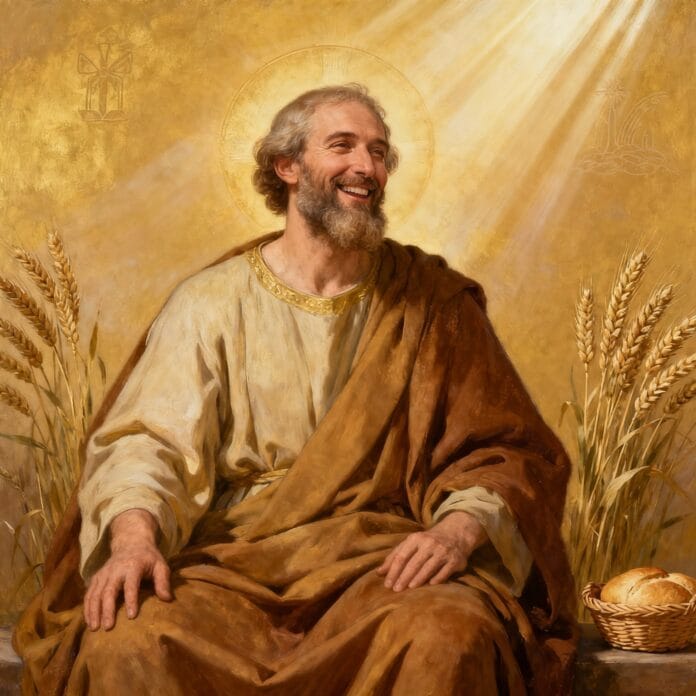
Reading from the letter of Saint Paul the Apostle to the Philippians
Brothers,
I felt great joy in the Lord in seeing your concern for me bloom again: it was alive and well, but you did not have the opportunity to show it.
It is not want that makes me speak this way, for I have learned to be content with what I have. I know how to live in poverty, and I also know how to live in abundance. I have been initiated into everything and for everything: into being satisfied and into knowing hunger, to be in abundance and in destitution.
I can do anything through the one who makes me strong.
However, you did well to share in my difficulties. You Philippians know that in the early days of the gospel, when I left Macedonia, no church shared with me in terms of income and expenses except yours. Even in Thessalonica, you sent me what I needed, and even twice.
It is not the gifts I seek; what I seek is the fruit that will accumulate to your credit. Moreover, I have received everything; I am overflowing; I am amply supplied since Epaphroditus delivered your gift to me: it is like a pleasing aroma, a sacrifice worthy to be accepted and pleasing to God.
And my God will supply all your needs according to his riches in majesty in Christ Jesus.
«"I can do all things through him who gives me strength."»
Inner freedom according to Saint Paul: learning to receive everything and to give everything.
How can Paul, imprisoned, serenely assert that he can do anything? The modern reader, often buffeted by uncertainty and comparison, seeks that peace of mind that liberates from both want and abundance. This passage from the letter to the Philippines Paul offers a clear answer: true strength lies in partnership, not performance. Through gratitude, solidarity, and trust in God, he outlines a simple yet joyful way of living, where dependence becomes freedom. This article explores how his testimony can teach us anew the strength to be fulfilled… even in deprivation.
- Context: a chained but free heart
- Central meaning: strength received, not possessed
- Themes: contentment, gratitude, alliance
- Tradition : joy saints in poverty interior
- Meditation prompts: becoming capable of "everything"«
- Conclusion: Living strong in grace
- Practical advice
In chains, Paul's freedom
Philippi: a Roman city proud of its status as a military colony, populated by former soldiers loyal to Caesar. It was there that Paul founded one of the first Christian communities in Europe, a warm, caring, and faithful Church. Years later, it is from its prison – probably in Ephesus or Rome – that he send them this letter of thanksgiving.
Paul, a prisoner, writes to a free community; yet paradoxically, he is the one who is inwardly freer. His message is imbued with immense joy: not the enthusiasm of a triumph, but the serenity of a man who has placed everything in Christ's hands. In his words, one perceives a balance between detachment and tenderness. He thanks the Philippians for their material support—without flattery or shame—while affirming that his peace does not depend on their gifts.
This passage (Ph 4,(10-19) encapsulates the entire spirit of Paul: a theology of gratitude, rooted in a very concrete experience of poverty and mission. He is neither a proud ascetic nor a resigned beggar; he experiences dependence as a place of communion. He has learned, he says, "to be content with what he has." These words evoke both the school of asceticism and the grace of contentment. He has been "formed"—a term of discipline, almost military—through contrasts: hunger and satiety, abundance and deprivation.
And the summit, a luminous phrase among Paul's letters:
«"I can do all things through him who gives me strength."»
This "all" is not omnipotence, but the fullness of a heart united to God. Paul does not boast; he bears witness. It is not a cry of heroic victory, but a whisper of trust: I can lack nothing as long as Christ remains my source.
In the Greco-Roman world, Stoic virtue advocated self-sufficiency: being master of oneself, independent of circumstances. Paul takes up this vocabulary, but transfigures it. It is no longer self-sufficiency, it is a Christ-sufficiency. Where the wise man says, "I am sufficient unto myself," Paul replies, "Christ is sufficient unto me."«
We have established the setting: joy of Paul, free in chains. Let us now turn to the heart of the text – this mysterious force of which he speaks.
The strength received, not possessed
We must first focus on the key verb: "I can." The Greek word dunamai expresses capacity, real possibility: not an illusion, but an active energy. Paul speaks of a power that does not come from him: en tō endunamounti me Christō — "in Him who strengthens me." In other words, strength is not added to man; it flows through him.
This inner shift is essential: instead of seeking to "be strong," Paul learns to receive strength. This is not Christian stoicism, but a fruitful dependence. Freedom according to the Gospel is not the absence of need, but the awareness of a source that never runs dry.
This vision transforms our relationship to everything we possess. Paul speaks of abundance and deprivation with the same serenity. This is not indifference; it is peace of a stable heart, rooted elsewhere. Christ is his measure. He can lack everything without feeling diminished, because his "everything" no longer depends on the visible.
It is also a learning process. Paul says, «I have learned to be content.» He didn't always know that. Confidence grows through experience, often through failure. This is spiritual realism: faith does not negate hunger not the difficulty, but gives them meaning. Each stage of deprivation becomes a place of revelation: Christ makes himself present in fragility.
This statement does not exclude solidarity; on the contrary. «Yet it was good of you to show solidarity when I was in trouble.» Paul does not despise the help of others; he receives it as a sign of the spiritual bond that unites them. He does not want to be an example of heroic independence, but of fraternal gratitude. The Philippians« offering becomes for him a spiritual sacrifice, »a pleasing aroma.” Their material gesture becomes a liturgy: an act of communion in Christ.
The letter ends with a promise: «My God will supply all your needs according to his riches.» The strength Paul receives, he desires for his brothers. This is the very dynamic of giving: what is received in God is not exhausted, but multiplied through sharing.
The heart of the text becomes clear: Christian strength is not domination, but trusting dependence. We will see how this strength unfolds in three concrete directions: contentment, gratitude, and covenant.
Contentment, a school of inner freedom
The Greek word autarkès, translated as "to be content," was the watchword of the Stoics. Paul borrows it to reveal its ultimate truth: the sufficiency of a heart turned toward God. This contentment is not resignation, but harmony. It expresses a peaceful relationship with life.
In a society governed by lack—lack of image, security, and recognition—this attitude seems out of step with the times. Yet, it responds to a deep thirst for stability. Paul's contentment does not deny desire; it gives it order. He learns to say, "What I have today is enough for me, for God is in it." Each day becomes a habitable space.
On a practical level, this requires an introspective approach: accepting what is, without suspicion or complaint. Paul doesn't minimize his hardships; he integrates them into a learning process. Being trained "for everything and for everything" means learning the resilience of the heart. In adversity, he doesn't tense up; he adapts. His strength lies in not letting lack define his being.
This kind of contentment cannot be improvised. It is cultivated through remembering our gifts, recognizing past experiences, and trusting in God's hand. When Paul says, "I have learned," he shows us a gradual path: that of a conversion of perspective.
Gratitude, the beating heart of faith
After contentment comes gratitude. Paul does not position himself as a passive recipient, but as someone who sees the spiritual meaning of the gestures received. The material gifts of the Philippians become "an offering of pleasing aroma." This sacrificial vocabulary, borrowed from Temple worship, reveals the sacred dimension of each act of brotherhood.
Gratitude liberates us from debt: it transforms giving into communion. Paul does not give thanks to flatter, but to bless. He immediately gives back to God the glory of what he receives. In this, he becomes the symbol of the grateful believer: one who keeps nothing for himself, but gives thanks.
In our lives, this dimension is often experienced discreetly: a thank you, a prayer, a silent offering. Yet, it is there that spiritual strength grows. Gratitude puts an end to comparison and opens us to joy. Saying "thank you" in times of sorrow is already a way of overcoming the fear of lack.
There letter to the Philippines the whole thing is a hymn to joy grateful. Even locked up, Paul sings. His secret: he contemplates loyalty God's presence in human actions. Where others would see dependence, he sees communion.
The alliance, a source of community fertility
Finally, this text speaks of covenant. The Philippians and Paul share the same spirit: material support and spiritual reciprocity. Far from a contract or an obligation, their relationship becomes a covenant in Christ. Practical solidarity becomes a mystical covenant.
Paul insists: «It is not the gift I seek, but the benefit that is added to your account.» His way of speaking suggests a benevolent calculation: the spiritual fruit of the act. In the economy of grace, every gift multiplies the blessing; nothing is lost.
In the Christian community, this logic of covenant is experienced each time one believer supports another, materially or morally. Aid does not create a hierarchy, but a circularity: each person becomes, in turn, the giver and the receiver.
For the Philippians, as for us, this covenant strengthens faith. By supporting Paul, they share in his work; by giving thanks, Paul confirms them in the blessing. The strength of one nourishes the strength of the other: this is how «God will supply all your needs according to his riches in Christ Jesus.»
We have explored the threefold movement of this passage: learning contentment, experiencing gratitude, and building covenant. Let us now enter into the perspective of the spiritual tradition.
Tradition: the joy of the saints in inner poverty
The Church Fathers often commented on this verse. For Saint John Chrysostom, it illustrates the true wealth of the Christian: that of fearing nothing. He writes: «He who is strengthened by Christ becomes superior to events.» Not because he dominates them, but because he welcomes them as divine instruction.
Saint Augustine, For his part, he connects this passage to his personal experience: he often felt powerless in the face of his passions, until he understood that grace does not simply add to human effort; it transforms it. For him, Paul's strength lies in... love of Christ poured into the heart.
Monastic tradition has made this saying a central theme. The desert monks, and later the Benedictines, sought this peaceful contentment that arises from simplicity. "Nothing disturbs you, God alone suffices": this phrase from Teresa of Avila This is an echo of that. Paul is often cited as a model of inner freedom: detachment not from the world, but from the illusions of control.
In the liturgy, this passage is often read at the Mass of the Missionary Saints. It illuminates their dynamism: serving without fear of lack, loving without expecting anything in return. In contemporary spirituality, from Charles de Foucauld to Mother Teresa, it remains a source of radical simplicity: doing everything "in Him who gives strength.".
The voice of the saints resonates with that of Paul: to be strong is to consent to one's poverty. Let us now see how this message can be translated into prayer and daily life.
Walking in the strength of Christ
- Recognizing one's addiction: every morning, say: "Lord, I can do nothing without you." This is not weakness, but lucidity.
- Reviewing one's shortcomings: what I believe to be a loss can become a meeting place if I invite God there.
- Practicing daily gratitude: three thank yous a day, unconditionally.
- Living joyfully sober: rejecting the superfluous not out of contempt, but to taste freedom.
- Share what you receive: to transform all grace into service.
- Praying for others in their need: the strength received is multiplied through intercession.
- Recite the verse from Paul during the trialNot as a magic formula, but as an act of faith: "I can do all things through Him who gives me strength."«
The strength of a free heart
Paul's strength is neither stoic nor triumphant; it is trusting. It does not seek to control everything, but to receive everything. The Christian is not called to succeed, but to consent: to consent to grace, to God's slowness, to God's surprise. Those who experience this become unshakeable, not because they control the world, but because they abide in Christ.
«"I can do anything" therefore does not mean: I succeed at everything, but: nothing can prevent me from loving and hoping. This statement invites each of us to an inner revolution: to move from the pride of achievement to joy of giving. Therein begins true freedom, where dependence becomes fruitfulness, and where weakness becomes a passage to the power of God.
Practical application
- Reread Philippians 4 each week as a morning prayer.
- Keep a gratitude journal: write down every sign of providence.
- To make a tangible offering to someone in need.
- Simplify an area of life (consumption, schedule) to cultivate contentment.
- Saying "thank you" to a loved one on whom one depends.
- To entrust to God a fear of lacking.
- Recite the key verse in moments of discouragement.
References
- Saint Paul, Letter to the Philippians, ch. 4.
- Saint John Chrysostom, Homilies on the Epistles of Paul.
- Saint Augustine, Confessions.
- Rule of Saint Benedict, ch. 7.
- Teresa of Avila, Prayer of the nada te turbe.
- Charles de Foucauld, Spiritual writings.
- Mother Teresa, A Simple Path.
- Jean Vanier, The community, a place of forgiveness and celebration.