












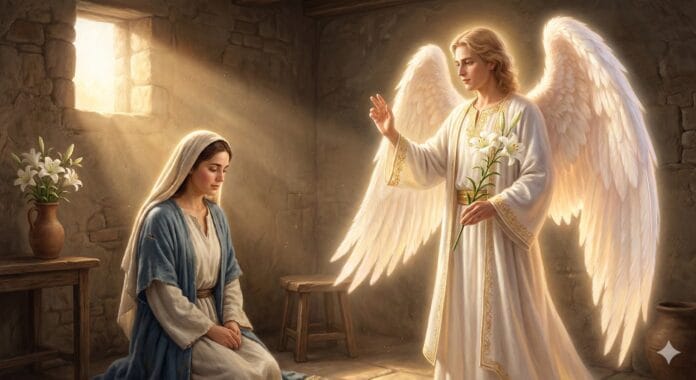
Gospel of Jesus Christ according to Saint Luke
At that time, the angel Gabriel was sent by God to a town in Galilee called Nazareth, to a virgin betrothed to a man named Joseph, a descendant of David; and the virgin’s name was Married. The angel came to her and said, «Greetings, you who are highly favored! The Lord is with you.» She was greatly troubled at his words and wondered what this greeting might mean. Then the angel said to her, «Do not be afraid, Married, »For you have found favor with God. Behold, you will conceive and bear a son, and you shall name him Jesus. He will be great and will be called the Son of the Most High. The Lord God will give him the throne of his father David, and he will reign over the house of Jacob forever; his kingdom will have no end.” Married She said to the angel, «How can this be, since I am a virgin?» The angel answered, «The Holy Spirit will come upon you, and the power of the Most High will overshadow you. So the child to be born will be holy; he will be called Son of God. And behold, your relative Elizabeth, though advanced in years, has also conceived a son, and this is the sixth month with her who was said to be barren. For nothing is impossible with God.» Married Then she said, «Here am I, the servant of the Lord; let it be done to me according to your word.»
Then the angel left her.
Welcoming the transformative grace: Mary, a model of saying yes to God
How the angel's greeting in Nazareth teaches us to recognize, welcome, and respond to God's calls in our daily lives.
The Annunciation is not just a distant event reserved for church stained-glass windows. It is the moment when God knocks on the door of an ordinary young woman and everything changes. In this dialogue between Gabriel and Married, We discover how God acts: he greets, reassures, offers, waits. And we learn how to respond: to welcome the upheaval, to ask questions, and then to say yes. This encounter in Nazareth reveals the face of a living, embodied faith that transforms our lives.
We will begin by exploring the context of this foundational scene and its place in Scripture, then we will analyze the structure of the dialogue and its theological dynamics. Next, we will develop three main themes: the grace that precedes, the freedom that responds, and the Spirit that fulfills. Finally, we will examine the concrete implications for our spiritual lives, the echoes within the Christian tradition, and the contemporary challenges posed by this ancient text.
The setting for the impossible: Nazareth, a young girl, and a heavenly message
The evangelist Luke situates the Annunciation with remarkable geographical and social precision. Nazareth is not Jerusalem. It is an unremarkable village, a small town in Galilee that the ancient Scriptures had never mentioned. The prophet Nathanael would later sum up the prevailing contempt: "Can anything good come out of Nazareth?"John 1, 46). Yet, it is there that God chooses to enter into human history, into the ordinariness of village life, far from the spotlights of the Temple and the palaces.
Married is a "virgin girl, betrothed" to Joseph. In first-century Judaism, betrothal already created a strong legal bond, even if the spouses did not yet live together. Married She lives, therefore, in this in-between state: betrothed but not yet a wife, committed but waiting. It is during this period of transition that the angel Gabriel appears. The divine choice does not fall upon a queen, a renowned prophetess, or a mature woman, but upon an anonymous teenage girl from a forgotten village.
The name "Gabriel" means "strength of God" or "God is my strength." In the Old Testament, Gabriel appears to the prophet Daniel to reveal to him the mysteries of the times to come (Daniel 8-9). Here, he becomes the messenger of the ultimate fulfillment: God will be born of a woman. The angel does not present himself as an ordinary visitor. He enters "her home," her intimate space, and pronounces an extraordinary greeting: "Hail, full of grace, the Lord is with you."«
This text occupies a central place in the Gospel of Luke. The author carefully constructs a parallel between the announcement to Zechariah (Luke 1, 5-25) and that at Married. In both cases, an angel announces a miraculous birth. But while Zechariah doubts and is forced to remain silent, Married She questions and receives an answer that leads her to consent. Luke thus outlines two attitudes towards God's impossibility: the skepticism of the elderly priest and the trusting faith of the young virgin.
The Annunciation also inaugurates the infancy narrative in the Gospel of Luke (chapters 1-2), which includes the Visitation, the birth of John the Baptist, the Nativity, the Presentation in the Temple, and the Finding of Jesus at age twelve. These accounts weave together prophecy and fulfillment, Old and New Testaments, promise and realization. Married is the guiding thread: she who carries, who gives birth, who keeps and meditates on all these things in her heart (Lk 2, 19.51).
Christian liturgy has made this passage a pivotal moment of the year. The Annunciation is celebrated on March 25, exactly nine months before Christmas, highlighting the incarnate reality of the pregnancy of Married. This date often falls during Lent, creating a fruitful tension: as we meditate on the Passion of Christ, we also celebrate the beginning of his human life. The Hail Mary, the Marian prayer par excellence, repeats word for word the greeting of Gabriel and Elizabeth. Thus, every day, millions of believers remember this moment when the Word became flesh.
The grammar of divine dialogue: structure and dynamics of the encounter
The Annunciation narrative follows a dramatic structure in five movements that reveals divine pedagogy. Understanding this structure allows us to grasp how God presents himself to us and how we can respond.
First move: the greeting that destabilizes. Gabriel did not say "Hello" Married »"Hail, full of grace, the Lord is with you." In Greek, "full of grace" is said kecharitomene, a perfect passive participle meaning "she who has been and remains filled with grace." It is not a one-time compliment, but the affirmation of a permanent state. Married She is not called by her given name, but by what she has become in God's eyes: a vessel of divine favor. This new designation precedes any explanation. God begins by declaring what he sees in us before telling us what he expects of us.
Second movement: turmoil and inner questioning. Married is "completely distraught" (dietarachthéThe Greek verb expresses a deep agitation, a disturbance that shakes from within. Luke specifies that she "wondered what this greeting could mean.". Married She doesn't panic; she's thinking. Her unease isn't fear, but questioning astonishment. She's trying to understand. This reaction contrasts with that of Zacharie who, faced with a similar announcement, asks for a sign out of disbelief. Married, She, however, is searching for meaning. Authentic spiritual upheaval does not paralyze the intellect; it stimulates it.
Third movement: the announcement that reassures and reveals. Gabriel senses the disturbance of Married and begins with "Do not be afraid." This phrase runs throughout the Bible, from Abraham's call to the resurrection of Christ. God does not want to terrify, he wants to liberate. The angel then explains: «You have found favor with God.» Grace is not earned, it is found like a treasure. Then comes the actual announcement: conception, birth, naming («you shall name him Jesus»), messianic identity («Son of the Most High,» «throne of David»), eternal reign. In a few sentences, Gabriel summarizes all the hope of Israel and all the Christian theology of the Incarnation.
Fourth movement: the practical question. Married She doesn't say, "I don't believe you," but rather, "How can this be, since I am a virgin?" Her question focuses on the "how," not the "if." She already accepts the possibility; she seeks to understand the modality. The angel responds by invoking the Holy Spirit and the "power of the Most High" who will overshadow her. This image recalls the cloud that covered the Tent of Meeting in the desert (Exodus 40:34-35) and the glory of God that filled the Temple (1 Kings 8:10-11). Married It becomes the new Temple, the place of the divine presence. Gabriel adds the sign of Elizabeth's pregnancy and concludes with the universal formula: "Nothing is impossible with God."«
Fifth movement: the fiat, the creative yes. «"Here I am, the servant of the Lord; let it be done to me according to your word."» Married She does not negotiate, does not ask for delays, does not set conditions. Her consent is total, immediate, and unconditional. She defines herself as a "servant" (pain), a term that can also be translated as "slave," indicating total belonging. She moves from "I" to "me": it is no longer she who acts, but the Word that will act within her. This fiat married (It's fair to say) freedom and surrender, decision and receptivity. Married says yes to what she doesn't fully understand, relying on loyalty of God.
This structure is not anecdotal. It outlines the pattern of everything Christian vocation God calls us by naming our deepest identity; we are shaken, he reassures and reveals, we question the concrete, we receive a light and a sign, and then we say yes. The Annunciation is thus the prototype of the response of faith.
The grace that precedes: receiving before giving
The first major theological theme of the Annunciation is that of prevenient grace. Married She did nothing to deserve this visit. She didn't fast for forty days, nor climb mountains, nor perform miracles. The angel arrives, that's all. And he begins by stating that Married is already "filled with grace." Grace precedes. It is first. It precedes all human initiative.
This priority of grace runs throughout biblical theology. «You did not choose me, but I chose you,» Jesus will say to his disciples (Jn 15:16). Saint Paul will repeat it forcefully: «For it is by grace you have been saved, through faith—and this is not from yourselves, it is the gift of God» (Episode 2, 8). Grace is always a free gift, not a wage. It falls like rain on the just and the unjust, like morning dew on grass that did not ask for it.
In the case of Married, This grace is manifested concretely by the preservation of the original sin, what Catholic theology calls the’Immaculate Conception. If Married If she is "full of grace" from the moment of the angelic greeting, it is because she already was before. God prepared her to be the mother of his Son. He could not sanctify her. Married After the Incarnation, the Temple had to be pure before receiving the divine presence. This preparation in no way diminishes the merit of Married, On the contrary: it shows that God respects our freedom so much that he takes the time to prepare us, to till the soil of our hearts, to shape us so that our yes is truly free and fruitful.
For us, this truth is liberating. We don't have to earn God's love. He is already there. We don't have to make ourselves worthy of his visit. He comes to us just as we are. Our spiritual efforts—prayer, fasting, charity—are not ways to force God's hand, but ways to prepare ourselves to recognize the grace that already awaits us. As Married, We are called not to produce grace, but to receive it. And this reception is not passive: it requires vigilance, openness, and availability.
The image of the "servant" used by Married This sheds light on this dynamic. The servant doesn't decide the schedule, but she is present, attentive, ready to respond when called. She doesn't sleep during the day, she doesn't leave without warning. Similarly, the spiritual life consists of cultivating this presence to oneself and to God, this inner listening that allows one to recognize his voice when he speaks. Married She had that openness. When the angel entered, she was there, in her intimate space, her heart open.
Grace, ultimately, is not a thing, but a relationship. To be "filled with grace" is to be in a living relationship with God. It is to live in his gaze, in his favor, in his friendship. Gabriel does not say, "God has given you many graces," but "The Lord is with you." Grace is presence. To seek grace is to seek God himself. To respond to grace is to welcome God into one's life. Married, By saying yes to the angel, he is not saying yes to a project, but yes to a person: the Son of the Most High who comes to dwell in his flesh.
In practical terms, this means that our spiritual life must be based on receptivity, not performance. We are invited to begin each day by recognizing that God has already visited us, that he has gone before us, that he is waiting for us. Before "doing," we must "receive." Before speaking to God, we must listen to him. Before seeking his will, we must acknowledge his presence. Married teaches us this primary attitude: wonder at the grace that has already touched us.
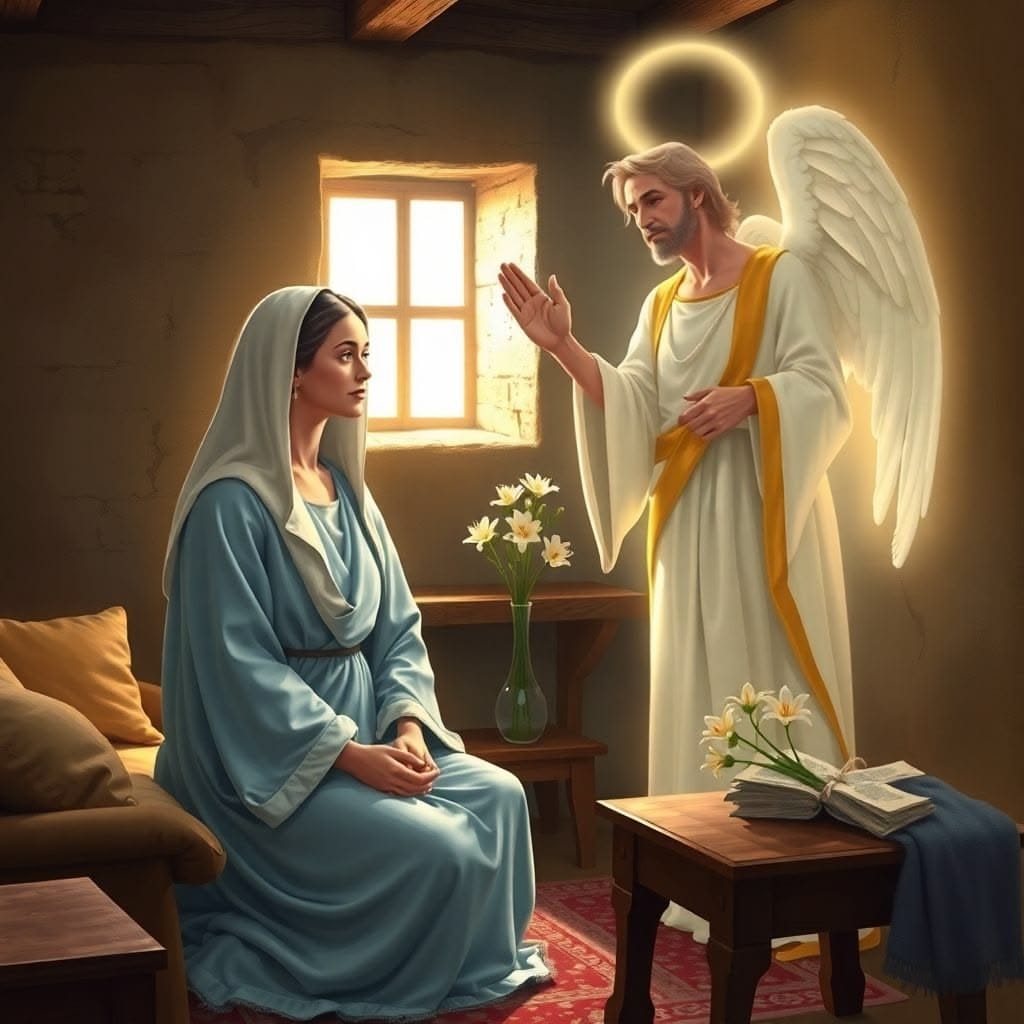
The freedom that responds: consenting without fully understanding
The second theological axis is that of human freedom in the face of grace. God never forces. He proposes, announces, invites. Then he waits. The angel does not tell Married "You will conceive, whether you want to or not." He said, "You will conceive," then he fell silent. And Married, After asking his question, he freely replies: "Let it be done to me according to your word."«
This freedom is crucial for understanding the Incarnation. The Word could not become incarnate against the will of Married. God needed this young girl's "yes" to enter history. Saint Bernard of Clairvaux, in a famous sermon, imagines the entire universe holding its breath awaiting the answer of Married "Answer quickly, O Virgin! Pronounce, O Our Lady, the word that the earth, hells and heavens await!" All creation depends on this consent.
But this "yes" is given in semi-darkness. Married She doesn't understand everything. She doesn't know her son will be crucified. She doesn't grasp the pain that awaits him. She doesn't see what comes next. Yet, she says yes. Her faith isn't an "obvious" faith, it's a "trusting" faith. It doesn't rest on irrefutable proofs, but on the word of God: "Nothing is impossible with God."« Married She believes that God can do what he says, even if she doesn't see how.
This freedom in faith is the model for every Christian decision. When God calls us to something—a commitment, a change, forgiveness, service—we never have the whole picture. We don't see all the consequences. We don't control every factor. But if we have recognized his voice, if we have perceived his presence, if we have received a sign of his will, then we can say yes without understanding everything. Total control is an illusion; trust is grace.
Married Nevertheless, she asks a question: "How will this happen?" She doesn't accept it blindly, like a robot. She uses her intelligence. She wants to understand. And God respects this need. The angel answers. He provides details, images, a sign (Elizabeth's pregnancy). Faith doesn't abolish intelligence; it transcends it without negating it. Married It questions, then it consents. This sequence is healthy. A faith that never questions is a fragile faith, often childish or ideological. A mature faith integrates doubt, questions it, works through it, and arrives at a stronger consent because it is more conscious.
There is also in the Fiat Married A dimension of active surrender. She doesn't say, "I'll try" or "I'll see," but "Let everything happen to me." She lets go. She relinquishes control. She accepts her age (in the sense that she becomes the object of divine action) while remaining active (she cooperates, she welcomes, she supports). This active passivity is at the heart of the mystical life. God acts within us, but he does not negate us. He makes us participants in his work. Married She carries Christ, but it is the Spirit who forms him within her.
For us today, this responsible freedom means that God will never do violence to our will. Even in moments when we feel an inner pressure to change, to forgive, to commit, this pressure is always an invitation, never a constraint. We can say no. Like the rich young man who sadly walked away from Jesus (Mc 10, (verses 17-22), we can refuse the call. God doesn't chase after us begging. He respects our choice. But he hopes for our yes. And when we say it, even trembling, even uncertain, he works wonders.
Saying yes to God also means accepting that we cannot control everything. It means recognizing that we are not the sole authors of our lives, but co-authors. The script is not entirely written by us. There is an element of surprise, of the unexpected, of mystery. Married She welcomes this unexpected event. She accepts the unknown. She trusts not her own abilities, but in loyalty from the One who calls. And it is this trust that makes her free: free from fear, free from the need for control, free from the exhausting quest for total security.
The Spirit that accomplishes: from Word to flesh
The third axis is that of the Holy Spirit, the hidden but essential agent of the Incarnation. Gabriel announces: «The Holy Spirit will come upon you, and the power of the Most High will overshadow you.» Without the Spirit, there is no Incarnation. Without the shadow of divine power, there is no virginal conception. The Spirit is the one who accomplishes what the Word proclaims.
In the Bible, the Spirit (ruah in Hebrew, pneuma (in Greek) is first and foremost breath, wind, air in motion. It is the breath of God. From Genesis, «a breath of God hovered over the surface of the waters» (Gn 1, 2). The Spirit is present at creation; it is the Spirit who gives life. At Sinai, it is again the Spirit who descends in fire and cloud to seal the Covenant. In the prophets, the Spirit is promised for the Messianic age: «I will pour out my Spirit on all people» (Joel 3:1). The Annunciation marks the fulfillment of this promise: the Spirit descends not on a people, but on a person., Married, to create within her the awaited Messiah.
The image of "shadow" is rich. In the desert, the cloud shaded the Hebrews and protected them from the scorching sun. Shadow is also a hidden presence, discreet but real. The Spirit does not dazzle. Married, He doesn't terrify her; he envelops her. He protects her. He creates within her an intimate space where the Word can take flesh. This discretion of the Spirit is worth pondering: God does not invade; he dwells. He does not impose himself; he offers himself. He does not break down doors; he enters when they are opened.
The link between Word and Spirit is fundamental. The Word (the Logos) is what God says; the Spirit is the one who brings that Word to fruition. Jesus will later say, «The words I have spoken to you—they are full of the Spirit and life» (John 6:63). The Word without the Spirit remains a dead letter. The Spirit without the Word becomes a vague emotion, a will-o'-the-wisp. But when the Word meets the Spirit in an open heart, what happened in Married : the Incarnation, the new life, the creation.
For us, this means that read the Bible Simply hearing teachings is not enough. The Spirit must open our understanding of the Scriptures. Jesus did this with the disciples on the road to Emmaus (Lk 24:45). The Spirit does this with us when we pray before reading, when we ask, «Lord, what do you want to tell me today?» Likewise, our good resolutions, our spiritual projects, our commitments will remain fragile as long as we do not entrust them to the Spirit. It is he who gives us strength, perseverance, and creativity.
The Spirit, in the Annunciation, is also the one who sanctifies. «He who is to be born will be holy; he will be called Son of God.» holiness is not primarily moral (not sinning), it is ontological (belonging to God). Christ is holy because he comes from the Spirit. We are called saints (1 Peter 2:9) because the Spirit has dwelt in us since baptism. holiness It is therefore not an achievement, it is an identity to be recognized and lived. Married The first is declared holy before acting in a holy way, because the Spirit has filled her with grace.
Finally, the Spirit is the agent of transformation. He transforms the bread and wine into the Body and Blood of Christ at each Eucharist. He transforms water into a sign of rebirth at baptism. He transforms hardened hearts into hearts of flesh. And he transformed the womb of Married in the tabernacle of the living God. The Spirit is the one who makes new from old, who draws life from death, who makes barrenness fruitful. Every time we say yes to God as Married, The Spirit begins to work within us. He starts to create, to shape, to give birth to Christ within us. And our life becomes, on our own scale, an "annunciation": a place where God draws near, where the Word takes on flesh, where Heaven touches earth.
Living the Annunciation in everyday life: four areas of application
The Annunciation is not a story fixed in the past. It is an ever-present event. Every time God calls us, every time we respond, the Annunciation is repeated. Let's look at how this mystery can transform four areas of our lives.
In the life of prayer. To pray is first and foremost to make oneself available, as Married in his house in Nazareth. Create a space of inner silence where God can "enter our home." Too often, we fill our prayer with words, requests, and plans. We speak without listening. The Annunciation invites us to reverse this logic: listen first, speak later. Begin by being silent, open your heart, to wait for God's visit. He may speak through a biblical passage, an event, an encounter, an intuition. Let us allow ourselves to be moved, as Married, without fleeing from the turmoil. And let us respond with our daily fiat: "Lord, may your will be done in me today."«
In family and friendly relationships. Married She said yes without consulting Joseph. She risked being misunderstood. And indeed, Joseph considered divorcing her (Mt 1:19). Following God's will can temporarily isolate us from those around us. Our loved ones will not always understand our spiritual choices. But just as Joseph also eventually received a revelation, our loved ones can in turn be touched by grace. The Annunciation also teaches us to respect the freedom of others: God did not force Married, We must not force those we love. Proclaiming the Good News means offering, bearing witness, living, and then letting the Spirit work. Do not manipulate, do not make them feel guilty, do not impose.
In career choices and vocations. «"How will this be done?" The question of Married It's very concrete. We too, when faced with a call from God—a career change, volunteer work, a life choice—must ask practical questions. This isn't a lack of faith, it's prudence. God gave us intelligence to use. But after questioning, after seeking advice, praying, and discerning, we must say yes without understanding everything. Many vocations fail because people wait to have all the answers. Married She didn't have all the answers, but she had the word of an angel and inner conviction. Sometimes, you have to move forward in the fog, trusting in what you see.
In times of hardship and suffering. The Annunciation is joyful, but it contains the seeds of the entire Passion. By saying yes to the motherhood of the Messiah, Married said yes to the sword that will pierce his own heart (Lk 2:35). When trials come—illness, bereavement, betrayal, failure—we can remember the fiat of Married. Saying yes to what happens to us does not mean approving of evil, but accepting that God can bring good even from the worst. It means rejecting bitterness and sterile rebellion, and choosing to remain open to God's action even in the darkest night. Married, Standing at the foot of the Cross, she says yes again. She consents to what she doesn't understand. And it is this yes in pain that allows the Resurrection.
Echoes in tradition: from the early Church to the present day
The Annunciation has nourished theological reflection and Christian piety since its origins. The Church Fathers saw in it the recapitulation of salvation history and the reversal of Eve's fall. Saint Irenaeus of Lyons, in the 2nd century, developed the parallel: "What the virgin Eve had bound up through her unbelief, the Virgin Married untied it by her faith.» Eve believed the serpent and disobeyed; ; Married She believed the angel and obeyed. Through a woman came death, through a woman comes life. This "Eve-Mary" pattern runs throughout patristic literature and structures Western Mariology.
Saint Augustine d'Hippone insists on the role of faith in Married :« Married conceived Christ first in her heart through faith, before conceiving him in her womb.» This is not merely a biological event; it is a spiritual act. The true motherhood of Married is to have believed. And Jesus will confirm this primacy of faith when he says: «Blessed are those who hear the word of God and keep it» (Luke 11, 28). Married She is the first disciple because she is the first believer.
In the Middle Ages, the Annunciation became a major theme in art and liturgy. Painters produced numerous scenes of the Annunciation: Fra Angelico, Simone Martini, Leonardo da Vinci, all of whom depicted it. Married reading (often the prophet Isaiah), then surprised by the angel. The open book symbolizes the Word about to be incarnate. The white lily, purity. The dove, the Holy Spirit. Every detail is laden with theology. In the mysteries of Rosary, The Annunciation is the first joyful mystery, the one that opens the entire cycle. To meditate on the Annunciation is to learn from Married to learn to welcome God.
The Protestant Reformation placed less emphasis on Married, but did not ignore the Annunciation. Luther wrote beautiful commentaries on the Magnificat, the hymn of Married after the Visitation, which extends the Annunciation. It emphasizes gratuitous grace, faith alone, the’humility of Married. Calvin sees in Married a model of submission to the Word of God, while rejecting devotions he considers excessive. Today, ecumenical dialogue finds common ground in the contemplation of the Annunciation: all Christians can agree that Married She is the first believer and the model of saying yes to God.
In the 20th century, the Second Vatican Council (1962-1965) replace Married in the mystery of Christ and the Church. Married She is not separate, she is at the heart. She is a "figure of the Church," meaning that what happens in her foreshadows what must happen in us: welcoming Christ, bearing him, giving him to the world. The Annunciation is therefore not only the story of Married, This is our story. Each of us is called to become "mother of Christ" by allowing him to be born and grow within us through faith and love.
Contemporary theologians such as Hans Urs von Balthasar and Joseph Ratzinger (Benedict XVIThey have contemplated the Annunciation in terms of receptivity and consent. Modernity values action, control, and autonomy. The Annunciation reminds us of the primacy of reception, welcoming, and availability. Married, By saying yes, she does not lose her freedom; she fulfills it. True freedom is not absolute independence, but the capacity to give oneself freely. And this self-giving to God is the path to human fulfillment.
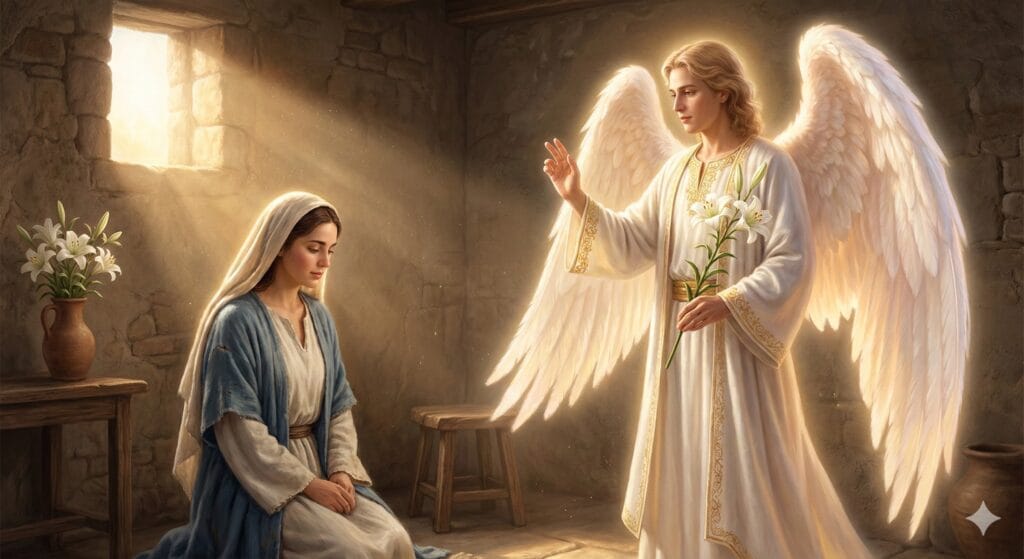
Entering into the mystery: a practical meditation approach
Here is a five-step meditation path to internalize the Annunciation and allow this mystery to transform our perspective and our heart.
Step 1: Place yourself in the presence. Find a quiet place. Sit comfortably. Take three deep breaths. Imagine yourself in the house of Married In Nazareth: humble, silent, bathed in light. You are Married, Or you are beside her. Let the silence envelop you. Say inwardly: "Here I am, Lord."«
Step 2: Accept the greeting. Listen to the angel say to you, «Hail, full of grace, the Lord is with you.» Let these words resonate within you. How do you feel hearing them? Overwhelmed, surprised, incredulous? Welcome this turmoil without running from it. Repeat several times, «The Lord is with me.» Believe it. Feel it.
Step 3: Ask your question. As Married, Ask God your question. What seems impossible in your life right now? What announcement from God seems unattainable? Simply ask: "How will this happen?" Don't look for the answer right away. Stay with the question.
Step 4: Receive the response. Open the Gospel (Luke 1, (pp. 26-38) and slowly read the angel's response. Pause at "Nothing is impossible with God." Let this statement sink in. What impossibilities in your life can God transform? Trust Him.
Step 5: Say your fiat. Say aloud or silently: «Here I am, I am the servant of the Lord. May it be done to me according to your word.» Don’t rush. Repeat it until it truly feels right. Then entrust to God a specific situation where you need to let go and trust him. Finish with a slow and mindful Lord’s Prayer.
This meditation can be practiced daily, even briefly, or deepened during a retreat. The essential thing is to internalize the movement of the Annunciation: listening, confusion, questioning, light, consent.
The Annunciation in the face of our world
The Annunciation raises questions that resonate strongly today. How do we talk about virginity in a hypersexualized society? How do we believe in miracles in a scientific world? How do we value receptivity in a culture of action? Let's address these tensions head-on.
The challenge of virginity. The virgin birth offends modern reason. Some liberal theologians see it as a symbol, not a historical fact. Yet, the Gospels of Matthew and Luke clearly affirm it. The Christian faith has always professed that Jesus was born of the Virgin. Married through the action of the Holy Spirit. This affirmation is not peripheral, it is central: it means that God can intervene in history, that the supernatural exists, that nature is not closed in on itself. To believe in the virginal conception is to believe that God is free, that he can create something new, that he is not a prisoner of the laws he has established. However, this faith cannot be proven scientifically. It relies on testimony: that of Married, From Joseph, the evangelists, the Church. We choose to believe or not to believe. But this faith is not absurd; it is reasonable if we admit that God exists and that he can act.
The challenge of feminism. Some feminists criticize the Marian model: a passive, submissive woman who accepts everything without question. This interpretation is superficial. Married She is not passive; she is active in her consent. She chooses freely. Moreover, she is not subject to a man, but to God. Her servitude is a form of freedom. Finally, by becoming the mother of God, Married receives the highest imaginable dignity. She becomes "Theotokos," Mother of God, a title affirmed at the Council of Ephesus (431). No man has borne God in his flesh. No man has nourished God with his milk. The motherhood of Married It is not alienation, it is elevation. It rehabilitates motherhood and femininity in their spiritual depth. Today, rediscovering Married, It's about valuing qualities that are often undervalued: gentleness, the reception, patience, Discretion. These are not weaknesses, they are strengths.
The challenge of individualism. Our era exalts autonomy: "I am master of my life." The fiat of Married It goes against the grain: «I am not the mistress of my life, but a servant of the Lord.» This language is shocking. Yet, it is liberating. Absolute autonomy is an illusion. We all depend on something or someone: our environment, our upbringing, our desires, our fears. Recognizing our dependence on God is choosing the best kind of dependence, the one that sets us free. God is not a tyrant, he is a Father. Placing ourselves in his hands is not abdicating, it is freeing ourselves from all other tyrannies: public opinion, money, power, the fear of death. Married, By becoming a servant of God, she becomes queen. The Christian paradox lies here: to serve God is to reign.
The challenge of doubt. Many of our contemporaries doubt. They would like to believe, but cannot. The Annunciation speaks to them: Married She herself doubted and questioned. Doubt is not the enemy of faith; it is often its prelude. God does not ask for absolute certainty, but for sufficient trust to say yes. And this yes can be fragile, trembling. The essential thing is to pronounce it. Then, God takes it upon himself to strengthen us. Like Peter walking on the water: he doubts, he sinks, but Jesus catches him (Mt 14:22-33). Honest doubt, accompanied by prayer and inquiry, often leads to a deeper faith. Married She didn't understand everything, but she trusted him. And that's enough.
Prayer inspired by the Annunciation
Lord, God of the impossible and of silence, you who have visited Married in the ordinariness of his home, come visit us in the ordinariness of our lives.
Teach us to create within ourselves this space of availability where your Word can enter without forcing doors, where your Spirit can descend without violence, where your love can germinate in the soil of our humanity.
As Married, We are often overwhelmed by your calls, your invitations, your plans. Our securities waver, our plans crumble, our certainties crack. Help us not to flee from this upheaval, but to navigate it by questioning, searching, and praying.
Grant us to hear, amidst the noise of our lives, your voice that names us by what we truly are, not by our failures or our masks, but by our deepest identity: filled with grace, loved from the beginning, called to bring your Son to the world.
Lord Jesus, Word made flesh in the womb of Married, Come also to take flesh within us. Not through physical conception, but through the faith that welcomes, the love that sustains, and the witness that brings your presence into the world.
Holy Spirit, shadow of the Most High, cover our poverty, our barrenness, our impossibilities. What we cannot do, you can do. What we dare not do, you dare. What we do not see, you bring about. Come and accomplish in us what the Word proclaims.
Married, Our sister and our mother, you who said yes in the darkness of faith, intercede for us who hesitate so much. Teach us your fiat, that simple and total yes that changes the course of world history and transforms our lives into places of the Incarnation.
That we consent each day to what happens to us, not through resignation, but through trust, not through passivity, but through active surrender, not through fear, but through love.
And when the hour of trial comes, of Calvary, of the night, may we remain standing, like you, Married of the Annunciation and Good Friday, saying yes even when all seems lost, believing that nothing is impossible for God, even the resurrection death, even the transformation of our lives, even the salvation of the world.
Through Jesus Christ, our Lord, who lives and reigns with you, Father, in the unity of the Holy Spirit, for ever and ever.
Amen.
The Annunciation, an event that remains relevant today
The Annunciation does not belong to the past. It is the foundational event that is repeated each time a heart opens to God. Every morning is a possible annunciation. Every prayer is a house of Nazareth into which the angel can enter. Every life choice is a fiat in the making. We are all called to become« Married »", that is to say, bearers of Christ, places where God takes on flesh.
The goal is not to outwardly reproduce the life of Married — we are not virgins, we do not live in Nazareth, we do not physically give birth to the Messiah. The challenge is to inwardly reproduce his attitude: listening, welcoming unease, asking a question, giving trust, and saying yes. These five movements are the heart of all spiritual life. They trace the path of holiness.
We live in a noisy world, saturated with information, obsessed with performance and control. The Annunciation reminds us that there is another path: that of inhabited silence, of fruitful receptivity, of liberating trust. God does not ask us to succeed, but to consent. He does not ask us to understand everything, but to trust him. He does not ask us to be strong, but to be available. He takes care of the rest.
Married She precedes us on this path. She shows us that it is possible to say yes to God, even when it is overwhelming, even when it is incomprehensible, even when it is painful. Her yes changed the world. Ours can change it too, in our own way. Every time we choose love over fear, forgiveness Rather than resentment, service rather than selfishness, we say yes to God. And the Annunciation continues.
Let us begin today. Let us create this inner space of silence and openness. Let us listen to the voice of God in his Word, in events, in people. Let us welcome the upheaval it may bring. Let us ask our questions without fear. Let us receive the light he gives us. And let us say our fiat, however fragile, however trembling: «Here I am, Lord. Thy will be done.» And the impossible will become possible. And Christ will be born within us. And our life will become an proclamation.
Practices for experiencing the Annunciation
- Meditate every day Luke 1, 26-38 by identifying yourself to Married and by listening to what God is telling you personally.
- Recite the Angelus (a Greetings Marriedmorning, noon and night to remember the Incarnation.
- Create a space of daily silence ten minutes where you make yourself available to the voice of God.
- Ask yourself this question every week What is God calling me to, and what is preventing me from saying yes?
- Practice trusting surrender in a concrete situation by repeating, "Let it be done to me according to your word."«
- Share your current Fiat with a loved one, what you are consenting to in your life right now.
- Visit a Marian shrine or contemplate an icon of the Annunciation to nourish your visual and embodied prayer.
References
- Gospel according to Saint Luke, chapter 1, verses 26-38 (source text)
- Saint Irenaeus of Lyon, Against heresies, III, 22, 4 (parallel Eve-Mary)
- Saint Augustine, Sermons, 215, 4 (faith of Married who conceives Christ)
- Second Vatican Council, Lumen Gentium, chapter VIII (Married in the mystery of Christ and the Church)
- Catechism of the Catholic Church, no. 484-507 (Immaculate Conception and Annunciation)
- Hans Urs von Balthasar, Married for today (Reflections on Marian receptivity)
- Joseph Ratzinger (Benedict XVI), The daughter of Zion (meditations on Married and the Church)
- Louis-Marie Grignion de Montfort, Treatise on True Devotion to the Blessed Virgin (Marian spirituality)