












A reading from the book of the prophet Ezekiel
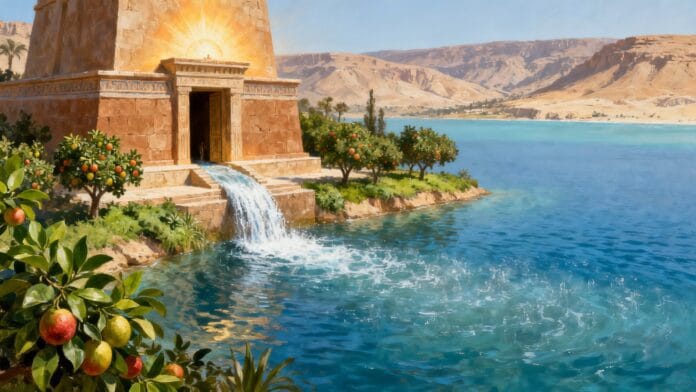
In those days, during a vision received from the Lord, the man brought me back to the entrance of the House, and behold, water was gushing out from under the threshold of the House, flowing eastward, for the front of the House faced east. The water was flowing from under the right side of the House, south of the altar.
The man led me out through the north gate and around the outside to the gate facing east, and there again the water was flowing out on the right side.
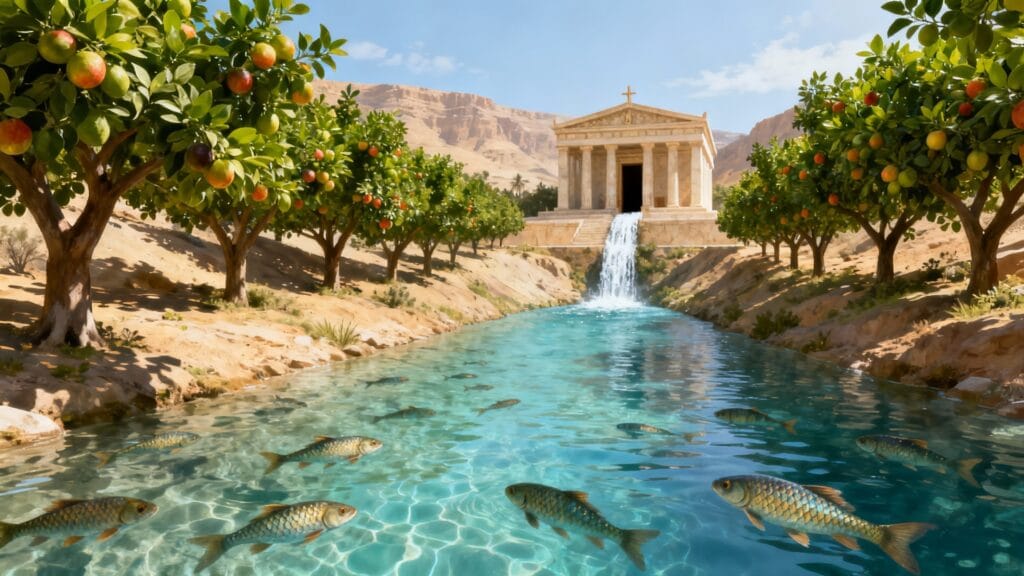
He said to me, «This water flows toward the eastern region, down into the Jordan Valley, and empties into the Dead Sea, purifying its waters. Wherever the stream flows, all living things will live and multiply. Fish will be plentiful, for this water purifies everything it reaches, and life will spring up wherever the stream flows.”.
Along the banks of the stream, on both sides, all kinds of fruit trees will grow; their leaves will not wither, and their fruit will never fail. Every month they will bear new fruit, for the water flows from the sanctuary. The fruit will serve as food, and the leaves as medicine.»
Springing forth from living water: the promise of life springing forth from the Temple of Ezekiel
A live reading from Ezekiel 47 to experience the grace that transforms life and purifies the world.
The prophet Ezekiel invites us to contemplate a striking vision: «I saw the water flowing from the Temple, and all whom the water touched were saved.» This fascinating text is not merely an ancient symbol; it speaks to every reader seeking inner healing and vibrant hope. This article is for those who seek to understand the life-giving power of the biblical message in their spiritual lives, exploring the context, meaning, and practical applications of this inspired word.
This reading begins by outlining the context of Ezekiel's text and its liturgical function. It then offers a central analysis of the paradox of the springing, purifying water. Next, it explores three key themes: the symbolism of living water, the effect of universal purification, and the ethical call to become bearers of this life. The text will be placed in dialogue with Christian tradition before offering concrete avenues for meditation and transformation.
Context
In the book of EzekielThe prophet of the Babylonian exile (circa 6th century BCE), in chapter 47, describes a heavenly vision received from the Lord. Here, the Temple, the sacred center of Israel, becomes the source of a miraculous stream flowing eastward to the Jordan Valley, eventually emptying into the Dead Sea. Within the historical context of captivity, this image symbolizes renewed hope for an exiled people, yearning for complete restoration.
The water springs forth "beneath the threshold of the House" and swells as it flows down, growing from a trickle to a torrent so deep that one must swim to cross it. This water revitalizes everything it touches: it "purifies" the Dead Sea, considered barren and unfit for life, makes fish and animals abound, and causes fruit trees to grow, bearing fruit continuously each month. Even the foliage of these trees has medicinal properties.
This symbolic framework illuminates several levels of interpretation: firstly, liturgical, as this text inspired the Gregorian antiphon Vidi aquam, sung at Easter during the sprinkling, a sign of purification and grace; but also theological, as an image of divine life springing forth from God's sanctuary to sanctify and save humanity. Ezekiel's vision thus opens us to a dynamic understanding of the divine gift, an eternal source of abundance and healing. The prophet invites us to observe how divine blessing is not static: it grows, expands, and purifies what seemed dead.
The river of life that transforms and purifies
The central idea of Ezekiel 47 is that of a life-giving spring, a divine gift that not only nourishes but transforms all of reality. The water flowing from the Temple, a symbol of God's presence, surges forth with force, its depths rising in contrast to the surrounding dryness and desolation. This river is paradoxical: it originates in a sacred, inner place, yet expands into a torrent capable of changing the external world, particularly the Dead Sea.
This dynamic illustrates a spiritual truth: life springs from the divine center and continues to grow, bringing healing and renewal wherever it goes. This flow of living water also represents the radical purity that comes from God, cleansing sin and spiritual death, and bringing the fullness of life. The symbol of the everlasting foliage and monthly fruits reaffirms the constant fertility and perpetual regeneration promised by God.
It is important to note that this river does not simply represent a one-off miracle, but a continuous and growing reality, reflecting divine grace which ceaselessly unfolds and purifies, despite human resistance and wounds. This image invites a profound existential transformation, an acceptance of this divine life which manifests itself concretely in humanity and creation.
Living water: a symbol of grace and divine presence
In the Bible, water is often associated with life and the Spirit of God. This vision of Ezekiel extends this symbolism by giving the water a specific origin: it springs from the Temple, representing God's presence among his people. This signifies that all true spiritual life comes from communion with God, an inexhaustible source of grace.
This element is an invitation to stand at the door of the inner Temple, to be receptive to this outpouring of life that purifies hearts and renews the soul. The gradual growth of the flow, from a gentle trickle to a powerful torrent, also evokes a spiritual journey where faith grows, until it becomes a force capable of overcoming trials and transforming the environment.
Universal sanitation: a vision of hope for all of creation
The water not only purifies the temple and the people, but it also flows down to the Dead Sea, traversing valleys and rivers, and transforming a natural place considered barren into a source of abundance. This transformation invites us to consider the universal reach of divine grace, capable of transcending all human, social, and ecological boundaries.
Thus, the text inspires us not to despair of seemingly hopeless or dead-end situations, for God's presence can renew all things, including those that appear definitively doomed. This universal transformation also entails a responsibility for believers: to welcome this source to nourish their own environment and participate in its healing, both social and environmental.
Ethical appeal: to become bearers of life and healing
The vision is not merely a future promise; it calls for concrete responsibility. The trees that produce nourishing fruit and medicinal leaves suggest a vocation to be like this living water, offering both food and medicine. It is an ethical call to live in solidarity and justice. charity, embodying in our actions the life we have received.
This practical dimension connects the spiritual to everyday ethics. It invites active, embodied engagement, where divine blessing is not kept private but shared. Through mutual support, forgiveness, caring for nature and the most vulnerable, believers become channels of this water that saves and heals.
Heritage and tradition: life-giving water in Christian thought
Ezekiel's vision profoundly influenced tradition. The Church Fathers and medieval theologians saw in it an anticipation of Christ and of the Holy Spirit, springing forth to renew humanity. Saint Augustine reminded us that this water is a sign of baptism, a source of inner regeneration.
In the liturgy, this image is found notably in the Gregorian antiphon Vidi aquam sung at Easter, a time of the Resurrection and holy water, a sign of purification and new life. This liturgical tradition, which continues to this day, emphasizes that the gift of living water is renewed each time divine grace is invoked and received.
Contemporary spirituality invites us to meditate on this water as the living presence of God that permeates daily life and nourishes prayer., charity and the mission. Thus, Ezekiel's vision remains a constant call to open oneself to this source in order to allow oneself to be inhabited and transformed.
Experiencing the outpouring: concrete paths to meditation
- Begin each day remembering that spiritual life springs from contact with God, the "inner temple".
- Meditating on the progression of water in Ezekiel as a metaphor for one's own spiritual growth.
- Take a moment to visualize water purifying what seems "dead" in your life and in the world.
- To strive to become a tree bearing nourishing fruit for others, through a concrete act of mutual aid or listening.
- Use prayer to ask for the life-giving Spirit who renews and strengthens.
- To commit to preserving nature with respect, a sign of divine life in creation.
- Practice gratitude for the small sources of life that rejuvenate the heart daily.
Conclusion
The vision in Ezekiel 47 reveals a powerful truth: divine life, symbolized by the water flowing from the Temple, is destined to save, purify, and transform all existence. This water is not a static symbol, but a dynamic reality that calls for a profound conversion, both inner and social. It invites us to recognize the source of all life and to become, through grace, bearers of light and healing. To grasp this message is to experience a spiritual revolution capable of renewing our world and making it a place of abundant life and peace.
Practical application
- Meditate daily on the symbolism of the water that springs from the Temple.
- Participating in a liturgical celebration, especially during Easter time, to encounter this life-giving water.
- Cultivating a personal commitment to solidarity and active justice.
- Caring for nature as an extension of divine life in creation.
- Practice an act of compassion each week.
- Read Ezekiel 47 in connection with texts on the Holy Spirit and baptism.
- Take regular time for introspection to allow yourself to be permeated by the life of God.